






Verify a Vietnamese plywood factory on the line that will press your order: its presses running your glue and thickness, its veneer and core stock, its QC and moisture records, and its export file. HCPLY opens all four at the producing factory before the 30% deposit. Skipping the check moves the risk to arrival, when a wrong core or glue means a claim on a container already paid for.
That is how to verify a plywood factory in Vietnam in one paragraph. The rest of this page is the working checklist, step by step, for an audit in person or by video. Choosing which suppliers to audit at all is covered on our page on how to find reliable Vietnam plywood suppliers. The audit below assumes you already hold a written specification and a quotation against it.
How to verify a plywood factory in Vietnam before paying a deposit
Audit the producing factory, not a sales office: watch a press running your glue and thickness, see the veneer and core stock of your species, read QC and moisture records for recent lots, and open the export file of a past shipment. Pay the deposit only when all four match your written specification.
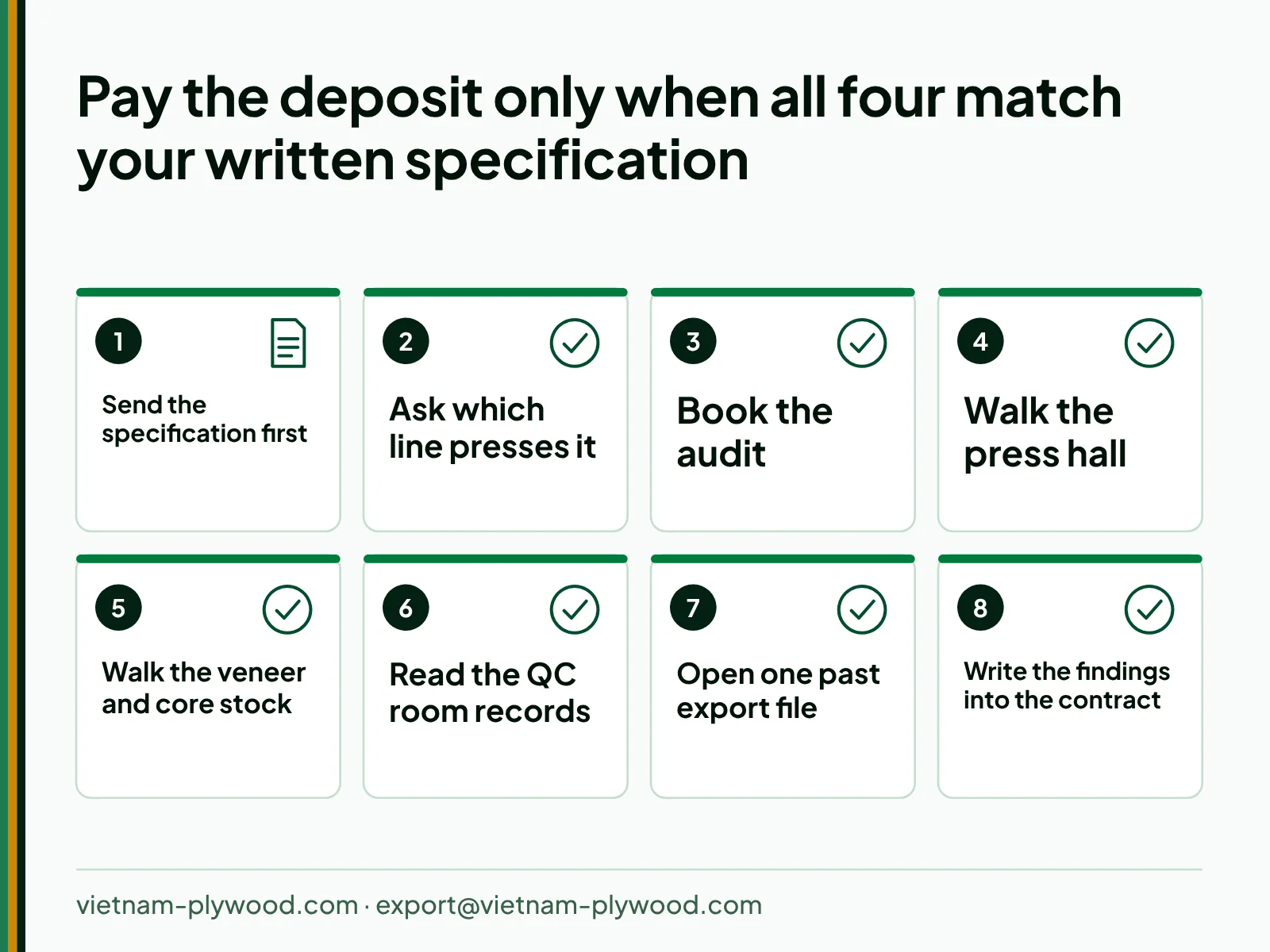
- Send the specification first. Application, core, glue, emission class, face and grade, thickness and tolerance, size, quantity, destination port. The audit is a test of that document.
- Ask which line presses it. Our furniture line, our commercial and packing line or our construction line; the answer decides which factory you audit.
- Book the audit. In person at the producing factory, or live video directed by you.
- Walk the press hall. Glue type, press temperature, panel thickness off the press.
- Walk the veneer and core stock. Species, veneer thickness, drying, core build.
- Read the QC room records. Thickness, boil tests, moisture, emission tests, lot numbers.
- Open one past export file. Invoice to packing list to QC lot, line by line.
- Write the findings into the contract. Approved sample, tolerances, test reports and documents, then pay the deposit.
Production: 15–45 days from the 30% deposit, set by order size, line loading and the contract. A second visit during production or before loading checks the same points on your own panels.
What should a plywood factory audit checklist cover?
The checklist covers eight areas: presses and glue, veneer and core stock, core construction, thickness, bond tests, moisture, emission records, and packing with the export file. For each area, write down what you saw, what evidence you took away, and which contract clause it supports.
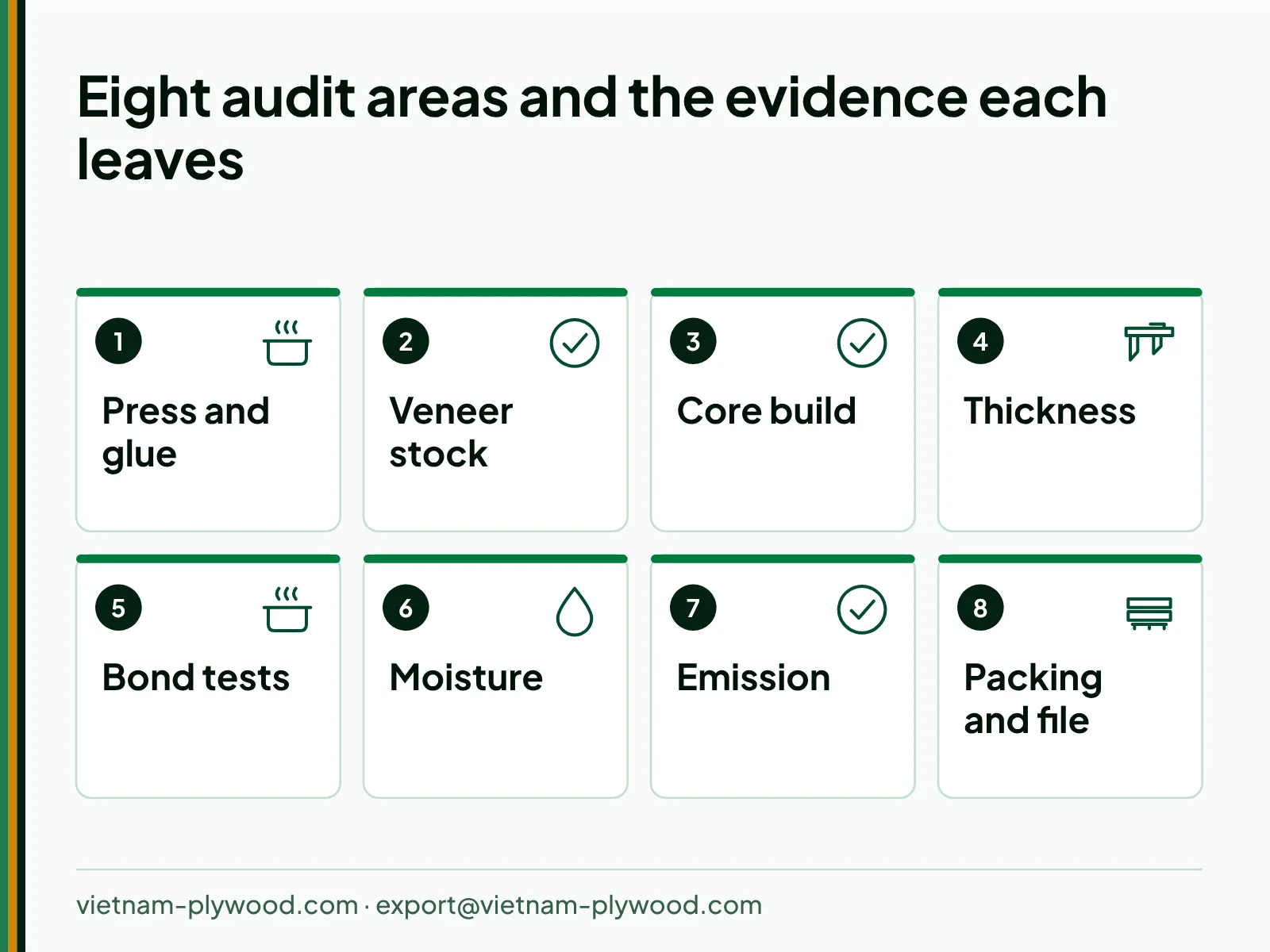
| Audit area | What to see on the floor | Evidence to take away | Contract clause it backs |
|---|---|---|---|
| Press and glue | Press loaded with your glue type at its temperature | Photo of press gauge and glue drum label | Glue field |
| Veneer stock | Face species and core species in the yard and dryer | Photo of stock with species named by the operator | Face and core fields |
| Core build | Cut edge of a panel off the press | Ply count, core construction, photo of the cut | Core construction field |
| Thickness | Caliper readings on panels off the press | Readings against your tolerance | Thickness and tolerance field |
| Bond tests | Boil-test pieces and log | Copy of the test log page | Test report for the agreed build |
| Moisture | Moisture meter readings and log | Copy of the moisture log page | Moisture clause, if you set one |
| Emission | Emission test records for the product type | Copy of the latest records | Emission field |
| Packing and file | Pallet marks, strapping, one past export file | Photos and a masked copy of the file | Packing and document clauses |
Take the questions behind each row from our list of 10 questions to ask a plywood supplier. The checklist turns those answers into things you see.
How do I confirm the presses are running my specification?
Ask to see a press loaded with your glue and your thickness, read the temperature on the gauge, and measure a panel off that press. Melamine (MR) glue presses at 110–120 °C and phenolic (WBP) at 130–145 °C, so a press running cooler than WBP range is not pressing a WBP order.
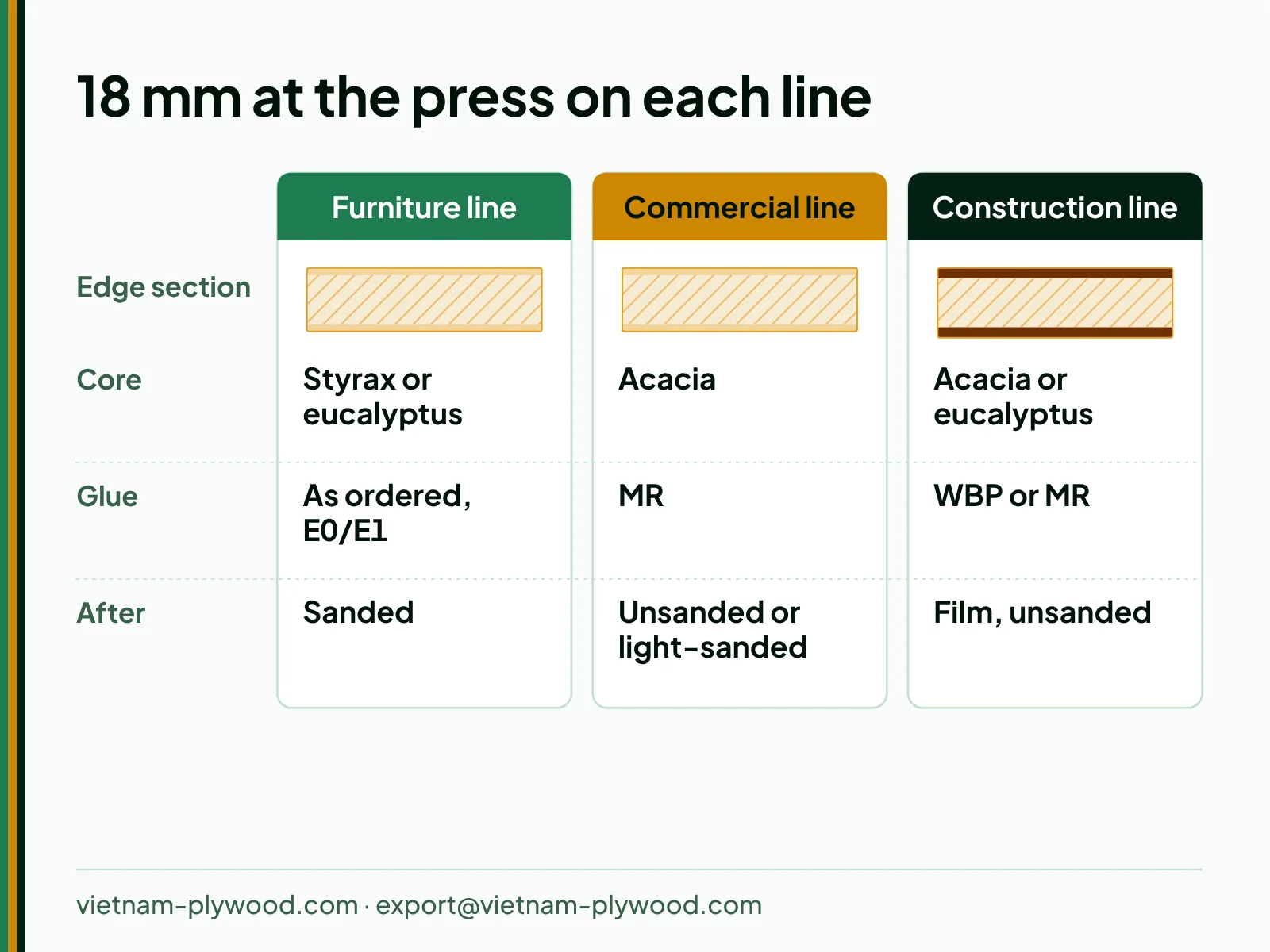
The same 18 mm order looks different on each of our lines, and the auditor should know which press hall to stand in.
| What you check at the press, 18 mm | Furniture line | Commercial and packing line | Construction line |
|---|---|---|---|
| Core on the lay-up table | Styrax or eucalyptus | Acacia | Acacia or eucalyptus |
| Glue | As ordered, with emission E0 or E1 | Melamine (MR) | Phenolic (WBP) or melamine (MR) |
| Press temperature | 110–120 °C MR; 130–145 °C WBP | 110–120 °C | 130–145 °C WBP; 110–120 °C MR |
| After the press | Sanding | Unsanded or light-sanded | Film pressed on, unsanded |
| Thickness tolerance | ±0.2 or ±0.3 mm as ordered | ±0.5 mm | ±0.5 mm |
| Core construction | Full stitched | As ordered | As ordered |
If a furniture buyer asks to see the construction line, we would show it, but an 18 mm sanded panel for cabinets is not pressed there. The construction line builds film-faced and anti-slip panels for formwork and decks; the commercial and packing line builds the crate and back-panel grades. Our furniture plywood page lists the faces and builds the furniture line presses.
Measure at least the four corners and the centre of a panel off the press, and compare with the tolerance in your contract. Length and width tolerance is ±2 mm on every line. A caliper reading out of tolerance on the first panel you pick is a finding, whatever the explanation.
What veneer and core stock should I see during an audit?
You should see core veneer of the species on your order, acacia, eucalyptus or styrax, peeled at 1.4–2.0 mm, and face veneer of your species at 0.2–0.4 mm. Vietnamese cores are only those three species; a panel quoted on another core species from Vietnam is a reason to ask where the core comes from.
Core species decides weight, because density follows the core, not the face: acacia 580 kg/m³, eucalyptus 650 kg/m³, styrax 500 kg/m³. Weighing one sheet is the fastest stock check an auditor can make. An 18 mm 1220 × 2440 mm sheet weighs 26.8 kg on styrax, 31.1 kg on acacia and 34.8 kg on eucalyptus.
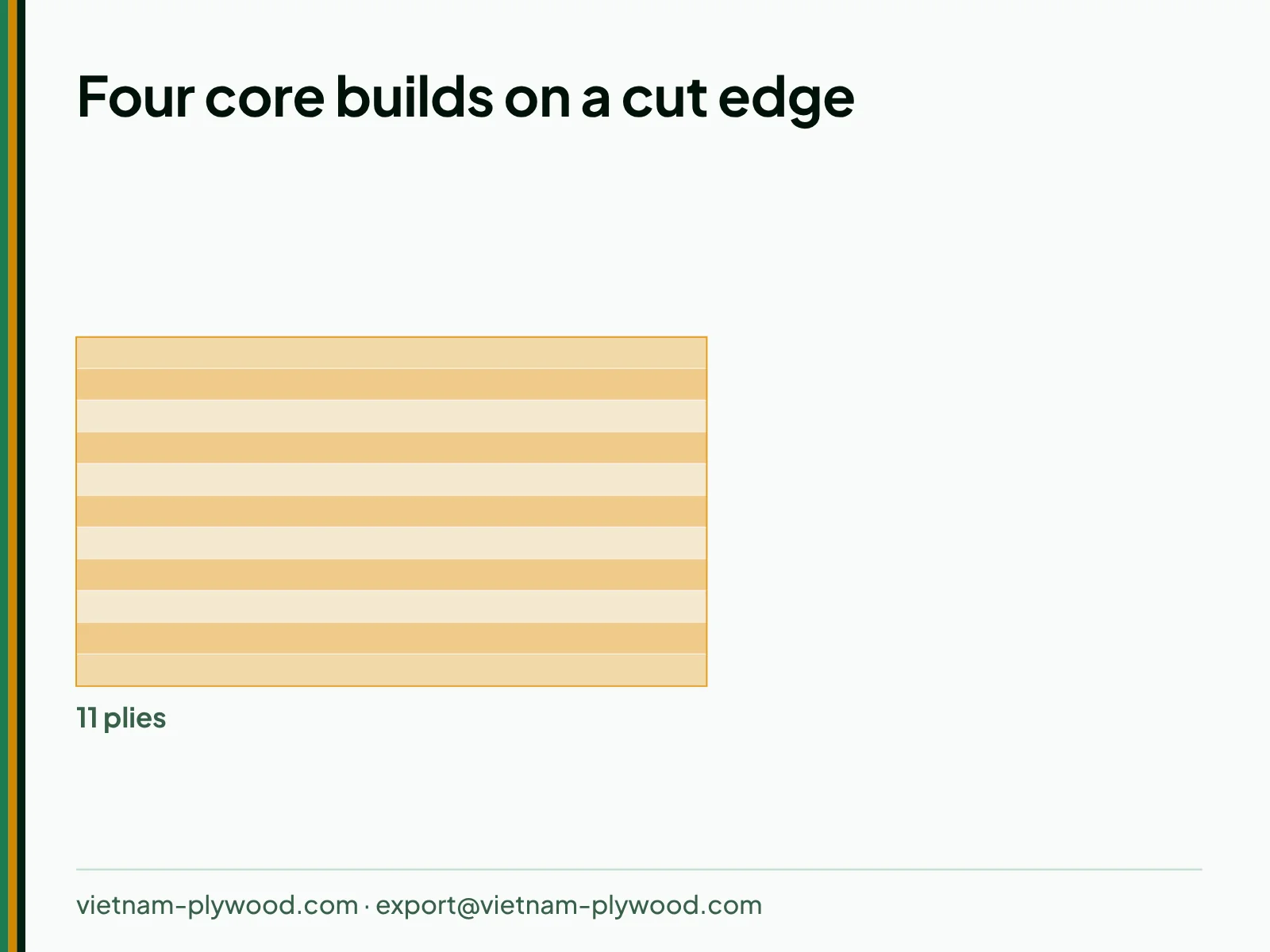
Ply count follows core veneer thickness. At 18 mm, expect 11–13 plies on a cut edge. Count them on a panel cut in front of you, not on a display sample.
Core construction is the stock question buyers skip most often. From best to cheapest:
- Full stitched: every core veneer stitched into a full sheet before lay-up.
- Stitched outer layers with edge-trimmed inner: the plies under the face stitched, inner plies trimmed and butted.
- Finger-jointed: core pieces joined end to end.
- Loose-laid: core pieces laid without joining.
A cut edge shows gaps and overlaps between core pieces, which is how you tell a loose-laid core from a stitched one. Write the construction you saw into the contract by name. Matt panels, which are unfaced raw core, show the core build on the surface itself.
Face stock is the other half. Face grades are A or B; birch faces are graded D, E or F only. Our faces are bintangor, okoume, EV (engineered veneer), gurjan, pine, poplar, eucalyptus, birch and sapele. Ask to see the face veneer of your species in the store, at the thickness you were quoted.
Which QC and moisture records should the factory show?
Ask for the records of the last few lots of your product type: thickness readings, boil-test results, veneer and panel moisture readings, and production records with lot numbers. For panels sold under CARB P2 / TSCA Title VI, ask for the emission test records too. Each record should carry a date, a product type and a lot number.
Bond tests follow the glue. A melamine (MR) glue line is tested to a 12-hour boil and a phenolic (WBP) glue line to a 72-hour boil. The log should name the test, the lot and the result; a log that only says “pass” without the lot proves little.
US rules give a buyer a right to some of these records. Under 40 CFR 770.40, the US EPA formaldehyde rule (as published in 2026), panel producers keep quarterly emission test records and ongoing QC test records for three years. The section states: “Panel producers must make the records described in paragraph (a)(1) of this section available to direct purchasers of their composite wood products.”
The same section lists the production records a certified producer keeps: “Production records, including a description of the composite wood product (s), the date of manufacture, lot numbers, and tracking information” that trace each product to a lot. The testing rhythm is in 40 CFR 770.20, which says “Hardwood plywood must be tested as follows: (A) At least one test per week per product type” at the lowest production band it lists, with more tests as weekly output rises.
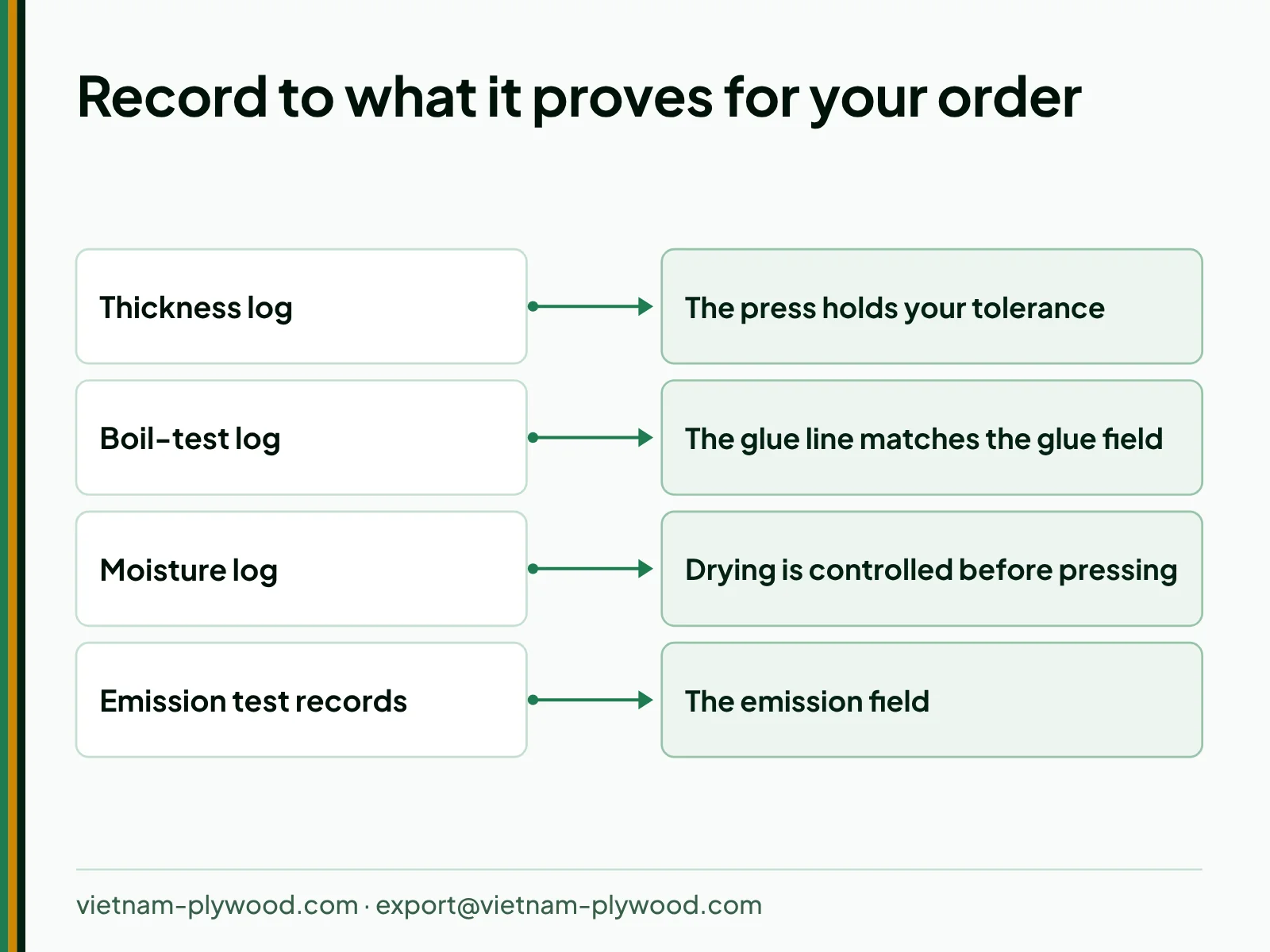
| Record | What a useful entry shows | What it proves for your order |
|---|---|---|
| Thickness log | Lot, readings per panel, tolerance | The press holds your tolerance |
| Boil-test log | Lot, glue type, hours, result | The glue line matches the glue field |
| Moisture log | Lot, veneer and panel readings | Drying is controlled before pressing |
| Emission test records | Date, product type, lot, test method, result, certifier | The emission field, for US-bound panels |
| Production records | Product description, date, lot number | Each pallet traces to a lot |
Moisture targets are set in your contract and the test report for the agreed build. Agree the target and the method before the audit, so the log can be read against it.
How do I check that the export documents are in the producing factory’s file?
Ask to open the complete file of one past shipment of a similar product, with buyer details masked, and trace it from the invoice to the packing list to the QC lot numbers. The file for each shipment holds the same named documents, so a missing one is easy to spot.
Each shipment’s set is: commercial invoice, packing list, B/L, certificate of origin (EUR.1 for EU lots), phytosanitary and fumigation papers, insurance under CIF. On top come the order’s certificate documents: the FSC claim on sales documents, the emission certificate, the test reports for the agreed build, and the EUTR/EUDR file set for EU lots.
Certificates belong to the member factories, and HCPLY shows them with factory details masked, on request. On site, the check is whether the certificate scope covers your product type and whether the producing factory’s own records carry the same claim. An FSC claim, for example, should appear on the sales documents of the past shipment, not only on a certificate copy.
| Document in the past file | Trace it to | A mismatch means |
|---|---|---|
| Commercial invoice | Packing list lines and the order | Product names drift between papers |
| Packing list | Pallet marks and QC lot numbers | Pallets cannot be traced to tests |
| Certificate of origin | Invoice lines | Origin paper written for another load |
| Emission certificate | Product type in the emission records | Certificate does not cover the panel |
| Test reports for the agreed build | Bond-test and thickness logs | Report is generic, not for the build |
| EUTR/EUDR file set (EU lots) | Species and lots on the packing list | Due diligence data does not fit the load |
After loading, the draft shipping documents come to you for approval. Ask to see an approved draft from the past file: it shows how the factory handles corrections before the originals are issued.
Can a factory audit be done by video instead of in person?
Yes, if the call is live, uncut and directed by you, with a second camera or phone free to move. Video proves press gauges, stock, labels, caliper readings and records well. It is weaker on touch and weight, so ask for a sheet weighed and a panel cut on camera.
| Check | In person | By live video |
|---|---|---|
| Press temperature and glue in use | Read the gauge, see the glue drum | Camera on the gauge and the drum label |
| Thickness | Measure yourself | Caliper held to the camera, five points |
| Core build | Cut a panel and count plies | Panel cut on camera, edge close-up |
| Sheet weight | Weigh one sheet | Sheet on a scale on camera |
| Sanding quality | Feel the face | Raking light across the face |
| Records | Read the logs | Pages held to the camera, lot numbers readable |
| Export file | Open it | Pages shown, then masked copies sent |
Run the video in the order of the checklist, and name the lot you want to see rather than accepting the one offered. Factory visit arrangements in person are handled by Lucy at export@vietnam-plywood.com.
Mixed orders: audit each line that presses your panels
When one order is split across lines, audit each line that presses a part of it, because each line has its own glue, core and tolerance. The container is still one: minimum order is one 40HC, and one container can carry several specifications as long as the payload limit holds.
Take a fit-out order in 15 mm, 1220 × 2440 mm: sanded styrax-core panels from the furniture line and acacia-core panels from the commercial and packing line. Both cores stack 1000 mm per pallet, so each pallet holds 66 sheets.
| Part of the order | Line to audit | Pallets | Sheets | Volume | Weight |
|---|---|---|---|---|---|
| Sanded panel, styrax core, ±0.3 mm | Furniture line | 9 | 594 | 26.52 m³ | 13.3 t |
| Commercial panel, acacia core, MR glue | Commercial and packing line | 7 | 462 | 20.63 m³ | 12.0 t |
| Container | — | 16 | 1056 | 47.15 m³ | 25.2 t |
The 40HC payload limit is 28.5 t, so the load sits about 3.3 t under it. Volume is sheets × 1.22 × 2.44 × 0.015 m, and weight is volume × density ÷ 1000. Pallet splits and loading order are on our page on mixed container loads of plywood; full-load sheet counts per thickness are on our container loads page.
Contractors buying film-faced panels alongside site timber run the same audit on our construction line; the project side is on our page on plywood supply for construction projects.
Findings that should stop the deposit
Some findings are not points to negotiate but reasons to stop before paying. Each one below means the panel you would receive is not the panel in the quotation.
- No press running your glue type at its temperature range on the day.
- A core species other than acacia, eucalyptus or styrax offered as Vietnamese core.
- A cut edge that shows a cheaper core build than the one quoted.
- Thickness out of tolerance on panels picked by you.
- Boil-test or emission records without lot numbers, or records that cannot be shown.
- A certificate whose scope does not cover your product type.
- No past export file that traces from invoice to QC lot.
A finding you accept with a correction belongs in the contract as a clause, with the check repeated before loading. How claims are raised and settled when a delivered lot differs from the contract is on our page on plywood claims handling.
From audit to quotation, contract and deposit
The audit feeds three documents: the corrected specification, the quotation against it, and the contract that names the approved sample, the tests and the documents. Payment follows the contract: 30% deposit, and the The remaining 70% is paid on the scan of the bill of lading, by T/T, or by irrevocable sight L/C.
Samples cost nothing: a first-time buyer pays the courier, and that charge comes off the first confirmed order. Bring the approved sample to the audit and set it beside panels off the press.
Prices start from US$250/m³ FOB Hai Phong (October 2026) for commercial plywood and from US$350/m³ FOB Hai Phong (October 2026) for furniture plywood. Other builds are quoted against the written specification. How a quotation is built is on our page on plywood quotation: what to know before pricing, and the order steps after the deposit are on our page on how to order plywood from Vietnam.
The specification to bring to the audit
Bring the specification on paper and tick each line as you see it on the floor. This one is for the furniture-line part of the mixed order above.
Application: kitchen and wardrobe carcasses
Line / core: furniture line, styrax core, full stitched
Glue: melamine (MR), 12-hour boil test report
Emission: E1
Face and grade: poplar, grade B, sanded both sides
Thickness and tolerance: 15 mm, +/-0.3 mm
Size: 1220 x 2440 mm, +/-2 mm
Quantity: 9 pallets (594 sheets) in a mixed 40HC
Destination port: to be named
Audit: in person at the producing factory, before deposit
To prepare the audit, write to Lucy at export@vietnam-plywood.com or use the contact page: request the spec sheet for your build, and name the line and date you want to audit.