





5/8 vs 3/4 plywood is a choice between roughly 16 mm and 19 mm nominal inch sizes, while HCPLY compares practical 15–16 mm and 18 mm export builds. Choosing the wrong thickness can raise sheet costs or cause rejected cabinet parts. The right decision starts with finished thickness, support spacing, core construction and the intended use.
What is the difference in 5/8 vs 3/4 plywood?
Nominal 5/8 inch equals 15.875 mm and nominal 3/4 inch equals 19.05 mm, a difference of 3.175 mm. An 18 mm metric panel is therefore thinner than a literal 3/4-inch panel, while 15 mm is thinner than literal 5/8 inch. Order the finished metric dimension and tolerance rather than assuming the inch label identifies the measured panel.
The plywood sizes and thickness specification guide explains how to record dimensions in an import purchase order.
Which thickness wins on measurable purchasing criteria?
The comparison below uses a common 1220 × 2440 mm sheet and distinguishes actual HCPLY 15 mm and 18 mm lookup values from nominal inch arithmetic. Weight comparisons hold the core constant. The 16 mm case is discussed separately because the standard container lookup does not include it.
| Metric | 15 mm reference | 18 mm reference | Verdict by use |
|---|---|---|---|
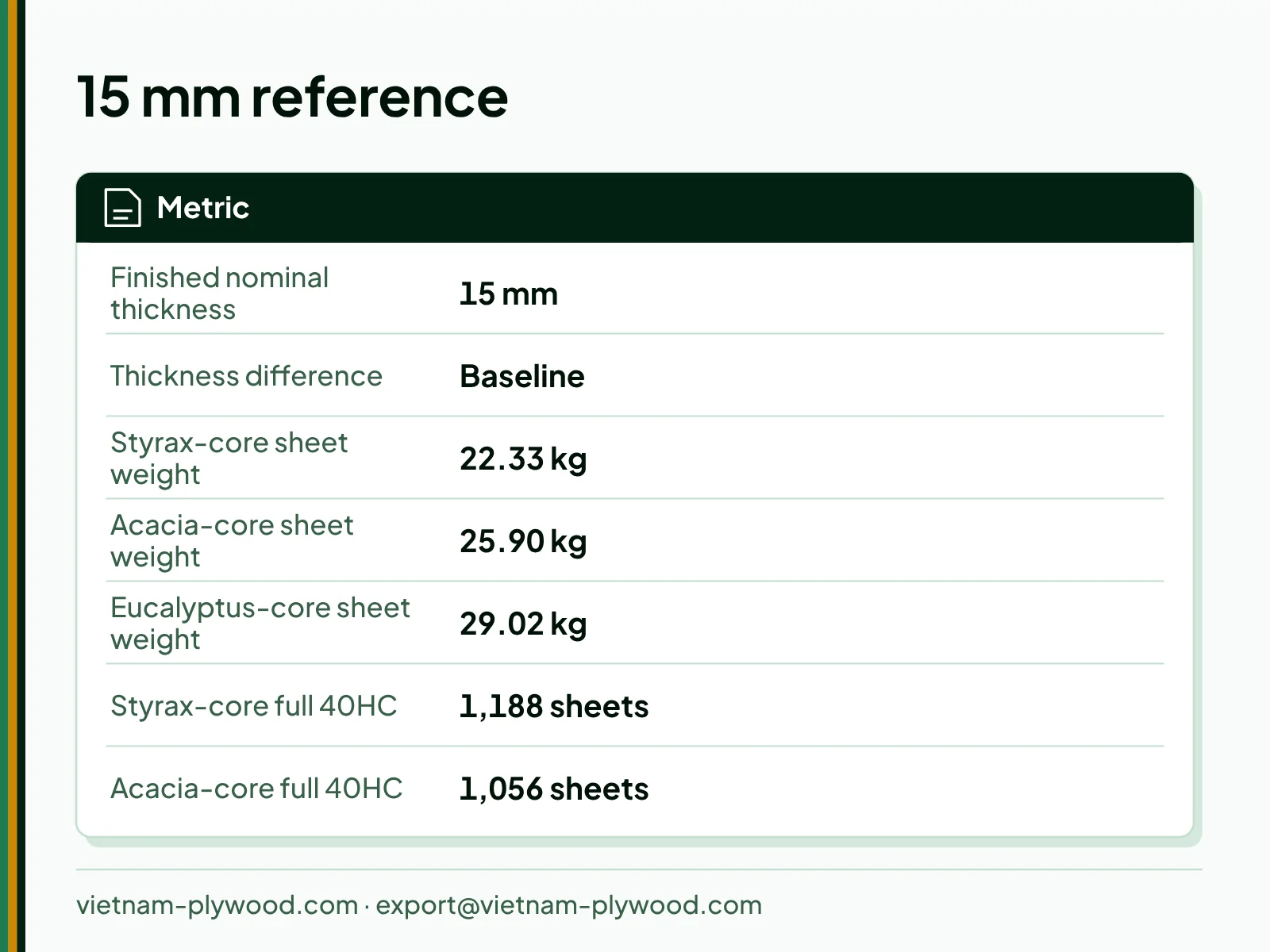
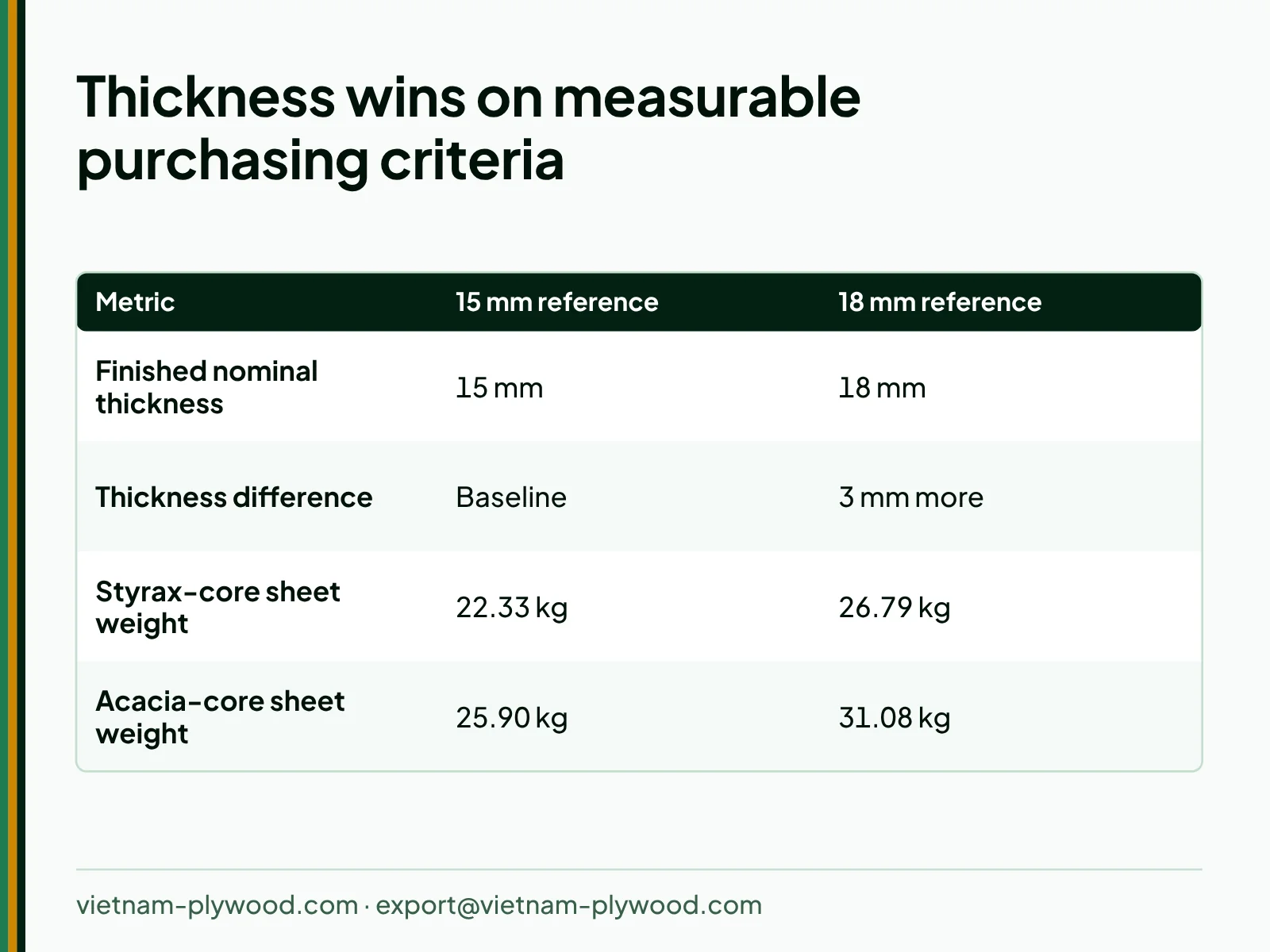
| Finished nominal thickness | 15 mm | 18 mm | 18 mm for drawings requiring 18 mm; 15 mm for lighter specified parts |
| Thickness difference | Baseline | 3 mm more | Check grooves and fittings before substitution |
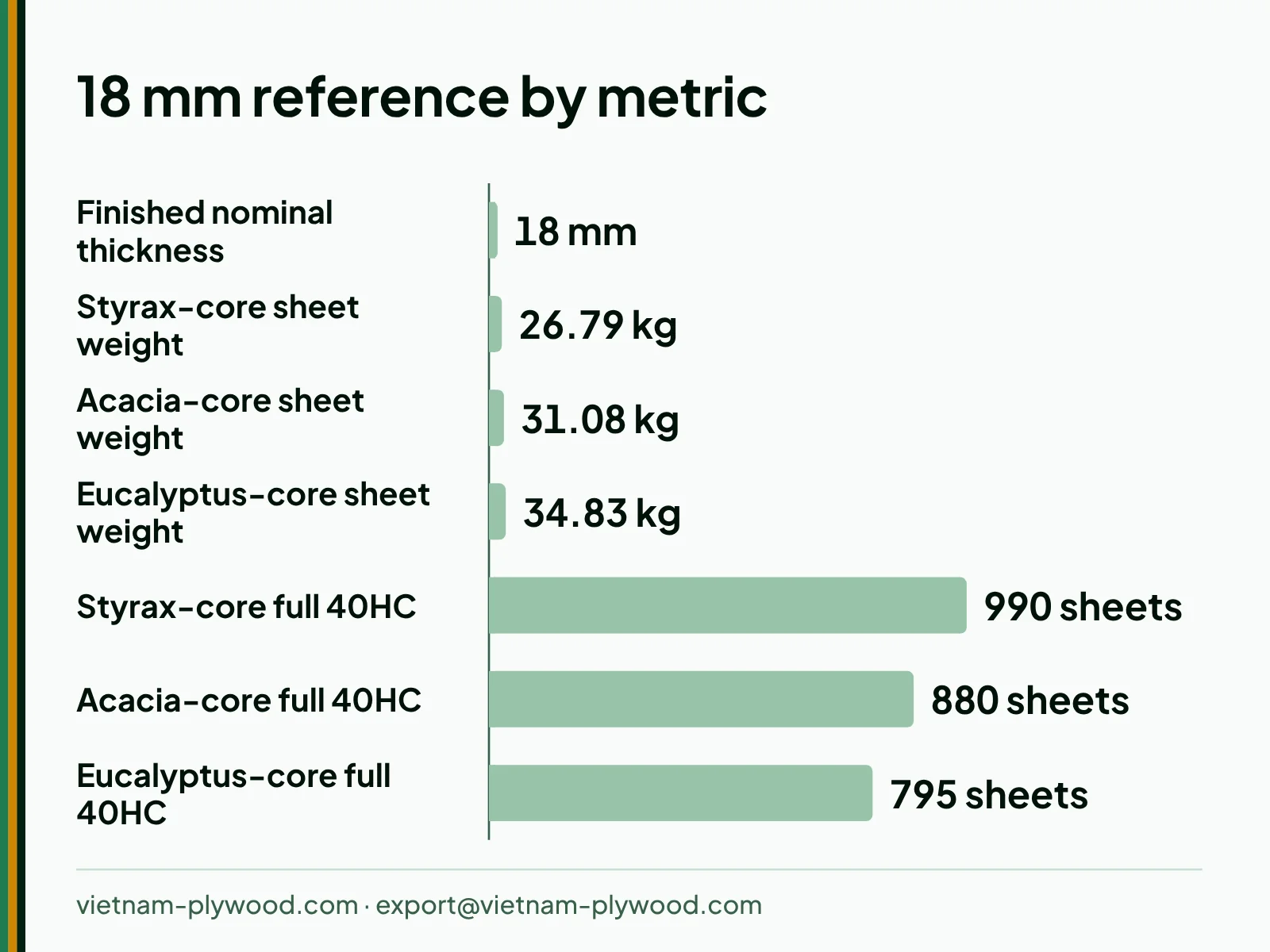
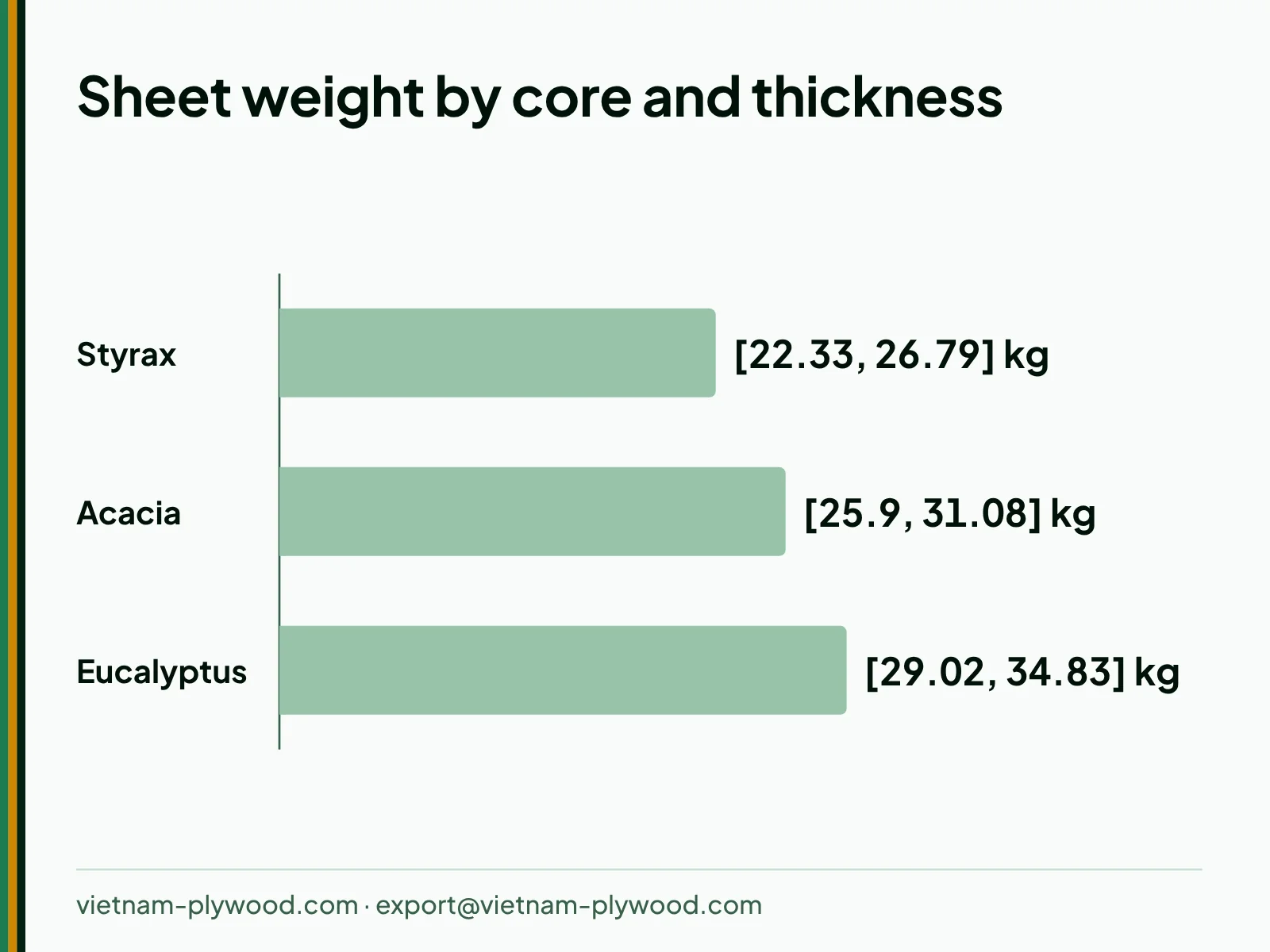
| Styrax-core sheet weight | 22.33 kg | 26.79 kg | 15 mm for handling; 18 mm where stiffness is needed |
| Acacia-core sheet weight | 25.90 kg | 31.08 kg | 15 mm for lighter packing; 18 mm for thicker specified builds |
| Eucalyptus-core sheet weight | 29.02 kg | 34.83 kg | 15 mm reduces handling weight |
| Styrax-core full 40HC | 1,188 sheets | 990 sheets | 15 mm for sheet count |
| Acacia-core full 40HC | 1,056 sheets | 880 sheets | 15 mm for sheet count |
| Eucalyptus-core full 40HC | 960 sheets | 795 sheets | 15 mm for sheet count |
| Price per sheet, same build and m³ rate | Lower | Higher | 15 mm for material spend; 18 mm when required performance justifies it |
| Cabinet sides | Suitable with approved design | More section depth | 18 mm for hardware or load designs calling for it |
| Subfloor or formwork | Only with accepted project design | Greater section depth | Neither thickness substitutes for required design verification |
Is 3/4 plywood stronger than 5/8?
A thicker panel of otherwise identical construction normally has greater bending stiffness, but thickness alone cannot establish an allowable load or structural grade. Veneer direction, voids, bonding, supports and loading all matter. A 15-to-18 mm increase changes the section geometry; it does not establish a tested HCPLY strength value.
The Wood Products Council’s WoodWorks technical guidance (2026) says that panel bending strength, stiffness and shear must be checked against the applicable design properties and loading arrangement. See Designing Wood Structural Panels for Out-of-Plane Cantilevers. For any structural subfloor, require the designer’s accepted panel specification and test report before buying; HCPLY does not offer an APA or PS 1 stamped panel.
What does each production line make at these thicknesses?
Our furniture line presses full-stitched, sanded styrax- or eucalyptus-core panels for cabinet and furniture components. Our commercial and packing line presses acacia-core MR-glue panels with unsanded or light-sanded faces. Our construction line presses acacia- or eucalyptus-core film-faced panels, including anti-slip film, for specified formwork applications.
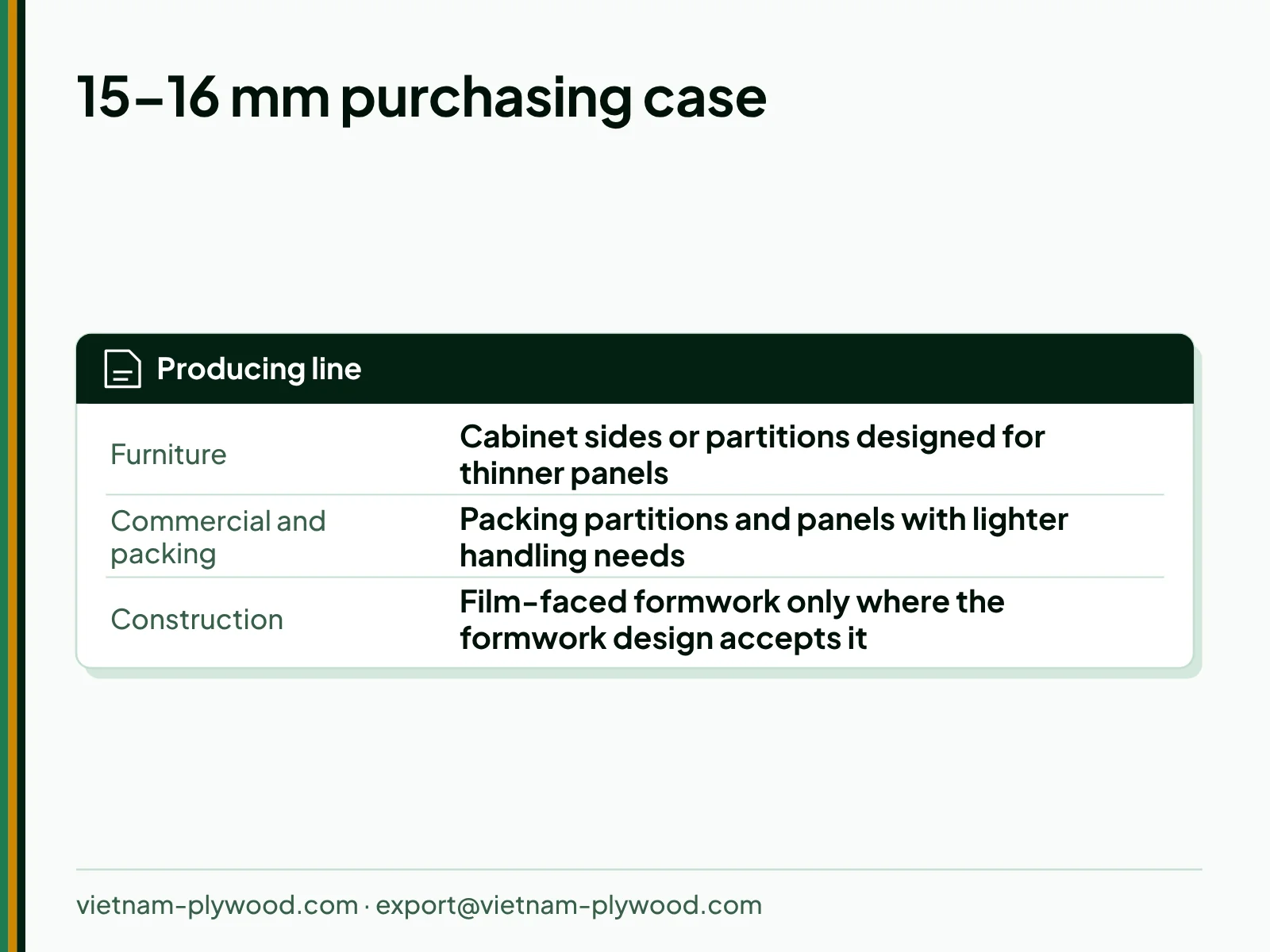
| Producing line | 15–16 mm purchasing case | 18 mm purchasing case | Buyer inspection priority |
|---|---|---|---|
| Furniture | Cabinet sides or partitions designed for thinner panels | Heavier cabinet components with approved 18 mm drawings | Sanded thickness and full-stitched core |
| Commercial and packing | Packing partitions and panels with lighter handling needs | Thicker packing components specified by the buyer | Core joints, edges and thickness |
| Construction | Film-faced formwork only where the formwork design accepts it | Thicker film-faced formwork for a design calling for 18 mm | Film, edge sealing and panel thickness |
For cabinet-facing options, see furniture plywood. Film-faced products use 120 g/m² standard film, 135 g/m² premium film or 220 g/m² anti-slip film.
How much more does an 18 mm sheet weigh?
At 1220 × 2440 mm, moving from 15 to 18 mm adds 4.46 kg per styrax-core sheet, 5.18 kg per acacia-core sheet and 5.81 kg per eucalyptus-core sheet. The core densities are styrax 500 kg/m³, acacia 580 kg/m³ and eucalyptus 650 kg/m³.
The 16 mm sheet is between the two specified reference thicknesses, but no fixed HCPLY 16 mm shipping lookup is available here. Request its actual core and stacking plan instead of using the 15 mm container count as a 16 mm commitment.
How does the thickness change a container order?
For the 1220 × 2440 mm reference, a full styrax-core 40HC falls from 1,188 sheets at 15 mm to 990 at 18 mm; acacia falls from 1,056 to 880, and eucalyptus from 960 to 795. Those are full single-build loads, not quantities to add together in one container.
For example, an acacia-only 15 mm reference load is 47.15 m³ and 27.35 t; the 18 mm reference is also 47.15 m³ and 27.35 t because fewer thicker sheets occupy the same stated volume. Mixing 15 and 18 mm panels requires a fresh pallet allocation and weight check. The container loading guide owns the detailed load calculation.
How does moving to 18 mm affect price per sheet?
An 18 mm sheet costs more than a 15 mm sheet at the same per-cubic-metre rate because it contains more wood volume. The first price driver is finished thickness and cubic volume; next come core construction and species, then face grade and sanding, followed by glue and emission requirements. A full-stitched sanded furniture build costs more than a simpler commercial packing build because it requires different core preparation and finishing.
For context, commercial plywood starts from US$250/m³ FOB Hai Phong (October 2026) and furniture plywood starts from US$350/m³ FOB Hai Phong (October 2026). These are category starting prices, not 15 mm or 18 mm sheet quotations. To compare two actual sheets, multiply each sheet’s cubic metres by the separately quoted rate for its exact build. See 15 mm plywood for the thinner reference specification.
When is 18 mm the correct cabinet-side choice?
Choose 18 mm when the cabinet drawing, hardware system or approved load design explicitly requires that finished thickness. For a side panel in a supported carcass, 15 or 16 mm can be a sensible specified choice when the joint details and hardware are designed around it. Substituting 18 mm after cutting grooves for 16 mm creates a fit problem even if the thicker panel is stiffer.
The factory inspector can measure finished panel thickness at agreed positions, inspect cut edges for core gaps and check face grade against the order. Furniture thickness tolerance is ±0.2 or ±0.3 mm as ordered; length and width tolerance is ±2 mm. The thickness tolerance guide explains how to put those checks into an acceptance specification.
When will a subfloor or concrete form need thicker plywood?
Use 18 mm only where the approved subfloor or formwork design calls for it; a thicker commercial panel is not automatically a structural subfloor. Support spacing, imposed loads, wet exposure and deflection criteria must be checked together. For construction work, obtain the accepted engineering design and relevant test report rather than inferring performance from nominal thickness.
Our construction line offers phenolic- or melamine-film builds with acacia or eucalyptus core. Glue is a separate specification: melamine MR is associated with a 12-hour boil, while phenolic WBP (weather and boil proof) is associated with a 72-hour boil. Film weight, edge treatment and site handling are separate from the thickness decision.
What should a factory inspection and document review cover?
At the producing factory, a buyer can witness thickness measurements, count and edge inspection, face checks and the comparison of pallet labels with the packing specification. For 18 mm panels, core construction can be checked at a cut edge; ply count is typically 11–13 because individual core veneers are 1.4–2.0 mm. See how many plies plywood has for the construction question.
The packing list records dimensions and quantities; after loading, the draft shipping documents come to you for approval. Certificate documents for the agreed build are handled with the shipment file; member-factory certificates are shown with factory details masked, on request.
Should an importer order 16 mm or 18 mm plywood?
Order 16 mm when the component drawing accepts 16 mm, the hardware fits and the lighter sheet improves handling or unit economics. Order 18 mm when the drawing, approved load design or required assembly thickness specifies 18 mm.
HCPLY handles specification, on-site quality control, export documents and loading, with production at the matching factory and direct shipment from it. The minimum order is one 40HC; specifications can be mixed within the payload limit. Factory lead time runs 15–45 days from receipt of the 30% deposit; the exact figure depends on order size, line loading and what the contract fixes. The remaining 70% is paid on the scan of the bill of lading, by T/T, or by irrevocable sight L/C.
A distributor supply programme can group compatible cabinet and packing specifications. We ship FOB Hai Phong, or CFR (CNF) or CIF to your port. Lucy at export@vietnam-plywood.com can review the written build before a contact request.
What specification should accompany the comparison?
Send the application and finished thickness first, then define the core, bond, emission class, face and acceptance checks.
Application: cabinet sides / packing / formwork (select one)
Line or core: furniture styrax/eucalyptus; commercial acacia; construction acacia/eucalyptus
Glue: MR melamine / WBP phenolic (select build)
Emission: E0 / E1 / E2 as required; separate from glue
Face and grade: name face veneer and grade; or film type and weight
Thickness and tolerance: 16 mm or 18 mm; finished tolerance in writing
Size: 1220 × 2440 mm or agreed cut size
Quantity: sheets and pallet mix within one 40HC
Destination port: [port and country]
Next step: plan a trial container with the two candidate builds and their agreed inspection criteria.