





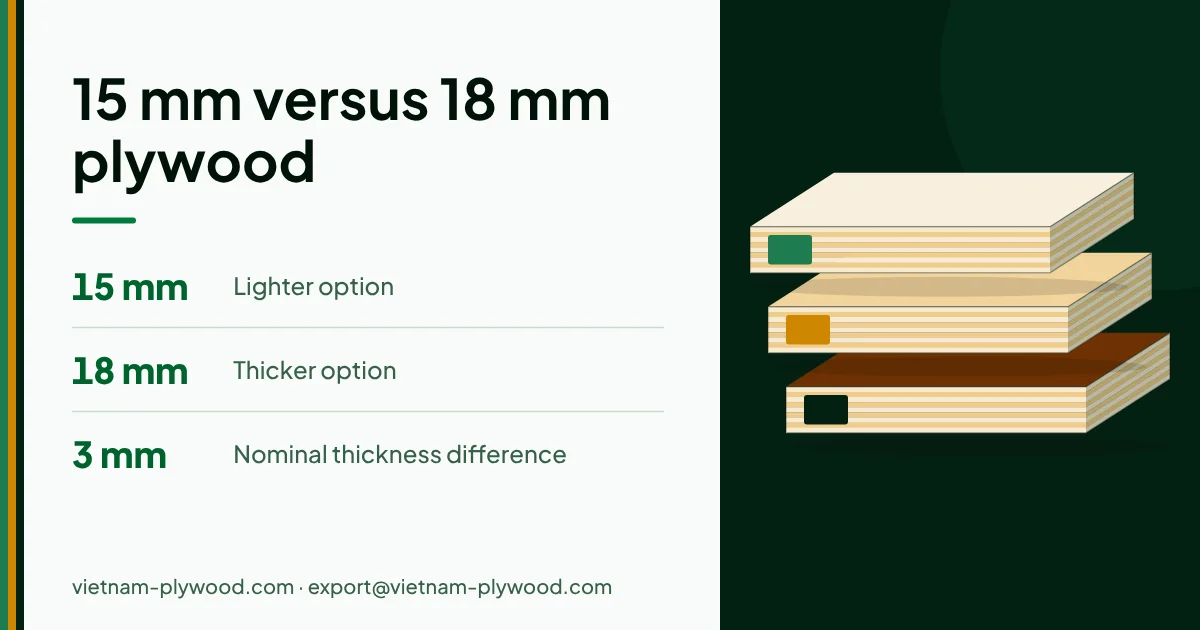
15 mm plywood can replace 18 mm in selected furniture carcasses and packing components when the design passes its load and fastening checks; it should not automatically replace a specified 18 mm formwork panel. Choosing the wrong thickness can mean rejected components, extra reinforcement costs or delayed installation. HCPLY produces plywood 15mm through the line suited to the written application, with the core, surface and tolerance specified before pressing.
What sizes and tolerances can you order in 15 mm?
15 mm panels are available across our furniture, commercial and packing, and construction lines in the listed sheet formats; the finish and tolerance distinguish the builds. The nominal thickness is the same, but the permissible finished variation differs.
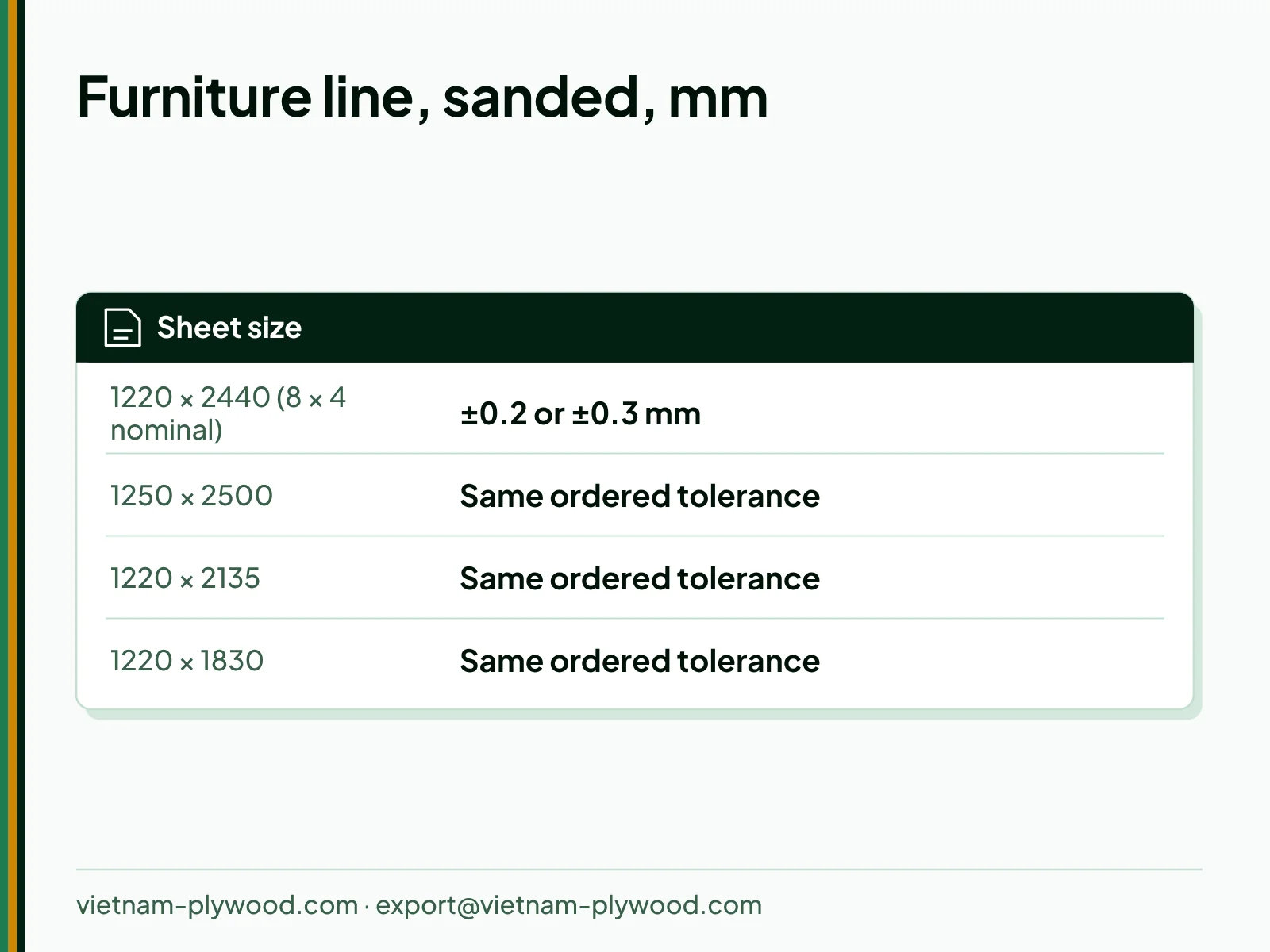
| Sheet size (mm) | Furniture line, sanded | Commercial and packing line | Construction line |
|---|---|---|---|
| 1220 × 2440 (8 × 4 nominal) | ±0.2 or ±0.3 mm | ±0.5 mm commercial; ±0.5–1.0 mm packing | ±0.5 mm |
| 1250 × 2500 | Same ordered tolerance | Same grade tolerance | Same grade tolerance |
| 1220 × 2135 | Same ordered tolerance | Same grade tolerance | Same grade tolerance |
| 1220 × 1830 | Same ordered tolerance | Same grade tolerance | Same grade tolerance |
| 915 × 2440 | Same ordered tolerance | Same grade tolerance | Same grade tolerance |
| 915 × 2135 | Same ordered tolerance | Same grade tolerance | Same grade tolerance |
| 915 × 1830 | Same ordered tolerance | Same grade tolerance | Same grade tolerance |
Length and width tolerance is ±2 mm; custom cutting is available. An 8 × 4 nominal sheet here means 1220 × 2440 mm, not an exact conversion of imperial feet. A cabinet cutting schedule must use the agreed millimetre dimension and thickness range, especially where panels fit into machined grooves.
The plywood sizes and thickness specification guide explains the wider thickness range. Nominal thickness alone does not establish a load rating, face quality or moisture performance. Write all these fields into the purchase specification rather than treating a 15 mm plywood board as one interchangeable commodity.
Can plywood 15mm replace 18 mm?
Plywood 15mm can replace 18 mm where the cabinet or packing design has enough stiffness, fastener holding and support at the thinner section. It cannot be substituted on thickness alone for load-bearing formwork, long unsupported shelves or specified structural assemblies. Compare the same core, span, support spacing and load before approving a change.
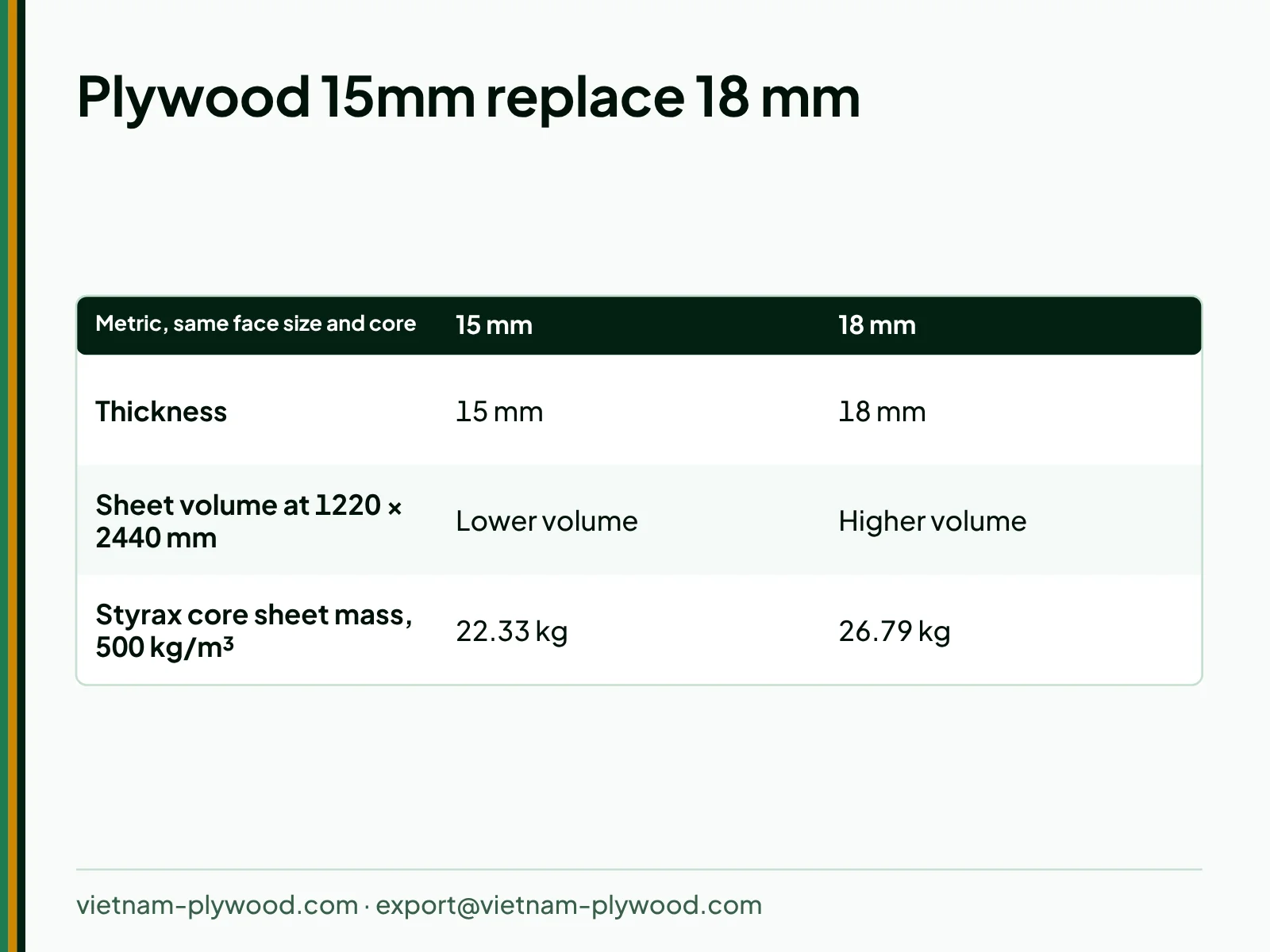
| Metric, same face size and core | 15 mm | 18 mm | Purchasing verdict |
|---|---|---|---|
| Thickness | 15 mm | 18 mm | 15 mm is 3 mm thinner |
| Sheet volume at 1220 × 2440 mm | Lower volume | Higher volume | 15 mm uses less veneer at equal area |
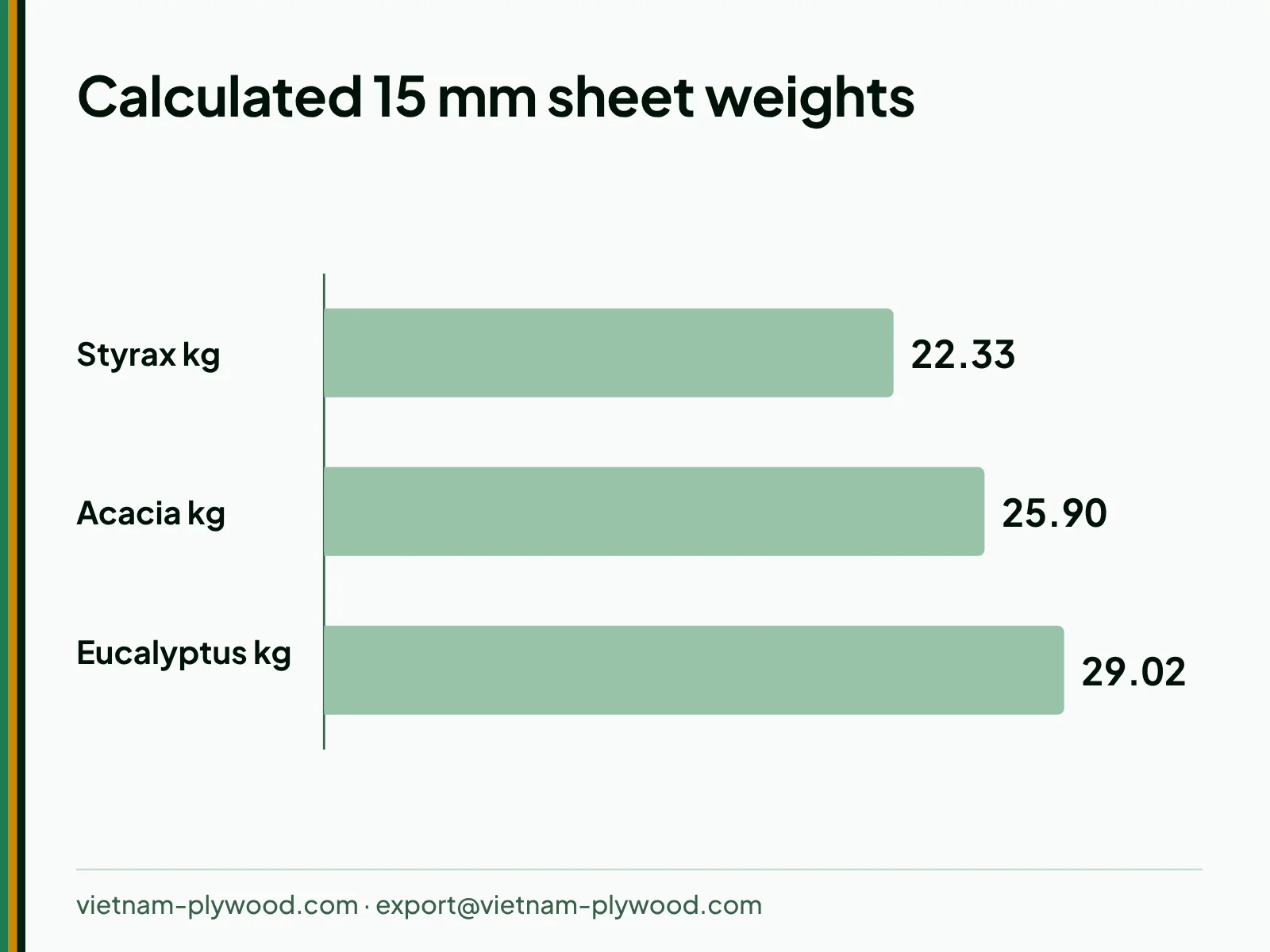
| Styrax core sheet mass, 500 kg/m³ | 22.33 kg | 26.79 kg | 15 mm is lighter |
| Acacia core sheet mass, 580 kg/m³ | 25.90 kg | 31.08 kg | 15 mm is lighter |
| Eucalyptus core sheet mass, 650 kg/m³ | 29.02 kg | 34.83 kg | 15 mm is lighter |
| Relative bending stiffness, ideal equal-material section | Lower | Higher | Evaluate stiffness against the approved design |
| Carcass panels with adequate framing | Evaluate joints and deflection | More thickness margin | 15 mm can be economical after a prototype |
| Wet-concrete formwork | Require engineered span/load verification | Also require engineered verification | Retain specified 18 mm unless the formwork design is recalculated |
The listed sheet weights use the specified core densities and exclude film weight. Face veneer and moisture affect actual scale readings. Stiffness must be checked against the proposed panel construction and supported span.
Which factory line presses a 15 mm panel?
The intended use selects the producing factory. Our three factories in Phu Tho and Hai Phong have different core construction, surface preparation and adhesive choices rather than a universal 15 mm recipe.
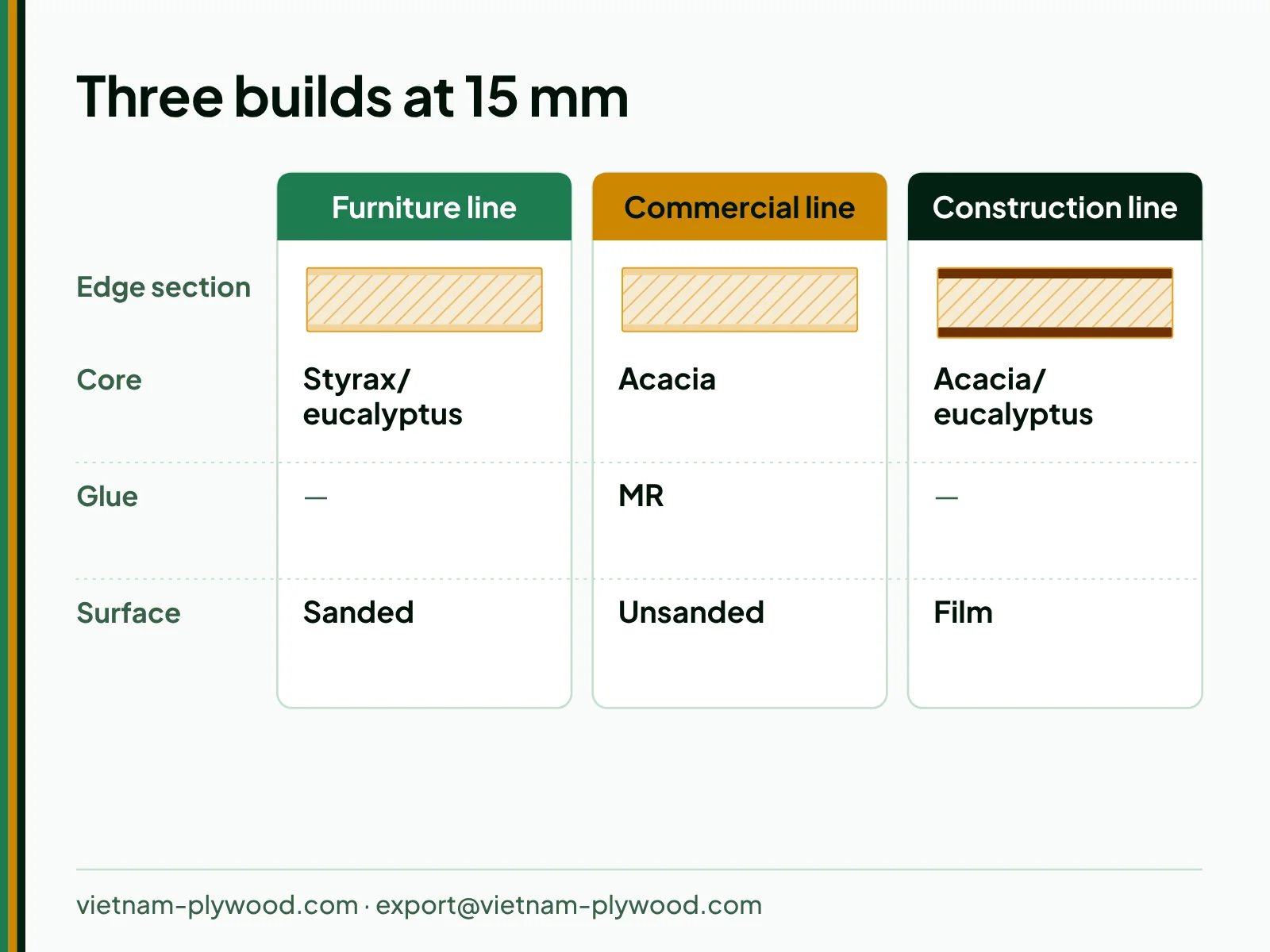
| Line | Typical 15 mm build | Face and finish | Practical buyer use |
|---|---|---|---|
| Our furniture line | Styrax or eucalyptus core, full stitched | Sanded, E0/E1; selected veneer face | Cabinet carcasses and fit-out components |
| Our commercial and packing line | Acacia core, MR glue | Unsanded or light-sanded; ordered face | Packing boxes, dividers and commercial stock |
| Our construction line | Acacia or eucalyptus core | Phenolic or melamine film; anti-slip film option | Formwork components after engineering review |
The furniture line can make a precise, sanded carcass panel; the packing line instead prioritizes a functional acacia-core sheet. The construction line presses film-faced panels, where the film, edge treatment and formwork design matter more than a decorative face. HCPLY coordinates specification, on-site quality control, export documents and loading, with shipment directly from the producing factory.
For furniture applications, review the furniture plywood range. For crates and protective packing, review packing or commercial plywood. The difference between full stitched and other veneer assemblies matters when machining exposed edges or driving screws near a joint.
Is 15 mm plywood enough for furniture carcasses?
15 mm can work for cabinet sides, backs, partitions and supported shelves when the joint design and expected loads are validated. The decisive questions are unsupported span, fixing geometry, door hardware loads, moisture exposure and whether the furniture drawing assumes an 18 mm edge.
For a visible cabinet face, specify bintangor, okoume, engineered veneer, gurjan, pine, poplar, eucalyptus, birch or sapele as the face veneer; the core remains styrax or eucalyptus on this line. Face veneer commonly measures 0.2–0.4 mm, with A/B face grades except birch D/E/F. A poplar-faced sheet is not automatically a poplar-core sheet.
The furniture build is sanded with ±0.2 or ±0.3 mm tolerance as ordered. Request a cut-and-assembled prototype using the final screw type and edge distance. Inspect joint opening, panel bow and loaded shelf deflection against the buyer’s drawing rather than accepting a thickness label as a performance certificate.
Is 15 mm suitable for industrial packing?
15 mm acacia-core plywood can suit crate walls, partitions and reusable packing components when the packaging engineer checks stacking loads, handling impacts and fastener positions. Our commercial and packing line uses MR glue and an unsanded or light-sanded finish for this build.
The packing tolerance is ±0.5–1.0 mm, wider than the furniture tolerance. That difference can be acceptable for crate walls but troublesome for a precision locating slot. A buyer should identify which parts are dimensional interfaces and which merely provide enclosure.
MR is a glue designation, separate from formaldehyde emission class. Melamine MR has a 12-hour boil condition, while phenolic WBP has a 72-hour boil condition. These adhesive descriptions do not establish outdoor performance for a finished crate. Specify the actual exposure and required test evidence.
When does formwork need 18 mm instead?
Keep 18 mm where the formwork engineer’s approved drawings, support spacing or allowable deflection call for that section. A 15 mm film-faced sheet is not a direct drop-in replacement under wet concrete pressure, particularly across longer bearer gaps.
The 15-to-18 mm geometric stiffness comparison shows why: at the same core and support geometry, the thinner section has lower ideal bending stiffness. Actual bending performance also reflects veneer orientation, defects, bonding and panel condition, so the geometric calculation cannot authorize a site substitution.
Film-faced specifications add surface variables. The construction line offers 120 g/m² standard film, 135 g/m² premium film and 220 g/m² anti-slip film only. A heavier overlay changes surface protection or grip; it does not make a 15 mm substrate mechanically equivalent to 18 mm.
With proper handling, a release agent on every pour and sealed edges, including cut edges, melamine-glue film-faced plywood is described at about 12–15 pours; phenolic-glue film-faced plywood at up to about 25 pours. These conditional reuse figures do not replace the structural check. Formwork buyers should give the pour geometry, bearer spacing and engineer-approved panel criteria before selecting either thickness.
Are 15 mm hardwood and poplar-faced 8 × 4 sheets available?
A 1220 × 2440 mm sheet can be specified with a poplar face or another listed veneer face, while the available core is determined by the selected line. The phrase 15mm poplar plywood often mixes face identity with core identity; HCPLY does not offer poplar-core plywood in our available builds.
Acacia and eucalyptus are hardwood core options in the stated builds, but the term hardwood plywood 15mm does not establish species, glue, emission class or structural grade. Request a face/core cross-section description instead of relying on a generic hardwood label. Birch-faced plywood is possible as a face choice; birch-core plywood is not pressed here.
Other catalog labels need decoding. A 15mm laminated plywood listing might mean decorative high-pressure laminate, melamine surface, or a film-faced panel. We explain melamine, high-pressure laminate and laminate faces as topics but do not offer them as a separate product line; the construction line’s melamine film is a specific formwork surface. A 16mm ply request is a different nominal thickness and must be quoted as such, rather than relabeling a 15 mm board.
The labels 15mm plyboard, 15mm ply sheets, ply wood 15mm and 15mm ply board are incomplete specifications. The phrase 15mm non structural plywood is a useful application boundary, but a buyer still needs the panel’s agreed dimensions, tolerance and finish. Compare the ply count explanation before making assumptions from a photographed edge.
How much weight can a 15 mm container load save?
At 1220 × 2440 mm, 15 mm panels use less wood volume than 18 mm at the same core. That is a useful handling calculation, although container totals also depend on pallet stack height and the 28.5 t payload limit.
| Core | Density | 15 mm sheets/pallet | Pallets per 40HC | Theoretical sheets | Calculated load |
|---|---|---|---|---|---|
| Styrax | 500 kg/m³ | 66 | 18 | 1,188 | 26.52 t |
| Acacia | 580 kg/m³ | 66 | 16 | 1,056 | 27.35 t |
| Eucalyptus | 650 kg/m³ | 64 | 15 | 960 | 27.86 t |
The listed loads use stack heights of 1000 mm for styrax and acacia and 970 mm for eucalyptus at this sheet size. Pallets and packing materials also consume payload; check the loading plan against the 28.5 t limit.
A mixed order can place furniture and packing specifications in one 40HC within the payload limit. For example, replacing an acacia-core 18 mm sheet with a 15 mm sheet of the same face size reduces panel mass according to the listed sheet weights. The remaining payload for other specifications must be recalculated using the actual sheet counts and packing weight, not inferred from the headline saving.
The detailed container-loading question belongs to the container load calculator and packing guide. Use that workflow for a mixed specification rather than treating the table as a freight booking instruction.
What can an inspector verify at the producing factory?
An inspector can witness thickness, dimensions, face quality, edge construction and the order’s packing identification before loading. These checks test whether the delivered 15 mm build matches the signed specification, without implying an unperformed strength test.
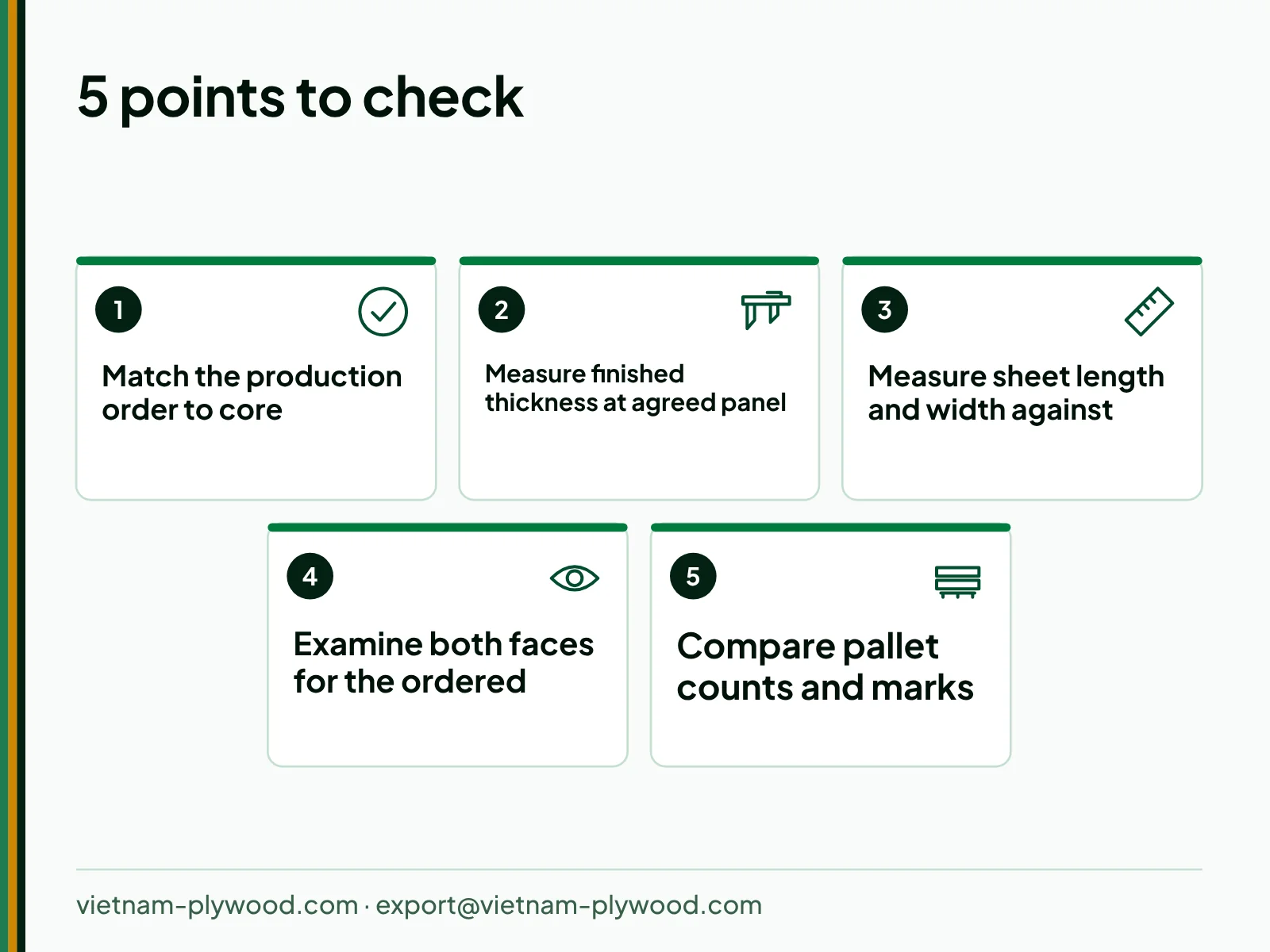
- Match the production order to core species, face, glue, emission requirement and ordered line.
- Measure finished thickness at agreed panel positions and compare the readings with the specified tolerance.
- Measure sheet length and width against the ±2 mm tolerance, then inspect the cut edges for core gaps and joints.
- Examine both faces for the ordered grade, sanding condition or film weight designation; inspect any specified edge sealing.
- Compare pallet counts and marks with the packing list, then witness loading and the final container record.
Buyers visit the factory office and inspect the goods at the producing factory. HCPLY handles on-site quality control and prepares draft shipping documents for buyer approval after loading. A factory-specific certificate, when relevant, is shown with factory details masked, on request; a certificate held by a member factory must not be described as a universal certification of every panel.
Which emission and shipping documents matter?
The written order determines which emission evidence accompanies a furniture or commercial 15 mm lot. Glue system and emission class are separate fields: E0, E1 and E2 identify emission classes, while MR and WBP identify adhesive systems.
For United States-bound regulated hardwood plywood, the United States Environmental Protection Agency’s 2025 Code of Federal Regulations, 40 CFR Part 770, describes formaldehyde emission standards and third-party certification provisions. It states that the part covers manufacture, including import, distribution and sale of composite wood products. Read the official 2025 regulation. An E0 or E1 order description alone does not establish CARB Phase 2 or Toxic Substances Control Act Title VI compliance.
The shipment document set contains a commercial invoice, packing list, bill of lading, certificate of origin, phytosanitary and fumigation papers, plus agreed certificate documents or test reports. European Union lots add EUR.1 where applicable and the EUTR/EUDR file set; cost, origin and applicability must be checked for the destination transaction. Under CIF, insurance is included in the documents.
The packing list records the quantity and sizes shipped, while agreed test reports or emission certificates address performance claims. FSC, CARB P2, ISO 9001 and CE certificates associated with member factories are shown with factory details masked, on request. Ask for evidence applicable to the actual producing factory and specified build rather than assuming a logo covers every variant.
What drives the price difference between 15 and 18 mm?
The 15 mm build has lower theoretical veneer volume per equal-area sheet, but the final quotation also depends on core, veneer quality, machining, adhesive and ordered quantity. For comparable construction, a full-stitched sanded furniture panel requires more processing than an unsanded packing panel; a film-faced formwork build adds film and its pressing requirements.
Within the furniture line, a specified decorative face and tighter sanding tolerance add selection and finishing work compared with a plain functional surface. Within packing, a wider tolerance and light sanding reduce finishing requirements. The 15 mm and 18 mm comparison must hold these variables constant before attributing a quoted difference to thickness.
For a 15 mm-specific price, request a quotation against the written build. Request a written quote against the selected line, face, core, glue, tolerance, sheet size and quantity. The minimum order is one 40HC; one container can carry several specifications as long as the payload limit holds.
Factory lead time runs 15–45 days from receipt of the 30% deposit; the exact figure depends on order size, line loading and what the contract fixes. The remaining 70% is paid on the scan of the bill of lading, by T/T, or by irrevocable sight L/C. We ship FOB Hai Phong, or CFR (CNF) or CIF to your port; see production lead time for the scheduling topic.
What should a buyer specify before ordering?
A complete inquiry states the application, manufacturing line, core, bonding, emissions, face, thickness tolerance and destination. This makes a 15 mm versus 18 mm comparison meaningful and gives the factory an inspection target.
Use the exact panel dimension, including the nominal 8 × 4 equivalent when relevant. State whether a cabinet drawing has been validated at 15 mm, whether a packing base has concentrated loads, or whether formwork has an engineer-approved span schedule. For alternative thickness programs, compare 10 mm plywood, 22 mm plywood and 25 mm plywood by their intended application rather than by nominal thickness alone.
Free samples are available; a first-time buyer pays the courier, and that charge comes off the first confirmed order. Ask Lucy at export@vietnam-plywood.com for a sample set matching the proposed production build.
Application: Cabinet carcass / industrial packing / engineered formwork
Line or core: Furniture—styrax / Commercial and packing—acacia / Construction—acacia or eucalyptus
Glue: MR melamine / WBP phenolic, as specified
Emission: E0 / E1 / E2 or agreed destination-specific evidence
Face and grade: [listed face veneer and grade] / [film type and weight]
Thickness and tolerance: 15 mm; [ordered ± tolerance]
Size: 1220 × 2440 mm or [listed/custom cut size]
Quantity: [sheets and 40HC mix]
Destination port: [port and country]
Ask for a 15 mm production-matched sample set before approving the final order.