





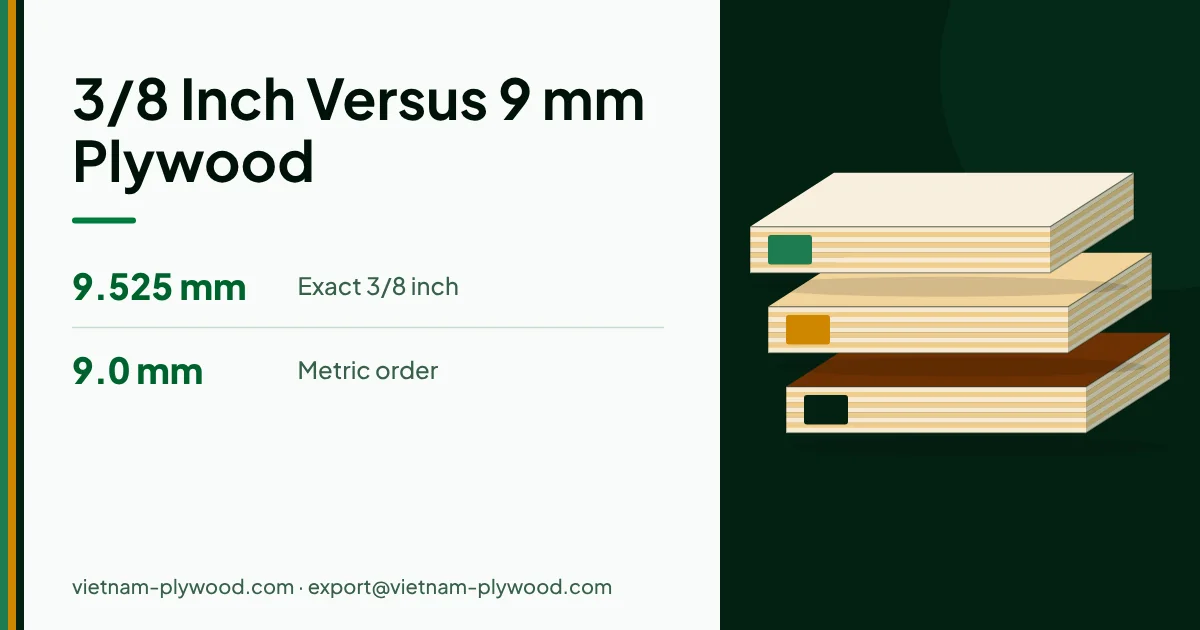
3/8 plywood in a metric export order is commonly specified as a 9 mm panel, with the finished tolerance written separately. Confusing nominal inch labels with measured thickness can lead to rejected cabinet components or delayed cargo acceptance. HCPLY builds 9 mm sheets for furniture, packing and selected light formwork applications, with the producing line chosen by the written specification.
What is plywood 3/8 in millimetres?
Plywood 3/8 means a nominal three-eighths-inch panel, equivalent to exactly 9.525 mm. HCPLY offers a 9 mm metric build for orders described as 3/8 plywood, but the buyer must specify which thickness controls acceptance. The 0.525 mm difference can make a cabinet groove too loose or cause an incoming inspection dispute. Record the target and tolerance in millimetres before production.
The US National Institute of Standards and Technology, in its SI Units – Length page updated in 2025, cites the 1959 federal definition of an inch as exactly 25.4 mm (NIST). Thus 3/8 × 25.4 = 9.525 mm. A 4 × 8 sheet is commonly specified for export as 1220 × 2440 mm; those dimensions should also be written explicitly. See our plywood sizes and thickness specification guide for the broader metric schedule.
Is 9 mm the same as 11/32 or 3/8 inch?
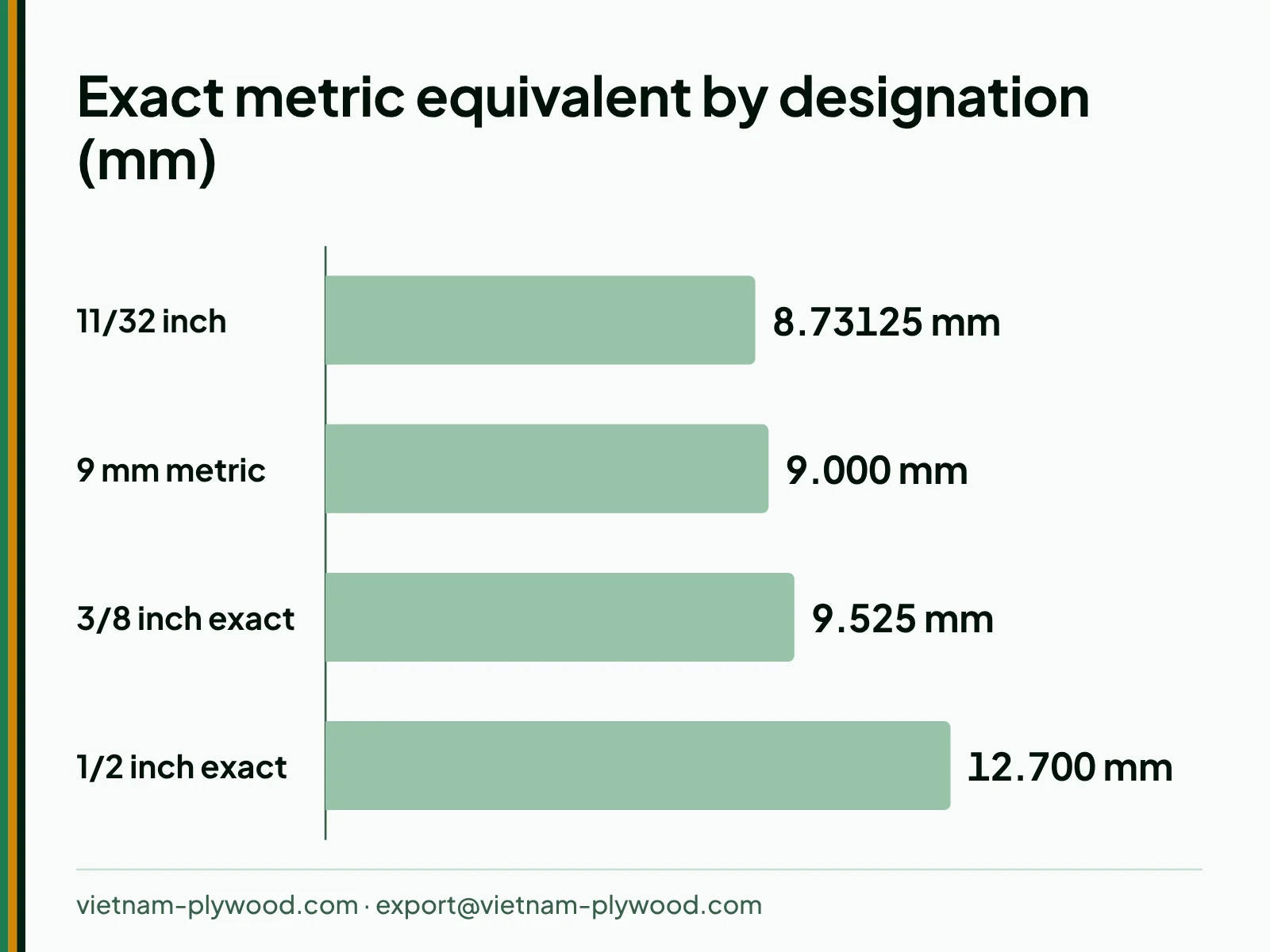
No. A 9 mm sheet, an 11/32-inch actual-thickness sheet and a full 3/8-inch sheet have different numerical targets.
| Designation | Exact metric equivalent | Difference from 9 mm | Purchasing verdict |
|---|---|---|---|
| 11/32 inch | 8.73125 mm | 0.26875 mm thinner | Match only when the drawing accepts this actual thickness |
| 9 mm metric | 9.000 mm | 0 mm | Specify for HCPLY metric production |
| 3/8 inch exact | 9.525 mm | 0.525 mm thicker | Specify 9.525 mm if exact inch thickness is required |
| 1/2 inch exact | 12.700 mm | 3.700 mm thicker | Consider for greater section thickness |
North American catalogues sometimes pair nominal 3/8 with 11/32 actual. That convention is a purchasing distinction, not a conversion equation. On a drawing, write the actual required value rather than relying on the sales label.
Which 9 mm build fits each application?
Our furniture line presses sanded, full-stitched 9 mm panels for cabinet backs and interior fit-out components. Our commercial and packing line makes acacia-core panels for protective packing and general commercial use. Our construction line makes film-faced 9 mm panels for light formwork only where the form design permits that thickness.
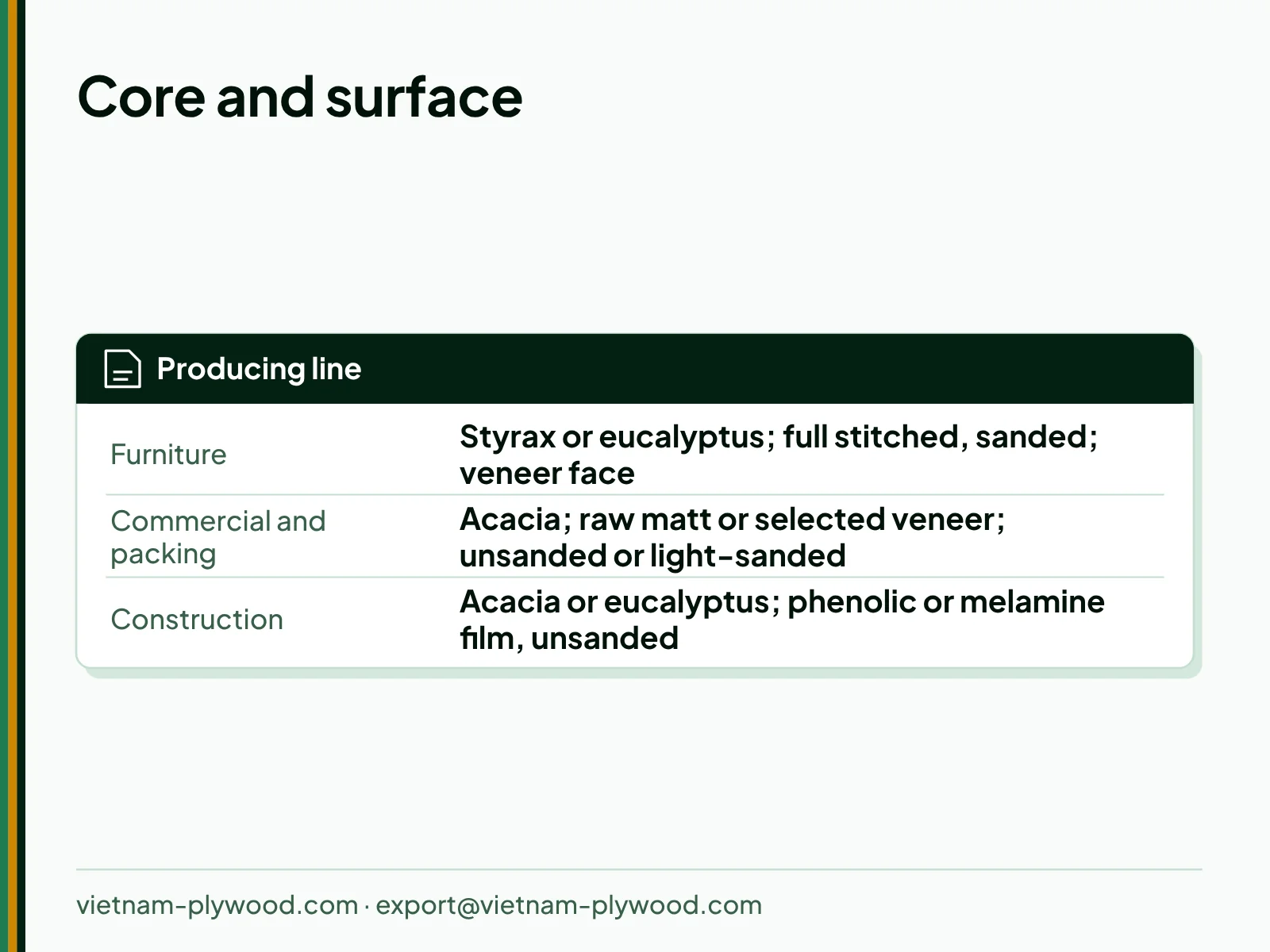
| Producing line | Core and surface | Ordered tolerance | Suitable decision |
|---|---|---|---|
| Furniture | Styrax or eucalyptus; full stitched, sanded; veneer face | ±0.2 or ±0.3 mm | Cabinet backs and close-fit panels |
| Commercial and packing | Acacia; raw matt or selected veneer; unsanded or light-sanded | Commercial ±0.5 mm; packing ±0.5–1.0 mm | Protective packing and utility partitions |
| Construction | Acacia or eucalyptus; phenolic or melamine film, unsanded | ±0.5 mm | Light forms with engineer-approved support |
HCPLY names a veneer-faced product by its face, rather than by its core. Bintangor, okoume, pine, poplar and engineered veneer are face choices; acacia, styrax and eucalyptus describe the cores. Density follows the core. The furniture plywood page explains the cabinet-facing product family.
What is 3/8 plywood used for?
The most direct 9 mm applications are cabinet backs, fitted interior panels, packaging dividers and light protective enclosures. A furniture maker values consistent sanding and a specified visible face; a packing buyer often prioritizes a practical acacia core and tolerance suited to the crate.
Groove-fit work calls for a measured thickness window; a surface-mounted back may accept a wider window. Thin shelving, floors, roof decks and bracing cannot be approved from nominal thickness alone.
Thicker 15 mm plywood or 18 mm plywood can be more appropriate when the engineered form design calls for greater stiffness. Film facing does not itself establish a structural rating.
What thickness tolerance belongs on the order?
Write “9.0 mm finished thickness, ±0.2 mm, sanded furniture plywood” when a close-fit furniture component requires that ordered grade. The alternative furniture tolerance is ±0.3 mm; commercial and film-faced panels use ±0.5 mm, while packing accepts ±0.5–1.0 mm.
For a 9.0 mm ±0.2 mm furniture order, the acceptance band is 8.8–9.2 mm. At ±0.3 mm it is 8.7–9.3 mm. A 9.0 mm ±0.5 mm commercial order accepts 8.5–9.5 mm.
Specify the measuring instrument, measurement points and acceptance sampling method in the purchase agreement. Inspectors can witness thickness measurements at the producing factory and compare them with the written target. The length and width tolerance is ±2 mm for the agreed cut size.
How do core, face and glue change a 9 mm sheet?
Core construction changes the panel behind the visible veneer. Full-stitched core is the highest construction tier in our range, followed by stitched outer layers with edge-trimmed inner veneers, finger-jointed core and loose-laid core. Choose the core construction to match machining and appearance needs.
Face veneer commonly measures 0.2–0.4 mm. The available veneer faces include bintangor, okoume, engineered veneer, gurjan, pine, poplar, eucalyptus, birch and sapele. A/B face grades are available except birch, which uses D/E/F grades. A raw matt panel has no decorative face.
Glue and formaldehyde emission are separate fields. Melamine MR bonding has a 12-hour boil specification, while phenolic weather-and-boil-proof bonding has a 72-hour boil specification. E0, E1 and E2 describe emission classes. For US regulated composite-wood requirements, CARB P2 / TSCA Title VI refers to a limit with third-party certification, rather than a glue type.
When is 3/8 better than 1/2 plywood?
Choose 9 mm when the component is lightly loaded and a thinner section fits the assembly; choose a thicker panel when the design requires additional stiffness or fixing depth. The choice is based on application and the actual specified build, not the inch nickname.
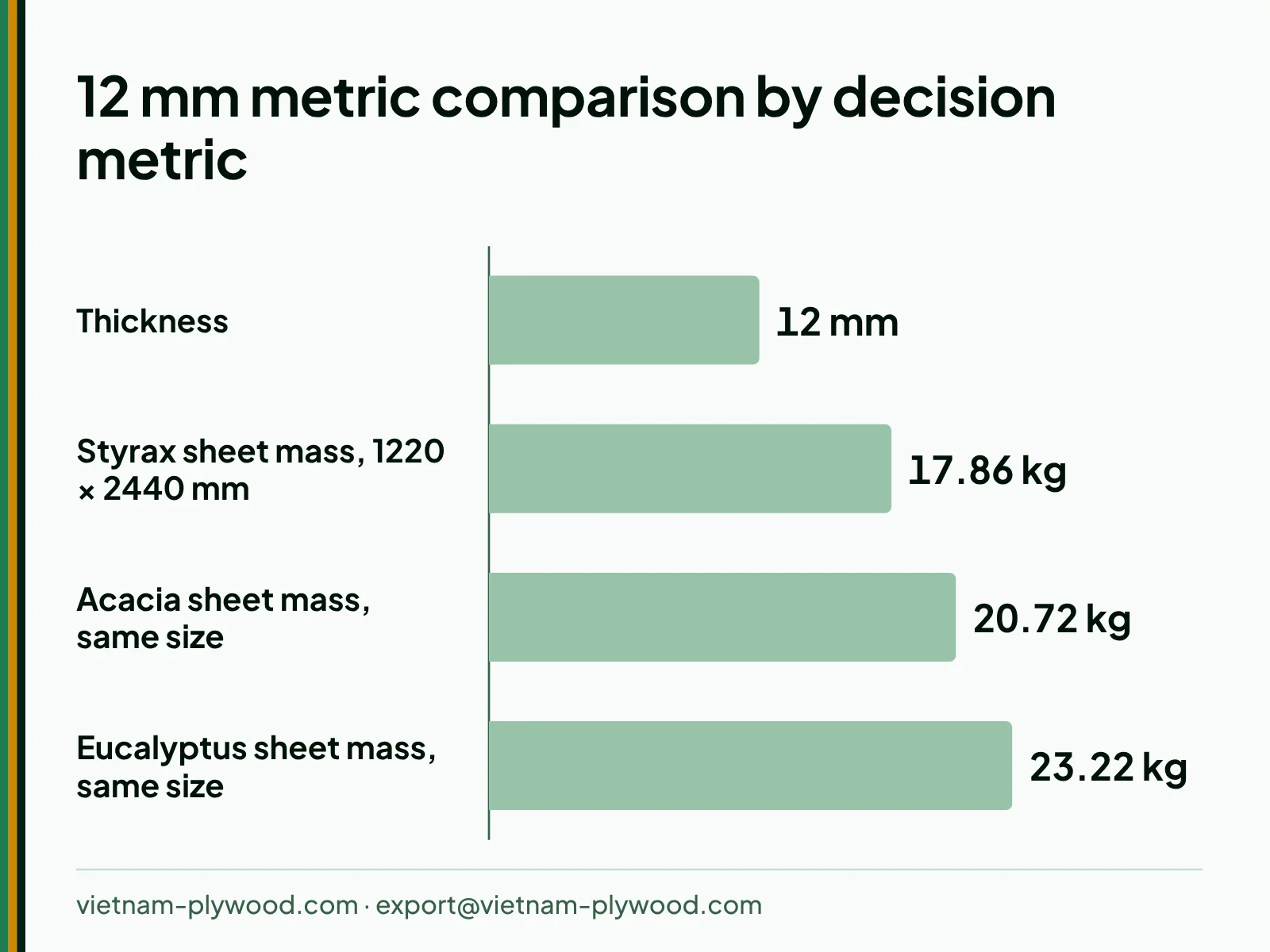
| Decision metric | 9 mm metric | 12 mm metric comparison | Verdict by use |
|---|---|---|---|
| Thickness | 9 mm | 12 mm | 9 mm for shallow grooves; 12 mm for a thicker section |
| Styrax sheet mass, 1220 × 2440 mm | 13.40 kg | 17.86 kg | 9 mm for lower handling mass |
| Acacia sheet mass, same size | 15.54 kg | 20.72 kg | 9 mm for lighter packing components |
| Eucalyptus sheet mass, same size | 17.41 kg | 23.22 kg | Select by core and component load |
| Structural approval | Requires assembly design | Requires assembly design | Neither thickness alone establishes a span rating |
For other thicknesses, consult the 18 mm specification or 22 mm plywood discussion. A thicker panel typically uses more wood per sheet and costs more per sheet for an otherwise comparable build.
How does 9 mm affect a 40HC shipment?
A full 40HC of 1220 × 2440 × 9 mm styrax-core sheets contains 1,998 sheets and weighs 26.76 t in the stated loading schedule. The acacia-core version contains 1,776 sheets at 27.60 t, and eucalyptus-core contains 1,605 sheets at 27.95 t. These figures exclude film weight.
The 28.5 t payload limit governs mixed loading. For example, an acacia 9 mm pallet holds 111 sheets, and an acacia 18 mm pallet holds 55 sheets. Using the sheet weights, one pallet of each is approximately 111 × 15.54 + 55 × 31.08 = 3,435.34 kg before packaging; the actual loading plan must also account for the remaining pallets and packaging.
Our container packing guide owns the full sheet-count calculation.
What can an inspector check before loading?
An inspector can compare the 9 mm purchase specification against sampled finished panels at the producing factory. HCPLY coordinates on-site quality control and the buyer can visit the factory office and inspect goods at the production location.
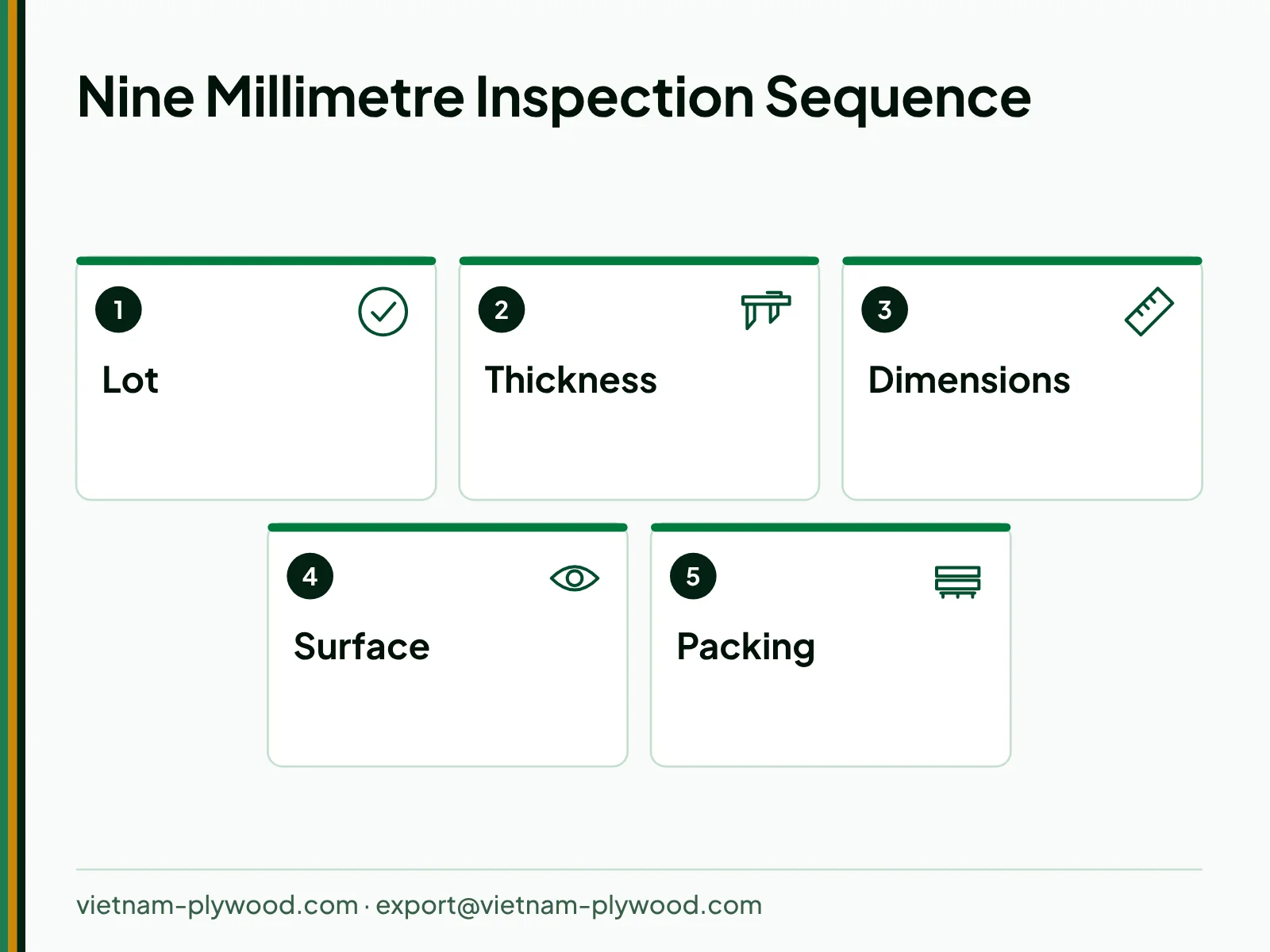
- Identify the lot and its intended line, core and face grade.
- Measure finished thickness against the ordered tolerance at the agreed panel locations.
- Check length and width against the specified cut size and ±2 mm tolerance.
- Inspect face defects, edge condition, sanding and core construction against the agreed reference.
- Compare packing marks, counted sheets and pallet allocation with the loading plan.
Where a certificate or test report is part of the agreed order, match it to the producing member factory and panel build. FSC, CARB P2, ISO 9001 and CE certificates, and EUTR/EUDR documents, are shown with factory details masked, on request. They belong to the member factories.
What should the export specification and documents say?
The commercial invoice and packing list should identify the agreed 9 mm product, size and quantity consistently with the order. The bill of lading records carriage; a certificate of origin supports origin documentation, with EUR.1 for applicable EU lots. After loading, the draft shipping documents come to you for approval.
The shipment document package includes phytosanitary and fumigation papers, insurance for CIF, and order-specific certificates or test reports. EU lots also carry the EUTR/EUDR file set.
HCPLY ships directly from the matching factory, FOB Hai Phong, with CFR (CNF) and CIF also available. Production takes 15–45 days from the 30% deposit, set by order size, line loading and the contract. The remaining 70% is paid on the scan of the bill of lading, by T/T, or by irrevocable sight L/C.
How should an importer request a 9 mm trial container?
Send the application, exact finished thickness and tolerance, core, face, glue, emission class and destination port together. HCPLY can then assign the build to the appropriate line and prepare a quotation for the written specification.
For a comparable starting point, commercial plywood is from US$250/m³ FOB Hai Phong (October 2026), while furniture plywood is from US$350/m³ FOB Hai Phong (October 2026). Face grade, core construction, sanding, glue and tolerance change the quotation; tighter sanded furniture construction costs more than a basic unsanded packing build.
The minimum order is one 40HC. Samples are free; new buyers book their courier, and its cost can be credited against a real order. For mixed product planning, see one supplier, several plywood types and construction plywood supply.
Application: cabinet backs / protective packing / engineered light forms
Line or core: furniture—styrax / commercial and packing—acacia / construction—acacia
Glue: melamine MR or phenolic WBP, as required
Emission: E0 / E1 / E2, specified separately
Face and grade: selected veneer A/B, or raw matt; birch D/E/F
Finished thickness and tolerance: 9.0 mm ±0.2 mm (furniture example)
Sheet size: 1220 × 2440 mm, length and width ±2 mm
Quantity: one 40HC, with specified mix if required
Destination port: [buyer to insert]
Plan a trial container with Lucy at contact or export@vietnam-plywood.com.