





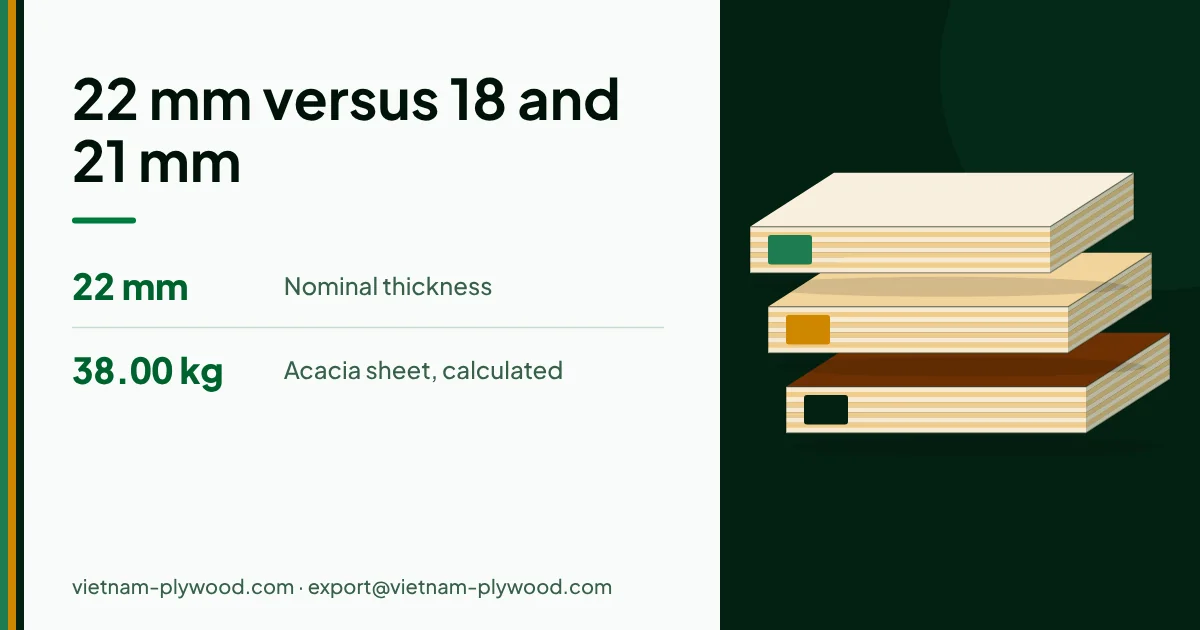
Which 22 mm plywood sizes and factory lines can buyers specify?
22 mm plywood is a made-to-order thickness within HCPLY’s 3–40 mm production range. It makes sense when a cabinet, counter or fit-out design needs more material than 18 or 21 mm; selecting it without checking the assembly adds weight and can reduce sheets per shipment. Our three factories in Phu Tho and Hai Phong build different panel specifications.
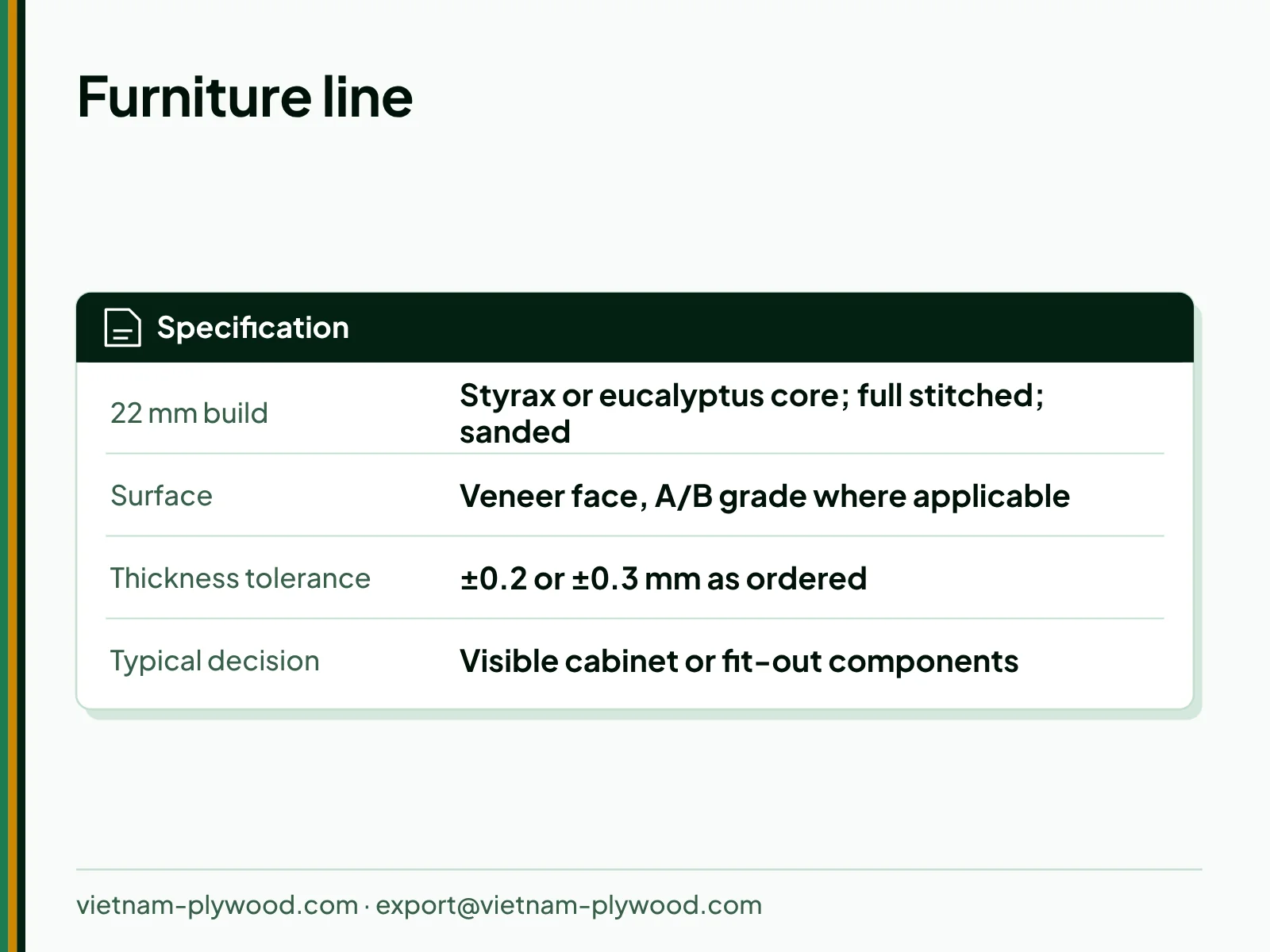
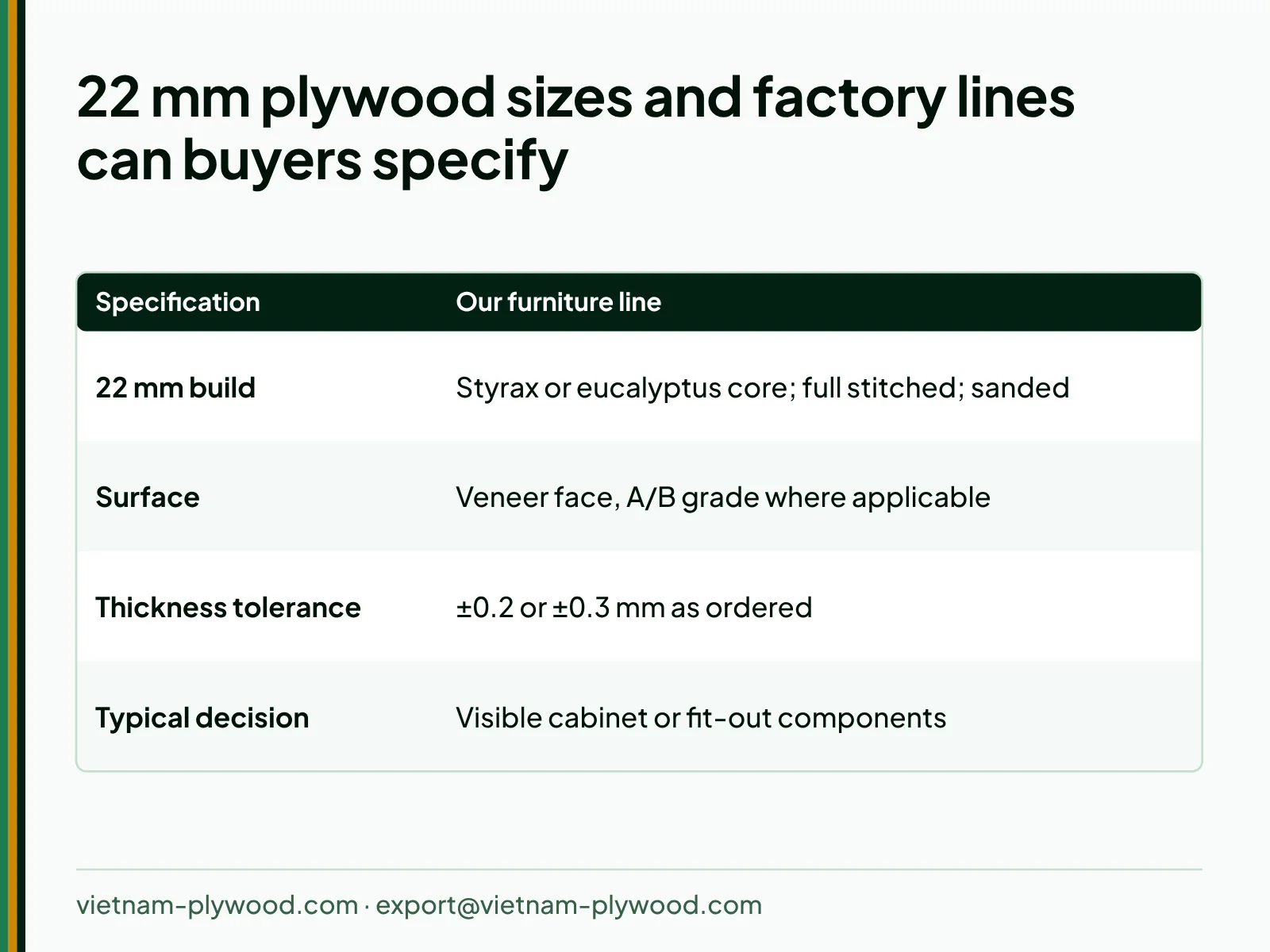
| Specification | Our furniture line | Our commercial and packing line | Our construction line |
|---|---|---|---|
| 22 mm build | Styrax or eucalyptus core; full stitched; sanded | Acacia core; unsanded or light-sanded | Acacia or eucalyptus core; unsanded |
| Surface | Veneer face, A/B grade where applicable | Raw matt or agreed veneer face | Phenolic or melamine film; anti-slip option |
| Thickness tolerance | ±0.2 or ±0.3 mm as ordered | ±0.5 mm commercial; ±0.5–1.0 mm packing | ±0.5 mm |
| Typical decision | Visible cabinet or fit-out components | Packing platforms and industrial panels | Formwork and temporary site surfaces |
Available sheet dimensions are 1220×2440, 1250×2500, 1220×2135, 1220×1830, 915×2440, 915×2135 and 915×1830 mm; custom cutting is available. Length and width tolerance is ±2 mm. The choice of face and grade should follow the end use, while the core determines the density. For broader dimensions and thickness choices, see the plywood sizes and thickness specification guide.
When should buyers choose 22mm ply over 18 or 21 mm?
Choose 22mm ply when the drawing calls for a thicker finished section, a deeper machining allowance or a heavier-duty substrate than 18 or 21 mm. A thicker sheet alone does not establish an approved span or structural load. Match the support spacing, fixing pattern, core build and service conditions to the project design before changing the bill of materials.
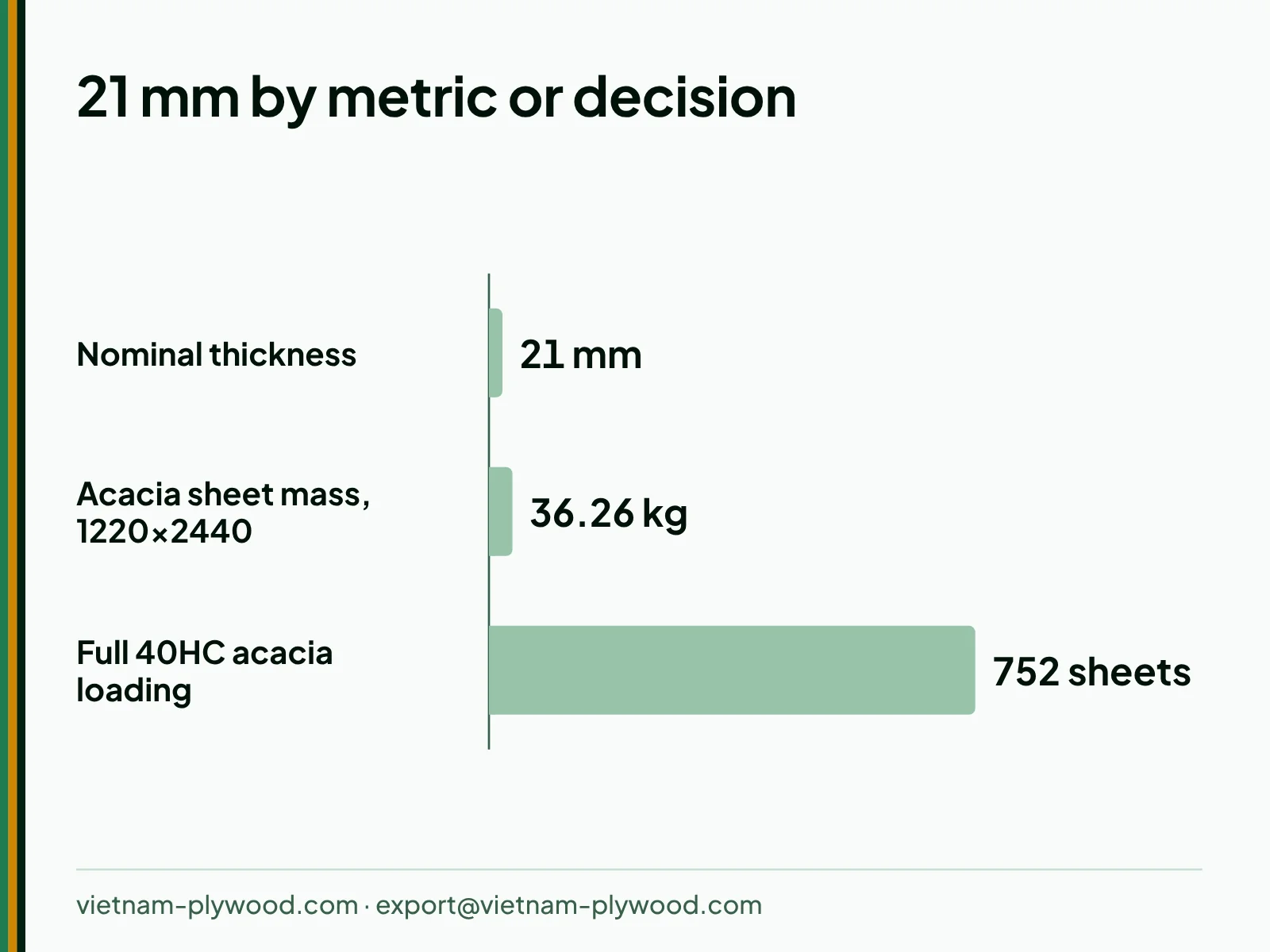
| Metric or decision | 18 mm | 21 mm | 22 mm | Verdict by use |
|---|---|---|---|---|
| Nominal thickness | 18 mm | 21 mm | 22 mm | 18 mm for established cabinet designs; 22 mm for a specified thicker section |
| Thickness added over 18 mm | Baseline | +3 mm | +4 mm | 21 mm is a smaller step where the drawing permits |
| Acacia sheet mass, 1220×2440 | 31.08 kg | 36.26 kg | Calculated 38.00 kg | 18 mm reduces handling mass |
| Full 40HC acacia loading | 880 sheets | 752 sheets | Calculated 720 sheets | 22 mm reduces piece count |
| Furniture finish | Sanded veneer | Sanded veneer | Sanded veneer | Select by machining and appearance specification |
The 22 mm entries are planning calculations using the stated acacia density and pallet stack height, rather than a published 22 mm loading lookup. Compare an 18 mm design in the thickness tolerance guide before changing tooling.
What is 22 mm plywood used for?
22 mm plywood serves heavy cabinet bases, counters, shelving components, furniture plinths and fit-out substrates when the approved drawing specifies this thickness. For furniture and cabinet makers, our furniture line presses a stitched, sanded panel that can be machined to the required dimensions. The finish specification should state the face species and grade before a cutting schedule is released.
Importers also request thicker plywood for workshop fixtures, display structures, van fit-outs and packing platforms. Those applications call for different face finishes and exposure conditions; a raw packing panel is not interchangeable with a visible cabinet face. A construction film-faced build is considered for formwork surfaces, with the structural design and handling regime assessed separately.
For floor overlays, roof decking, stairs and raised platforms, buyers should obtain project-specific span, load, fixing and exposure requirements. The thickness does not by itself confer a structural grade. See plywood supply for construction projects for the specification workflow.
How much extra does a 22 mm sheet weigh?
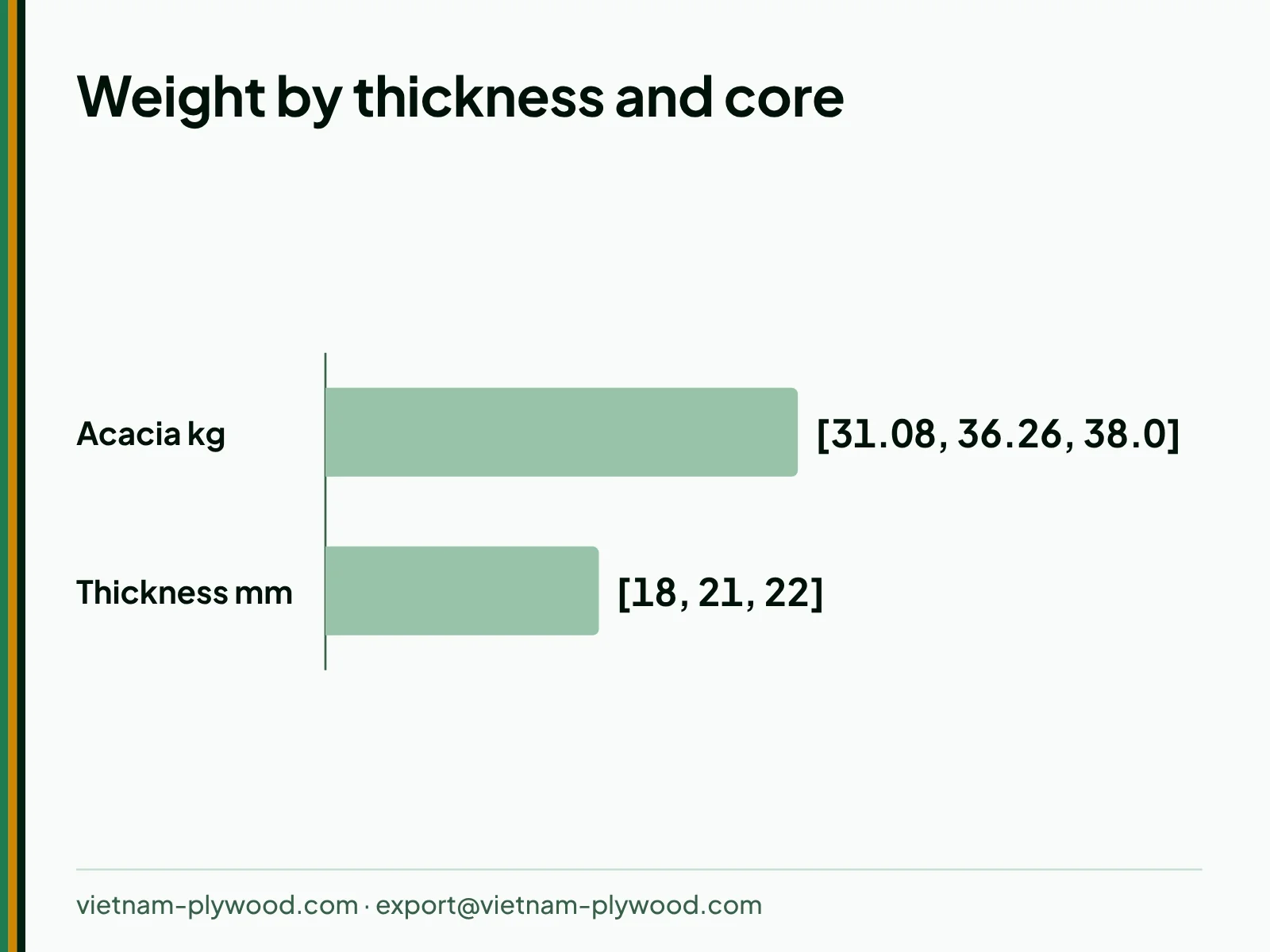
At 1220×2440 mm, an acacia-core 22 mm sheet calculates to 38.00 kg, versus the stated 31.08 kg for 18 mm and 36.26 kg for 21 mm. The difference from 18 mm is approximately 6.92 kg per sheet; the difference from 21 mm is approximately 1.74 kg. These are core-density calculations and exclude any film weight, packaging or moisture adjustment.
| Core | Density | 18 mm sheet | 21 mm sheet | 22 mm calculated sheet |
|---|---|---|---|---|
| Styrax | 500 kg/m³ | 26.79 kg | 31.26 kg | 32.75 kg |
| Acacia | 580 kg/m³ | 31.08 kg | 36.26 kg | 38.00 kg |
| Eucalyptus | 650 kg/m³ | 34.83 kg | 40.63 kg | 42.55 kg |
Calculation: length × width × thickness in metres × core density. For example, 1.22 × 2.44 × 0.022 × 580 = 37.997344 kg for acacia. A birch face does not turn an acacia core into birch-core plywood. The veneer face changes appearance; the core drives this planning weight.
How does 22 mm affect container freight?
A 22 mm order carries fewer sheets than an 18 mm order at the same pallet stack height. For 1220×2440 mm acacia panels, 1000 mm stack height permits floor(1000 ÷ 22) = 45 sheets per pallet. Across 16 pallets that is 720 sheets, compared with 880 sheets at 18 mm.
The 22 mm acacia calculation gives approximately 27.36 tonnes of panels before pallets and packing, below the 28.5-tonne 40HC payload limit. A 21 mm acacia load uses 752 sheets and 27.27 tonnes from the stated lookup. The 22 mm calculation therefore reduces sheets by 32 against 21 mm while panel mass remains close; freight cost per usable sheet can rise even if container freight itself is unchanged.
A mixed-specification order can combine 22 mm furniture panels with thinner furniture panels where production and packing arrangements permit, provided total loaded mass remains within the payload limit. Use the container loading reference for the broader loading method; the actual packing plan must account for pallets and other cargo mass.
Is 22 mm plywood the same as 7/8 inch?
No. Seven-eighths of an inch equals 22.225 mm, so nominal 22 mm is 0.225 mm thinner. The US National Institute of Standards and Technology states in its SI Units – Length page, updated in 2025, that one inch is exactly 25.4 mm. That conversion is a unit definition, not a panel tolerance or substitution approval.
An inch-based purchase order should identify whether 7/8 plywood means an exact nominal 22.225 mm, a trade label, or an acceptable 22 mm metric build. For close-fitting cabinet joinery, compare the required finished thickness with the ordered sanding tolerance. A drawing that says 7/8 inch should not be silently changed to 22 mm at quotation stage. Reference: NIST SI Units – Length.
Is 22 mm a standard thickness or made to order?
22 mm is within our manufacturing range but outside the commonly ordered 3, 5, 9, 12, 15, 18, 21 and 25 mm thicknesses. Specify it as a written order dimension, together with its tolerance and surface finish. Do not assume a merchant’s 22 mm cut panel is equivalent to the factory build requested for export.
Our furniture line uses styrax or eucalyptus cores with full stitching and sanding; our commercial and packing line uses acacia and moisture-resistant (MR) glue; our construction line uses film-faced acacia or eucalyptus builds. Each order is pressed at the producing factory that matches its specification and shipped from that factory. Buyers can inspect goods there and visit the factory office.
The furniture plywood page describes the finish-oriented option. A distributor ordering multiple specifications can use plywood supply programmes for distributors to organize a consistent written specification.
Which core, glue and face should the specification name?
For furniture panels, the starting point is a full-stitched styrax or eucalyptus core, sanded to the ordered tolerance, with E0 or E1 emission class. Face choices include bintangor, okoume, engineered veneer (EV), gurjan, pine, poplar, eucalyptus, birch and sapele; common face veneer thickness is 0.2–0.4 mm. Specify A/B face grade except that birch faces use D/E/F grades.
For commercial or packing panels, acacia core and MR glue address a different finish and handling brief. The construction line uses phenolic or melamine film, including anti-slip film where specified. Standard film is 120 g/m², premium film 135 g/m² and anti-slip film 220 g/m²; these are surface specifications, not core densities.
Glue type and emission class belong in separate fields. MR melamine glue is described by a 12-hour boil condition; phenolic weather-and-boil-proof (WBP) glue by a 72-hour boil condition. Neither label replaces an emission certificate or a performance test against the buyer’s agreed requirement.
What can an inspector check at the producing factory?
An inspector can witness thickness measurements across selected 22 mm panels, compare readings with the agreed tolerance and record the face and edge condition. The inspection should identify the producing line and the ordered core construction. For sanded furniture panels, the acceptance band is the selected ±0.2 or ±0.3 mm; for commercial or film-faced panels it is ±0.5 mm.
The inspector can also check cut dimensions against ±2 mm, examine veneer stitching and inspect packing marks before loading. A representative cut edge helps reveal inner-layer arrangement and gaps that a smooth face can conceal. Moisture should be tested against the order’s agreed method and acceptance criteria; see moisture content standards and testing.
HCPLY coordinates on-site quality control, documents and loading. Certificate documents belonging to the member factories, including FSC, CARB P2, ISO 9001 and CE where relevant to the order, are shown with factory details masked, on request. Test reports for any claimed special performance must match the actual agreed build.
What must appear on the purchase order and shipping papers?
The purchase order should identify 22 mm nominal thickness, tolerance, core, glue, emission class, face grade, dimensions and quantities. It should also identify the application and destination port so the producing factory can prepare the correct packing plan. For an order involving structural or marine claims, acceptance must be against a test report the buyer accepts.
The shipment document set includes commercial invoice, packing list, bill of lading (B/L), certificate of origin, phytosanitary and fumigation papers, and agreed certificate documents. European Union lots include EUR.1 and the EUTR/EUDR file set; insurance is included under CIF. After loading, the draft shipping documents come to you for approval.
The packing list is the document that ties 22 mm sheet counts, dimensions and packages to the shipment. A clear thickness description across the contract and shipping papers helps receiving teams identify the goods. Review how many plies in plywood when specifying the inner build; ply count follows veneer thickness rather than nominal sheet thickness alone.
How should buyers price and order a 22 mm programme?
For a 22 mm quotation, the largest cost drivers are core construction and core species, then face grade and finishing, glue system, and cutting or packing requirements. A full-stitched sanded furniture build costs more to produce than a less-finished commercial packing build because of veneer selection, stitching and sanding. A higher-grade decorative face adds selection work compared with a raw matt face.
The minimum order is one 40HC, with mixed specifications allowed within the payload limit. Factory lead time runs 15–45 days from receipt of the 30% deposit; the exact figure depends on order size, line loading and what the contract fixes. The remaining 70% is paid on the scan of the bill of lading, by T/T, or by irrevocable sight L/C. We ship FOB Hai Phong, or CFR (CNF) or CIF to your port.
Samples cost nothing: a first-time buyer pays the courier, and that charge comes off the first confirmed order. For a written 22 mm quotation, send the specification to Lucy at export@vietnam-plywood.com through contact.
What specification should a buyer send for a trial container?
Send a build-specific request rather than the shorthand “22m plywood” or “plywood 22.” That distinction helps the factory quote the intended product instead of guessing a face, core or tolerance. A trial order can compare 22 mm against an existing 18 or 21 mm design using the same inspection checklist.
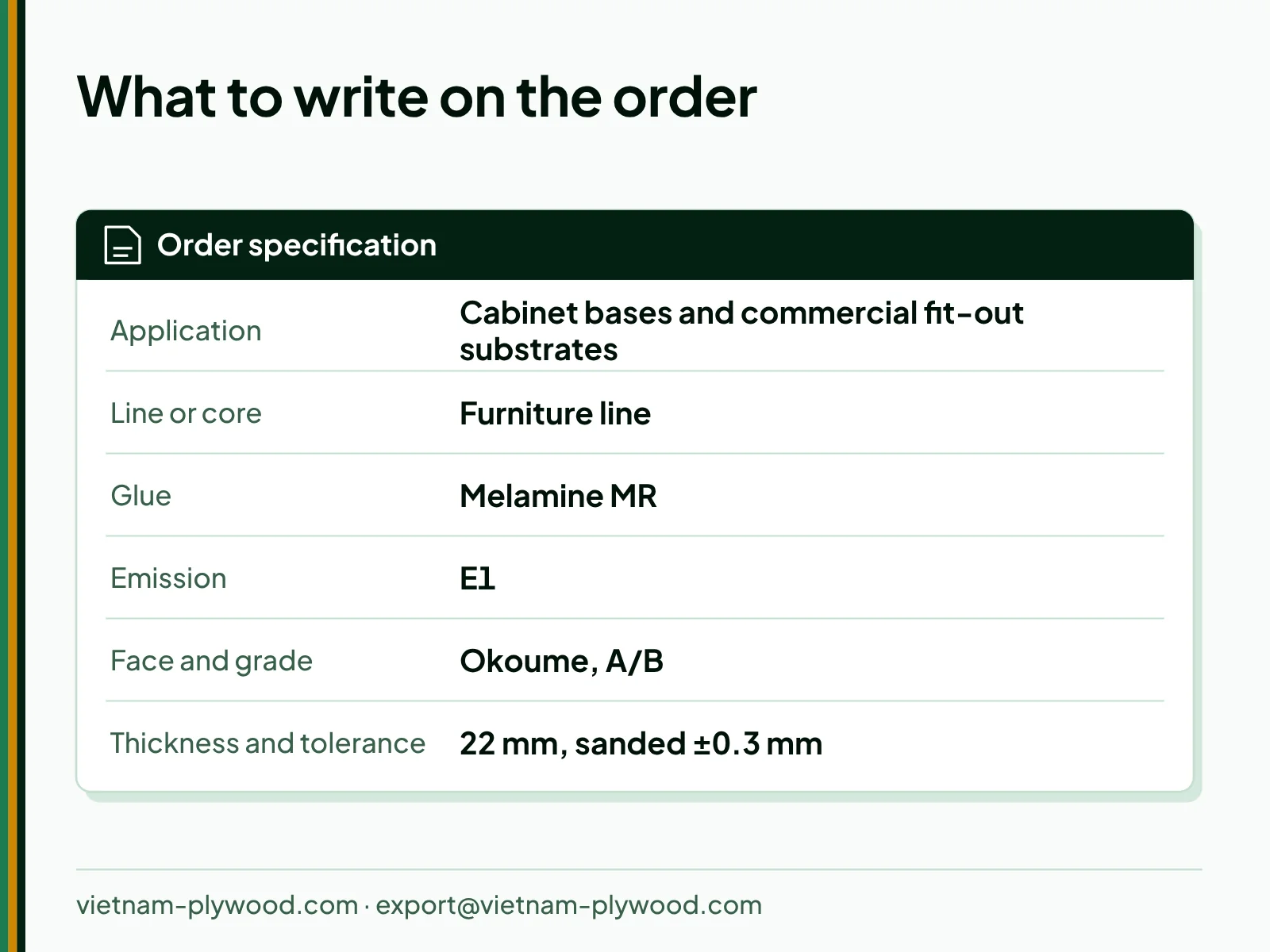
Application: Cabinet bases and commercial fit-out substrates
Line or core: Furniture line; styrax core, full stitched
Glue: Melamine MR
Emission: E1
Face and grade: Okoume, A/B
Thickness and tolerance: 22 mm, sanded ±0.3 mm
Size: 1220 × 2440 mm
Quantity: One 40HC; packing plan by specification
Destination port: [buyer to enter]
Next step: plan a trial container with Lucy, using the drawing, cut list and destination port to settle the build and loading arrangement.