





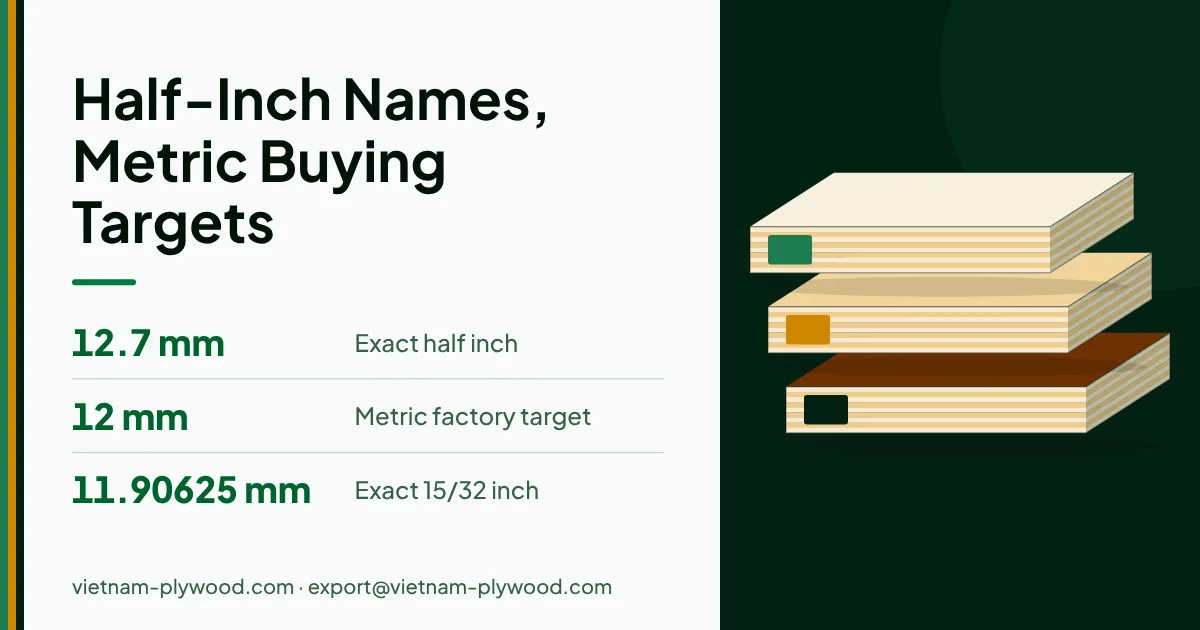
1/2 plywood from HCPLY can be specified as a 12 mm metric sheet for cabinet parts, packing or formwork, with a different build on each line. Confusing 12 mm, 12.7 mm and 15/32 inch can cause rejected panels, reworked grooves and delayed assembly. We quote the finished thickness and its tolerance in millimetres so the buyer and inspector use the same acceptance target.
What is 1/2 plywood in millimetres?
1/2 plywood is a nominal half-inch panel description; an exact half inch is 12.7 mm. A buyer asking HCPLY for a 12 mm panel is ordering a different metric target. The difference matters for cabinet grooves, edge alignment and acceptance inspection. Put the target and permitted deviation on the purchase specification before production.
The US National Institute of Standards and Technology (NIST), in its SI Units – Length explanation of the 1959 definition, states: “The value for the inch, derived from the value of the Yard effective July 1, 1959, is exactly equivalent to 25.4 mm.” See NIST’s length reference. Half of that exact value is 12.7 mm. The plywood sizes and thickness specification guide covers other nominal-to-metric selections.
A 12.7 mm finished slot should not be matched with 12 mm stock without checking fit.
Is 12 mm plywood the same as 1/2 inch plywood?
No: 12 mm is 0.7 mm thinner than the exact 12.7 mm half inch, before any manufacturing tolerance. The two descriptions can serve similar purchasing categories, but they do not define identical dimensions.
| Order description | Nominal target | Difference from exact half inch | Purchasing verdict |
|---|---|---|---|
| Exact 1/2 inch | 12.7 mm | 0 mm | Use when the drawing demands 12.7 mm |
| 12 mm metric plywood | 12 mm | −0.7 mm | Specify for parts designed around 12 mm |
| 15/32 inch | 11.90625 mm | −0.79375 mm | Check the drawing and actual grade specification |
For cabinet grooves, packing clearance and form joints, test actual panels at the agreed limits.
What does 15/32 mean beside a half-inch label?
15/32 inch equals 11.90625 mm mathematically. It is a separate fractional measurement, although some US listings use 15/32 as the actual-size description beside nominal half-inch plywood.
Do not turn that retail naming convention into an automatic tolerance for an export order. A request for “15/32 structural 1 plywood” carries a grade and performance implication beyond its dimension. HCPLY can discuss the thickness, but any structural-grade claim needs a test report the buyer accepts. We do not apply an APA or PS 1 stamp to our panels.
If an engineering drawing calls out a specific structural panel, obtain its applicable grade, test documentation and design requirements before evaluating a substitute. A 12 mm furniture panel is not interchangeable solely because its thickness looks close.
Which line builds a 12 mm sheet for each use?
Our furniture line builds 12 mm sanded plywood with a styrax or eucalyptus core for cabinet and furniture components. Our commercial and packing line builds acacia-core sheets for packaging. Our construction line builds film-faced acacia- or eucalyptus-core sheets for formwork.
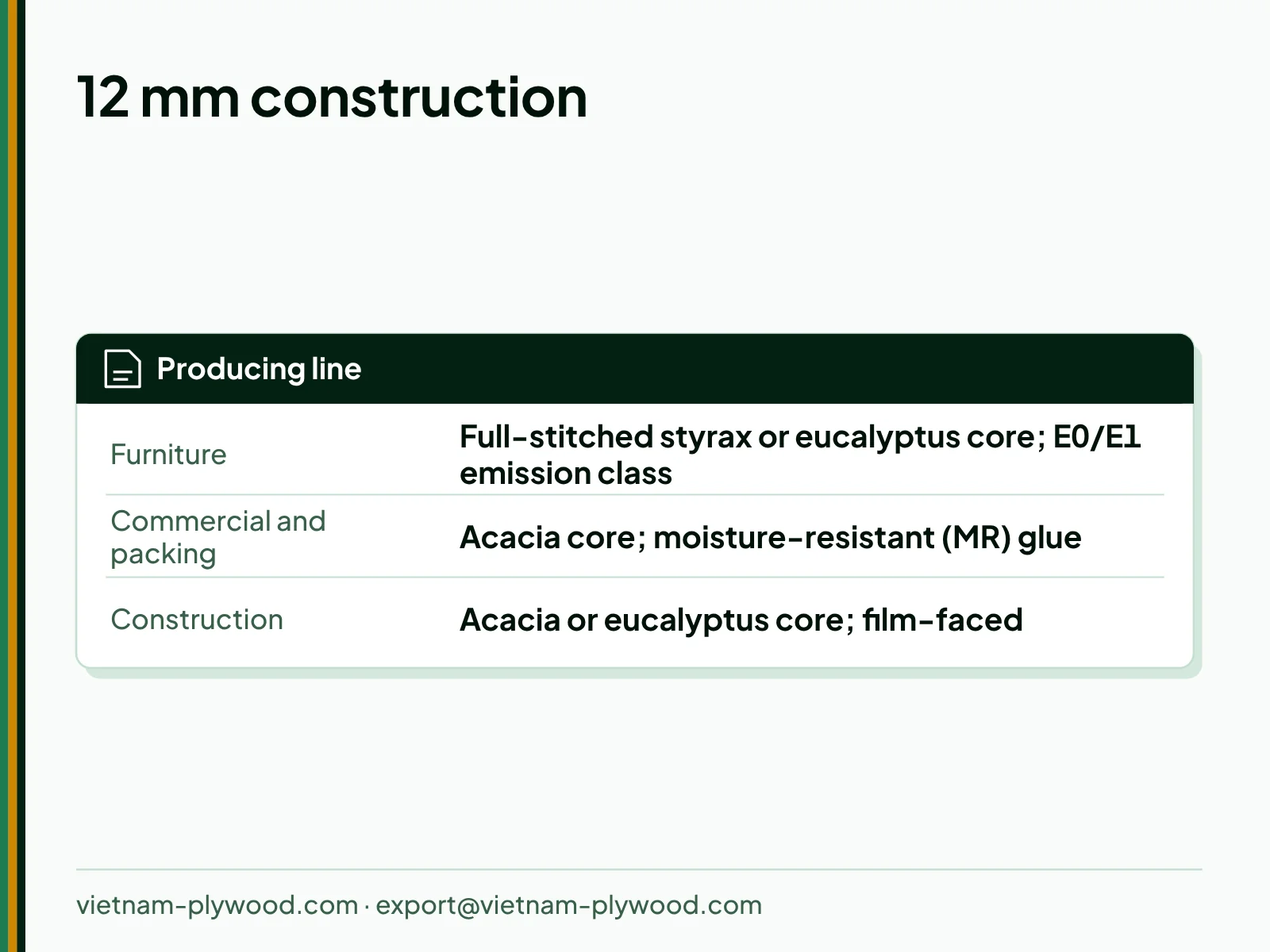
| Producing line | 12 mm construction | Face or surface | Thickness tolerance | Suitable buying brief |
|---|---|---|---|---|
| Furniture | Full-stitched styrax or eucalyptus core; E0/E1 emission class | Sanded veneer face | ±0.2 or ±0.3 mm as ordered | Cabinet parts and fit-out panels |
| Commercial and packing | Acacia core; moisture-resistant (MR) glue | Unfaced matt or veneer face, unsanded or light-sanded | ±0.5 mm commercial; ±0.5–1.0 mm packing | Crates, partitions and packaging components |
| Construction | Acacia or eucalyptus core; film-faced | Phenolic or melamine film, unsanded | ±0.5 mm | Form faces and temporary works specified by the contractor |
The surface veneer names the veneered product, while core species governs the core-density calculation. Furniture buyers can select pine, poplar, okoume, bintangor or other offered faces against the intended finish. A 1/2-inch pine plywood enquiry therefore needs a separate core specification; pine face does not mean pine core. See furniture plywood and the comparison of grades across factory lines.
What thickness tolerance should the order state?
State the finished nominal thickness in millimetres and the tolerance belonging to the chosen line. For 12 mm sanded furniture plywood, order ±0.2 mm or ±0.3 mm. Commercial and film-faced panels use ±0.5 mm; packing uses ±0.5–1.0 mm.
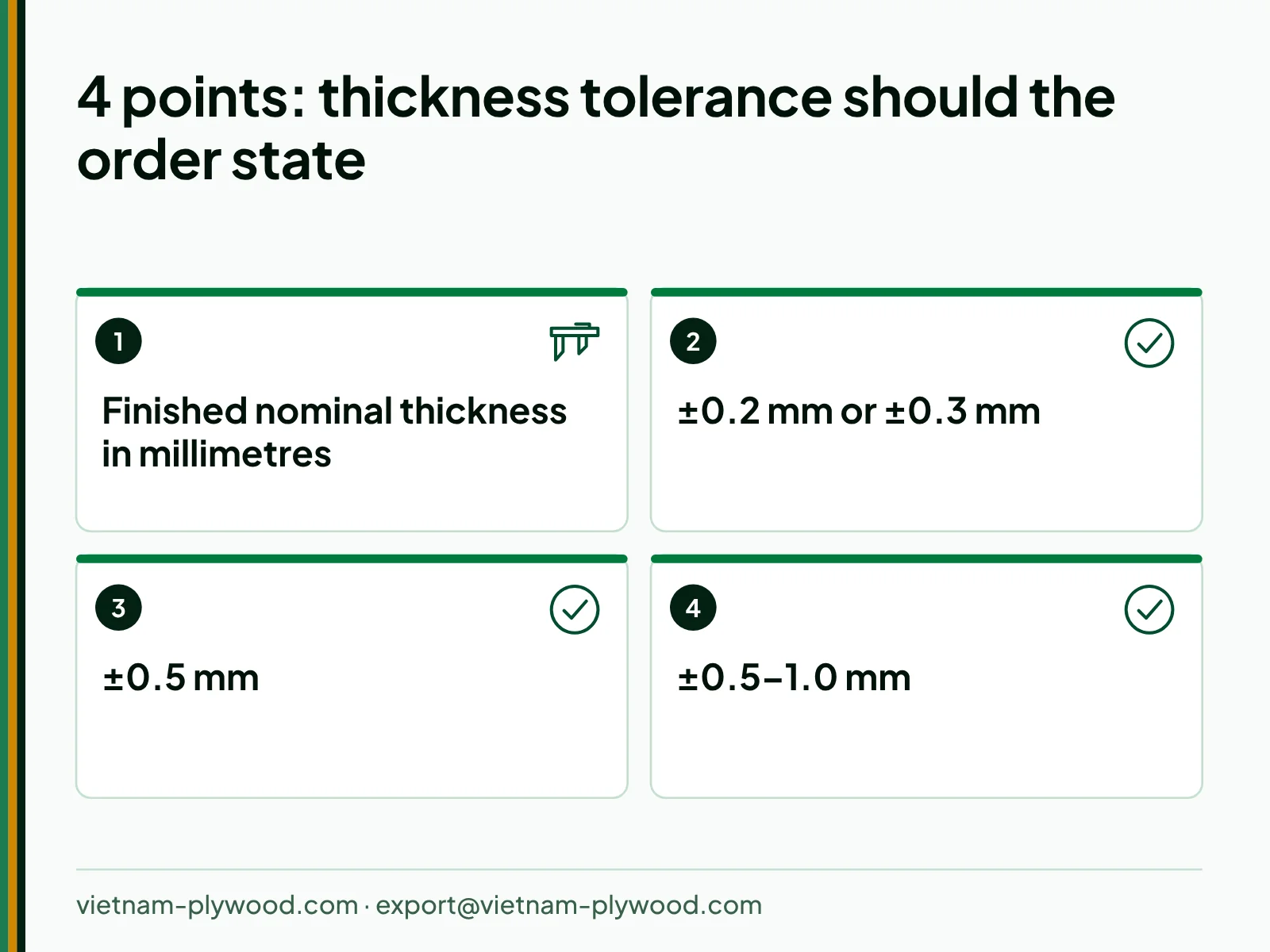
A 12 mm furniture order at ±0.2 mm defines an acceptance interval of 11.8–12.2 mm. A 12 mm commercial order at ±0.5 mm defines 11.5–12.5 mm. Neither interval should be casually relabelled as a 12.7 mm finished panel.
Length and width tolerance is ±2 mm. Include the measurement method, inspection location and acceptance record in the agreed inspection plan. A buyer or inspector can witness thickness readings on finished panels at the producing factory, record the readings against the order and inspect the edges for core gaps. For the difference between core layups, see how many plies plywood has.
Why do we quote and inspect US half-inch orders in mm?
Millimetres make the finished target, tolerance and measurement record explicit. “1/2” alone does not say whether the buyer wants 12.7 mm exact, a 12 mm metric product or a 15/32 inch nominal-market equivalent.
First, HCPLY translates the US request into a written metric thickness and sheet size. Next, the producing factory builds to the chosen line specification. Finally, on-site quality control checks finished panels against that same metric requirement before loading.
This approach avoids a purchasing disagreement in which both sides believe they ordered “half inch” but inspect against different numbers. State the intended use before choosing the tolerance; a furniture joint, a crate wall and a form face have different fit concerns.
How much does a 12 mm sheet weigh and load?
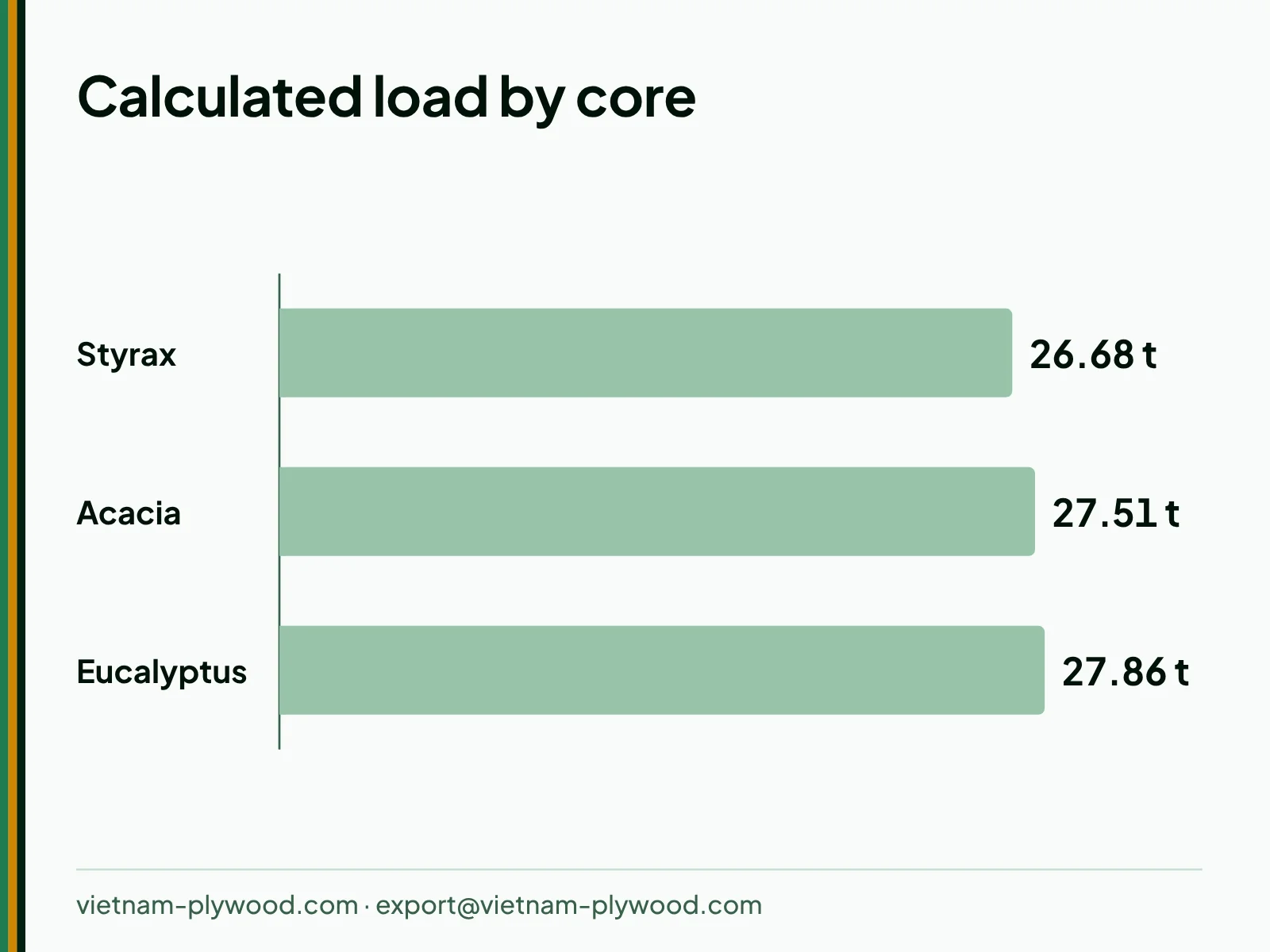
At 1220 × 2440 × 12 mm, the core-based sheet weights are 17.86 kg styrax, 20.72 kg acacia and 23.22 kg eucalyptus. These are core-density calculations; surface film weight is excluded.
| Core | Density | Sheets per pallet | Full 40HC sheets | Calculated load |
|---|---|---|---|---|
| Styrax | 500 kg/m³ | 83 | 1,494 | 26.68 t |
| Acacia | 580 kg/m³ | 83 | 1,328 | 27.51 t |
| Eucalyptus | 650 kg/m³ | 80 | 1,200 | 27.86 t |
The 40HC payload ceiling is 28.5 t. Specifications can be mixed within that payload limit; for example, a cabinet-panel allocation and a packing-panel allocation can travel together after their pallet quantities and combined weights are checked. The container-loading guide owns the full loading calculation and container-sheet-count question.
Which glue, emission and face details matter?
Choose the glue system separately from the emission class. Our commercial and packing line uses MR glue; melamine MR is described by a 12-hour boil condition. Phenolic weather-and-boil-proof (WBP) glue uses a 72-hour boil condition. These describe bonding systems, not an emission grade.
Furniture orders can specify E0 or E1 emission class. E2 is another emission classification; CARB Phase 2 and TSCA Title VI refer to US limits involving third-party certification. Request the agreed emission documentation for the exact factory and build. Member-factory certificates, including FSC, CARB P2, ISO 9001 and CE, are shown with factory details masked, on request.
Veneer faces can include pine, poplar, eucalyptus, birch, okoume, bintangor, engineered veneer, gurjan or sapele; common face veneer is 0.2–0.4 mm. Face grade A/B is available except birch, which uses D/E/F descriptions. Film-faced products use 120 g/m² standard film, 135 g/m² premium film or 220 g/m² anti-slip film. Specify the face and core separately.
How should a US importer request the quote and documents?
Request a 12 mm finished target, the line-specific tolerance, core, face, glue, emission class and destination port. Add whether the product is for cabinet components, packaging or formwork so the production and inspection brief matches its use.
Commercial plywood starts from US$250/m³ FOB Hai Phong (October 2026); furniture plywood starts from US$350/m³ FOB Hai Phong (October 2026). These starting points do not replace a build-specific quotation. For 12 mm panels, core construction and face quality are major cost drivers: full-stitched sanded furniture construction costs more than simpler loose-laid packing construction because of veneer preparation, core assembly and finishing. Film, glue and inspection requirements also affect the formwork quote.
Minimum order is one 40HC. Factory lead time runs 15–45 days from receipt of the 30% deposit; the exact figure depends on order size, line loading and what the contract fixes. The balance is 70% against the scanned bill of lading, by telegraphic transfer or irrevocable letter of credit at sight. Delivery terms are FOB Hai Phong, cost and freight (CFR/CNF), or cost, insurance and freight (CIF). Free samples are available; new buyers book their own courier, and its cost can be credited against a real order. See production lead time.
The shipment file includes a commercial invoice, packing list, bill of lading, certificate of origin, phytosanitary and fumigation papers, applicable order certificates and test reports, and insurance for CIF. After loading, the draft shipping documents come to you for approval. Ask Lucy at export@vietnam-plywood.com to align the written thickness requirement with the invoice and packing list.
What should the inspector check before shipment?
The inspector should check the 12 mm nominal thickness and its written tolerance on finished panels, then compare the actual surface, edge and dimensions with the agreed build. Inspect the producing factory where the order is pressed and packed.
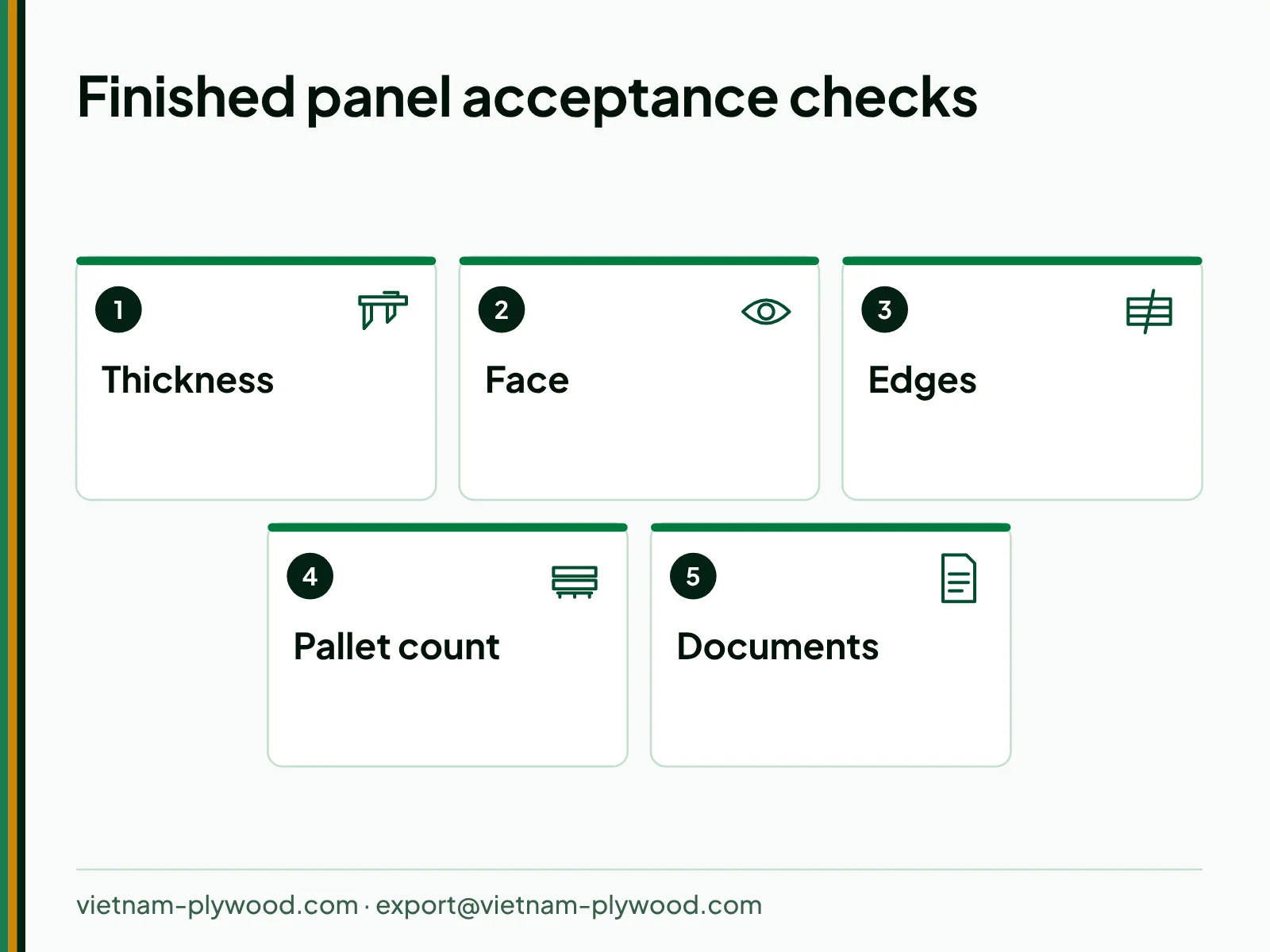
- Match the purchase specification to the factory work order: core, face, glue, emission and target dimensions.
- Measure finished thickness at the agreed locations and record readings against the line-specific tolerance.
- Examine face grade, sanding or film condition, and visible edge construction against the accepted sample.
- Check the marked pallet quantities, packing list and planned shipment weight before loading.
- Review the draft shipping paperwork when issued after loading.
HCPLY manages the export process from specification and on-site QC through documents and loading. Buyers can visit the factory office and inspect the goods at the producing factory. Use the following request to start a precise discussion.
Application: cabinet parts / packing / concrete forms
Line and core: furniture–styrax / commercial–acacia / construction–eucalyptus
Glue: MR melamine / WBP phenolic (choose one)
Emission: E0 / E1 / agreed US documentation
Face and grade: species, A/B (birch D/E/F) / specified film
Finished thickness and tolerance: 12 mm ± [agreed line tolerance]
Sheet size: 1220 × 2440 mm / other agreed metric dimensions
Quantity: [sheets and pallets; minimum one 40HC]
Destination port: [US port]
Next step: book a factory visit to witness the 12 mm inspection with Lucy.