





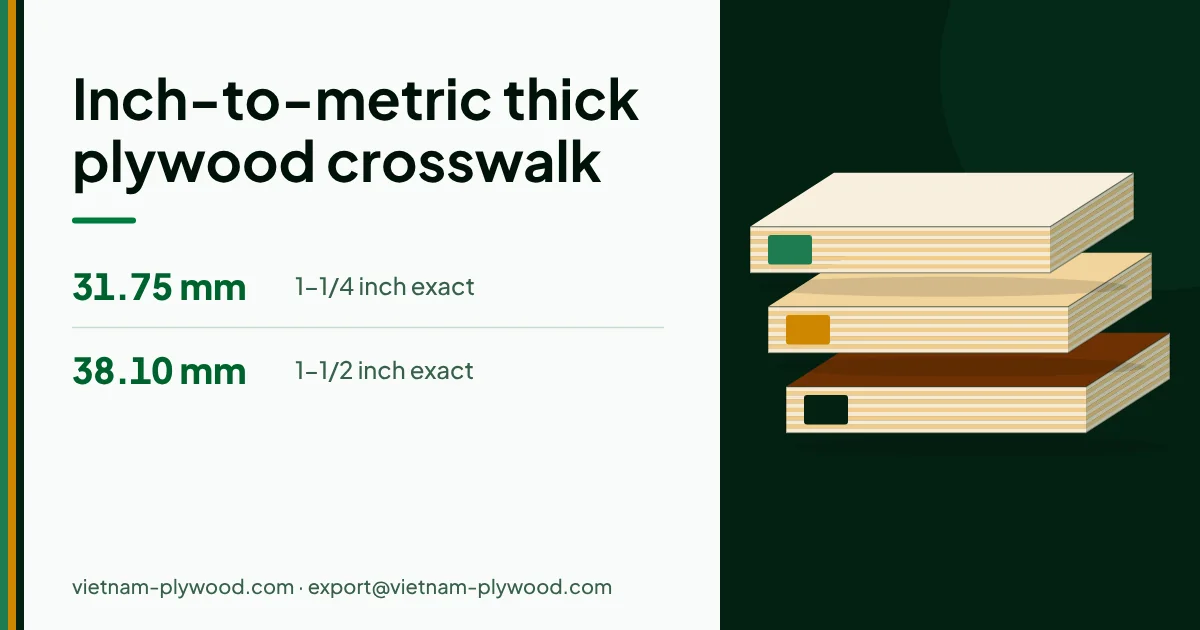
HCPLY can build 1-1/4 plywood as a metric 31.75 mm target or an approved 32 mm nominal panel, and 1-1/2 inch plywood as 38.10 mm or an approved 38 mm nominal panel. An unapproved substitution can make cabinet components miss their fit and lead to rejected loads or costly rework. The purchase order must identify the controlling metric dimension.
Which metric thickness answers a 1-1/4 plywood order?
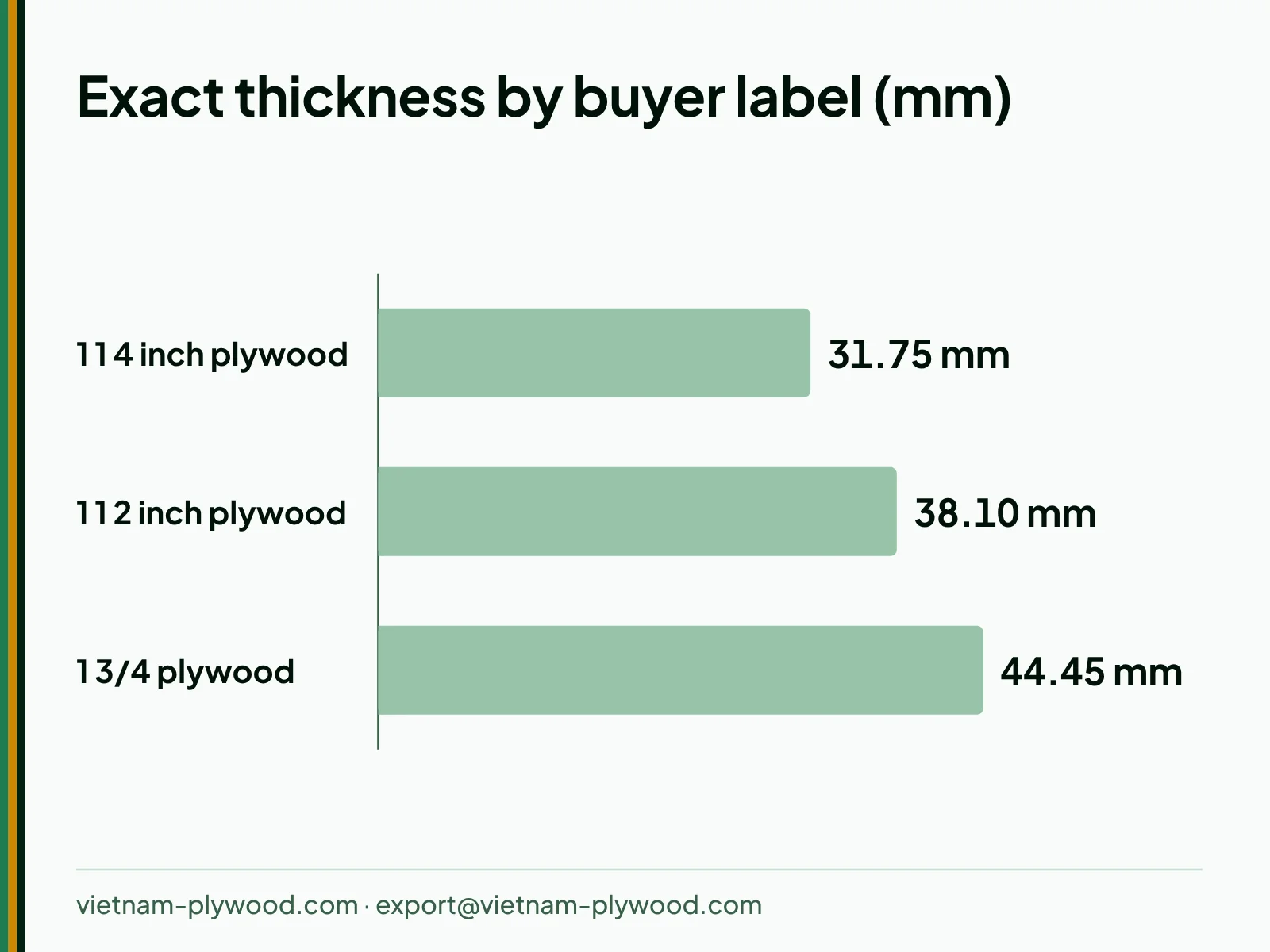
1-1/4 inch equals exactly 31.75 mm. For a metric production order, write 31.75 mm if the design requires the exact conversion. A 32 mm nominal panel is a practical alternative only when the buyer approves its finished-thickness range. At 32 mm, the nominal difference is +0.25 mm before the specified manufacturing tolerance is applied.
The US National Institute of Standards and Technology (NIST) explains in its SI Units – Length reference that the 1959 international-inch definition makes one inch exactly 25.4 mm. That conversion, rather than a rounded catalog label, controls the calculations here: NIST length reference.
For a 32 mm furniture panel ordered at ±0.2 mm, the acceptance band is 31.8–32.2 mm. That band does not include the exact 31.75 mm target. At ±0.3 mm, the band is 31.7–32.3 mm, which does include it, but acceptance still follows the ordered nominal dimension. See the broader plywood size and thickness specification guide for the distinction between a nominal label and an inspection dimension.
Which metric thickness answers a 1-1/2 inch plywood order?
1-1/2 inch equals exactly 38.10 mm. A buyer can write 38.10 mm as the nominal finished thickness or approve a 38 mm metric nominal thickness. The latter is 0.10 mm below the exact conversion before tolerance. The order should not interchange these numbers silently.
For 38 mm sanded furniture plywood at ±0.2 mm, the permitted interval is 37.8–38.2 mm. For 38.10 mm at the same tolerance, it is 37.90–38.30 mm. Both intervals overlap, yet they have different acceptance endpoints.
Distributors sometimes receive inquiries written as plywood 1 1 2, 1 1 2 plywood or 1-1/2 thick plywood. These labels all need a single controlling metric specification before manufacturing. They should not be interpreted as permission to supply any panel near 38 mm.
How do 1-1/4, 1-1/2 and other thick inch labels compare?
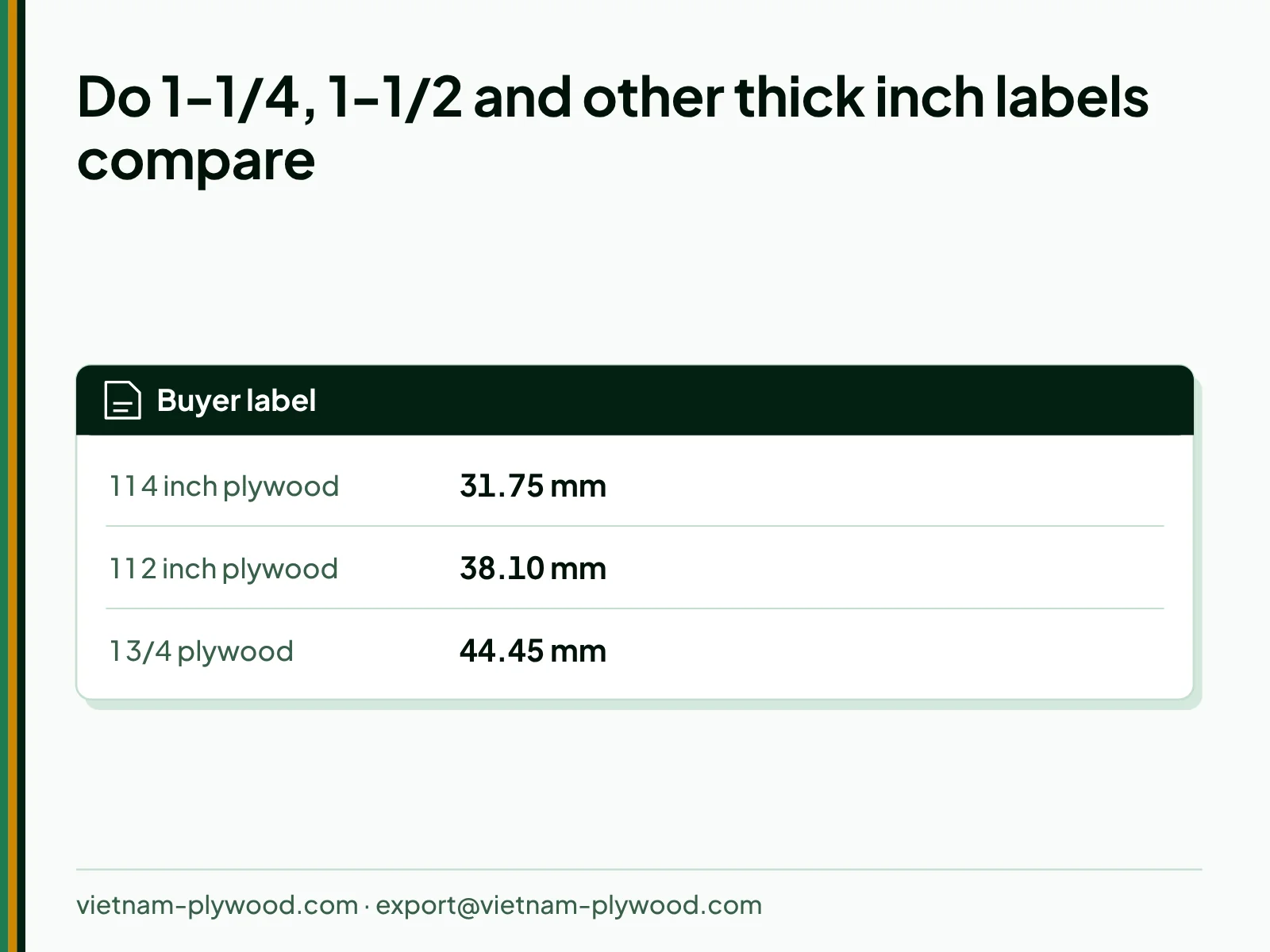
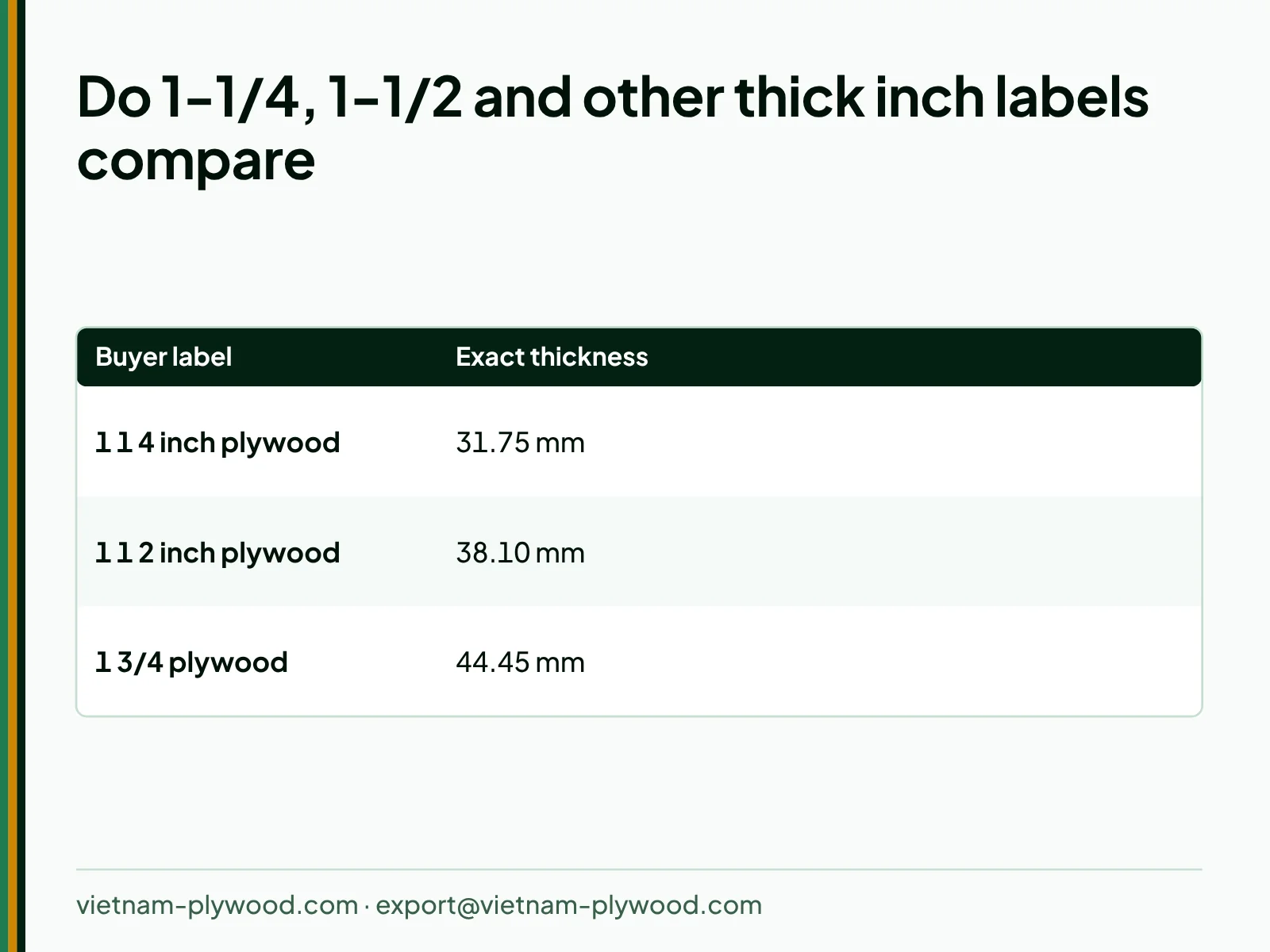
The conversion table separates exact arithmetic from proposed nominal metric choices. The proposed choice is a quotation and drawing decision, rather than an automatic interchangeability rule.
| Buyer label | Exact thickness | Possible metric order target | Difference from exact inch label | Buying decision |
|---|---|---|---|---|
| 1 1 4 inch plywood | 31.75 mm | 32 mm | +0.25 mm | Approve 32 mm only against fit and tolerance |
| 1 1 2 inch plywood | 38.10 mm | 38 mm | −0.10 mm | Approve 38 mm only against fit and tolerance |
| 1 3/4 plywood | 44.45 mm | None within our 3–40 mm range | — | Redesign or select another material specification |
For a thinner comparison, see 20 mm plywood and 12 mm plywood.
Can a metric factory press these extra-thick panels?
Yes. HCPLY’s panel thickness range is 3–40 mm, so both 31.75 mm and 38.10 mm fall inside that range. Our furniture line is the first specification route for sanded cabinet and fit-out panels.
Extra-thick plywood is built from multiple veneer layers. Core veneer thickness is 1.4–2.0 mm, so the actual ply schedule must be established for the chosen finished thickness rather than inferred from an inch label. For context, an 18 mm panel uses 11–13 plies; that figure should not be projected into a fixed ply count for 32 or 38 mm panels.
Our furniture plywood page covers the furniture application family. A buyer should specify cabinet fit, surface finishing, drilling and edge exposure before selecting a core construction.
Which of our lines should make the order?
The furniture line suits a sanded, full-stitched build with a specified decorative face. The other lines answer different purchasing needs, even at the same nominal thickness. The table keeps the application and tolerance tied to the production route.
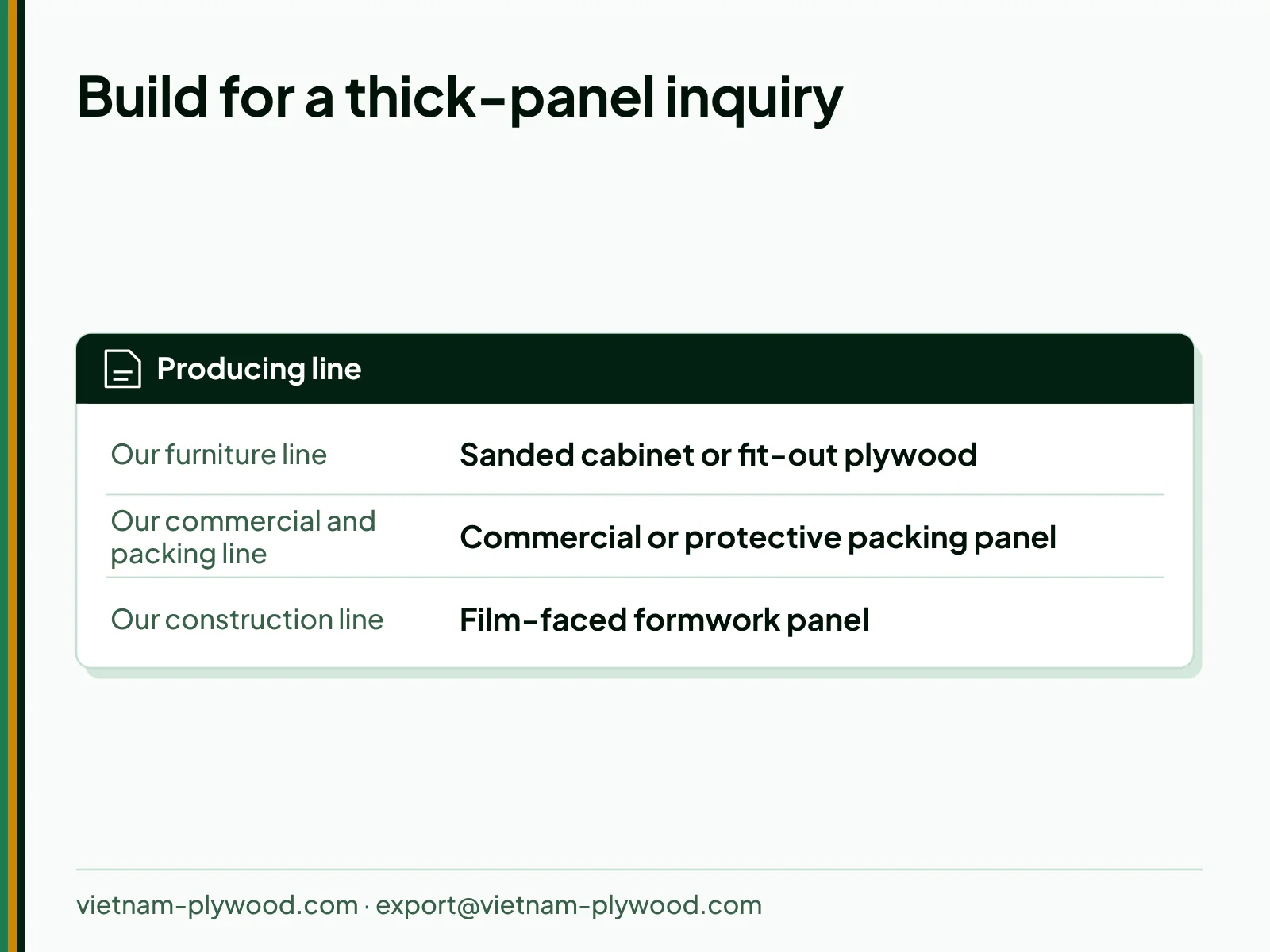
| Producing line | Build for a thick-panel inquiry | Core and surface | Finished-thickness tolerance | Verdict by use |
|---|---|---|---|---|
| Our furniture line | Sanded cabinet or fit-out plywood | Styrax or eucalyptus core; selected veneer face | ±0.2 or ±0.3 mm as ordered | First choice for fitted furniture |
| Our commercial and packing line | Commercial or protective packing panel | Acacia core; unsanded or light-sanded | Commercial ±0.5 mm; packing ±0.5–1.0 mm | Choose for packing or commercial use |
| Our construction line | Film-faced formwork panel | Acacia or eucalyptus core; film surface, unsanded | ±0.5 mm | Choose for concrete formwork |
A construction buyer needing film-faced panels should start with the construction-project plywood supply requirements. A furniture buyer should not assume that film-faced thickness tolerances or unsanded packing surfaces will satisfy a fitted cabinet drawing. HCPLY routes each approved order to the factory suited to its specification.
What tolerance belongs on the purchase order?
For sanded furniture plywood, write ±0.2 mm or ±0.3 mm, selecting one tolerance on the order line. For commercial or film-faced panels, write ±0.5 mm; packing plywood uses ±0.5–1.0 mm.
For example, “32.0 mm ±0.2 mm, finished sanded thickness” has a different acceptance band from “31.75 mm ±0.2 mm.” A buyer whose machine setup assumes exactly 31.75 mm must decide whether the first interval is acceptable.
Length and width have a ±2 mm tolerance. State a listed sheet size such as 1220 × 2440 mm, or request custom cutting with the drawing attached.
What core, face and glue should the buyer specify?
For fitted furniture, the starting build is a full-stitched styrax or eucalyptus core, sanded to the agreed thickness. Core species controls panel density: styrax is 500 kg/m³ and eucalyptus is 650 kg/m³. A face veneer name describes the visible surface, rather than the material throughout the core.
Specify the visible face separately: bintangor, okoume, engineered veneer (EV), gurjan, pine, poplar, eucalyptus, birch or sapele. A/B face grades apply except that birch faces use D/E/F grades. Common face veneer thickness is 0.2–0.4 mm.
Bonding and formaldehyde emission are separate order fields. Melamine glue is moisture resistant (MR) with a 12-hour boil specification; phenolic glue is weather and boil proof (WBP) with a 72-hour boil specification. E0 and E1 are emission classes for the furniture line. Where a US compliance requirement applies, CARB Phase 2 / TSCA Title VI is a third-party-certified US limit, rather than another glue name.
What can the buyer witness at the producing factory?
The buyer or appointed inspector can check a labelled sample against the approved metric nominal thickness and tolerance. Record measurement positions on the panel, the instrument used and the actual readings. For a tight furniture fit, include a measurement near an edge and at an interior position, then compare every recorded value with the same acceptance interval.
A full-stitched core is a different build from stitched outer layers with edge-trimmed inner layers, finger-jointed veneers or loose-laid veneers.
Buyers visit the factory office and inspect goods at the producing factory. Lucy coordinates the export specification and on-site quality control.
How should a US importer plan a trial container?
The minimum order is one 40HC container, with specifications mixed within its 28.5 t payload limit. A thick-panel order requires its own packing calculation because the published lookup covers selected thinner thicknesses, not 31.75, 32, 38 or 38.10 mm. For the loading method and established thickness examples, use the container-load guide.
The reference densities are 500 kg/m³ for styrax, 580 kg/m³ for acacia and 650 kg/m³ for eucalyptus. Do not use a face veneer name to calculate the weight of a core.
We can quote FOB Hai Phong, CFR (CNF) or CIF. Factory lead time runs 15–45 days from receipt of the 30% deposit; the exact figure depends on order size, line loading and what the contract fixes; the 70% balance is against the scanned bill of lading, by T/T or irrevocable letter of credit at sight. See production lead time when arranging the receiving schedule.
Which documents should carry the agreed thickness?
The commercial invoice and packing list identify the shipment and ordered goods; the agreed purchase specification and inspection record establish the dimensional acceptance criteria. The export document set also includes the bill of lading, certificate of origin and applicable phytosanitary and fumigation papers. After loading, the draft shipping documents come to you for approval.
Order-specific certificate documents can include an emission certificate or test report for the agreed build. Member-factory FSC, CARB P2, ISO 9001 and CE documents are shown with factory details masked, on request.
An invoice that says “1-1/2 inch” while the order says “38.10 mm ±0.2 mm” creates avoidable ambiguity at receiving inspection. Keep the inch label as a reference and the metric value as the acceptance dimension.
How should a US buyer write the order line?
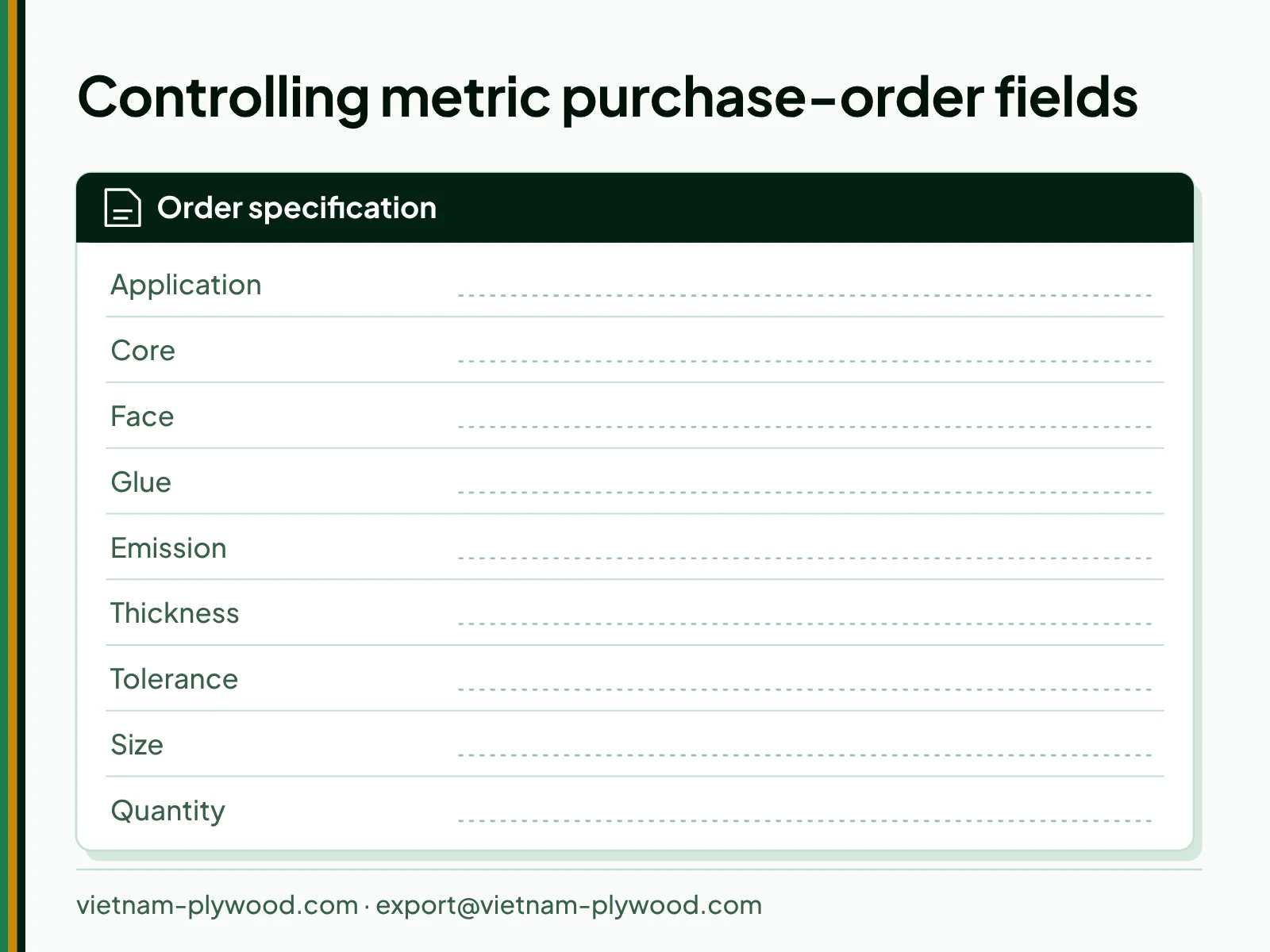
Put the application first, followed by the producing line, core, face, bonding, emission class, finished metric thickness, tolerance, sheet size and quantity. Include the inch name in parentheses as a buying reference. Use the same dimensional wording on the approved sample and inspection checklist.
For example, 32.0 mm ±0.2 mm is a valid written target for a buyer who has approved that interval for a 1-1/4 inch inquiry. Neither instruction should be silently substituted for the other. State the destination port and the intended surface finishing process in the request to contact Lucy.
Select the version that matches the drawing and send it with the required quantities.
Application: Cabinet and commercial fit-out components
Producing line/core: Furniture line / full-stitched styrax core
Glue: Melamine (MR)
Emission: E1
Face and grade: Bintangor A/B
Finished thickness and tolerance: 32.0 mm ±0.2 mm (1-1/4 inch reference)
Alternative only if approved: 38.10 mm ±0.2 mm (1-1/2 inch reference)
Sheet size: 1220 × 2440 mm; length/width ±2 mm
Quantity: One 40HC trial container; final specification mix on packing plan
Destination port: [buyer to insert US port]
Plan a trial container with Lucy at export@vietnam-plywood.com, using the approved metric target and tolerance as the basis for the quotation.