





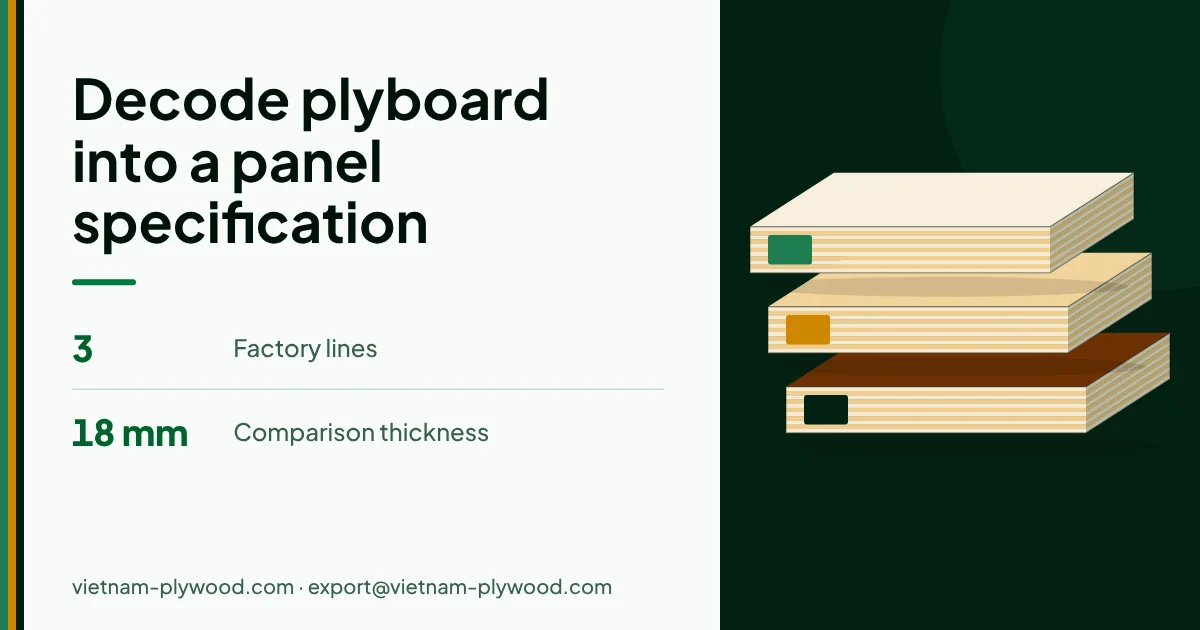
Plyboard in a quote should become a defined plywood specification before production. Choosing the wrong core or glue can waste money, delay fabrication or lead to a rejected load. At HCPLY, we translate the plyboard vs plywood enquiry into measurable construction, face and adhesive requirements for the intended application.
Is plyboard vs plywood a material difference?
Plyboard vs plywood is often a naming difference in a purchase enquiry, but it can also mean a different panel construction. Some sellers use plyboard as another name for plywood; others mean strip-core blockboard. An importer should identify the cross-section before comparing quotations, because the same label can conceal different cores, adhesives and tolerances.
A plywood edge shows stacked veneer layers, usually with alternating grain directions. A strip-core board shows wider solid-wood strips beneath its outer faces. HCPLY presses veneer-core plywood; we do not press blockboard. Ask for an edge photograph and a written core description before accepting either term.
For the broader taxonomy of panel materials, see wood board types for importers.
What does plyboard mean on a supplier quote?
On a quote, plyboard is an incomplete product description. The buyer needs a named construction, intended application, adhesive, face, thickness and dimensional tolerance. A line reading “18 mm hardwood plyboard” does not identify whether hardwood describes the face or the core.
Our plywood is named by its face veneer. A birch-faced sheet can therefore contain styrax or eucalyptus core; birch face alone does not establish core density. For cabinet production, ask for face grade, sanding and emission class. For distribution, distinguish commercial veneer-core panels from furniture-grade panels before comparing unit prices.
The trade term “ply boards” sometimes also covers particleboard or fibreboard in informal catalogues. These are different constructions; compare chipboard and plywood and HDF plywood versus MDF panels when the quote names fibres or particles.
Which plyboard types fit each buying use?
Plyboard types should be classified by construction and service conditions rather than by a seller’s short label. The following comparison separates common trade descriptions from the build a purchaser can actually inspect.
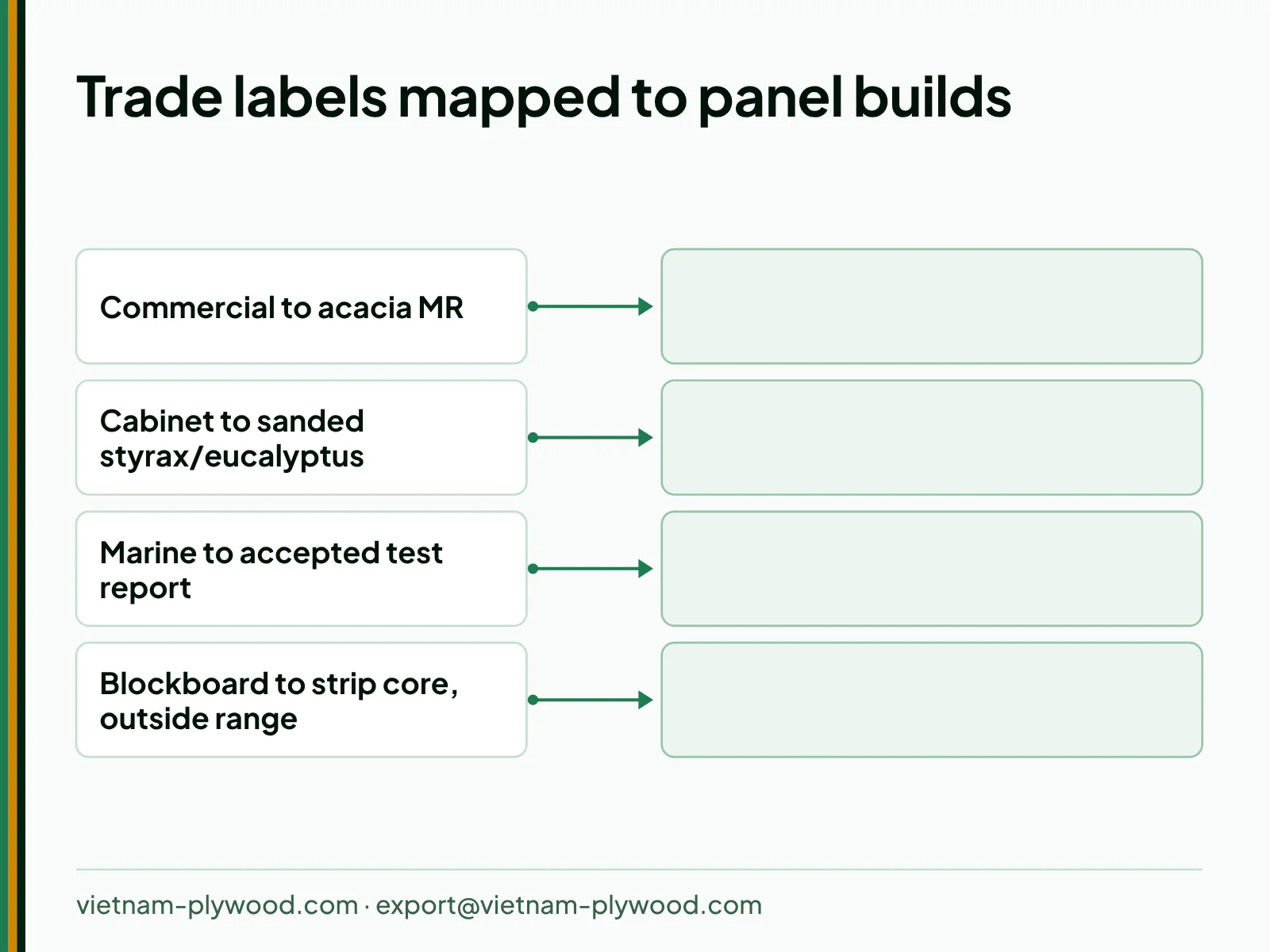
| Trade description | Core metric | Glue / face metric | Typical buying use | Verdict by use |
|---|---|---|---|---|
| Commercial plyboard sheets | Acacia veneer core, 580 kg/m³ | MR glue; unsanded or light-sanded | Dry interior backing and packing | Select when surface finish is secondary |
| Cabinet-grade plyboard | Styrax 500 or eucalyptus 650 kg/m³ veneer core | Full-stitched, sanded; E0/E1 | Cabinet carcasses and visible furniture components | Select for controlled faces and machining |
| BWP or weather-resistant plyboard | Specify veneer core explicitly | Phenolic WBP adhesive, 72-hour boil designation | Wet-service designs requiring an agreed test | Select against the project’s exposure specification |
| Marine plywood | Specify core, bond and accepted test report | “Marine” only against a buyer-accepted report | Marine-related procurement | Do not buy by name alone |
| Strip-core plyboard / blockboard | Solid-wood strips, rather than veneer plies | Depends on manufacturer | Long panels where strip-core construction is requested | Source separately; HCPLY does not press it |
| Film-faced construction board | Acacia or eucalyptus veneer core | Phenolic or melamine film | Concrete formwork | Select for formwork, not cabinet appearance |
The table compares specified constructions, not universal strength rankings. A panel’s bending capacity and suitability for a structural floor require the applicable design data and accepted test evidence.
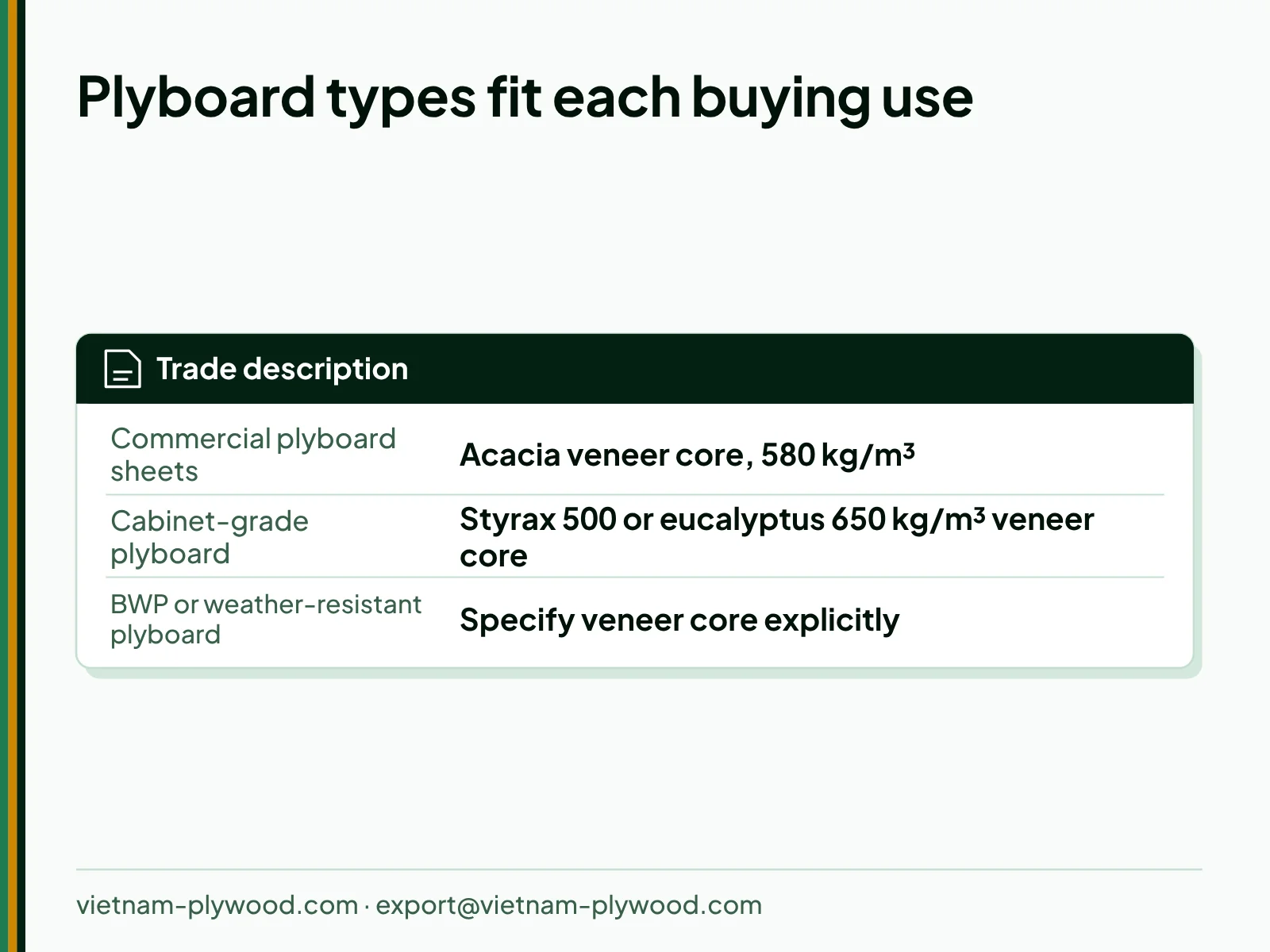
Which of our lines would press the requested build?
Our furniture line presses full-stitched, sanded styrax- or eucalyptus-core plywood for cabinet and furniture orders. Our commercial and packing line presses acacia-core MR plywood with unsanded or light-sanded faces. Our construction line presses film-faced panels with acacia or eucalyptus cores for formwork.
For the same nominal 18 mm thickness, the factory selection changes the face finish, core and dimensional tolerance. Furniture panels are ordered at ±0.2 or ±0.3 mm thickness tolerance; commercial and film-faced panels use ±0.5 mm, while packing panels use ±0.5–1.0 mm. Length and width tolerance is ±2 mm.
The three builds can be compared further in plywood grades across factory lines. Each order is produced and inspected at the producing factory.
How do I turn a plyboard enquiry into a build specification?
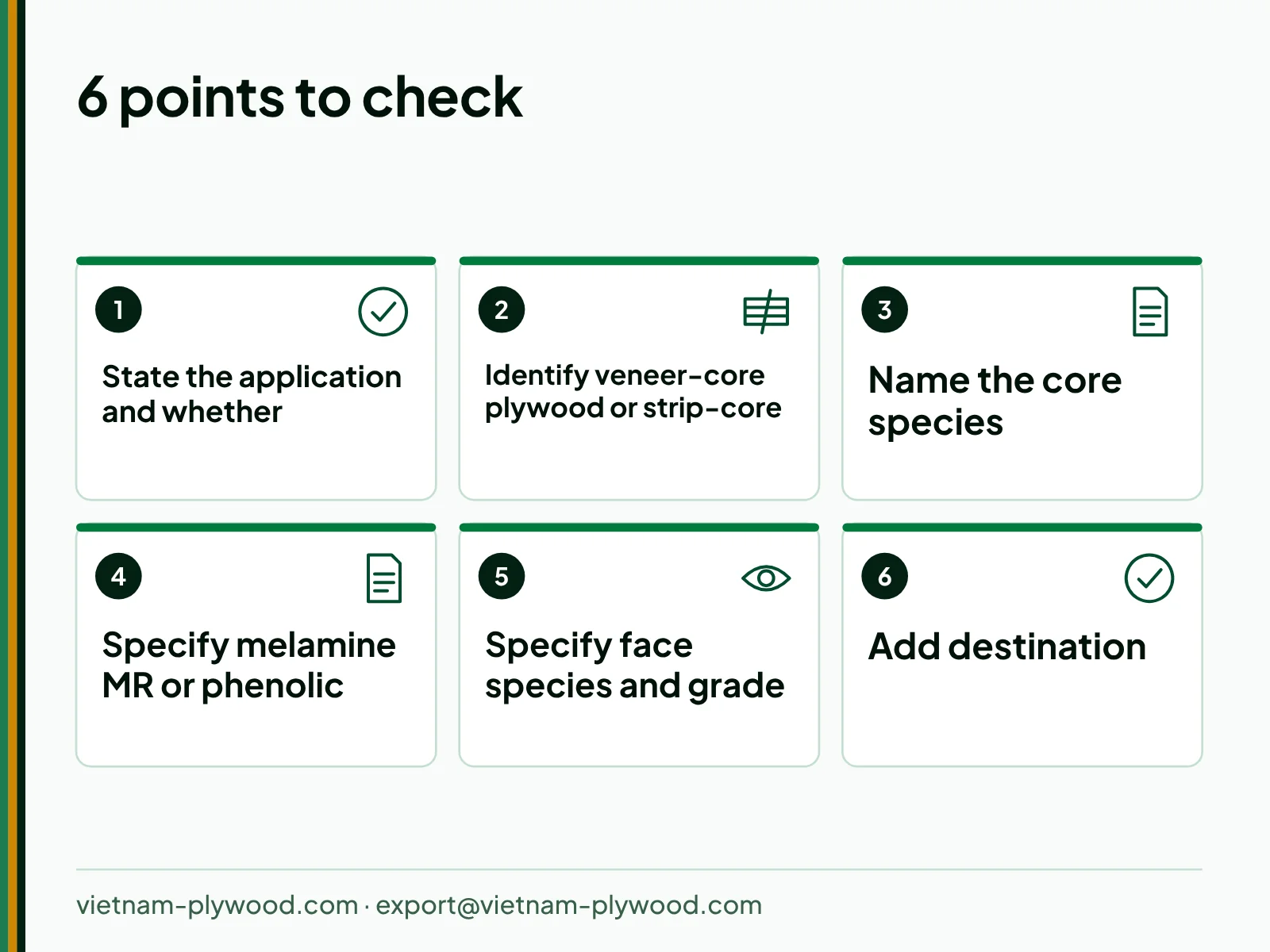
Turn a plyboard enquiry into a purchase specification by replacing the trade label with measurable fields. This prevents a cabinet buyer from receiving packing-grade material or a moisture-exposed component from being ordered with the wrong bond.
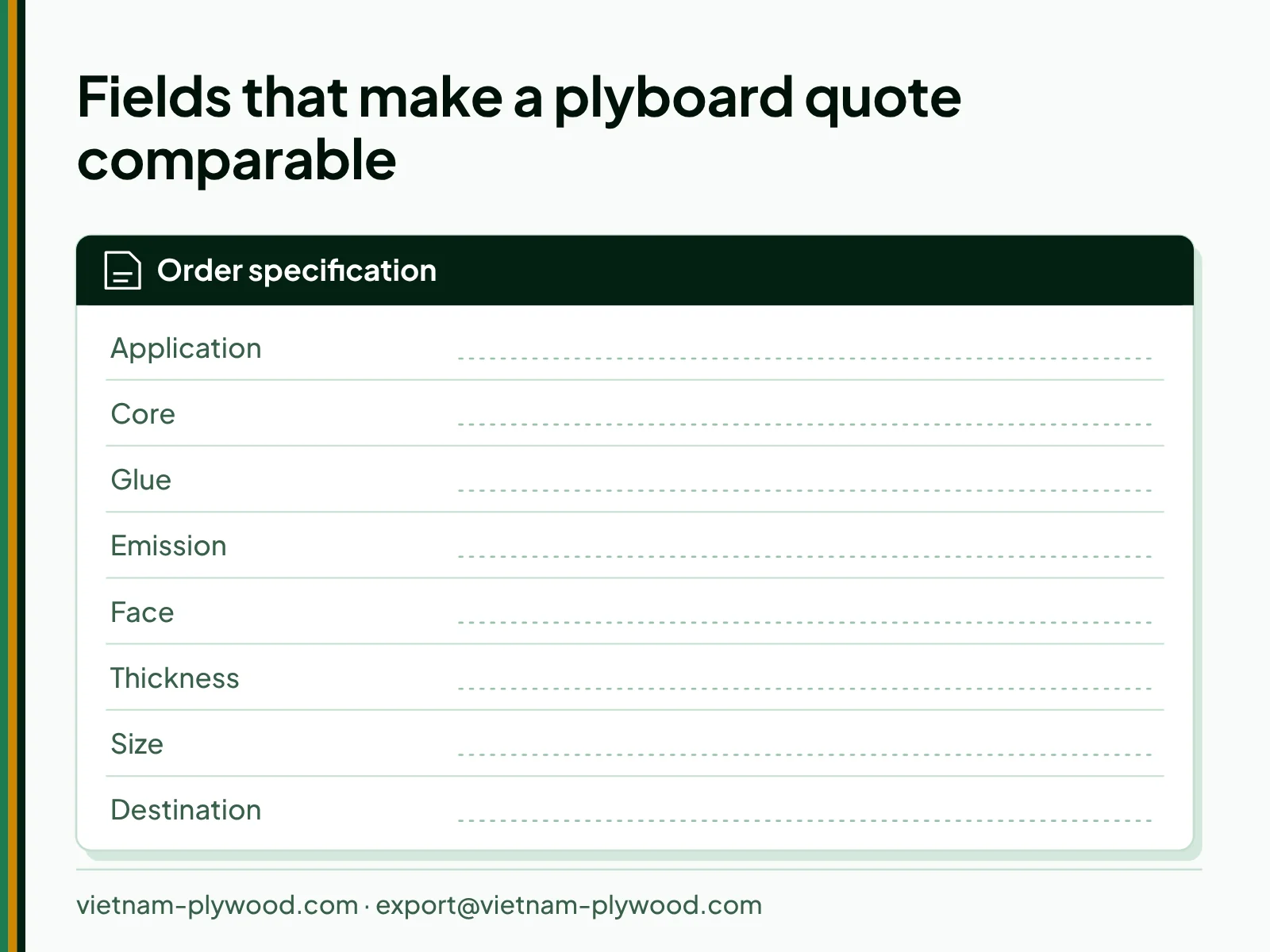
- State the application and whether the panel is decorative, concealed, packing or formwork material.
- Identify veneer-core plywood or strip-core blockboard from a cut-edge view.
- Name the core species: styrax, eucalyptus or acacia for our lines.
- Specify melamine MR or phenolic WBP adhesive separately from E0, E1 or E2 emission class.
- Specify face species and grade, sanding, thickness tolerance and sheet dimensions.
- Add destination, quantity and any test or certificate documents required by the importing market.
Our common sheet sizes include 1220 × 2440 and 1250 × 2500 mm; thicknesses run from 3 to 40 mm. An 18 mm veneer-core sheet has 11–13 plies, depending on veneer thickness. If the finish is decorative, furniture plywood provides the relevant product context.
What should a cabinet maker specify?
A cabinet maker should specify a full-stitched, sanded furniture build with the required face and emission class. For example, a styrax-core panel can carry bintangor, okoume, engineered veneer or another listed face, with A/B face grading where applicable. Birch faces use D/E/F grading instead.
A face veneer commonly measures 0.2–0.4 mm. The visible veneer species does not change the core-density designation. For doors and cabinet components, define face appearance, machining requirements and thickness tolerance in the same enquiry.
Melamine, high-pressure laminate and other laminate faces are separate finishing topics, not products pressed on our lines. See MFC versus melamine plywood for that distinction. HCPLY does not press MDF, OSB or chipboard.
Which plyboard build suits flooring?
Flooring requires a specified load case, support spacing, moisture exposure and accepted performance evidence. A generic plyboard sheet description cannot establish structural suitability. For a decorative, non-structural floor layer, surface finish and thickness control may dominate the selection; for a load-bearing subfloor, the designer must identify the required structural classification and test report.
Our commercial MR build is intended for applications where its stated adhesive and finish are suitable. A wet-service specification should identify the WBP bond requirement and the project acceptance criteria. Neither a phenolic adhesive label nor a dense core alone establishes a structural grade.
For concrete casting rather than occupied-floor panels, review plywood supply for construction projects. Film-faced formwork panels have a different surface and handling requirement.
What separates marine plywood from plyboard?
Marine plywood is a performance designation that needs an accepted test report; plyboard is a trade label that may identify several constructions. A buyer asking for marine plywood vs plyboard should first specify whether the intended panel is veneer-core plywood, then state bond durability, core quality and test criteria.
Phenolic WBP means weather and boil proof in the stated glue designation, with a 72-hour boil condition; melamine MR is associated with a 12-hour boil condition. Those adhesive descriptions alone do not establish marine classification or service life. HCPLY discusses marine or BS 1088 builds only against a test report the buyer accepts.
For exterior installations, also specify edge sealing, surface protection and inspection requirements. A quoted “waterproof plyboard” without these fields cannot be compared consistently.
How should buyers check emission documents?
Emission class and adhesive type must appear as separate specification fields. E0, E1 and E2 identify emission classes, while MR and WBP describe glue or bond selection. CARB Phase 2 and TSCA Title VI relate to the US formaldehyde compliance framework and its third-party certification requirements.
The US Environmental Protection Agency’s 2025 Code of Federal Regulations, 40 CFR §770.10, sets a 0.05 parts-per-million formaldehyde emission limit for regulated hardwood plywood with veneer or composite cores. See the 2025 federal regulation for its scope and exceptions.
Relevant member-factory certificates, including FSC, CARB P2, ISO 9001 and CE, are shown with factory details masked, on request. Request the document matching the actual producing factory and the ordered build.
How do core choice and loading affect an order?
Core density changes sheet weight and the number of sheets in a full 40HC. For 18 mm sheets measuring 1220 × 2440 mm, styrax weighs 26.79 kg per sheet and fits 990 sheets; acacia weighs 31.08 kg and fits 880; eucalyptus weighs 34.83 kg and fits 795. These calculated loads exclude film weight.
The corresponding full-load weights are 26.52 t, 27.35 t and 27.69 t, respectively, against a 28.5 t payload limit. Specifications can be mixed within a container while staying inside that limit. The container loading guide covers the wider loading question.
The minimum order is one 40HC. This weight difference matters when a buyer combines cabinet and commercial plywood in a shipment.
What can an inspector witness before shipment?
An inspector can compare the order specification with a marked stack, measure sheet thickness and dimensions, inspect face grading and sanding, and examine a cut edge for core construction. At the producing factory, a buyer can also review the agreed test report and the documents assigned to that build.
HCPLY coordinates the specification, on-site quality control, export papers and loading. Buyers visit the factory office and inspect the goods at the producing factory. The shipment document set includes commercial invoice, packing list, bill of lading and certificate of origin, alongside applicable shipment and order certificates; after loading, the draft shipping documents come to you for approval.
The invoice and packing list should identify the actual panel specification and quantities, rather than relying on the word “plyboard” alone.
What should go into the final enquiry?
The final enquiry should identify the exact panel build, application and destination so the quotation is comparable. Commercial plywood starts from US$250/m³ FOB Hai Phong (October 2026); furniture plywood starts from US$350/m³ FOB Hai Phong (October 2026). Core construction, face grade, adhesive, machining finish and ordered volume affect the quotation.
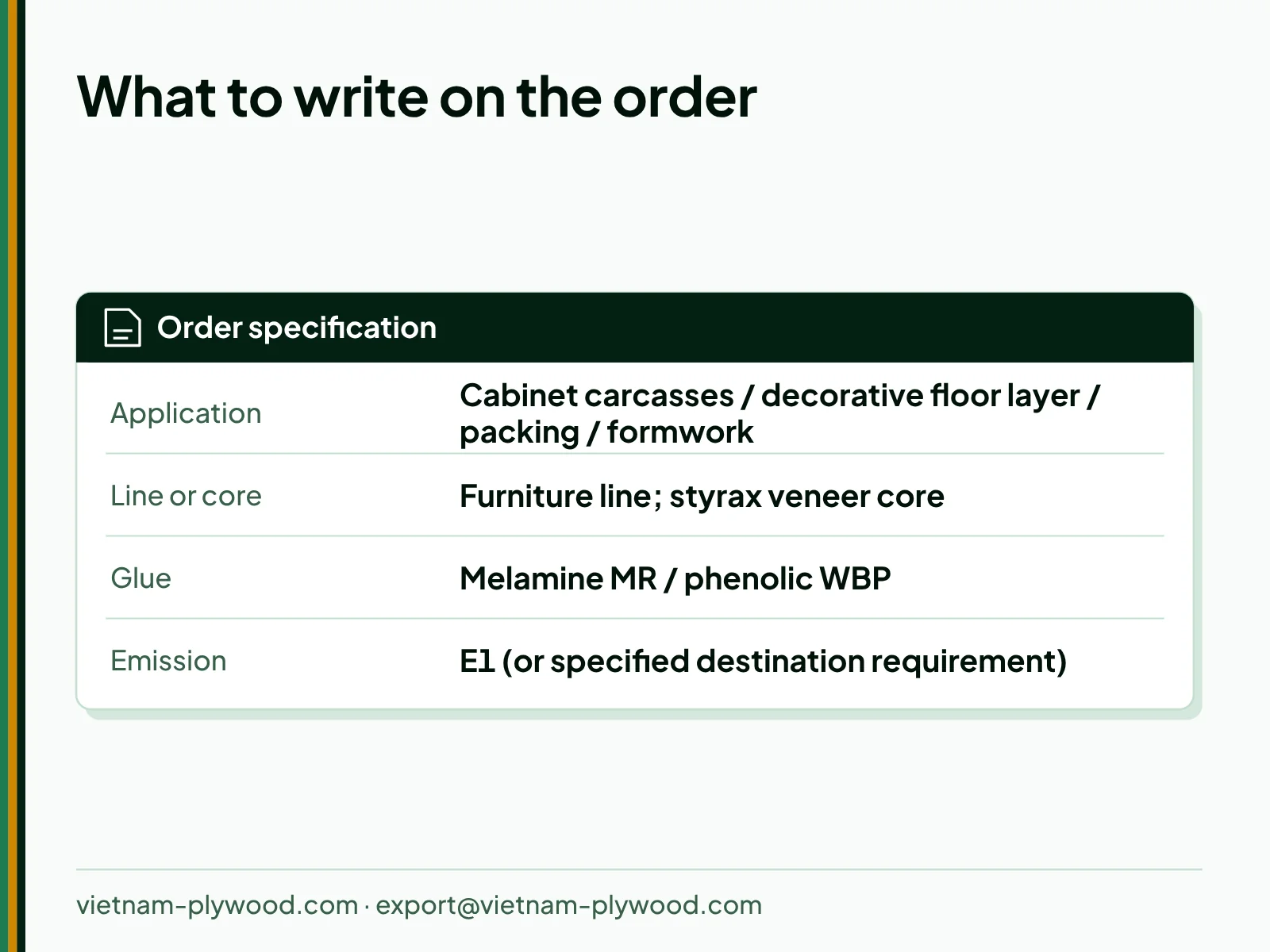
HCPLY can arrange FOB Hai Phong, CFR (CNF) or CIF shipments. Send the written specification to Lucy at export@vietnam-plywood.com or through contact. Use the following format to avoid a trade-name-only quote.
Application: cabinet carcasses / decorative floor layer / packing / formwork
Line or core: furniture line; styrax veneer core
Glue: melamine MR / phenolic WBP
Emission: E1 (or specified destination requirement)
Face and grade: bintangor A/B, sanded
Thickness and tolerance: 18 mm; ±0.2 mm
Sheet size: 1220 × 2440 mm
Quantity: one 40HC; list each specification if mixed
Destination port: [port, country]
Ask Lucy for a sample set matching the selected face, core and glue specification.