





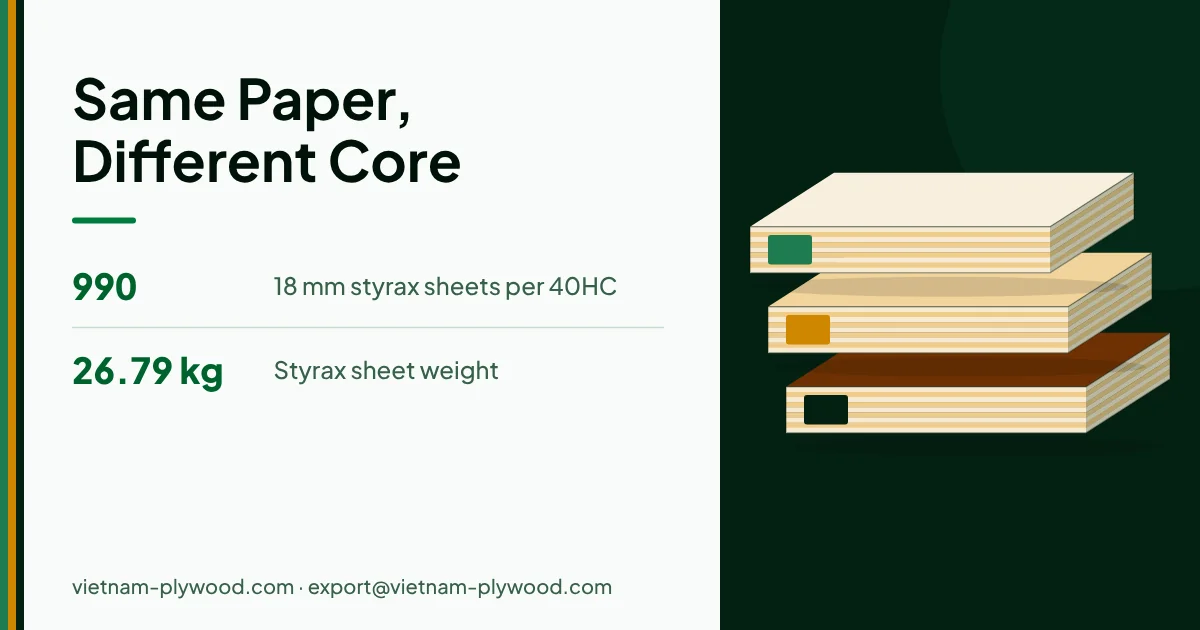
Melamine faced chipboard and a plywood core can carry the same decorative paper, but their edges, fasteners and shipment weights behave differently. Choosing the wrong substrate can mean rejected cabinet parts, extra edging labour or avoidable freight. HCPLY supplies sanded plywood cores for the buyer’s laminator, not finished melamine furniture board. This guide compares the substrate decisions behind melamine faced chipboard vs plywood for commercial cabinet production.
What is melamine faced chipboard?
Melamine faced chipboard (MFC) is particleboard covered with decorative melamine-impregnated paper, commonly pressed into a finished furniture surface. Its wood particles form the substrate; the paper provides the visible colour or woodgrain. The term mfc wood describes this composite board, rather than a solid-wood species. MFC furniture board arrives ready for cutting and edging, whereas a raw plywood core needs a separate facing operation.
MFC is widely specified for wardrobe carcasses, office furniture, retail fixtures and dry-interior cabinets. Woodgrain, solid-colour and textured papers make consistent batches possible. Surface cleaning is straightforward, but damage to a cut edge or a joint can expose the particle substrate. For a broader material taxonomy, see engineered wood types.
What changes when the same paper covers plywood?
The face can look identical while the substrate behaves differently. Melamine-faced plywood uses cross-laminated veneer plies beneath its decorative layer; MFC uses resin-bonded particles. HCPLY supplies matt or calibrated plywood substrates from our furniture line for the buyer’s laminator to face. We do not press chipboard, and we do not sell melamine-faced panels.
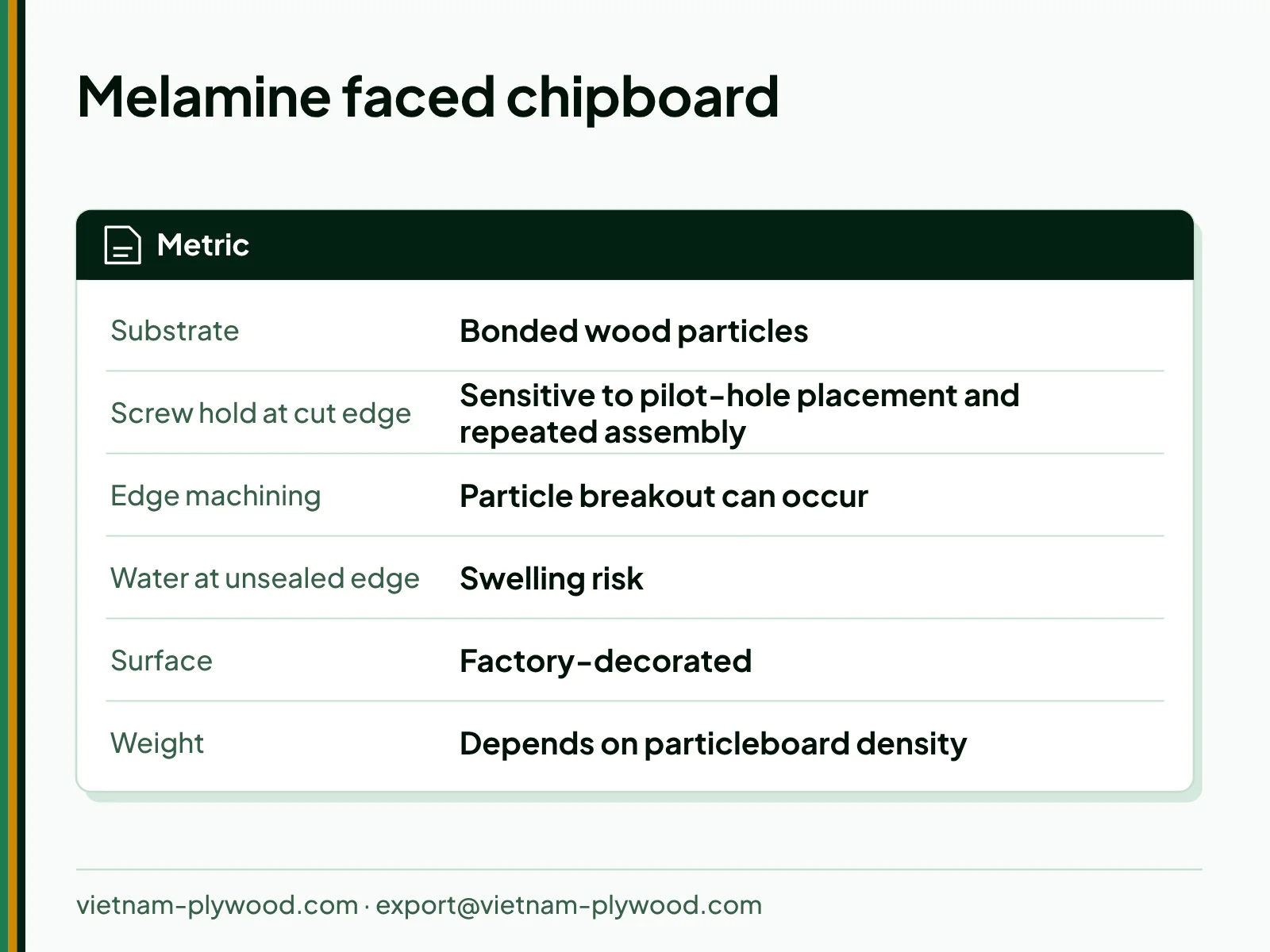
| Metric | Melamine faced chipboard | Plywood core with the same paper | Verdict by use |
|---|---|---|---|
| Substrate | Bonded wood particles | Cross-laid veneer plies | Plywood for repeated edge fastening |
| Screw hold at cut edge | Sensitive to pilot-hole placement and repeated assembly | Continuous veneer structure gives a stronger starting point, subject to joint testing | Plywood for dismantled and reassembled carcasses |
| Edge machining | Particle breakout can occur | Veneer splintering and void exposure can occur | Trial-cut both for exposed edges |
| Water at unsealed edge | Swelling risk | Ply swelling and bond damage remain possible | Seal both; specify exposure conditions |
| Surface | Factory-decorated | Buyer applies matching paper | MFC for a ready-faced purchasing route |
| Weight | Depends on particleboard density | Core-dependent; HCPLY values below | Compare kilograms, not labels |
| Cost | Often lower starting substrate cost | Added veneer preparation and facing expense | MFC for lowest initial dry-interior carcass cost |
This mfc board vs plywood comparison assumes comparable thickness, paper and edge treatment. Decorative surface scratch resistance is governed mainly by the actual paper and pressing specification; a plywood core alone cannot improve it.
Does a plywood core hold screws better than MFC?
A well-made plywood core commonly provides better resistance to repeated screw withdrawal at an edge than particleboard, but fastening geometry and the tested board matter. Cross-grain veneers distribute a screw’s load through layered wood rather than isolated particles. The outcome changes with screw diameter, pilot hole, edge distance, ply quality and moisture history.
For production approval, run the same hinge-plate and connector screws into both candidate boards. Measure initial withdrawal force, repeat after assembly cycles and inspect splitting or crumbling around the holes. Record the fastener type and edge distance alongside the result. Avoid treating a face-grade label as a fastening specification.
Full-stitched furniture cores offer a more continuous edge than loose-laid construction. Our furniture line can prepare sanded cores for that test, while a cabinet maker controls drilling and hardware installation. The chipboard or plywood comparison explores the wider substrate choice.
How do moisture and edge chipping compare?
Both substrates need protected cut edges in damp-service cabinetry. Melamine paper slows surface contact with spills, yet exposed joints and penetrations remain moisture entry points. Particleboard can swell and lose edge integrity; plywood can swell, check or delaminate if its glue and exposure exceed the intended service.
Compare test pieces after the same wetting and drying sequence. Measure thickness change at the edge, photograph the bond line, then inspect the machined corner after drilling and routing. A melamine-faced board is not automatically waterproof because its decorative paper is intact.
For a plywood order, specify the adhesive separately from the emission class. Our furniture line offers sanded styrax or eucalyptus cores with E0 or E1 emission classes; melamine MR glue is described by a 12-hour boil condition, and phenolic WBP by a 72-hour boil condition. These glue descriptors do not replace a finished-assembly moisture test.
Which plywood core keeps carcass cost closest to MFC?
Styrax is the first plywood-core candidate to quote when keeping carcass material cost close to MFC is the priority. Its listed density is 500 kg/m³, against acacia at 580 kg/m³ and eucalyptus at 650 kg/m³. Lower density reduces transport weight, although density alone cannot establish a purchase-price ranking.
For a furniture carcass, compare a styrax full-stitched, sanded core with a eucalyptus furniture core at identical thickness, tolerance and surface preparation. Acacia from our commercial and packing line is a separate MR-glue, unsanded or light-sanded build; lower finishing requirements can change its raw-panel quote, but laminator preparation adds cost. A core with stitched outer layers and edge-trimmed inner plies normally costs less to construct than a full-stitched core, with greater edge-quality trade-offs.
MFC usually wins on an already-faced, basic dry-interior bill of materials. Plywood becomes commercially attractive when screw failures, rework, lighter shipments or a specified laminated finish offset its extra processing. Request matched written quotations covering substrate, calibration, paper pressing, edge banding and rejects. The furniture plywood indicative starting point is from US$350/m³ FOB Hai Phong (October 2026); that is a raw plywood reference, not a price for faced board or MFC.
Which line builds the core for a laminator?
Our furniture line presses the sanded plywood core intended for subsequent decorative facing. The other lines make different panels for different purchasing needs, rather than substitute MFC.
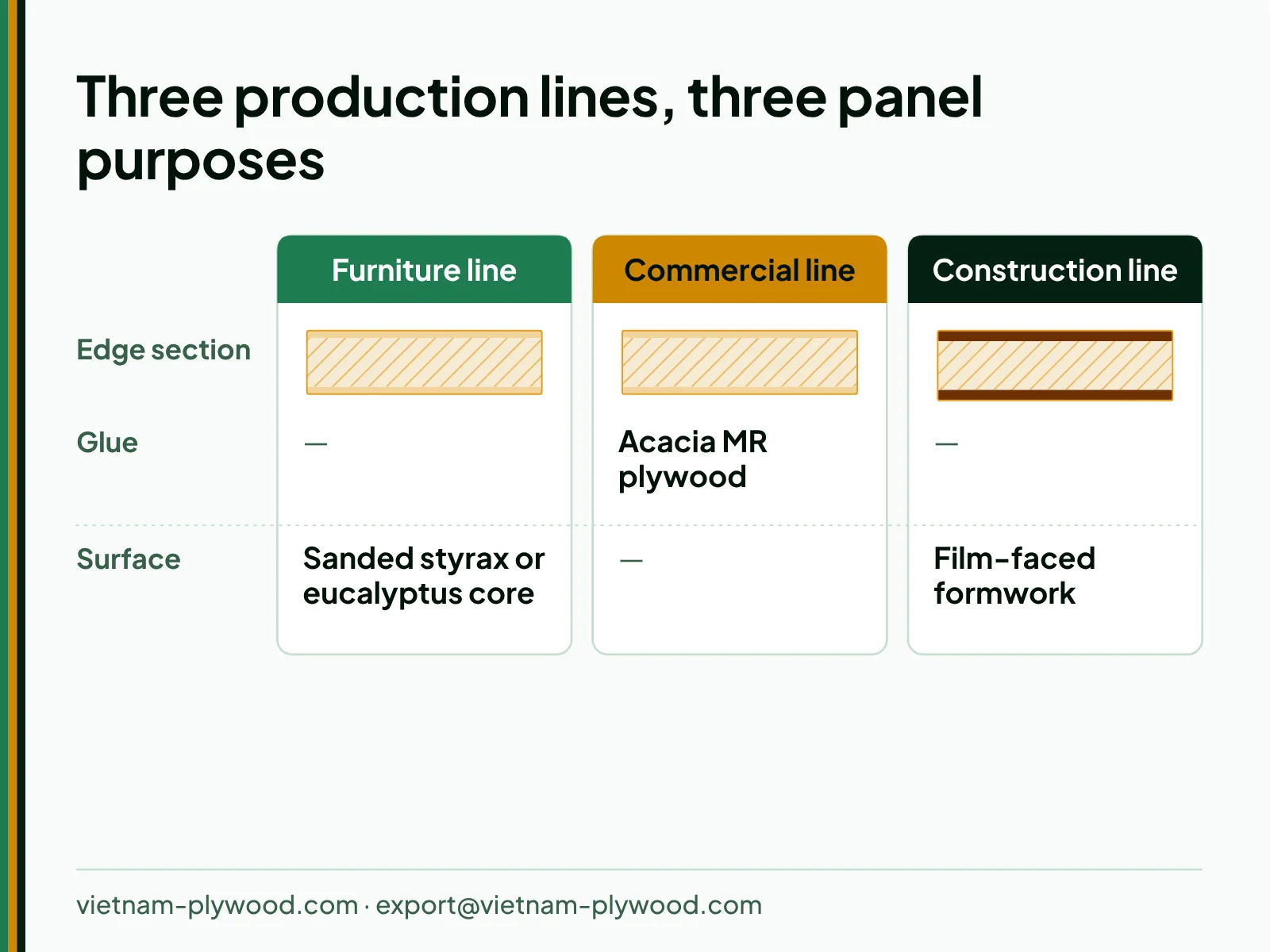
| Producing line | Comparable 18 mm request | Surface and intended route |
|---|---|---|
| Furniture | Styrax or eucalyptus, full-stitched | Sanded, calibrated core for cabinet production and buyer-side facing |
| Commercial and packing | Acacia, MR glue | Unsanded or light-sanded general-purpose and packing plywood |
| Construction | Acacia or eucalyptus | Unsanded film-faced or anti-slip formwork panel |
At the producing factory, an inspector can witness a thickness-gauge check across the sheet, review sanded faces under angled light and inspect cross-sections for core gaps. For furniture sanded boards, order the thickness tolerance as ±0.2 or ±0.3 mm; commercial and film-faced tolerance is ±0.5 mm. Length and width tolerance is ±2 mm. These checks should be recorded against the signed specification, not against the paper’s printed design.
Learn about the Vietnam plywood manufacturing range and how several plywood types fit an order.
What should a laminator order for melamine facing?
A laminator should order a dimensionally controlled, sanded plywood substrate with a documented core construction and emission requirement. A matt unfaced core is the starting material; paper, resin application and pressing remain the laminator’s responsibility.
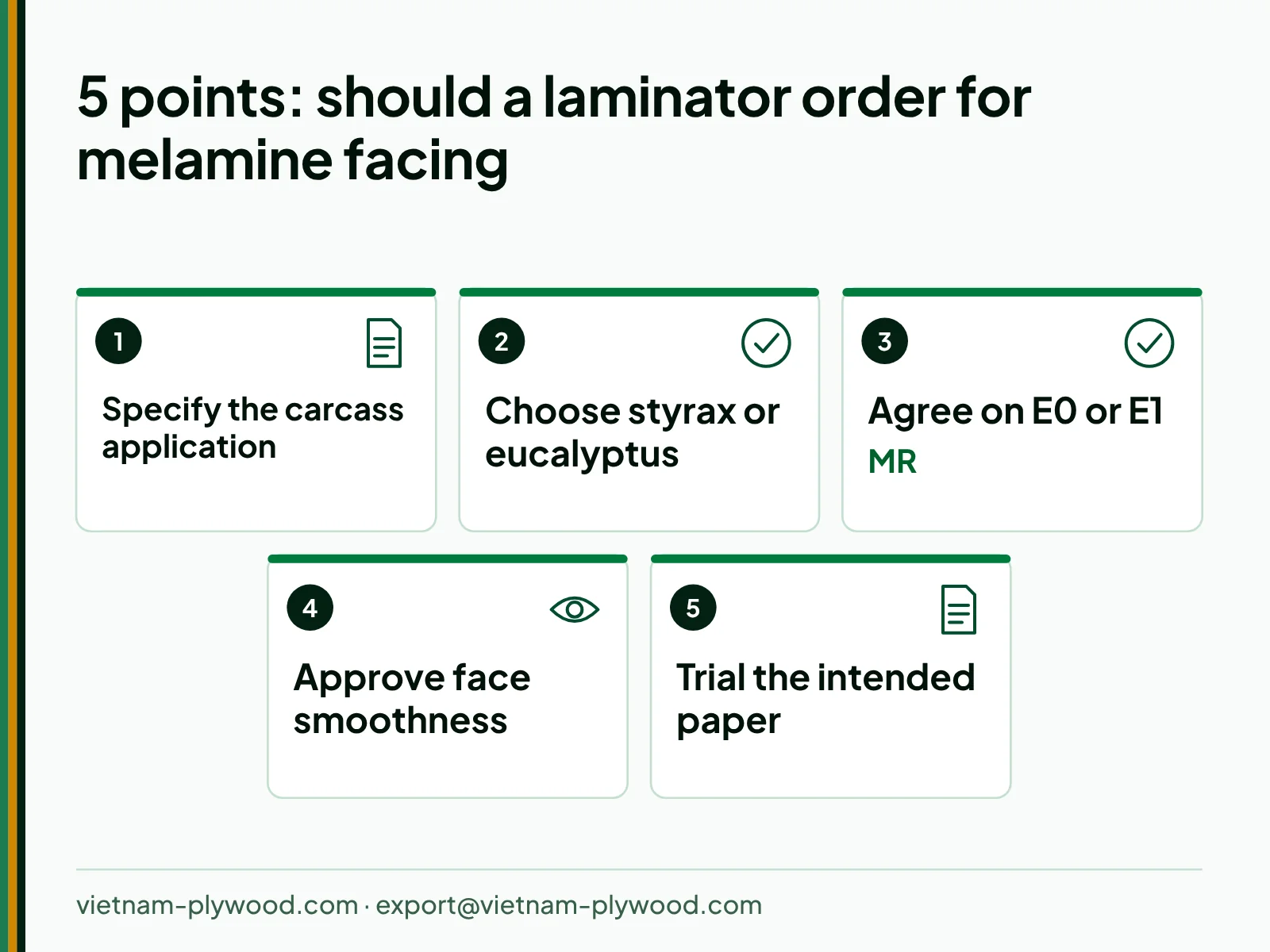
- Specify the carcass application, panel thickness and edge-fixing pattern before selecting the core.
- Choose styrax or eucalyptus, full-stitched construction and the furniture sanding tolerance needed by the press.
- Agree on E0 or E1 as an emission class, separately from MR or WBP glue.
- Approve face smoothness, thickness readings, edge voids and panel flatness on actual samples.
- Trial the intended paper, press settings, cut quality, edging adhesive and screw joints at the buyer’s plant.
A decorative paper pressed directly onto a substrate is commonly described as thermally fused melamine. High-pressure laminate (HPL) is a separately manufactured laminate subsequently bonded to a board; these constructions should not be conflated. We explain both finishes as purchasing topics, rather than offering them as an HCPLY facing line. For other substrate comparisons, see HDF plywood versus MDF panels.
How much plywood fits a 40HC container?
For 18 mm, 1220 × 2440 mm plywood, the listed full-container counts are 990 styrax sheets, 880 acacia sheets or 795 eucalyptus sheets. The corresponding loads are 26.52 t, 27.35 t and 27.69 t, excluding decorative facing weight. A 40HC has a 28.5 t payload limit.
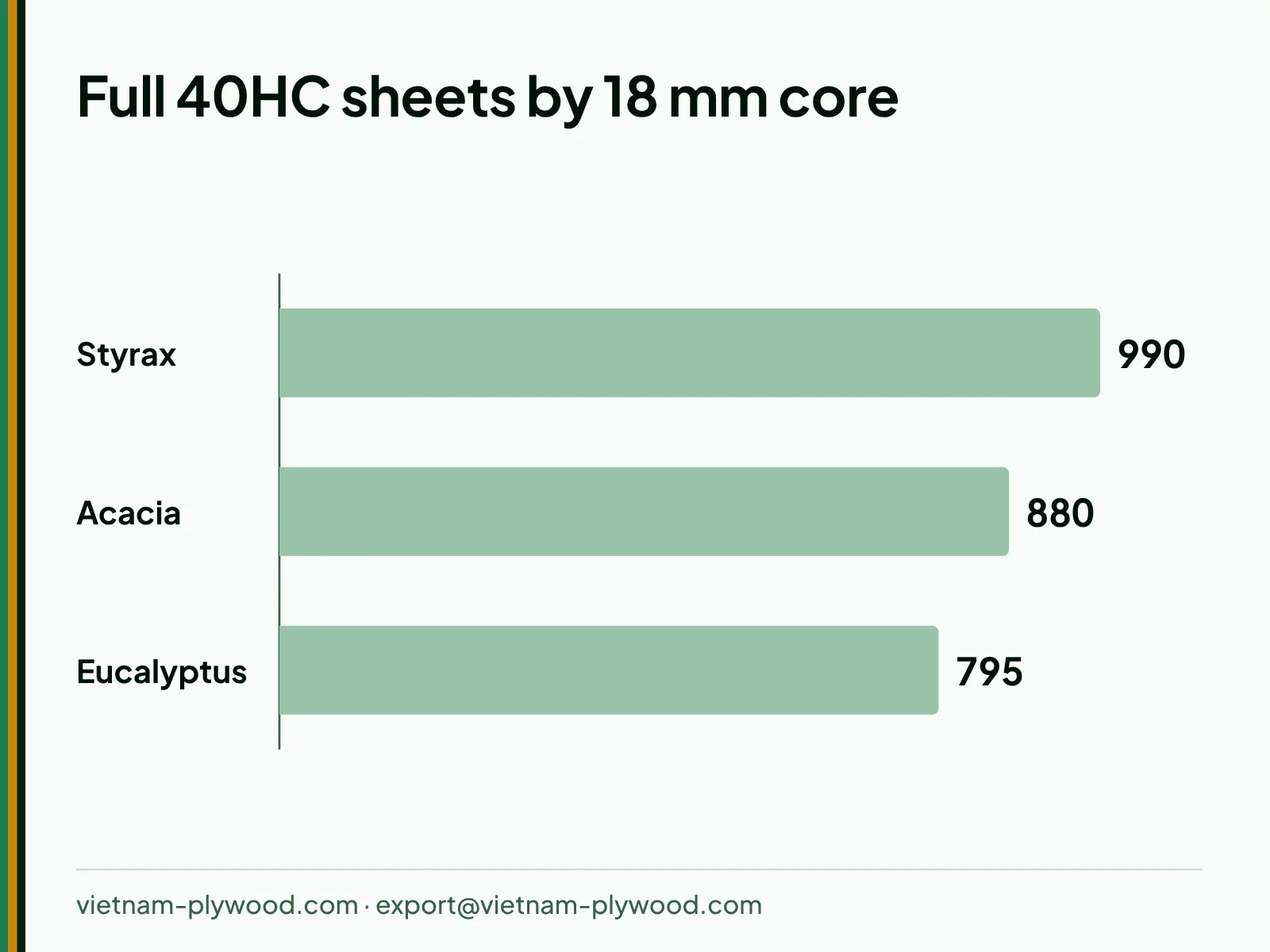
| 18 mm core | Weight per sheet | Sheets per pallet | Pallets | Full 40HC sheets |
|---|---|---|---|---|
| Styrax | 26.79 kg | 55 | 18 | 990 |
| Acacia | 31.08 kg | 55 | 16 | 880 |
| Eucalyptus | 34.83 kg | 53 | 15 | 795 |
These are raw-core loading figures; a melamine-faced finished panel adds facing mass and may change packing. Without the MFC supplier’s measured density, dimensions and pallet plan, an MFC-versus-plywood container-count claim would be speculation. Compare both on delivered usable carcass parts and freight per part. For the dedicated calculation context, see container loads and packing.
What must US-bound cabinet buyers document?
US-bound buyers should treat formaldehyde compliance as a product-and-document question independent of the decorative face. The US Environmental Protection Agency’s 2016 rule, summarized on its official page and updated in 2026, covers hardwood plywood, medium-density fiberboard and particleboard under Toxic Substances Control Act (TSCA) Title VI. It includes third-party certification, labeling and recordkeeping requirements: EPA formaldehyde standards.
The 2025 Code of Federal Regulations, 40 CFR Part 770, also defines particleboard as discrete particles pressed with resin and addresses certain laminated-product producers separately: official CFR text. An E0 or E1 purchase description is not a substitute for the required US documentation. Ask for the emission certificate and test report matching the agreed build and destination requirements.
FSC, CARB P2, ISO 9001 and CE documents belong to member factories and are shown with factory details masked, on request. The shipment document set includes the commercial invoice, packing list, bill of lading, certificate of origin and relevant phytosanitary or fumigation papers; US-bound order certificates belong with the agreed product file. After loading, the draft shipping documents come to you for approval.
How should buyers compare samples before placing an order?
Approve the core through a side-by-side production trial using the intended paper, cutter and cabinet hardware. A visual sample alone cannot predict the finished panel’s machining yield.
Record starting thickness at several points, visible gaps at both long edges and the face’s sanding pattern. After lamination, compare bow, paper adhesion, edge banding, corner chip-out and the number of usable parts. Run identical pilot holes and screw cycles on matching samples, then record failure modes rather than relying on a generic strength claim.
A useful inspection sheet identifies core species, glue type, emission class, thickness tolerance, sheet size, press batch and acceptance criteria. The buyer may inspect goods at the producing factory and visit the factory office. HCPLY coordinates specification, on-site quality control, documents and loading through export@vietnam-plywood.com.
How does an export order proceed?
A written core specification establishes the quotation, sample trial and factory inspection plan. The minimum order is one 40HC; one container can carry several specifications as long as the payload limit holds. Production takes 15–45 days from the 30% deposit, set by order size, line loading and the contract.
The remaining 70% is paid on the scan of the bill of lading, by T/T, or by irrevocable sight L/C. We ship FOB Hai Phong, or CFR (CNF) or CIF to your port. Samples cost nothing: a first-time buyer pays the courier, and that charge comes off the first confirmed order. See production lead time for the scheduling context.
HCPLY has three member factories in Phu Tho and Hai Phong; each order is produced and shipped directly from the factory suited to its specification. Furniture and commercial plywood capacity is up to 100 containers a month; construction plywood is up to 140. The buying decision should still rest on the agreed sample and inspection criteria.
What specification should a buyer send?
Send the substrate specification separately from the laminator’s decorative-paper specification. That keeps core quality, adhesive and finished-face performance accountable to the correct production step.
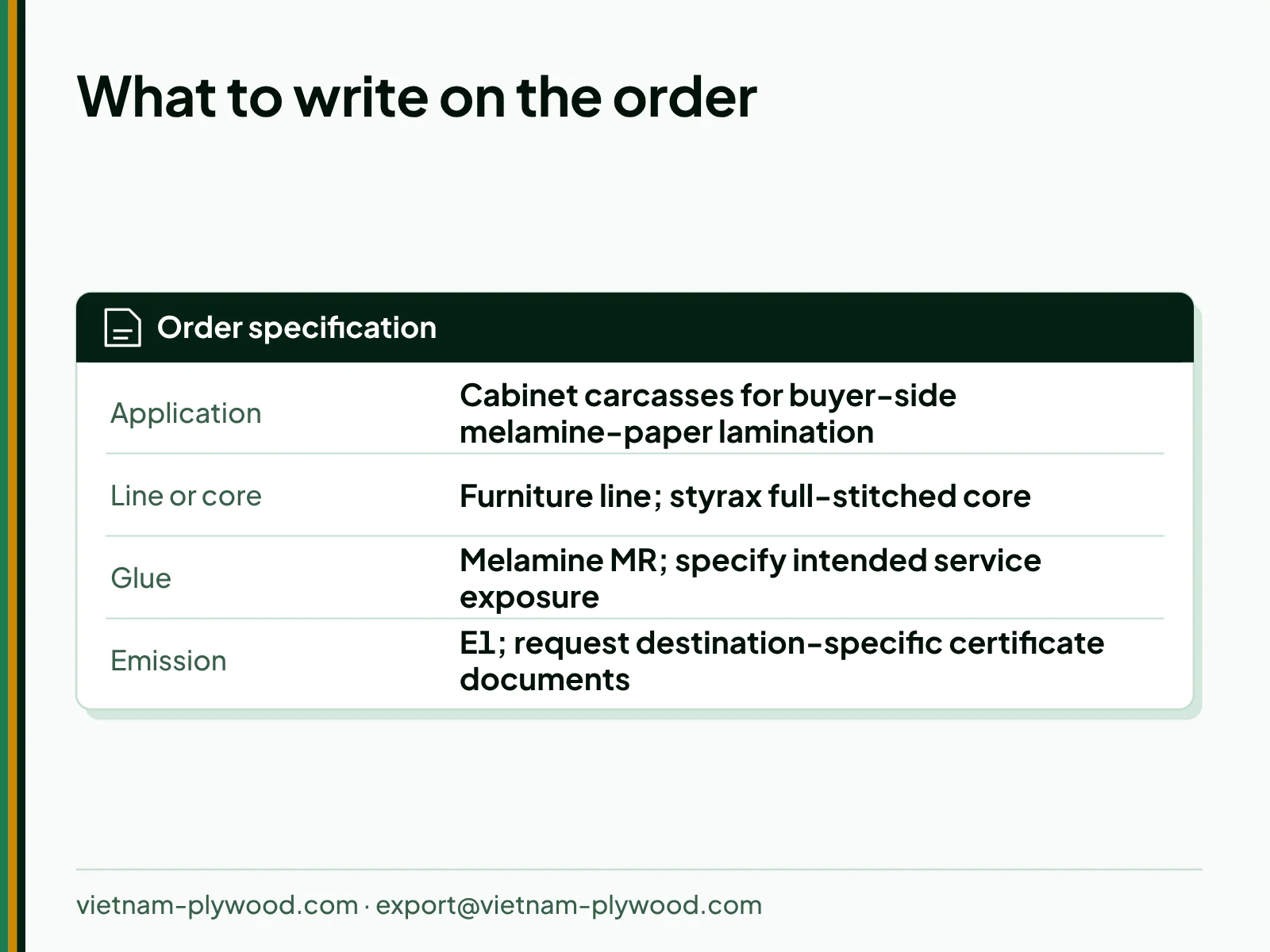
Application: Cabinet carcasses for buyer-side melamine-paper lamination
Line or core: Furniture line; styrax full-stitched core
Glue: Melamine MR; specify intended service exposure
Emission: E1; request destination-specific certificate documents
Face and grade: Matt raw core; sanded faces, facing by buyer
Thickness and tolerance: 18 mm; ±0.2 mm
Size: 1220 × 2440 mm
Quantity: One 40HC, styrax packing plan
Destination port: [buyer to enter]
Ask Lucy at contact for a sample set matched to the intended paper, machining process and cabinet hardware.