





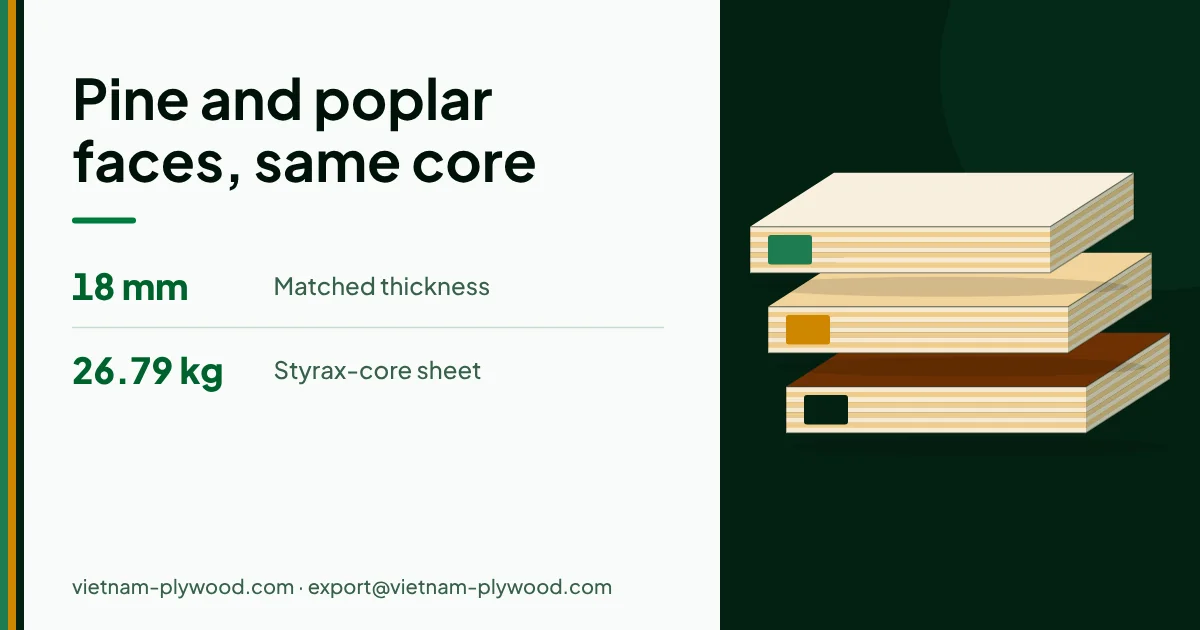
Pine-faced plywood shows stronger grain and possible knots, while poplar-faced plywood gives a quieter surface for painted furniture. Choosing the wrong face can mean rejected cabinet fronts, extra finishing work and delayed shipment. HCPLY builds both over specified furniture cores, so buyers can compare appearance without confusing face species with panel weight.
Poplar vs pine plywood: which face wins for furniture?
Poplar vs pine plywood is primarily a choice between a quiet paint-ready appearance and visible grain with knots. For painted cabinet doors, choose poplar-faced plywood with an approved colour range; for clear-finished shelves and fit-outs, choose pine-faced plywood with agreed knot limits. On the same core, the face changes the look far more than the shipping weight.
We make both faces on our furniture line with full-stitched styrax or eucalyptus cores. A buyer comparing poplar wood vs pine lumber should distinguish solid-wood properties from the behaviour of a thin decorative plywood face. The hardwood plywood guide explains that construction.
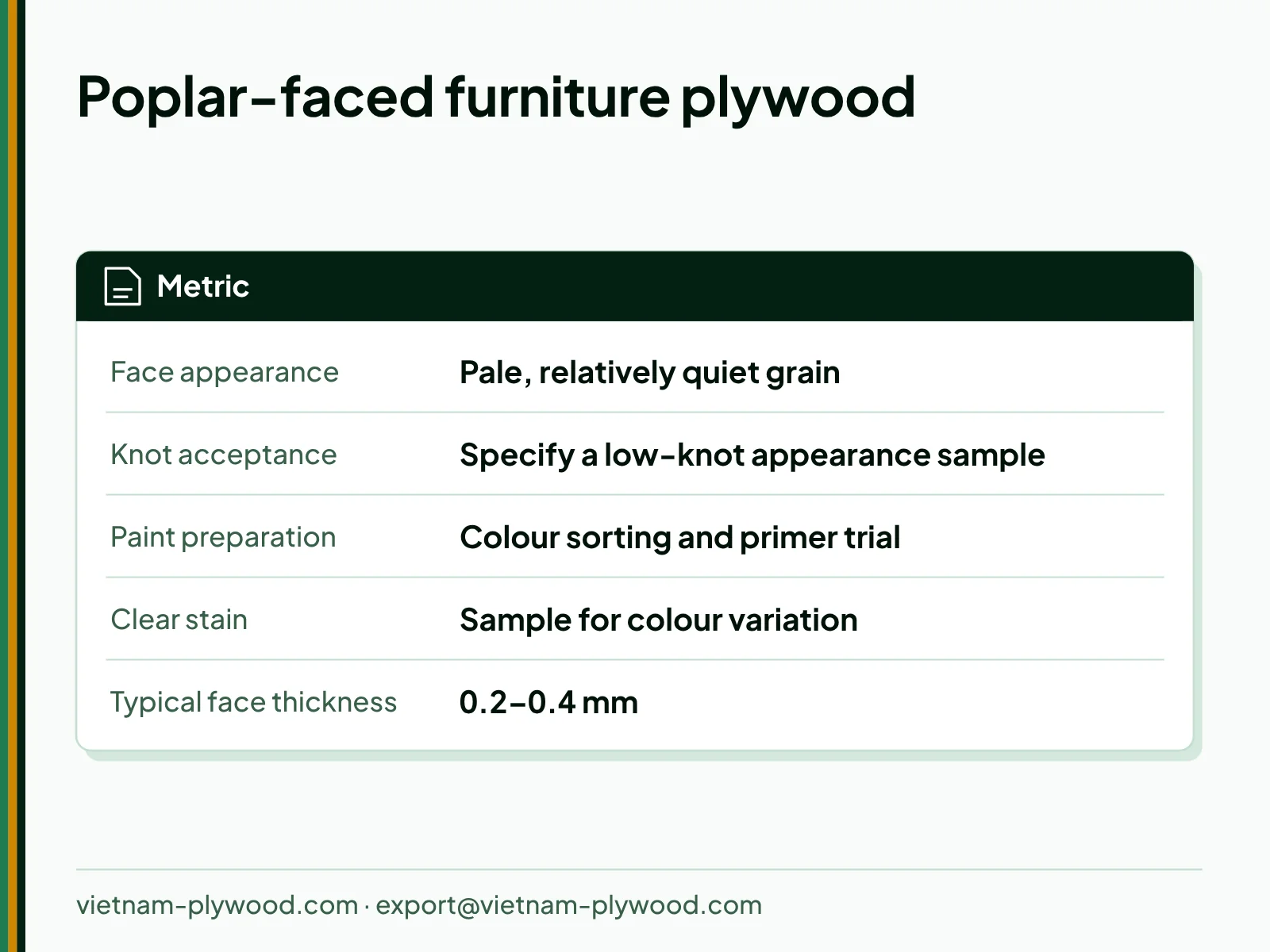
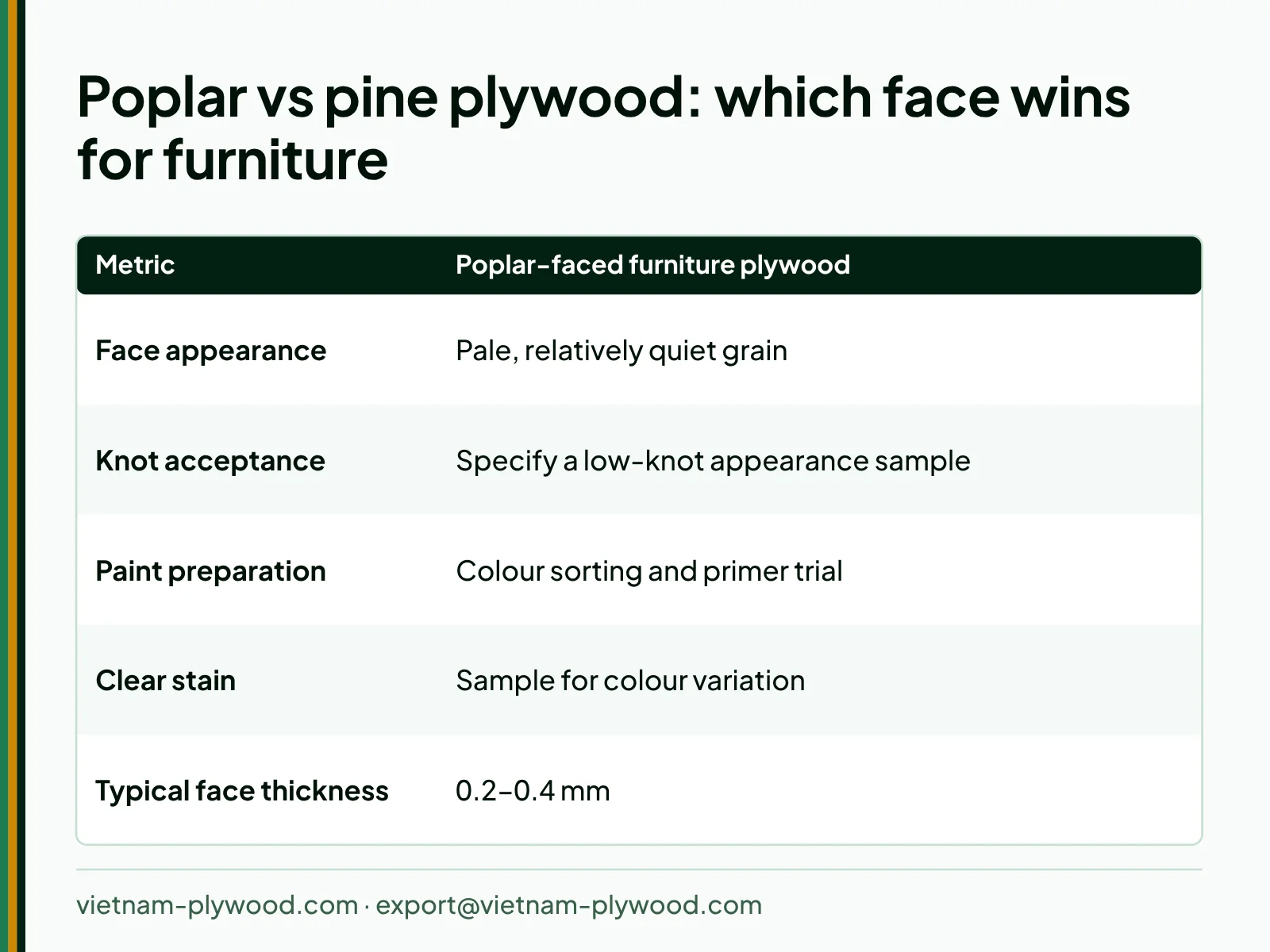
| Metric | Poplar-faced furniture plywood | Pine-faced furniture plywood | Verdict by use |
|---|---|---|---|
| Face appearance | Pale, relatively quiet grain | More pronounced rings and possible knots | Poplar for painted fronts; pine for natural display |
| Knot acceptance | Specify a low-knot appearance sample | Specify sound-knot size, count and location | Poplar for uniform doors; pine for character |
| Paint preparation | Colour sorting and primer trial | Knot sealing and resin-bleed trial | Poplar for opaque paint |
| Clear stain | Sample for colour variation | Grain contrast becomes prominent | Pine for visible wood figure |
| Typical face thickness | 0.2–0.4 mm | 0.2–0.4 mm | Neither face defines panel strength |
| Available face grade | A or B | A or B | Match grade pair to exposed surfaces |
| 18 mm styrax-core sheet | 26.79 kg at 1220 × 2440 mm | 26.79 kg at 1220 × 2440 mm | Tie for core-based loading estimate |
| 18 mm eucalyptus-core sheet | 34.83 kg at 1220 × 2440 mm | 34.83 kg at 1220 × 2440 mm | Tie; choose core for weight requirement |
| Quotation | Face yield and sorting affect cost | Knot restrictions and matching affect cost | Compare identical written builds |
Is poplar or pine plywood better for cabinet doors?
Poplar is the practical starting face for an opaque painted cabinet programme; pine suits a visible-grain door programme. Door makers should test finished samples under their actual coating sequence before locking the face grade.
For poplar, check light and dark streaks across adjoining doors, filler response and how the primer covers grain. For pine, check resin pockets, knot visibility and whether the finish accentuates growth-ring contrast. Neither thin face alone determines hinge performance or shelf stiffness. Core construction, thickness, edge treatment and hardware placement matter more. For alternative decorative faces, see poplar, birch and okoume veneers.
Which plywood is lighter: pine-faced or poplar-faced?
At the same thickness and core, pine-faced and poplar-faced panels use the same core-based planning weight. An 18 mm, 1220 × 2440 mm styrax-core sheet is 26.79 kg; eucalyptus core is 34.83 kg. The face species does not switch those reference weights.
We use styrax at 500 kg/m³ and eucalyptus at 650 kg/m³ for furniture builds.
The hardwood versus softwood plywood comparison separates veneer names from panel construction.
How do knot rules and face grades compare?
Both faces are offered as A or B grades, with the actual visible acceptance fixed against an approved physical sample. A letter alone cannot settle a dispute over knot count, knot colour or repair visibility.
For pine, record the largest permitted sound knot, whether dead knots and open knots are rejected, acceptable resin marks, and any restrictions around machining zones. For poplar, record dark mineral-like streaks, colour bands, splits, patches and face repairs. Inspect both face and back: an A/B order gives a different visible-back expectation from A/A.
Ask the producing factory to lay reference panels beside production sheets under consistent light. The inspector can count knots in a marked inspection area, photograph edge repairs and check that face defects remain within the signed sample. The inspection record should identify the face/back grade pair and batch.
Which face takes paint and stain better?
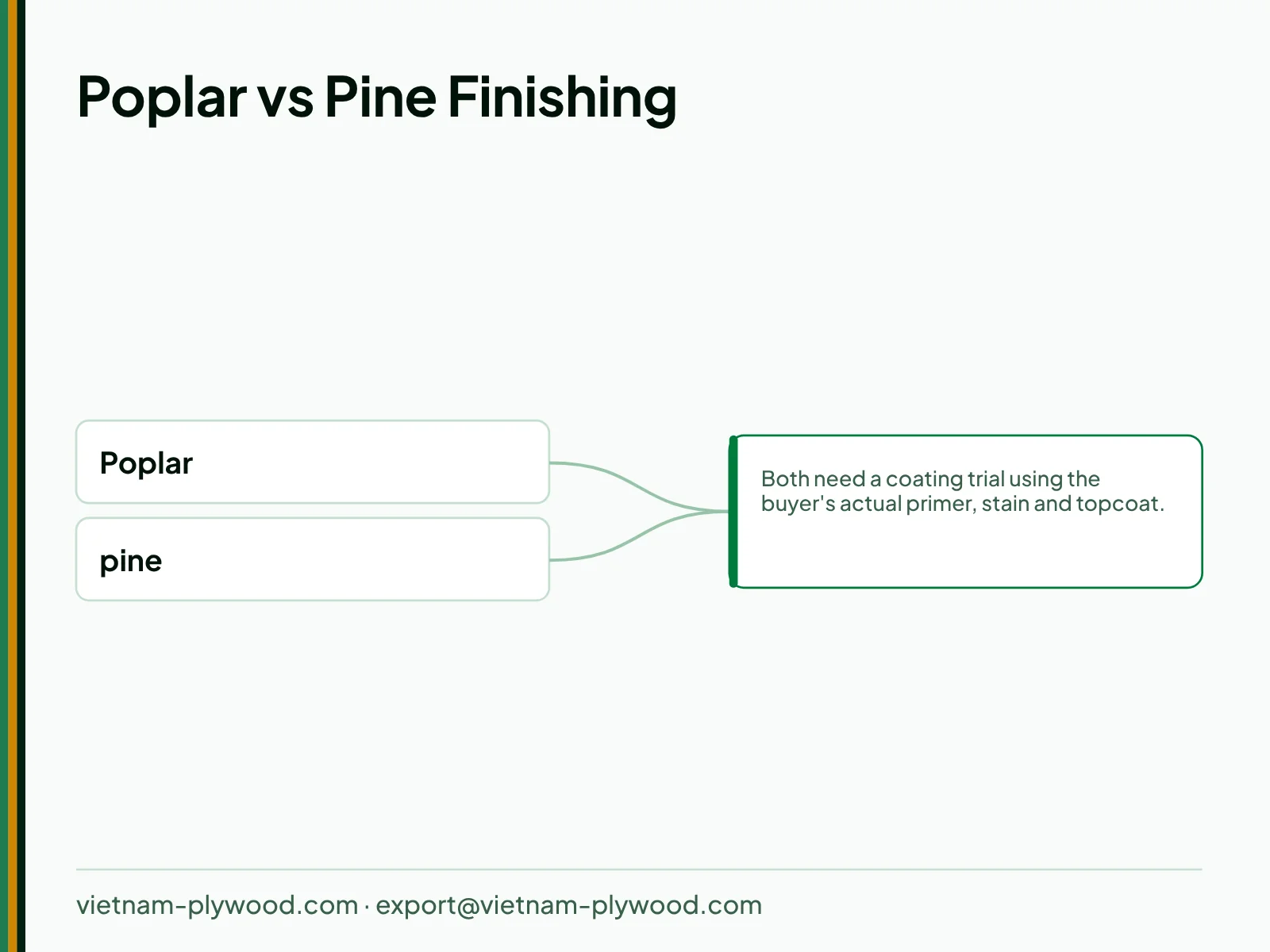
Poplar is usually the easier starting point for a uniform opaque painted face; pine is attractive when a stain or clear finish should show growth rings. Both need a coating trial using the buyer’s actual primer, stain and topcoat.
The U.S. Forest Service’s 2010 Wood Handbook, Chapter 16 explains that finish choice considers appearance, protection, cleanability and wood properties. That principle applies to face veneers as well as solid boards.
On poplar, inspect blotching and colour shift after a clear stain; use a tinted primer or opaque system when a uniform cabinet colour is the goal. On pine, seal knots as required by the coating system and compare earlywood and latewood stain uptake. Make the trial on production-faced plywood, since the 0.2–0.4 mm veneer must not be sanded aggressively.
Which of our three factories makes each build?
Our furniture line presses pine-faced and poplar-faced plywood over full-stitched styrax or eucalyptus cores, sanded to the ordered furniture tolerance. The other lines serve different specifications rather than making the same furniture surface.
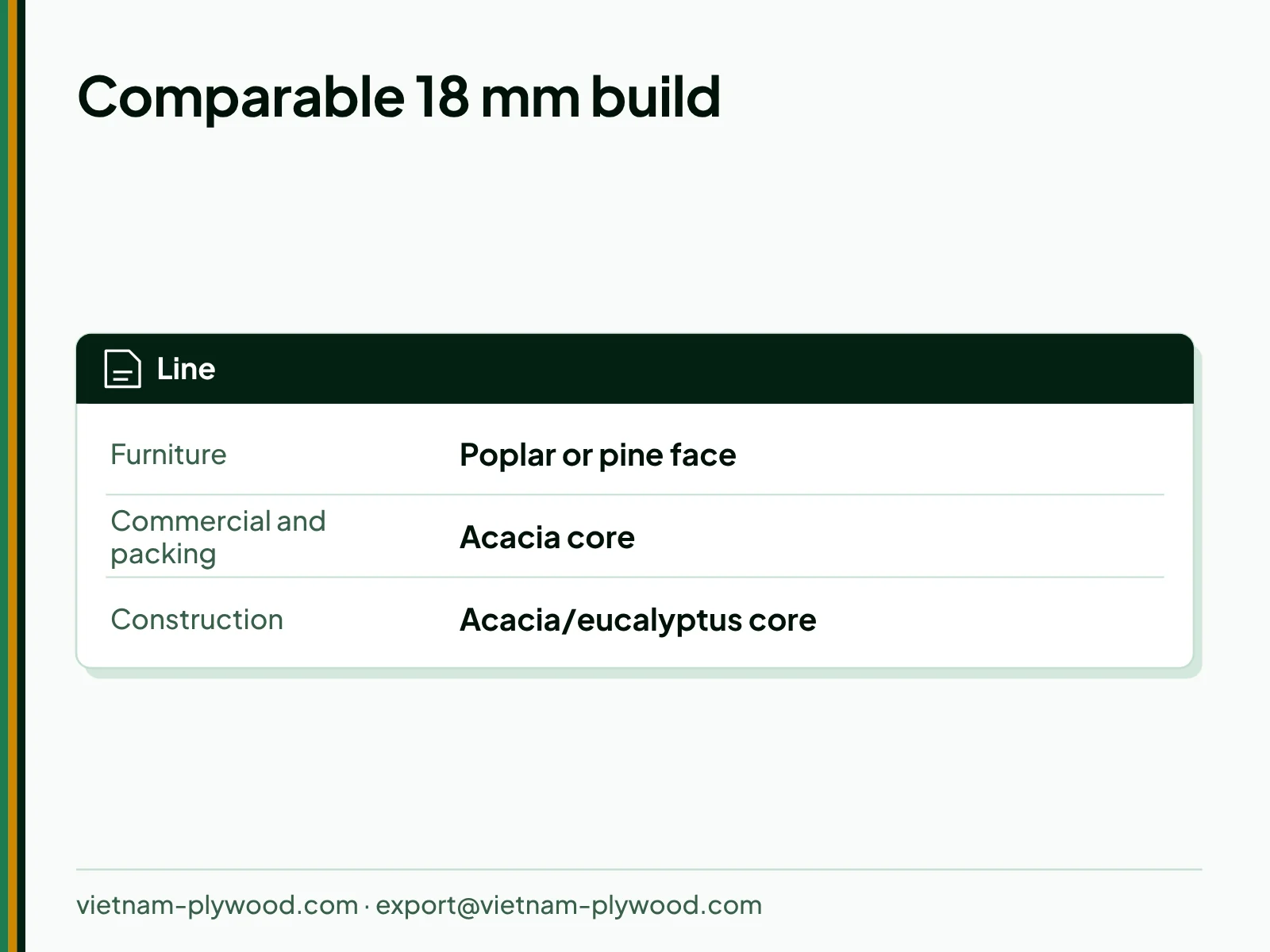
| Line | Comparable 18 mm build | Finish and use verdict |
|---|---|---|
| Furniture | Poplar or pine face, stitched styrax/eucalyptus, sanded ±0.2 or ±0.3 mm | Painted cabinets or visible-grain interiors |
| Commercial and packing | Acacia core, MR glue, unsanded or light-sanded, ±0.5 mm commercial tolerance | Utility packing and commercial applications |
| Construction | Acacia/eucalyptus core, phenolic or melamine film, unsanded, ±0.5 mm | Concrete formwork rather than decorative furniture |
Our commercial and packing line supplies packing or commercial plywood; our construction line serves construction project plywood. The face comparison belongs to the furniture specification. HCPLY manages specification, on-site quality checks and loading at the producing factory.
Can pine and poplar panels share one container?
Yes. Pine-faced and poplar-faced furniture sheets can share one 40HC when the combined specifications and weight fit the 28.5 t payload limit. The minimum order is one 40HC, and specifications can be mixed within that limit.
For 18 mm, 1220 × 2440 mm styrax-core panels, the full-container reference is 990 sheets, 53.05 m³ and 26.52 t across 18 pallets. A mixed pine-and-poplar order on that core can use the stated full-container reference; list the face quantities separately and check the final packing plan against the payload limit.
Eucalyptus-core 18 mm panels have a different full-load reference: 795 sheets, 42.60 m³ and 27.69 t across 15 pallets. Do not apply the styrax count to an eucalyptus order. For other thicknesses and pallet arrangements, use the container loading guide.
How large is the pine-versus-poplar price gap?
The price gap is driven first by the accepted face appearance and veneer yield, then by core choice, face/back grade pair, thickness and machining requirements. A tightly matched, low-knot pine face can cost more than a more permissive pine selection because more veneer is rejected during sorting.
A highly uniform poplar face can likewise cost more than a grade that accepts visible colour variation. Therefore neither species has a fixed universal premium. Compare pine and poplar quotations on the same core, dimensions, glue, emission class and tolerance, with both approved samples attached.
For furniture plywood, the indicative starting point is from US$350/m³ FOB Hai Phong (October 2026). This is a furniture-category starting price, not a separate pine or poplar quotation. Request the two face options side by side to see the actual differential for the specified order.
What thickness, glue and emission specification should buyers send?
Specify the face and core separately, then the glue and emission requirement as separate fields. Our furniture line offers styrax or eucalyptus full-stitched cores with E0 or E1 emission classes; a glue choice must be written independently.
The thickness range is 3–40 mm, including common 9, 12, 15, 18 and 21 mm furniture orders. Available sizes include 1220 × 2440 and 1250 × 2500 mm, with custom cutting. For sanded furniture, select ±0.2 mm or ±0.3 mm thickness tolerance as ordered; length and width tolerance is ±2 mm.
Melamine adhesive is the MR option with a 12-hour boil designation; phenolic adhesive is the WBP option with a 72-hour boil designation. These describe adhesive performance, while E0 and E1 describe emissions. Discuss the exposure conditions of the finished furniture before choosing the bond.
What should an inspector check before loading?
The inspector should compare the pine and poplar faces against separate signed approval samples, then verify core construction and thickness on the actual batch. This catches a costly substitution before panels are packed.
At the producing factory, open selected packs and inspect both faces under the same light. Mark unacceptable knots, repairs or colour shifts, and check the face grade against the approved reference. Measure thickness at agreed positions and inspect exposed edges for core gaps, overlaps and stitching quality.
What paperwork follows the mixed order?
The shipment document set identifies the goods through the commercial invoice, packing list, bill of lading and certificate of origin. For European Union lots, the certificate of origin is EUR.1 and the EUTR/EUDR file set accompanies the order.
Phytosanitary and fumigation papers are included, with insurance under CIF and any agreed factory certificate documents or test reports. The packing list is the practical cross-check for pine versus poplar pack counts and grade descriptions. After loading, the draft shipping documents come to you for approval.
Member-factory FSC, CARB P2, ISO 9001 and CE documents, where relevant to the agreed build, are shown with factory details masked, on request. For the ordering route and Vietnam plywood manufacturing, specify the intended destination and applicable documentation before production.
Which face should go into the trial container?
Choose poplar for a painted cabinet range with tight colour acceptance, and pine for a clear-finished range where grain and sound knots are intentional. Keep the core and tolerance constant in the trial so the finish difference can be judged fairly.
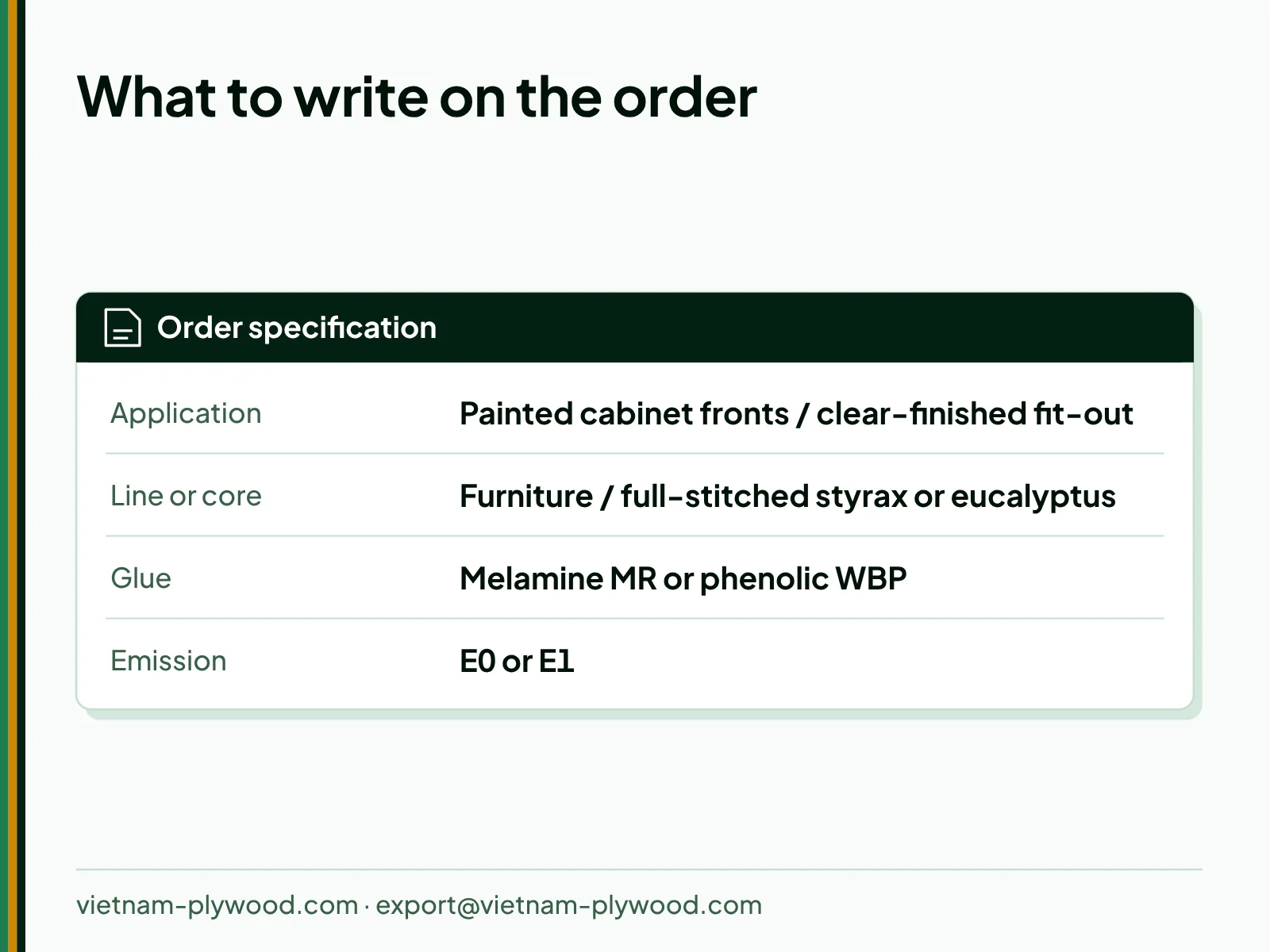
Send Lucy at export@vietnam-plywood.com the specification below, or use the contact form. We can quote the two face grades against the same core and destination.
Application: painted cabinet fronts / clear-finished fit-out
Line or core: furniture / full-stitched styrax or eucalyptus
Glue: melamine MR or phenolic WBP
Emission: E0 or E1
Face and grade: poplar A/B; pine A/B; approved knot and colour samples
Thickness and tolerance: 18 mm; ±0.2 mm or ±0.3 mm
Size: 1220 × 2440 mm
Quantity: one 40HC, specify split by face and pack
Destination port: [port and country]
Next step: plan a trial container with both face samples and the intended finish schedule.