





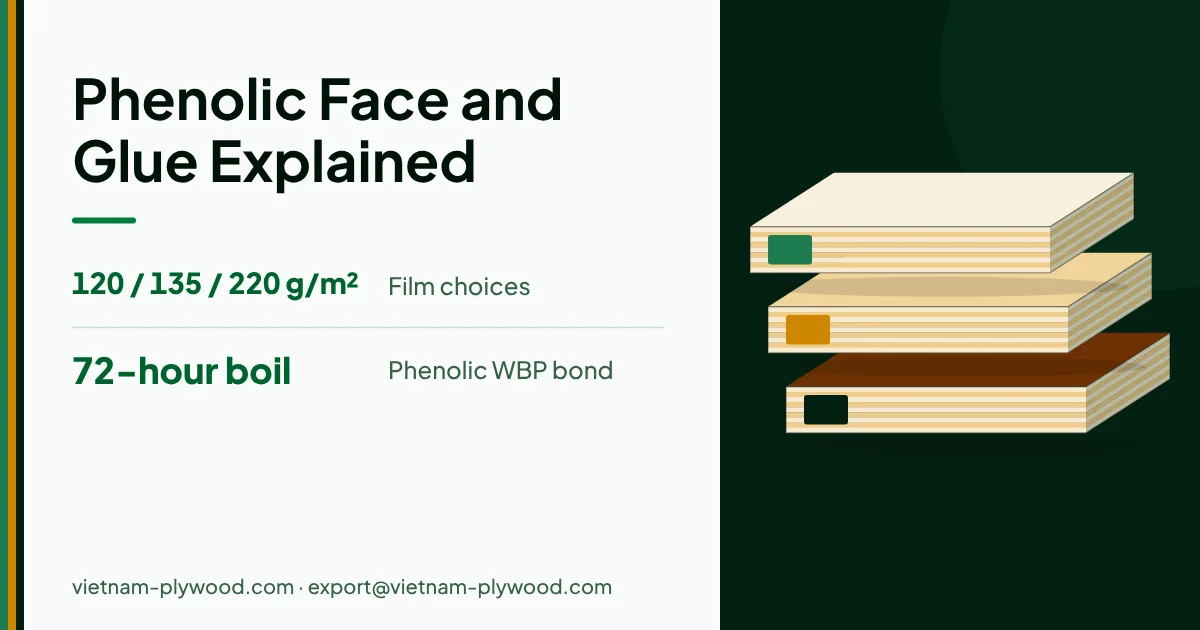
Phenolic plywood is plywood specified with a phenolic film surface, a phenolic adhesive between veneers, or both, for work such as concrete forming and transport-floor lining. Ordering the wrong combination can cost a rejected load or extra days replacing panels. At HCPLY, the answer to what is phenolic plywood used for begins by separating the working face from the internal glue bond.
What is phenolic plywood?
Phenolic plywood is a trade description for a plywood panel with phenolic resin in its surface overlay, veneer adhesive, or both. The surface film provides a working skin; the adhesive holds the veneer layers together. A buyer should identify both components before comparing quotations.
A film-faced panel has resin-impregnated paper pressed onto its outer surfaces. The face can be smooth for a concrete finish or textured for footing on a transport deck. A dark glue line alone does not identify the film, and a dark face alone does not identify the glue.
Our construction plywood range places this distinction inside a written panel specification. A request saying only “phenolic 18 mm” leaves the surface, bond and core open to different interpretations.
What is phenolic plywood used for?
Phenolic plywood is used for concrete form faces, reusable shuttering, site panels and selected transport-floor surfaces where the specified overlay and bond suit the work. Smooth film helps produce a consistent concrete contact face; textured anti-slip film is chosen for foot traffic and cargo handling. Neither surface description establishes a structural load rating.
For formwork, specify the concrete-contact finish, number of planned cycles, release-agent practice and treatment of cut edges. A smooth film is the natural starting point when the concrete surface matters. For transport flooring, specify texture, abrasion exposure, wheel or point loads and fastening layout; the floor designer must check load capacity.
A boat application described as “marine” requires a test report the buyer accepts, rather than a name on the quotation.
Does phenolic describe the face, glue, or both?
The word describes three distinct order configurations. The comparison below is the shortest way to prevent an unsuitable substitute.
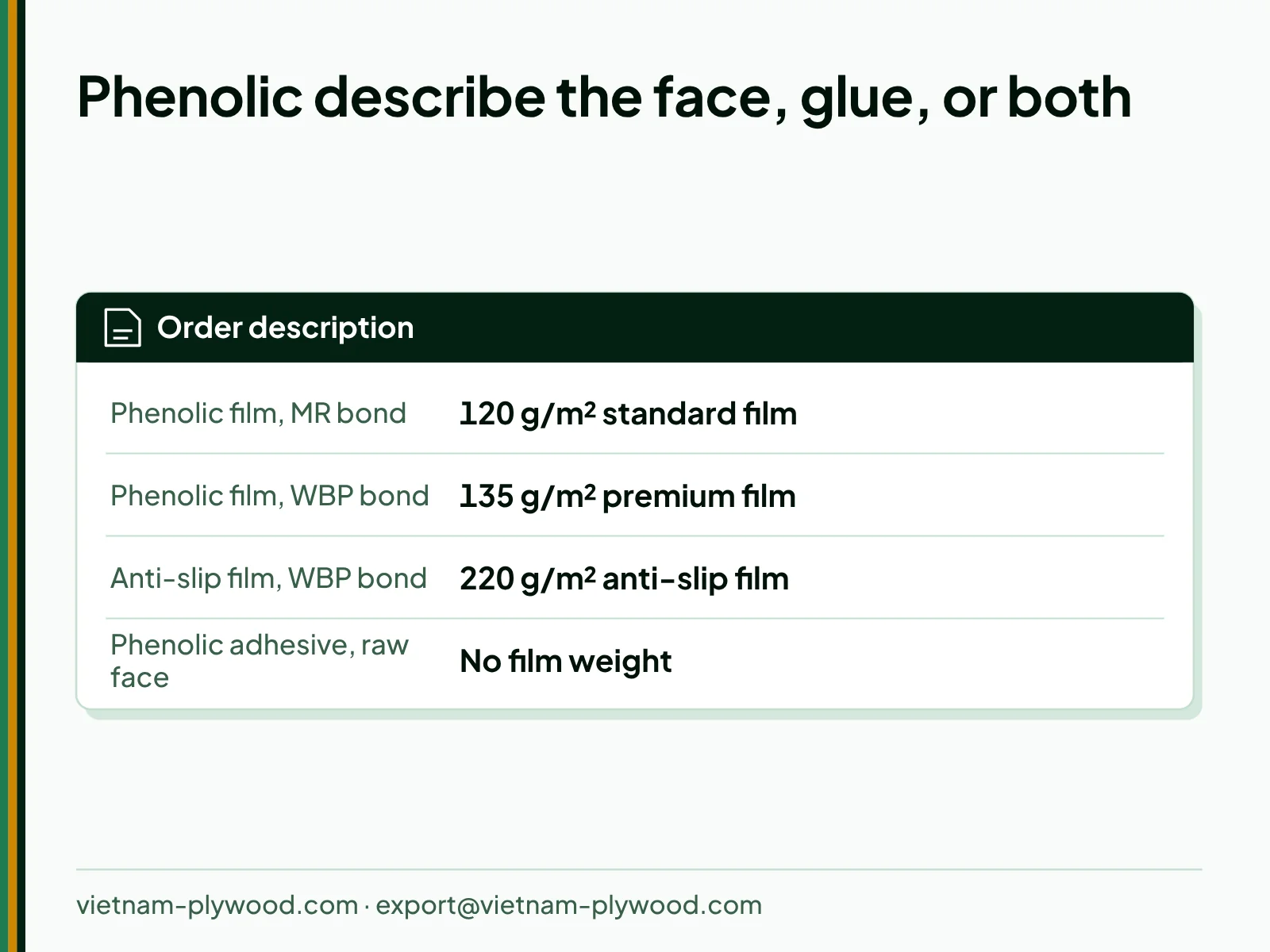
| Order description | Surface metric | Bond specification | Suitable starting use | Buying verdict |
|---|---|---|---|---|
| Phenolic film, MR bond | 120 g/m² standard film | Melamine MR, 12-hour boil | Managed concrete forming cycles | Choose only when the exposure and reuse plan suit MR |
| Phenolic film, WBP bond | 135 g/m² premium film | Phenolic WBP, 72-hour boil | Repeated concrete formwork | Choose for the stronger wet-bond requirement |
| Anti-slip film, WBP bond | 220 g/m² anti-slip film | Phenolic WBP, 72-hour boil | Specified transport-floor surfaces | Choose for traction, then verify floor loads |
| Phenolic adhesive, raw face | No film weight | Phenolic bond specified separately | Jobs requiring a bond property without film | Do not substitute for a film-faced concrete finish |
Our construction line presses the film-faced configurations. A raw-faced phenolic-bond request needs its own agreed build rather than being assumed from a film-faced quotation. See the film-faced plywood product for the surface options.
How does phenolic plywood differ from ordinary plywood?
Phenolic plywood differs from an unspecified ordinary panel through the declared surface and bond; plywood itself remains a layered veneer product. In its undated plywood technical overview, APA — The Engineered Wood Association explains that plywood is cross-laminated veneer bonded with heat and pressure. Its bond classifications distinguish moisture exposure from structural strength.
An ordinary raw plywood face exposes wood grain and can need further finishing. A film overlay changes contact behaviour, cleaning and surface wear. A stronger adhesive bond improves the bond’s suitability for wet service, but does not give the sheet a span rating or resistance to fungal decay.
The structural versus non-structural plywood decision belongs to the load-bearing design, while roof sheathing plywood involves a different installation and exposure assessment. A form face cannot be promoted to roof sheathing merely because both are plywood.
Which factory line makes each build?
Our construction line presses phenolic or melamine film onto acacia or eucalyptus cores, including anti-slip film. The other lines address different buyers and surface requirements rather than replacing that press operation.
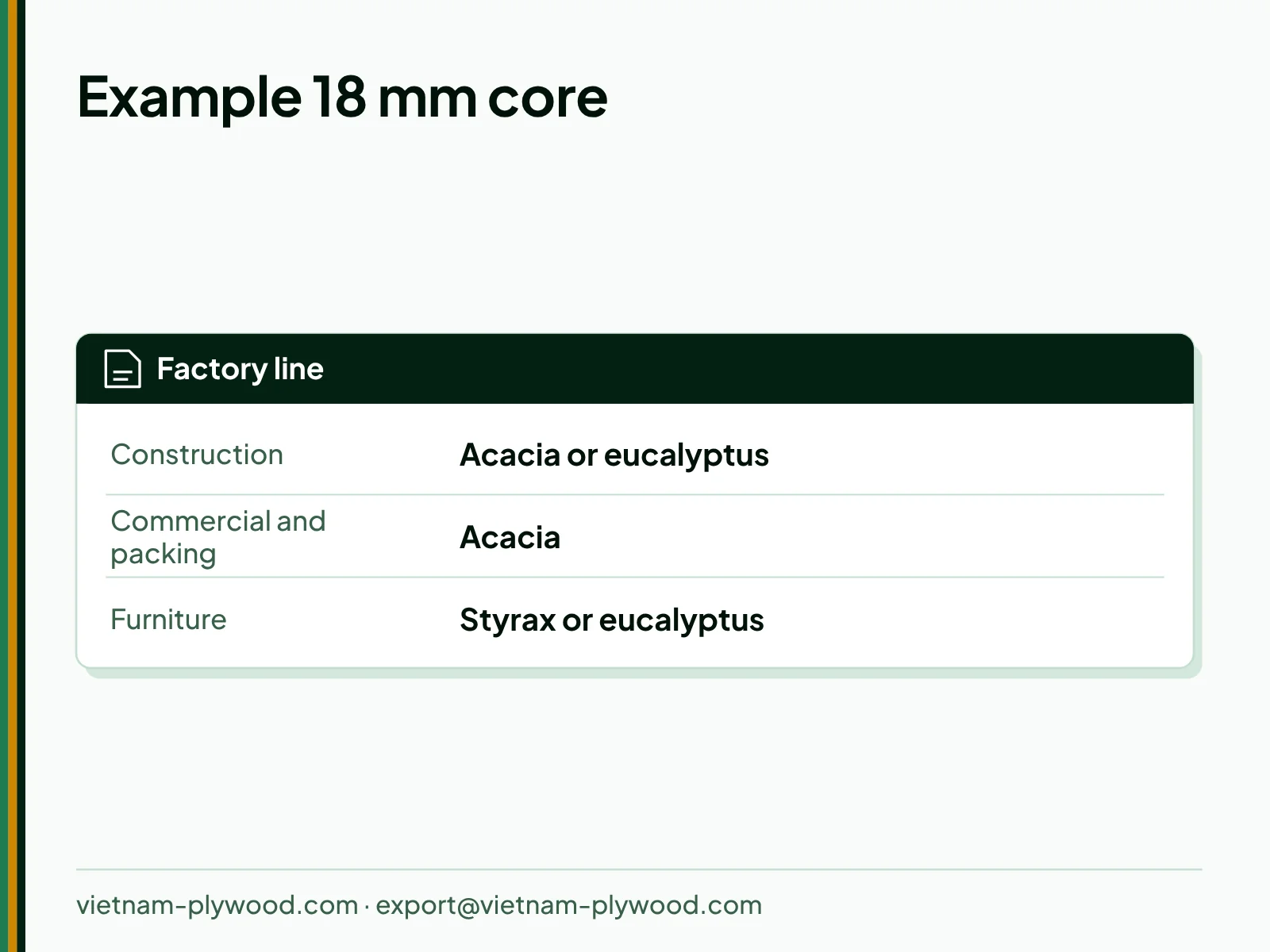
| Factory line | Example 18 mm core | Surface and preparation | Intended order |
|---|---|---|---|
| Construction | Acacia or eucalyptus | 120 or 135 g/m² smooth film, or 220 g/m² anti-slip; unsanded core | Concrete form or specified transport floor |
| Commercial and packing | Acacia | Raw, unsanded or light-sanded, MR glue | Packing and commercial panel |
| Furniture | Styrax or eucalyptus | Full-stitched, sanded, E0/E1 | Cabinet or furniture component |
Core density follows the wood: acacia 580 kg/m³, eucalyptus 650 kg/m³ and styrax 500 kg/m³. Surface names do not change those density assumptions. HCPLY directs the order to the producing factory and checks the agreed build there.
Is phenolic plywood waterproof?
Phenolic plywood resists selected wet conditions through its bond and surface, but wood edges and veneers can still absorb water. Seal original and cut edges and inspect them after handling.
APA’s 2017 Moisture Exposure Recommendations distinguishes Exposure 1 from Exterior bond classification and relates each to in-service moisture. That distinction is a useful warning against treating “phenolic” as a universal exterior rating.
A phenolic adhesive also does not establish a marine standard. If a project requests BS 1088 or a structural designation, write the exact criterion and evaluate the panel against a test report the buyer accepts. Check drainage, edge sealing and the actual wetting cycle before approving a panel for continuous outdoor service.
How are glue and film checked at the producing factory?
Inspectors should compare the order’s two resin fields against the panel and its production records. Visual colour is useful for locating a layer, but a dark line cannot replace a bond test or the documented adhesive specification.
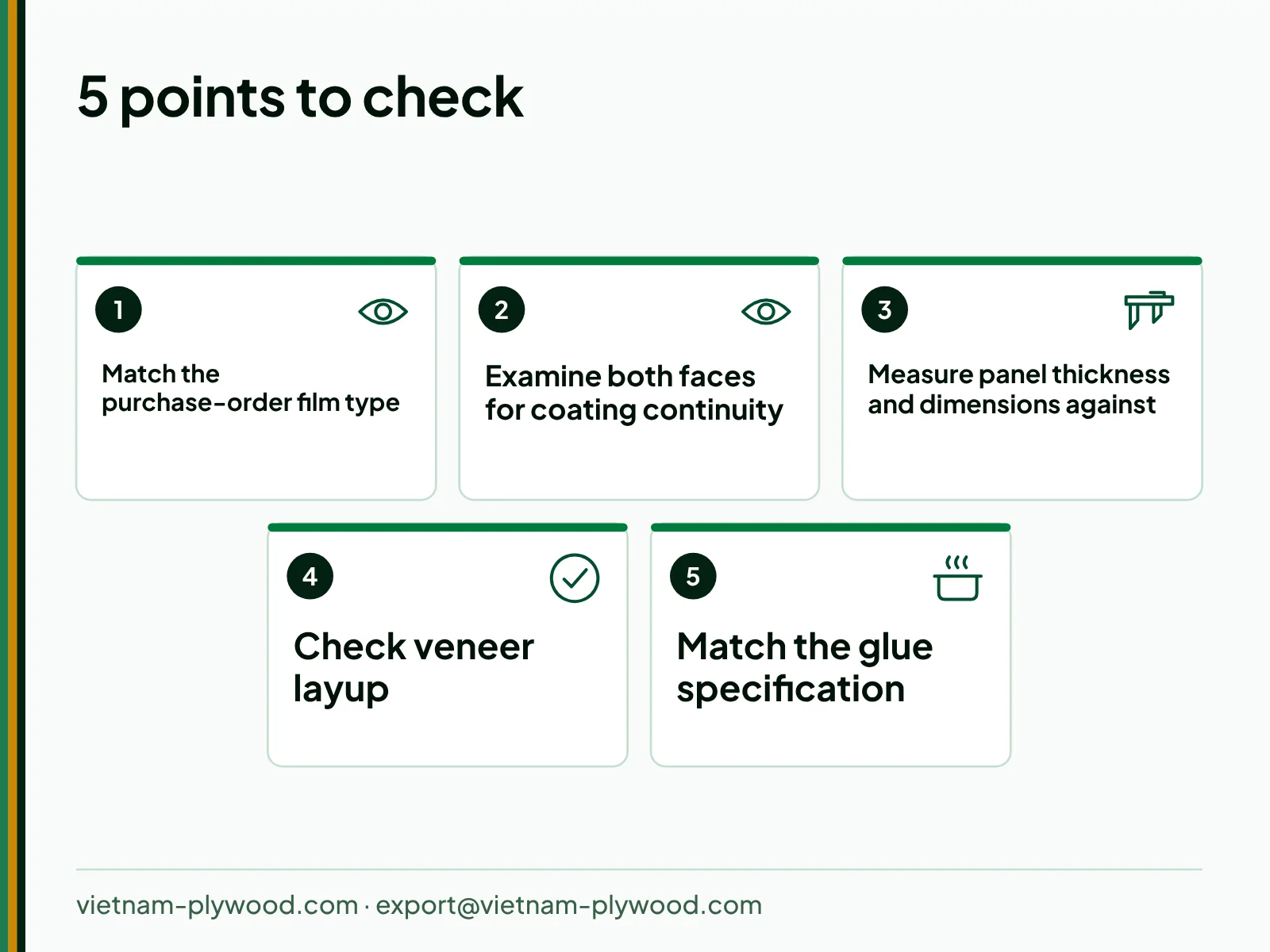
- Match the purchase-order film type and declared weight to the film material and production batch.
- Examine both faces for coating continuity, scratches, texture and defects at the edges.
- Measure panel thickness and dimensions against the written tolerance, including selected sheets from the packed lot.
- Check veneer layup, core joints and exposed edges for gaps or damage.
- Match the glue specification to the agreed test report and inspection record before approving the lot.
For construction film-faced plywood, thickness tolerance is ±0.5 mm and length or width tolerance is ±2 mm. A buyer can witness measurements and face inspection at the producing factory. The glue bond requires documentary or test evidence rather than an assumption from appearance.
What size and quantity should a buyer specify?
Start with panel dimensions, thickness, core and the loading weight rather than a generic container count. HCPLY offers 3–40 mm thickness and standard formats including 1220 × 2440 mm and 1250 × 2500 mm, with custom cutting available.
For an 18 mm, 1220 × 2440 mm acacia-core panel, the core-based reference is 31.08 kg per sheet. The reference full 40HC load is 880 sheets, 47.15 m³ and 27.35 t; film weight is excluded from that calculation. The 40HC payload ceiling is 28.5 t, so a mixed specification needs its actual weights checked.
The container loading reference covers full-container calculations, while mixed container loads explains how different specifications can be combined. Keep film weight and packing details visible in the final load plan.
What changes the service life and purchase cost?
Service life depends on the adhesive, surface condition, concrete mix, release-agent practice and handling between pours. With proper handling, release agent on every pour and sealed edges including cut edges, melamine-glue film-faced plywood gives about 12–15 pours; phenolic-glue film-faced plywood gives up to about 25 pours.
Phenolic-glue film-faced construction normally costs more than a comparable melamine-glue build because the bond system is different. A premium film can cost more than standard film, and anti-slip film adds a distinct surface requirement. Core choice, thickness, quantity and destination also affect the quotation. Ask for a written build quotation instead of comparing an unnamed “phenolic plywood” unit price.
Reuse estimates should never replace a site-specific trial and a clear finish acceptance standard.
Which emission and shipment papers belong with the order?
Emission classification is separate from the adhesive and the film. E0, E1 and E2 are emission classes; phenolic and melamine identify adhesive systems. For US-bound products in the relevant regulated category, the US Environmental Protection Agency’s 2025 codification of 40 CFR Part 770 sets out product applicability, third-party certification and formaldehyde limits. It also identifies exemptions, so classification must follow the actual product and use.
The shipment document set includes the commercial invoice, packing list, bill of lading, certificate of origin, phytosanitary and fumigation papers, and agreed certificate or test documents. EU lots include the EUR.1 origin document and EUTR/EUDR file set; CIF lots include insurance. After loading, the draft shipping documents come to you for approval.
Member-factory FSC, CARB P2, ISO 9001 and CE documents, where relevant, are shown with factory details masked, on request. State the requested evidence in the purchase order; a generic resin label cannot substitute for a certificate or a test report.
How should phenolic film and glue appear on an order?
Write the film face and glue bond as separate fields, then add the core, emission class, size and acceptance checks. The quotation should repeat these fields so a substitution cannot hide behind the same product name.
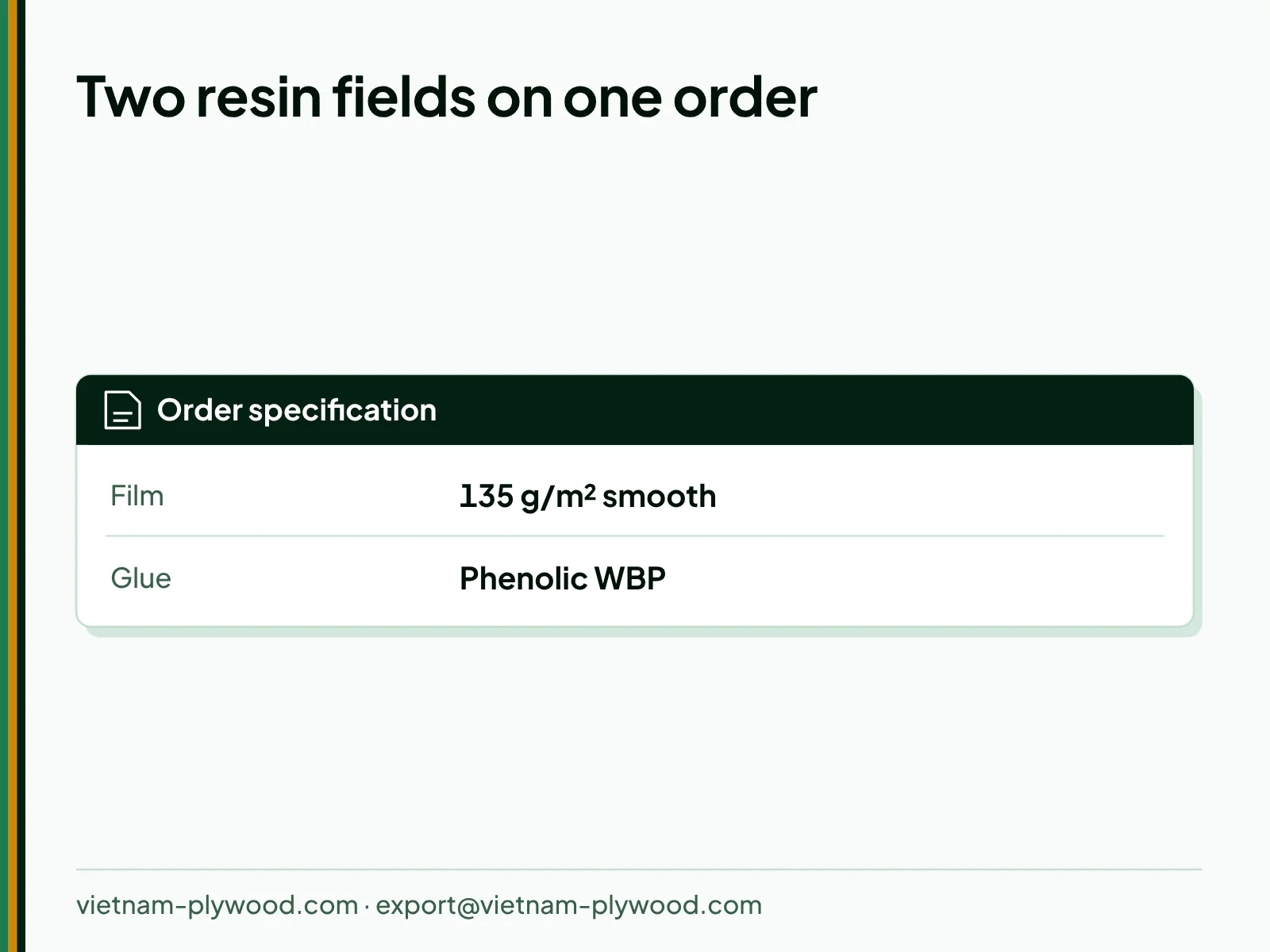
For a formwork programme, identify the concrete-contact finish and intended reuse practice. For transport flooring, identify the anti-slip face and ask the floor designer to specify load and support requirements. Construction project supply and production lead time address project coordination once the build is fixed.
Our three factories are in Phu Tho and Hai Phong; the buyer visits the factory office and inspects at the producing factory. HCPLY manages specification, on-site quality control, documents and loading.
What should be sent for a quotation and factory visit?
Send the complete specification below to Lucy at export@vietnam-plywood.com. Replace example values with the job’s approved design requirements, particularly the floor loads and finish criteria.
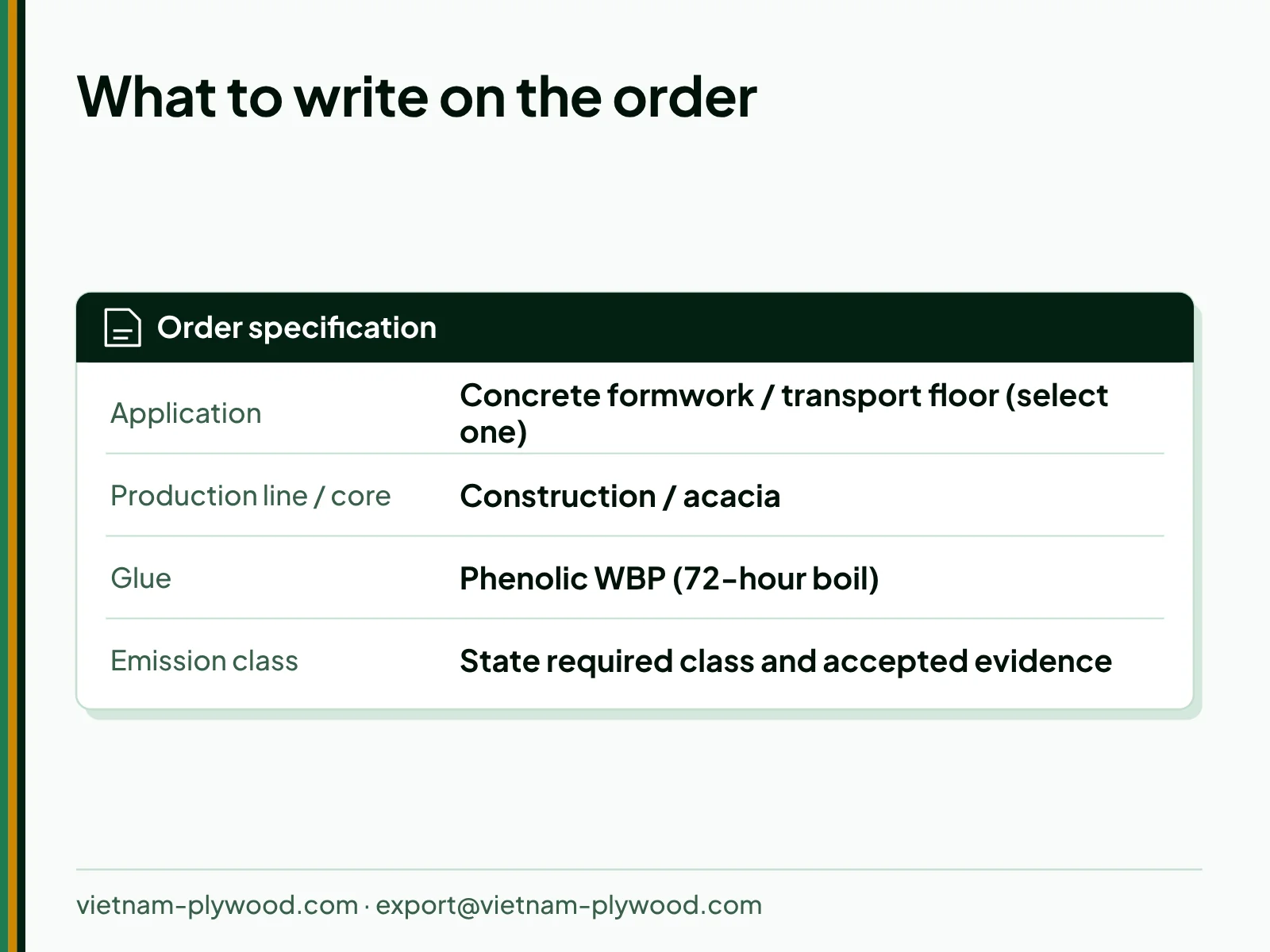
Application: concrete formwork / transport floor (select one)
Production line / core: construction / acacia
Glue: phenolic WBP (72-hour boil)
Emission class: state required class and accepted evidence
Face and grade: phenolic smooth film 135 g/m² / specify face acceptance;
  OR anti-slip film 220 g/m² / specify traction acceptance
Thickness and tolerance: 18 mm / ±0.5 mm
Size and tolerance: 1220 × 2440 mm / ±2 mm
Quantity: state sheets and proposed 40HC mix
Destination port: state port and delivery term
Inspection: film, dimensions, core and agreed bond test report
Next step: book a factory visit to inspect the selected construction-line build before shipment.