





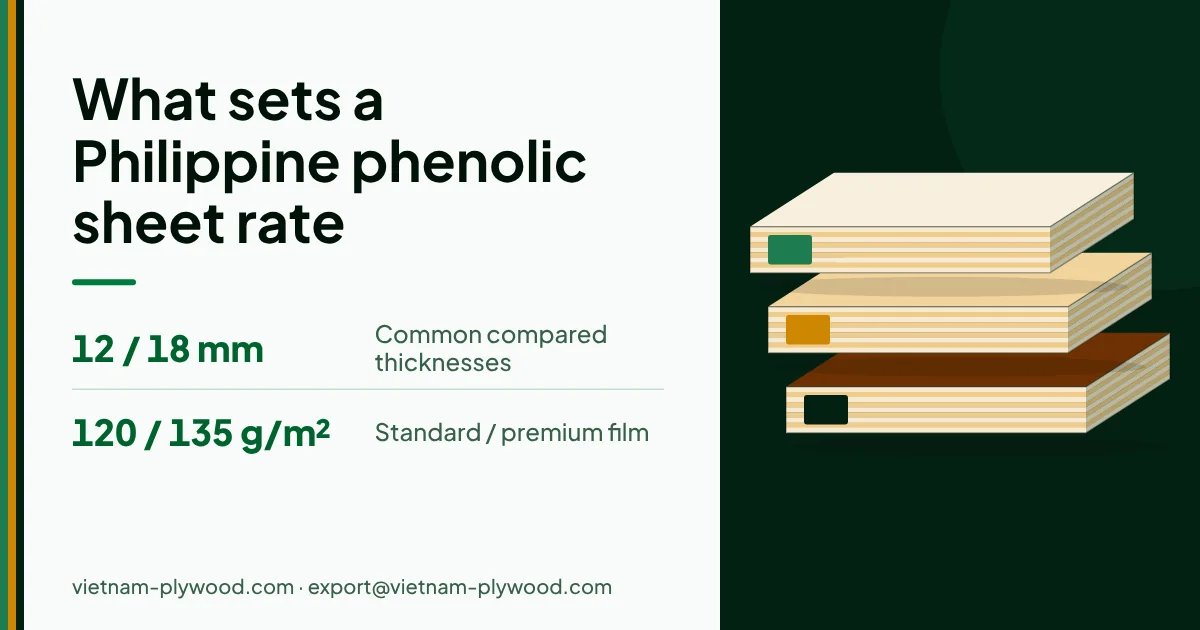
What decides phenolic board price in the Philippines?
For HCPLY, phenolic board price in the Philippines starts with thickness, then changes with the film surface, adhesive system, core construction and buying channel. A sheet quotation becomes useful only after the buyer matches its dimensions and specification to the intended pour cycle. Importers must also compare landed cost with the local delivered sheet rate, rather than compare currencies alone.
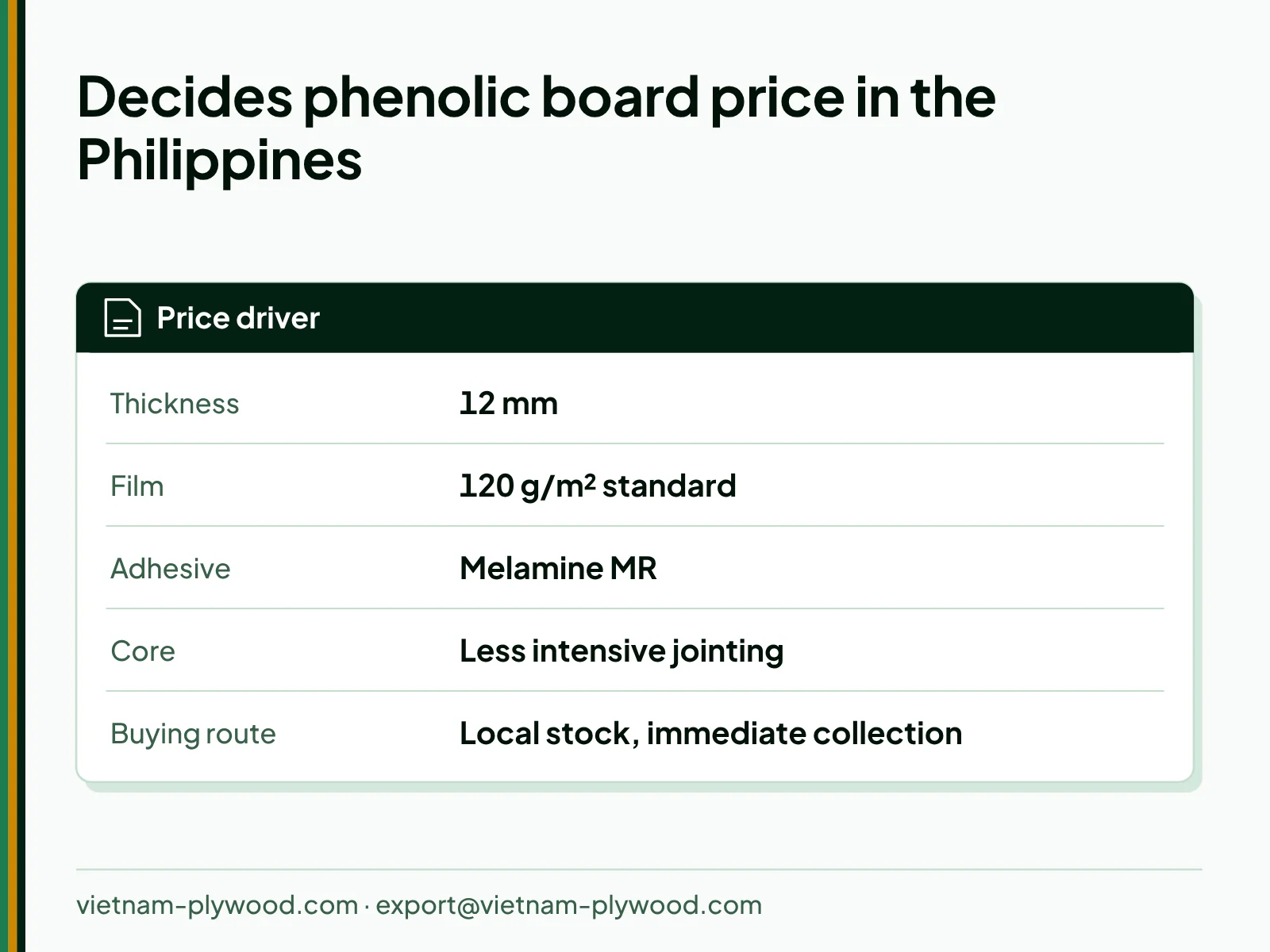
In Philippine construction purchasing, “phenolic board” commonly refers to film-faced plywood for concrete formwork. HCPLY presses this product on our construction line. An apparent saving can disappear when a thinner panel needs more support, damaged edges shorten service, or the import calculation omits destination charges.
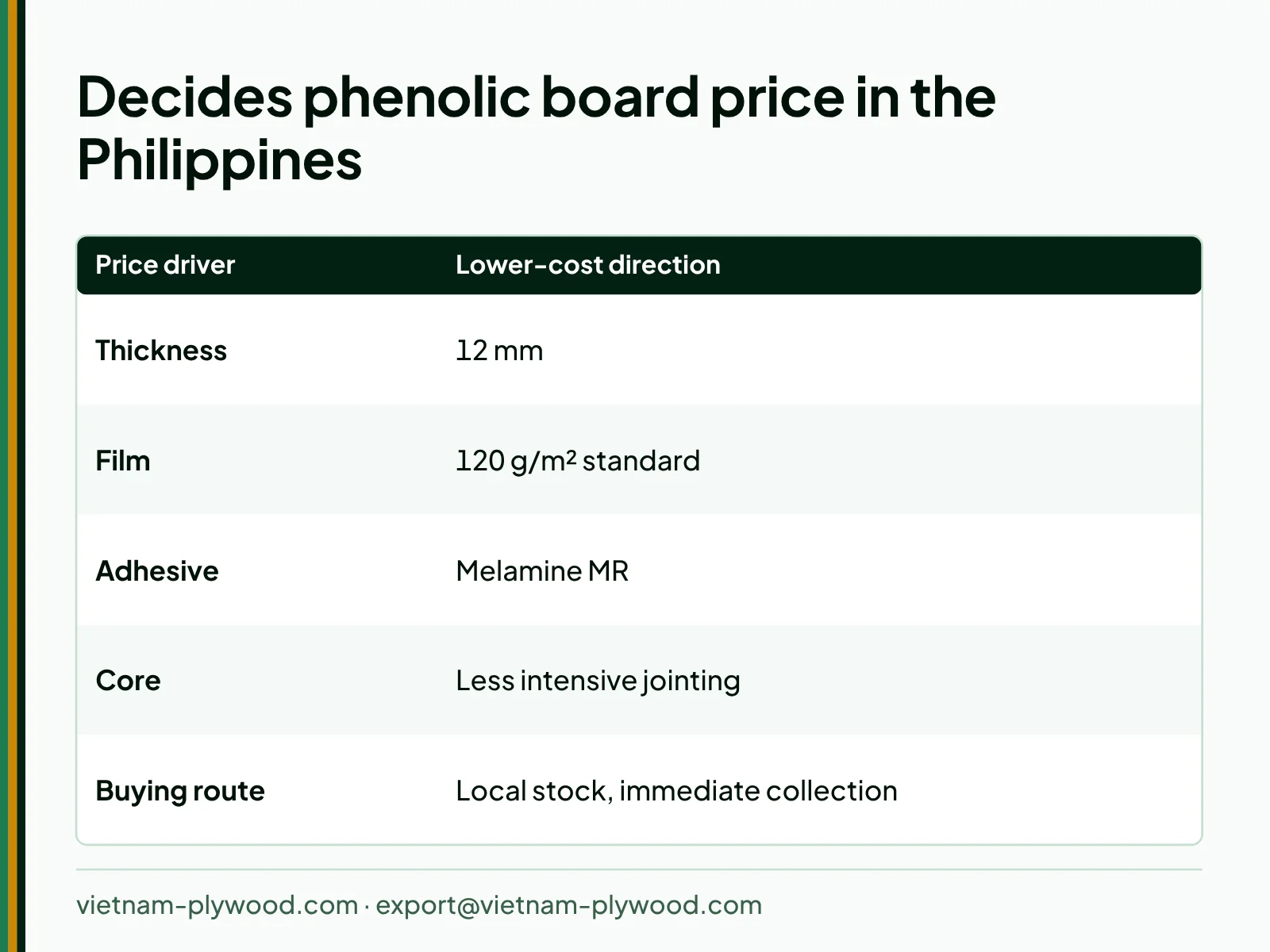
| Price driver | Lower-cost direction | Higher-cost direction | What to request |
|---|---|---|---|
| Thickness | 12 mm | 18 mm at the same build | Measured thickness and tolerance |
| Film | 120 g/m² standard | 135 g/m² premium; 220 g/m² anti-slip for its intended use | Film weight and surface |
| Adhesive | Melamine MR | Phenolic WBP for longer boil resistance | Glue specification |
| Core | Less intensive jointing | Full stitched veneers | Edge/core inspection |
| Buying route | Local stock, immediate collection | Imported shipment with freight and clearance | Same delivered location and quantity |
These directions explain the specification premium; they are not a Philippine retail price schedule. For the broader cost structure, see Vietnam plywood export cost factors.
Why do 1/2-inch and 3/4-inch sheets have different rates?
A nominal 1/2-inch sheet is commonly offered as 12 mm, while a nominal 3/4-inch sheet is commonly offered as 18 mm. The thicker sheet contains more wood and adhesive per square metre, adds shipment weight and changes handling requirements.
Compare nominal labels with the measured thickness on arrival. Our construction line offers a ±0.5 mm thickness tolerance and ±2 mm length/width tolerance; specify the ordered nominal dimension rather than assuming inch names are exact metric conversions. For 1220 × 2440 mm acacia-core sheets, 12 mm weighs 20.72 kg and 18 mm weighs 31.08 kg, excluding film.
A 4 × 8 sheet quotation must also state whether the actual dimensions are 1220 × 2440 mm. Otherwise a price per sheet can conceal a different area.
How do film, glue and core change the quotation?
Film weight sets the wear surface, glue sets bond durability, and the core controls panel integrity under repeated handling. The construction line presses phenolic or melamine film on acacia or eucalyptus core, with an unsanded base.
Our standard film is 120 g/m²; premium film is 135 g/m²; 220 g/m² is an anti-slip surface. A heavier anti-slip face should be specified for traction requirements, rather than treated as an automatic upgrade for a smooth concrete finish.
Melamine glue is MR, with a 12-hour boil specification; phenolic glue is WBP (weather and boil proof), with a 72-hour boil specification. With proper handling, a release agent on every pour and sealed edges including cut edges, melamine-glue film-faced panels yield about 12–15 pours, while phenolic-glue panels reach up to about 25 pours. Compare cost per pour against the intended handling plan.
Core options differ in veneer jointing: full stitched, stitched outer layers with edge-trimmed inner veneers, finger-jointed, then loose-laid. Ask for an edge sample and the chosen jointing construction before comparing rates.
Is phenolic board the same as film-faced plywood?
In Philippine formwork listings, phenolic board usually means film-faced plywood, but the name alone does not identify the glue inside. A dark film surface does not establish phenolic adhesive, core species or performance.
The purchase order should separate film type and weight from glue type. Our film-faced plywood specification describes the build; a buyer can witness edge inspection, thickness measurement and surface checks at the producing factory.
Do not confuse this construction panel with solid phenolic resin sheet or plastic-faced board. Those materials can have different substrates and procurement criteria, even when sellers use overlapping names.
How should Philippine local sheet listings be compared?
Local listings establish the selling unit and available variants, but they rarely provide all the factory-build fields needed for a like-for-like comparison. Ask the seller to quote the same thickness, sheet dimensions, adhesive, film and core construction.
For example, a 4 × 8 listing may present 12 mm and 18 mm as selectable variants.
A Philippine retail offer can be valuable for urgent site replenishment. Our 2026 plywood pricing analysis provides related export-pricing context.
How does an imported container compare with local sheet rates?
Compare imported phenolic panels on a delivered-per-usable-sheet basis after freight, duties, taxes, clearance and inland delivery. HCPLY quotes the written film-faced build rather than assigning a generic price to every construction grade.
For 18 mm, 1220 × 2440 mm acacia-core panels, the full 40HC reference load is 880 sheets, 47.15 m³ and 27.35 tonnes, excluding film weight. The payload ceiling is 28.5 tonnes, so actual mixed-load planning must account for film, pallets and other cargo. The container loading reference owns the complete loading calculation.
Use this worksheet: agreed FOB panel invoice + international freight + insurance where applicable + assessed import charges + port and clearance costs + inland transport + loss allowance, divided by usable sheets received. Convert currencies at the transaction’s documented exchange rate. Compare that result with a local quote delivered to the same site.
The Philippine Tariff Commission’s Philippine Tariff Finder, updated in 2026, covers tariff schedules for 2024–2028 and rules of origin. Check the correct classification and origin treatment for the exact imported product; the schedule itself does not supply a universal plywood duty rate. Philippine Tariff Finder.
Can commercial plywood share the same container?
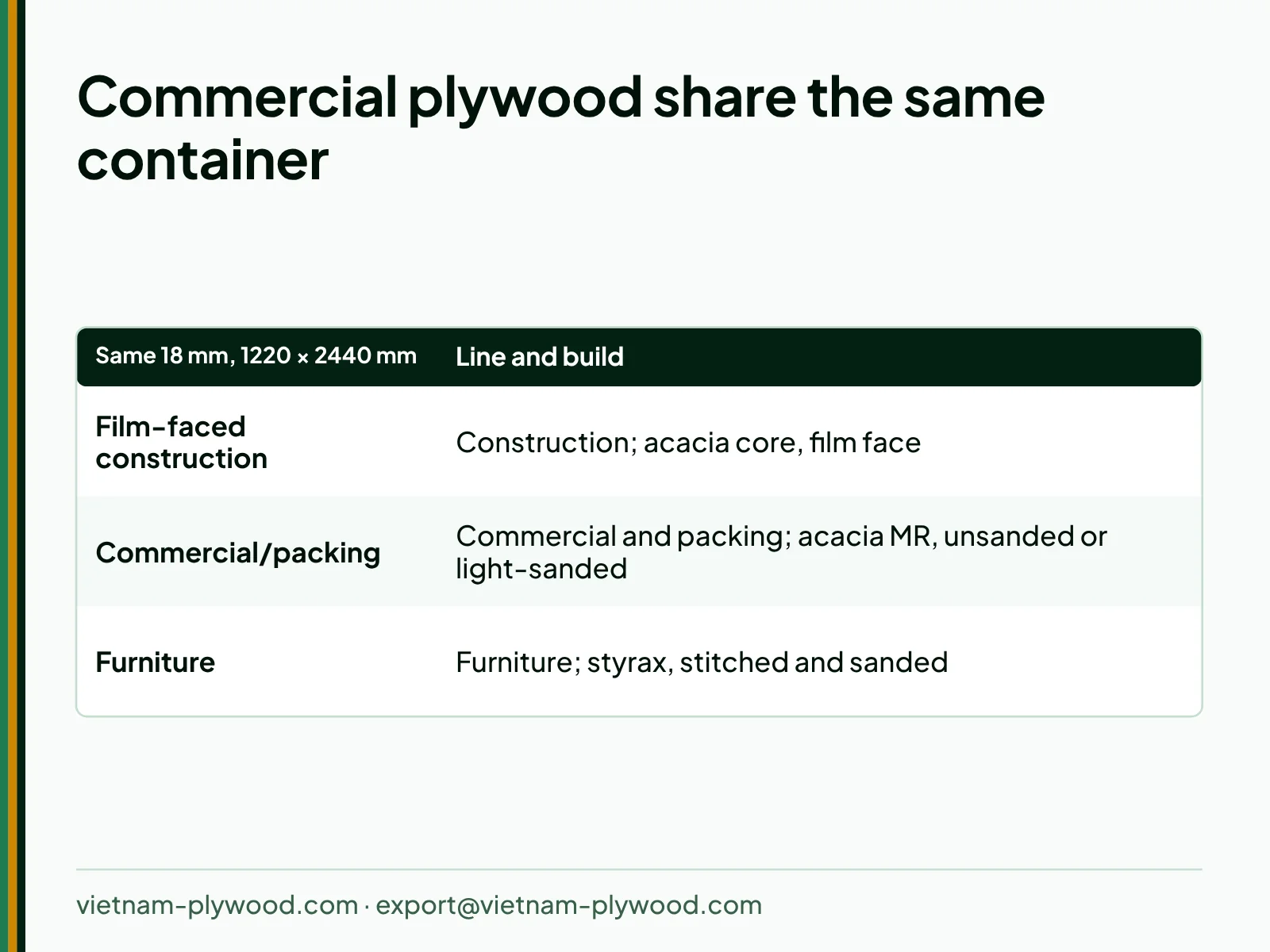
Yes. A 40HC can carry mixed specifications within the payload limit, so a formwork importer can combine construction sheets with commercial panels. The construction line presses the film-faced order, while our commercial and packing line makes acacia-core MR panels; our furniture line makes sanded styrax- or eucalyptus-core panels for interior work.
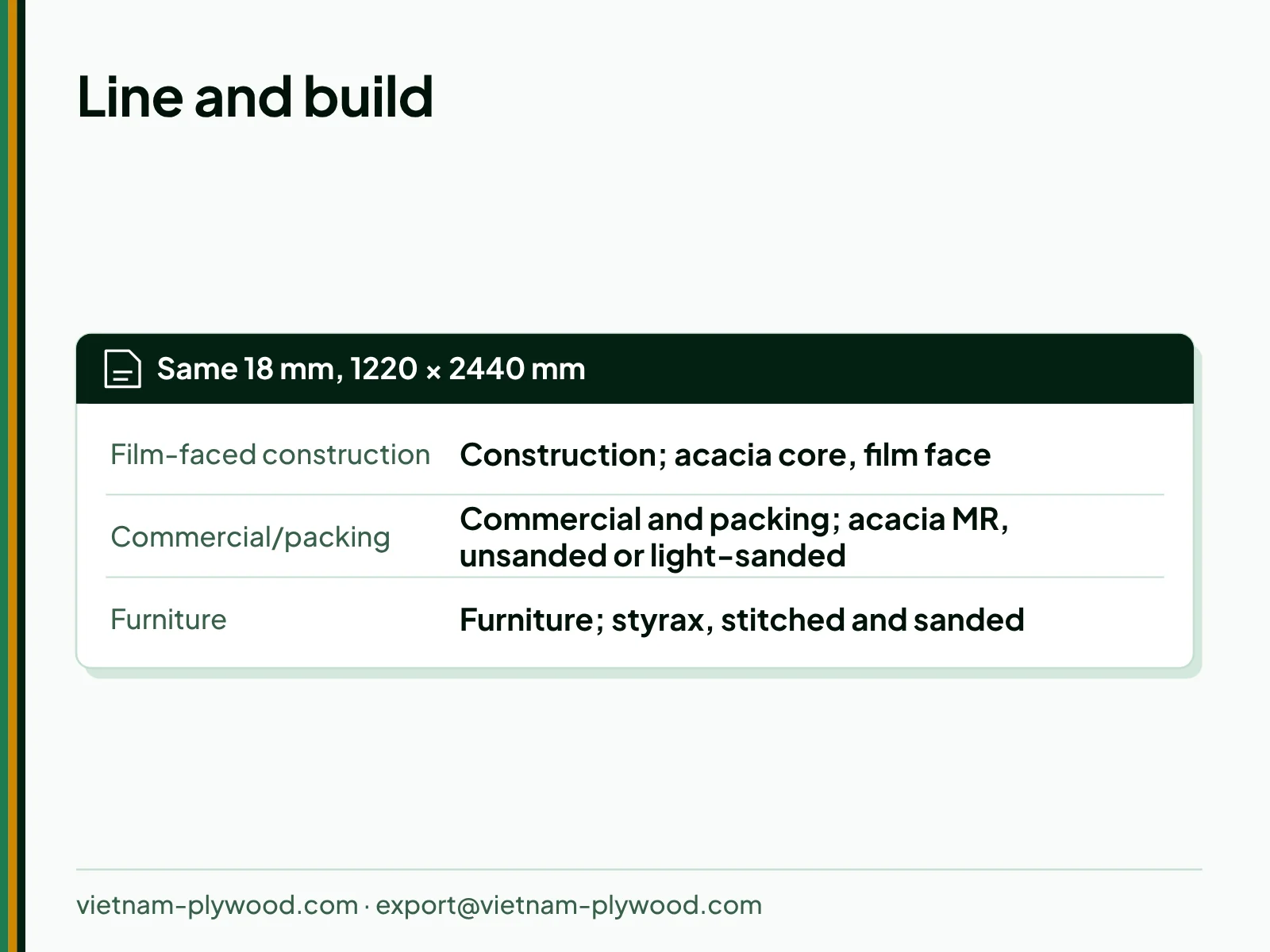
| Same 18 mm, 1220 × 2440 mm | Line and build | Reference sheet mass | Full single-core 40HC reference |
|---|---|---|---|
| Film-faced construction | Construction; acacia core, film face | 31.08 kg before film | 880 sheets, 27.35 t before film |
| Commercial/packing | Commercial and packing; acacia MR, unsanded or light-sanded | 31.08 kg | 880 sheets, 27.35 t |
| Furniture | Furniture; styrax, stitched and sanded | 26.79 kg | 990 sheets, 26.52 t |
These are full-load reference cases, not quantities to add together. For example, 400 acacia construction sheets and 400 acacia commercial sheets have a core-panel mass of 24.864 tonnes before film and packing. Reserve payload for those additions and calculate the actual pallet configuration. See factory-line grade comparison and several plywood types in one order.
Is plastic phenolic board priced above film-faced plywood?
Plastic phenolic board and film-faced plywood require separate quotations because their construction and service criteria can differ. A plastic-faced or solid-resin product cannot be priced from a plywood film-weight specification.
HCPLY does not press plastic phenolic board. For a contractor comparing options, request substrate composition, thickness, face material, fastening method, cleaning regime and documented reuse performance from each seller. Only then compare cost per usable pour, including repairs and handling.
An anti-slip film-faced panel is another distinct item: its 220 g/m² film serves a traction application. It should not be treated as equivalent to a plastic panel simply because both have a textured surface.
What drives a Crocodile-labelled board quotation?
A branded Philippine sheet quotation reflects the listed grade, thickness, channel and delivery terms. Brand names alone do not disclose veneer jointing, glue type or film mass.
For any Crocodile-labelled offer, request a specification sheet for the exact 12 mm or 18 mm variant and compare it against an unbranded factory specification on the same terms. The useful questions are whether the quoted sheet is dimensionally comparable, what core and adhesive it contains, and what happens when edges are cut or damaged.
HCPLY does not claim to manufacture another seller’s branded board. For a written alternative, we quote the construction-line specification and an agreed inspection scope rather than imitate a brand label.
What can the inspector check before shipment?
An inspector can measure thickness, length and width, examine exposed core edges, check film appearance and verify pallet identification at the producing factory.
Ask for glue and film specifications in the order record, then match the inspected goods to the packing list. If emission classification matters, list it separately from adhesive: E0, E1 and E2 are emission classes, while CARB P2 / TSCA Title VI concerns a US limit with third-party certification.
HCPLY manages specification, on-site quality control, export documents and loading. Member-factory certificates such as FSC, CARB P2, ISO 9001 and CE, and EUTR/EUDR documentation, are shown with factory details masked, on request. The agreed build and relevant reports should be checked before shipment release.
Which trade terms and documents affect the comparison?
The quotation must identify its delivery basis: FOB Hai Phong, CFR (CNF) or CIF. Factory lead time runs 15–45 days from receipt of the 30% deposit; the exact figure depends on order size, line loading and what the contract fixes; the 70% balance is against the scanned bill of lading, by T/T or irrevocable letter of credit at sight.
The minimum order is one 40HC. Samples are free; new buyers book their own courier, whose cost can be credited against a real order. For Philippine cargo, the shipment document set includes the commercial invoice, packing list, bill of lading, certificate of origin, phytosanitary and fumigation papers, insurance under CIF, plus agreed certificate or test documents. After loading, the draft shipping documents come to you for approval.
The invoice identifies the transaction value and the packing list identifies the goods being cleared. Agree those fields with the importer’s customs team before the vessel departs. For pricing components beyond the panel, see plywood pricing factors.
What specification should the buyer send?
Send a written construction-panel specification and destination port so Lucy can price the actual build. Include the local comparison’s dimensions and the intended formwork handling plan.
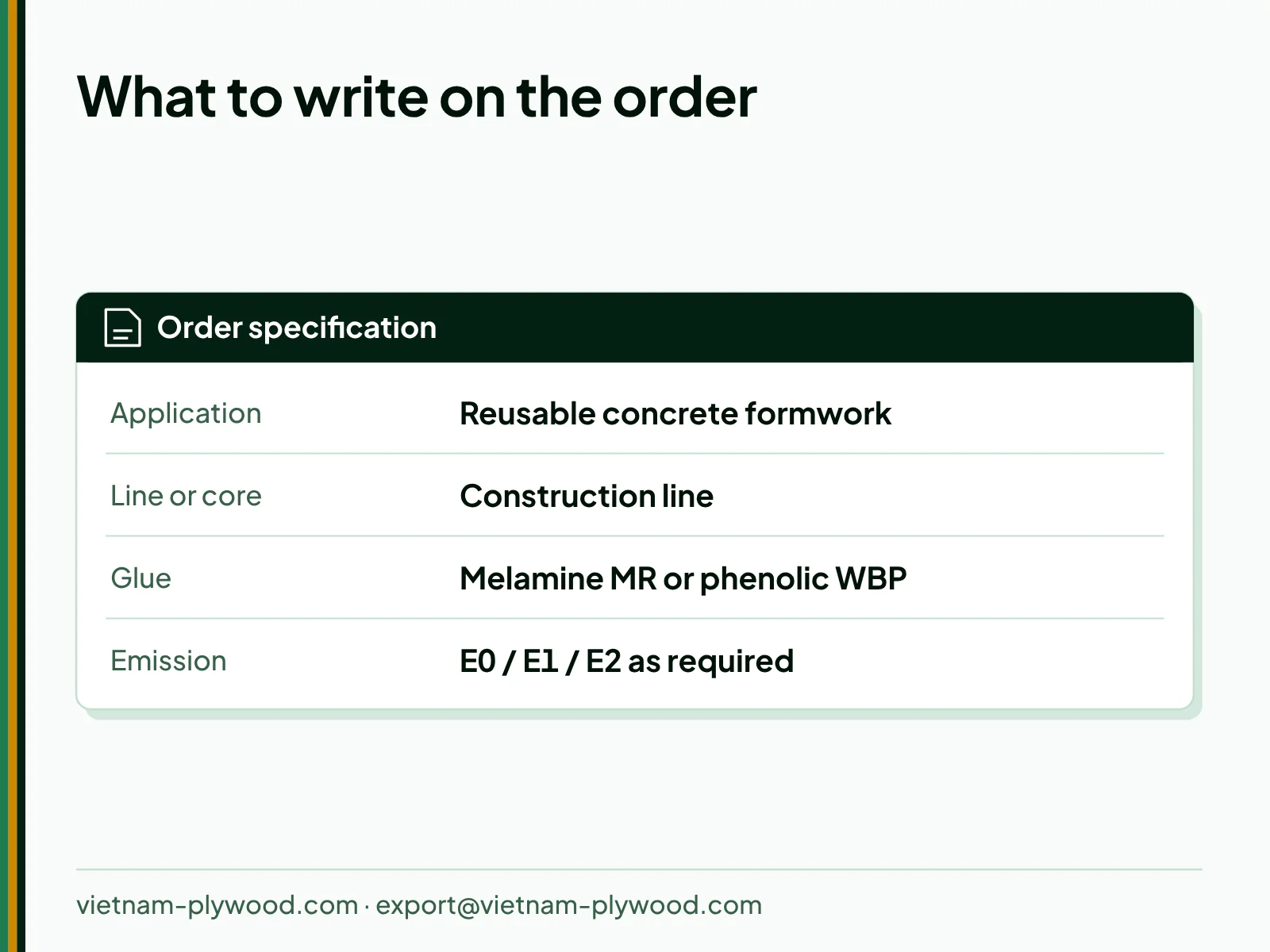
Application: Reusable concrete formwork; intended pour cycle: [state]
Line or core: Construction line; acacia or eucalyptus core; jointing: [state]
Glue: Melamine MR or phenolic WBP
Emission: E0 / E1 / E2 as required
Face and grade: Film-faced; 120 or 135 g/m² (220 g/m² anti-slip only if needed); grade: [state]
Thickness and tolerance: 12 or 18 mm; ±0.5 mm
Size: 1220 × 2440 mm or specified alternative; ±2 mm length/width
Quantity: [sheets], mixed specifications if needed; minimum one 40HC
Destination port: [Philippine port]; delivery basis: FOB / CFR / CIF
Ask Lucy at export@vietnam-plywood.com for a sample set through contact before finalizing the order.