





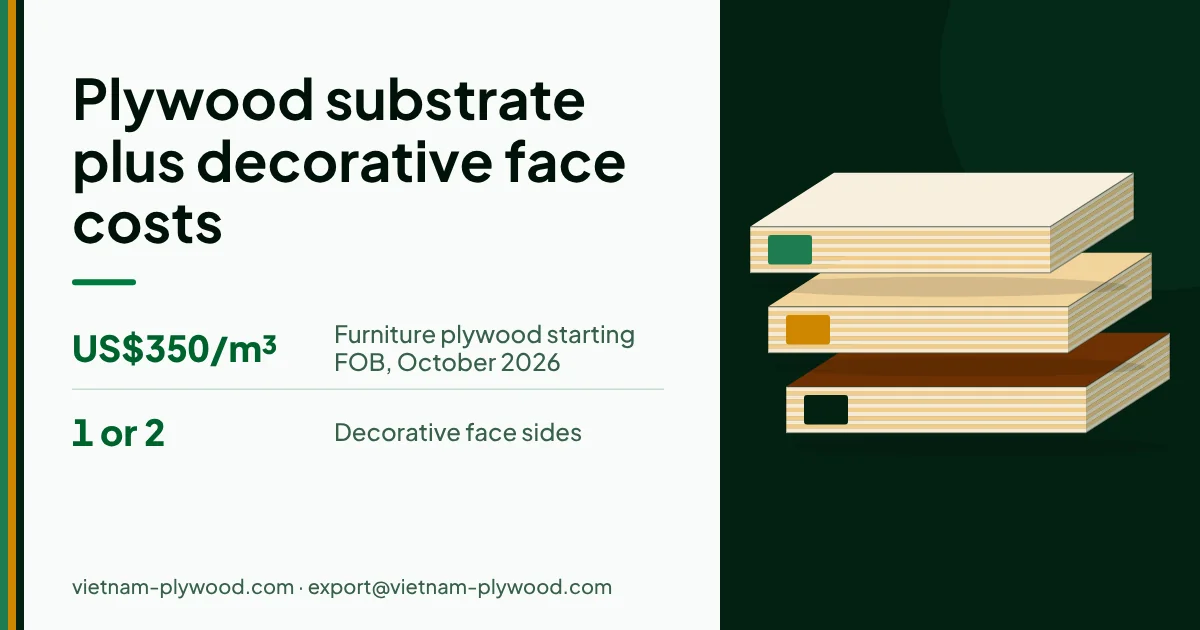
A laminated plywood price combines the plywood underneath with the decorative laminate and its pressing cost. Choosing an uneven substrate or an incomplete face specification can waste material and delay cabinet production. HCPLY makes calibrated furniture plywood in Vietnam for buyers arranging decorative lamination, with separate dated starting prices for the bare panel.
What determines laminated plywood price per m³?
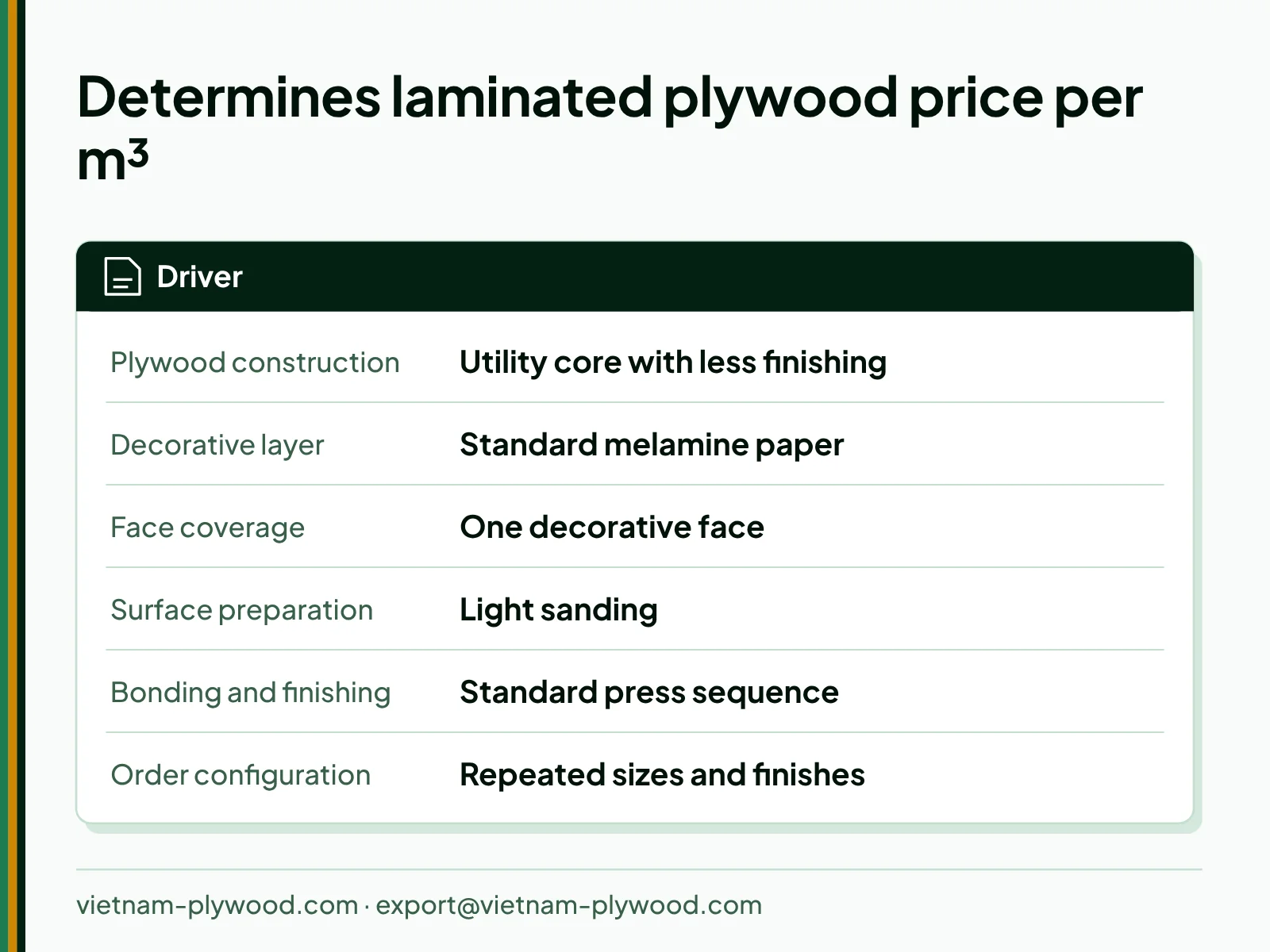
Laminated plywood price per cubic metre starts with the plywood substrate, then adds the chosen decorative surface, bonding work and finishing. The largest comparison errors come from changing the core build or face system while keeping the same product name. A quote should identify which party supplies and presses the laminate.
HCPLY manufactures plywood substrates; melamine, high-pressure laminate (HPL) and other decorative laminate faces are discussed here as downstream processes, not HCPLY product lines. For the broader cost structure, see Vietnam plywood export cost factors.
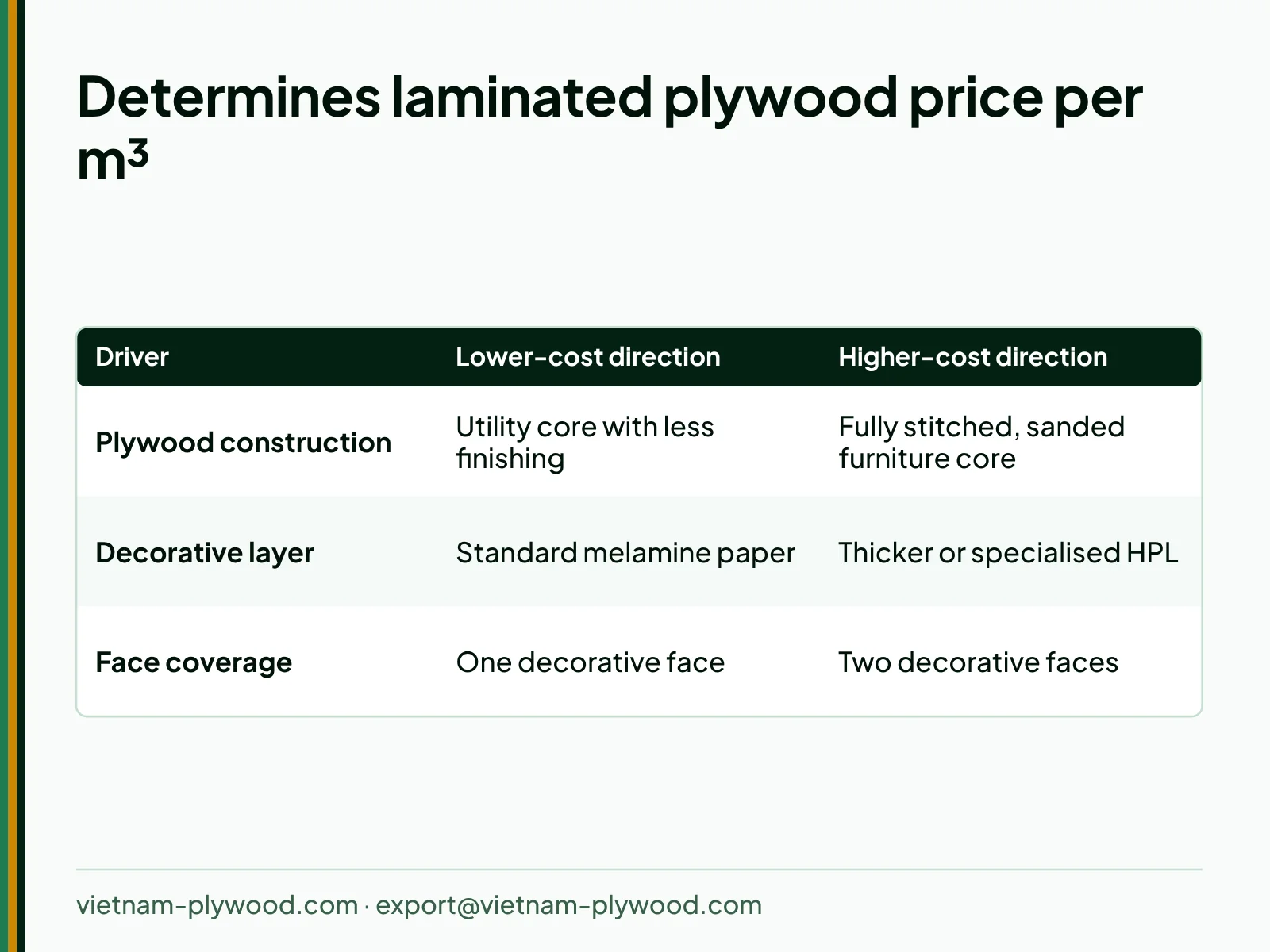
| Driver | Lower-cost direction | Higher-cost direction | What to specify |
|---|---|---|---|
| Plywood construction | Utility core with less finishing | Fully stitched, sanded furniture core | Core joining and calibration |
| Decorative layer | Standard melamine paper | Thicker or specialised HPL | Face material, design and grade |
| Face coverage | One decorative face | Two decorative faces | Front and reverse schedules |
| Surface preparation | Light sanding | Tight, consistent calibration | Thickness tolerance |
| Bonding and finishing | Standard press sequence | Extra adhesive, handling or trimming | Who performs each operation |
| Order configuration | Repeated sizes and finishes | Numerous decors or cut formats | Quantities by specification |
| Trade basis | Substrate FOB | Finished panel delivered | Scope, named port and freight |
This is an order of commercial decision points, not a numerical ranking of their percentage contribution.
How much of the price is the plywood underneath?
The plywood portion can be benchmarked using HCPLY’s dated starting prices: commercial plywood from US$250/m³ FOB Hai Phong (October 2026) and furniture plywood from US$350/m³ FOB Hai Phong (October 2026). These are prices for base plywood, not a finished laminated panel. The furniture substrate is the more relevant starting point when a decorative press needs a smooth, stable face.
A laminator’s finished-panel quote adds the selected paper or sheet laminate, adhesive where required, press operations, balancing back, waste allowance and any downstream machining. Without that separate laminate quotation, there is no defensible percentage of the final invoice attributable to the plywood.
The difference between the two base starting points reflects different builds rather than a fixed upgrade charge. Our furniture line uses a full stitched, sanded styrax or eucalyptus core, with E0 or E1 emission options. Our commercial and packing line uses acacia with moisture-resistant (MR) glue and an unsanded or light-sanded surface. For more detail, compare furniture-grade plywood cost.
Which HCPLY line builds a suitable laminating substrate?
Our furniture line presses the calibrated base panel used by an independent laminator for cabinet and fit-out faces. The other lines build different plywood for their own applications.
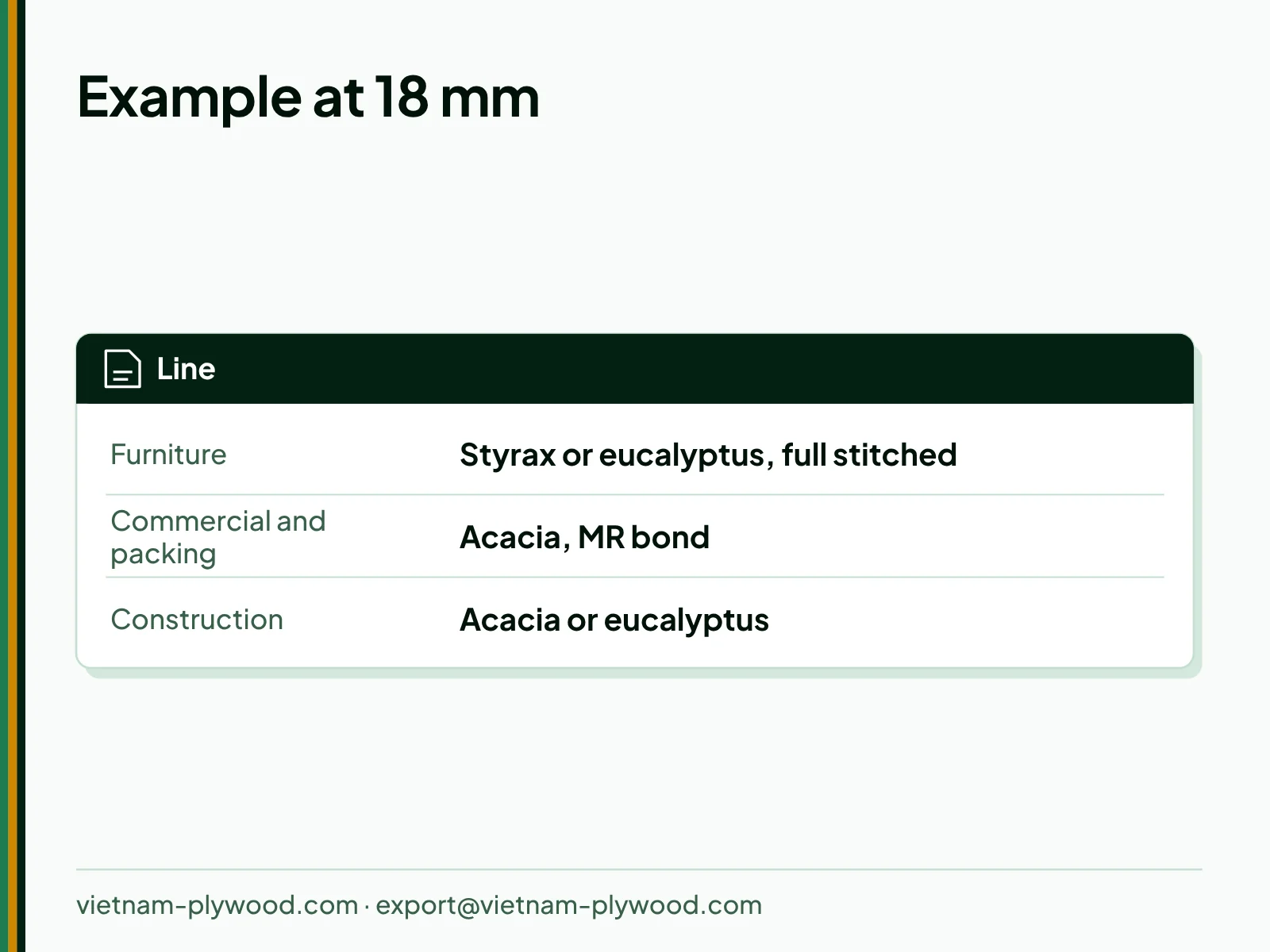
| Line | Example at 18 mm | Surface and core | Verdict for decorative lamination |
|---|---|---|---|
| Furniture | Styrax or eucalyptus, full stitched | Sanded; ±0.2 or ±0.3 mm as ordered | First choice for visible cabinet faces |
| Commercial and packing | Acacia, MR bond | Unsanded or light-sanded; ±0.5 mm commercial tolerance | Packing and utility applications; extra preparation for visible laminate |
| Construction | Acacia or eucalyptus | Phenolic or melamine film, unsanded; ±0.5 mm | Formwork face rather than decorative laminate substrate |
The film on our construction line is a formwork facing, not melamine décor paper. The construction line offers 120 g/m² standard film, 135 g/m² premium film and 220 g/m² anti-slip film. See the plywood manufacturer in Vietnam overview for the manufacturing scope.
Does one-side laminated plywood cost less than two sides?
One decorative face normally needs less decorative material than two equivalent faces. However, the reverse face may need a balancing layer to control panel movement after pressing. Therefore, a one-side laminated plywood price should include the back construction, even when the back is hidden inside a cabinet.
Ask for a front-and-back schedule rather than the phrase “single sided.” One quote may include a plain balancing paper; another may include a matching decorative sheet. Their face material cost, pressing work and appearance are different. If both sides remain visible, a matching two-sided build is easier to inspect for colour and texture consistency.
For a wardrobe carcass, the visible face and concealed reverse can have different cosmetic requirements. For a partition or door viewed from both sides, matching faces may be justified.
Is melamine-faced plywood cheaper than veneer-faced plywood?
Melamine décor paper is often a lower-cost surface route than a selected natural decorative veneer with its associated finishing, but the final comparison must hold the substrate constant. A veneer-faced panel may need sanding and subsequent coating; melamine paper is pressed to provide its decorative finish. A premium textured décor or a high-grade veneer can reverse a simplistic price assumption.
HCPLY offers veneer-faced furniture plywood with faces such as bintangor, okoume, engineered veneer (EV), gurjan, pine, poplar, eucalyptus, birch and sapele. Common face veneer thickness is 0.2–0.4 mm. Face grades are A/B, while birch faces use D/E/F.
A buyer comparing melamine plywood price against a veneer quotation should write down whether the veneer figure includes a final coating. Melamine, HPL and laminate faces are not HCPLY product lines. Our role in this comparison is to specify and inspect the plywood beneath the decorative surface.
How does HPL change the price compared with melamine?
High-pressure laminate typically adds more material and bonding work than directly pressed melamine décor paper. HPL is a separately manufactured sheet attached to the plywood, while melamine-faced board uses resin-impregnated decorative paper in a pressing process. HPL selection also introduces sheet thickness, surface finish, adhesive and edge-treatment choices.
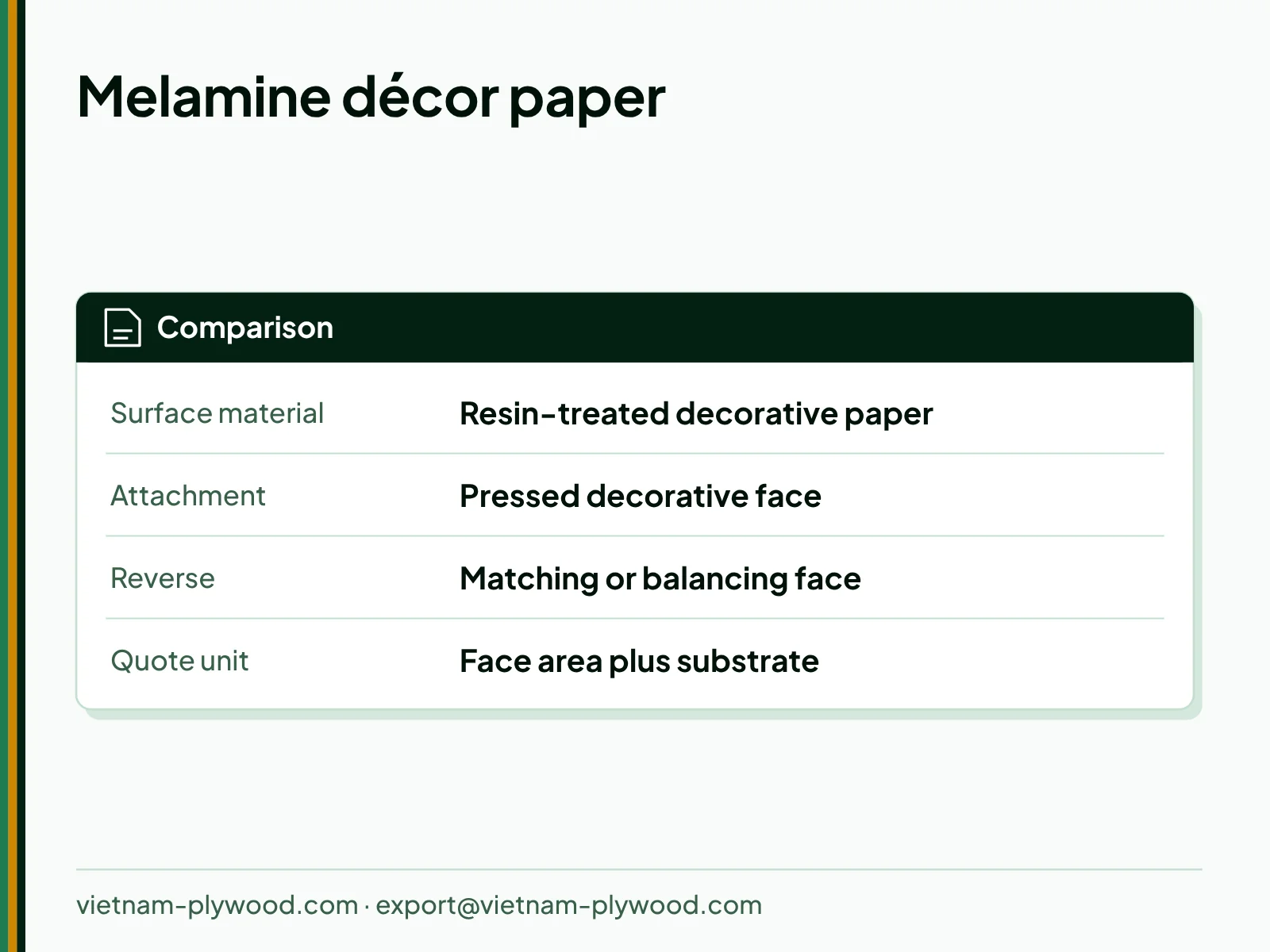
The October 2026 manufacturer discussion of HPL cost factors describes material composition, thickness, finish, production, order volume and logistics as variables. This supports treating HPL as a separate priced component rather than applying a universal uplift to plywood. Specify whether a mica plywood laminate sheet price refers to the HPL sheet alone or to the finished plywood assembly.
| Comparison | Melamine décor paper | HPL sheet | Buying verdict |
|---|---|---|---|
| Surface material | Resin-treated decorative paper | Separately made layered laminate | Melamine for routine cabinet interiors; HPL for more demanding wear surfaces |
| Attachment | Pressed decorative face | Separate adhesive and bonding step | HPL adds process variables |
| Reverse | Matching or balancing face | Backing or balancing specification | Price both sides explicitly |
| Quote unit | Face area plus substrate | Sheet/face area plus substrate | Convert only after dimensions are fixed |
A decorative HPL surface must not be confused with our phenolic formwork film. A request for hpl plywood price needs the decorative laminate specification and a separate finishing quotation.
Why do two quotes with the same product name differ?
Two “18 mm laminated plywood” quotations can describe different core densities, joining methods, face systems and included services. The buyer should first align the physical substrate, then align the decorative finish and delivery basis. A lower total may simply omit the back face, bonding or freight.
At HCPLY, styrax core density is 500 kg/m³, acacia 580 kg/m³ and eucalyptus 650 kg/m³. Core veneers are commonly 1.4–2.0 mm thick, with 18 mm plywood built from 11–13 plies. Full stitched core construction costs more to prepare than stitched outer layers with edge-trimmed inner layers; finger-jointed and loose-laid constructions sit below those options in the construction hierarchy.
Glue and formaldehyde emission are separate specification fields. MR melamine glue is associated with a 12-hour boil specification; phenolic weather-and-boil-proof (WBP) glue with 72 hours. E0, E1 and E2 describe emission classes. A US CARB P2 or TSCA Title VI requirement needs the applicable third-party certification evidence, rather than a change in the word used for glue.
How should 12 mm and 18 mm sheet prices be compared?
A laminated plywood price per sheet needs fixed dimensions and a clear distinction between substrate thickness and finished thickness. At identical length and width, 18 mm consumes more plywood volume than 12 mm, while both have the same decorative face area.
Costing follows base plywood volume × substrate rate + covered face area × laminate rate + pressing and finishing. Count each decorative side and the balancing reverse. This expression is a comparison method, not a finished-panel HCPLY quotation. State whether the furniture tolerance of ±0.2 or ±0.3 mm applies before laminating.
What changes when the order ships by container?
A substrate shipment is constrained by payload and core density before any decorative layer is added. For 18 mm, 1220 × 2440 mm base plywood, the full 40HC lookup is 990 styrax sheets at 26.52 t, 880 acacia sheets at 27.35 t or 795 eucalyptus sheets at 27.69 t. The planning payload limit is 28.5 t, and these figures exclude any decorative laminate weight.
Our furniture line’s styrax and eucalyptus options therefore produce different sheet counts even at identical dimensions. A buyer arranging lamination after import can plan substrate quantities using those figures, then calculate finished-goods packing independently. The container loading guide owns the wider loading calculation.
The minimum order is one 40HC, and specifications can be mixed within its payload limit. A mixed load can combine different furniture substrate faces and thicknesses if the order is written by specification. For a mixed build, the pallet plan needs a new weight check rather than copying a full-container figure from a single core.
What can an inspector check at the producing factory?
An inspector can check the plywood substrate before decorative pressing by measuring thickness, examining the exposed core edges and comparing the face to the agreed grade. At the producing factory, the buyer can also witness the selected packs and compare markings with the packing list. This inspection isolates substrate quality from later defects introduced during lamination.
For furniture plywood, the sanded tolerance is ±0.2 or ±0.3 mm as ordered; length and width tolerance is ±2 mm. Check several panels across packs and record where each measurement was taken. Inspect the face under angled light for sanding lines and repaired areas that could show through a thin decorative layer.
After the laminator presses the face, a separate acceptance check should cover colour, texture, flatness, edges and bond quality against its approved sample. HCPLY’s on-site QC concerns the plywood produced on our lines.
Which export documents matter for a laminating substrate?
The commercial invoice and packing list identify the agreed substrate and shipment quantities, while the bill of lading records the sea shipment. The order’s certificate documents can include an emission certificate, agreed test reports or an FSC claim on sales documents. Certificates held by member factories are shown with factory details masked, on request.
For EU lots, the export file includes EUTR/EUDR materials and EUR.1 certificate of origin as applicable. The European Commission’s 2026 EU Deforestation Regulation guidance describes wood and certain derived products within its scope and outlines operator due-diligence duties. Buyers should match their imported product classification and role to the European Commission’s EUDR overview.
HCPLY handles specification, factory QC, export documents and loading. After loading, the draft shipping documents come to you for approval. Delivery can be quoted FOB Hai Phong, CFR (CNF) or CIF; the buyer should compare the same delivery term before judging two landed prices.
What specification should a laminator send?
A laminator should request a substrate quotation with core construction, surface grade, thickness calibration and destination written explicitly. That lets the producing factory price the plywood while the laminator separately prices melamine or HPL work. A decorative face sample should be approved with the party performing that process.
Factory lead time runs 15–45 days from receipt of the 30% deposit; the exact figure depends on order size, line loading and what the contract fixes. The remaining 70% is paid on the scan of the bill of lading, by T/T, or by irrevocable sight L/C. Free samples are available; new buyers book their courier, and its cost can be credited against a real order.
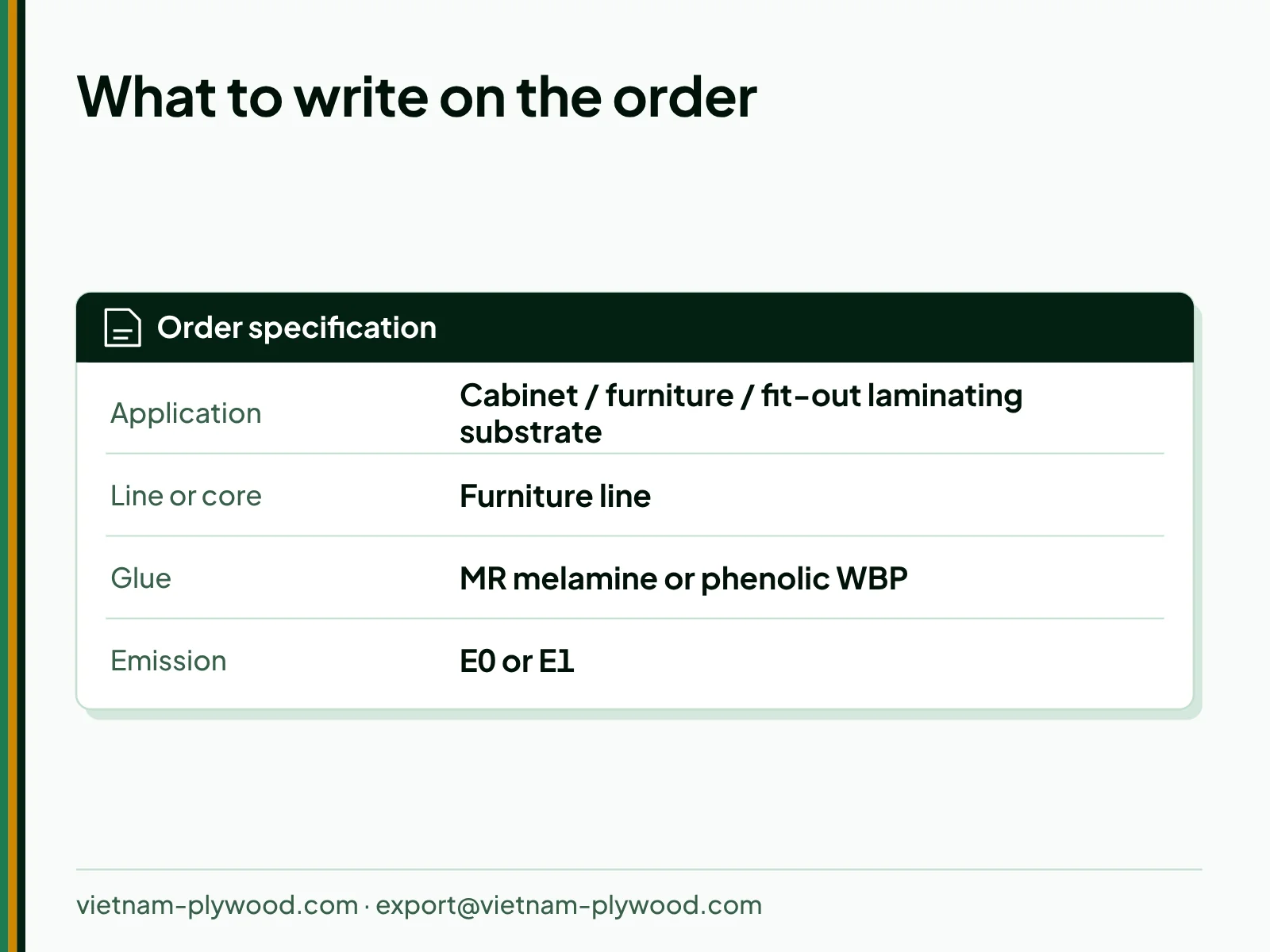
The plywood production lead-time guide covers scheduling questions. For a base-panel quote, send the following lines to Lucy at export@vietnam-plywood.com:
Application: cabinet / furniture / fit-out laminating substrate
Line or core: furniture line; styrax or eucalyptus; full stitched
Glue: MR melamine or phenolic WBP, as required
Emission: E0 or E1; destination compliance documents requested
Face and grade: specified veneer or matt; A/B (birch D/E/F)
Thickness and tolerance: 12 or 18 mm; ±0.2 or ±0.3 mm as ordered
Size: 1220 × 2440 mm or requested cut size
Quantity: sheets by specification; one 40HC minimum
Destination port: [port]; trade term: FOB Hai Phong / CFR / CIF
Decorative laminate: type, front/back and finish handled by laminator
Request the laminating-substrate specification sheet for the selected furniture build.