





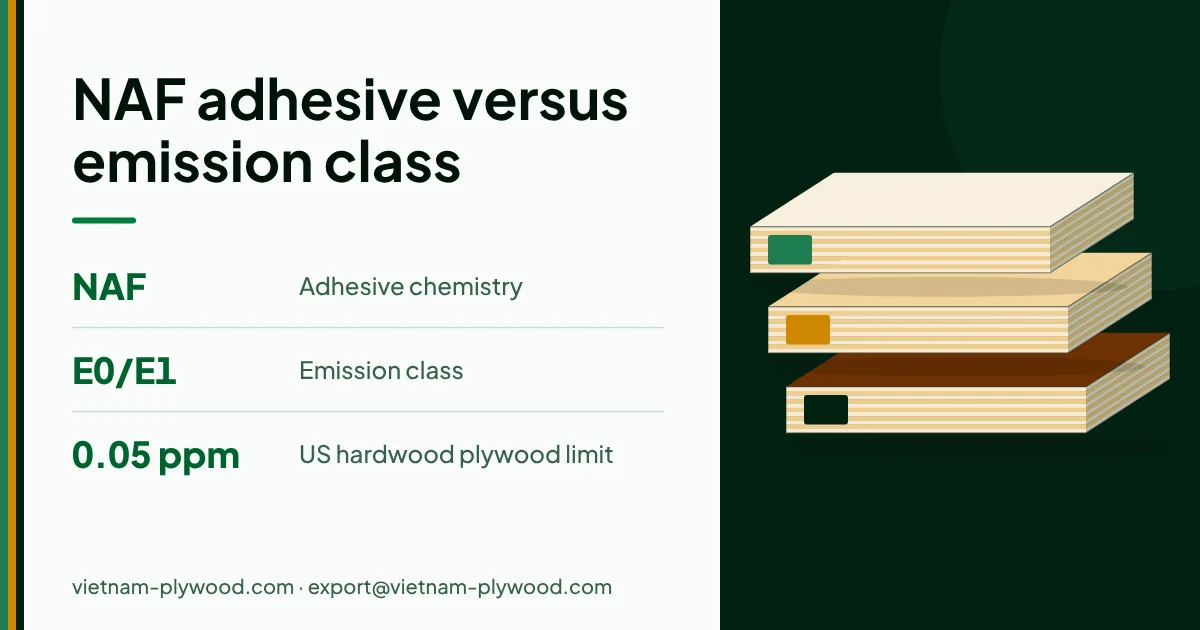
Formaldehyde free plywood is specified by adhesive chemistry and an emission evidence requirement; E0 or CARB P2 alone does not mean NAF. Choosing the wrong designation can mean another test cycle, a delayed cabinet programme or a rejected load. HCPLY separates standard E0/E1 furniture builds from a separately specified NAF upgrade so buyers can order the right panel and documentation.
What is formaldehyde free plywood?
Formaldehyde free plywood usually means plywood bonded with no-added-formaldehyde (NAF) adhesive, rather than a sheet with zero measurable emissions. Wood itself can release small amounts of formaldehyde. A purchasing specification should therefore identify both the adhesive formulation and the emission test or regulatory approval required for the destination market.
For furniture and cabinet orders, distinguish the glue chemistry from the emission class before approving a sample. A low-emission panel can pass an agreed test while still using a formaldehyde-containing resin. Conversely, a NAF adhesive description alone does not replace a panel emission report.
HCPLY’s furniture plywood is the relevant starting point for interior cabinet and fit-out applications. Our furniture line quotes E0 or E1 builds as standard; a NAF adhesive system is a separately specified upgrade requiring a written glue specification and an agreed evidence route. See the wider glue and emission category for related purchasing decisions.
What does NAF plywood mean?
NAF plywood uses adhesive formulated without added formaldehyde in the resin’s cross-linking structure. The California Air Resources Board (CARB), in its NAF/ULEF guidance, identifies soy, polyvinyl acetate (PVA) and methylene diisocyanate (MDI) as examples of NAF resin chemistry (CARB guidance).
NAF describes how the panel is bonded; it does not promise a zero reading from the finished wood panel. The CARB guidance also distinguishes ultra-low-emitting formaldehyde (ULEF) resin, which contains formaldehyde but achieves emissions below the applicable Phase 2 standard.
A procurement team should ask whether every adhesive used in the panel build qualifies. CARB’s NAF FAQ explains that a panel containing a phenol-formaldehyde layer does not become NAF simply because another veneer layer is bonded with PVA (CARB FAQ). That distinction matters for multi-stage lamination and veneer assembly.
Is E0 plywood formaldehyde free?
E0 plywood is an emission-class specification, not proof of a NAF glue formulation. The label alone cannot establish the test method, result or resin ingredients. Buyers should state the applicable method and acceptance limit alongside the E0 requirement.
Our furniture line offers E0 and E1 emission-class builds with full stitched, sanded styrax or eucalyptus cores. Those classes belong in the emission field of the order; glue chemistry belongs in a separate field. Calling a panel “E0 glue” would obscure the distinction that the inspection and laboratory documents need to preserve.
For a practical discussion of interior exposure and panel selection, see plywood formaldehyde safety. For a broader terminology comparison, see plywood glue types and emission standards.
How do NAF, E0 and CARB P2 compare?
NAF identifies resin composition; E0 describes an emission class; CARB Phase 2 (P2) is a regulated emissions limit with a compliance framework. These labels answer different purchasing questions, so an RFQ should never substitute one for another.
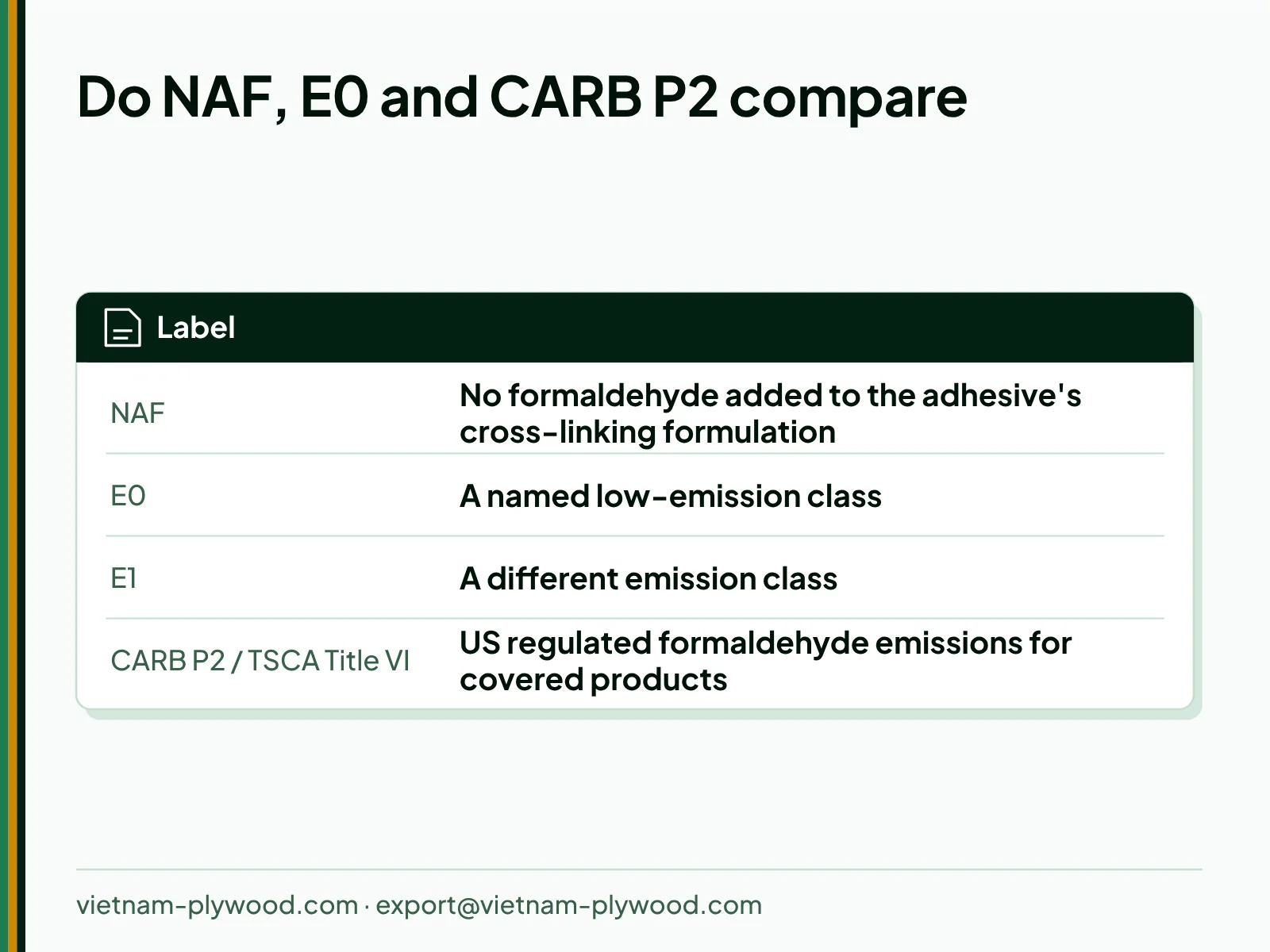
| Label | What it measures or describes | Evidence to request | Buying verdict |
|---|---|---|---|
| NAF | No formaldehyde added to the adhesive’s cross-linking formulation | Resin declaration, panel construction traceability and applicable NAF approval evidence | Specify when adhesive chemistry is part of the contract |
| E0 | A named low-emission class | Report naming the test method, class limit and measured result | Specify for an agreed emission-class purchase |
| E1 | A different emission class | Report against the named E1 method and threshold | Use when the buyer’s applicable specification calls for E1 |
| CARB P2 / TSCA Title VI | US regulated formaldehyde emissions for covered products | Third-party certification, compliant panel labeling and supporting test records | Use the US compliance route for covered hardwood plywood |
The US Environmental Protection Agency (EPA), in its 2026 consumer FAQ, lists 0.05 ppm as the TSCA Title VI limit for hardwood plywood with veneer or composite core (EPA FAQ). CARB P2 and the federal emission limits are aligned, but a bare P2 claim is not a substitute for the applicable US certification and labeling documents.
The EU’s 2023 Regulation 2023/1464 adds a formaldehyde release restriction of 0.062 mg/m³ for furniture and wood-based articles from 6 August 2026, with stated exclusions and its own test conditions (EUR-Lex regulation). This is a separate legal test context, rather than an automatic conversion of an E0 or US report.
Which glue is used for no-added-formaldehyde plywood?
A genuine NAF specification names the proposed resin system, such as PVA, soy-based or MDI-based adhesive, and identifies every bonded layer it covers. The factory then needs to establish that the selected formulation works with the requested veneer assembly and processing route.
Our standard glue descriptions are melamine moisture-resistant (MR), associated with a 12-hour boil specification, and phenolic weather-and-boil-proof (WBP), associated with a 72-hour boil specification. Those are glue and durability descriptions, not NAF designations. A low measured emission from a phenolic panel does not turn its adhesive into NAF.
Adhesive selection must also match moisture exposure, bonding performance and the buyer’s agreed test. For water exposure, review whether plywood is waterproof and what a plywood boiling test demonstrates. A boil result addresses bond durability; it does not measure formaldehyde release.
Is a NAF glue line standard or an upgrade?
A NAF glue line is an upgrade request on our furniture line; E0 and E1 are the standard emission-class options. The upgrade requires a resin specification, production agreement and a matching evidence plan before an order is accepted as NAF.
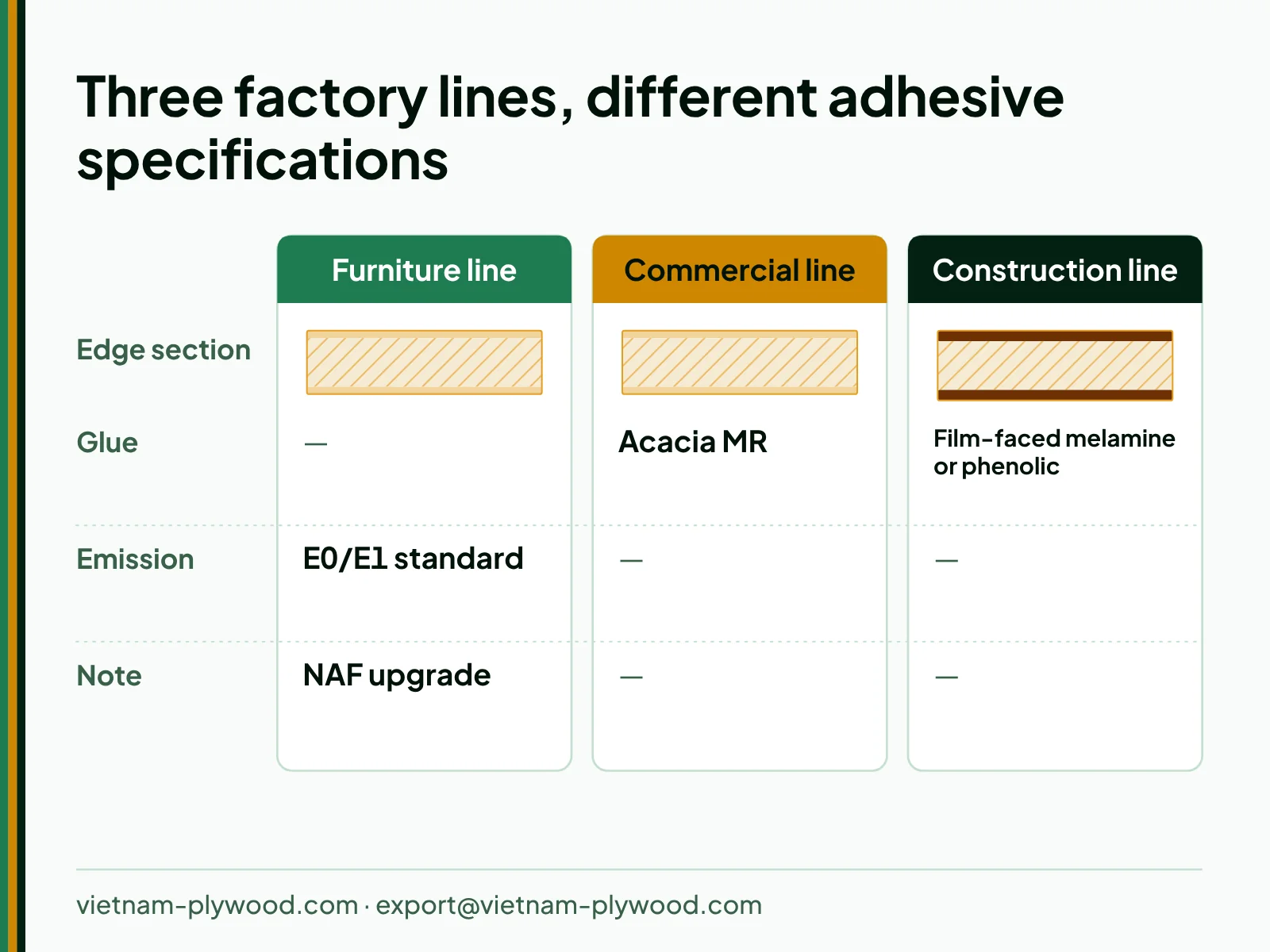
| Producing line | Standard construction for an 18 mm request | Emission or glue discussion | Suitable purchasing use |
|---|---|---|---|
| Our furniture line | Full stitched, sanded styrax or eucalyptus core | E0/E1 standard; NAF separately specified | Cabinet carcasses, furniture and fit-out panels |
| Our commercial and packing line | Acacia core, unsanded or light-sanded | MR glue; no NAF designation from the standard build | Commercial uses and export packing |
| Our construction line | Acacia or eucalyptus core, film-faced and unsanded | Melamine or phenolic system; film weight specified separately | Concrete formwork and construction use |
An 18 mm panel typically has 11–13 plies, depending on veneer thickness. A buyer seeking a NAF furniture panel should avoid replacing the requested furniture construction with a packing or film-faced build solely because its nominal thickness matches. The factory-line comparison explains the wider build differences.
HCPLY has three member factories in Phu Tho and Hai Phong. Each order is made at the producing factory that matches its specification, with on-site QC and direct shipment from that location.
Which test report proves the claim?
The correct evidence is a report for the agreed panel construction, test method and limit, backed by adhesive documentation when the claim concerns NAF chemistry. A generic resin brochure or an unrelated panel’s laboratory result cannot establish the delivered lot’s specification.
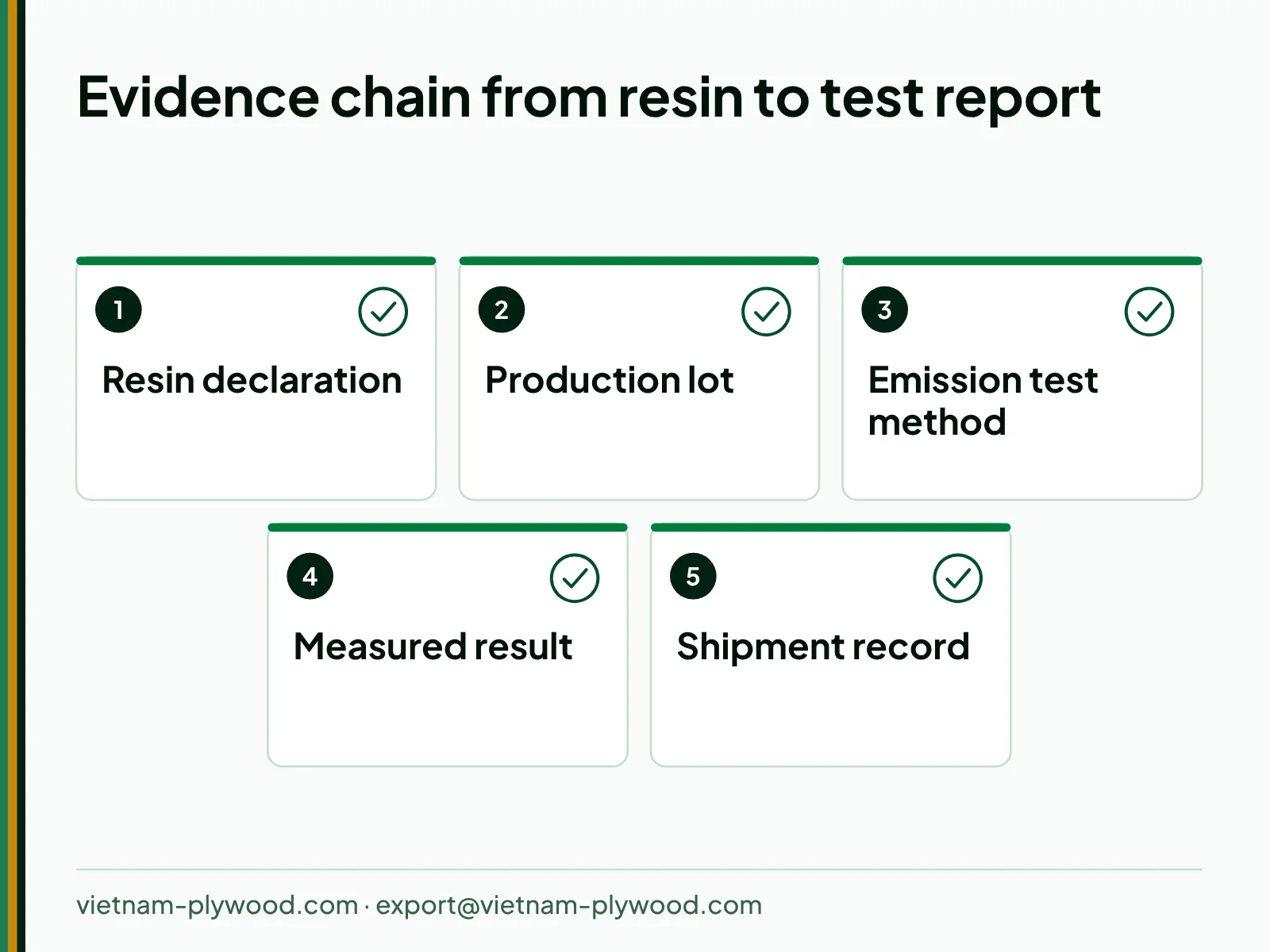
For covered US hardwood plywood, the EPA’s 2016 rule and 2026 guidance describe third-party certification, emissions testing and panel labeling under TSCA Title VI (EPA rule summary). The report and certificate trail should identify the relevant producing facility, product type, method and applicable compliance route.
For E0 or E1, request the laboratory’s actual result and the test method defining the claimed class. For a NAF requirement, request the adhesive formulation declaration and the approval or certification documents required by the destination market, together with emissions evidence. A test result establishes measured emissions under stated conditions; the resin record establishes what was added to the glue.
Certificates held by member factories, including CARB P2 documents, are shown with factory details masked, on request. The buyer can review the relevant certificate and test report for the agreed build before the shipment documents are finalized.
What can an inspector witness at the factory?
An inspector can compare the approved glue and emission specification against the production records, panel identification and sampling plan at the producing factory. This provides a practical link between the ordered build and the laboratory evidence.
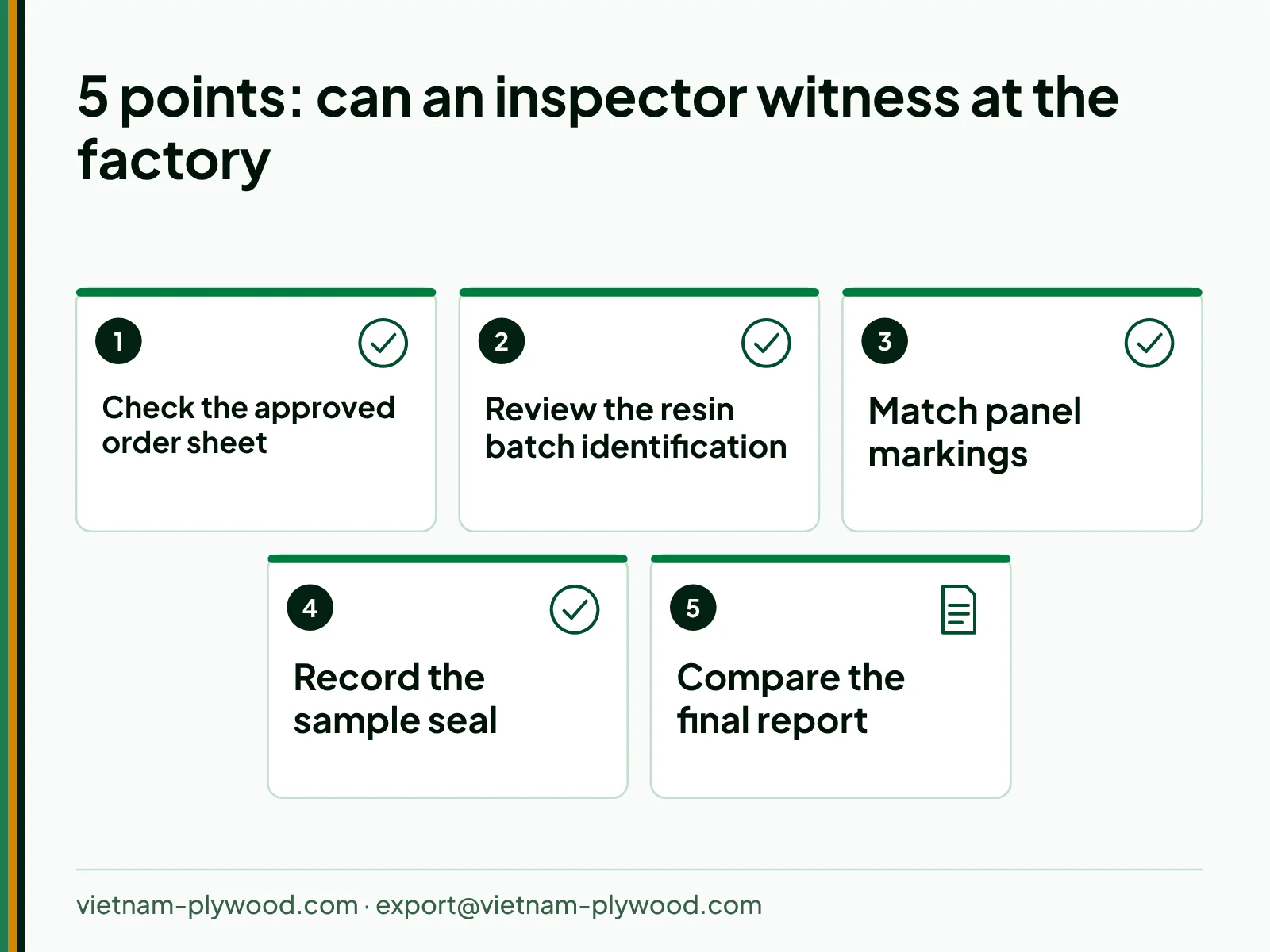
- Check the approved order sheet for separate glue, emission and core fields.
- Review the resin batch identification and adhesive application records for the production run.
- Match panel markings, thickness, face grade and production lot to the sample selected for testing.
- Record the sample seal, laboratory destination and report reference in the inspection file.
- Compare the final report with the buyer’s agreed test method and acceptance threshold.
Buyers visit the factory office and inspect goods at the producing factory. HCPLY manages specification, on-site QC, export documentation and loading. This inspection approach is particularly valuable when an upgrade differs from the factory’s standard furniture recipe.
How should a mixed container be planned?
A mixed container can combine furniture specifications when the pallet plan and payload limit permit. For example, 18 mm, 1220 × 2440 mm styrax-core furniture panels weigh 26.79 kg per sheet in the planning lookup; the full single-build reference is 990 sheets, 53.05 m³ and 26.52 t.
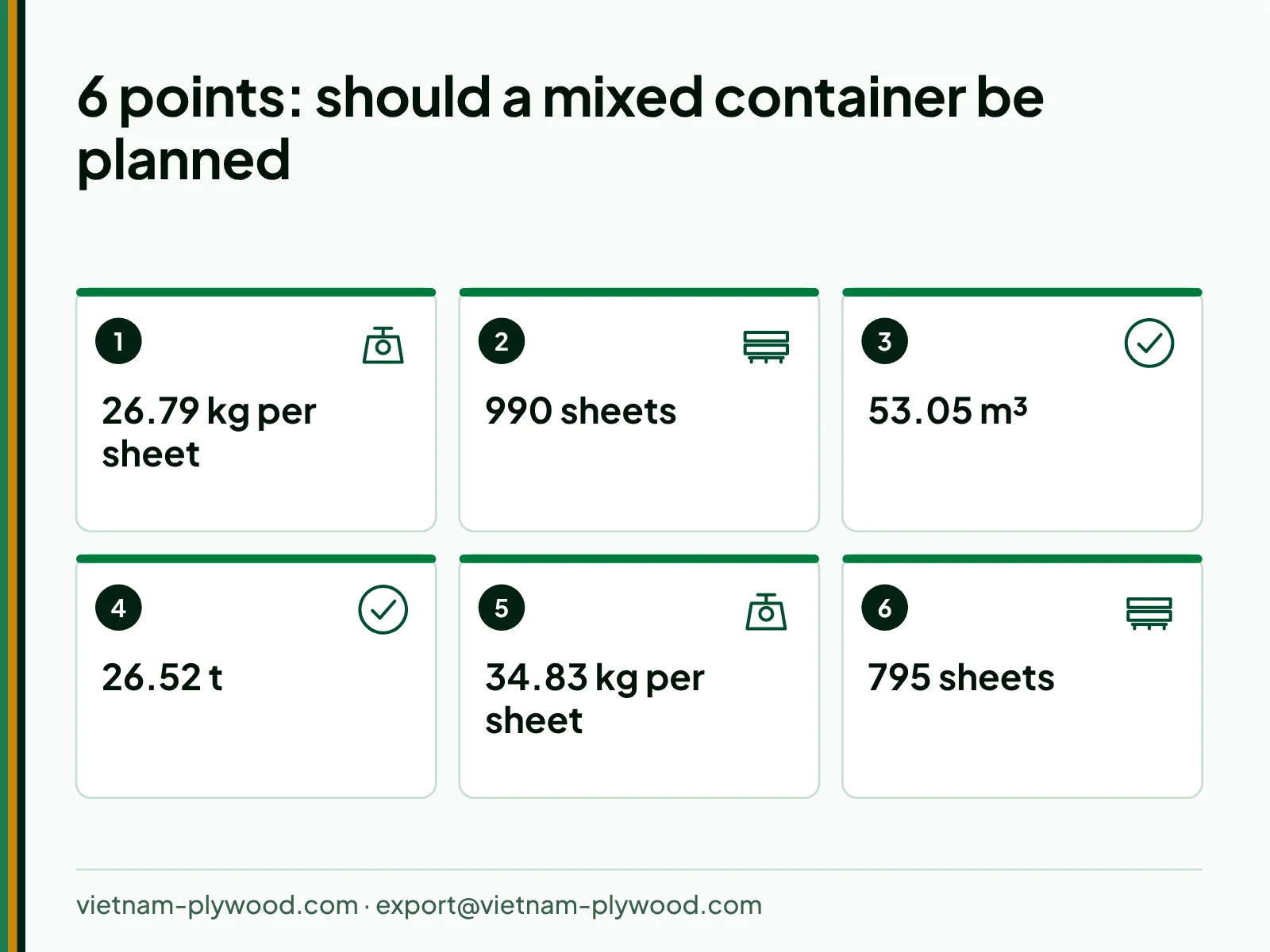
An equivalent 18 mm eucalyptus-core furniture build weighs 34.83 kg per sheet, with a full reference of 795 sheets, 42.60 m³ and 27.69 t. These figures exclude any film weight and are planning references for the stated cores and dimensions. A NAF resin choice still requires its own approved specification.
The 40HC payload ceiling is 28.5 t. Mixing the two core types changes the sheet count and weight balance, so the final pallet plan should be calculated from the actual mix rather than adding two full-container totals. See container loading calculations and distributor supply programmes for the related logistics questions.
What affects the quotation and export paperwork?
The main quotation drivers are the NAF resin upgrade and its evidence requirements, followed by core construction, face selection, thickness and order mix. A separately qualified NAF adhesive build costs more than the standard E0/E1 furniture configuration because it adds a different resin and qualification route. The price should be requested against a written specification.
Standard furniture plywood starts from US$350/m³ FOB Hai Phong (October 2026). That dated starting figure is for furniture plywood, rather than a NAF upgrade quotation. The minimum order is one 40HC, and specifications can be mixed within the payload limit.
Production is 15–45 days after the 30% deposit, depending on quantity, production conditions and agreement. The 70% balance is against the scanned bill of lading (B/L), by telegraphic transfer (T/T) or irrevocable letter of credit (L/C) at sight. We ship FOB Hai Phong, or CFR (CNF) or CIF to your port.
For a shipment, the commercial invoice, packing list and B/L identify the agreed goods. The shipment documents also include the certificate of origin (EUR.1 for EU lots), phytosanitary and fumigation papers, insurance under CIF, and applicable order certificates and test reports; EU lots include the EUTR/EUDR file set. After loading, the draft shipping documents come to you for approval. The emission certificate or agreed test report is the document that addresses the panel emission requirement.
How should a buyer specify a trial order?
A useful trial specification names the intended cabinet application, the producing line, resin chemistry and the exact emission acceptance route. It also fixes the face, dimensions and destination so the factory can quote and prepare representative inspection samples.
HCPLY can discuss a sample build with Lucy at export@vietnam-plywood.com. Samples are free; new buyers book their courier, and that courier cost can be credited against a real order. For an agreed NAF upgrade, ask for the resin and test documentation together rather than relying on the phrase “plywood without formaldehyde.”
Application: Cabinet carcasses / interior furniture
Line or core: Furniture line / styrax or eucalyptus core
Glue: NAF adhesive upgrade; resin chemistry to be agreed
Emission: Named test method, limit and report required
Face and grade: Okoume A/B (or specified alternative)
Thickness and tolerance: 18 mm, sanded ±0.2 mm as ordered
Size: 1220 × 2440 mm
Quantity: One 40HC, with proposed specification mix
Destination port: [buyer to enter]
Next step: plan a trial container against this specification and its evidence requirements.