





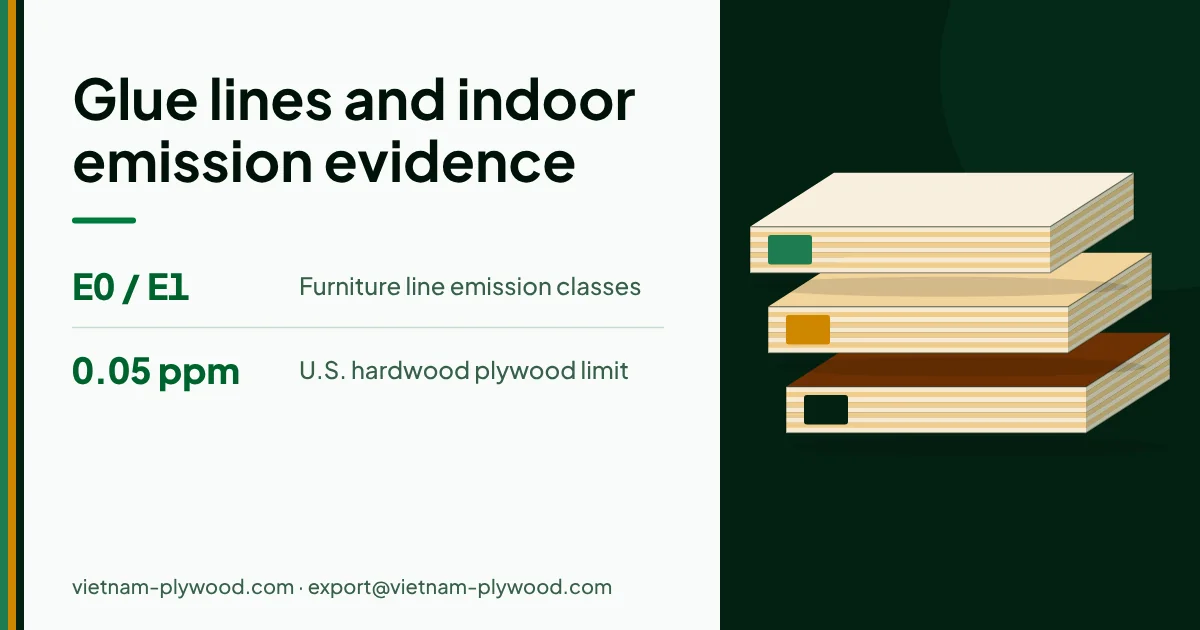
Plywood can release formaldehyde from its adhesive bonds, although the amount depends on the resin and tested panel. Choosing an unsuitable emission specification can mean rejected cabinet stock, replacement costs and delayed fit-out work. At HCPLY, our furniture line makes indoor plywood to an ordered emission class, with the producing factory’s supporting report available on request.
Does plywood have formaldehyde?
Yes. Many plywood adhesives contain formaldehyde-derived chemistry, and finished panels can release measurable formaldehyde into surrounding air. Wood also contains naturally occurring traces, but the industrial adhesive system is the main specification decision for a plywood buyer. The relevant purchasing question is the measured emission from the finished build under a stated test method, rather than whether its label says “safe.”
The U.S. Environmental Protection Agency (EPA), in its 2016 rule summary, explains that formaldehyde used in wood-product adhesives can enter indoor air. For procurement, specify the application and emission target before choosing a face veneer. Our glue and emission topic library separates bonding performance from emission requirements.
Does all plywood contain formaldehyde?
No. Plywood can use adhesive systems without intentionally added formaldehyde, while ordinary bonded plywood can still release small amounts. “No added formaldehyde” describes resin formulation; it does not mean that a laboratory will necessarily measure zero formaldehyde from a finished wood panel.
The 2025 U.S. Code of Federal Regulations, 40 CFR Part 770, recognizes limited certification exemptions for qualifying no-added-formaldehyde and ultra-low-emitting-formaldehyde resin systems. Those exemptions require their own technical conditions. Read our no-added-formaldehyde plywood explanation before writing either term into a purchase order.
A low-emission designation also differs from a statement about the glue’s moisture resistance. A panel might meet an indoor emission target while having a bond specification unsuitable for wet service. Conversely, a moisture-resistant adhesive does not automatically establish indoor emission compliance.
Where does formaldehyde in plywood come from?
The adhesive layers between veneers are the principal manufacturing-related source; natural wood contributes a separate background. Plywood consists of peeled veneers assembled with glue, then pressed into a bonded sheet. The resin formulation, application and cure influence what remains available to release after pressing.
In our furniture line, the relevant procurement fields are the specified glue system and the separate E0 or E1 emission class. Our commercial and packing line uses acacia core with moisture-resistant (MR) glue. Our construction line makes film-faced panels with phenolic or melamine film and its own specified bond system.
For bonding choices, melamine MR is associated with a 12-hour boil specification and phenolic weather-and-boil-proof (WBP) with a 72-hour boil specification in our product definitions. These are bond-performance descriptions, not emission measurements. The distinction is developed in WBP glue versus MR glue.
Does Vietnamese plywood contain formaldehyde?
Vietnamese origin alone does not determine formaldehyde emission: the adhesive and finished-panel test result do. A Vietnamese plywood order should identify its intended indoor use, producing line, emission target and accepted test method. An origin declaration cannot replace those fields.
HCPLY operates three member factories in Phu Tho and Hai Phong. Our furniture line uses styrax or eucalyptus cores, full-stitched construction and sanded faces for cabinet and furniture applications. Buyers can inspect the ordered build at the producing factory and request the relevant emission evidence with factory details masked.
We name products by face veneer, while density follows the core. A bintangor-faced styrax-core panel and an okoume-faced eucalyptus-core panel need separate build descriptions even if both are ordered for cabinets. The furniture plywood specification page covers the indoor panel family.
Which line and emission class should an indoor order use?
Our furniture line is the starting point for indoor cabinet plywood specified to E0 or E1; the other lines serve different uses. Emission class and glue type must appear as distinct entries on the order. CARB Phase 2 (P2) and Toxic Substances Control Act (TSCA) Title VI describe U.S. regulated emissions with third-party certification, rather than a universal synonym for E0.
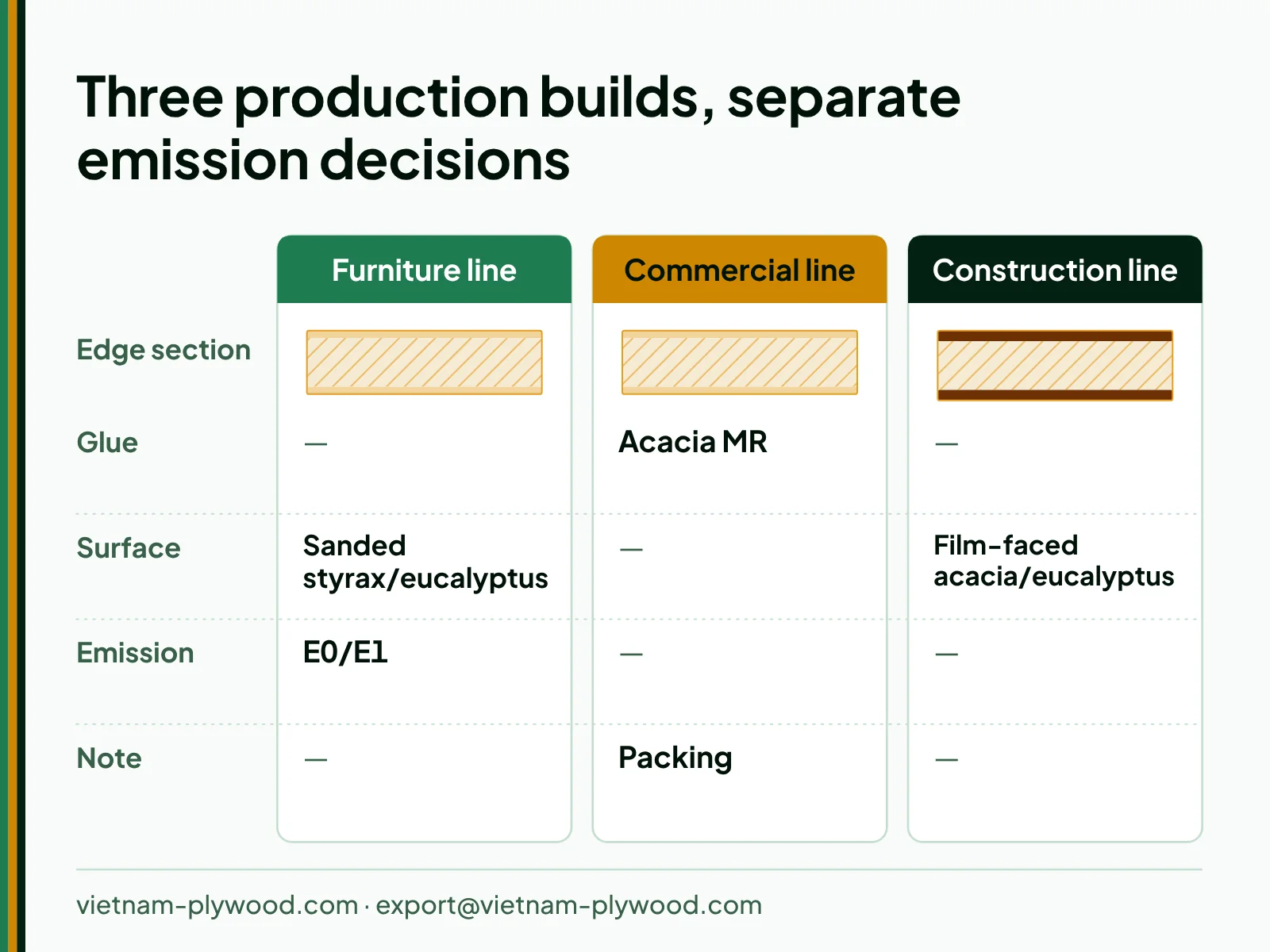
| Production line | Typical core and finish | Glue or bond field | Emission decision and buyer use |
|---|---|---|---|
| Furniture | Styrax or eucalyptus; full stitched, sanded | Specify glue separately | E0 or E1 ordered for cabinets and indoor furniture; request the applicable report |
| Commercial and packing | Acacia; unsanded or light-sanded | MR | Packing and commercial use; do not substitute its build for a tested indoor furniture order |
| Construction | Acacia or eucalyptus; film-faced, unsanded | Phenolic or melamine build | Formwork and construction use; film and boil performance do not establish an indoor class |
An 18 mm furniture panel can be ordered with ±0.2 mm or ±0.3 mm thickness tolerance; commercial and film-faced tolerances are ±0.5 mm. Thickness and sanding affect fit, but neither is a formaldehyde result. For a cabinet tender, specify the emission target independently of thickness and face grade.
E0, E1 and E2 are emission-class terms; their numerical limits depend on the applicable standard and test method. Avoid comparing an E0 figure from one method with a CARB P2 figure from another without matching conditions. Our E0 versus CARB P2 comparison explains why the standard reference belongs beside the class.
Is plywood safe for indoor use?
Indoor suitability is assessed against the destination’s emission rules and the finished product’s tested performance. Formaldehyde exposure can irritate eyes, skin, nose and throat, and higher exposure can have serious long-term health consequences. The EPA’s 2016 consumer guidance identifies these health concerns, which is why emission evidence matters for cabinets and interior joinery.
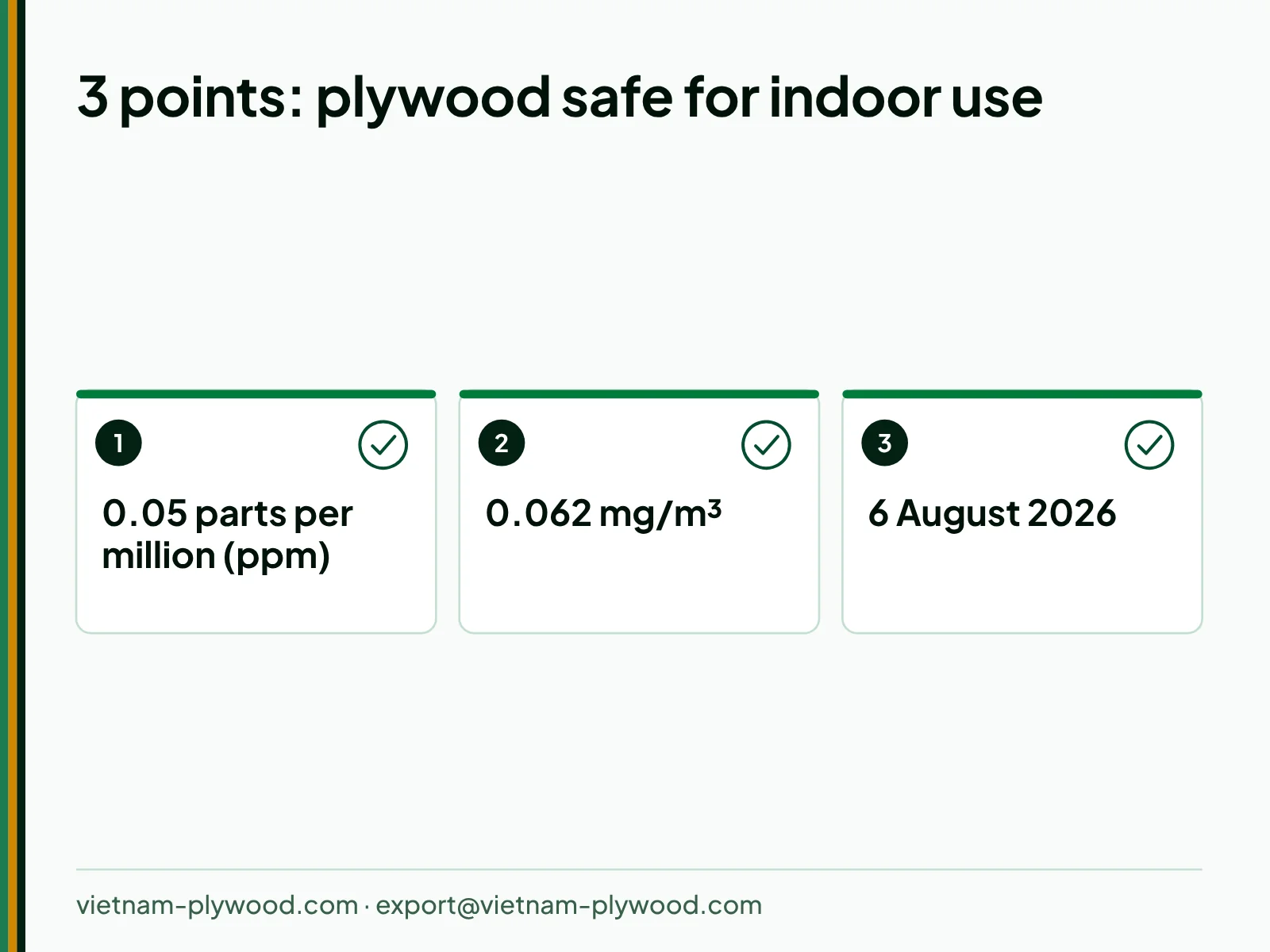
For regulated U.S. hardwood plywood with veneer or composite core, 40 CFR Part 770 (2025) lists a formaldehyde emission limit of 0.05 parts per million (ppm). Its 2016 rule requires recognized third-party certification for covered panels. A supplier’s informal description of “low emission” does not replace the required U.S. compliance documentation.
The European Commission’s 2023 Regulation (EU) 2023/1464 sets 0.062 mg/m³ for furniture and wood-based articles under specified chamber conditions, applicable after 6 August 2026, with defined exceptions. That is an article-level restriction; it is not simply another spelling of an E1 panel grade. An importer should match the proposed end product and testing basis to the applicable market rule.
Indoor air also receives emissions from other products and materials. A panel test characterizes the panel under its stated conditions; it does not measure an entire finished room. Cabinet makers should keep material records aligned with the finished assembly’s requirements.
How long does plywood offgas?
Plywood can continue releasing residual formaldehyde after manufacture, but there is no defensible universal number of days for every resin and room. The release pattern is affected by panel chemistry, temperature, humidity, ventilation and exposed surface area. An older sheet is therefore not automatically a substitute for a compliant emission report.
The European Commission’s 2023 regulation acknowledges that emissions from articles are expected to decline over time through off-gassing. That observation gives no fixed clearance date for a particular shipment. For a project deadline, commission or request a test performed under the specified method instead of waiting an arbitrary period.
Sealing, coating and cabinet fabrication can change exposed surfaces and the finished assembly. Any claim about a coated assembly should be supported by testing for that configuration. Avoid treating odour, storage duration or a dark adhesive line as a quantitative test.
What report proves a plywood order’s emission level?
A report identifies the tested panel, method, measured result and comparison limit; a generic certificate image cannot establish the ordered build. Request the report tied to the producing factory and verify the specimen description against the purchase specification. For a U.S.-regulated order, also check the relevant third-party certification and labeling records.
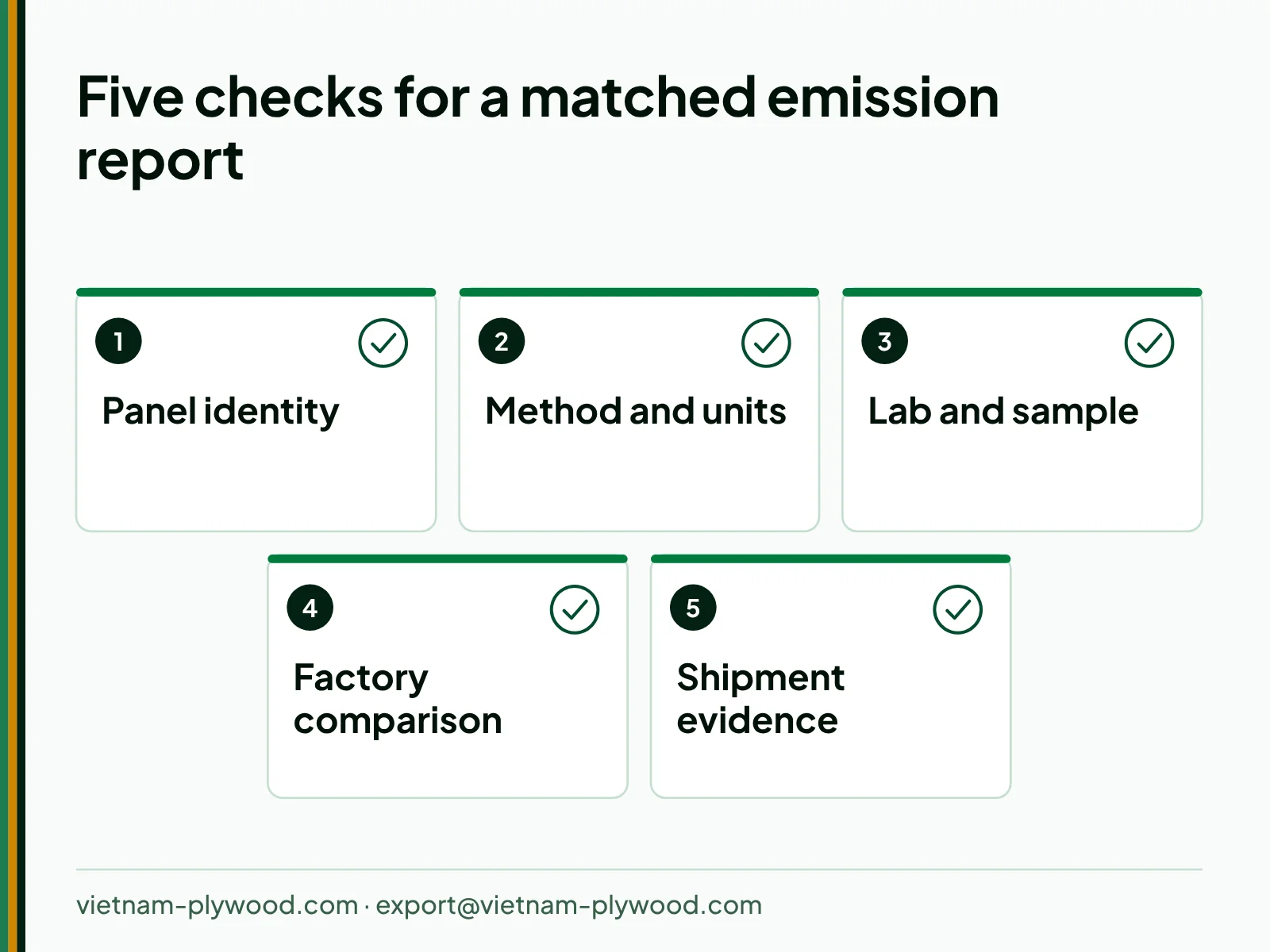
Use this inspection sequence:
- Match the report’s panel construction, core, face, glue system and thickness to the order.
- Check the named test standard, chamber or other method, units and measured emission result.
- Check the test date, laboratory identity, sample identification and the limit being applied.
- Compare the reported build with the physical panel and production records during the factory visit.
- Put the agreed emission report or certificate documents into the shipment document requirements.
The EPA’s October 2026 rule update adds ISO 12460-2:2024 as a small-scale chamber quality-control method and updates referenced methods. This does not mean results from different methods can be compared as identical numbers. The laboratory’s method and the destination requirement must be read together.
Member-factory certificates, including CARB P2 where applicable, are shown with factory details masked, on request. The buyer can witness material identification, veneer layup and panel sampling at the producing factory. Sampling records help connect a tested specimen to the ordered batch; a visual inspection alone cannot quantify emissions.
Can low-emission plywood share a container with other builds?
Yes. Specifications can be mixed within one 40HC container, provided the combined payload stays within 28.5 t. Different panel builds still need separate item descriptions and the relevant emission documentation for indoor stock.
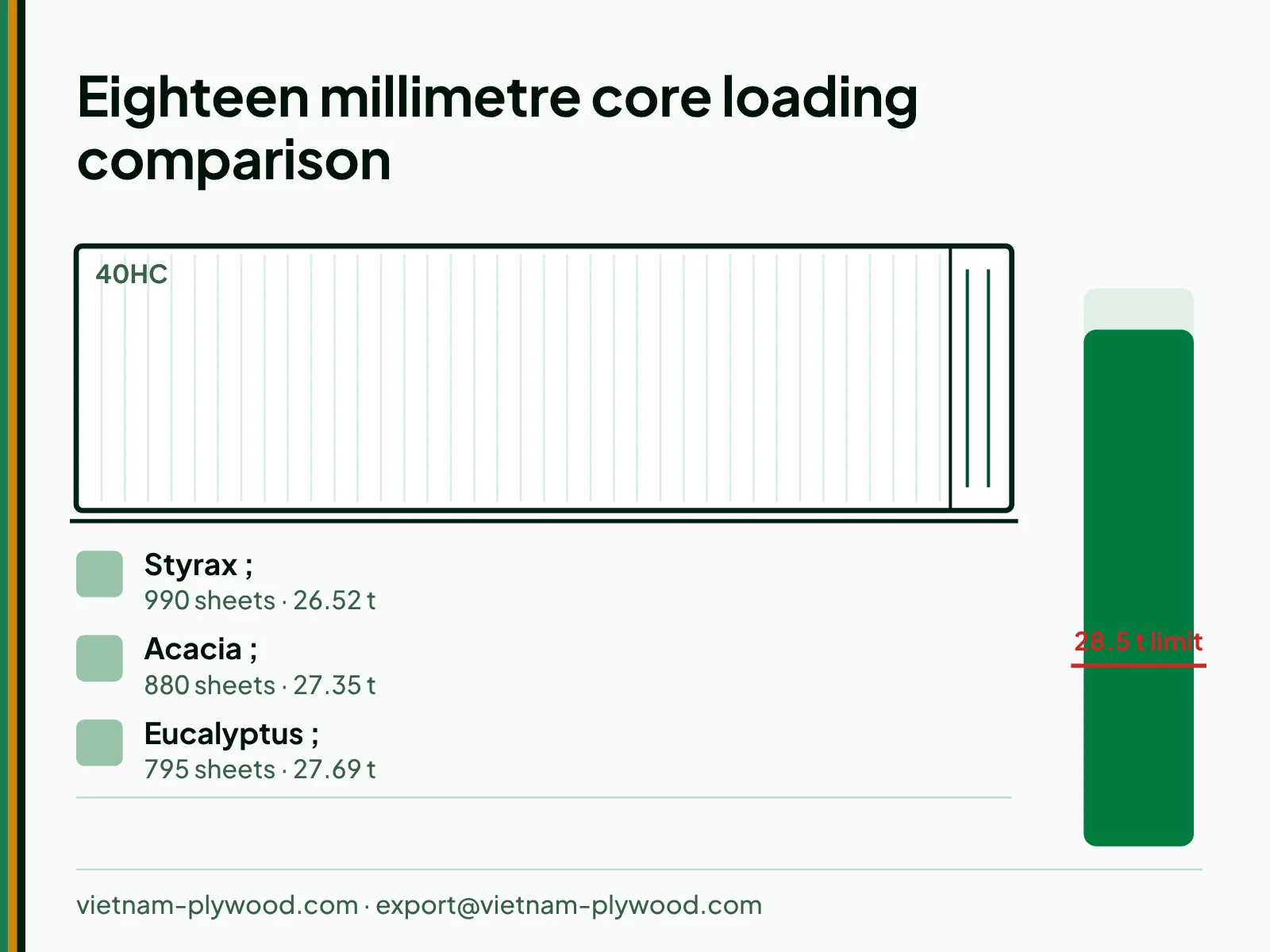
For 18 mm, 1220 × 2440 mm sheets, the full-container lookup gives 990 styrax-core sheets at 26.52 t, 880 acacia-core sheets at 27.35 t, or 795 eucalyptus-core sheets at 27.69 t. These are separate full-container examples, not quantities to add together. Film weight is excluded from those figures.
For a mixed order, ask for a pallet-by-pallet loading plan showing each core, thickness, sheet count and total payload before approval. The core densities are 500 kg/m³ for styrax, 580 kg/m³ for acacia and 650 kg/m³ for eucalyptus. Our container packing reference handles the detailed loading question.
What should the buyer inspect before loading?
Inspect the physical construction and its traceable emission paperwork at the factory making the order. For furniture plywood, examine full-stitched veneer layup, sanded surfaces, face grade and measured thickness. Compare the actual label or batch identification with the laboratory report and packing description.
HCPLY coordinates specifications, on-site quality control, documents and loading. Buyers visit the factory office and inspect goods at the producing factory. The export paperwork can include an agreed emission certificate or test report alongside the commercial invoice, packing list, bill of lading and certificate of origin.
For European lots, the documentation set can also include EUR.1 and the EUTR/EUDR file set; these serve origin and due-diligence purposes rather than replacing an emission test. After loading, the draft shipping documents come to you for approval. Separate bond-quality checks are covered under plywood delamination causes.
How should a cabinet importer write the order?
Write the emission requirement as a measurable acceptance criterion beside the construction details. A request reading only “E0 plywood” leaves the test method, face and core unspecified. Ask for a report matching the agreed panel and destination requirement before committing the cabinet production schedule.
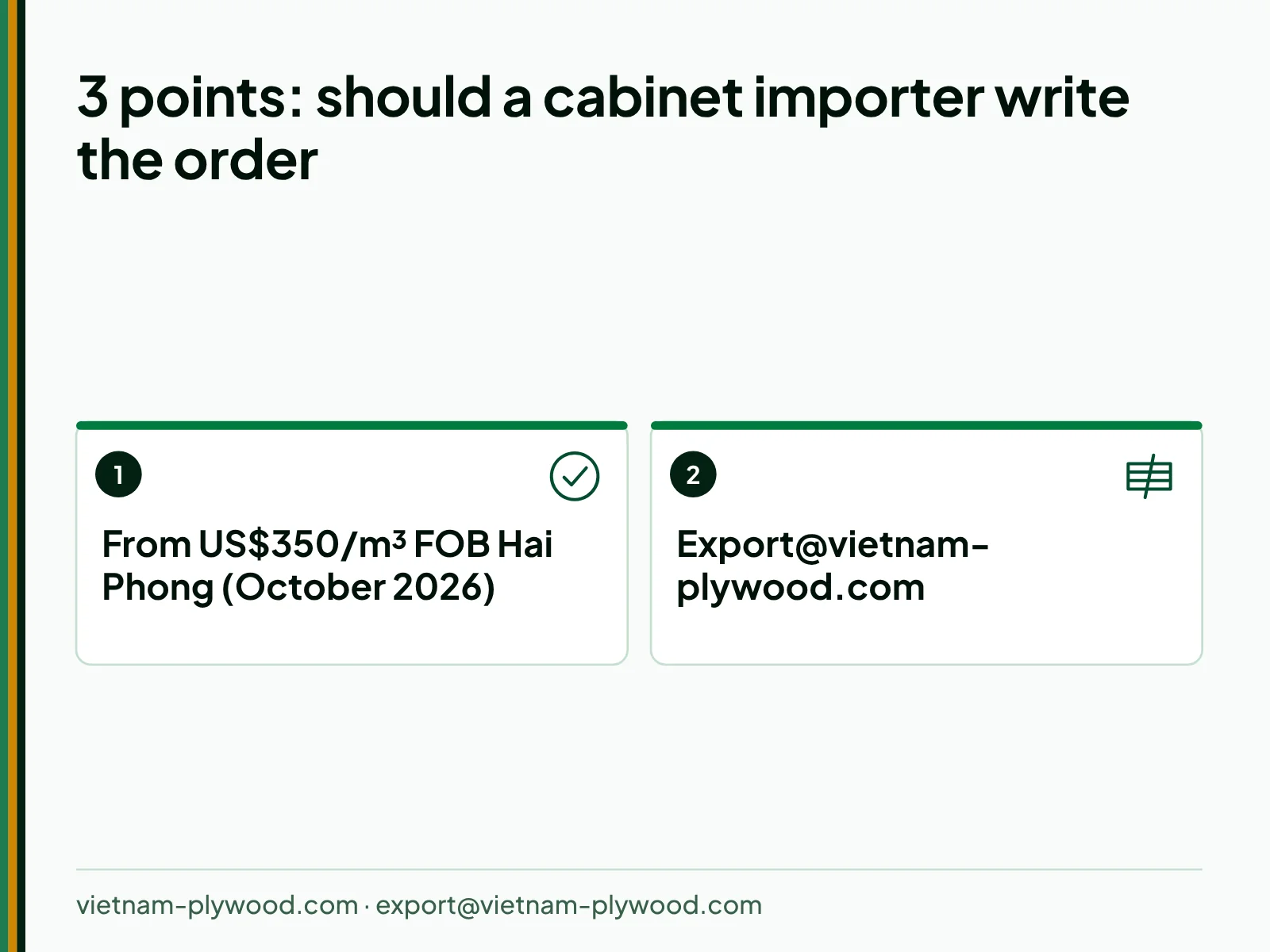
A practical first order starts at one 40HC, with mixed specifications allowed within its payload limit. Production is 15–45 days from the 30% deposit, set by order size, line loading and the contract. Balance is 70% on the scanned bill of lading, by T/T or irrevocable sight L/C; delivery terms are FOB Hai Phong, CFR (CNF) or CIF.
For furniture plywood, the indicative starting price is from US$350/m³ FOB Hai Phong (October 2026). The quoted build changes with core construction, face grade, sanding tolerance, resin and emission testing requirements. Full-stitched sanded furniture construction costs more to make than loose-laid unsanded packing construction because veneer preparation and finishing work differ.
Send Lucy at export@vietnam-plywood.com the written build and destination. Free samples are available; a first-time buyer pays the courier, and that charge comes off the first confirmed order. Use the contact page to request a matched report and trial-container quotation.
Application: indoor cabinet and furniture components
Line or core: furniture line; styrax or eucalyptus core
Glue: specify adhesive system separately from emission class
Emission: E0 or E1; state destination rule, test method and report requirement
Face and grade: specify veneer species and A/B face grade
Thickness and tolerance: 18 mm; ±0.2 mm or ±0.3 mm as ordered
Size: 1220 × 2440 mm
Quantity: one 40HC; list quantities for each specification
Destination port: [port and country]
Next step: plan a trial container around the approved panel specification and matching emission evidence.