





Medium density overlay plywood is a resin-treated paper-overlaid plywood used for painted surfaces and certain concrete forms; HCPLY does not press it, but quotes application-specific alternatives. Choosing the wrong face can mean extra finishing costs, delayed formwork cycles or a rejected load. Our construction line offers film-faced panels for forming, while our furniture line offers sanded veneer-faced plywood for paint trials.
What is medium density overlay plywood?
Medium density overlay plywood is a plywood panel bonded to a resin-impregnated fibre-paper surface, usually intended to receive paint or produce a controlled concrete finish. MDO stands for medium-density overlay; the word density describes the overlay category rather than the plywood core’s measured density. Its continuous face covers veneer grain, making it different from ordinary sanded plywood.
An MDO panel has cross-laminated wood veneers beneath its overlay. The resin-treated paper can be applied to one or both faces. In North American specifications, the distinction between General and Concrete Form grades matters more than the abbreviation alone. The APA engineered-wood association’s MDO/HDO guidance identifies separate MDO General and Concrete Form grades and different resin contents.
The paper face is sometimes described as paper faced plywood. That description alone does not identify overlay resin loading, bond classification, face treatment or suitability for repeated pours. For a wider comparison of overlay types, see HDO or MDO plywood.
What is MDO plywood used for?
MDO plywood is used for painted signs, exterior trim and siding, soffits, industrial surfaces and selected concrete forms. A sign shop values the uniform paint base; a formwork yard values the concrete-face texture and release behaviour. Those are different purchasing tests.
The APA’s 2011 HDO/MDO Plywood Product Guide discusses exterior siding, concrete forming and industrial containers. The published application categories explain why a sign-grade MDO panel should not automatically be substituted for a concrete-form grade. APA’s guide listing identifies the October 2011 revision.
How does MDO differ from MDF and film-faced plywood?
MDO is overlaid plywood; medium-density fibreboard (MDF) is a fibre-based board, while film-faced plywood carries a different resin-film surface. HCPLY does not press MDF or MDO. The face, substrate and intended finish determine which material belongs in the specification.
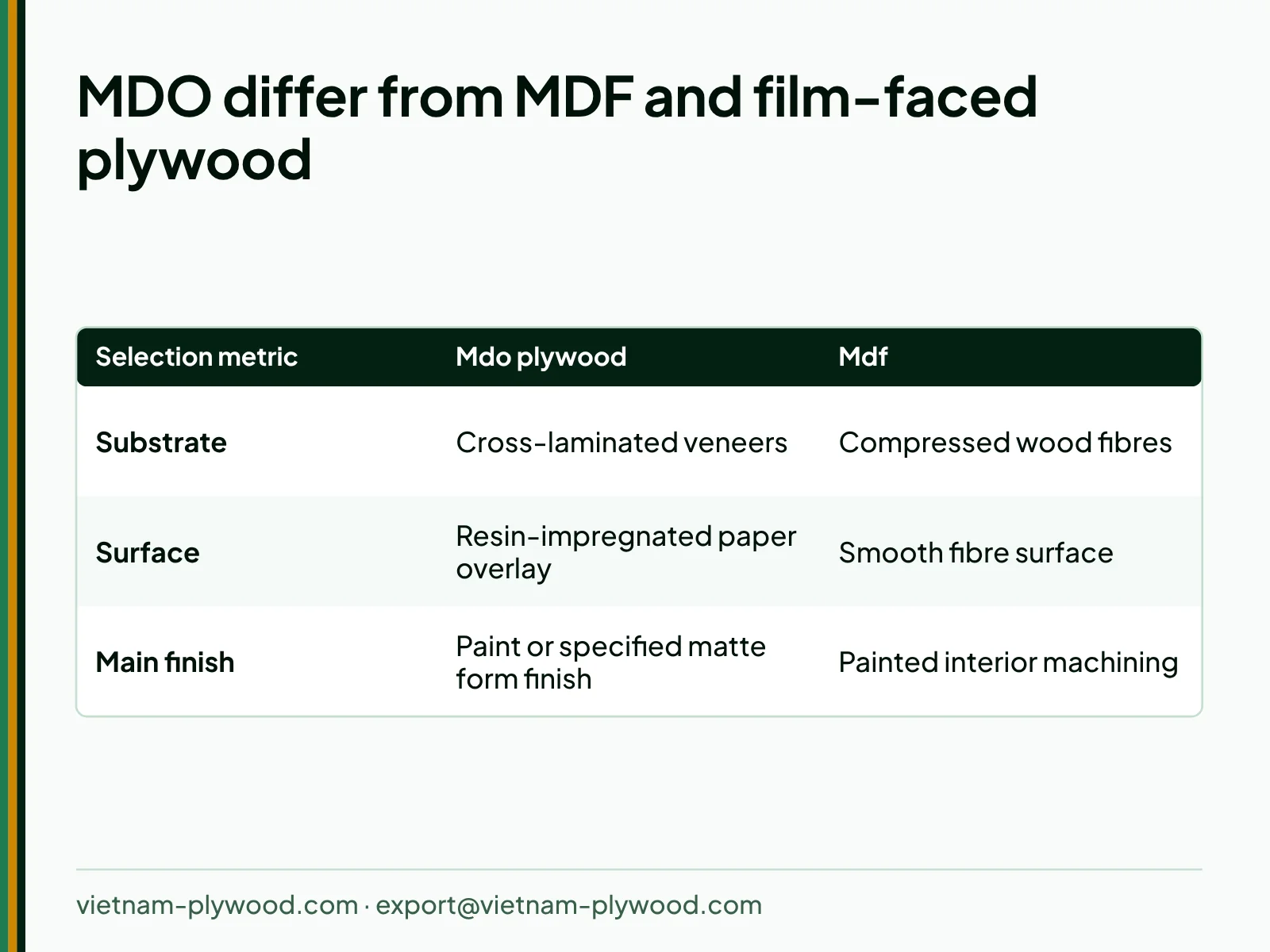
| Selection metric | MDO plywood | MDF | HCPLY film-faced plywood | HCPLY sanded furniture plywood |
|---|---|---|---|---|
| Substrate | Cross-laminated veneers | Compressed wood fibres | Acacia or eucalyptus veneers | Styrax or eucalyptus veneers |
| Surface | Resin-impregnated paper overlay | Smooth fibre surface | Phenolic or melamine film | Sanded wood veneer |
| Main finish | Paint or specified matte form finish | Painted interior machining | Concrete release surface | Painted or decorative wood surface |
| Moisture decision | Check exterior bond and seal cuts | Check board-specific exposure rating | Specify glue and edge protection | Specify glue and coating system |
| Verdict for signs | First choice when paper-overlay face is required | Interior-only where specified | Poor paint-base substitute | Trial for accepted veneer texture |
| Verdict for forms | Use Concrete Form grade | Do not substitute | Quote for ordinary forming | Do not substitute |
An enquiry for “mdo vs mdf plywood” mixes a surface treatment with a different substrate. MDF has no veneer cross-lamination, while MDO retains plywood’s layered construction. Neither the MDO label nor a smooth appearance supplies structural design values. Any specified structural grade requires a test report the buyer accepts.
Is MDO plywood waterproof?
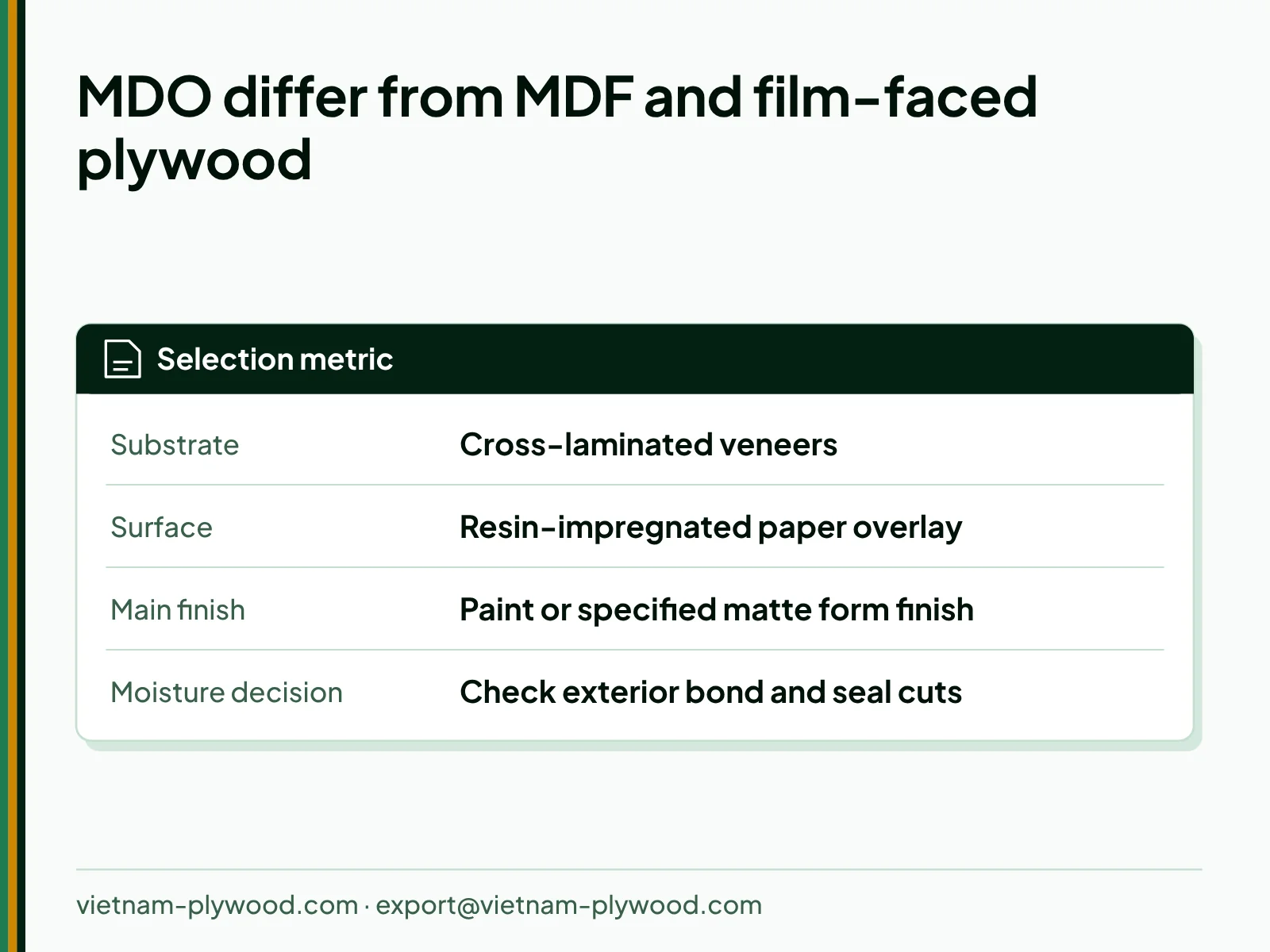
MDO plywood is not a waterproof finished assembly: its overlay can resist surface wetting, but cut edges, penetrations and joints still need protection. Exterior-bond plywood and a paint-ready overlay address different failure paths. Specify the exposure class, coating system, edge sealing and installation details separately.
For outdoor signs, a coating trial should include the edges and drilled holes, not just the broad face. For formwork, seal cut edges and apply the specified release agent. Standing water at unprotected cuts can still affect the wood beneath an intact face.
APA’s MDO/HDO panel guidance calls for sealing exposed edges and face-priming and top-coating MDO in exterior or high-moisture applications. That advice concerns the specified MDO product; a substitute needs its own coating and exposure assessment.
Does HCPLY manufacture MDO plywood?
HCPLY does not press MDO or HDO plywood; the producing factory is selected for the alternative panel actually ordered. Our three factories in Phu Tho and Hai Phong make distinct veneer-faced, commercial and construction plywood builds. An MDO request is therefore handled as an application review, not relabelled as an MDO offer.
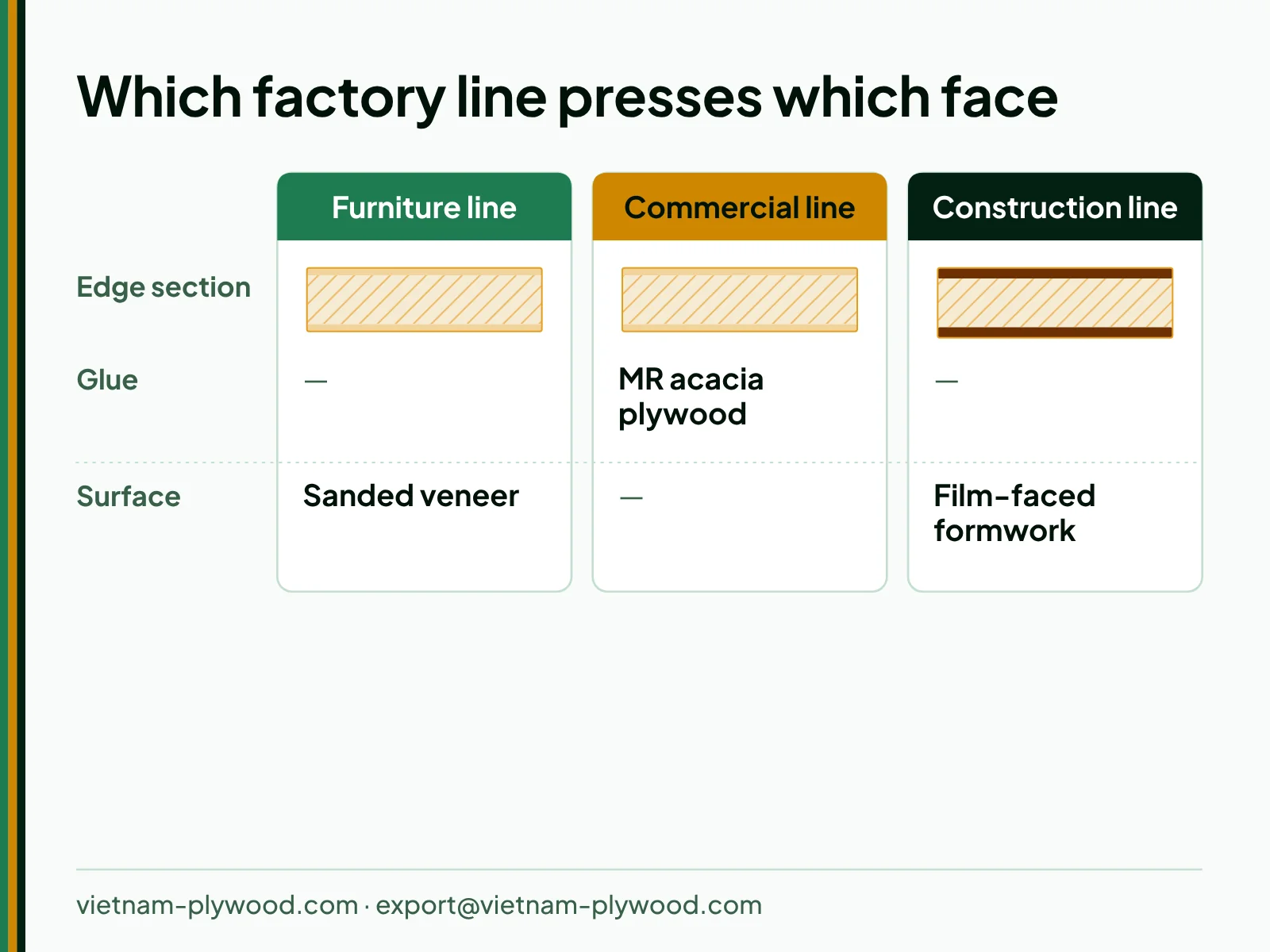
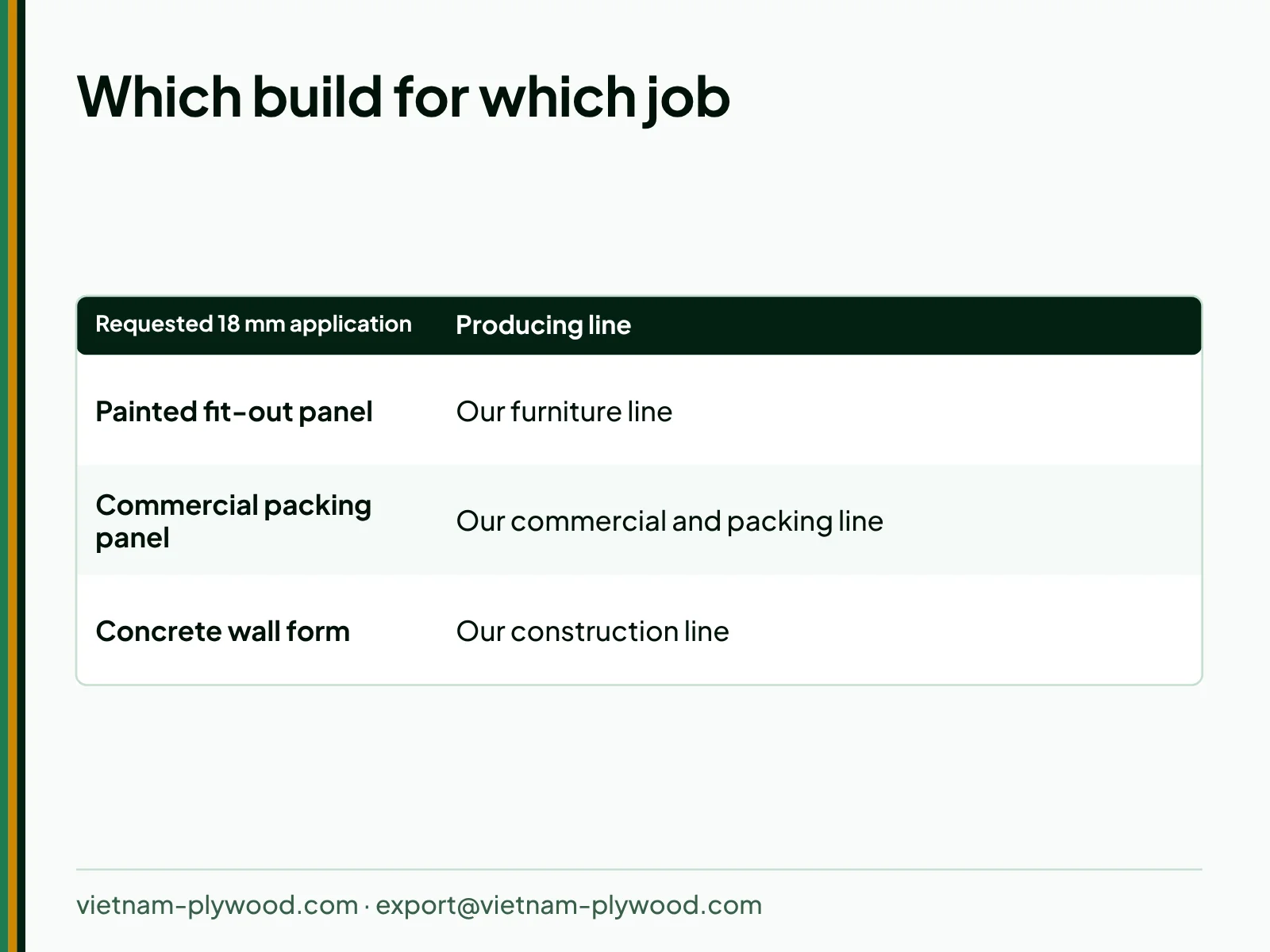
| Requested 18 mm application | Producing line | Actual panel offered | Limit against MDO |
|---|---|---|---|
| Painted fit-out panel | Our furniture line | Sanded, stitched-core veneer-faced plywood | Grain can print through paint |
| Commercial packing panel | Our commercial and packing line | Acacia-core MR, unsanded or light-sanded | No resin-paper paint face |
| Concrete wall form | Our construction line | Acacia- or eucalyptus-core film-faced plywood | Concrete texture differs from MDO matte overlay |
The comparison makes clear that the same nominal thickness does not produce equivalent surfaces. Our furniture line uses styrax or eucalyptus cores, full stitching and sanded faces. Our commercial and packing line uses acacia core and MR glue. Our construction line presses film-faced panels with acacia or eucalyptus cores.
Which alternative can we quote for concrete forms?
For mdo plywood for concrete forms, we quote film-faced plywood from Vietnam where the project accepts a film-produced concrete finish. Our construction line offers phenolic or melamine film with acacia or eucalyptus cores. Standard film weight is 120 g/m²; premium is 135 g/m², while 220 g/m² is anti-slip film only.
For repeated forming, the glue and release procedure matter. Melamine MR glue is associated with a 12-hour boil specification; phenolic WBP glue with a 72-hour boil specification. With proper handling, a release agent on every pour and sealed edges, including cuts, melamine-glue film-faced panels give about 12–15 pours and phenolic-glue panels up to about 25 pours.
These are film-faced reuse figures, not MDO reuse figures. A project specifying a matte MDO concrete finish needs a sample cast comparison before substitution. A glossy or otherwise distinct film surface can change the visible result, especially on architectural concrete. The construction-project supply programme covers coordination around the approved forming specification.
Which alternative can we quote for paint-grade work?
For paint-grade work, our furniture line can quote sanded veneer-faced plywood with an agreed glue specification and a coating trial. Available faces include bintangor, okoume, engineered veneer, gurjan, pine, poplar, eucalyptus, birch and sapele. The common face veneer thickness is 0.2–0.4 mm; ordinary face grades are A/B, while birch uses D/E/F.
A smooth sanded veneer is still wood, so its grain and veneer joints can show through opaque paint. The resin-paper MDO face is designed to reduce that appearance. Buyers who require a uniform signboard surface should retain genuine MDO in their procurement specification rather than approve veneer-faced plywood by description alone.
Specify the primer, topcoat, finish level and exposure before requesting samples. Test face appearance under angled light after the complete coating schedule. For interior cabinets or fit-out panels, a sanded veneer face may be accepted where the finish permits wood texture. An outdoor sign with strict grain-hiding requirements is a much harder substitution.
What specifications belong on an MDO replacement enquiry?
A replacement enquiry must name the end use and measurable acceptance checks before the alternative panel is priced. “5/8 mdo plywood” gives a nominal inch thickness, but does not establish a permitted millimetre tolerance, face grade or exposure condition. Send the exact target thickness and tolerance rather than assuming the two are interchangeable.
HCPLY thicknesses run from 3–40 mm, with common orders at 3, 5, 9, 12, 15, 18, 21 and 25 mm. Sanded furniture thickness tolerance is ±0.2 or ±0.3 mm as ordered; commercial and film-faced is ±0.5 mm. Length and width tolerance is ±2 mm. Common sizes include 1220 × 2440 and 1250 × 2500 mm, with additional listed sizes and custom cutting.
For 18 mm plywood, the veneer thickness of 1.4–2.0 mm produces 11–13 plies. A core inspection should record stitching and visible gaps rather than rely on ply count alone. Glue type and emission class belong in separate fields: E0, E1 and E2 describe emission classes, while MR and WBP describe glue performance.
Where does an MDO substitute fall short?
An MDO substitute falls short wherever the paper-overlay face, documented grade or resulting finish is a mandatory part of acceptance. A sanded panel can be painted but can reveal grain; a film-faced form panel can release concrete but can leave a different surface texture. Neither substitution transfers an MDO grade or trademark.
Do not replace a named MDO sign board with an ordinary veneer face when the purchase order requires a resin-paper overlay. Do not treat an MDO form plywood description as proof of a particular concrete finish. Record the approved deviation in the purchase specification so the factory and receiving inspector work from the same acceptance criteria.
What can the buyer inspect at the producing factory?
The buyer can inspect the actual substitute’s face, edges, thickness and packing before shipment. HCPLY arranges inspection at the producing factory, with buyers visiting its factory office and inspecting goods on site. A witness check can compare a sealed reference sample against production sheets.
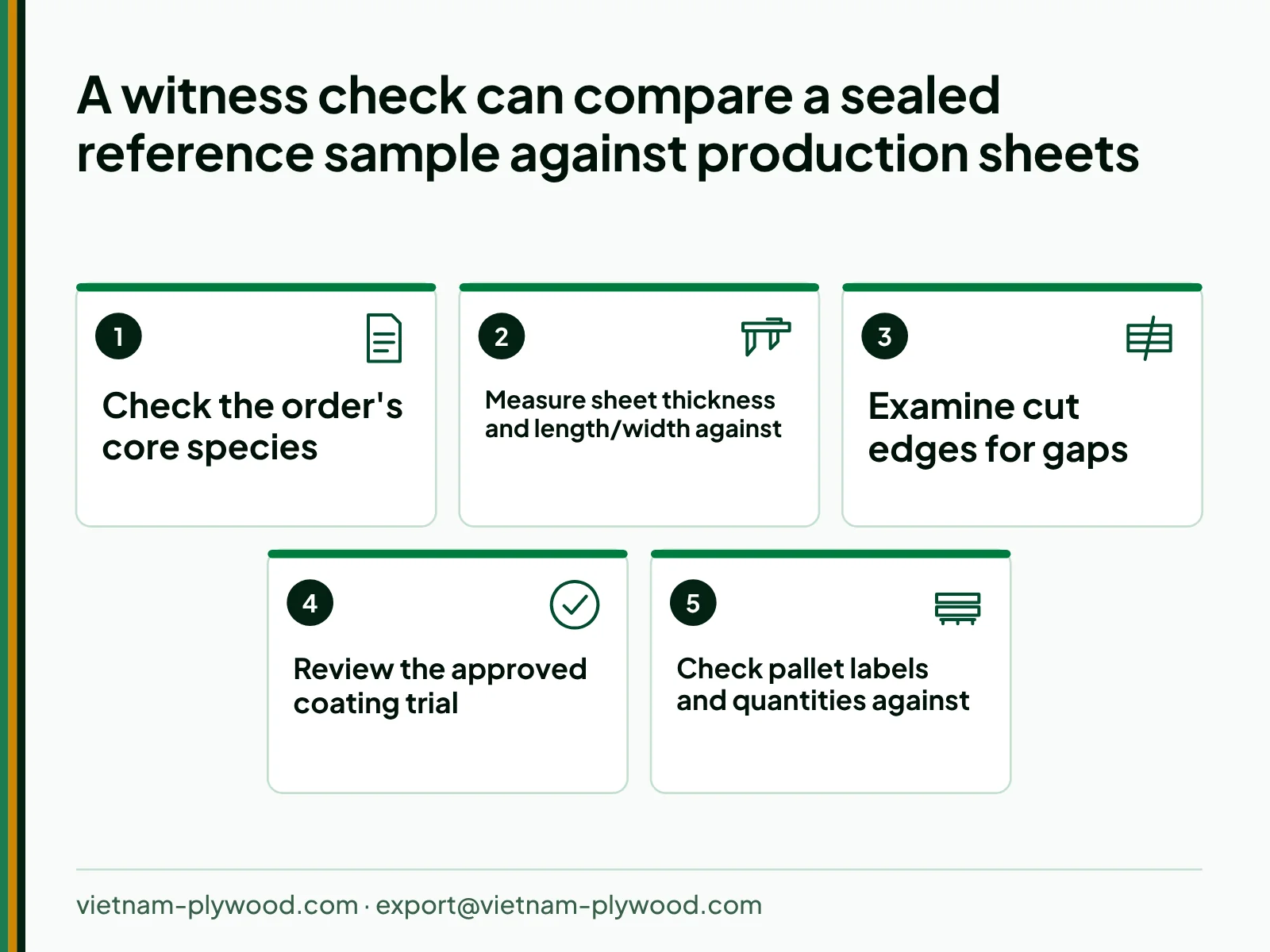
- Check the order’s core species, face material, glue and emission fields against the production record.
- Measure sheet thickness and length/width against the ordered tolerance at several positions.
- Examine cut edges for gaps, stitching and damaged veneer; inspect face film or sanding quality under consistent light.
- Review the approved coating trial or concrete casting result, where the buyer has specified one.
- Check pallet labels and quantities against the packing list before loading.
Factory-member FSC, CARB P2, ISO 9001 and CE certificates, and EUDR/EUTR documents, are shown with factory details masked, on request. The order’s applicable certificate and test-report documents accompany the shipment documentation. An MDO-specific certification cannot be transferred to a different panel.
How do substitution choices affect export packing?
Core choice affects container mass even at the same sheet thickness. For 18 mm, 1220 × 2440 mm panels, the reference weights are 26.79 kg per styrax sheet, 31.08 kg per acacia sheet and 34.83 kg per eucalyptus sheet. The corresponding full 40HC reference loads are 990, 880 and 795 sheets, respectively, before any film weight is added.
The calculated full-load masses are 26.52 t, 27.35 t and 27.69 t, against a 28.5 t payload limit. Mixed specifications can share a container within that limit, but the final packing plan must use the ordered build and pallet arrangement. See container loading calculations for the loading topic and distributor supply programmes for mixed-order planning.
The minimum order is one 40HC. Factory lead time runs 15–45 days from receipt of the 30% deposit; the exact figure depends on order size, line loading and what the contract fixes. The remaining 70% is paid on the scan of the bill of lading, by T/T, or by irrevocable sight L/C. We ship FOB Hai Phong, or CFR (CNF) or CIF to your port.
How do we turn a substitute into an approved order?
Approval starts with a written application specification and a representative sample set. For a formwork order, include the desired cast finish and the planned release and edge-sealing procedure. For paint-grade work, include the complete coating schedule and appearance criterion. The buyer should approve the trial result before changing an MDO specification.
The quotation compares the chosen core, glue, face, finish and tolerances. Film-faced pricing needs a written specification rather than an unsupported generic MDO rate. For sanded furniture plywood, the indicative starting price is from US$350/m³ FOB Hai Phong (October 2026); the ordered face, core construction and finish determine the quotation. For commercial plywood, the indicative starting price is from US$250/m³ FOB Hai Phong (October 2026).
Each shipment’s document set includes a commercial invoice, packing list, bill of lading and certificate of origin, with EUR.1 for EU lots. It also includes applicable phytosanitary and fumigation papers, CIF insurance, agreed certificate and test-report documents, and the EUTR/EUDR file set for EU lots. After loading, the draft shipping documents come to you for approval.
Send Lucy at export@vietnam-plywood.com the following specification through contact:
Application: painted sign / fit-out panel / concrete form
Line or core: furniture—styrax or eucalyptus / construction—acacia or eucalyptus
Glue: MR melamine / WBP phenolic, as agreed
Emission: E0 / E1 / E2, as ordered
Face and grade: sanded veneer A/B (birch D/E/F) / specified film weight
Thickness and tolerance: ___ mm; ___ mm
Size: ___ × ___ mm
Quantity: ___ sheets / ___ 40HC
Destination port: ___
Acceptance: paint trial or concrete cast finish; edge sealing; inspection criteria
Ask for a sample set matched to the intended coating or concrete finish before approving the substitute.