





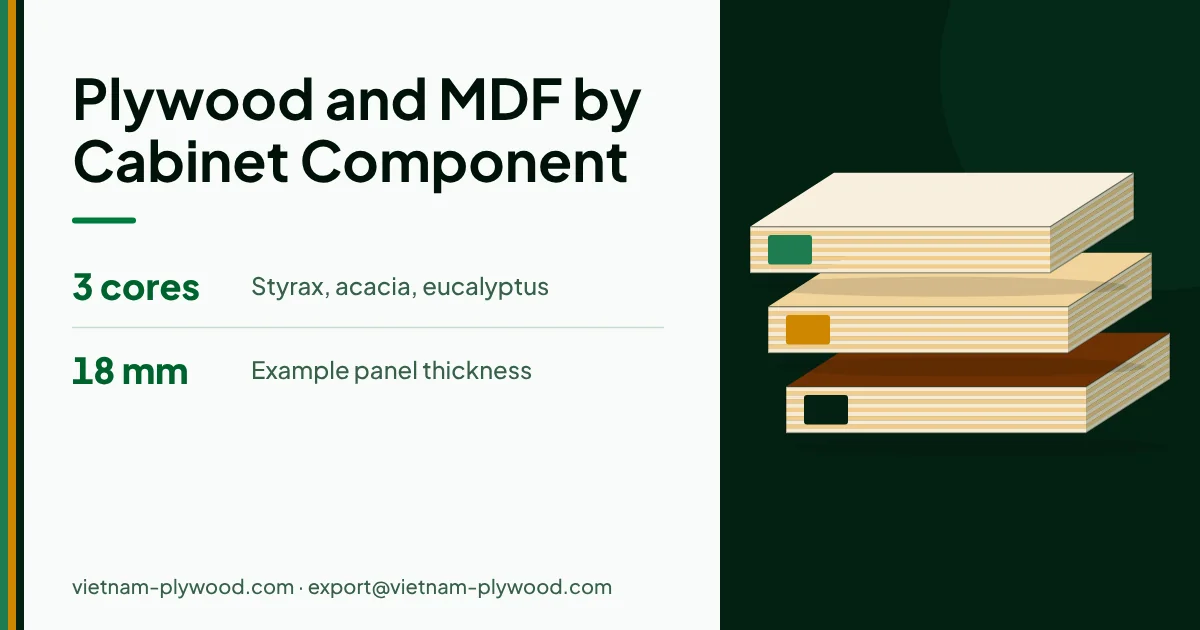
HCPLY recommends a full stitched furniture plywood build as the lowest-cost starting candidate where cabinet screws and occasional moisture matter; MDF often remains the economical choice for dry painted fronts. A wrong substitution can mean stripped hinges, swollen edges, wasted machining and rejected cabinet parts. The choice should be made component by component, using the actual core, adhesive and joint design.
What is the difference in plywood vs MDF?
Plywood vs MDF comes down to construction: plywood bonds cross-oriented wood veneers, while medium-density fiberboard (MDF) presses refined wood fibers and resin into a uniform panel. For cabinet buyers, that changes edge fastening, shelf deflection, machining, finishing and response to accidental wetting. The least costly sensible panel therefore changes with the part being manufactured.
MDF offers a smooth, grain-free face for painted doors and decorative routed details. Plywood offers continuous veneer layers that can distribute bending loads and support mechanical joints. Neither material is automatically suitable for standing water. Panel construction, adhesive, edge treatment and the finished cabinet design must all be specified.
Particleboard uses larger wood particles rather than MDF’s refined fibers; it is another distinct board category. HCPLY presses plywood, not MDF, oriented strand board (OSB), chipboard or blockboard. For the underlying material definitions, see our plywood definition for buyers and engineered wood explanation.
Which material wins each furniture metric?
The practical verdict changes by component, exposure and finish. The table compares ordinary interior MDF with a correctly constructed furniture plywood panel of comparable thickness; specialty MDF and alternative plywood builds require separate evaluation.
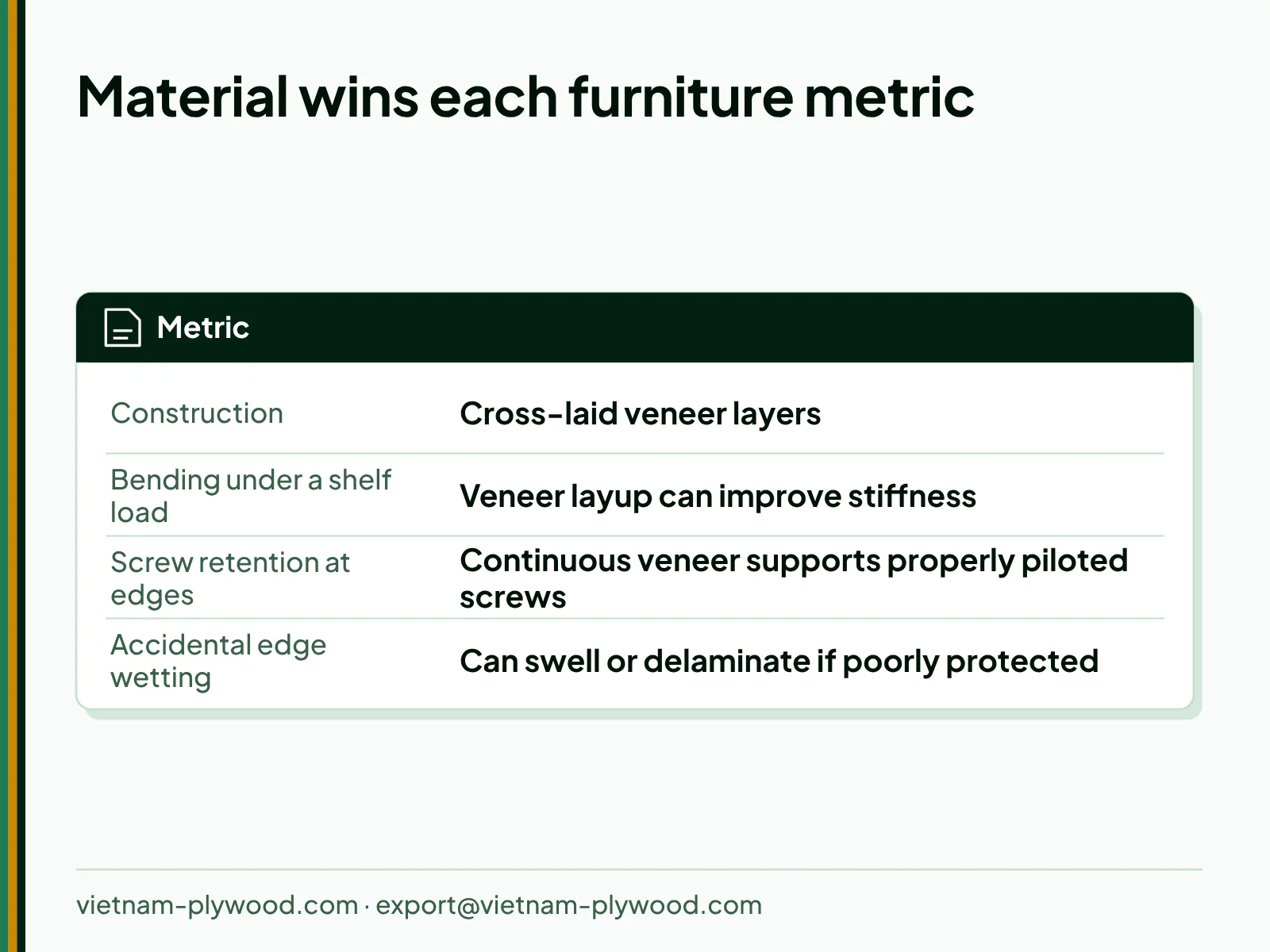
| Metric | Plywood | MDF | Verdict by use |
|---|---|---|---|
| Construction | Cross-laid veneer layers | Uniform compressed fibers | Plywood for mechanical carcass joints; MDF for routed decorative faces |
| Bending under a shelf load | Veneer layup can improve stiffness | Deflection needs close span control | Plywood for longer loaded shelves; test the actual span |
| Screw retention at edges | Continuous veneer supports properly piloted screws | Edge threads can strip or split | Plywood for repeated hardware attachment |
| Accidental edge wetting | Can swell or delaminate if poorly protected | Ordinary MDF edges can swell markedly | Sealed plywood for splash-prone carcasses |
| Painted surface | Veneer grain and joints need preparation | Uniform face takes smooth paint | MDF for flat or routed painted fronts |
| Visible wood finish | Natural or engineered veneer face | Needs a decorative facing | Plywood for exposed wood appearance |
| Machining | Veneer tear-out requires tooling control | Fine dust and edge sealing need attention | MDF for intricate routing; plywood for jointed parts |
| Weight | Determined by core species | Determined by board density | Compare actual kilograms per sheet |
| Initial material cost | Core, face, glue and grade change price | Standard MDF often has a lower initial price | MDF for dry decorative parts; compare total installed cost |
| Emissions documentation | Depends on product and certification | Depends on product and certification | Request the required evidence for either material |
A generic strength ranking cannot replace a panel test. The design must account for grain orientation, support spacing, fastening method, service moisture and the specific material batch.
Is plywood or MDF stronger at screws and wet edges?
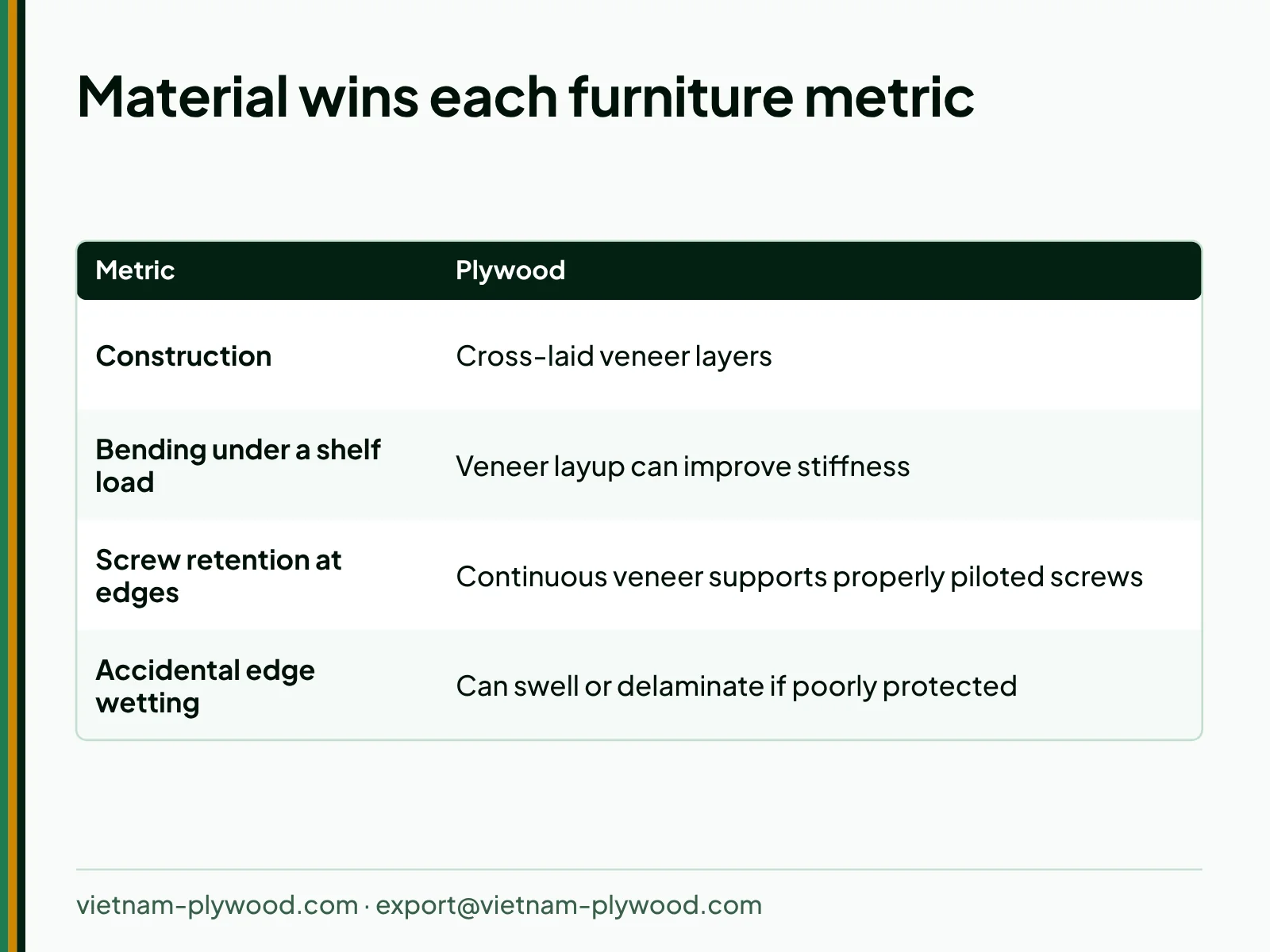
For a cabinet carcass joined with screws, suitable plywood is usually the stronger starting choice because veneers give the threads a layered wood substrate. Standard MDF can perform in designed joints, especially with inserts or appropriate connectors, but its edge fastening deserves separate pull-out testing. No universal screw-retention ratio applies across products.
At the producing factory, a buyer can witness a cut-edge inspection for core gaps, veneer continuity and the ordered face quality. A production sample can then undergo an agreed pilot-hole and screw-pull comparison with the buyer’s MDF reference. The test must record screw type, insertion depth, edge distance, conditioning and failure mode.
For moisture, inspect edge sealing and the bond line separately. A plywood core can absorb water; moisture-resistant glue does not make unfinished wood waterproof. A sealed edge is especially relevant at sink-base cutouts and cabinet service penetrations. Agree on a wetting and drying protocol before making comparative performance claims.
Is MDF lighter than plywood?
MDF is not necessarily lighter: compare density and thickness for the actual products. HCPLY’s Vietnam core reference densities are styrax 500 kg/m³, acacia 580 kg/m³ and eucalyptus 650 kg/m³. The face species names the plywood product, while the core governs the stated density.
At 18 mm and 1220 × 2440 mm, the corresponding plywood sheet weights are 26.79 kg for styrax, 31.08 kg for acacia and 34.83 kg for eucalyptus. A buyer comparing MDF must obtain that board’s measured density or sheet weight; a blanket plywood-versus-MDF weight percentage would mislead.
Weight affects cabinet handling, hardware loading and freight calculations. Compare the same nominal dimensions, moisture condition and packaging basis. For a shipment calculation rather than a material choice, use the container loading reference.
Which plywood build is the lowest sensible substitute?
The lowest-cost candidate for a screw-fastened, dry interior carcass is an appropriately specified furniture-line styrax-core plywood with a functional face, full stitched core and sanded thickness. It is a candidate to test against MDF, not a measured universal winner. Where humidity, load or edge damage risk rises, the build and adhesive must be reconsidered.
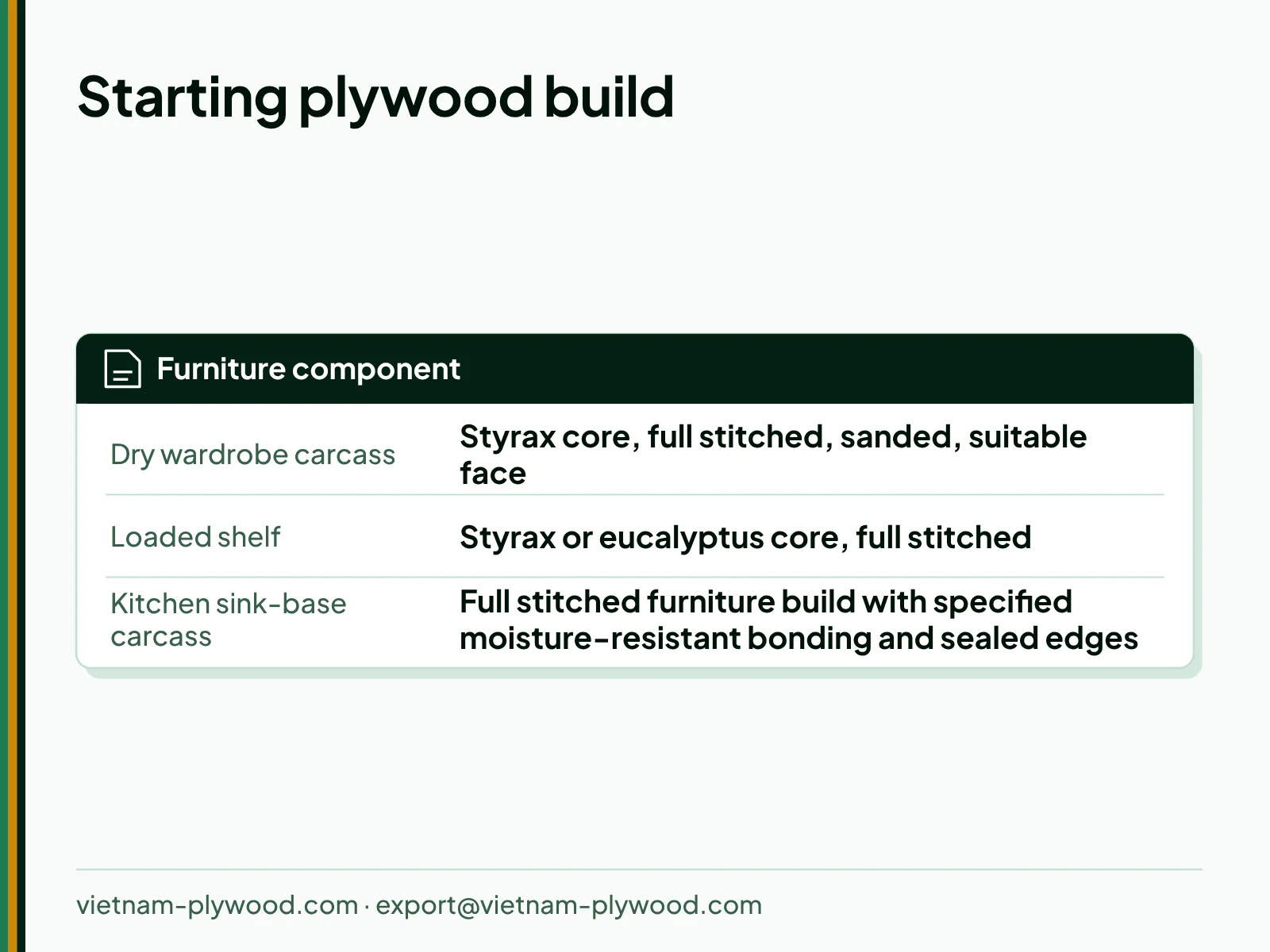
| Furniture component | Starting plywood build | Why this build | MDF alternative |
|---|---|---|---|
| Dry wardrobe carcass | Styrax core, full stitched, sanded, suitable face | Edge joints and manageable weight | MDF with engineered connectors in a dry location |
| Loaded shelf | Styrax or eucalyptus core, full stitched | Veneer continuity and thickness selection | MDF with shorter supports or reinforcement |
| Kitchen sink-base carcass | Full stitched furniture build with specified moisture-resistant bonding and sealed edges | Joint integrity and wet-edge protection | Moisture-resistant MDF with validated sealing |
| Visible cabinet side | EV or birch face over specified styrax/eucalyptus core | Decorative appearance without birch-core construction | Faced MDF where edge fastening is limited |
| Routed painted door | Furniture plywood only if the finishing system accepts veneer movement | Mechanical substrate where required | MDF commonly wins for smooth detailed routing |
HCPLY’s furniture line uses styrax or eucalyptus cores, full stitched construction, sanding and E0/E1 emission classes. A birch face is a veneer description; it does not mean Baltic birch or birch-core plywood. For appearance alternatives, compare Vietnam plywood faces and birch alternatives.
What would the other factory lines build?
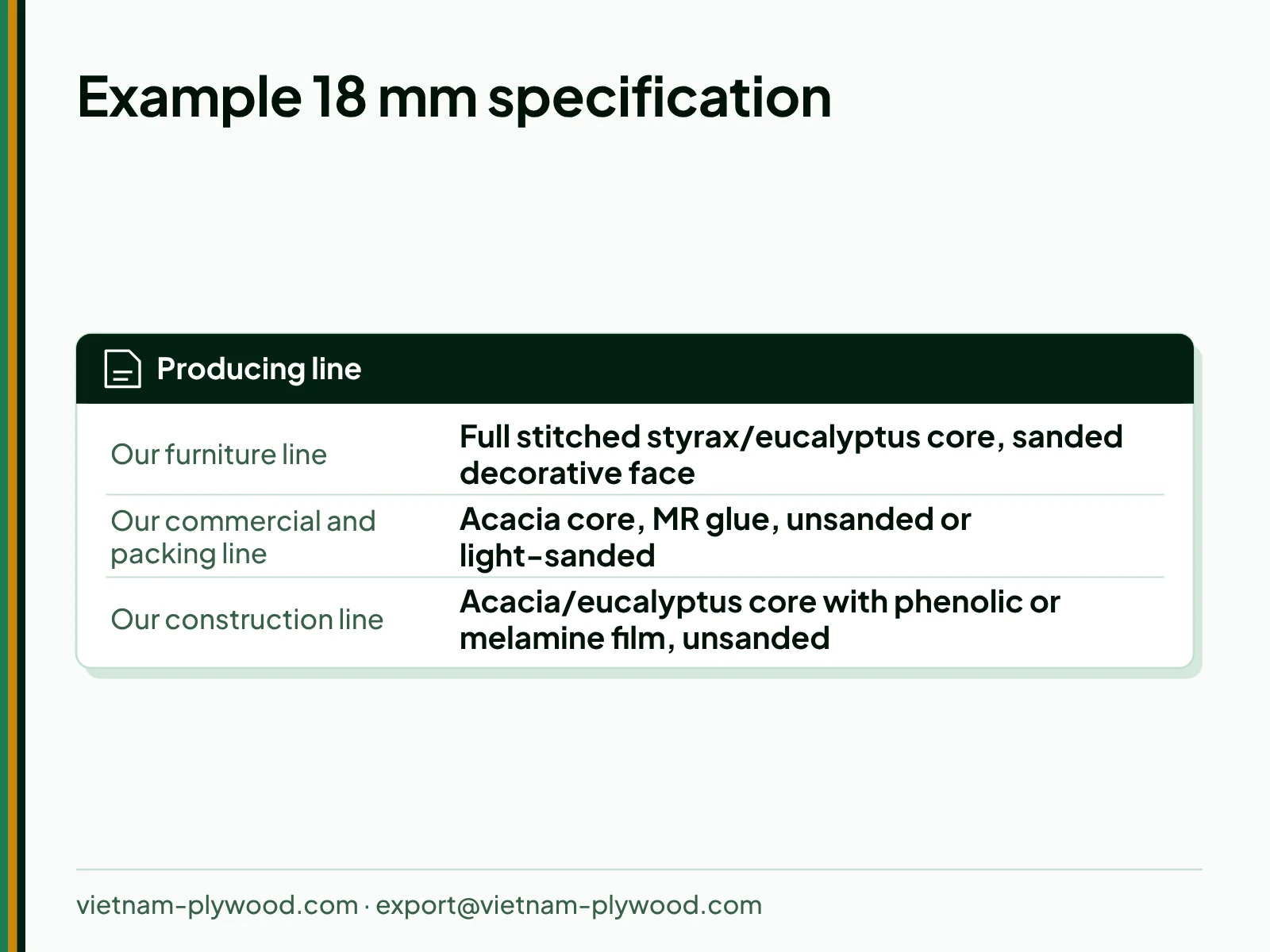
The furniture line is the natural starting point for finished cabinet components. The other lines make different plywood specifications, so the same nominal 18 mm sheet should never be purchased solely by thickness.
| Producing line | Example 18 mm specification | Thickness tolerance | Intended purchasing decision |
|---|---|---|---|
| Our furniture line | Full stitched styrax/eucalyptus core, sanded decorative face | ±0.2 or ±0.3 mm as ordered | Carcasses, shelves and finished furniture parts |
| Our commercial and packing line | Acacia core, MR glue, unsanded or light-sanded | ±0.5 mm; packing ±0.5–1.0 mm | Packing and general commercial panel work |
| Our construction line | Acacia/eucalyptus core with phenolic or melamine film, unsanded | ±0.5 mm | Formwork and jobsite panel use |
The commercial line is not a like-for-like furniture substitute when a tightly calibrated surface or visible veneer is needed. Film-faced formwork plywood also does not solve a painted cabinet-front requirement. Read the commercial plywood export specification for its separate buying criteria.
Is MDF cheaper than plywood?
Standard MDF often has a lower purchase price than decorative furniture plywood, especially for dry painted parts. For HCPLY, furniture plywood starts from US$350/m³ FOB Hai Phong (October 2026); commercial plywood starts from US$250/m³ FOB Hai Phong (October 2026). Those starting points describe different plywood lines, not an MDF quotation or interchangeable cabinet grades.
For a furniture-panel quotation, core construction and face selection usually matter first, followed by glue requirement, sanding and tolerance, then thickness, cutting and order mix. A full stitched furniture core with a decorative face costs more to build than a less finished commercial core. A birch or engineered veneer face must be evaluated against its requested grade rather than priced by the word “birch” alone.
Calculate the cost per usable cabinet part: sheet yield, rejects, machining time, edge treatment, hardware, finishing and replacement risk. An MDF door can win on paint preparation while a plywood carcass can reduce joint-related rework. Ask for quotes against the same part drawings rather than comparing unmatched cubic-metre prices.
Is plywood or MDF better for shelves?
Plywood is the safer starting material for shelves carrying sustained loads across wider spans. Its cross-laminated structure can offer useful bending performance, but actual deflection is controlled by span, thickness, core, grain direction, edge reinforcement and load duration. MDF can work well for shorter, supported display shelves.
Specify the shelf’s clear span and design load before choosing thickness. For a 1220 × 2440 mm plywood sheet, common available thicknesses include 12, 15, 18, 21 and 25 mm; HCPLY’s overall thickness range is 3–40 mm. An 18 mm panel typically contains 11–13 plies because core veneer thickness changes the count.
Request a sample shelf cut to production width and a loading comparison with the MDF alternative. Record deflection immediately and after sustained loading, and inspect fasteners at the supports. A face grade alone says little about shelf performance.
What works for kitchens, wardrobes and painted fronts?
Use furniture plywood for screw-fastened kitchen and wardrobe carcasses when joint reliability and occasional moisture exposure are the priorities. Use MDF selectively for dry painted fronts and decorative profiles where its homogeneous surface reduces finishing work. A cabinet can sensibly combine both materials.
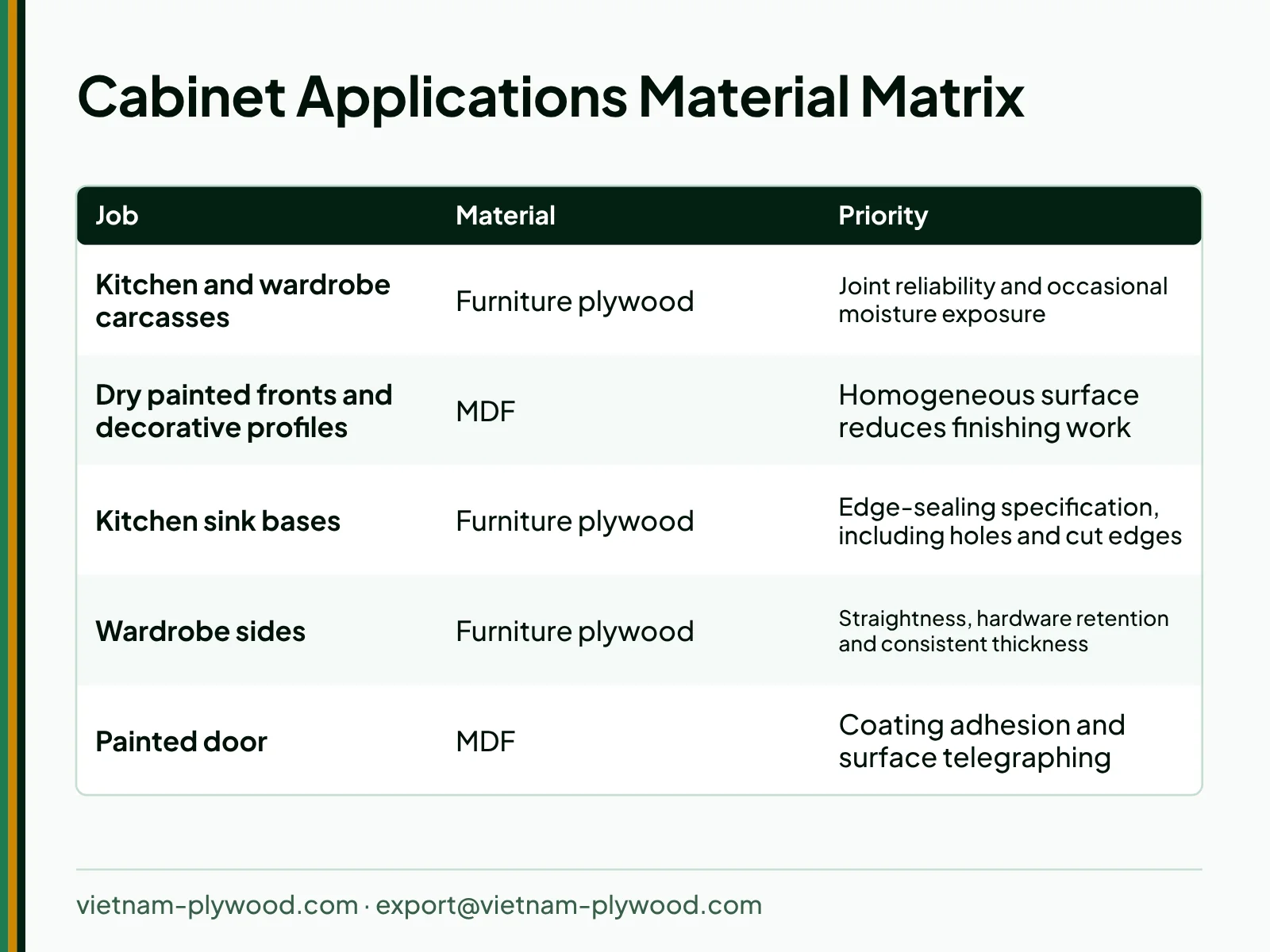
Kitchen sink bases require a deliberate edge-sealing specification, including holes and cut edges. Wardrobe sides need straightness, hardware retention and consistent thickness more than a premium visible face on every hidden surface. For a painted door, test coating adhesion and surface telegraphing before replacing MDF with veneered plywood.
Melamine and high-pressure laminate (HPL) faces are finishing topics rather than HCPLY product lines. Likewise, a birch-faced panel is different from all-birch plywood. The plywood manufacturer overview describes the production lines available for the underlying panel.
How should buyers check emissions and documents?
For United States orders, specify the applicable formaldehyde-emission requirement independently from the glue bond. The US Environmental Protection Agency explains in its TSCA import guidance that Title VI covers hardwood plywood, particleboard and medium-density fiberboard, including relevant component parts and finished goods. See the EPA’s TSCA import requirements (US EPA, guidance accessed 2026).
E0 and E1 are emission classes; MR and weather-and-boil-proof (WBP) describe glue performance. Melamine MR uses a 12-hour boil reference, while phenolic WBP uses a 72-hour boil reference. Neither adhesive label substitutes for a formaldehyde-emission document.
Member-factory FSC, CARB P2, ISO 9001 and CE certificates, plus EUTR/EUDR documents, are shown with factory details masked, on request. For the agreed build, the order’s certificate documents and test reports accompany the export paperwork. Buyers should identify the required emission certificate and relevant production factory before approving the specification.
How is a mixed plywood shipment planned?
HCPLY can combine plywood specifications in a 40HC container within its 28.5 t payload limit. At 18 mm, 1220 × 2440 mm, a full styrax-core load is 990 sheets, 53.05 m³ and 26.52 t; an acacia-core load is 880 sheets, 47.15 m³ and 27.35 t. These are separate full-load reference cases, excluding film weight, rather than an additive mixed-load allowance.
For a mixed furniture and commercial order, plan pallet positions and cumulative gross weight against the final packing list. The packing list identifies quantities and package weights; the commercial invoice identifies the invoiced goods. Draft shipping documents are sent for buyer approval after loading.
Minimum order is one 40HC, with specifications mixed inside the payload limit. HCPLY handles specification, on-site quality control, export documents and loading at the producing factory. The multi-type plywood ordering explanation and distributor supply programmes cover order planning.
What specification should a buyer send?
Start with the part and its failure risk, then state the plywood construction and the acceptance check. For furniture panels, ask the producing factory to show core continuity, thickness readings, edge condition and representative cut samples during inspection. Specify the comparison MDF grade separately if a direct trial is needed.
HCPLY’s three factories operate in Phu Tho and Hai Phong; the selected factory makes and ships its own order. Buyers can inspect goods at that factory and meet at its factory office. Lucy coordinates the export specification and factory inspection through export@vietnam-plywood.com.
Use the following purchase enquiry as a starting point:
Application: kitchen carcass / wardrobe / shelf / painted front
Line or core: furniture line; styrax or eucalyptus core; full stitched
Glue: MR melamine or phenolic WBP, as required by exposure
Emission: E0 / E1; destination-market evidence required
Face and grade: EV / birch / other agreed face; specified grade
Thickness and tolerance: 18 mm; ±0.2 or ±0.3 mm as ordered
Size: 1220 × 2440 mm or cut-to-size drawing
Quantity: sheets and pallet mix; minimum one 40HC
Destination port: [port and country]
Ask Lucy for a sample set through the contact page before approving a production comparison.