





Choose an LVL supplier by matching the end use to a written specification and checking production evidence before shipment. A wrong choice can mean rejected packing members, damaged cargo or days lost replacing a load. HCPLY produces non-structural LVL for industrial packing and coordinates inspection and export from the producing factory. This is how to choose an lvl supplier with measurable acceptance criteria.
How to choose an LVL supplier?
To decide how to choose an LVL supplier, start with the finished use, then compare written specifications, production evidence and loading plans. Ask for a sample made to the same build as the proposed order. Inspect dimensions, moisture and bonding at the producing factory before approving a full-container shipment. A supplier’s catalogue alone cannot answer these questions.
Laminated veneer lumber (LVL) uses bonded veneer layers with grain primarily running along the member. For a broader product explanation, see LVL meaning and uses. We press non-structural LVL for industrial and packing applications. A structural beam requires its own engineering specification and accepted test evidence; see LVL beams.
What specification should I send to an LVL supplier?
Send one drawing and one written acceptance schedule. The drawing should mark section width, depth and length, permitted dimensional deviation, end squareness and whether pieces will be cut or fastened after arrival. State the end use as pallet runner, crate component, industrial spacer or another defined non-structural application.
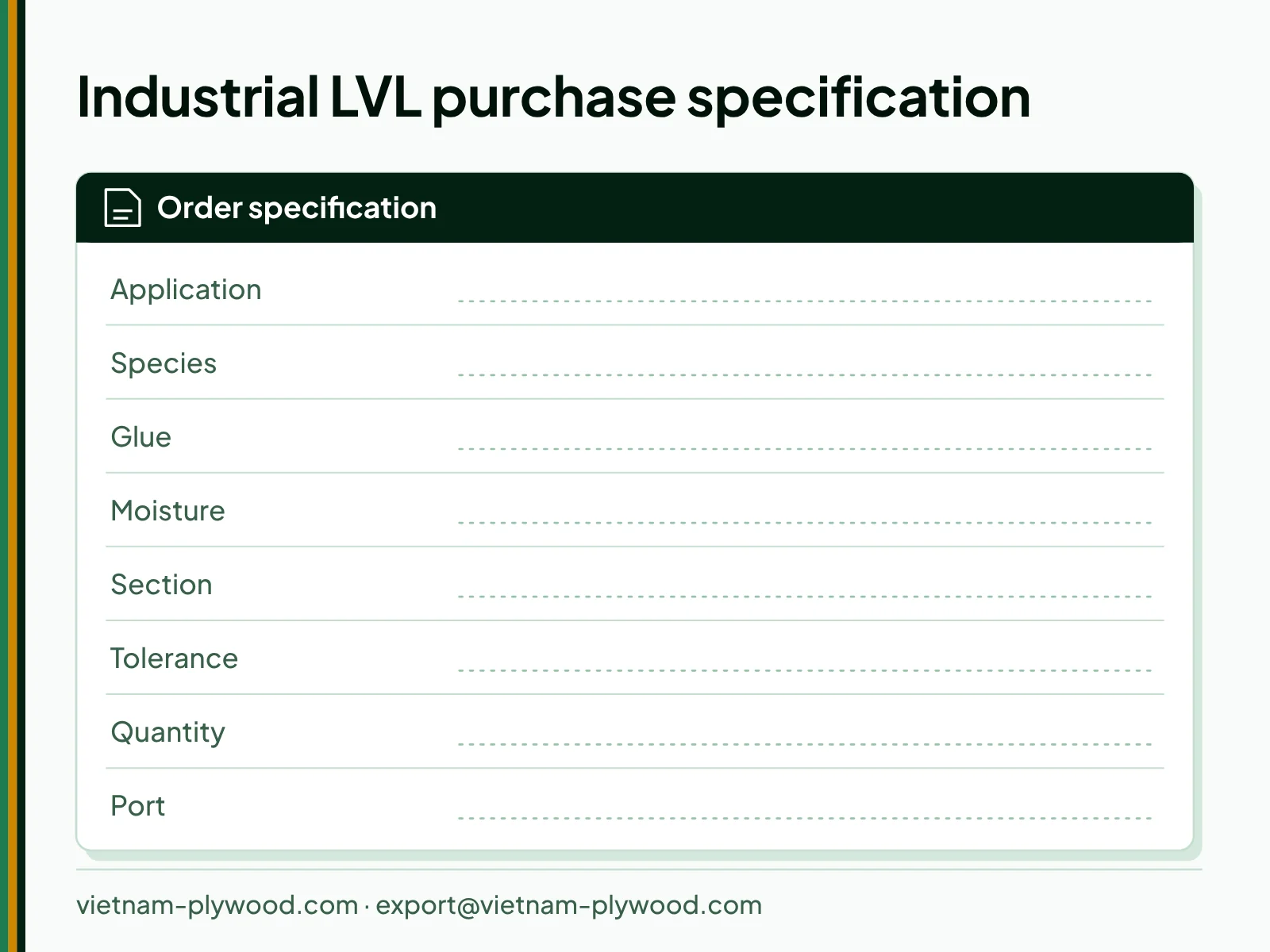
- Identify the species or veneer composition requested and the acceptable visual defects.
- State the adhesive and exposure condition, keeping bond durability separate from any emission requirement.
- Give the target moisture content, test method, sampling locations and acceptable range; agree these values in writing.
- Specify section dimensions, tolerance at receipt, quantity per length and packaging method.
- Name the destination port and any documents the importer needs for clearance.
Moisture is especially relevant when the buyer will machine, nail or store components after delivery. LVL outdoor exposure explains why an indoor packing build should not be silently substituted for prolonged wet exposure.
Which production line should make the order?
The producing factory should match the product’s construction and intended use. Our commercial and packing line handles industrial packing requirements, including non-structural LVL; the other lines produce plywood matched to their own uses. The same nominal 18 mm requirement can lead to different constructions.
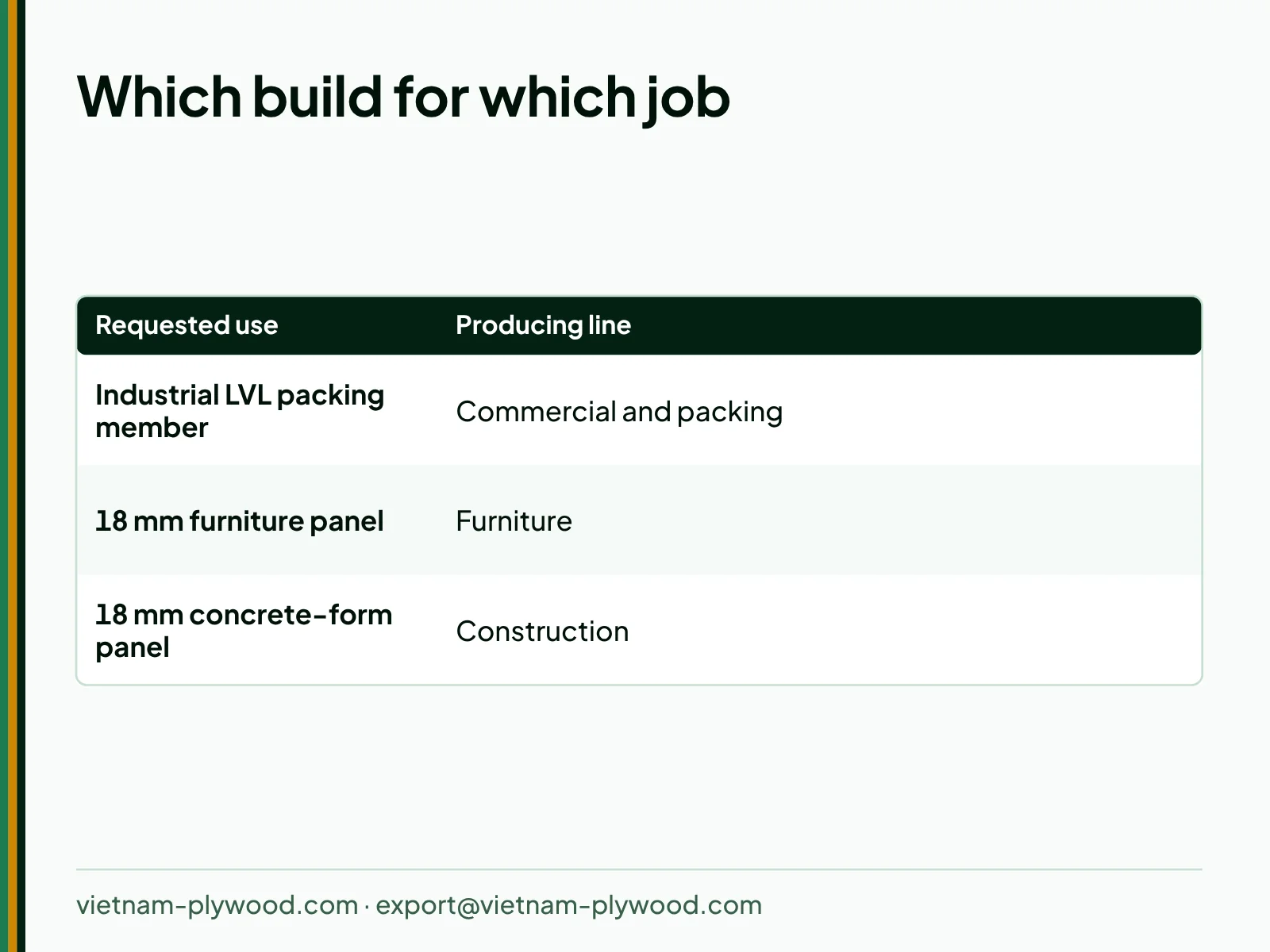
| Requested use | Producing line | Typical build decision | Inspection emphasis |
|---|---|---|---|
| Industrial LVL packing member | Commercial and packing | Veneer orientation, section and agreed bond | Section, moisture and end condition |
| 18 mm furniture panel | Furniture | Styrax or eucalyptus core, full stitched and sanded | Face, sanding and thickness |
| 18 mm concrete-form panel | Construction | Film-faced acacia or eucalyptus core | Film, edges and thickness |
Our furniture line makes plywood for cabinets and frames; see LVL for furniture frames for the application distinction. Our construction line presses film-faced plywood rather than structural LVL beams. A buyer can compare these options through one supplier for several plywood types.
What checks should I run before a first LVL order?
Run checks against the agreed acceptance schedule, with the inspector recording results from actual production lots. Ask to see veneer lay-up, adhesive identification, pressing records, cut sections and the packed bundles. A retained sample helps settle disputes about appearance but does not replace checks on shipment goods.
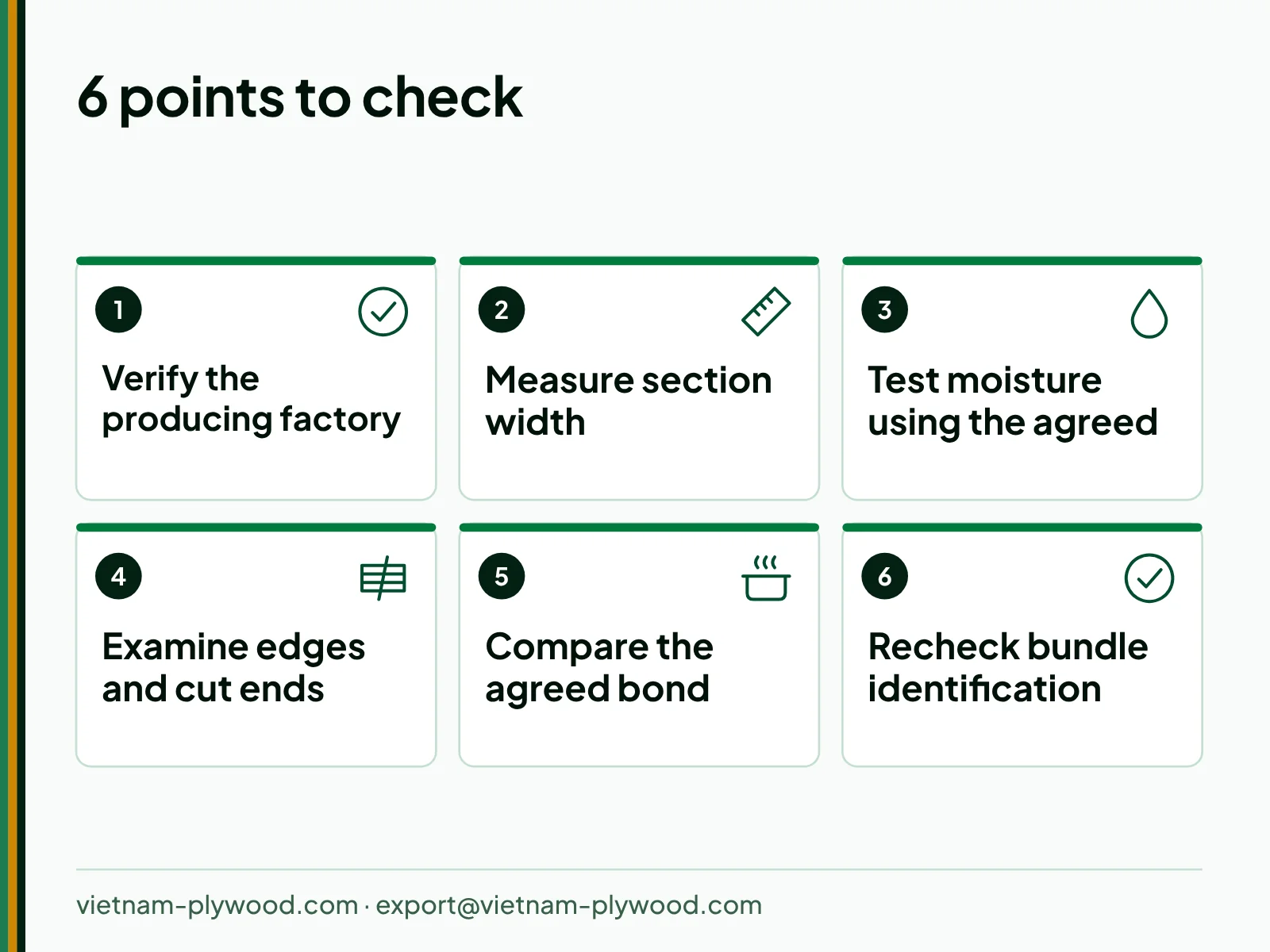
- Verify the producing factory and identify the production batch on the packing record.
- Measure section width, depth, length and squareness at agreed sampling points.
- Test moisture using the agreed meter or laboratory method and record the reading location.
- Examine edges and cut ends for open glue lines, gaps, delamination and damage.
- Compare the agreed bond or performance report with the exact product build and intended use.
- Recheck bundle identification, protection and loading condition before the container is sealed.
For structural uses, require engineering design values and a test report the buyer accepts. The LVL strength and properties discussion helps separate performance terms from visual grades.
How should I compare samples and factory evidence?
Use a scored comparison sheet with pass/fail fields instead of ranking samples by appearance alone. Record each measurement, the agreed tolerance and whether corrective work is possible before loading. Reject a batch against the written acceptance rules when defects exceed those limits.
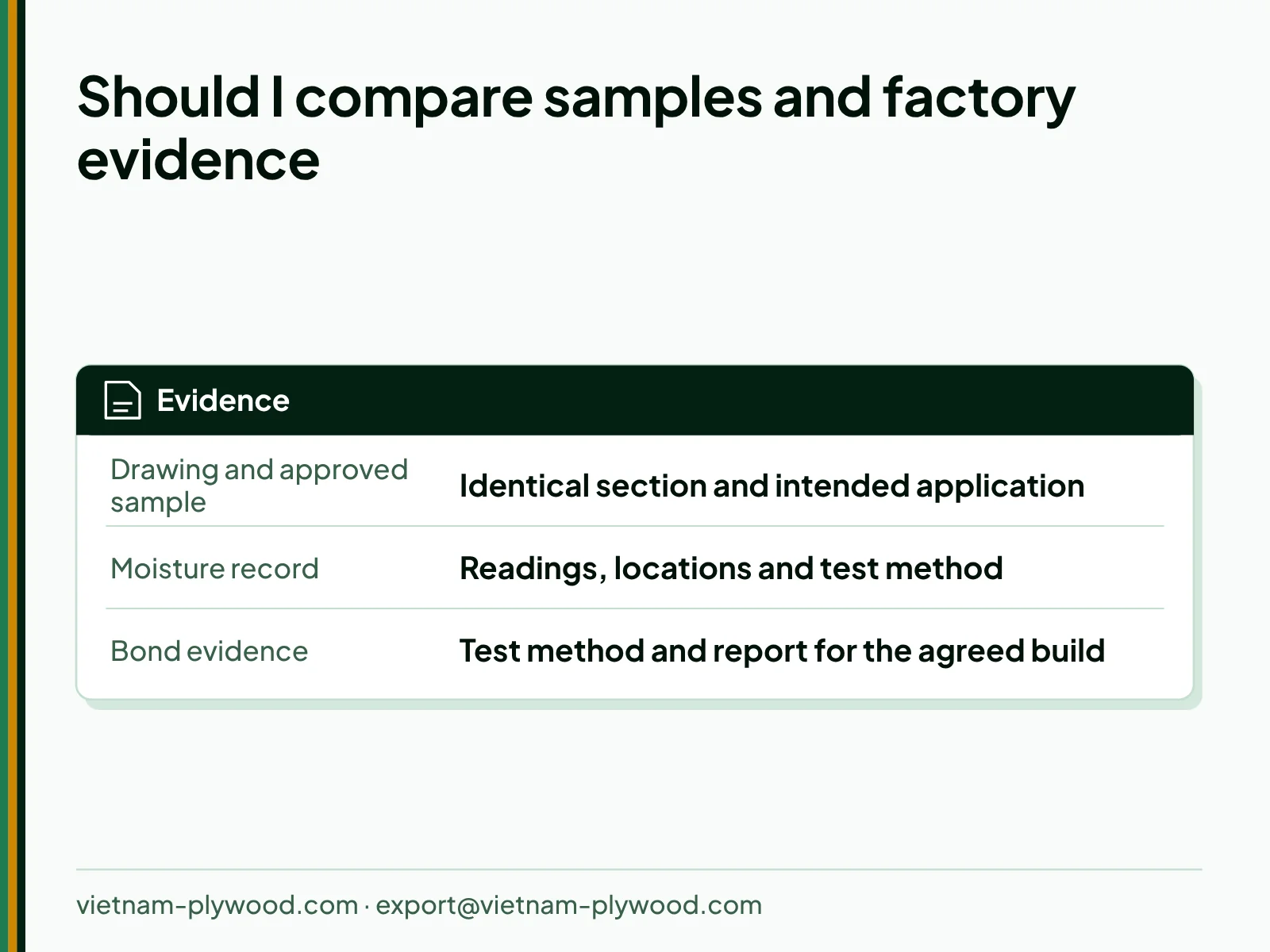
| Evidence | What to request | Decision it supports |
|---|---|---|
| Drawing and approved sample | Identical section and intended application | Whether the offer matches the requirement |
| Moisture record | Readings, locations and test method | Whether the lot meets the agreed moisture range |
| Bond evidence | Test method and report for the agreed build | Whether the adhesive performance fits exposure |
| Dimension log | Sampled widths, depths and lengths | Whether machining or assembly fit is acceptable |
| Packing photos | Bundle marks, edge protection and count | Whether receipt inspection can identify each lot |
The 2025 US Code of Federal Regulations, 40 CFR § 63.2292, defines LVL by its bonded veneer layers and their primarily lengthwise grain direction. Use that construction description to check the offered material, then specify the bond test, dimensional acceptance and intended use separately.
Can LVL be exported from Vietnam by the full container?
Yes. We handle full-container export orders from Vietnam, with the order specification, on-site quality control, documents and loading coordinated at the producing factory. The minimum order is one 40HC container. Factory lead time runs 15–45 days from receipt of the 30% deposit; the exact figure depends on order size, line loading and what the contract fixes.
Delivery can be FOB Hai Phong, CFR (CNF) or CIF. The balance is 70% against the scanned bill of lading, by telegraphic transfer (T/T) or irrevocable letter of credit at sight. Free samples are available; a first-time buyer pays the courier, and that charge comes off the first confirmed order.
For the shipment, plan the commercial invoice, packing list, bill of lading, certificate of origin, phytosanitary and fumigation papers, applicable certificate documents and destination-specific requirements. Insurance is included under CIF; EU lots add EUR.1 where applicable and the EUTR/EUDR file set. After loading, the draft shipping documents come to you for approval.
Can LVL be loaded in the same container as plywood?
Yes, LVL and plywood specifications can share a 40HC container when the combined cargo remains within its 28.5 t payload limit and the physical stowage plan works. For example, an 18 mm, 1220 × 2440 mm acacia plywood sheet weighs 31.08 kg. A full acacia plywood load at that size is 880 sheets, 47.15 m³ and 27.35 t, leaving 1.15 t of nominal payload headroom before adding LVL or other cargo.
That headroom is a weight ceiling, not a calculated LVL allocation: the LVL section, length, density, bundle dimensions and securing plan must be known first. Reducing plywood quantity can free more payload for LVL. The container-loading calculations cover plywood loads, while the mixed order needs a separate stowage drawing and bundle count.
Use the plywood supply programmes approach to list each item by bundle, cubic metres and weight before the loading plan is approved.
How do glue, moisture and exposure change the decision?
Adhesive choice must follow the service environment and the buyer’s acceptance test. Our plywood production distinguishes melamine MR glue, associated with a 12-hour boil test, from phenolic WBP glue, associated with a 72-hour boil test. These plywood facts should never be copied into an LVL performance certificate without evidence for the actual LVL build.
For dry industrial packaging, start with the expected storage conditions and handling cycle. For exposed storage or repeated wetting, write the exposure and bonding requirement explicitly and request an accepted test report. Emission classes such as E0, E1 and E2 are separate from glue chemistry; CARB P2 and TSCA Title VI address US emission limits and third-party certification, where applicable.
What should the first-order agreement record?
Write the specification and inspection criteria into the purchase agreement before the deposit. Identify who approves the drawing, sample, pre-shipment inspection and any permitted replacement or rework. Name the port, delivery term, package marking and documents required for the destination.
For the first order, keep a versioned drawing and inspection sheet with the same revision code. Ask for dated photographs of marked bundles and a loading record that can be reconciled against the packing list. A vague description such as “packing LVL, standard quality” leaves too many decisions until after pressing.
What drives the LVL quotation?
Section dimensions and veneer composition drive material usage first; bonding and exposure requirements can change adhesive and testing costs. Tighter dimensional and moisture acceptance limits add sorting, drying or machining work. Order mix, bundle configuration and the delivery term then affect handling and freight.
A larger or more demanding section can cost more than a simpler packing member because it uses more material and may require additional process controls. Request a quotation against the written drawing, acceptance schedule and destination rather than comparing an unqualified price per cubic metre. We quote the agreed non-structural LVL build after reviewing these details.
What happens during a factory visit?
A factory visit should follow the order from veneer preparation through pressing, section cutting, inspection and bundle marking. Buyers visit the factory office and inspect goods at the producing factory in Phu Tho or Hai Phong. Ask the inspector to choose samples from the production lot rather than only from a display stack.
HCPLY can show member-factory FSC, CARB P2, ISO 9001 or CE documents, and EUDR/EUTR papers where relevant, with factory details masked, on request. A document must be checked for scope, validity and relevance to the actual product. Record the inspected lot, the accepted measurements and any corrective action before authorizing loading.
What should I send to start the order?
Send Lucy a drawing and acceptance schedule, then book a visit to the producing factory. Use HCPLY’s manufacturer overview to understand the related plywood lines and contact to arrange the visit. The compact request below gives our team the fields needed to review an industrial LVL enquiry.
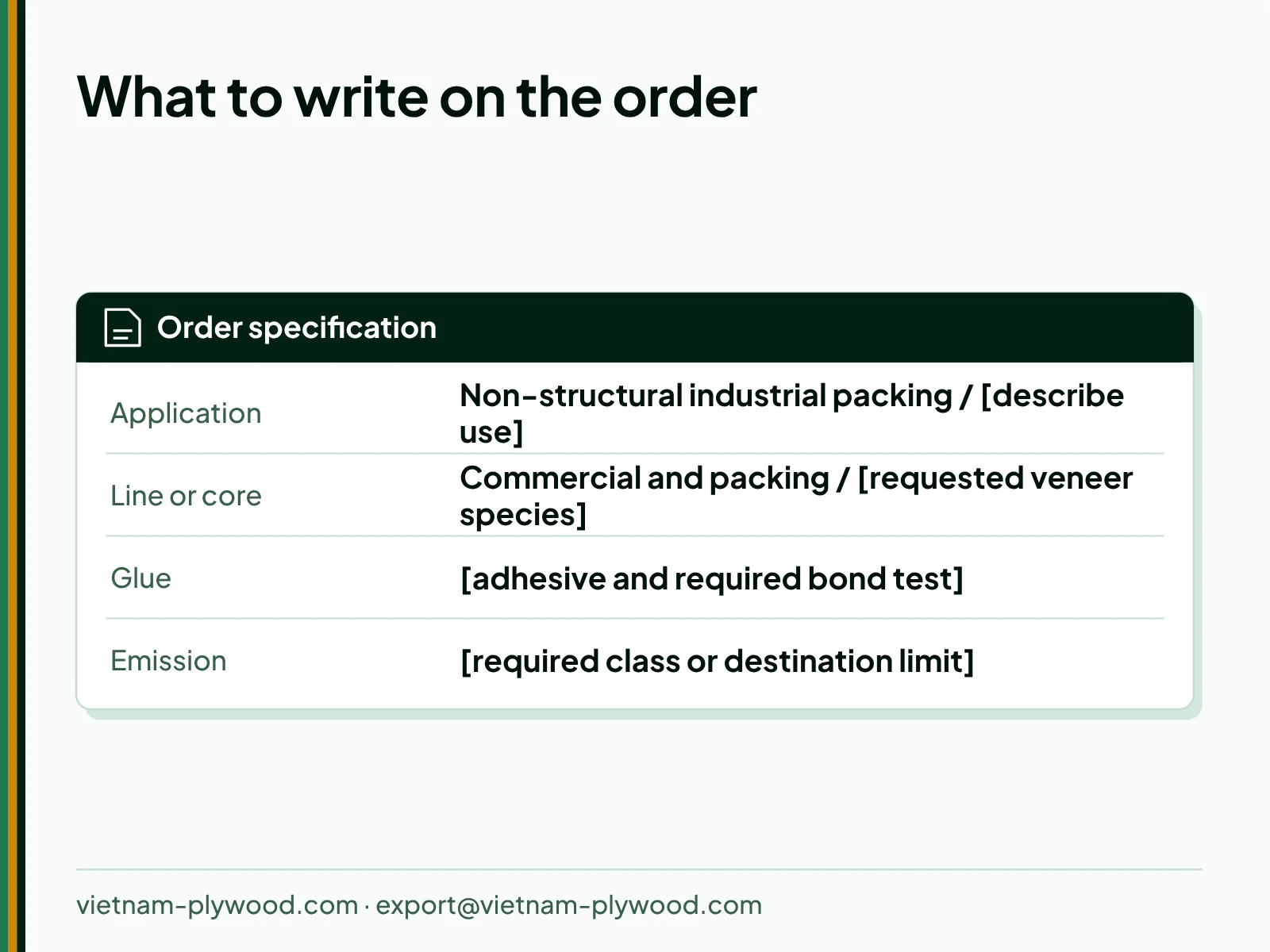
Application: non-structural industrial packing / [describe use]
Line or core: commercial and packing / [requested veneer species]
Glue: [adhesive and required bond test]
Emission: [required class or destination limit]
Face and grade: [surface appearance and defect acceptance]
Thickness and tolerance: [section depth/width, tolerance in mm]
Size: [length × width × depth in mm; drawing revision]
Quantity: [pieces, bundles and estimated m³]
Destination port: [port, country; FOB/CFR/CIF]
Moisture acceptance: [range, method and sampling plan]
Inspection: [lot sampling and accepted test evidence]
Next step: book a factory visit with Lucy at export@vietnam-plywood.com.