





Is LVL vs solid timber a strength comparison?
For frames, slats and pallet runners, LVL vs solid timber is primarily a choice about repeatable non-structural parts. A wrong selection can raise trimming costs, delay assembly or produce a rejected load. HCPLY quotes non-structural laminated veneer lumber (LVL) by intended use; structural-grade LVL is a separate product with documented design values.
Structural strength cannot be inferred from the LVL name. APA – The Engineered Wood Association, in its 2019 structural composite lumber selection guide, describes structural composite lumber as dried, graded wood elements bonded into billets and then resawn. The 2019 structural composite lumber guide addresses graded structural products. HCPLY quotes its non-structural parts against the intended application.
Which material fits each non-structural part?
The choice changes with the finished component and its acceptance criteria. Compare actual cut sections and permitted defects rather than a generic claim about engineered wood.
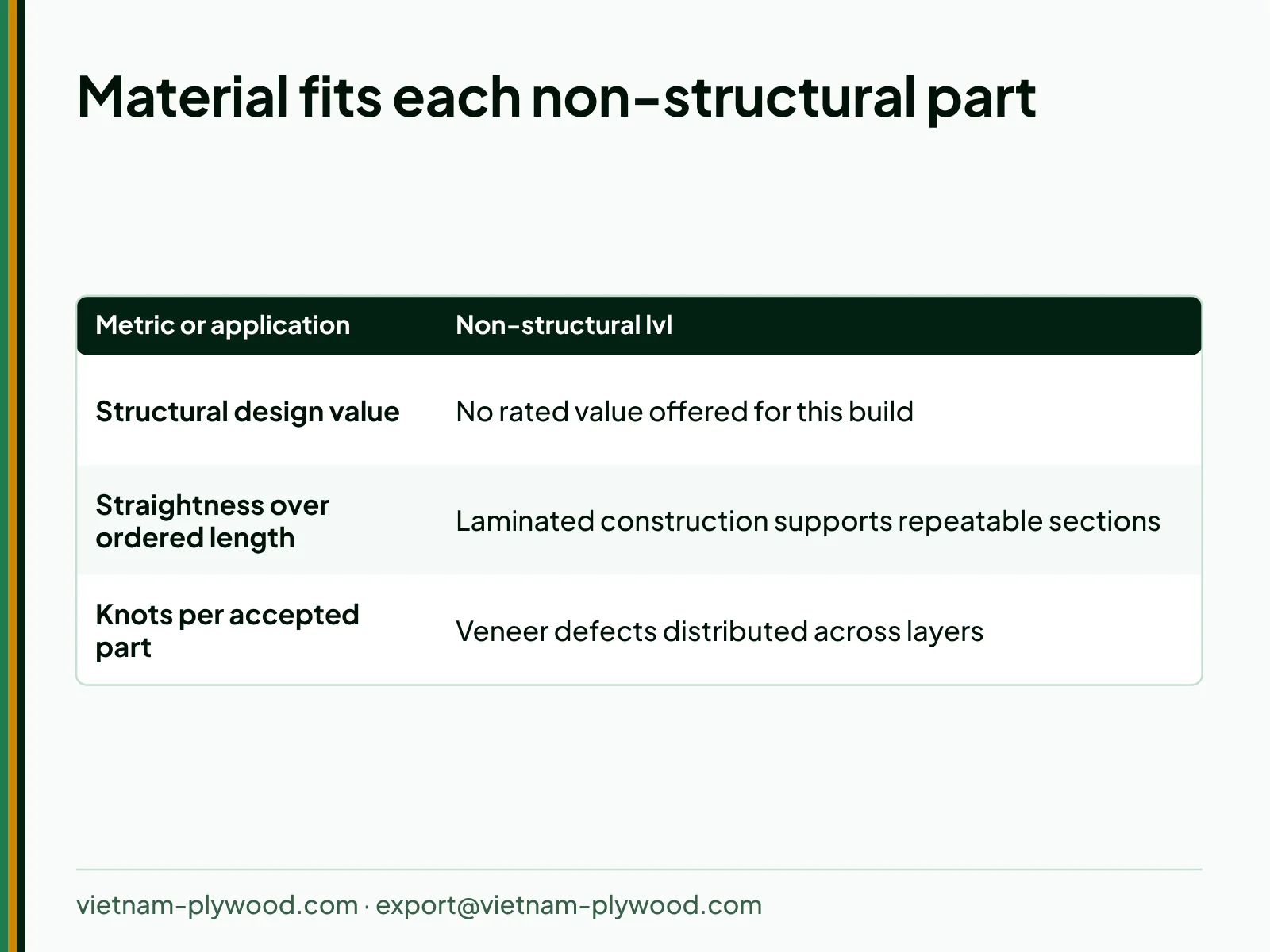
| Metric or application | Non-structural LVL | Sawn solid timber | Verdict by use |
|---|---|---|---|
| Structural design value | No rated value offered for this build | Requires its own documented grade | Neither for structural beams without accepted design evidence |
| Straightness over ordered length | Laminated construction supports repeatable sections | Depends on sawing, drying and knots | Trial LVL for concealed frames |
| Knots per accepted part | Veneer defects distributed across layers | Knots can force cutting around defects | Compare rejection on bed slats |
| Visible natural grain | Layered edges remain visible | Continuous wood grain | Sawn timber for exposed trim |
| Yield, accepted pieces/m³ | Calculate after trimming and rejection | Calculate on identical finished dimensions | Winner is the higher measured yield |
| Cost, delivered accepted part | Quote plus cutting and rejected stock | Quote plus drying, grading and trimming | Lower accepted-part cost wins |
| Wet-service behavior | Adhesive and edge exposure need specification | Species, treatment and drying matter | Test the intended exposure |
| Pallet runner fastening | Evaluate splitting and fastener withdrawal | Evaluate knots and end splitting | Choose after assembly trial |
The plywood types library places LVL among other engineered panel choices; the LVL supplier page covers the product request itself.
Which HCPLY line makes the relevant build?
Our commercial and packing line is the route for the non-structural LVL discussed here. The other lines build different products for different specifications, so a common nominal thickness does not mean interchangeable construction.
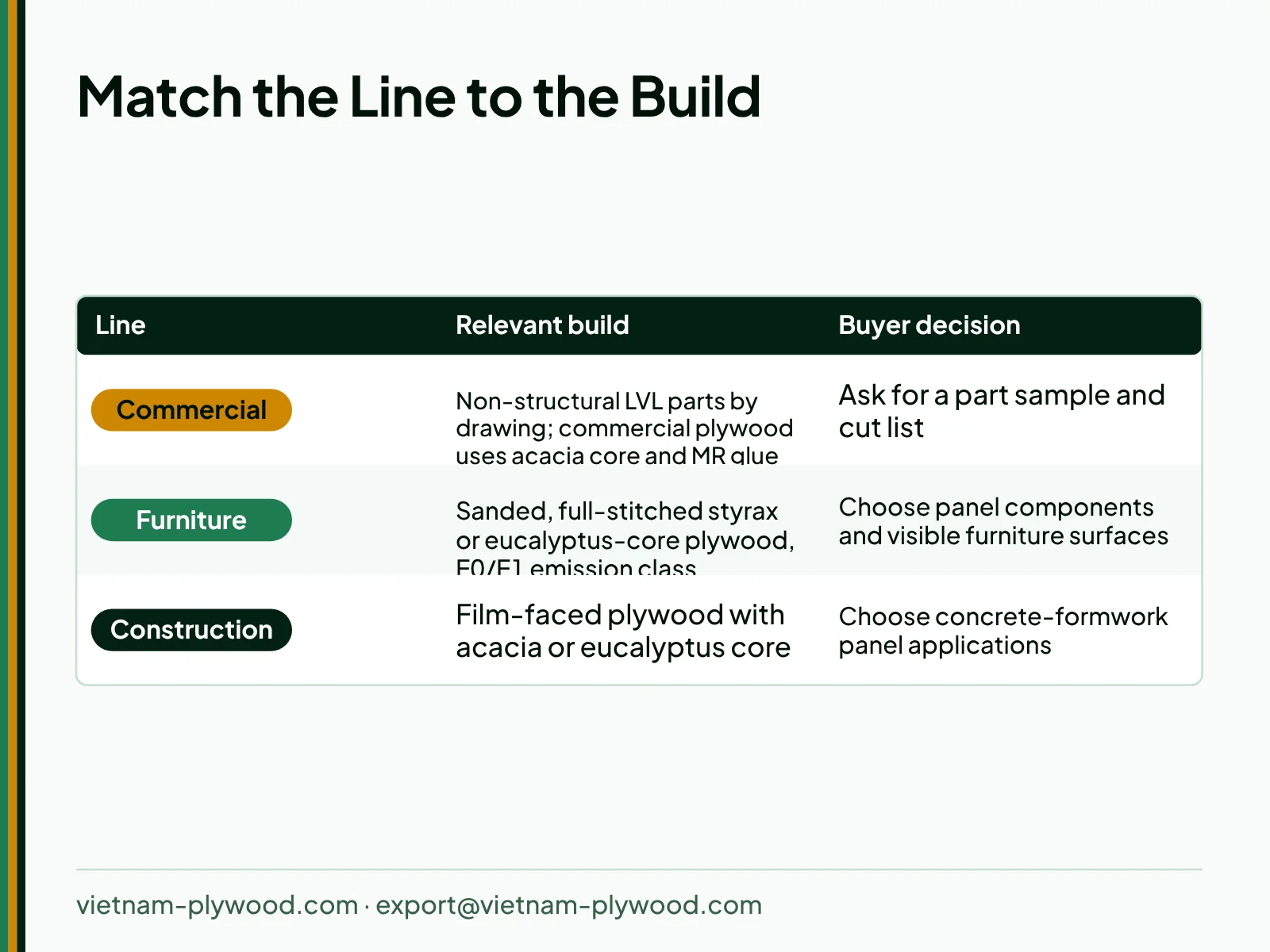
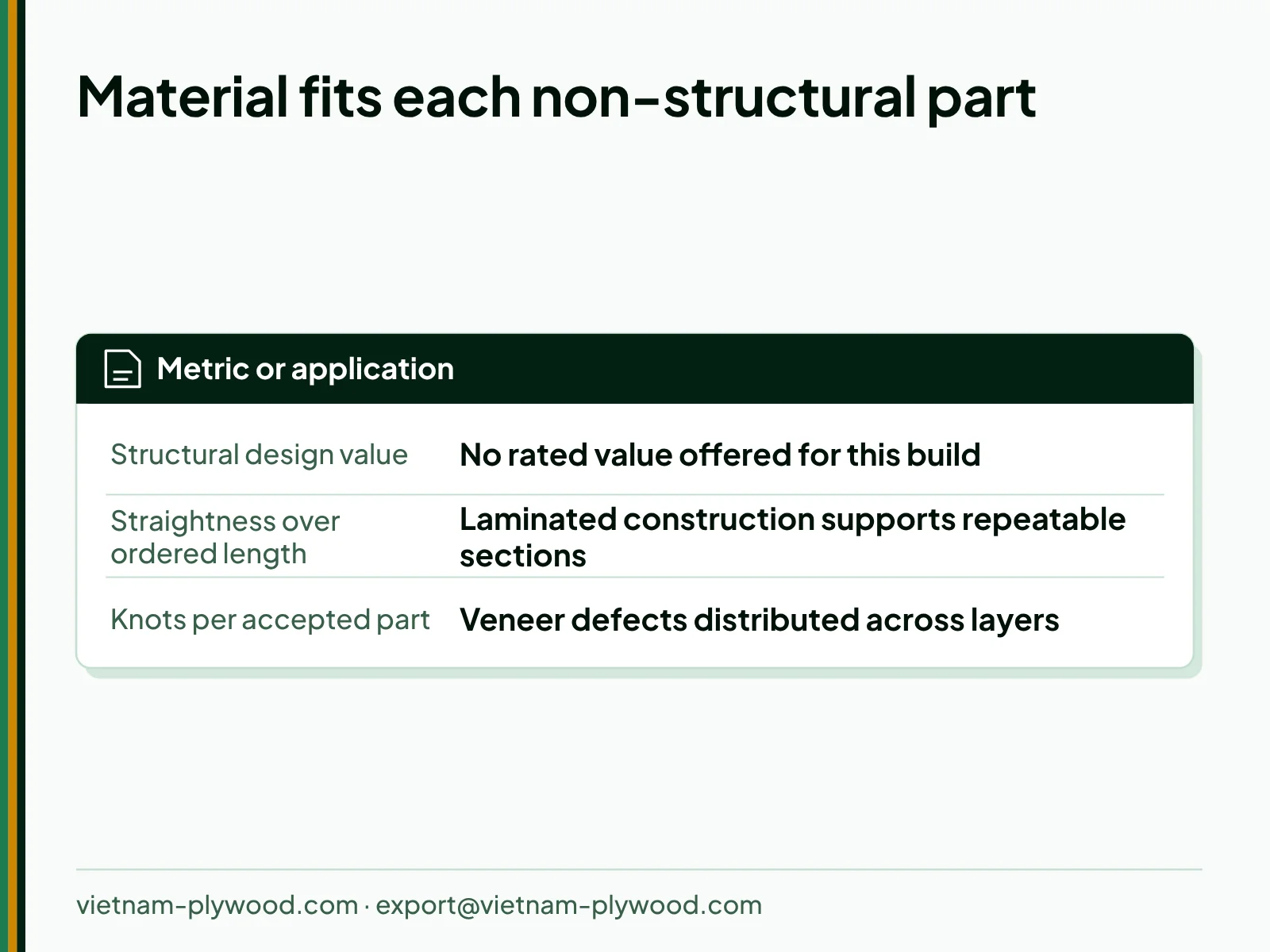
| Line | Relevant build at the same nominal 18 mm request | Buyer decision |
|---|---|---|
| Commercial and packing | Non-structural LVL parts by drawing; commercial plywood uses acacia core and MR glue | Ask for a part sample and cut list |
| Furniture | Sanded, full-stitched styrax or eucalyptus-core plywood, E0/E1 emission class | Choose panel components and visible furniture surfaces |
| Construction | Film-faced plywood with acacia or eucalyptus core | Choose concrete-formwork panel applications |
HCPLY has three member factories in Phu Tho and Hai Phong. Orders are produced at the factory matching the agreed specification. The comparison with MDF or plywood helps when the part is a panel rather than a narrow longitudinal member.
Is LVL straighter and more consistent than solid timber?
LVL is often a useful candidate where repeatable straight pieces matter, but its delivered straightness must be measured. Veneer orientation and pressing can reduce the influence of individual knots; they cannot remove all moisture-related movement.
The APA 2022 technical topic on LVL dimension adjustment factors specifically addresses dimensional changes from moisture variation. Set the conditioning method, measurement points and acceptable bow, twist and thickness range before comparing samples.
For sawn timber, record species, drying method, moisture range, grade and straightness at receipt. Comparing a dry LVL piece with freshly sawn wet pine would obscure the actual procurement decision.
How do furniture frames and bed slats compare?
Furniture frames reward consistent joint positions and repeatable section dimensions. LVL can reduce sorting where a frame rail will be concealed, while sawn timber may be preferred for visible edges or a design requiring continuous natural grain.
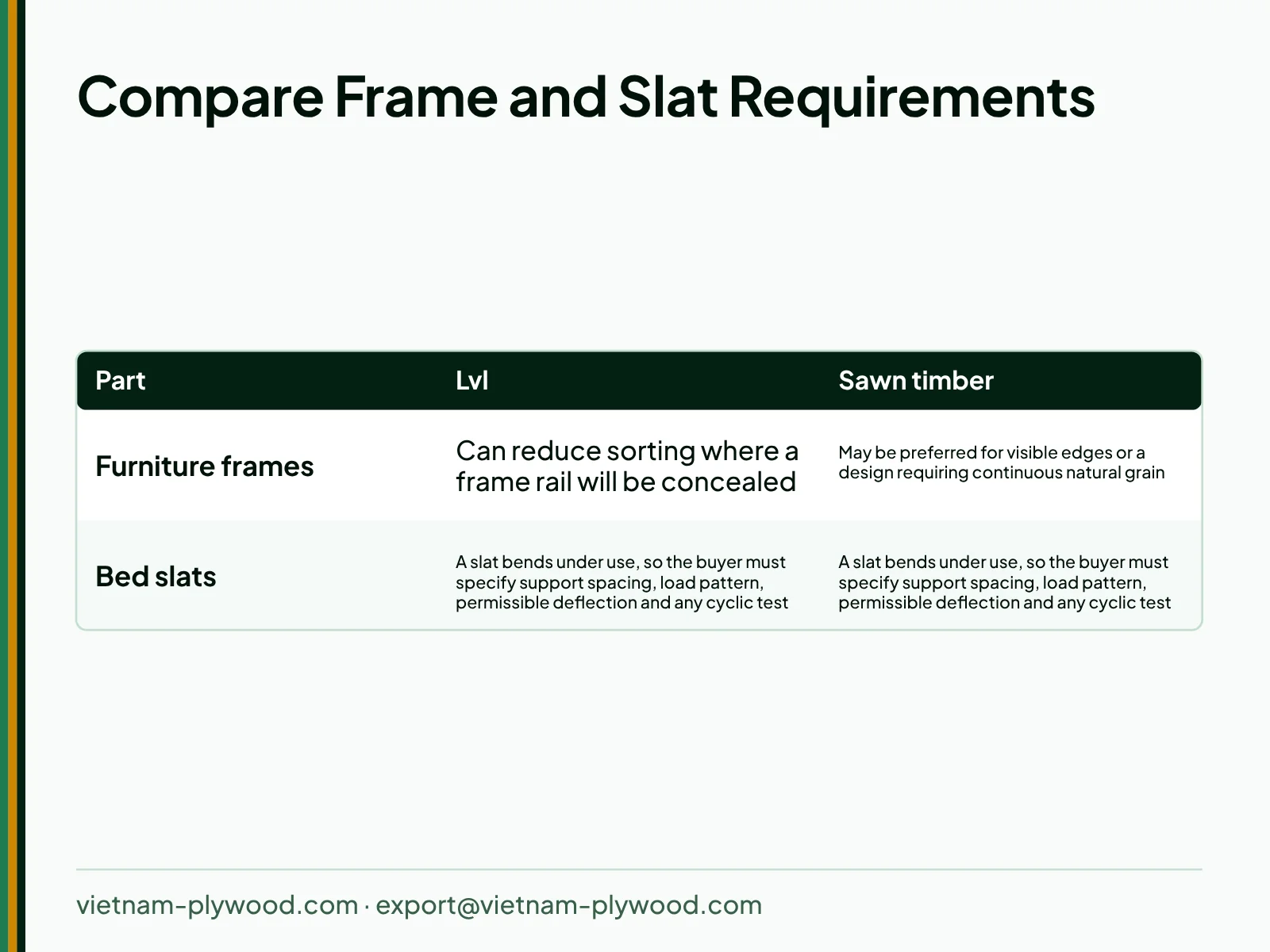
Bed slats require a separate trial. A slat bends under use, so the buyer must specify support spacing, load pattern, permissible deflection and any cyclic test. Non-structural LVL has no published load rating in this offer; a sample that looks straight does not establish bending capacity.
Inspect the slat ends after cutting and fastening. Edge damage, delamination and splits affect assembly even when the piece passes dimensional checks. For a panel-based frame alternative, compare veneer sheet construction and the finished surface requirement.
How does LVL compare with pine timber for door stock and pallet runners?
Against pine timber, LVL offers a different defect pattern and a more controlled manufactured cross-section. Pine can still be economical when the buyer can purchase a suitable dry grade and cut around knots with little loss.
Door stock requires checks for machining, screw holding, hinge locations and finishing. If the visible door edge must show continuous pine grain, a sawn or appropriately faced solution may be preferable. HCPLY does not offer an HPL or melamine-faced LVL line.
For pallet runners, compare end splitting under nails, fastener retention, crush damage and fork contact. A straight runner with poor fastening performance is a failed part. Use the actual pallet drawing and a representative assembly test, rather than assuming a beam strength ranking settles the choice.
Does LVL give a better yield per m³?
Yield per cubic metre is the volume of accepted finished parts divided by the purchased input volume. A claim that LVL always yields more would require actual cut-list and rejection records.
Start with the same finished length, width and thickness. Count parts lost to knots, bow, cracks, trimming, machining and joint defects. Record usable pieces after final inspection, then multiply by the finished piece volume to compare accepted output against input.
For example, a buyer should compare the number of accepted door rails produced from each purchased cubic metre, not simply count nominal lengths on arrival. The result can reverse if sawn pine is already well graded or the LVL cutting pattern creates excessive offcuts.
Where core choice affects panel weight and handling, the acacia and eucalyptus core comparison addresses that separate decision.
Is LVL cheaper than lumber?
LVL is not automatically cheaper than lumber. For a plain short runner, readily available sawn pine can have the lower purchase price. For long straight rails with tight rejection limits, laminated parts can cost more at purchase yet less per accepted finished component.
Order the main price drivers this way: first the specified section and length with acceptable defects; next veneer selection, layup and adhesive; then cutting, sanding, packing and shipment. More demanding bonding and tighter sorting add manufacturing work compared with a simpler non-structural build.
Request quotations on identical delivered quantities and finished acceptance criteria. Compare purchase cost plus machining, rework, rejected pieces and freight allocation. There is no general LVL price figure here; distributor supply programmes explain how a repeat specification can be documented across orders.
What happens with moisture, finishes and machining?
Moisture affects both materials. LVL edges and adhesive lines need an agreed exposure class; sawn timber can cup, split or twist when its moisture condition changes. Store both products off the floor and protected from rain during handling.
Do a machining trial before approving a door-stock order: cut, drill, fasten and finish the representative pieces. Record whether the veneer edges need covering and whether screw holes produce local splitting. An attractive sample face does not settle edge performance.
The choice of glue and the emission requirement are separate specification fields. A melamine MR glue designation describes bonding, while E0, E1 or E2 describes an emission class. A buyer needing a specific emission certificate should put that requirement in the order.
What should an inspector check at the producing factory?
At the producing factory, the buyer or inspector can witness sampling from identified bundles and compare each part against the approved drawing. Check dimensions at more than one point, straightness along the full length, visible glue-line integrity and damage at cut ends.
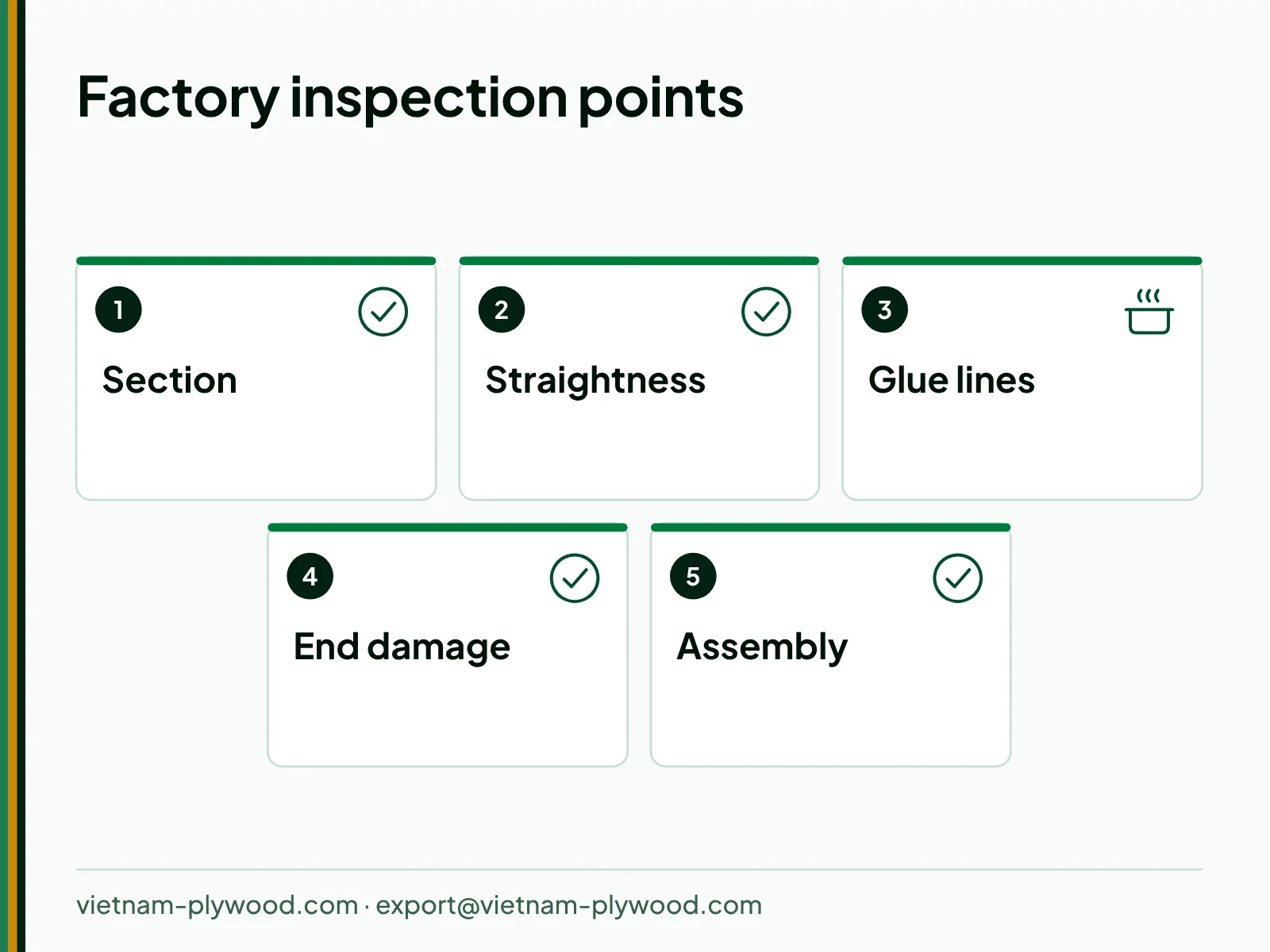
Record the measurement tool, sample selection and pass/fail criterion. For pallet runners, assemble a sample pallet and check fastening and fork-entry clearances. For bed slats, perform the agreed application test rather than substituting a visual check for bending performance.
Lucy coordinates on-site quality control and export documentation. Buyers can visit the factory office and inspect goods at the producing factory. Factory-specific FSC, CARB P2, ISO 9001 or CE documents, where relevant to the agreed build, are shown with factory details masked, on request.
How does the order move through export?
The minimum order is one 40HC, with specifications mixed within the 28.5 t payload limit. For a reference plywood load, 18 mm 1220 × 2440 mm acacia-core sheets total 880 sheets, 47.15 m³ and 27.35 t; these plywood figures cannot be transferred to an LVL runner load.
An LVL-and-plywood mixed load needs actual LVL section weights, pallet dimensions and securing arrangements. Use the mixed-container planning page and the container packing reference for the relevant loading calculation.
HCPLY ships FOB Hai Phong, CFR (CNF) or CIF. Factory lead time runs 15–45 days from receipt of the 30% deposit; the exact figure depends on order size, line loading and what the contract fixes; the The remaining 70% is paid on the scan of the bill of lading, by T/T, or by irrevocable sight L/C.
The commercial invoice and packing list identify the shipped parts and quantities; the B/L and certificate of origin support the shipment record. After loading, the draft shipping documents come to you for approval.
What specification should the buyer send?
A useful RFQ identifies the finished part, its acceptance test and the destination. Avoid a request for “strong LVL” without a load definition, or for “pine equivalent” without the pine grade and moisture condition.
Send the cutting drawing and a sample inspection plan with the fields below. The contact page reaches Lucy at export@vietnam-plywood.com. The next step is to book a factory visit to examine the agreed build and inspection method.
Application: non-structural furniture frame / bed slat / door stock / pallet runner
Line or core: commercial and packing line; proposed core and LVL layup
Glue: MR melamine or agreed bonding requirement
Emission: required class and certificate, if applicable
Face and grade: exposed/concealed face, accepted defects
Thickness and tolerance: finished section, measurement method, acceptance range
Size: finished width x length; cutting drawing and straightness limit
Quantity: accepted parts and total order volume
Destination port: named port and requested trade term