





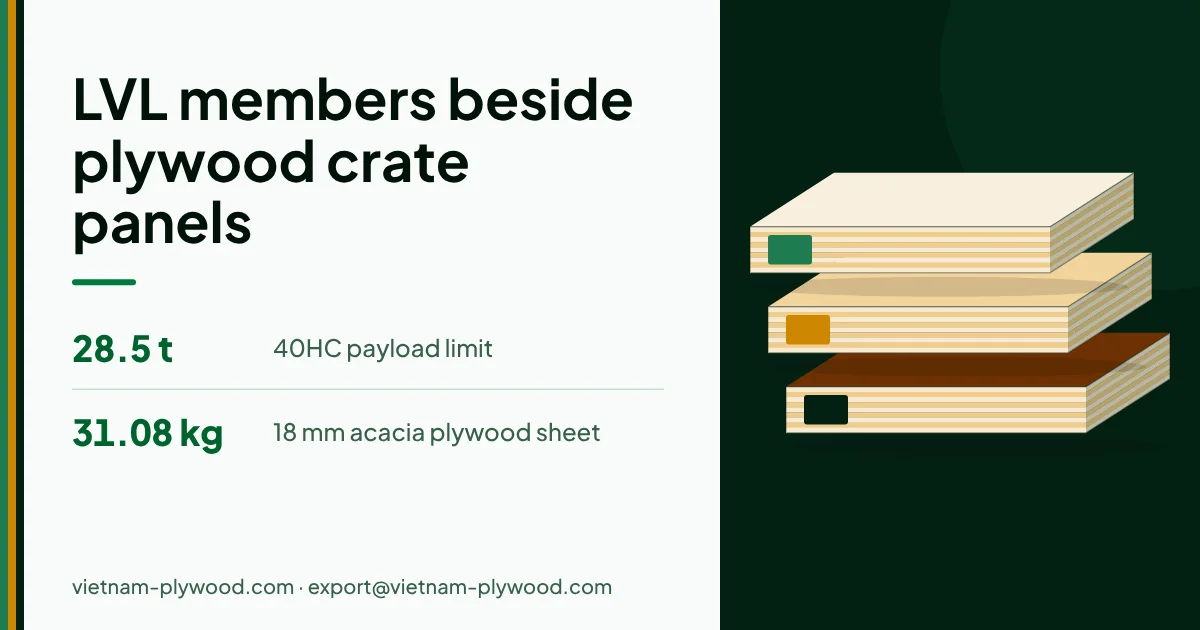
HCPLY would put long, grain-direction members such as runners and door stock into laminated veneer lumber (LVL), while ordering broad crate walls and bases as plywood. Choosing the wrong form can add cutting waste, require extra reinforcement, or cause a packing load to be rejected. The lvl vs plywood decision starts with each component’s load direction, fastening pattern and dimensions.
What is the difference between LVL vs plywood?
LVL aligns most veneer grain along the member’s length, while plywood alternates grain direction between layers. That makes LVL suited to long members carrying loads primarily along one axis and plywood suited to broad panels resisting loads in two directions. Neither name alone specifies an allowable load; the intended section, grade, bond and test evidence still matter.
Laminated veneer lumber is made from bonded wood veneers arranged predominantly in parallel. Plywood is a sheet made with cross-oriented veneer layers. See the plywood definition for buyers and LVL terminology and uses for the individual constructions.
Natural Resources Canada, in its technical explanation of laminated veneer lumber, distinguishes parallel LVL veneers from perpendicular plywood layers. That distinction helps procurement teams separate sheet schedules from member schedules: Natural Resources Canada.
Which material wins for each packing component?
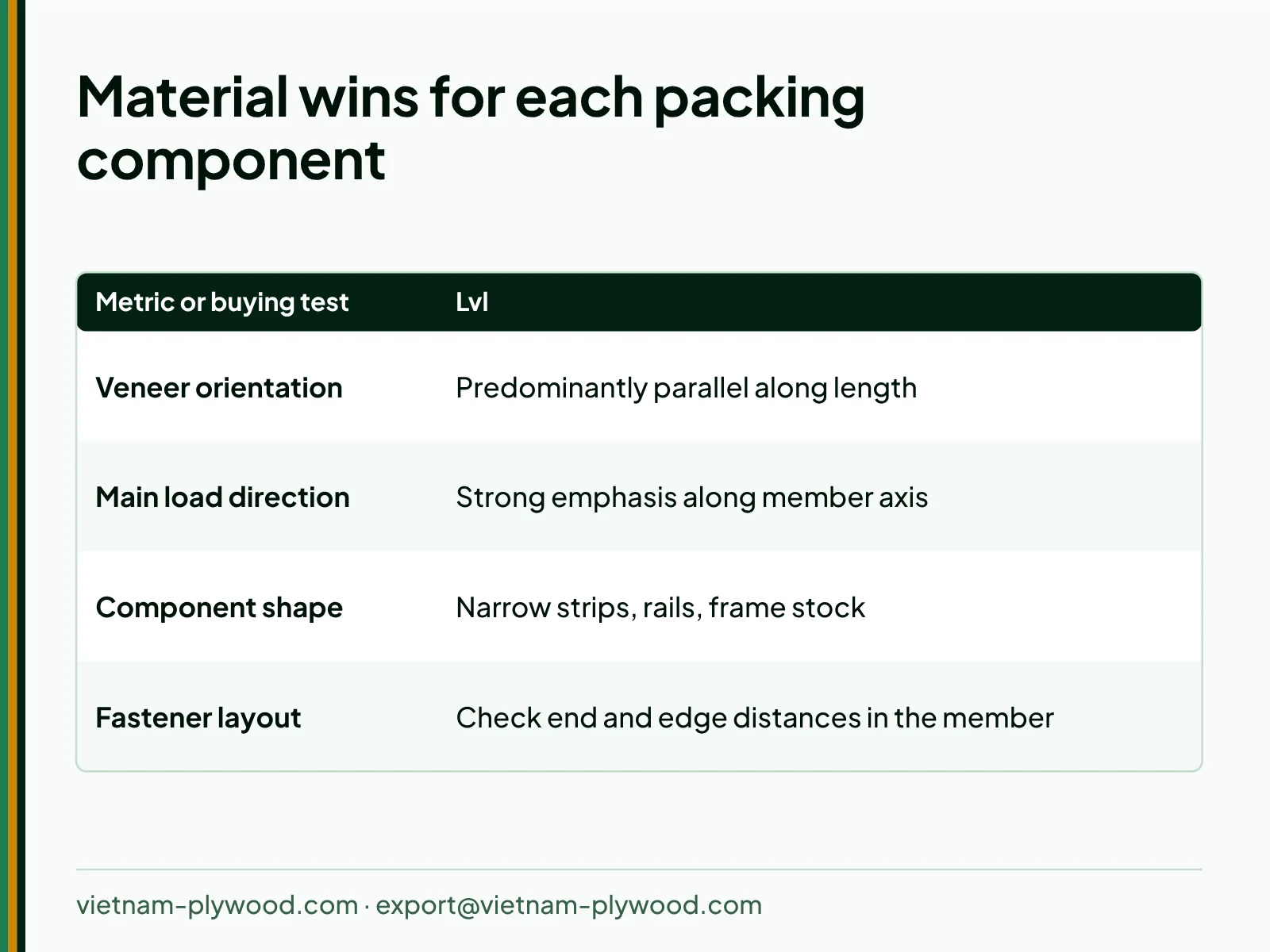
Use the table to split a bill of materials before requesting samples.
| Metric or buying test | LVL | Plywood | Verdict by use |
|---|---|---|---|
| Veneer orientation | Predominantly parallel along length | Alternating across layers | LVL for lengthwise members; plywood for panels |
| Main load direction | Strong emphasis along member axis | Useful across two sheet axes | LVL runners; plywood crate walls |
| Component shape | Narrow strips, rails, frame stock | Broad sheets and cut panels | LVL slats; plywood lids and sides |
| Fastener layout | Check end and edge distances in the member | Check edge distances and face fastening in the panel | Choose by joint detail |
| Finish surface | Usually specified for a functional member | Face grade can be selected | Plywood for visible faces |
| Moisture exposure | Bond specification and edge protection matter | Bond specification and edge protection matter | Neither wins by name alone |
| Cut yield | Efficient when the schedule needs long strips | Efficient when the schedule needs large rectangles | Compare the cutting plan |
| Load evidence | Member section and direction need acceptance criteria | Panel span and support need acceptance criteria | Ask for application-specific evidence |
| Purchase unit | Piece dimensions and quantity | Sheet size, thickness and quantity | Keep separate order lines |
The Plywood Types category covers other face and core choices. For packing, a strong-looking face cannot replace a defined core build or a load test.
Is LVL a type of plywood?
No. LVL and plywood are both veneer-based engineered wood, but their layups differ. LVB (laminated veneer board) can use a mixed orientation; request its cross-section. A seller might call LVL “LVL plywood” informally; a purchase order should instead name the product and show its veneer orientation.
The phrase lvl wood vs plywood should lead to an orientation check, not a label-only comparison.
Is LVL stronger than plywood?
LVL can be the more appropriate choice for a member loaded along its long axis; plywood can be more appropriate for a plate or wall loaded across its surface. “Stronger” needs a named test, direction, span, support spacing and allowable deflection before it becomes a purchasing decision.
Request the loading diagram and acceptance method for each part, especially when cargo weight is high or lifting points concentrate forces.
A generic material comparison cannot replace that requirement.
Which parts should be LVL, and which should be plywood?
Put lengthwise runners, rails, door stock and narrow frame members on the LVL schedule; put large sides, lids, dividers and deck panels on the plywood schedule. Slats can be LVL when their span and grain direction suit the design.
A packaging engineer should size members against the actual cargo and handling method. A packing company can then compare the cut list with the material’s manufactured format before approving the order.
At HCPLY, our commercial and packing line uses acacia core, moisture-resistant (MR) glue and unsanded or light-sanded plywood. Its sheet-based build is suited to the crate faces and partitions in this example. Discuss the member schedule separately through our LVL supply page, with dimensions and loading requirements attached.
How do our three production lines change the order?
We place plywood work with the producing factory that matches the written specification; a buyer can inspect goods there.
| Line | Core and surface at the same nominal 18 mm | Practical use verdict |
|---|---|---|
| Our furniture line | Styrax or eucalyptus core, full stitched and sanded; E0/E1 emission class | Finished cabinet or furniture panels, not a basic crate wall |
| Our commercial and packing line | Acacia core, MR glue, unsanded or light-sanded | Crate walls, dividers and packing panels |
| Our construction line | Acacia or eucalyptus core with phenolic or melamine film, unsanded | Formwork faces, rather than ordinary packing stock |
Film-faced plywood belongs to construction supply applications, where release surfaces matter. Furniture-grade sanding adds cost when the panel will remain hidden inside a crate.
What specification prevents a wrong substitution?
Name each component by function, then attach its dimensions, orientation, bond and inspection criteria.
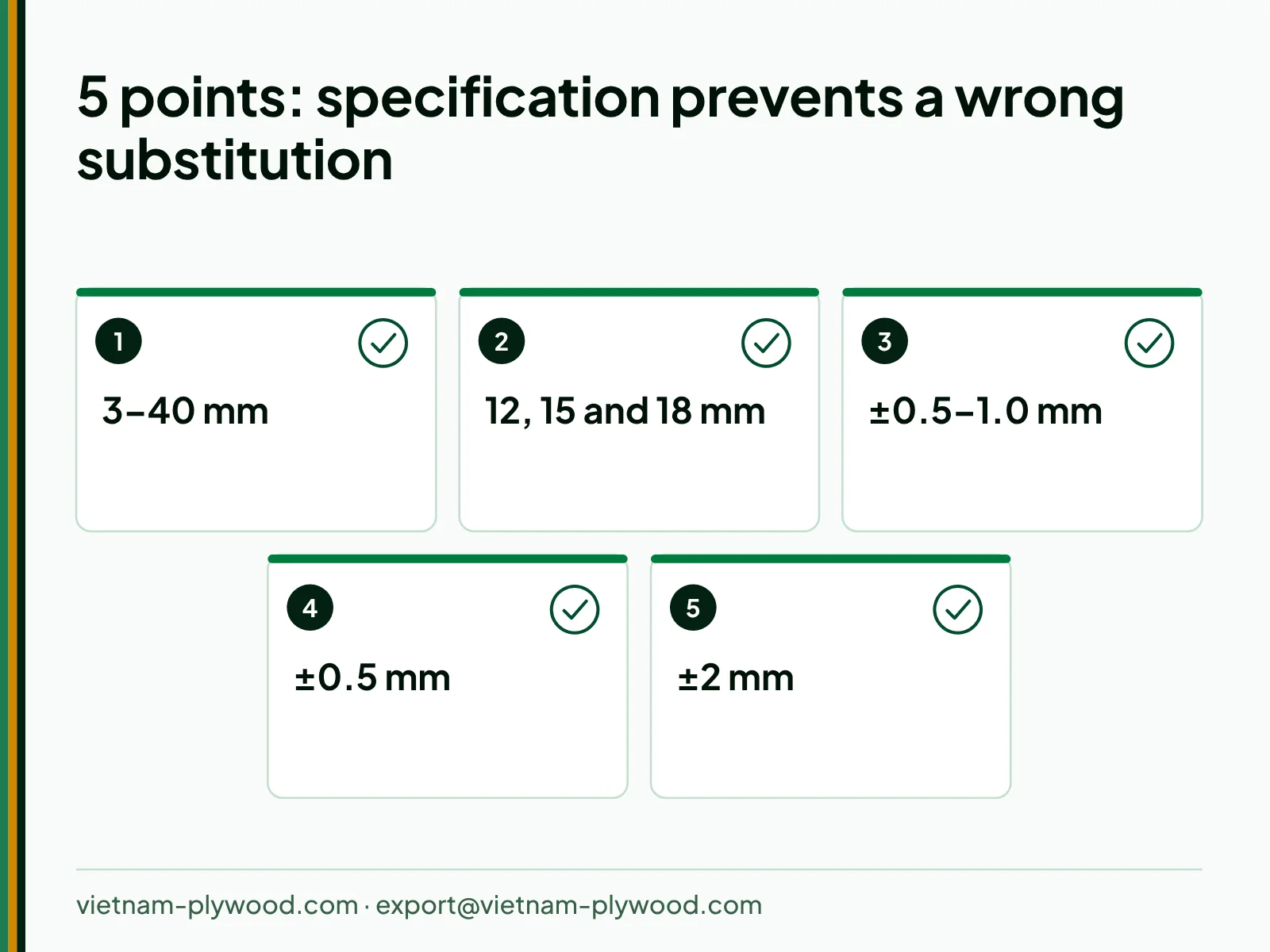
For plywood, our stated thickness range is 3–40 mm; common thicknesses include 12, 15 and 18 mm. Packing thickness tolerance is ±0.5–1.0 mm; commercial plywood is ±0.5 mm. Length and width tolerance is ±2 mm. Keep these plywood tolerances separate from any LVL member tolerance agreed in its own specification.
Choose the core and face as separate fields: acacia identifies the packing core, while a face name identifies the surface veneer. MR glue and an emission class also belong in separate fields. Where the cargo will meet wet conditions, write the exposure and bond requirement into the order instead of assuming that either product name covers it.
Can LVL and plywood ship in the same container?
Yes. Specifications can be mixed in one 40HC container within the 28.5 t payload limit, provided the actual packed weights and securing plan fit. A plywood-only loading figure is a baseline, not an LVL weight allowance.
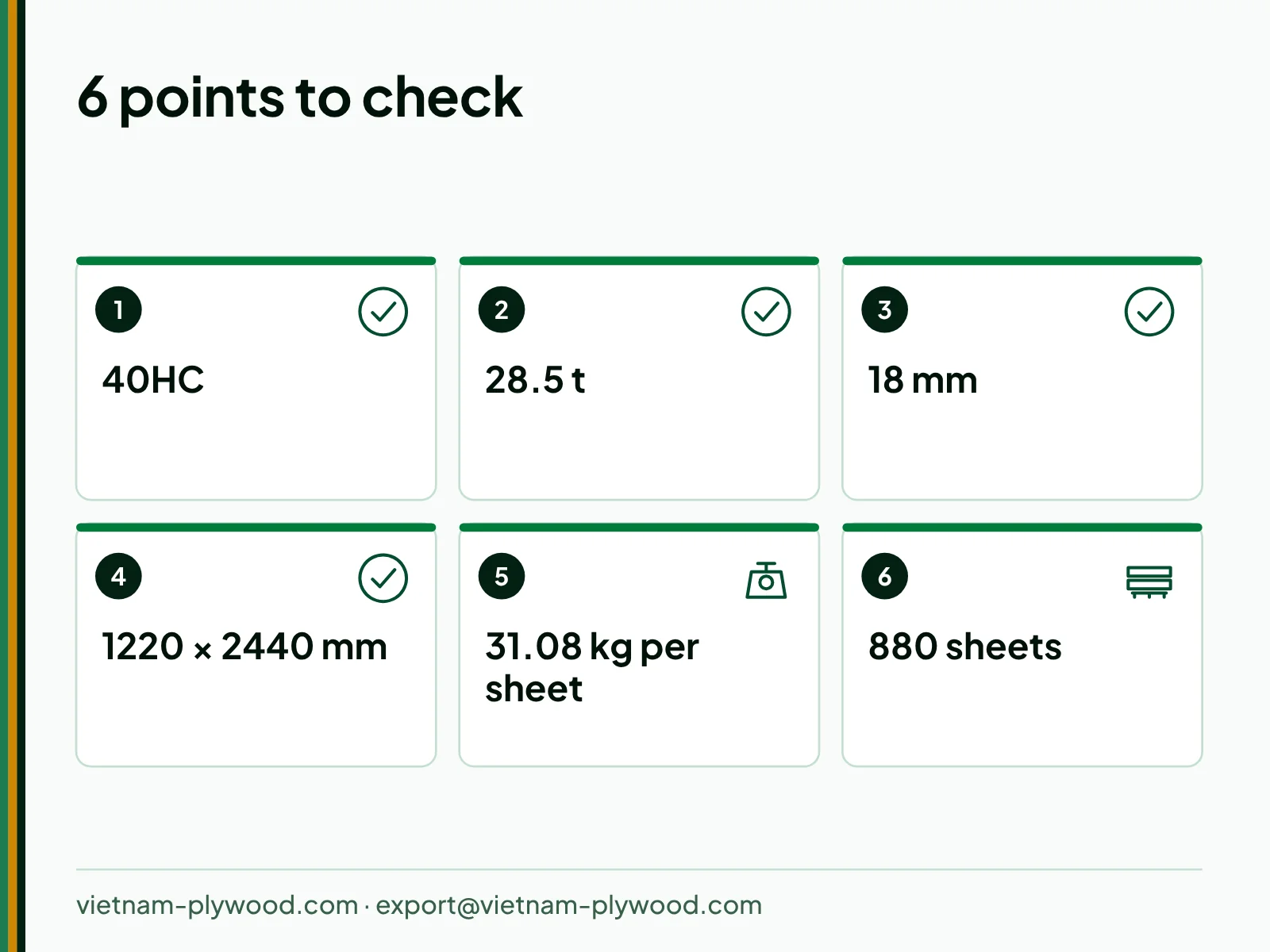
At 18 mm, 1220 × 2440 mm acacia-core plywood weighs 31.08 kg per sheet. A full acacia plywood-only reference load is 880 sheets, 47.15 m³ and 27.35 t. For a mixed load, reduce the plywood quantity and obtain the measured gross weight of the LVL bundles, pallets and dunnage before approving the loading plan.
Reserve LVL space by its packed dimensions and measured gross weight, including dunnage. The container-loading reference covers the sheet-only loading calculation.
Do LVL and plywood share export documents?
Yes, mixed goods can travel under one set of export documents for the shipment, with LVL and plywood identified separately in the commercial invoice and packing list. We coordinate the export paperwork and send draft shipping documents for buyer approval after loading.
The shipment file includes the bill of lading (B/L), certificate of origin, phytosanitary and fumigation papers, and any agreed certificate or test documents. Insurance is included under CIF; EU lots include EUR.1 and the EUTR/EUDR file set. The invoice and packing list should show the distinct item descriptions, quantities and package marks so customs and receiving teams can reconcile both product types.
For member-factory certificates such as FSC, CARB P2, ISO 9001 or CE, relevant documents are shown with factory details masked, on request. See export-ready commercial plywood for the panel-specific checks.
What should an inspector witness before loading?
Inspect the veneer orientation in sample cut edges and match the packed goods to each line of the purchase order. The producing factory should make the selected packs accessible for measurement and identification.
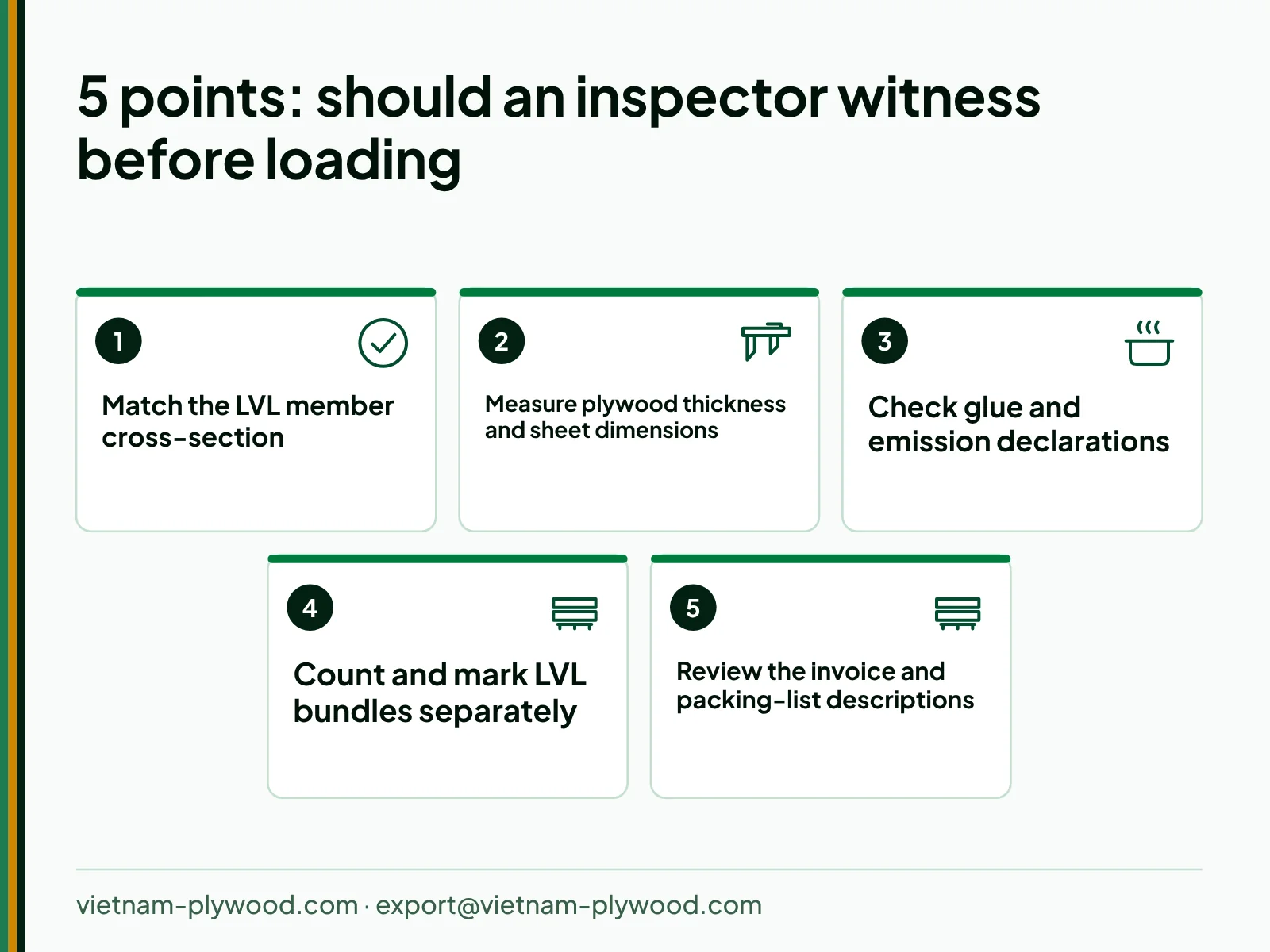
- Match the LVL member cross-section and grain direction to its approved drawing; record any end-joint arrangement.
- Measure plywood thickness and sheet dimensions at agreed sampling points; inspect exposed edges for gaps and the faces for damage.
- Check glue and emission declarations as distinct specification fields, with any required reports tied to the correct product.
- Count and mark LVL bundles separately from plywood pallets; reconcile gross weights with the loading plan.
- Review the invoice and packing-list descriptions before approving draft shipping papers.
HCPLY handles on-site quality control and loading coordination. Buyers can visit the factory office and inspect at the production site, rather than accepting an unlabelled mixed stack as evidence of the agreed build.
How should a buyer compare the two quotations?
Compare total component cost after cutting, fastening and transport, rather than comparing an LVL piece price with a plywood sheet price. LVL’s parallel layup and member dimensions can raise processing requirements; a furniture-grade sanded panel costs more to prepare than an unsanded packing panel. Offcut waste can reverse a material-only saving.
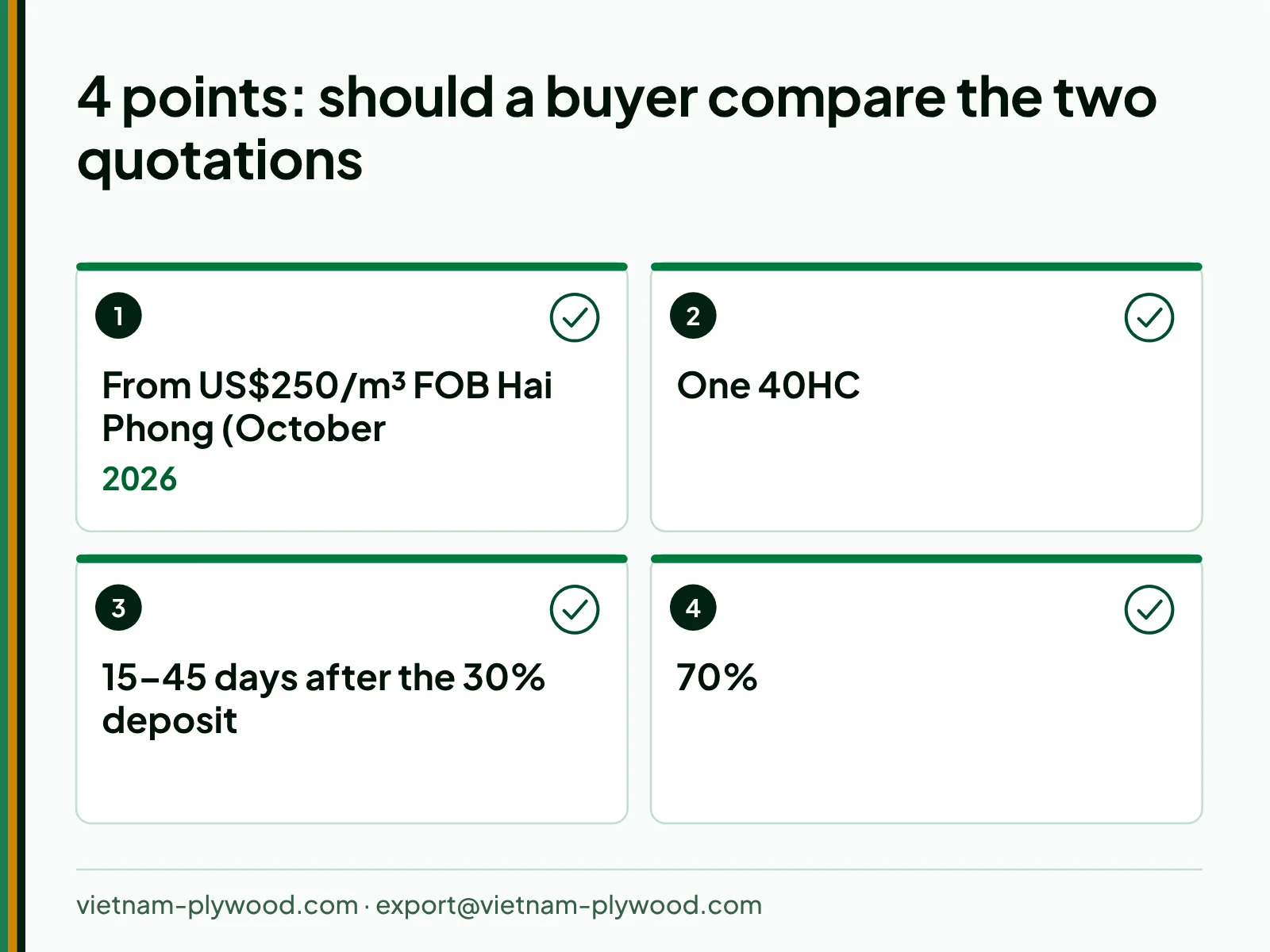
There is no stated LVL starting price; request a quotation against the written member specification. Commercial plywood starts from US$250/m³ FOB Hai Phong (October 2026), with the final quote driven by the selected build and quantity.
Our minimum order is one 40HC. Production is 15–45 days after the 30% deposit, depending on quantity, production conditions and agreement; the 70% balance is against the scanned B/L, by T/T or irrevocable L/C at sight. Delivery can be FOB Hai Phong, CFR (CNF) or CIF. Free samples are available; new buyers book their courier, with that cost creditable against a real order.
What should go into the purchase request?
Send two component schedules and one loading objective: the plywood sheet requirements and the LVL member requirements should remain individually testable. Include cargo support points, lifting method and destination port so the quotation can address both material and packing design.
Application: industrial export crate; component-by-component load diagram attached
Line or core: commercial and packing line / acacia plywood; LVL member build to quote
Glue: plywood MR; LVL bond requirement and exposure stated separately
Emission: required class or market limit for each item
Face and grade: plywood face and A/B grade as agreed; LVL appearance criteria
Thickness and tolerance: plywood 18 mm, packing ±0.5–1.0 mm; LVL dimensions/tolerance to agree
Size: plywood 1220 × 2440 mm; LVL member width × depth × length schedule
Quantity: plywood sheets and LVL pieces, packed gross weight by item
Destination port: [port, country]; delivery term: FOB Hai Phong / CFR / CIF
Ask Lucy at export@vietnam-plywood.com for a sample set of the proposed LVL member and packing plywood builds before finalizing the mixed load. The contact page is available for the component drawings and inspection checklist.