





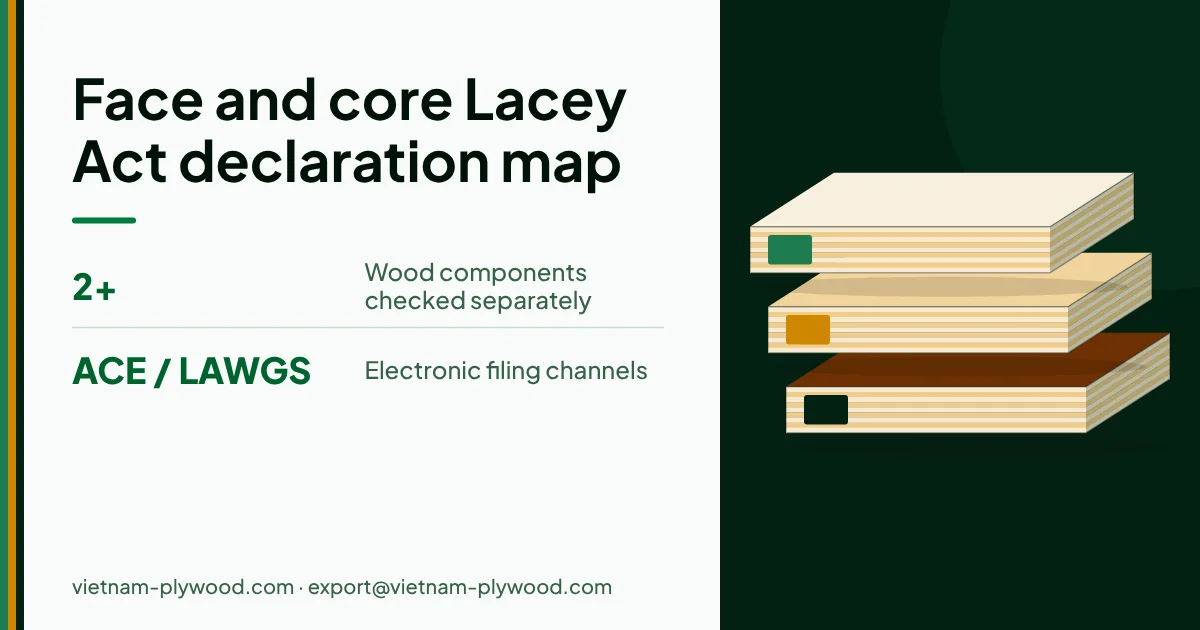
HCPLY prepares face-and-core species records so US importers can complete Lacey Act declarations for Vietnam plywood without treating the whole panel as one tree species. A wrong harvest country or unverified botanical name can delay entry, create correction costs, or expose a shipment to enforcement. The US importer or authorized agent makes the filing; our export team supplies the product evidence.
What does lacey act plywood vietnam compliance require?
Lacey act plywood vietnam compliance means identifying the wood in each covered imported panel, its country of harvest, its quantity and its declared value. For veneer plywood with different face and core woods, the declaration must reflect the actual component species rather than a single commercial product name. The US importer files; HCPLY documents the build and sourcing trail.
The Lacey Act is a US law restricting trade in plants taken, transported or sold contrary to applicable laws. The US House Office of the Law Revision Counsel’s 2026 text of 16 U.S.C. §3372 specifies scientific names, plant quantity, value and harvest country for covered declarations. The legality prohibition applies even when a shipment’s declaration information appears complete.
The US Department of Agriculture’s Animal and Plant Health Inspection Service (APHIS) states in its 2026 filing guidance that importers must understand the supply chain for each plant component. An invoice saying only “Vietnam plywood” is therefore an inadequate source for species-by-species data. A Vietnam manufacturing location alone cannot establish where every veneer tree was harvested.
The Certifications resource hub covers related document topics. For this shipment, start with the actual bill of materials and the importer’s classification, not a certificate title.
Does every plywood shipment need PPQ 505?
Covered US imports of plywood require declaration data under the Lacey Act, with applicability checked against the exact Harmonized Tariff Schedule (HTS) classification and entry type. APHIS’s 2025 declaration requirements explains the applicable entry criteria before filing. The heading and product description must match the goods actually entered.
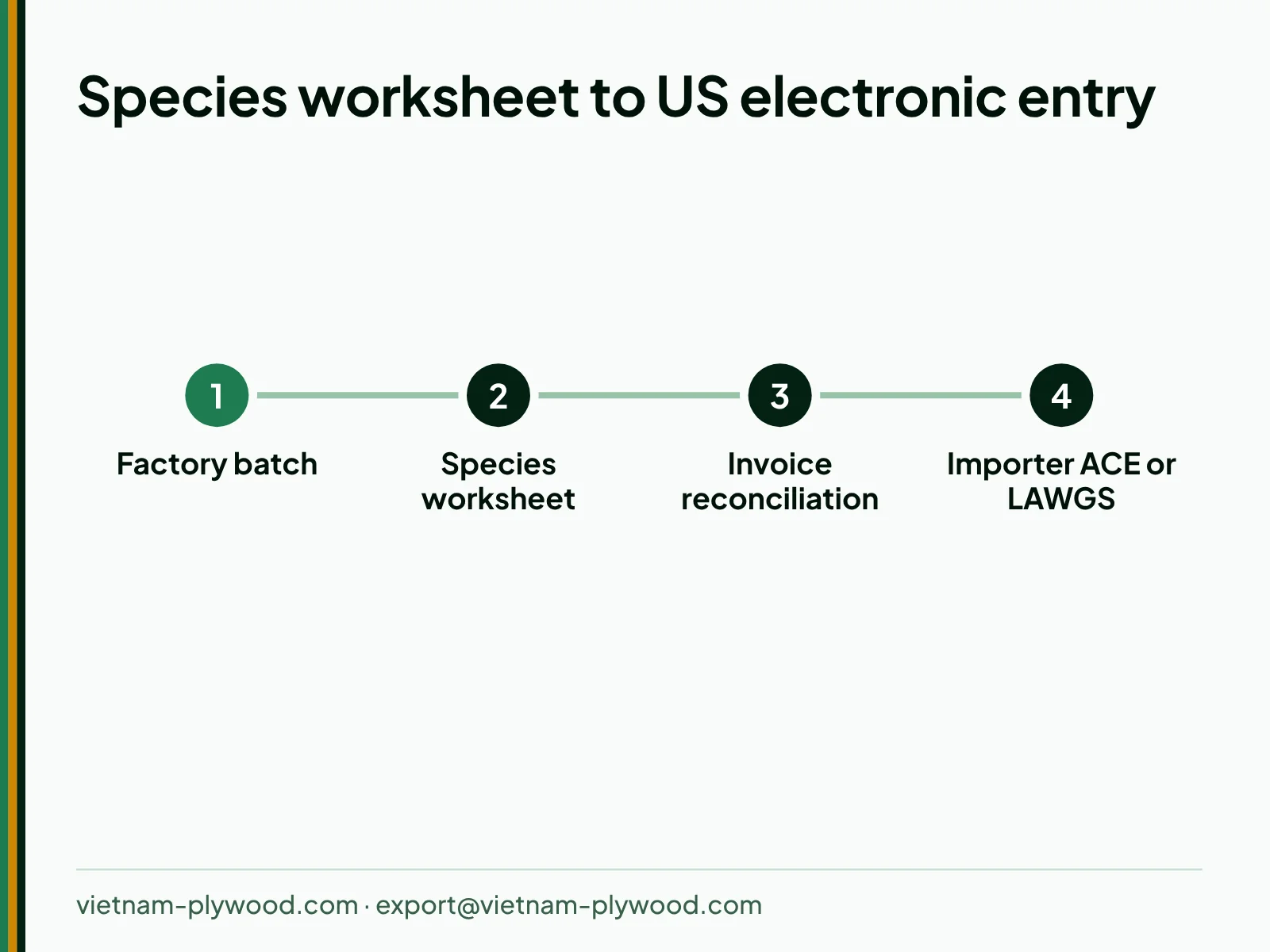
PPQ 505 is the name of the plant and plant product declaration, but it is no longer a paper workflow. APHIS’s October 2026 instructions say that paper PPQ 505 and 505B submissions have not been accepted since January 1, 2026. The importer of record or its agent files electronically using Customs and Border Protection’s Automated Commercial Environment (ACE) or APHIS’s Lacey Act Web Governance System (LAWGS).
Ask the customs adviser to check each tariff line, its entry type and any applicable exception before the vessel arrives. Do not assume a packaging item and the plywood sold as merchandise have the same filing treatment. APHIS’s 2025 FAQ distinguishes wooden packaging used solely to carry another product from packaging imported as the merchandise itself.
A declaration is separate from duty classification and trade-remedy exposure. Neither a filed declaration nor a manufacturer’s origin statement settles tariff liability. The importer should retain the customs adviser’s classification rationale alongside the purchase specification.
How is PPQ 505 completed for multi-species plywood?
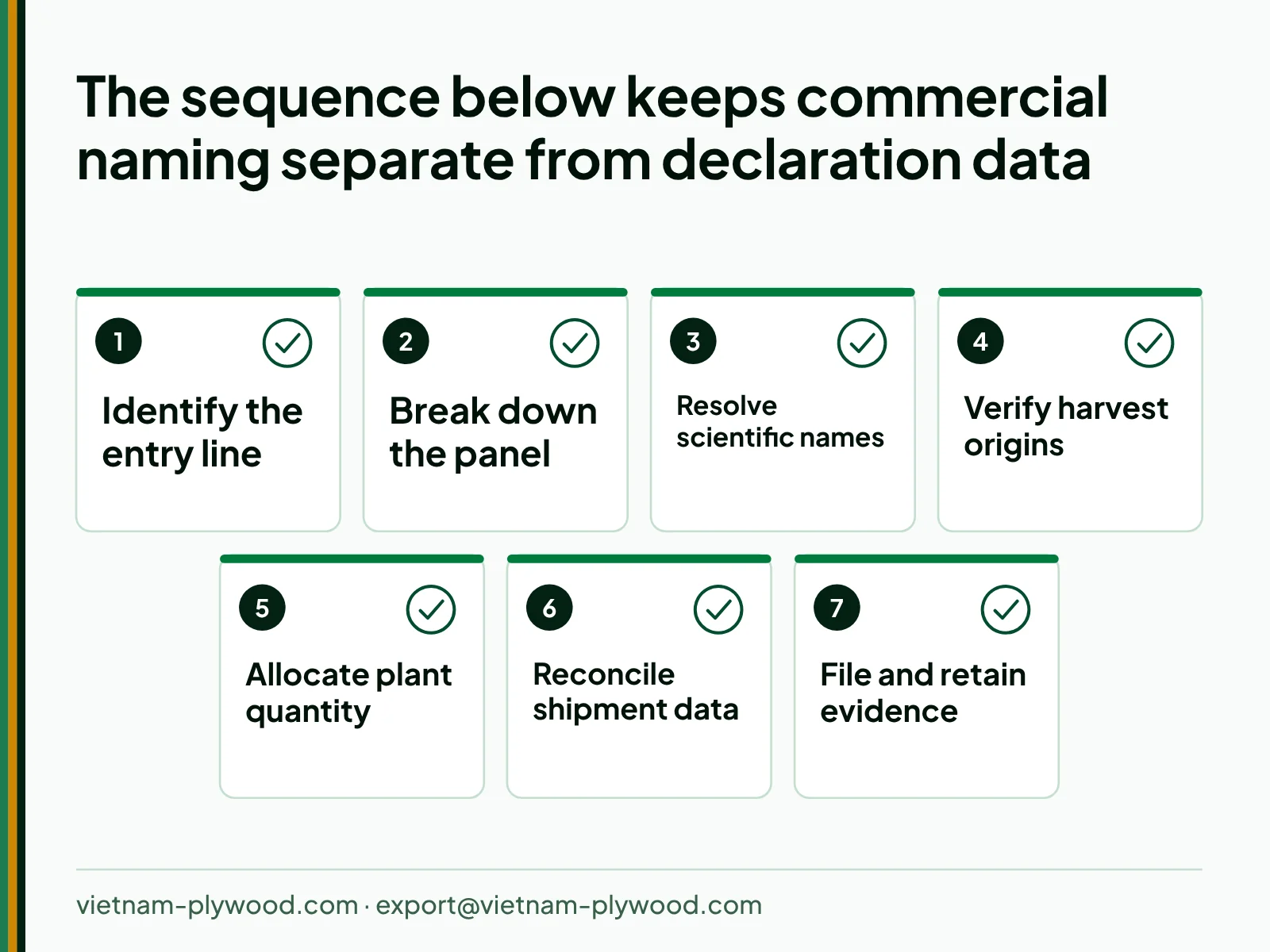
The importer enters each relevant wood species and country-of-harvest combination, with corresponding plant quantities, alongside shipment identifiers and value information. The manufacturer must first translate commercial veneer descriptions into verified botanical names. The sequence below keeps commercial naming separate from declaration data.
- Identify the entry line. Match the invoice description, tariff classification and actual plywood specification to the customs adviser’s entry line.
- Break down the panel. Record the face, back and core wood components, including any different core species in the production batch.
- Resolve scientific names. Verify genus and species from the timber and veneer supply records; a trade name alone is insufficient.
- Verify harvest origins. Obtain the country where each component’s timber was harvested, not merely the factory or export port.
- Allocate plant quantity. Prepare the quantity attributable to each species-country pair using a documented method acceptable to the filer.
- Reconcile shipment data. Match descriptions, quantities, value, container and shipping references against the final invoice and packing list.
- File and retain evidence. The importer or agent submits through ACE or LAWGS and retains supporting records for due-care review.
The US statute permits listing potential species or harvest countries in specified circumstances when the exact species or harvest origin is unknown. That is not permission to invent a likely answer. The importer should document why uncertainty exists, seek source evidence and apply the statutory provision accurately.
APHIS describes special use designations for certain circumstances, including genuinely composite material. Ordinary veneer plywood should not automatically be assigned a composite-material designation merely because it consists of glued layers. Ask the filer to assess the actual construction against APHIS’s published definition.
What if the face and core are different woods?
Declare the verified species and harvest origin of each wood component, even when the commercial product is named after its face veneer. An okoume-faced panel with an acacia core is sold by its face description, but that name does not establish the botanical identity or origin of the core. The same distinction applies to bintangor, engineered veneer (EV) and other faces.
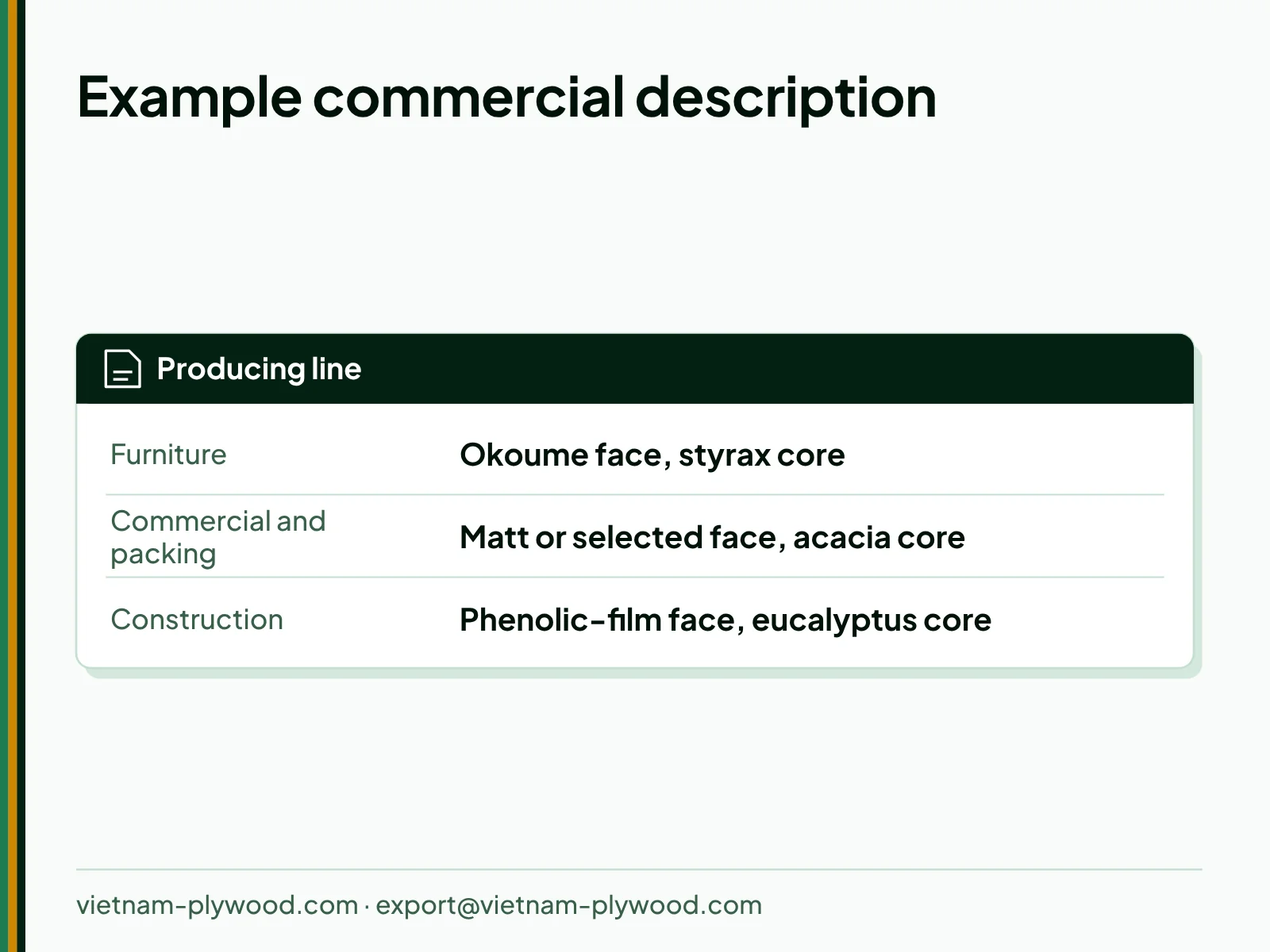
Our furniture line can build sanded plywood with styrax or eucalyptus core and selected decorative face veneers. Our commercial and packing line builds acacia-core panels with an unsanded or light-sanded surface. Our construction line builds film-faced panels with acacia or eucalyptus core; the film describes the surface, not the wood species beneath it.
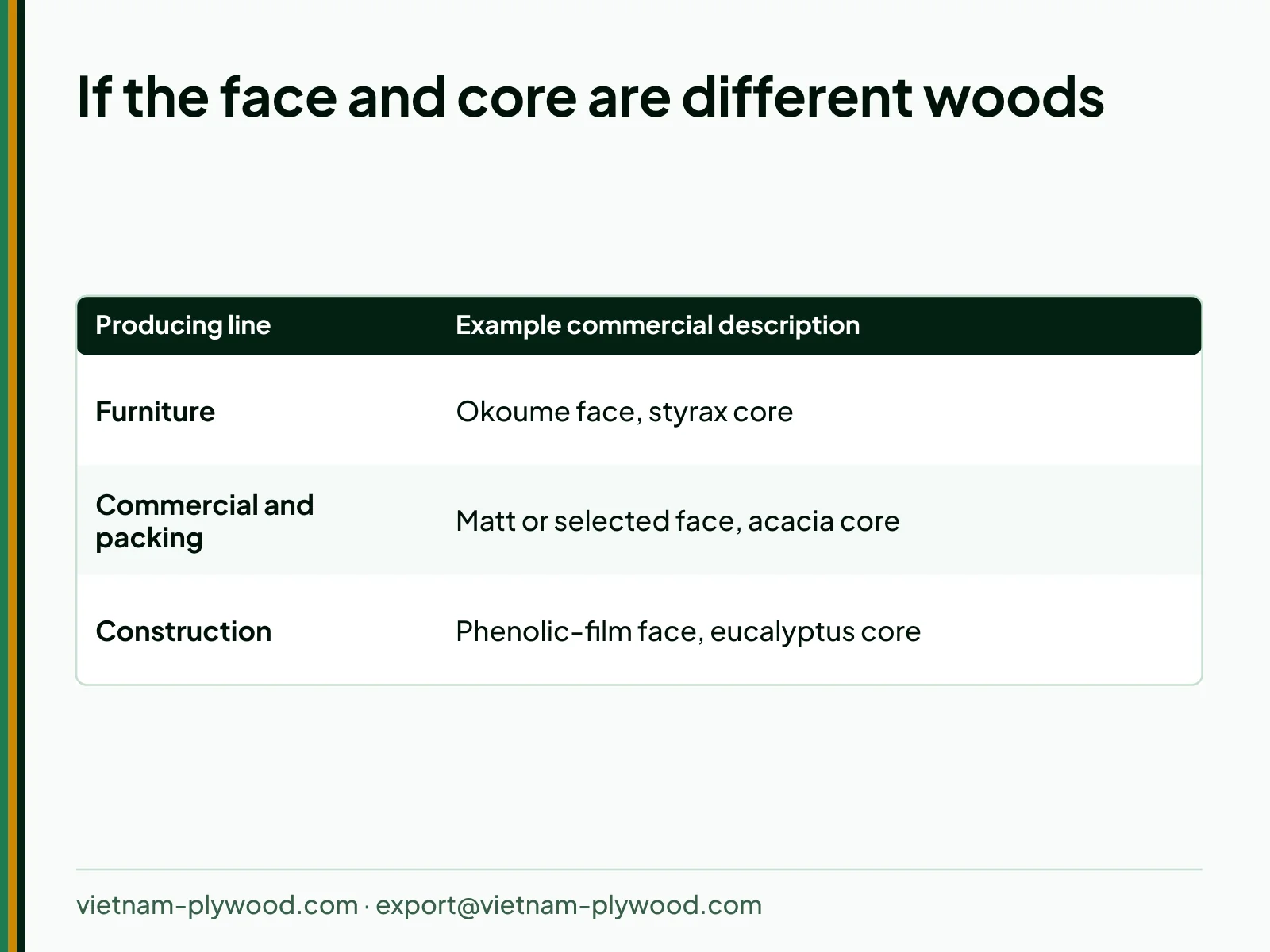
| Producing line | Example commercial description | Wood information needed for declaration | What the other lines would build |
|---|---|---|---|
| Furniture | Okoume face, styrax core | Verified face/back species, styrax species, harvest countries, plant quantities | Commercial line: acacia-core packing or commercial panel; construction line: filmed formwork panel |
| Commercial and packing | Matt or selected face, acacia core | Verified face/back species if present, acacia species, harvest countries, plant quantities | Furniture line: sanded decorative panel; construction line: film-faced panel |
| Construction | Phenolic-film face, eucalyptus core | Eucalyptus species and any other wood veneer species, harvest countries, plant quantities | Furniture line: sanded faced panel; commercial line: acacia-core utility panel |
These are build descriptions, not pre-filled legal declarations. “Acacia”, “eucalyptus” and “styrax” in a sales specification do not automatically supply a complete genus-and-species pair. We must check the exact batch records before providing the botanical data.
A film is not itself a wood species. Likewise, a decorative face cannot stand in for a core species. For construction procurement, see plywood supply for construction projects; for decorative builds, see furniture plywood.
What can a buyer inspect at the producing factory?
A buyer can witness the match between the order specification, veneer identification records, production batches and finished pallet labels at the producing factory. That inspection tests whether the species statement belongs to the goods being loaded. It cannot, by appearance alone, establish the botanical identity or legality of every harvested tree.
At the factory office, ask for the approved product specification and the source records supporting each listed wood component. On the production floor, compare the face veneer, core layup and panel labels with the order’s batch references. Then trace selected packed pallets back to the batch and sourcing documents used for the declaration worksheet.
An inspector should flag a core substitution, an unrecorded veneer blend or an origin claim supported only by a manufacturing address. A face-grade change also matters when it changes the actual wood species. Record exceptions before the final shipping documents are prepared, so the export data and US entry data can be reconciled.
HCPLY runs on-site quality control and loading coordination at the producing factory. Buyers inspect goods there, rather than relying on a generic product photograph. The inspection is a check on traceability and build identity; it does not replace the importer’s due-care assessment.
Can several product lines share one declaration set?
Several product lines can be supported by a coordinated shipment-level evidence package, but APHIS does not permit a blanket Lacey Act declaration. Each applicable entry or product line still needs its correct species, harvest-country, quantity and value data. One spreadsheet can organize those records without erasing differences between panels.
APHIS states in its 2025 declaration FAQ that a blanket declaration cannot be submitted. Accordingly, a mixed shipment should have a line-by-line mapping from the commercial invoice to the declaration inputs. Different faces, cores or harvest origins need separate treatment where the filing requires it.
For example, a container might combine furniture plywood with commercial panels if the agreed specifications and payload allow it. The minimum order is one 40HC, and one container can carry several specifications as long as the payload limit holds. The shipment still needs accurate product-level data; the container number does not make every panel composition identical.
For 18 mm sheets at 1220 × 2440 mm, the single-core loading examples are 990 styrax sheets, 880 acacia sheets or 795 eucalyptus sheets. Those are separate full-load examples, not additive quantities. A mixed load requires its own pallet and weight calculation against the 28.5 t payload limit; see container loading calculations and mixed container arrangements.
Which records does the manufacturer provide?
The manufacturer supplies a batch-specific product and sourcing evidence package for the importer to assess and use in its declaration. The package should distinguish confirmed facts from information still being traced. A certificate by itself cannot identify every veneer component in a particular shipment.
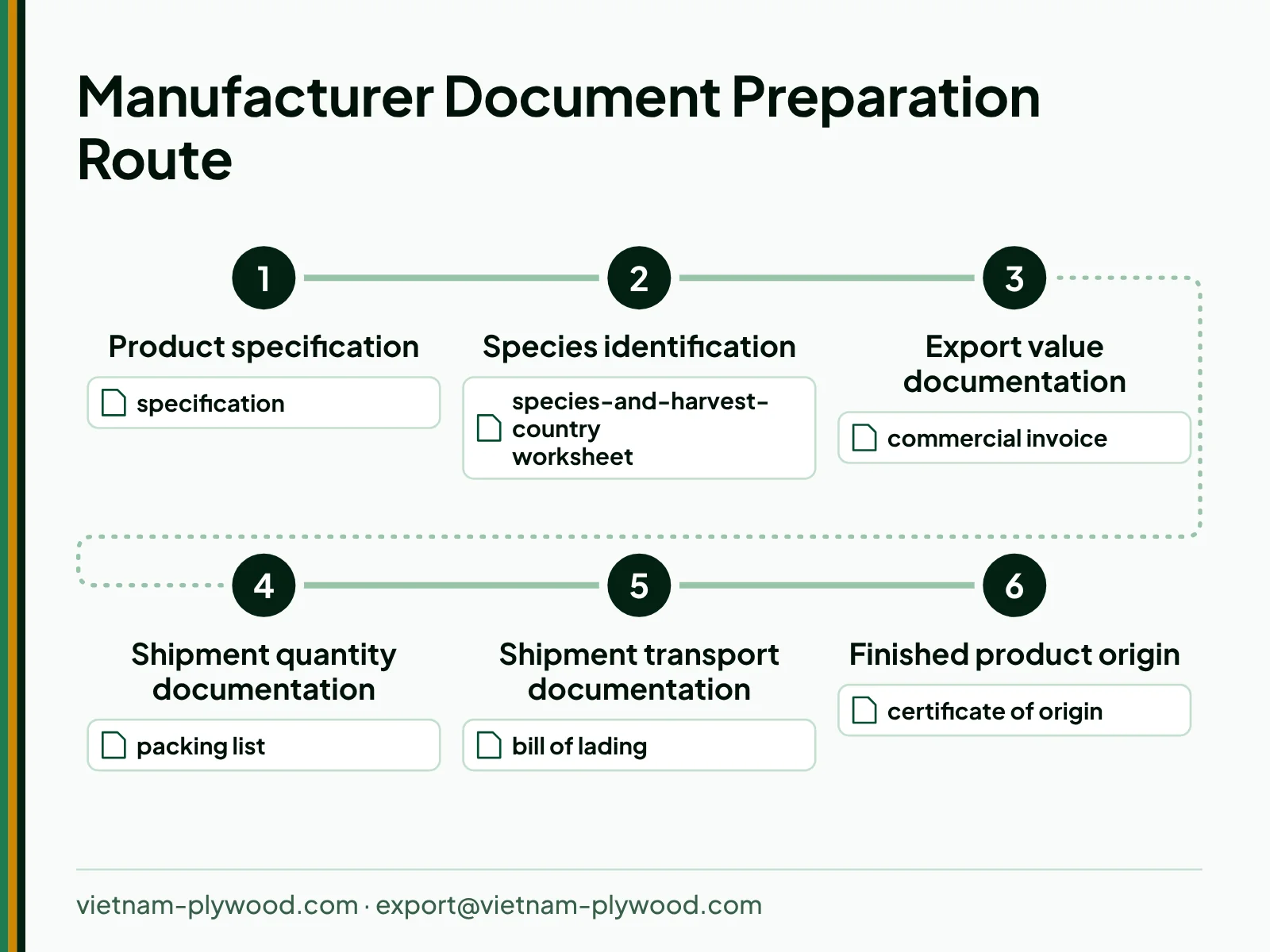
Start with a specification showing the producing line, face/back construction, core material, glue, thickness, tolerance and sheet size. Add a species-and-harvest-country worksheet with each verified botanical name, its component location and the supporting source record. Include batch references that tie this worksheet to the actual pallets.
For the export shipment, our document set includes the commercial invoice, packing list, bill of lading, certificate of origin and relevant phytosanitary or fumigation papers. Agreed certificate documents and test reports are included where specified. After loading, the draft shipping documents come to you for approval; the US declaration itself remains the importer’s filing.
Member-factory FSC, CARB P2, ISO 9001, CE and EUTR/EUDR documents are shown with factory details masked, on request. Their relevance must be checked for the particular order and issuing factory. A certificate of origin for the finished product does not substitute for each species’ country of harvest.
The US statute requires declaration data; APHIS’s 2025 FAQ says the amendments do not impose additional paperwork submission beyond the import declaration. Supporting harvest and chain records are nevertheless useful for due care and for resolving questions later. Keep a traceable copy of what the manufacturer supplied and what the importer actually filed.
How should quantity and value be reconciled?
Quantity and value should be reconciled by product line and by the species-country pairs used in the declaration. The packing list establishes shipped panels, while the species worksheet establishes which wood material those panels contain. Neither document alone necessarily supplies the correct plant-material allocation.
For an 18 mm, 1220 × 2440 mm acacia-core sheet, the loading table lists 31.08 kg per sheet and 880 sheets, 47.15 m³ and 27.35 t for a full 40HC. These panel-level figures do not allocate wood quantities between different face and core species.
Where a different face veneer is present, do not assign the entire panel volume to the acacia core without a documented allocation method. The face veneer is commonly 0.2–0.4 mm, but the actual face/back construction must come from the approved batch specification. Ask the filer which metric units and quantity breakdown its filing process requires.
Compare the invoice value for each entered product with the customs adviser’s value field. The FOB Hai Phong commercial invoice is a commercial source document; the importer determines the value entered under US filing rules. Avoid distributing one total shipment value equally across unlike products merely for convenience.
What if species or harvest country is unknown?
An unknown species or harvest country calls for a documented inquiry and a carefully assessed statutory filing approach, a botanical name grounded in the source records. First determine whether the gap concerns a missing document, a genuine mixed supply or a component that cannot be identified from available evidence. Those situations need different follow-up work.
The US Code allows specified lists of possible species or harvest countries when the actual information is unknown under the conditions in section 3372(f). APHIS also describes limited special use designations. Neither route should be treated as an automatic exemption for veneer plywood whose source records could be obtained.
Ask the producing factory to isolate the relevant production batch and identify the supplier records behind each veneer component. If several species could have been used, record the source and reason for that range. The importer and customs adviser then decide how to report the facts under the current APHIS instructions.
If the evidence remains inadequate, pause the affected specification or lot rather than copying a botanical name from another shipment. The cost of replacing an unsupported declaration after arrival can exceed the effort of correcting the worksheet before loading. A new order should start with a species data requirement in the written specification.
How does Lacey relate to TSCA Title VI and other checks?
Lacey Act declarations concern wood species, harvest origin and timber legality; TSCA Title VI concerns formaldehyde emissions for covered composite wood products. A Lacey filing does not demonstrate emissions compliance. Conversely, an emissions certificate cannot establish where a face or core tree was harvested.
For covered US hardwood plywood, ask separately for the applicable third-party certification and product identification under TSCA Title VI. Glue chemistry and emissions classification are different specification fields. Our furniture line offers E0/E1 emission classes, while the US CARB P2/TSCA Title VI limit and certification requirements must be evaluated for the actual covered product.
Trade-remedy orders and tariff classifications are another separate question for the US importer. A Vietnamese export origin statement does not resolve whether a particular construction falls within an antidumping or countervailing-duty scope. Keep the customs adviser’s tariff review independent of the species declaration worksheet.
EU timber documentation belongs to a different market framework; see EUDR due-diligence statements. Other market-specific requirements are discussed under UK timber imports and Gulf plywood requirements. Do not reuse a foreign-market form as a substitute for the US filing.
What mistakes cause a declaration to be challenged?
The most preventable errors are using a commercial face name as the entire species list, confusing manufacturing country with harvest country, and copying a prior shipment’s composition. A mismatch between the invoice, packing list and species worksheet creates another avoidable question. Each error can be identified before the importer submits its entry.
A useful pre-shipment review checks the full product name, face/back species, core species, harvest countries, plant quantities, values and batch references. The importer then compares the draft entry against the documents and flags discrepancies for correction. Do not claim that passing a factory inspection makes the entry legally approved.
What should the buyer send before requesting the spec sheet?
Send the intended US product build and destination details so the producing factory can prepare a species-and-origin worksheet tied to the order. The importer should also identify the customs adviser’s required format for plant quantities and line-level declaration data. This reduces rework between production and entry preparation.
Application: US import for distribution / cabinet production / formwork
Producing line or core: furniture styrax/eucalyptus | commercial acacia | construction acacia/eucalyptus
Glue: melamine MR | phenolic WBP (specify agreed build)
Emission: E0 | E1 | E2 | applicable US certification requirement
Face and grade: specify face species/trade name and grade; include back face
Thickness and tolerance: ___ mm; ___ mm tolerance
Size: ___ × ___ mm
Quantity: ___ sheets / ___ m³; mixed lines identified separately
Destination port: ___, United States
Required supporting data: verified genus/species, country of harvest and batch traceability for each wood component
Request the face-and-core specification sheet from Lucy at export@vietnam-plywood.com before finalizing the order.