






The EU importer files the EUDR due diligence statement for plywood in TRACES, and HCPLY’s producing factory supplies the named document behind each field: the invoice, the packing list, the geolocation file, the legality records. If one field disagrees with the load, the customs declaration cannot be lodged and the container waits at the EU port, running up storage and demurrage, until the statement is corrected.
HCPLY ships EU lots FOB Hai Phong, CFR or CIF from our three factories in Phu Tho and Hai Phong, and the EUTR/EUDR file set travels with every EU lot. This article goes through the statement field by field and belongs with our other plywood certification articles. The wider importer duties, from risk assessment to mitigation, are covered in EUDR due diligence for plywood importers in the EU.
Who submits the EUDR due diligence statement for plywood?
The importer that releases the plywood for free circulation in the EU submits it. That company is the upstream operator: it holds a valid EU EORI number, registers in the EUDR Information System and files before the customs declaration is lodged. Under FOB, CFR or CIF from Vietnam, the producing factory supplies the data and does not file.
The European Commission’s 2026 page on roles and responsibilities under the EUDR states this directly. The operator is generally the company importing under the customs procedure “release for free circulation”, and it needs an EORI number and a registration in the Information System. If a company outside the EU does the import itself, the first EU-based company that sells the panels on is also an operator, and both file their own statement.
An authorised representative can do the filing. The same Commission page describes an EU-based person or company formally appointed to submit statements for the operator. The operator keeps full responsibility for the product.
Distributors further down the chain do not file again. Regulation (EU) 2025/2650, approved in December 2025, amended the original Regulation (EU) 2023/1115. The plywood producer WISA’s EUDR page (updated January 2026) reads the amendment as limiting the reference-number chain to the first downstream operator. Application starts on 30 December 2026 for large and medium operators; the full timetable is on our page on EUDR application dates for plywood. UK buyers work under a separate law, covered in UKTR rules for plywood imports.
Which fields does the due diligence statement in TRACES ask for?
The statement asks for the operator’s details, the activity, and the HS code with a description and species names. It then asks for the quantity, the country of production and the location of every plot with its production dates. It ends with any statement it refers to and a signed declaration that due diligence found no risk or only negligible risk.
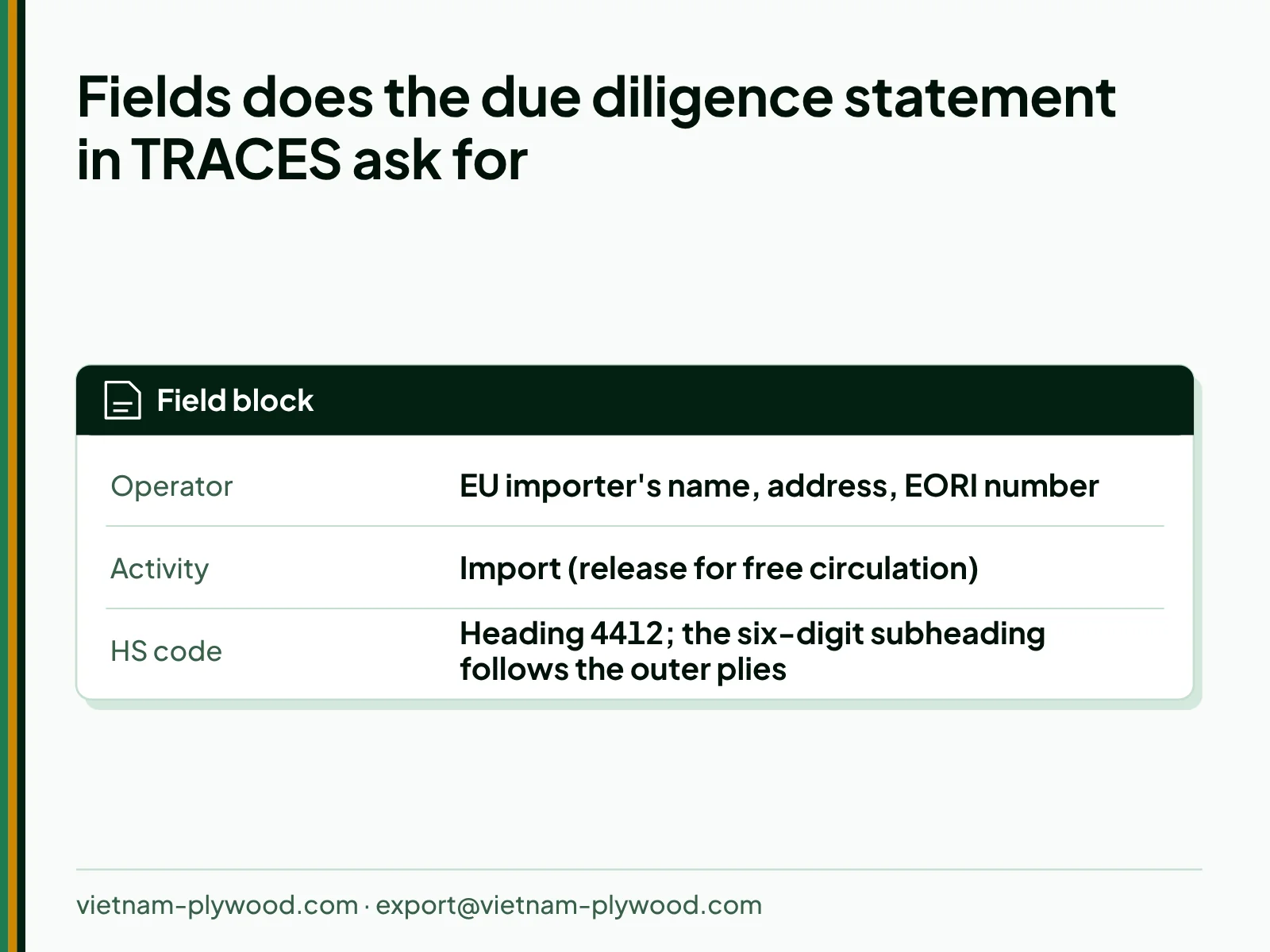
There is no separate EUDR plywood due diligence statement template. The Commission’s 2026 page Understand due diligence under the EUDR says Annex II of the Regulation is the template and that it is the same for all commodity sectors. The Commission’s 2026 guide to the Information System calls it a specialised tool of the TRACES platform. There the operator selects the product type, enters HS code, description and quantity, then marks the origin on a map or uploads coordinates.
| Field block | What goes in for plywood | Where the rule sits |
|---|---|---|
| Operator | EU importer’s name, address, EORI number | Annex II |
| Activity | Import (release for free circulation) | Information System |
| HS code | Heading 4412; the six-digit subheading follows the outer plies | Annex I, Annex II |
| Description and trade name | Face, core, thickness, size, glue | Article 9(1)(a) |
| Species | Common name and full scientific name of every species, face and core | Article 9(1)(a) |
| Quantity | Net mass in kg, plus cubic metres as the supplementary unit | Article 9(1)(b) |
| Country of production | Where the trees grew, per species | Article 9(1)(c) |
| Geolocation and production date | GeoJSON plot file, plus harvest date or date range | Article 9(1)(d) |
| Referenced statements | Empty for a direct import from Vietnam | Annex II |
| Declaration and signature | Name, function, date | Annex II |
Two parts of Article 9 sit in your records and not in the form. One is the name, postal address and email address of your supplier and of your buyers. The other is the evidence that the wood is deforestation-free and legally harvested; by signing, you confirm you hold it.
Which document from the producing factory fills each field?
Each field maps to one paper in the export document set for an EU lot. The commercial invoice carries the HS code and description, the packing list carries net mass and volume, and the EUTR/EUDR file set carries species, country of production, plots, harvest dates and legality evidence.
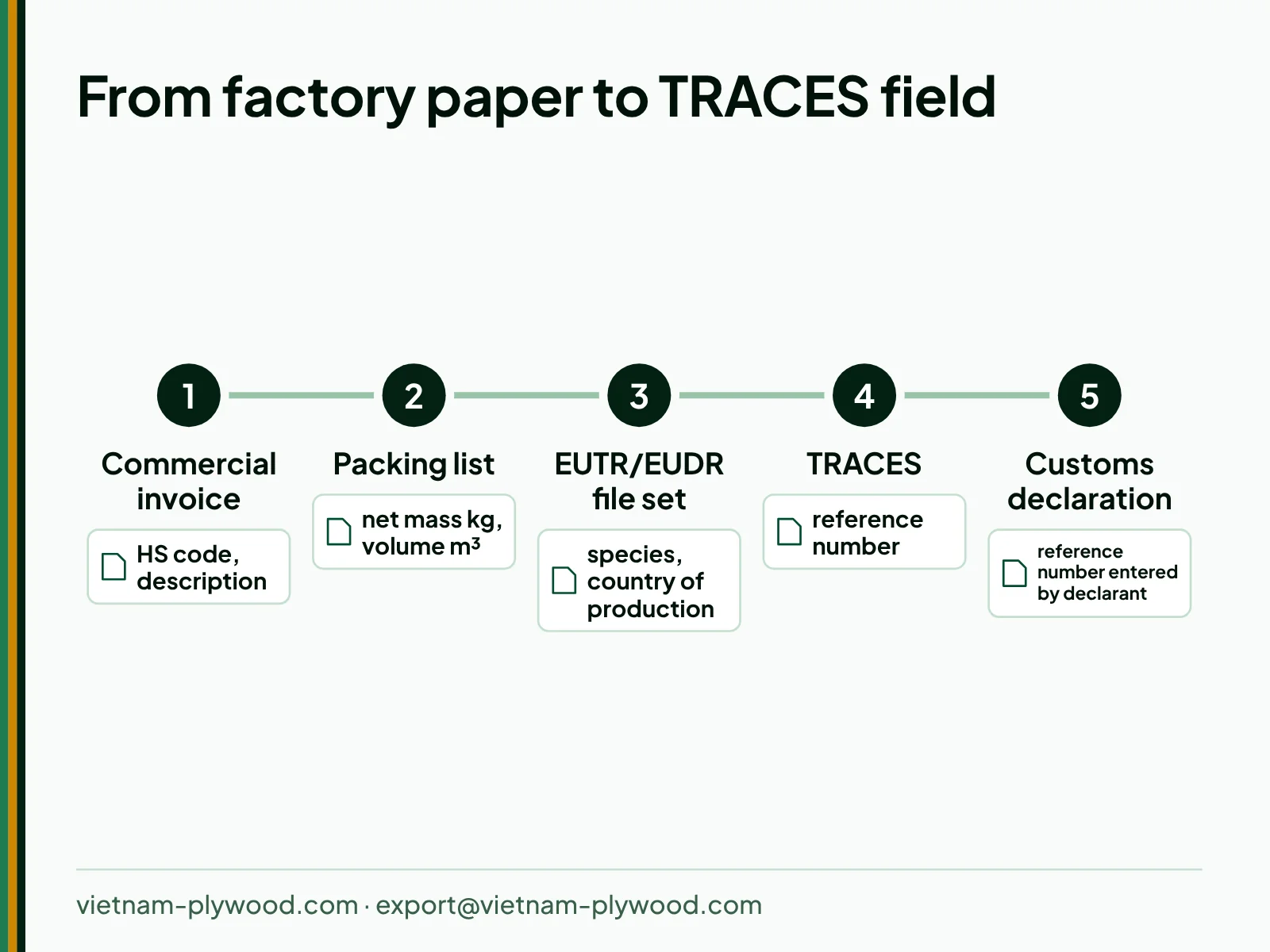
| TRACES field | Document from the producing factory | What to compare before you file |
|---|---|---|
| HS code | Commercial invoice | Same code your customs broker puts on the import declaration |
| Description, trade name | Commercial invoice, packing list | Face, core, thickness and size match the order |
| Species and scientific names | EUDR file set: species declaration | Every species in the panel, face and core |
| Net mass (kg) | Packing list | Net weight of panels, without pallets and wrapping |
| Volume (m³) | Packing list | Sheets × length × width × thickness, per item |
| Country of production | EUDR file set: plot list | One entry per country where the logs grew |
| Geolocation | EUDR file set: GeoJSON file | Uploads without errors; plots match the plot list |
| Production date or range | EUDR file set: harvest records | A harvest date or range for each plot |
| Legality evidence (kept on file) | EUDR file set: harvest, land-use, transport and purchase papers | Names and plots match the GeoJSON |
| Deforestation-free evidence (kept on file) | EUDR file set: plot list | Your check of each plot against forest maps for clearing after 31 December 2020 |
The certificate of origin does not fill the country-of-production field. An EUR.1 states Vietnam as the tariff origin of the finished plywood, while the statement asks where each species was harvested. A face veneer peeled from logs grown outside Vietnam adds a second country of production and its own plots, even though the EUR.1 still reads Vietnam.
After loading, the draft shipping documents come to you for approval. Check the draft invoice and packing list against your draft statement at that point, because the statement must be accepted before the customs declaration goes in. Days at sea from Hai Phong, by carrier and route, are 30–40 to Northern Europe and 25–35 to the Mediterranean, which is your filing window.
HS code, description and species: naming the panel
Plywood is heading 4412, and the six-digit subheading follows the outer plies, so the face decides the code. We also name a product by its face: okoume plywood is an okoume face over an acacia, eucalyptus or styrax core. The statement needs more than that name, because Article 9 asks for the common name and full scientific name of every species the product contains.
For our panels that means two species entries for a faced panel. The core is acacia, eucalyptus or styrax, the only core species we press. The face is one of bintangor, okoume, EV (engineered veneer), gurjan, pine, poplar, eucalyptus, birch or sapele. A matt panel, which is unfaced raw core, carries one species.
A description line built from the order reads: plywood, 18 mm, 1220 × 2440 mm, okoume face (Aucoumea klaineana), styrax core (Styrax tonkinensis), MR glue, E1. The scientific names come from the species declaration in the file set, written as they appear on the harvest papers. For acacia and eucalyptus cores, the declaration names the exact species or hybrid recorded at harvest.
Okoume and sapele are named in the tropical wood list of Chapter 44, and birch, eucalyptus and poplar are named in the 4412.33 group; pine on both outer plies falls under 4412.39. For bintangor, gurjan and EV faces, your customs broker sets the subheading from the species, and the invoice then carries that code. On film-faced construction panels, the phenolic or melamine film has a paper base made of wood fibre; ask the producing factory how the file covers it before you sign.
Quantity: net mass and cubic metres from the packing list
The statement takes net mass in kilograms and, for heading 4412, cubic metres as the supplementary unit; both come from the packing list of the shipment. Article 9, as quoted on the Commission’s 2026 due diligence page, sets kilograms of net mass for products entering the market. It adds the Combined Nomenclature supplementary unit where one applies.
Density follows the core, so the net mass follows the core too. Sheet weight is length × width × thickness × density. At 18 mm and 1220 × 2440 mm, one sheet weighs 26.8 kg on styrax (500 kg/m³), 31.1 kg on acacia (580 kg/m³) and 34.8 kg on eucalyptus (650 kg/m³).
| Full 40HC, 18 mm, 1220 × 2440 mm | Styrax core | Acacia core | Eucalyptus core |
|---|---|---|---|
| Stack height per pallet | 1000 mm | 1000 mm | 970 mm |
| Sheets per pallet | 55 | 55 | 53 |
| Pallets | 18 | 16 | 15 |
| Sheets | 990 | 880 | 795 |
| Volume | 53.05 m³ | 47.15 m³ | 42.60 m³ |
| Net mass | 26.52 t | 27.35 t | 27.69 t |
The 40HC payload limit is 28.5 t. Sheet counts for other thicknesses are on our container loads page.
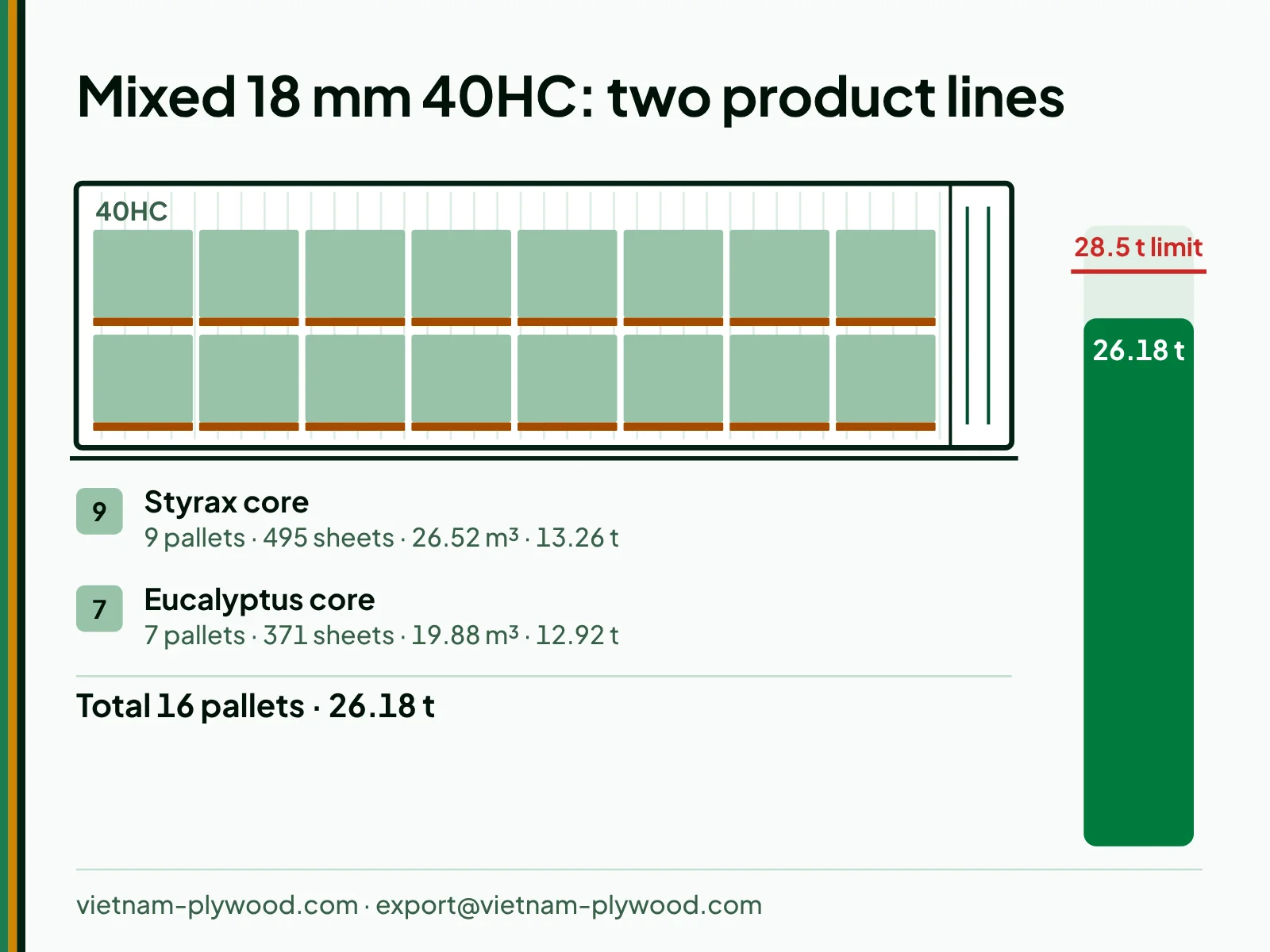
Minimum order: one 40HC; one container can carry several specifications as long as the payload limit holds. For example, take 9 pallets of styrax-core and 7 pallets of eucalyptus-core 18 mm from our furniture line. The styrax pallets hold 495 sheets (26.52 m³, 13.26 t), and the eucalyptus pallets hold 371 sheets (19.88 m³, 12.92 t).
The load is 866 sheets, 46.40 m³ and 26.18 t, inside the limit. On the statement it becomes two product lines, each with its own species, net mass, volume and plots. Our page on mixed container loads explains how the pallets are split.
The formula is for planning; the statement takes the packing-list net mass of the actual shipment.
What is in an EUDR geolocation file?
An EUDR geolocation file is a GeoJSON file that lists every plot where the wood in the shipment grew. Each plot is a point or polygon in WGS 84 longitude and latitude, with optional properties naming the producer, country and plot. The Commission’s GeoJSON file description, updated 17 August 2026, sets the rules TRACES applies on upload.
- Coordinates: WGS 84 (EPSG:4326) in decimal degrees, longitude first, then latitude.
- Geometry types: Point, MultiPoint, Polygon, MultiPolygon. LineString and MultiLineString are rejected.
- Properties TRACES reads: ProducerName, ProducerCountry (ISO2 code, VN for Vietnam), ProductionPlace, and Area in hectares for points. Names are case-sensitive; other properties are ignored.
- Precision: coordinates are cut to 6 decimal places on storage, so extra decimals add nothing.
- Size: 25 MB per statement, counting all uploaded GeoJSON files.
- Variants: Type I lists plots of one producer; Type II groups several producers by ProducerName and ProducerCountry.
For an EUDR GeoJSON, plywood brings at least two plot sets: the plantations behind the core veneer and the source of the face veneer. The skeleton of one point feature looks like this, with your plot data in place of the angle-bracket placeholders:
{"type":"FeatureCollection","features":[
 {"type":"Feature",
  "properties":{"ProductionPlace":"<plot code>","ProducerCountry":"VN","Area":<hectares>},
  "geometry":{"type":"Point","coordinates":[<longitude>,<latitude>]}}
]}
The same Commission page lists the errors that stop an upload. They include open polygons, crossing lines, polygons with holes and an area typed in quotes (“3” is read as zero). Property names in the wrong case and PDF or password-protected files are also rejected.
Should EUDR geolocation be given as a polygon or a point?
Use a polygon for any plot larger than 4 hectares and a single point for a plot of 4 hectares or less. The Regulation’s geolocation definition asks for polygons that trace the perimeter of plots above 4 hectares. The Commission’s GeoJSON description recommends single points for plots under 4 hectares to keep files small.
A point without an Area property is set to 4 hectares by default. Give the real area as a number, so the record matches the plot list. A polygon needs at least four coordinate pairs, and the first and last pair must be identical to close the shape.
Shapes with holes are rejected; the Commission’s workaround is to split the shape into two half-shapes. A straight boundary needs only its two end points, which keeps large plantations under the 25 MB limit. The plot list in the file states each plot’s area in hectares, and that figure decides point or polygon.
Filling the statement in TRACES, step by step
The statement is filled in ten steps, and only steps 3 to 8 happen in the form itself.
- Register the operator, and any authorised representative, on the PRODUCTION server. Practise on the ACCEPTANCE server first; the Commission notes that submissions there have no legal value.
- Collect the lot’s papers: draft commercial invoice, draft packing list, and the EUTR/EUDR file set with its GeoJSON.
- Create a new statement and select import as the activity.
- Add one product line per build: HS code, description, and the common and scientific name of each species.
- Enter net mass in kilograms and volume in cubic metres from the packing list.
- Enter the country of production for each species and upload the GeoJSON. Check the map preview: every point should fall in the province named on the plot list.
- Finish your risk assessment and any mitigation, and file the record with the lot papers.
- Submit the statement and note the reference number shown in the dashboard.
- Send the reference number to your customs declarant and, after sale, to your first downstream buyer.
- Keep the full file for five years from the date the plywood is placed on the market.
Reference numbers: from TRACES to the customs declaration
Once the statement is accepted, TRACES issues a reference number, and your customs declarant must enter it on the import declaration for that plywood. The Commission’s 2026 due diligence page says the statement must be submitted and the number obtained before the customs declaration is lodged.
One statement can cover several shipments, and one customs declaration can carry several reference numbers. When the quantity declared in a statement is used up, a new statement is needed for further quantities.
This suits call-off buying. A distributor taking repeat 40HC loads of one build can declare a quantity across several sailings, as long as every lot falls inside the declared species, plots and volume. Our plywood supply programmes for distributors follow this pattern.
The referenced-statement field stays empty for a direct import from Vietnam, because no EU operator has filed for this wood before you.
What EUDR documents should I ask my plywood supplier for?
Ask for every paper that fills a field of your statement or supports your risk assessment, tied to the lot by species, plot and pallet mark. For a Vietnamese plywood lot, the set is:
- Species declaration: common and scientific name for each species, face and core.
- Plot list: plot code, area in hectares, country, province, and harvest date or range for each plot.
- GeoJSON file: the same plots, validated against the Commission’s file rules.
- Legality evidence: harvest documents, land-use rights, timber transport records and purchase invoices along the chain to the producing factory.
- Deforestation-free evidence: the material your own check needs to show each plot was not deforested after 31 December 2020.
- Chain records: log intake register, production batch record and pallet marks linking plots to this lot.
- Commercial papers: commercial invoice with HS code, packing list with net mass and m³.
- Certificate documents for the order: for example the FSC claim on sales documents when the order carries one.
Before an order, EUDR and EUTR documents are shown with factory details masked, on request. For a booked EU lot, the full set travels with the commercial invoice, packing list, B/L, EUR.1, and the phytosanitary and fumigation papers.
An FSC claim supports the file without replacing the plot data. Article 10, as listed on the Commission’s 2026 due diligence page, counts certification as complementary information only where it meets the Article 9 requirements. The same page sets a five-year retention period for all due diligence documents.
Samples follow their own rule. The Commission’s July 2026 news on the EUDR product scope says its delegated act clarifies that samples for analysis and testing fall outside the Regulation. That act still awaits scrutiny by Parliament and Council. Samples cost nothing: a first-time buyer pays the courier, and that charge comes off the first confirmed order.
Checks you can witness at the producing factory
You or your inspector can watch the plot-to-pallet chain in person at the producing factory. HCPLY runs on-site QC on every order, and buyers inspect goods at the factory that pressed them. Each check below takes place where the panels are made.
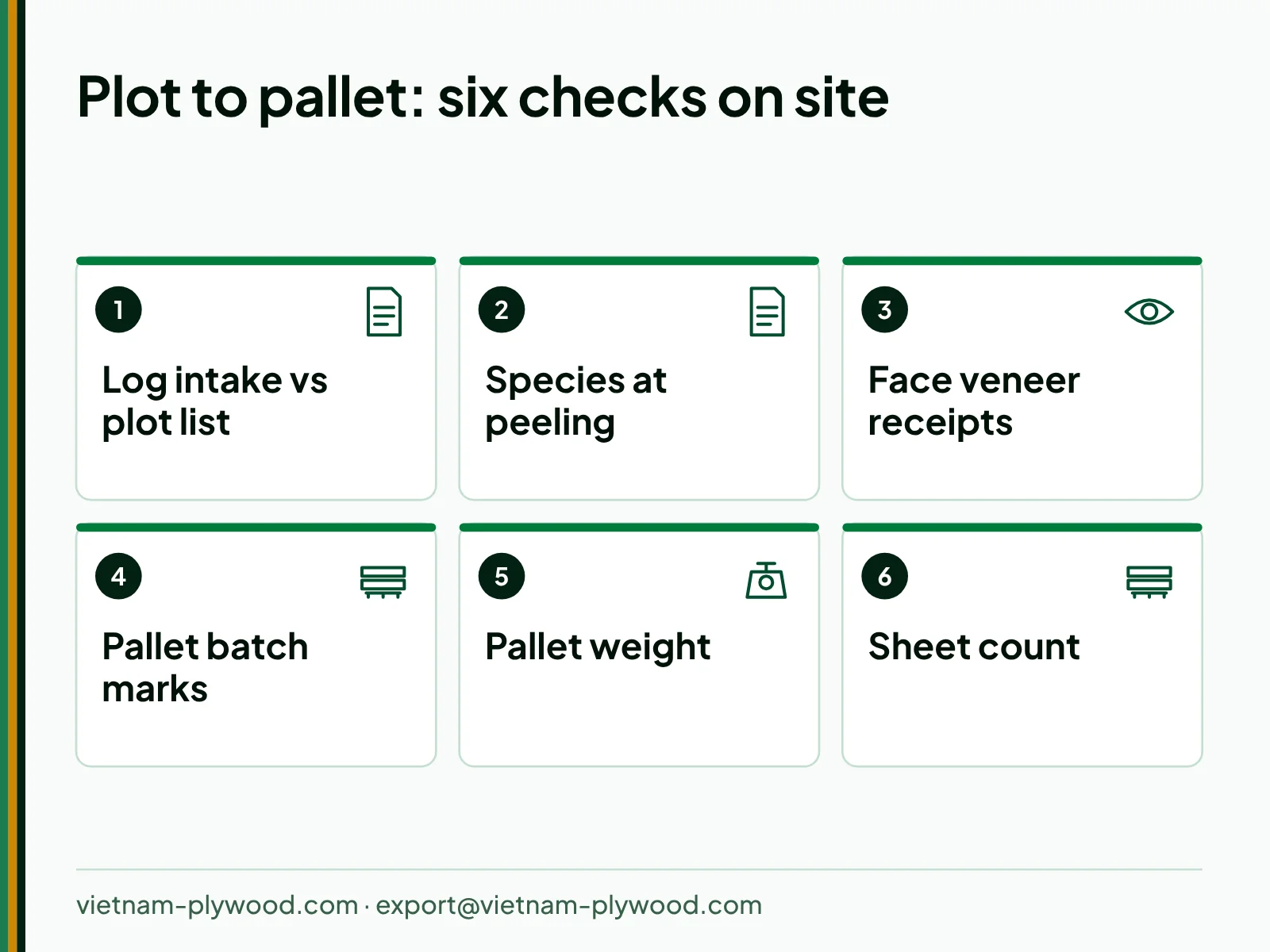
- Log intake: compare the intake register for your batch against the plot list: plot code, species and delivery date.
- Peeling line: confirm the core species being peeled for your order matches the species declaration.
- Face veneer stock: match the receipts for the face veneer on your order to the face-veneer entries in the plot list and their country.
- Batch marking: check that each pallet’s batch mark appears on the packing list and in the file set.
- Weight: weigh a pallet and compare it with the packing-list net mass for that item.
- Count: count the sheets on a pallet against the sheets-per-pallet figure.
A difference found at the factory takes a phone call to fix. The same difference found at the EU border costs a held container.
The same 18 mm on each line, and what it adds to the statement
The build changes the statement through the number of species and the weight per container. The table puts 18 mm, 1220 × 2440 mm on each of our lines.
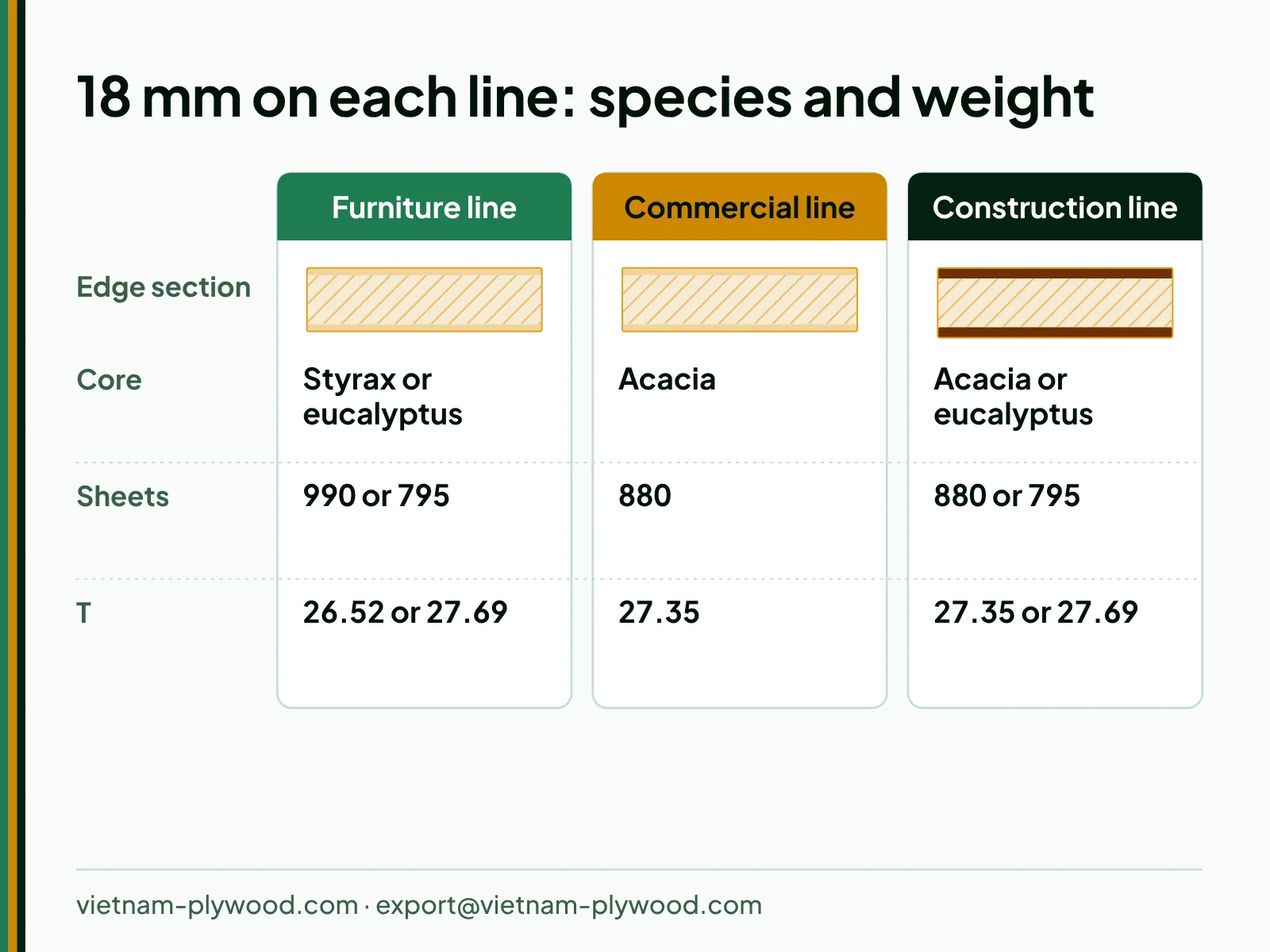
| Metric | Our furniture line | Our commercial and packing line | Our construction line |
|---|---|---|---|
| Core | Styrax or eucalyptus | Acacia | Acacia or eucalyptus |
| Density | 500 or 650 kg/m³ | 580 kg/m³ | 580 or 650 kg/m³ |
| Face | Veneers such as okoume, bintangor or sapele, grade A or B | Veneers such as bintangor, okoume or pine, or matt | Phenolic or melamine film, 120 g/m² standard, 135 g/m² premium, 220 g/m² anti-slip |
| Species entries on the statement | Core + face | Core + face, core only if matt | Core, plus the film question |
| Sheets per full 40HC | 990 (styrax) or 795 (eucalyptus) | 880 | 880 (acacia) or 795 (eucalyptus) |
| Net mass per full 40HC | 26.52 t or 27.69 t | 27.35 t | 27.35 t or 27.69 t |
| Thickness tolerance | ±0.2 or ±0.3 mm, sanded | ±0.5 mm | ±0.5 mm |
| Verdict by use | Furniture and cabinet panels | Packing and general use; matt gives the shortest statement | Formwork and site work |
The shortest statement comes from a panel that uses one species throughout. That means a matt acacia panel from our commercial and packing line, or a eucalyptus face on eucalyptus core from our furniture line. Every added face species brings its own scientific name, country entry and plot set.
Specification lines to send for an EUDR lot
Send the build and the EUDR lines together, so the file set is built for the lot as it is pressed.
Application: furniture carcass panels, EU import (EUDR lot)
Line / core: furniture line, styrax core, full stitched
Glue: melamine (MR, 12-hour boil)
Emission: E1
Face and grade: okoume, B/B
Thickness and tolerance: 18 mm, ±0.3 mm, sanded
Size: 1220 × 2440 mm
Quantity: one 40HC (990 sheets at 18 mm)
Destination port: <your EU port>, CIF
EUDR: species declaration, plot list, GeoJSON (points ≤ 4 ha, polygons > 4 ha), harvest dates, legality file
Next step: send these lines to Lucy at export@vietnam-plywood.com or through our contact page. Request the spec sheet for your build and a masked sample of the HCPLY EUDR file set.