






UKTR requires a legality-based due diligence file for plywood placed on the Great Britain market; EUDR adds deforestation checks for covered Northern Ireland entries. Choosing the wrong regime can hold up customer deliveries and force costly document rework. HCPLY connects plantation-core and face-veneer records to the producing factory and shipment.
Does UKTR apply to plywood imported from Vietnam?
Yes. UK Timber Regulation (UKTR) applies when an operator first places covered plywood from Vietnam on the Great Britain market. The importer must collect supply-chain information, assess illegal-harvest risk and reduce identified risk to negligible before placing the goods on the market. A missing origin trail can delay release to customers and increase inspection costs.
The UK Office for Product Safety and Standards (OPSS), in its 2025 timber guidance, identifies plywood and other composite timber products as covered. The relevant operator is normally the business first placing the consignment on the Great Britain market. A distributor purchasing panels already placed there is usually a trader, with supplier and customer recordkeeping duties.
For importers, the file starts before loading: product description, every timber species, country of harvest, supplier identity, quantity and legality evidence. Risk assessment belongs to the importer, even when HCPLY assembles the production and shipment records. The certifications resource centre covers related product documentation.
What goes in a UKTR due diligence file for one container?
A usable UKTR file connects the shipment to each timber component and records a reasoned legality decision. A customs entry and commercial invoice identify a shipment, but do not by themselves establish where its wood was harvested.
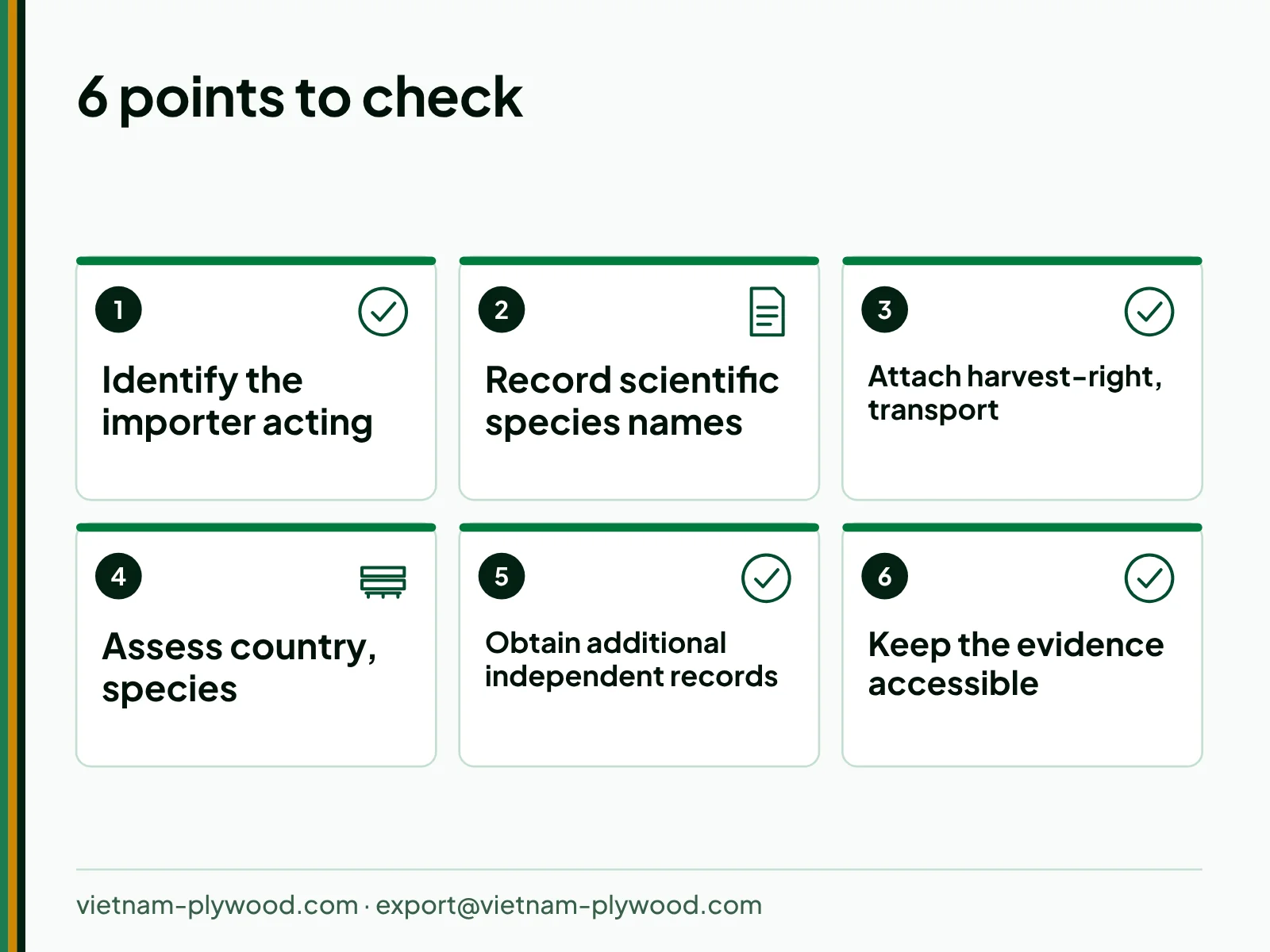
- Identify the importer acting as operator and the exact plywood specification, purchase order, invoice and shipment reference.
- Record scientific species names, common names, harvest countries, supplier identities, volumes and relevant product codes for each wood component.
- Attach harvest-right, transport, purchase and processing records appropriate to the relevant jurisdiction and supplier chain.
- Assess country, species, supplier and supply-chain complexity risks; document any conflicting dates, missing transfers or uncertain origin.
- Obtain additional independent records or verification where needed, then record why the remaining risk is negligible before market placement.
- Keep the evidence accessible for OPSS inspection and link subsequent sales records to the incoming lot.
OPSS’s 2025 guidance says operators must gather information, assess risk and mitigate identified risk. FSC UK’s UKTR explanation also describes five-year record retention. An FSC certificate can help assess risk, but it cannot replace the operator’s evaluation.
For HCPLY shipments, the commercial invoice, packing list, bill of lading (B/L), certificate of origin, phytosanitary and fumigation papers form the shipment record. Order-specific emission certificates, test reports and FSC claims on sales documents are added where agreed. The UKTR legality assessment needs the underlying timber-origin chain alongside those export papers.
How does UKTR differ from EUDR?
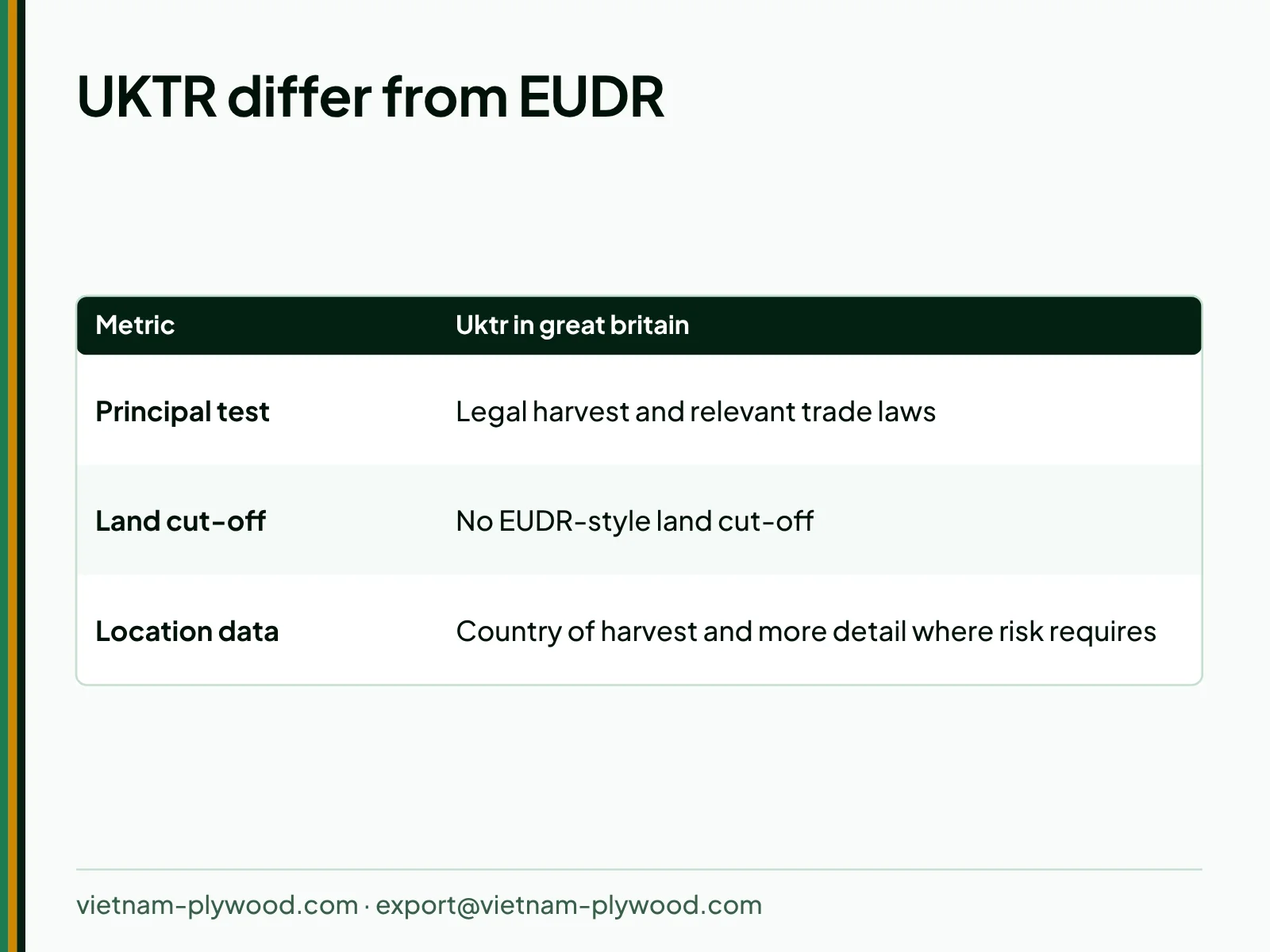
UKTR tests legality of harvesting and trade; the EU Deforestation Regulation (EUDR) additionally tests deforestation-free origin and requires structured plot information. Both demand a traceable wood supply chain, but an ordinary UKTR risk file does not automatically satisfy EUDR.
| Metric | UKTR in Great Britain | EUDR for covered Northern Ireland entries | Buyer decision |
|---|---|---|---|
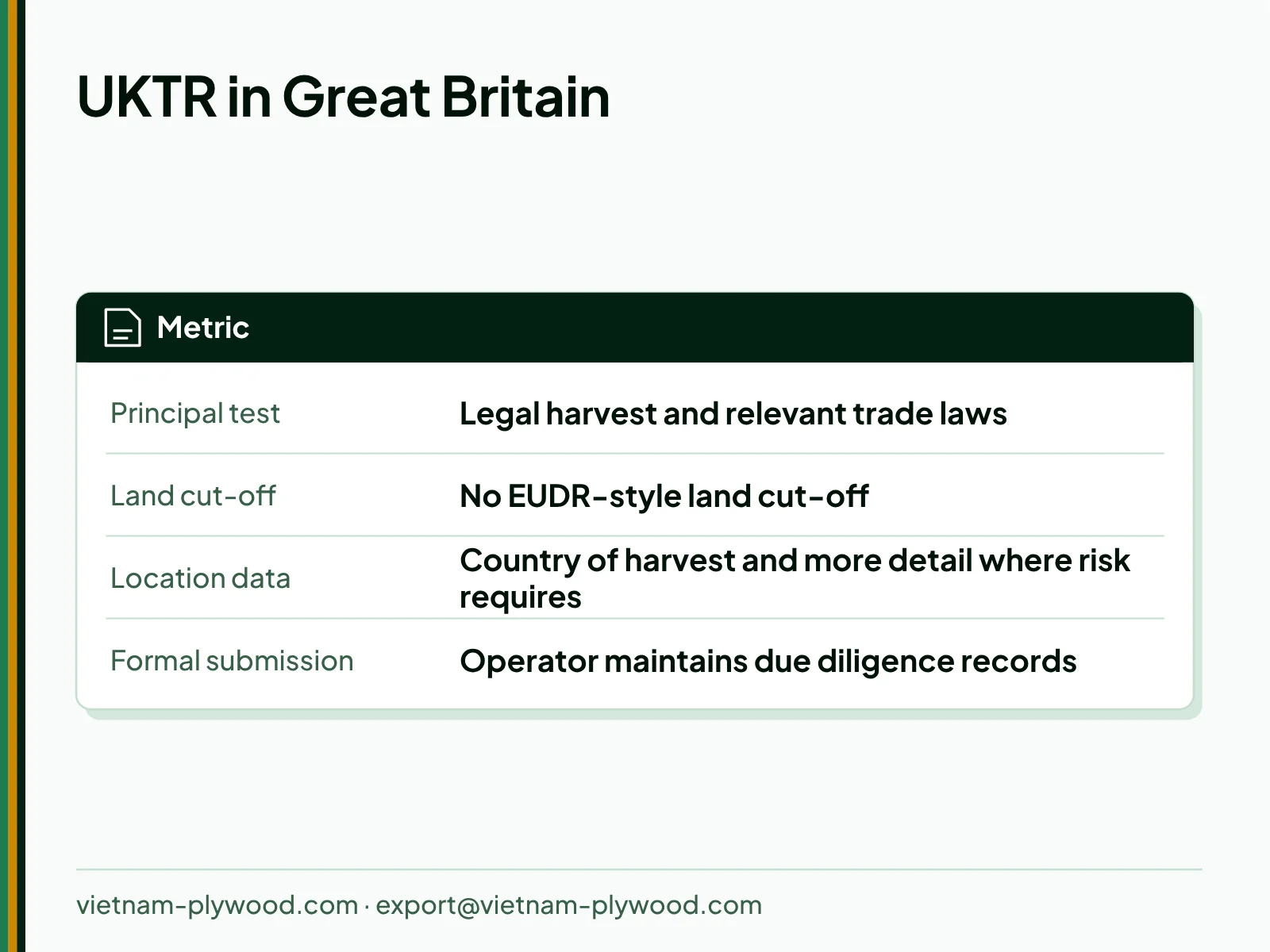
| Principal test | Legal harvest and relevant trade laws | Legal production plus deforestation-free production | GB-only: UKTR; NI in-scope: EUDR |
| Land cut-off | No EUDR-style land cut-off | No deforestation after 31 December 2020 | Obtain plot history for NI |
| Location data | Country of harvest and more detail where risk requires | Geolocation of relevant production plots | Collect coordinates early for NI |
| Formal submission | Operator maintains due diligence records | Relevant operator submits a digital due diligence statement or applicable simplified declaration | Establish operator role |
| Evidence approach | Gather, assess, mitigate illegal-harvest risk | Gather, assess, mitigate legal and deforestation risks | Separate the decisions |
The European Commission’s 2026 EUDR overview describes the deforestation-free, legal-production and digital-statement tests. The EUR-Lex 2026 legislation summary describes the amended implementation timetable. Our EUDR versus EUTR comparison examines the transition separately.
Does EUDR apply to UK imports in Great Britain or Northern Ireland?
EUDR does not apply to imports placed solely on the Great Britain market; it will apply in Northern Ireland for covered wood products. The UK government’s November 2026 Northern Ireland guidance states this territorial distinction directly.
For covered timber products, the published Northern Ireland start is 30 December 2026 for medium and large businesses and for micro and small businesses handling products previously covered by the EU Timber Regulation. The wider micro and small business date is 30 June 2027 for other relevant products. A plywood importer should check the product code, operator classification and applicable transition rule rather than assuming the later date applies.
Great Britain has announced future deforestation-related legislation, but an announced intention is different from a current EUDR obligation. The UK government’s November 2026 policy paper describes proposed Great Britain measures. For date-specific planning, see EUDR application dates.
Which legality papers cover plantation cores and imported faces?
A plantation core needs a traceable harvest-to-factory record; an imported face veneer needs its own upstream origin and import trail. Treating the face species as the entire panel’s species leaves the core unassessed.
Our commercial and packing line uses Vietnamese acacia core. Our furniture line uses styrax or eucalyptus core and can use a named decorative face. The construction line uses acacia or eucalyptus core beneath film. A buyer should request harvest-location and species identification, land or harvest authorization as applicable, producer and transporter records, mill intake logs, and the records connecting input batches to finished panels.
For a face veneer imported into Vietnam, request its species and country of harvest, upstream supplier invoices, transport and import records, and any required export or harvest permissions from the source jurisdiction. Check whether the supplier’s paperwork identifies harvest country rather than merely the country where veneer was traded or processed.
The producing factory can show the intake-to-production batch trail and the panel construction during inspection. HCPLY’s three factories make different builds, so the relevant evidence is tied to the actual production order. Certificate copies for member factories, including FSC where applicable, are shown with factory details masked, on request.
What can an inspector check at the producing factory?
An inspector can compare the raw veneer intake, production batch, finished panel and loading records against the purchase specification. The strongest check follows a named batch through physical stock and documents rather than inspecting an isolated certificate.
At the producing factory, the buyer can witness veneer species and face identification, core assembly, panel thickness checks, bundle labels and pallet counts. Record which veneer lot entered which press batch, then compare packed markings with the packing list. For an imported face, trace the face-veneer intake reference back to the upstream supplier documents.
A 1220 × 2440 mm, 18 mm sheet weighs 26.79 kg with styrax core, 31.08 kg with acacia or 34.83 kg with eucalyptus, using the core densities. These are core-based planning weights, excluding film weight. The density follows the core, even when the panel is named after its face. Such comparisons help identify inconsistent load descriptions; they are not substitutes for timber-origin documents.
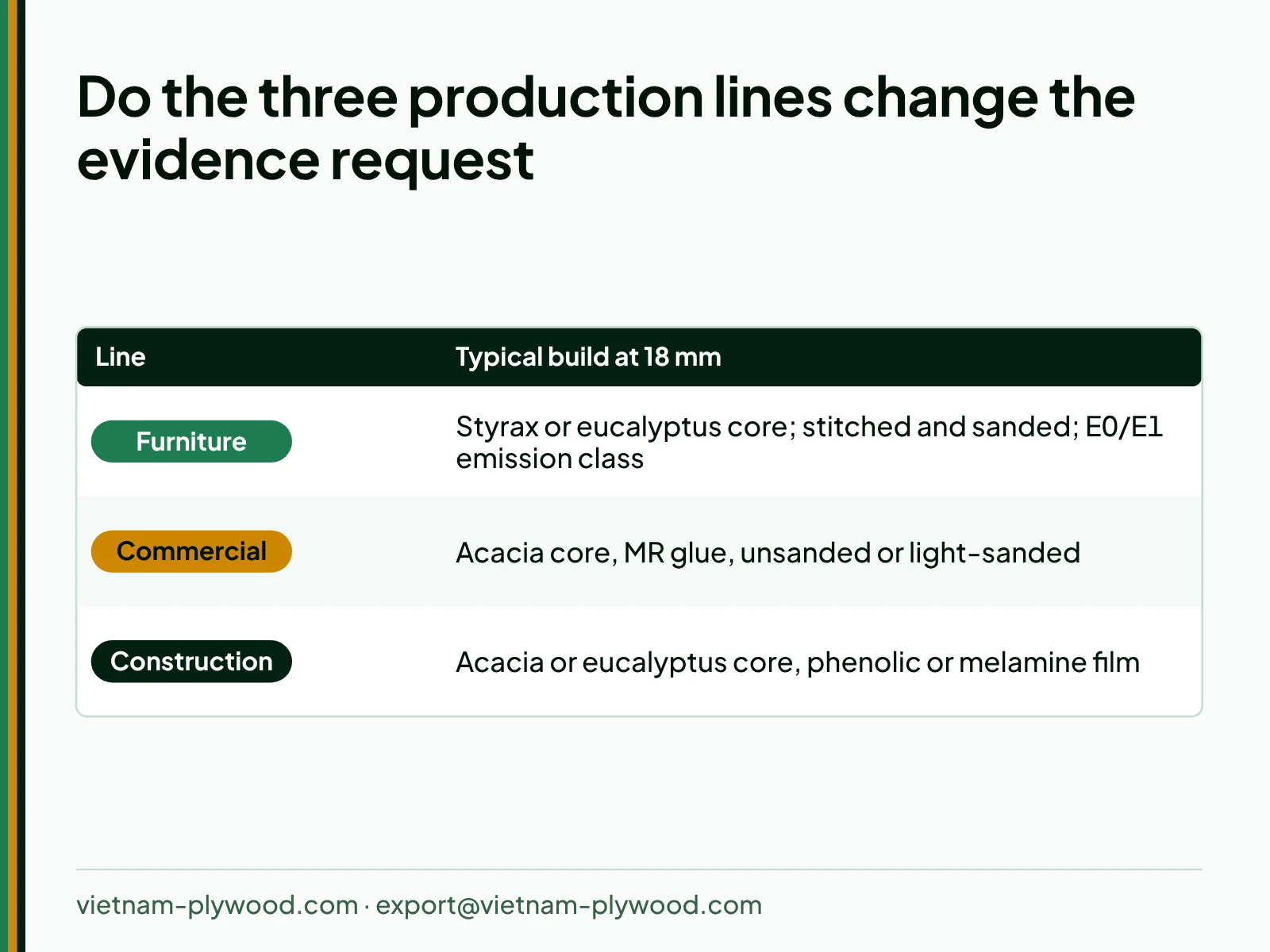
How do the three production lines change the evidence request?
The producing line determines the core construction and the records that must be matched to the legality file. Request the actual core and face components on the order, not a generic plywood description.
| Line | Typical build at 18 mm | Component-origin focus | Suitable buyer use |
|---|---|---|---|
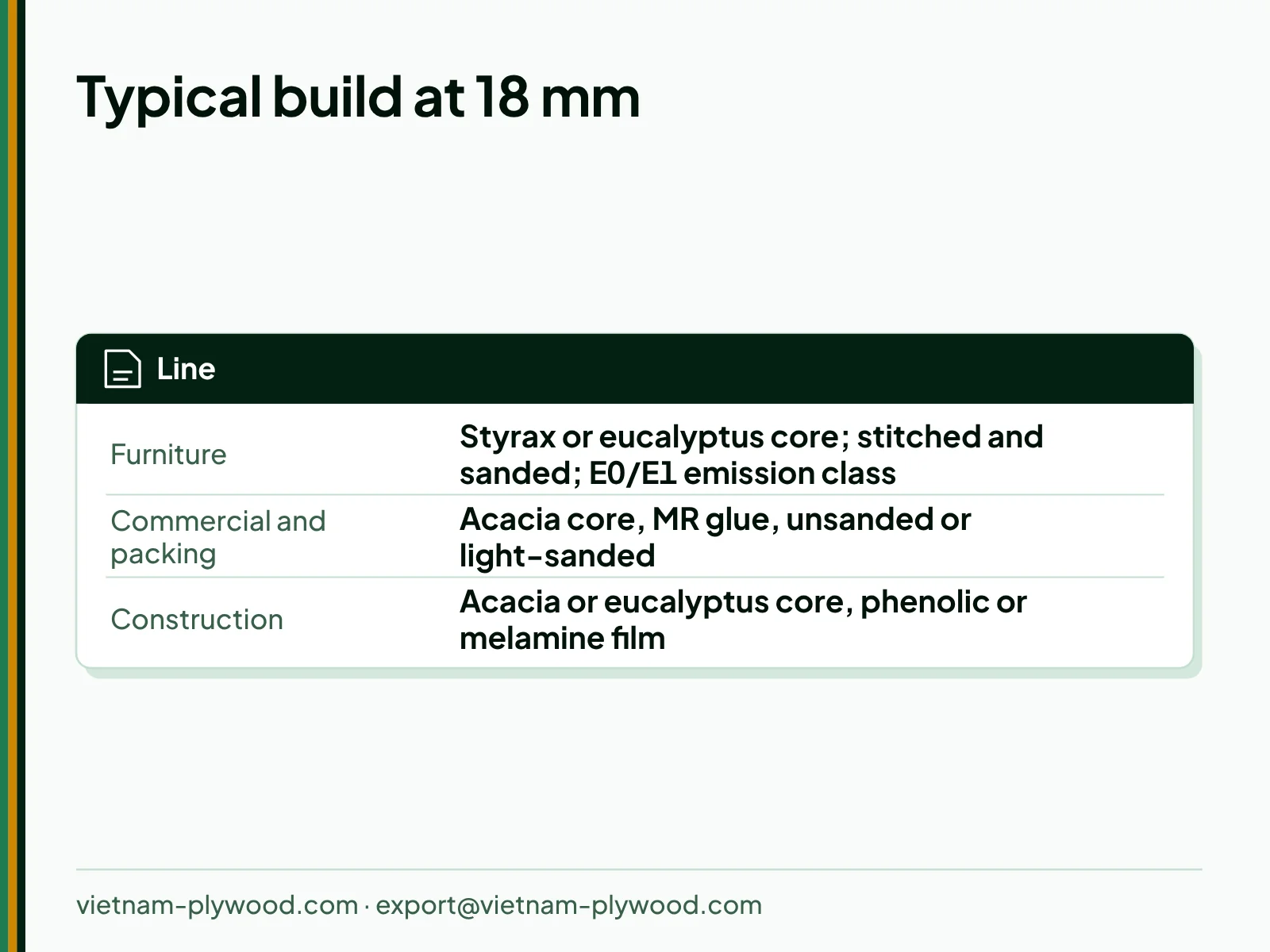
| Furniture | Styrax or eucalyptus core; stitched and sanded; E0/E1 emission class | Core lots plus named face veneer and grade | Cabinets and furniture manufacture |
| Commercial and packing | Acacia core, MR glue, unsanded or light-sanded | Acacia intake and any face-veneer origin | Distribution and industrial packing |
| Construction | Acacia or eucalyptus core, phenolic or melamine film | Core lot and film input identification | Formwork supply |
The table describes production choices, not legal exemptions. A film surface does not remove the need to identify the wood beneath it. The furniture plywood specification and commercial plywood options explain the respective product builds.
Can different specifications share a container?
Yes. A minimum order is one 40HC, and specifications can be mixed within its 28.5 t payload limit. Keep separate lot and pallet identifiers so each specification remains traceable within the shipment.
For a 1220 × 2440 mm, 18 mm build, the full-container reference is 990 styrax-core sheets at 26.52 t, 880 acacia-core sheets at 27.35 t, or 795 eucalyptus-core sheets at 27.69 t. A mixed load needs a fresh sum of the pallet weights and a clear split by core, face and batch. The container-loading calculator addresses other sizes and thicknesses.
A single shipping record can describe multiple panel specifications, while the legality file must preserve the component-origin evidence for each. When mixing an imported face veneer with locally harvested core, keep their origin trails distinct even if the finished panels travel together.
When does a Northern Ireland shipment need the EUDR file?
A covered plywood consignment entering Northern Ireland from Vietnam needs the EUDR evidence when the applicable EUDR obligations begin for its operator and product. The file must support legality, deforestation-free origin and the required digital submission, including geolocation of relevant wood-production plots.
The UK Department for Environment, Food & Rural Affairs (Defra), in its 2026 movement guidance, distinguishes direct rest-of-world entries from Great Britain movements. Importers must establish the responsible operator, the customs route and whether a due diligence statement reference must appear in the declaration.
For a shipment arriving before the applicable transition date, the existing EU timber regime remains relevant under the transition provisions. For later covered entries, a conventional UKTR dossier alone lacks the EUDR plot and deforestation checks. Our EUDR due diligence statement page details the statement workflow.
How should a buyer check the evidence before ordering?
Start with the destination and the actual wood components, then request records for each upstream chain. The importer should complete its risk decision before the panels are placed on the relevant market.
First, specify Great Britain or Northern Ireland and the expected placing-on-market date. Next, identify core species, face species, harvest countries and each material supplier. Then review origin and harvest documents against batch intake records, paying special attention to imported veneer and any unexplained supplier change.
For Northern Ireland, add plot geolocation, post-2020 land-use evidence and the digital declaration responsibilities. Where a supplier document lacks a harvest country or the plot record cannot be linked to a batch, resolve that gap before shipment planning. Our export team coordinates specification, on-site quality checks, documents and loading from the relevant factory.
Production takes 15–45 days from the 30% deposit, set by order size, line loading and the contract. The remaining 70% is paid on the scan of the bill of lading, by T/T, or by irrevocable sight L/C. Plan the document review within the production lead-time process.
Which documents travel with the plywood order?
The export paperwork identifies the commercial shipment; the timber legality dossier supports the importer’s regulatory decision. These records should reference compatible lot descriptions and quantities.
For an order shipped FOB Hai Phong, CFR (CNF) or CIF, HCPLY prepares the commercial invoice, packing list, B/L, certificate of origin, phytosanitary and fumigation papers. Insurance is included under CIF. The order’s agreed certificate documents and test reports accompany the relevant specification; after loading, the draft shipping documents come to you for approval.
Northern Ireland or EU-directed orders also require the EUTR/EUDR file set as applicable. The importer or responsible operator handles its own regulatory assessment and required electronic submission. A certificate of origin for customs does not identify every plantation plot or replace species-by-species evidence.
For other markets, different legality frameworks apply; the Lacey Act plywood overview covers the United States. Keep this order’s destination rules separate from unrelated market checklists.
What should the importer send for a UKTR-ready quotation?
Send a written build and destination specification with the origin-evidence request. That gives the producing factory a concrete basis for matching raw-material lots, inspection points and export documents.
Application: importer/distributor stock for GB or Northern Ireland
Line or core: furniture styrax/eucalyptus | commercial acacia | construction acacia/eucalyptus
Glue: melamine MR | phenolic WBP (as specified)
Emission: E0 | E1 | E2 (as required for the build)
Face and grade: named veneer and A/B, or film specification
Thickness and tolerance: ___ mm; ordered tolerance ___ mm
Size: ___ x ___ mm
Quantity: ___ sheets / ___ 40HC
Destination port: ___; GB or Northern Ireland market
Origin evidence: core and face species, harvest country, batch trail; NI plot data where applicable
Request the spec sheet from Lucy at export@vietnam-plywood.com through contact.