






Buying plywood through Irish stockists is suitable for smaller, immediate releases; a direct container import suits distributors with predictable demand and a controlled specification. Choosing the wrong route ties up cash, adds handling days or leaves a load that customers reject. HCPLY helps importers compare factory builds, loading weights and shipment documents before they commit.
Plywood Ireland: buy locally or import a container?
For plywood Ireland distributors, local stock wins when the order is small or urgent; importing wins when a written specification and full-container demand justify the freight, customs work and inventory commitment. Compare landed cost per usable sheet, rather than a factory quotation against a local delivered price.
Local supply avoids an overseas production cycle and allows a buyer to inspect available stock quickly. Direct imports allow repeated specifications across replenishment orders and inspection at the producing factory.
For a broader purchasing framework, see our buying guides and distributor supply programmes.
Which buying route fits the order?
Use the same application and acceptance criteria when comparing a domestic quotation with an import quotation.
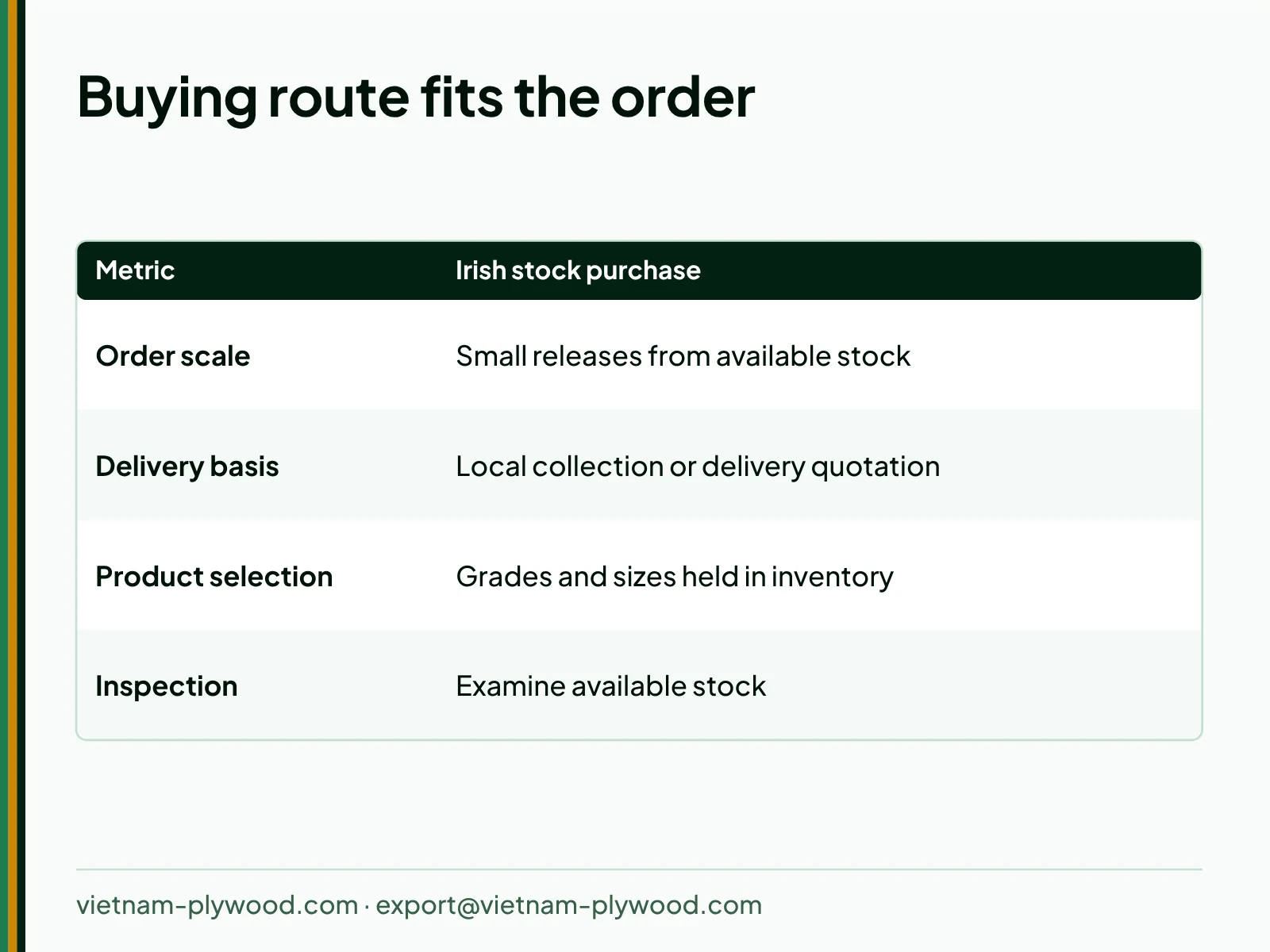
| Metric | Irish stock purchase | Direct 40HC import | Verdict by use |
|---|---|---|---|
| Order scale | Small releases from available stock | Minimum one 40HC | Local for irregular small demand; import for repeat distribution |
| Delivery basis | Local collection or delivery quotation | FOB Hai Phong, CFR (CNF) or CIF | Compare delivered Irish costs before choosing |
| Product selection | Grades and sizes held in inventory | Written face, core, glue, tolerance and size | Import for a repeatable custom assortment |
| Inspection | Examine available stock | Witness checks before factory loading | Local for immediate selection; import for batch control |
| Working capital | Pay for the released quantity | Deposit and shipment balance | Local when stock turnover is uncertain |
| Documentation | Domestic supplier paperwork | Import clearance and product compliance file | Local for simpler purchasing; import when documentation capacity exists |
Conversely, a lower nominal sheet price can disappear after inland delivery, port costs, duty, handling and rejected sheets.
What does a container actually hold?
A 40HC has a 28.5 t payload limit in our loading model. For 18 mm, 1220×2440 mm plywood, the core changes both sheet weight and the full-container count. These are core-based calculations without film weight.
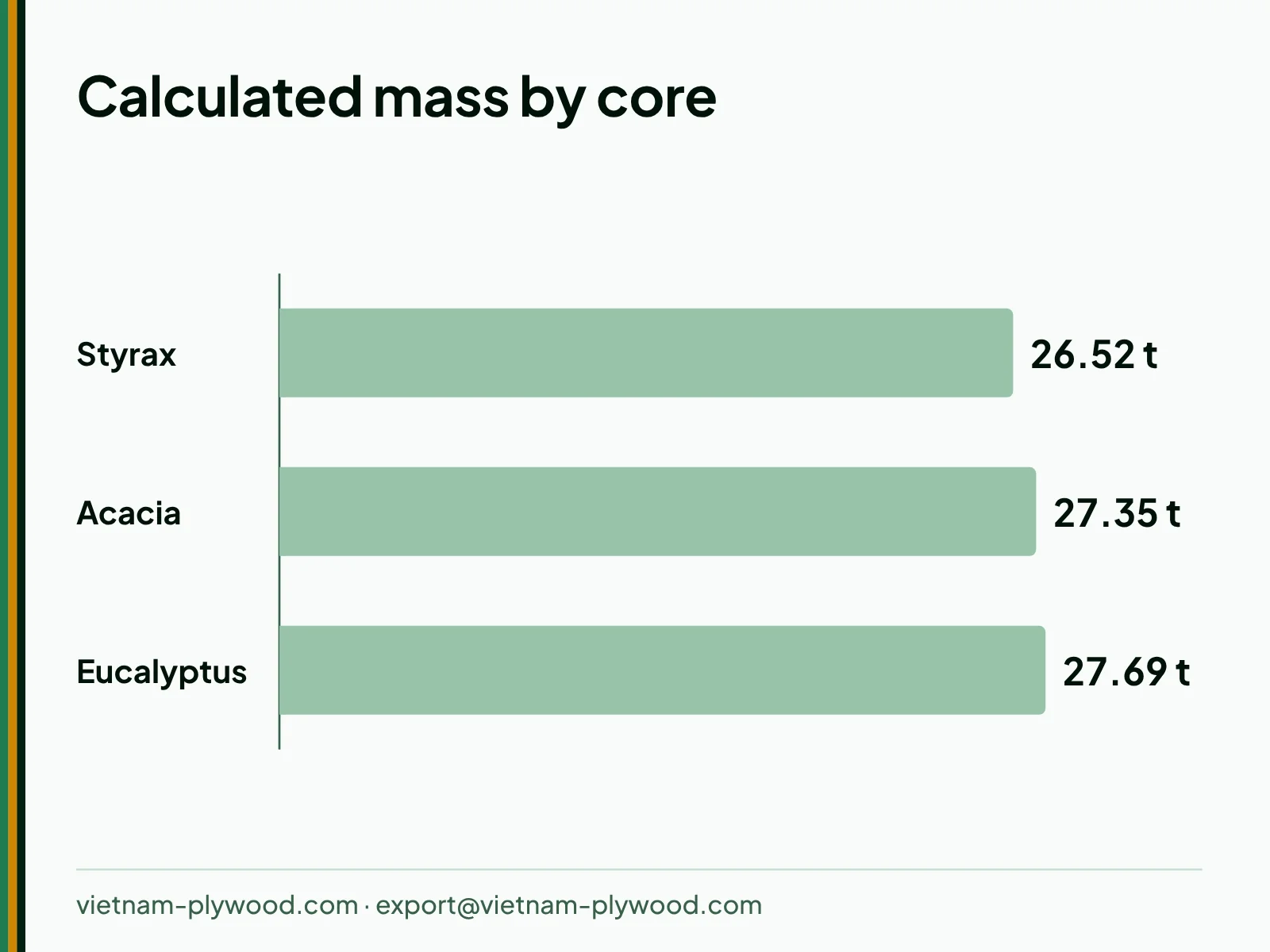
| Core | Sheet weight | Pallets | Sheets per pallet | Full 40HC | Calculated mass |
|---|---|---|---|---|---|
| Styrax | 26.79 kg | 18 | 55 | 990 sheets | 26.52 t |
| Acacia | 31.08 kg | 16 | 55 | 880 sheets | 27.35 t |
| Eucalyptus | 34.83 kg | 15 | 53 | 795 sheets | 27.69 t |
A distributor can mix specifications within the payload limit, but the loading plan must account for each core and pallet arrangement. The container packing reference owns the detailed calculations for other sizes and thicknesses.
Ask for a packing plan before agreeing the final assortment, particularly when heavier eucalyptus panels share space with lighter furniture panels.
Which factory line makes the required grade?
HCPLY operates three factories in Phu Tho and Hai Phong, with each order produced at the line matching its specification. Our furniture line makes sanded, full-stitched styrax- or eucalyptus-core panels. Our commercial and packing line makes acacia-core MR-glue panels; our construction line presses film-faced acacia- or eucalyptus-core panels.
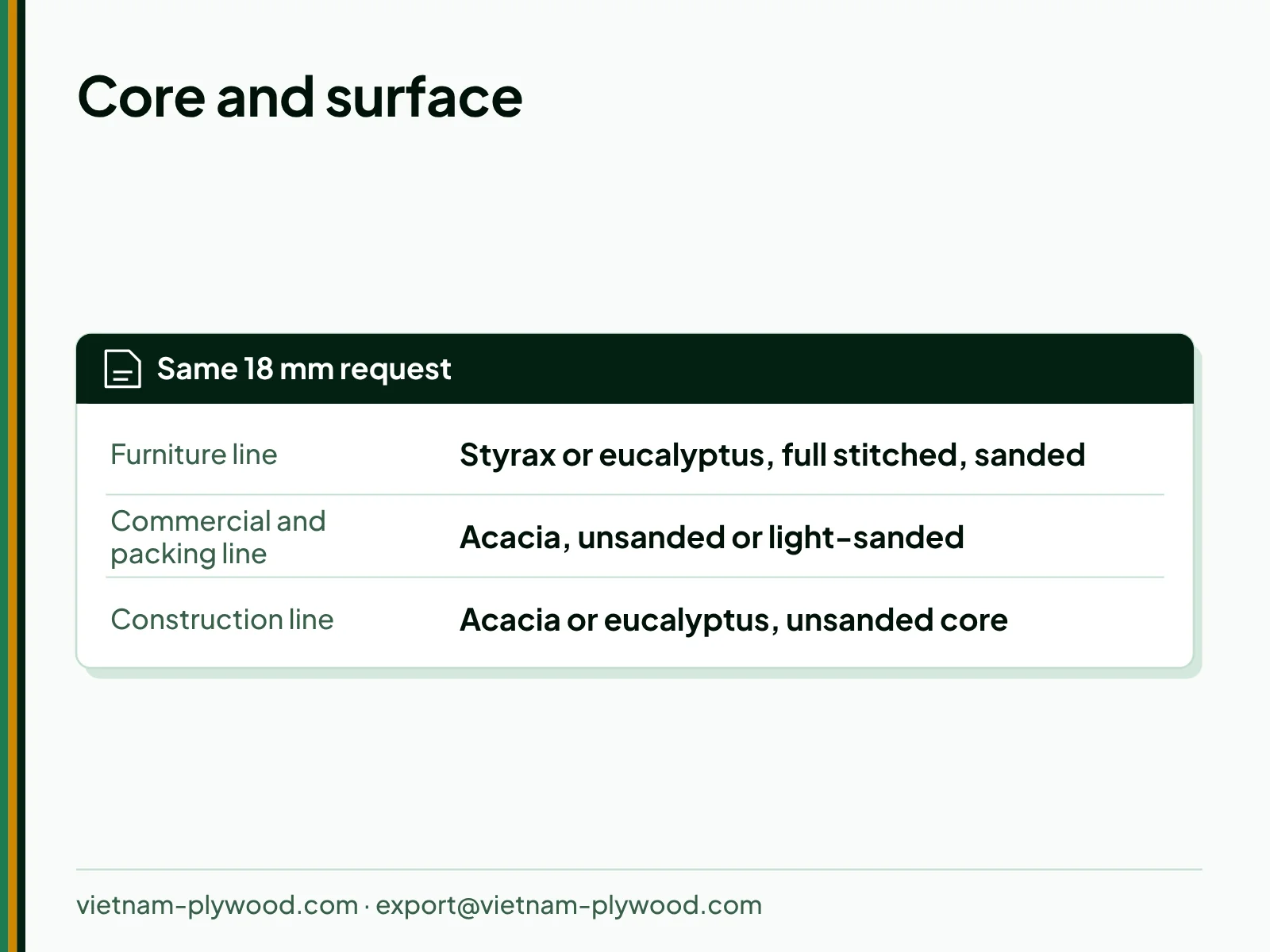
| Same 18 mm request | Core and surface | Glue or finish | Practical buyer use |
|---|---|---|---|
| Furniture line | Styrax or eucalyptus, full stitched, sanded | E0/E1 emission class | Cabinet and furniture component stock |
| Commercial and packing line | Acacia, unsanded or light-sanded | MR glue | General commercial and packing demand |
| Construction line | Acacia or eucalyptus, unsanded core | Phenolic or melamine film | Formwork and site distribution |
We do not press MDF, OSB, chipboard, blockboard, bamboo, MDO, HDO, 3-ply spruce panels or birch-core plywood. Birch is a possible face veneer, with D/E/F face grades, rather than a birch-core offer. Compare the three builds in the factory-line grade comparison.
Which specifications should an Irish distributor lock?
Start with end use, then fix core construction, face grade, adhesive, emission class and measurable dimensions. A furniture buyer might specify a sanded 18 mm panel with a face veneer selected from bintangor, okoume, engineered veneer, gurjan, pine, poplar, eucalyptus, birch or sapele. A formwork yard should specify the film and adhesive separately.
Our available thickness range is 3–40 mm. Common thicknesses include 3, 5, 9, 12, 15, 18, 21 and 25 mm. At 18 mm, the build uses 11–13 plies according to the core veneer thickness. Common sheet sizes include 1220×2440 and 1250×2500 mm, alongside other listed formats and custom cutting.
Sanded furniture tolerance is ±0.2 or ±0.3 mm as ordered; commercial and film-faced tolerance is ±0.5 mm, packing ±0.5–1.0 mm, and length and width ±2 mm. Put these values on the purchase specification. Glue and emissions remain separate fields: MR melamine glue and WBP phenolic glue describe bonding, while E0, E1 and E2 describe emission classes.
What is the price basis for importing?
Commercial plywood starts from US$250/m³ FOB Hai Phong (October 2026); furniture plywood starts from US$350/m³ FOB Hai Phong (October 2026). These dated starting figures exclude the Irish landed-cost components and do not replace a specification-based quotation.
Within a comparable size, a sanded full-stitched furniture build costs more than a basic unsanded commercial build because core preparation and finishing add work. Face selection, thickness tolerance, glue and ordered volume also affect the offer. For film-faced grades, request a quotation against the exact film weight and adhesive rather than applying either starting figure.
Quote validity matters when freight or input costs change; see price changes and quote validity.
What customs and EU evidence belongs in the file?
Ireland is an EU market, so an importer must establish the applicable tariff classification, origin treatment, customs declaration requirements and product obligations before shipment. Do not use UK marking or UK trade terms as a substitute for the Irish rules.
The European Commission’s 2026 EUDR guidance states that the regulation covers wood and certain derived products, with application from 30 December 2026 for large and medium operators and 30 June 2027 for micro and small enterprises. Relevant operators must prepare due-diligence information, including production legality and plot geolocation. Read the European Commission’s EUDR overview when preparing an Irish import programme.
For construction products, the European Commission explains that CE marking follows the applicable assessment, declaration and technical-documentation process. It is tied to a harmonised technical specification or European Technical Assessment; a supplier’s generic certificate list does not replace the product-specific route. See the Commission’s construction-product marking explanation.
Member-factory FSC, CARB P2, ISO 9001 and CE documents, along with EUDR/EUTR documents, are shown with factory details masked, on request.
What should an inspector witness before loading?
An inspector can witness measurements, face sorting, edge condition, core construction at a cut sample and pallet counts at the producing factory.
For furniture panels, inspect sanding consistency, veneer appearance and stitched core construction. For commercial stock, inspect core gaps, edge condition and the ordered unsanded or light-sanded finish. For construction stock, inspect film continuity and edge sealing, including any cut edges.
Film-faced stock is specified by film weight: 120 g/m² standard, 135 g/m² premium or 220 g/m² anti-slip only. With proper handling, a release agent on every pour and sealed edges including cut edges, melamine-glue film-faced plywood gives about 12–15 pours; phenolic-glue film-faced plywood gives up to about 25 pours. These are handling-conditioned figures, not a substitute for inspection of the ordered build.
Buyers can visit the factory office and inspect at the producing factory. HCPLY handles specification, on-site quality control, export documents and loading.
How do payment, timing and shipping work?
The minimum order is one 40HC. Production takes 15–45 days from the 30% deposit, set by order size, line loading and the contract. The remaining 70% is payable against the scanned bill of lading, by T/T or irrevocable L/C at sight.
We ship FOB Hai Phong, or CFR (CNF) or CIF to your port. For Northern Europe, the stated sea-transit range from Hai Phong is 30–40 days by carrier and route; it is a regional planning range rather than an Ireland-port schedule. Add customs release, inland distribution and inventory intake to the buyer’s replenishment plan.
The shipment file includes commercial invoice, packing list, bill of lading, certificate of origin (EUR.1 for EU lots), phytosanitary and fumigation papers, insurance under CIF, agreed certificate or test documents and the EUTR/EUDR file set for EU lots. After loading, the draft shipping documents come to you for approval.
How should a distributor start a trial container?
Start with the highest-turnover application and a written acceptance specification. A trial container should test saleable yield, pallet handling, customer acceptance and landed cost rather than simply the first invoice value.
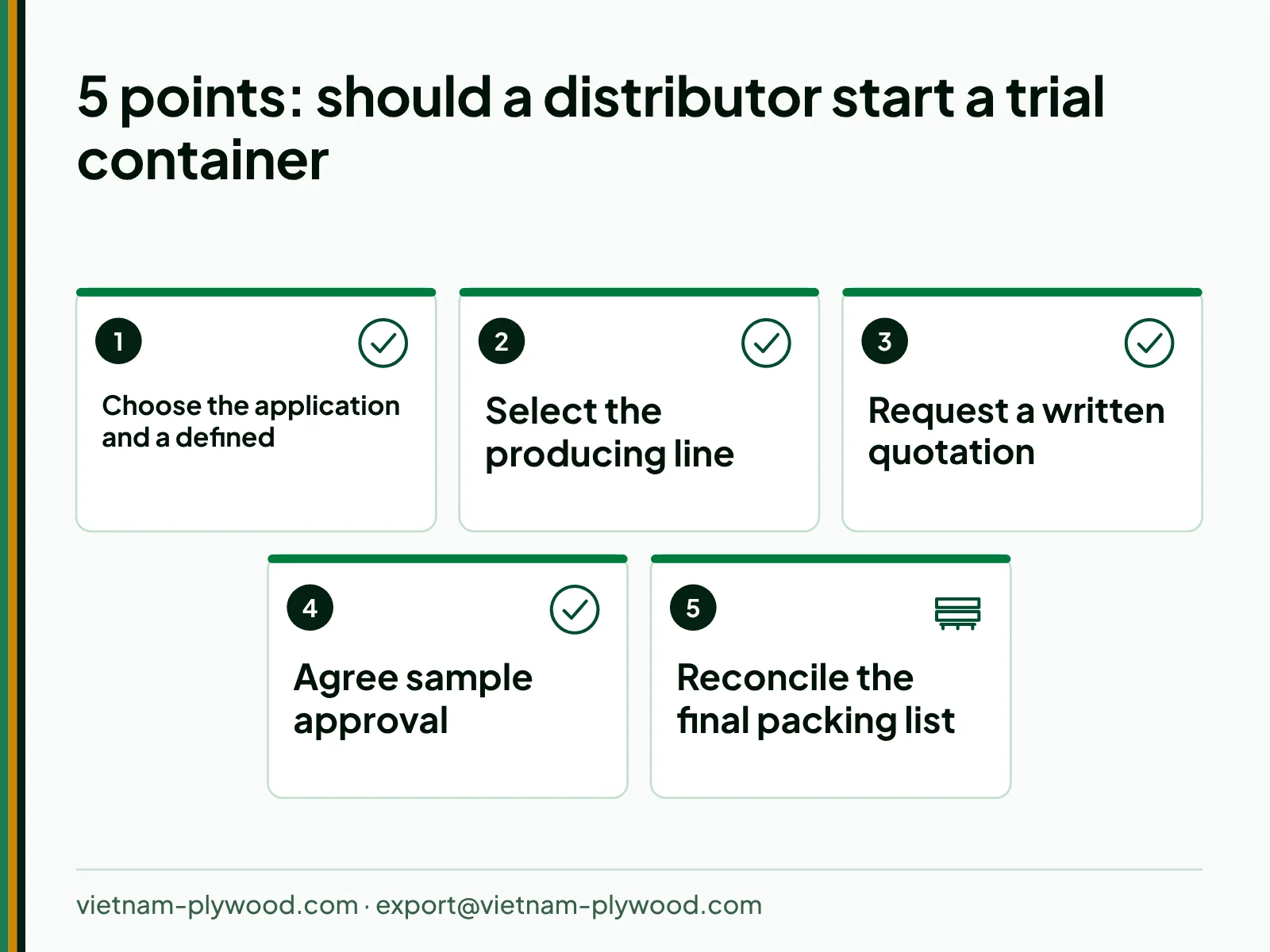
- Choose the application and a defined customer segment, such as cabinet manufacturers or formwork yards.
- Select the producing line, face, core, glue, emission class and thickness tolerance.
- Request a written quotation and a proposed mixed-load plan within the payload limit.
- Agree sample approval, inspection checkpoints, documentation and Irish clearance responsibilities.
- Reconcile the final packing list with the ordered assortment before stock enters distribution.
Free samples are available; new buyers book their own courier, and courier cost can be credited against a real order. A trial can also test whether a construction supply programme or furniture plywood assortment fits the customer base.
What should go in the first enquiry?
Send Lucy the destination port and a specification for each requested product, including the intended application and target order quantity. Use this format as the starting point:
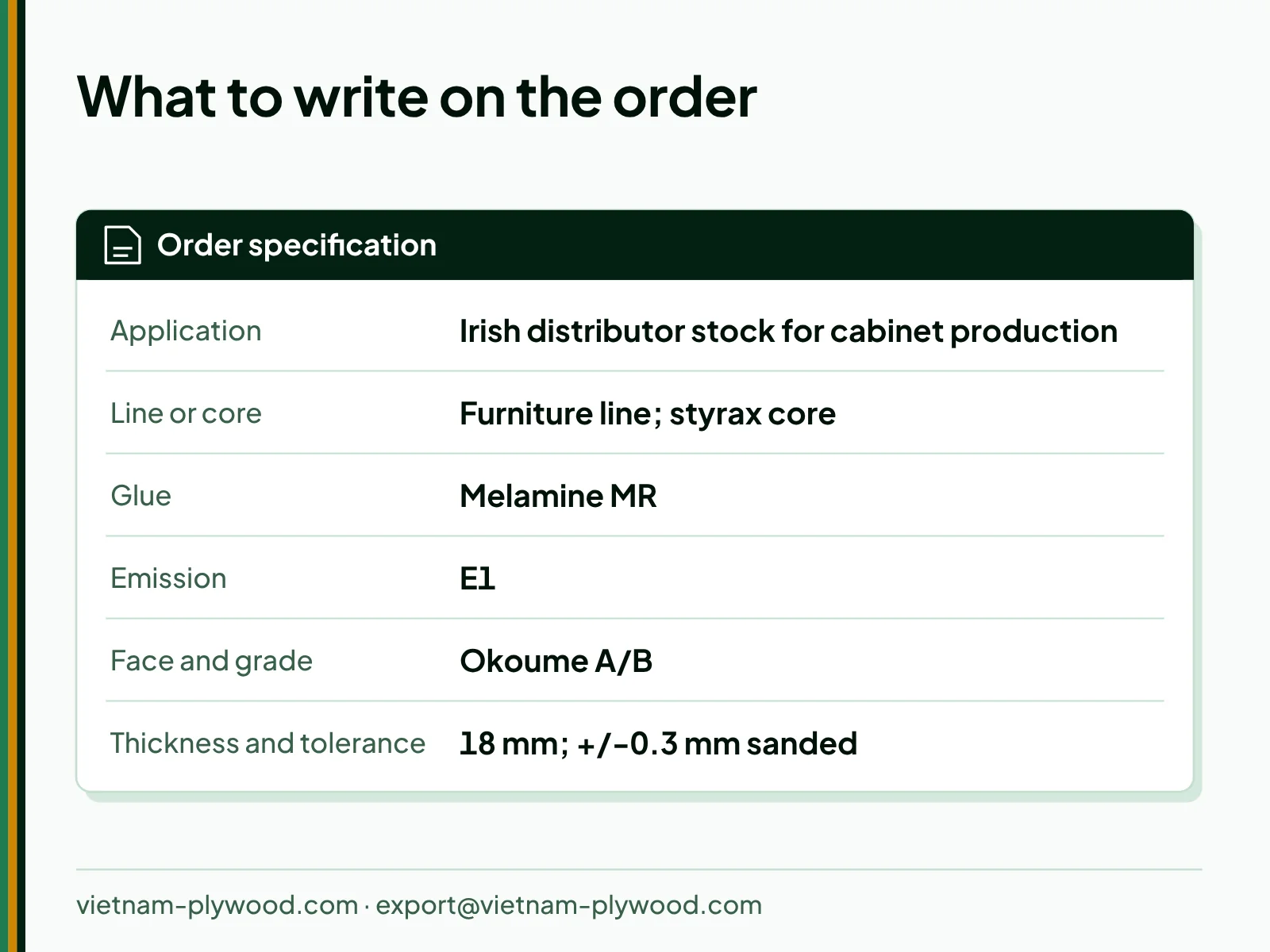
Application: Irish distributor stock for cabinet production
Line or core: furniture line; styrax core
Glue: melamine MR
Emission: E1
Face and grade: okoume A/B
Thickness and tolerance: 18 mm; +/-0.3 mm sanded
Size: 1220 x 2440 mm
Quantity: one 40HC; proposed mix by item
Destination port: [Irish port]
Plan a trial container with Lucy at contact or export@vietnam-plywood.com.