





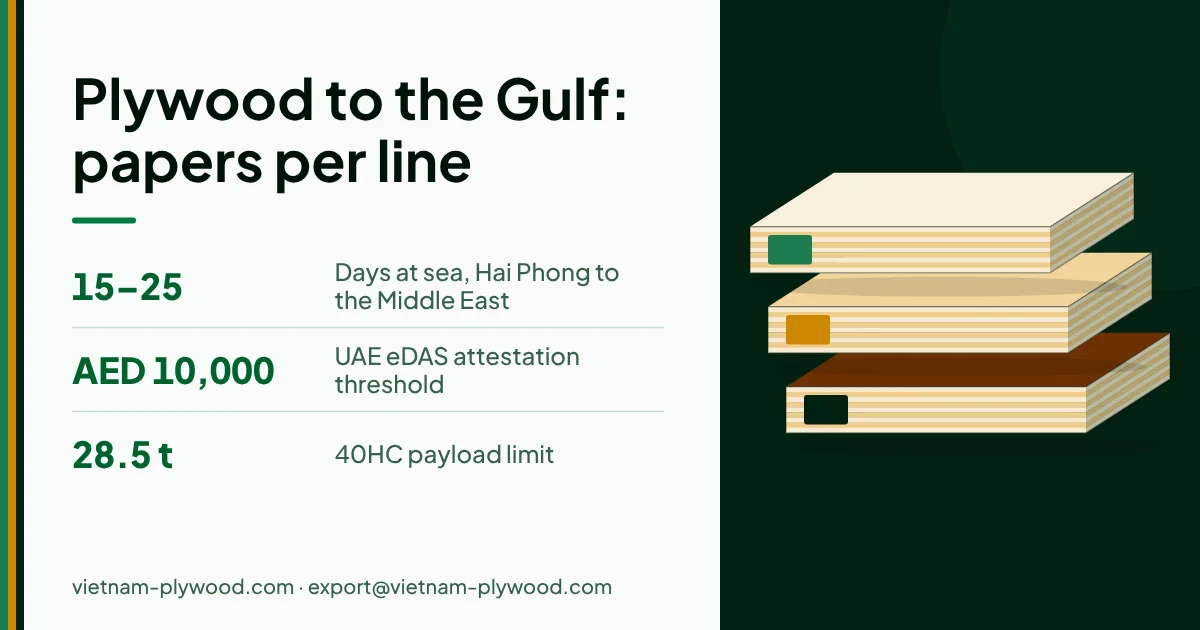
A Gulf or Levant plywood order clears on four papers that agree line for line: the commercial invoice, packing list, B/L and certificate of origin, attested in the UAE or legalised where the destination asks. HCPLY issues them as one set for a mixed container from Hai Phong. One mismatched line means a held box at Jebel Ali or Dammam, paying terminal storage while papers are reissued.
That is the short version of how to import plywood from Vietnam to the Middle East. The rest of this page goes through it per product line, because a typical order from the region mixes film-faced and anti-slip site panels with sanded panels for joinery. The general route from enquiry to arrival, for any market, is on our page on how to import plywood from Vietnam. Country detail, such as a Saudi or Kuwaiti customs portal, stays with your clearing agent and our market pages.
How to import plywood from Vietnam to the Middle East, step by step
You fix the specification per product line, choose FOB Hai Phong, CFR or CIF, pay the deposit, approve the draft documents after loading and hand the original set to your clearing agent. In the UAE you also attest the invoice and certificate of origin online. Every step below names the paper it produces.
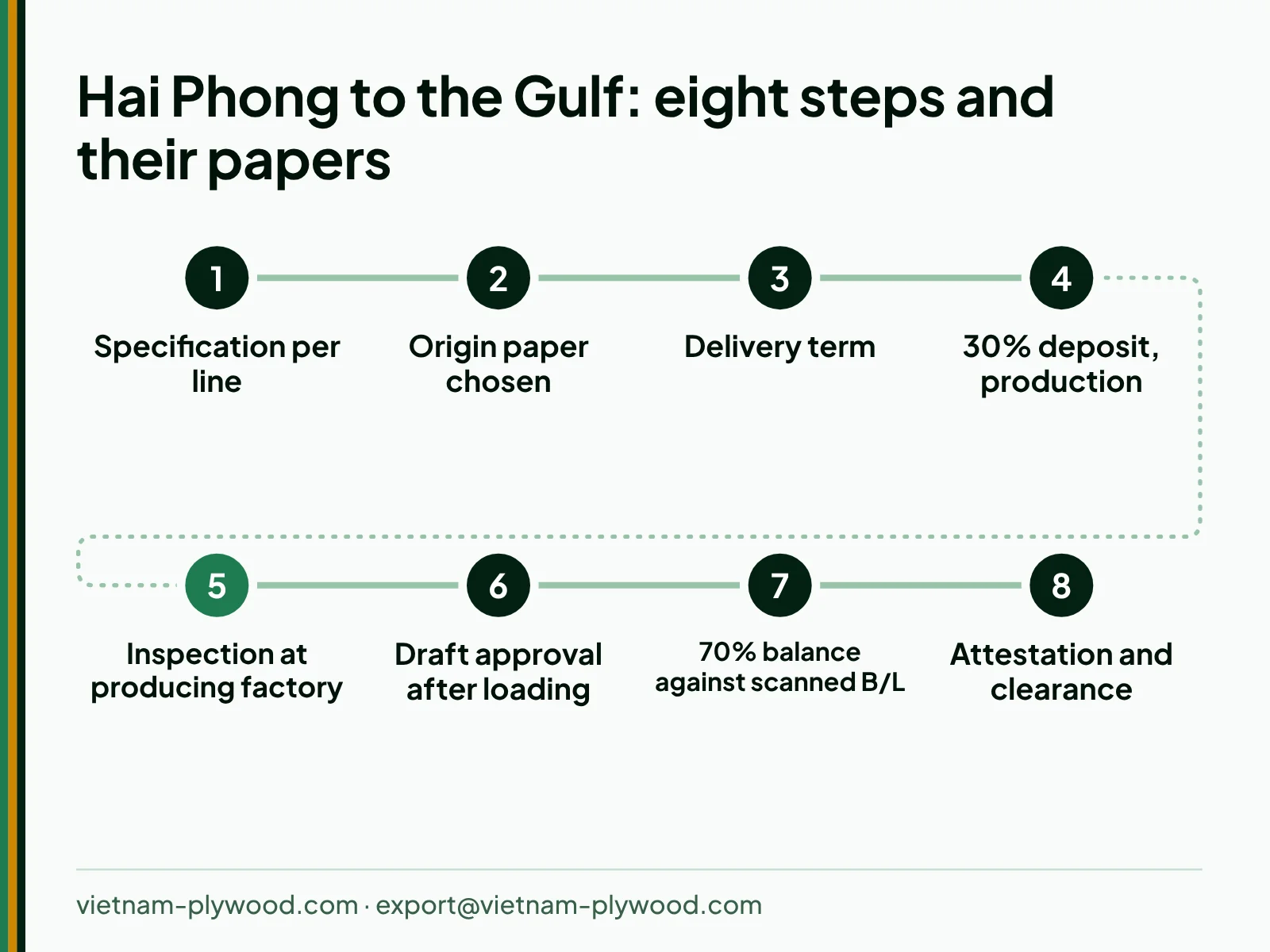
- Write the specification per line. Application, core, glue, emission class, face and grade or film weight, thickness and tolerance, size, quantity and discharge port. A mixed order has one block per panel type.
- Name the origin paper you need. Tell us whether your customs claims the UAE CEPA rate (a UAE-VN form C/O) or takes the standard Vietnamese certificate of origin.
- Agree the delivery term. FOB Hai Phong, CFR (CNF) or CIF. Under FOB you book the vessel; under CFR or CIF we book it, and CIF adds the insurance paper.
- Pay the deposit and confirm the build. Production: 15–45 days from the 30% deposit, set by order size, line loading and the contract.
- Inspect at the producing factory. You or your inspector witness thickness, film weight, edges and pallet counts before loading.
- Approve the drafts. After loading, the draft shipping documents come to you for approval. Check every line of the invoice against the packing list and the certificate of origin.
- Pay the balance and receive the originals. The remaining 70% is paid on the scan of the bill of lading, by T/T, or by irrevocable sight L/C.
- Attest or legalise, then clear. Your clearing agent lodges the declaration with the set; in the UAE the importer attests the invoice and certificate of origin through eDAS first.
The vessel time sits between steps 6 and 8. Days at sea from Hai Phong to the Middle East are 15–25, by carrier and route; the sailing pattern per port is on our page on Hai Phong transit times.
Which certificate of origin does a plywood shipment to the Gulf need?
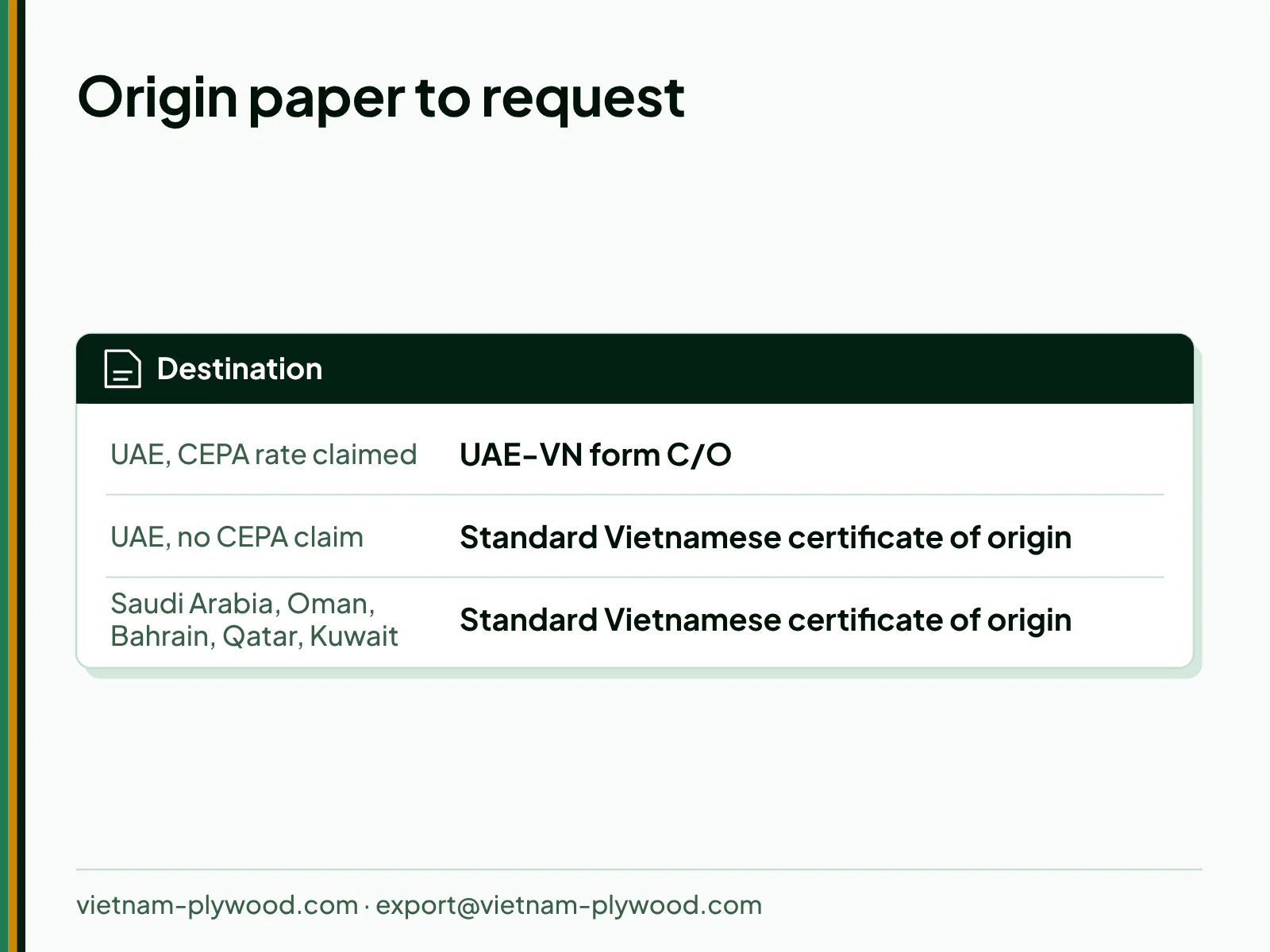
For the UAE, the paper that saves duty is the UAE-VN form C/O under the UAE–Viet Nam Comprehensive Economic Partnership Agreement. For the other Gulf and Levant destinations, the standard Vietnamese certificate of origin is the usual document. Either way it is one certificate per shipment, listing every panel line on the invoice.
The UAE Ministry of Economy and Tourism’s 2026 page on the UAE–Viet Nam CEPA states that the agreement “was signed on 28 October 2024 and entered into force on 3 February 2026”. The same page says the UAE commits to remove tariffs on 99% of Vietnamese originating exports. Whether heading 4412 sits at zero from day one or phases down is a tariff-line check your clearing agent makes on the ministry’s dashboard.
Vietnam’s side of the paperwork is set by Circular 24/2026/TT-BCT of the Ministry of Industry and Trade. The VCCI Center for WTO and International Trade (May 2026) summarises the accepted proofs: a UAE-VN form C/O, a self-certification by an approved exporter, or a self-certification for consignments of no more than 500 USD. Its summary also gives a general qualifying value content of no less than 35% of the ex-works price.
That value rule matters for plywood with an imported face. Our cores are acacia, eucalyptus and styrax grown in Vietnam, and they carry most of the panel’s volume. A face such as okoume or sapele may be peeled from imported logs, so the origin file for a CEPA claim records the face source next to the core.
| Destination | Origin paper to request | Who uses it |
|---|---|---|
| UAE, CEPA rate claimed | UAE-VN form C/O | UAE importer, at customs and in eDAS |
| UAE, no CEPA claim | Standard Vietnamese certificate of origin | UAE importer, in eDAS and at customs |
| Saudi Arabia, Oman, Bahrain, Qatar, Kuwait | Standard Vietnamese certificate of origin | Importer, at customs |
| Jordan, Lebanon and other Levant ports | Standard Vietnamese certificate of origin, legalised if the destination asks | Importer, at customs |
EU lots use a different paper, the EUR.1, and the EU route is on our page on importing plywood from Vietnam to the EU.
Do plywood export documents need legalisation for Gulf and Levant countries?
For the UAE, yes: the importer attests the commercial invoice and certificate of origin electronically once goods are valued at AED 10,000 or more. For the other countries, the step follows each destination’s own rule, and the apostille does not cover shipping papers. Ask your clearing agent which route your port takes before we print the originals.
The UAE Ministry of Foreign Affairs FAQ (2026) states that under Cabinet Resolution No. 38 of 2022, “LCA (electronic) attestation has become mandatory for goods imported into the UAE valued at Dh10,000 and above, effective from February 1, 2023”. The same MOFA eDAS FAQ lists what to upload: “No, kindly just upload the Commercial invoice and Certificate Of Origin.” It also exempts free-zone discharge and requires each shipment as its own transaction.
Three practical points follow for a plywood importer in the UAE:
- The attestation happens in the UAE, from the importer’s company account registered with its trade licence. Nothing is stamped at a UAE embassy in Hanoi.
- One shipment, one transaction. A mixed container is one invoice and one certificate of origin, so it is one eDAS transaction, not three.
- Free zone or local market. A box discharged into a free zone needs no attestation; one entering the local market does.
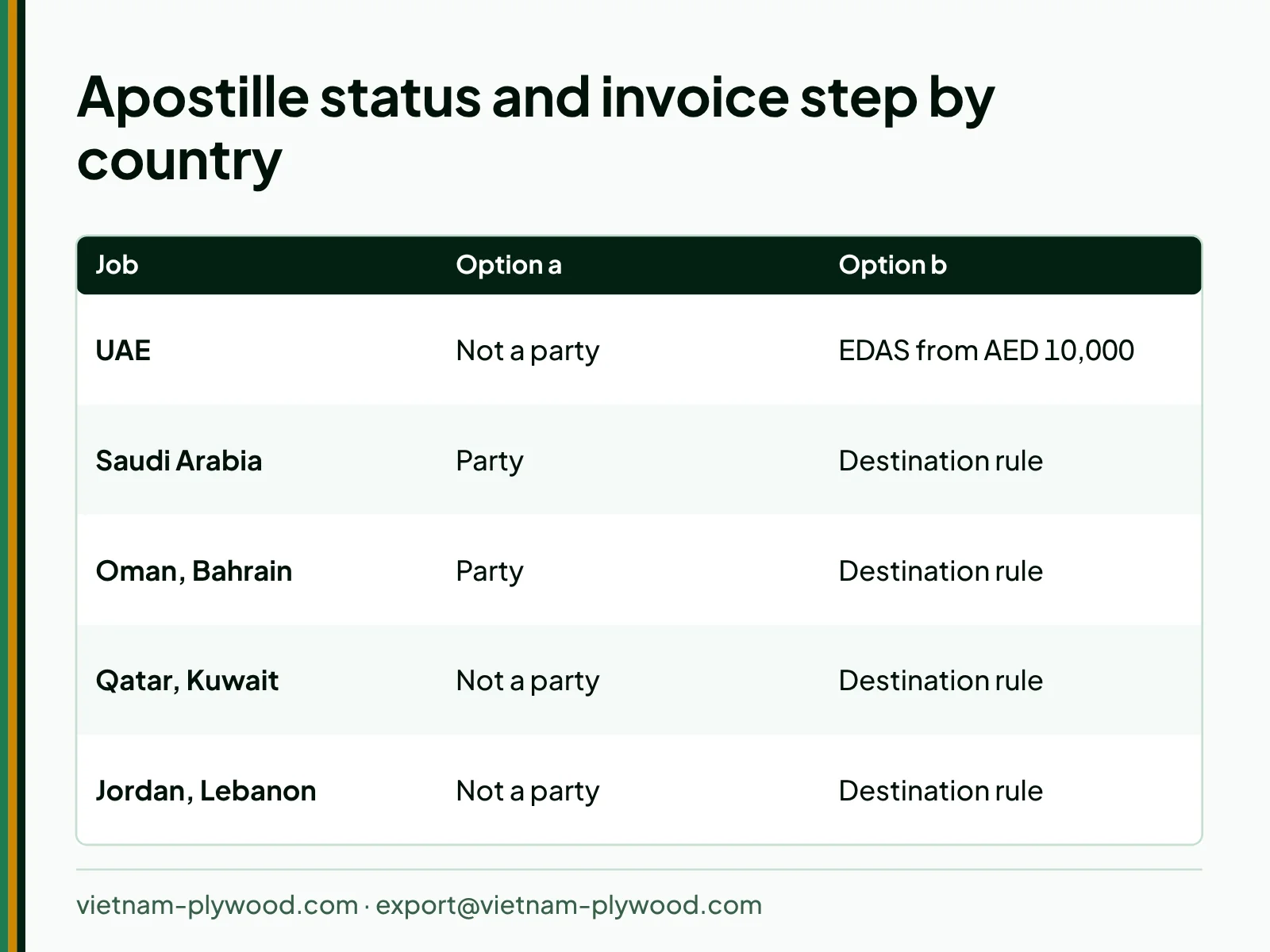
The apostille is a separate question. The Hague Conference’s 2026 status table for the Apostille Convention lists Viet Nam as acceding on 31 December 2025, with entry into force on 11 September 2026, marked as an accession with objections. Saudi Arabia, Oman and Bahrain are parties; the UAE, Qatar, Kuwait, Jordan and Lebanon are not on the table.
Even between two parties, the convention does not reach the shipping set. Article 1 of the 1961 Apostille Convention says it shall not apply “to administrative documents dealing directly with commercial or customs operations”. Invoices and certificates of origin fall in that group, so they follow the destination’s chamber, attestation or consular route. The apostille still helps with company papers, such as a power of attorney for your agent.
| Country | Apostille Convention, as listed in 2026 | Step for the invoice and certificate of origin |
|---|---|---|
| UAE | Not a party | Importer attests online through MOFA eDAS from AED 10,000 |
| Saudi Arabia | Party | Destination rule; apostille excludes commercial and customs papers |
| Oman, Bahrain | Party | Destination rule; apostille excludes commercial and customs papers |
| Qatar, Kuwait | Not a party | Destination rule, chamber or consular route |
| Jordan, Lebanon | Not a party | Destination rule, chamber or consular route |
What papers does each plywood type need for a Gulf import?
All panel types share the same five base papers, and each type adds the certificate documents of its own build. Film-faced and anti-slip panels add the test report for the agreed build; furniture panels add the emission certificate; an FSC claim goes on the sales documents when you order it.
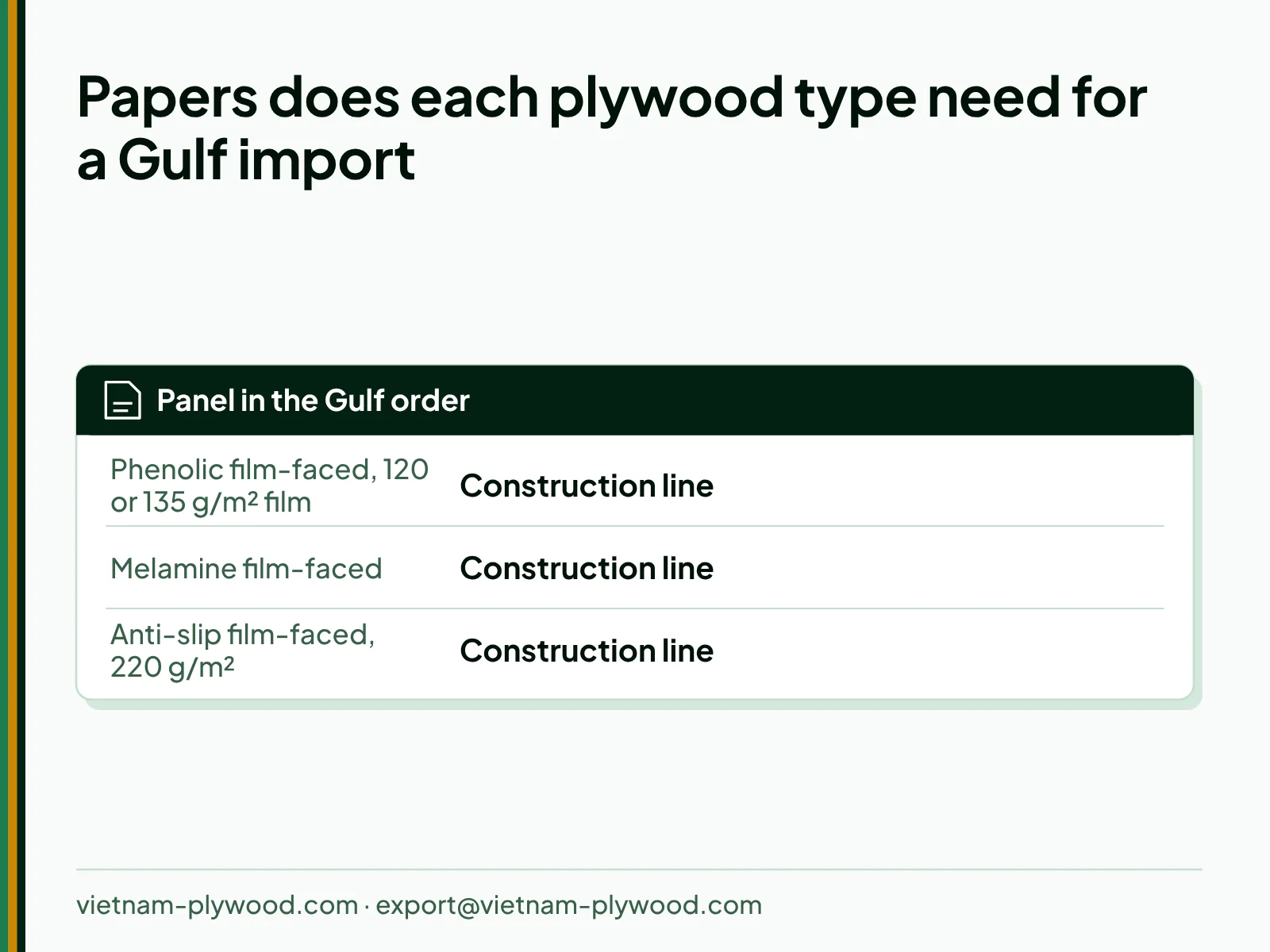
| Panel in the Gulf order | Producing line | Shared papers | Added for this panel |
|---|---|---|---|
| Phenolic film-faced, 120 or 135 g/m² film | Construction line | Invoice, packing list, B/L, certificate of origin, phytosanitary and fumigation papers | Test report for the agreed glue and build |
| Melamine film-faced | Construction line | Same five | Test report for the agreed build |
| Anti-slip film-faced, 220 g/m² | Construction line | Same five | Test report for the agreed build |
| Sanded furniture panel, E0 or E1 | Furniture line | Same five | Emission certificate; FSC claim on sales documents if ordered |
| Commercial or packing panel, MR glue | Commercial and packing line | Same five | Test report if the buyer asks for one |
Under CIF the set adds the insurance certificate. Certificates belong to the member factories and are shown with factory details masked, on request.
The HS heading for all of these is 4412, plywood. The six-digit subheading follows the outer plies, so the face species decides the code; your clearing agent sets the full national code, and the invoice then carries it per line. A film-faced panel and a bintangor-faced furniture panel can therefore sit on the same invoice under different codes.
Which of our lines builds each panel in a mixed Gulf order?
Site panels come from our construction line and joinery panels from our furniture line; packing and crate panels come from our commercial and packing line. Each order is produced in the factory that fits the specification and shipped directly from it, so the line decides core, glue and tolerance before any paper is drawn up.
| 18 mm, 1220 × 2440 mm | Construction line | Furniture line | Commercial and packing line |
|---|---|---|---|
| Surface | Phenolic or melamine film; anti-slip film | Sanded face, grade A or B | Unsanded or light-sanded face |
| Core | Acacia or eucalyptus | Styrax or eucalyptus | Acacia |
| Glue | Phenolic (WBP, 72-hour boil) or melamine (MR, 12-hour boil) | As ordered, emission E0 or E1 | Melamine (MR, 12-hour boil) |
| Core build | As ordered | Full stitched | As ordered |
| Density (follows the core) | 580 or 650 kg/m³ | 500 or 650 kg/m³ | 580 kg/m³ |
| Sheet weight | 31.1 kg acacia, 34.8 kg eucalyptus | 26.8 kg styrax, 34.8 kg eucalyptus | 31.1 kg |
| Thickness tolerance | ±0.5 mm | ±0.2 or ±0.3 mm as ordered | ±0.5 mm; packing ±0.5–1.0 mm |
| Typical Gulf use | Slab and wall formwork, platforms, decks | Joinery, cabinets, fit-out | Crates, packing, back panels |
If a site buyer asks the furniture line for a formwork panel, HCPLY sends the order to the construction line instead: the sanded face and E0/E1 emission add nothing to a pour. The reverse also holds; film-faced panels from the construction line are unsanded and do not take a lacquer for joinery. Hot-press temperature follows the glue: MR at 110–120 °C, WBP at 130–145 °C.
Furniture-line panels and their face options are on our furniture plywood page.
Can film-faced, anti-slip and furniture plywood ship under one document set?
Yes. A mixed 40HC from Hai Phong travels on one commercial invoice, one packing list, one B/L and one certificate of origin, each listing the panel types as separate lines. The limit is weight: the 40HC payload limit is 28.5 t, and density follows the core.
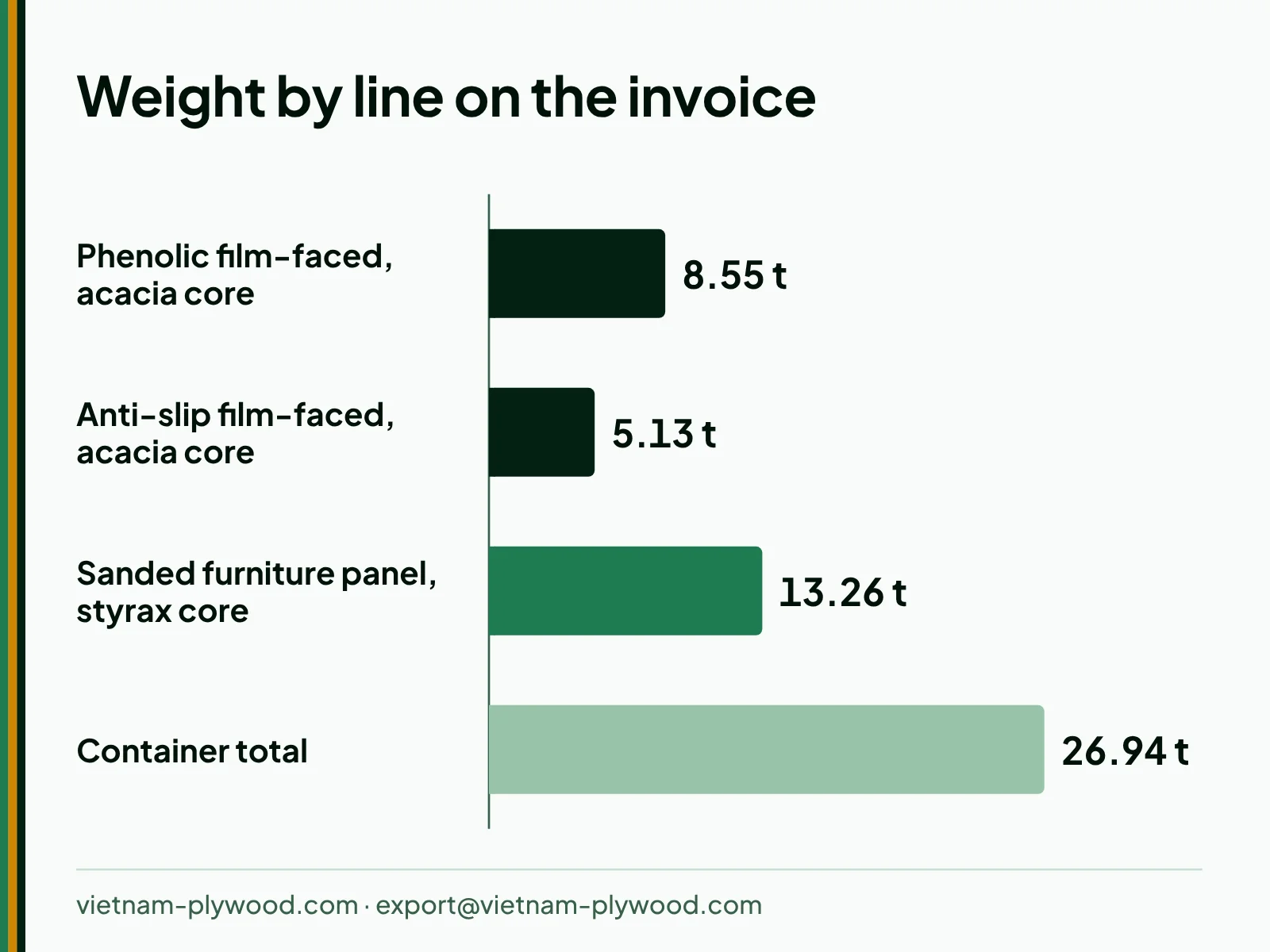
Minimum order: one 40HC; one container can carry several specifications as long as the payload limit holds. Take a typical Gulf mix in 18 mm, 1220 × 2440 mm. Stack height is 1000 mm per pallet for acacia and styrax cores, so each pallet holds 55 sheets.
| Line on the invoice | Pallets | Sheets | Volume | Weight |
|---|---|---|---|---|
| Phenolic film-faced, acacia core | 5 | 275 | 14.74 m³ | 8.55 t |
| Anti-slip film-faced, acacia core | 3 | 165 | 8.84 m³ | 5.13 t |
| Sanded furniture panel, styrax core | 9 | 495 | 26.52 m³ | 13.26 t |
| Container total | 17 | 935 | 50.10 m³ | 26.94 t |
The arithmetic is sheets × 1.22 × 2.44 × 0.018 for cubic metres, then cubic metres × density ÷ 1000 for tonnes. The load is half the acacia allowance of 16 pallets and half the styrax allowance of 18, and it stays 1.56 t under the payload limit. Film weight is not in the formula, so treat it as planning; the packing list gives the actual net and gross weight.
On paper, that one container becomes three invoice lines, three packing-list blocks with pallet numbers, and three lines on the certificate of origin. The eDAS transaction in the UAE is still one. How pallets are split and marked is on our page on mixed container loads of plywood; full-container sheet counts per thickness are on our container loads page.
Glue, film and edges for Gulf site panels
For Gulf formwork, specify the glue first: phenolic (WBP, 72-hour boil) holds through repeated wetting and sun better than melamine (MR, 12-hour boil). Then choose the film: 120 g/m² standard, 135 g/m² premium, or 220 g/m² anti-slip for decks and walkways. Glue and emission are two fields on the order.
Reuse depends on handling. With proper handling, a release agent on every pour and sealed edges (cut edges included), melamine-glue film-faced about 12–15 pours, phenolic-glue up to about 25 pours. On a Gulf site, the cut edge left raw in the sun is the usual weak point, so the edge sealing condition carries most of that figure.
Core choice changes weight more than handling. An 18 mm acacia-core film-faced sheet weighs 31.1 kg and a eucalyptus-core sheet 34.8 kg. A full 40HC of 18 mm on a eucalyptus core is 15 pallets and 795 sheets; on acacia it is 16 pallets and 880 sheets.
Price follows these choices. Film-faced and anti-slip panels have no published figure: phenolic glue costs more than melamine, a 135 g/m² film more than 120 g/m², and a full stitched core more than a loose-laid one. Commercial plywood starts from US$250/m³ FOB Hai Phong (October 2026), and furniture plywood from US$350/m³ FOB Hai Phong (October 2026).
What a buyer or inspector can witness at the producing factory
Each check below produces evidence that ends up in the HCPLY export set, so witness it before the 70% balance falls due. Buyers visit the factory office and inspect goods at the producing factory; an inspector you appoint can do the same.
| Check | What you see | Paper it ties to |
|---|---|---|
| Thickness | Caliper readings against ±0.5 mm for film-faced, ±0.2 or ±0.3 mm for sanded furniture panels | Specification line on the invoice |
| Film weight | Film label against 120, 135 or 220 g/m² as ordered | Test report for the agreed build |
| Glue | Boil-test pieces cut from the lot: 12 hours for MR, 72 hours for WBP | Test report for the agreed build |
| Edges | Sealed edges on film-faced panels, cut edges included | Reuse condition in the order |
| Pallet count and marks | Pallet numbers and sheet counts per invoice line | Packing list |
| Container | Pallet sequence by line, door photos, seal number | B/L and packing list |
The pallet marks are the check that saves time at a Gulf port. If the customs officer opens the door and the first pallet’s mark matches the first line of the packing list, the examination is short. Our page on plywood supply programmes for distributors shows how repeat orders keep the same marking from one container to the next.
Delivery terms, sea time and the paper timeline
Under FOB Hai Phong you book the vessel and insurance; under CFR (CNF) we book the freight; under CIF we add insurance and its certificate. The document set is the same for all three, apart from the insurance paper. Days at sea from Hai Phong to the Middle East are 15–25, by carrier and route.
| Stage | What happens | Paper |
|---|---|---|
| Order | Specification signed per line; 30% deposit | Proforma invoice |
| Production | 15–45 days from the 30% deposit, set by order size, line loading and the contract | QC records at the producing factory |
| Loading | Mixed load stuffed by line | Loading photos, draft invoice and packing list |
| Draft approval | After loading, the draft shipping documents come to you for approval | Draft B/L, certificate of origin |
| Balance | The remaining 70% is paid on the scan of the bill of lading, by T/T, or by irrevocable sight L/C | Original set released |
| Arrival | Attestation in the UAE, or the destination’s step | Attested invoice and certificate of origin |
Under an L/C, the bank checks the documents against the credit word by word. Write the certificate of origin type, UAE-VN form C/O or standard, into the L/C so the bank and the customs officer read the same paper.
For buyers who also sell into North America, US entries add anti-dumping and countervailing duty questions that the Gulf does not have; they are on our page on US duties on Vietnamese plywood.
What lands in your Gulf cost per cubic metre
Your landed cost is the FOB price plus freight, insurance, import duty, attestation fees and port charges at the discharge port. Only the FOB part comes from the factory. The rest depends on route, CEPA eligibility and the port.
- FOB value: from the quotation per invoice line, in cubic metres.
- Freight and insurance: per container under FOB, or included under CFR or CIF.
- Duty: the destination rate for the subheading of each line, or the CEPA rate in the UAE with a UAE-VN form C/O.
- Attestation: in the UAE, charged on the invoice value through eDAS.
- Port and clearance: handling, storage if papers are late, and your agent’s fee.
A mixed container spreads freight across lines by volume, so a heavy eucalyptus-core line and a light styrax-core line carry the same freight per cubic metre. The worked method, with a template, is on our page on plywood landed cost calculation for importers.
The specification lines to send for a Gulf mixed load
Send one block per panel type, plus the destination details that decide the origin paper and attestation. This one fits the example container above.
Destination: Jebel Ali, UAE, local market (eDAS attestation)
Origin paper: UAE-VN form C/O
Delivery term: CFR Jebel Ali

Line 1  Application: slab formwork
        Line/core: construction line, acacia core
        Glue: phenolic (WBP); emission: as required
        Face: phenolic film 120 g/m², edges sealed
        Thickness: 18 mm ±0.5 mm   Size: 1220 x 2440 mm
        Quantity: 5 pallets

Line 2  Application: deck walkways
        Line/core: construction line, acacia core
        Glue: phenolic (WBP)
        Face: anti-slip film 220 g/m²
        Thickness: 18 mm ±0.5 mm   Size: 1220 x 2440 mm
        Quantity: 3 pallets

Line 3  Application: joinery, fit-out
        Line/core: furniture line, styrax core, full stitched, sanded
        Glue: as specified; emission: E1
        Face: bintangor, grade B
        Thickness: 18 mm ±0.3 mm   Size: 1220 x 2440 mm
        Quantity: 9 pallets
Next step: send these lines to Lucy at export@vietnam-plywood.com or through our contact page and request the spec sheet, with the document list per line for your port.