





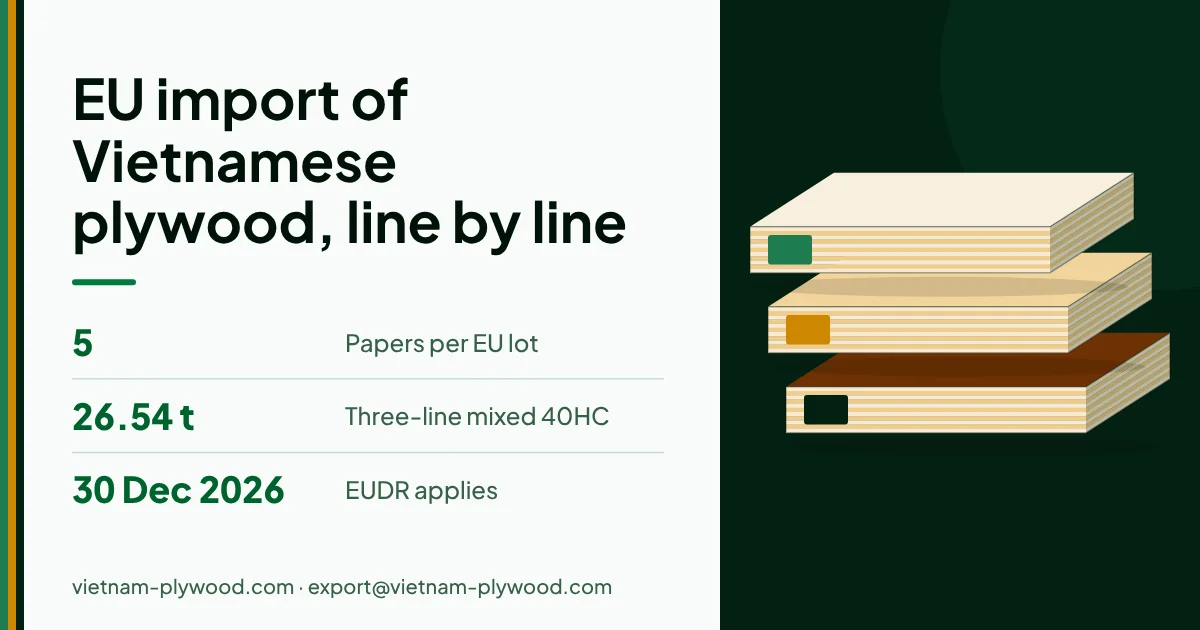
How to import plywood from Vietnam to Europe comes down to five papers per lot: an EORI-backed customs declaration, a valid EVFTA proof of origin, the EUTR or EUDR due diligence file, a Declaration of Performance for construction use and an emission report for furniture panels. HCPLY ships each line FOB Hai Phong with those papers drafted; one missing paper costs the duty preference or holds the container.
The general route from order to delivery is on our guide to importing plywood from Vietnam. This page covers only the European Union, and it is written per product line, because the furniture line, the commercial and packing line and the construction line each meet a different EU rule at the border.
How to import plywood from Vietnam to Europe, step by step
To import plywood from Vietnam to Europe, register an EORI number and an EUDR account, write one specification per line, confirm the CN code and origin proof, order one 40HC, witness QC at the producing factory, approve the draft documents, file the due diligence statement before the declaration, then pay duty and import VAT at release.
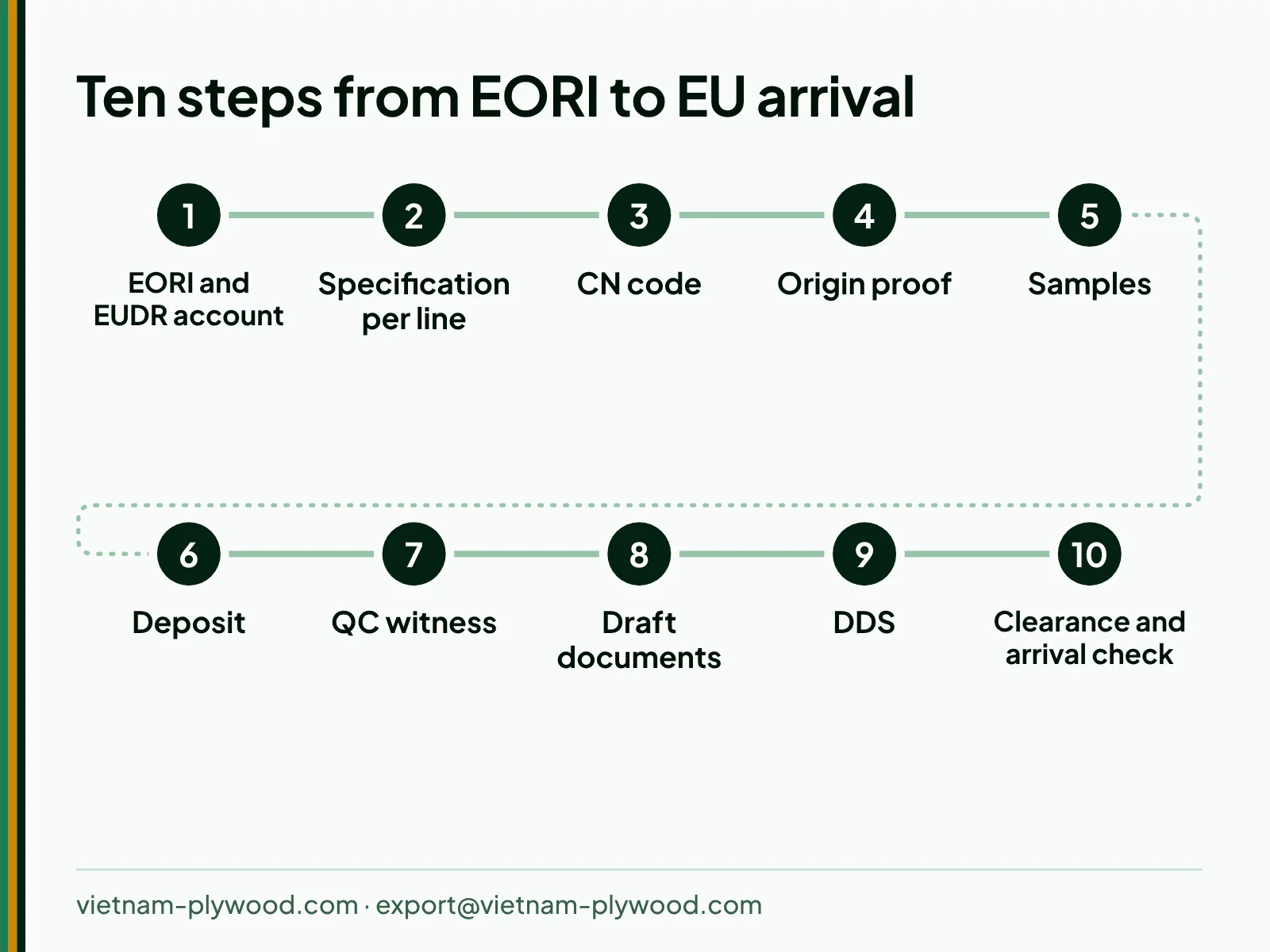
These are the steps in the order a first EU order runs.
- Register as an economic operator. The European Commission’s Access2Markets customs clearance guide (2026) explains that the EORI number is “a unique identifier, assigned by a customs authority in an EU country to all economic operators”. The same EORI is needed to register in the EUDR Information System.
- Write the specification per line. Application, core, glue, emission class, face and grade, thickness and tolerance, size and quantity. The closing block on this page is the template.
- Fix the customs code. Your customs broker classifies each specification by its outer ply and reads the duty for that CN code. For a disputed face, a Binding Tariff Information ruling settles it before the first shipment.
- Agree the origin proof. Decide at quotation that the lot ships with a certificate of origin on the EVFTA form, which the certificate of origin page explains document by document.
- Approve samples. Samples cost nothing: a first-time buyer pays the courier, and that charge comes off the first confirmed order.
- Sign and pay the deposit. Production runs 15–45 days from the 30% deposit, set by order size, line loading and the contract.
- Witness QC at the producing factory. Thickness, size, glue bond and pallet count are checked on site, before the container is closed.
- Approve the draft documents. Draft shipping documents go to you for approval after loading. The remaining 70% is paid on the scan of the bill of lading, by T/T, or by irrevocable sight L/C.
- File the due diligence statement. From 30 December 2026 the reference number must exist before the customs declaration is lodged.
- Clear and check on arrival. The carrier lodges the entry summary declaration, your customs broker lodges the import declaration, and you inspect the panels against the packing list using our arrival check for plywood.
Which line builds your EU order, and which rule applies to it?
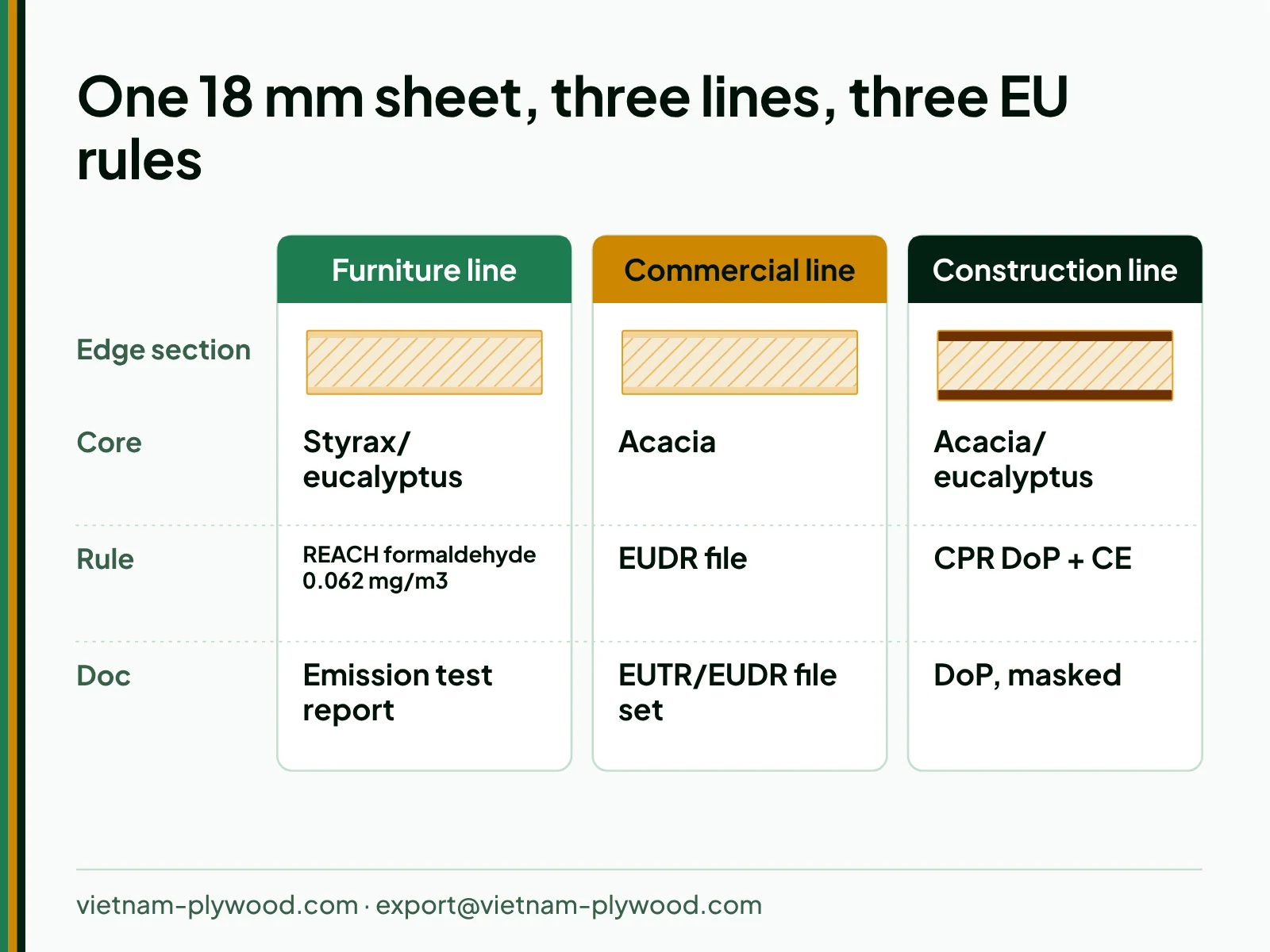
Each of our lines meets one main EU rule beyond customs: furniture panels meet the formaldehyde limit, construction panels meet the Construction Products Regulation, and commercial and packing panels mostly meet customs and the deforestation file only. The table puts the same 18 mm sheet on each line.
| 18 mm, 1220×2440 mm | Furniture line | Commercial and packing line | Construction line |
|---|---|---|---|
| Core | styrax or eucalyptus | acacia | acacia or eucalyptus |
| Core density | 500 or 650 kg/m³ | 580 kg/m³ | 580 or 650 kg/m³ |
| Glue | melamine (MR) or phenolic (WBP) as ordered | MR | phenolic or melamine, under film |
| Emission class | E0 or E1 | as ordered | as ordered |
| Surface | full stitched core, sanded | unsanded or light-sanded | phenolic or melamine film, unsanded |
| Thickness tolerance | ±0.2 or ±0.3 mm as ordered | ±0.5 mm (packing ±0.5–1.0 mm) | ±0.5 mm |
| Sheet weight | 26.79 kg (styrax) | 31.08 kg | 31.08 or 34.83 kg |
| Main EU rule beyond customs | REACH formaldehyde limit | EUDR file only, plus packaging rules when it becomes a crate | CPR: DoP and CE marking where used as a construction product |
| Document that answers it | emission test report for the agreed build | EUTR/EUDR file set | DoP and CE documents, factory details masked |
A buyer who orders a furniture-grade face on a commercial-line build saves money and loses the sanded tolerance; the reverse adds cost with no gain on a crate. Our comparison of plywood grades across the factory lines sets the full build side by side, and the packing or commercial plywood page settles the most common choice on the commercial line.
What import duty applies to Vietnamese plywood in the EU under EVFTA?
The duty is fixed per 8-digit CN code, and the code follows the species of the outer ply, so two panels from the same container can carry different rates. The European Commission’s EVFTA page (2020) states the EU–Vietnam Trade Agreement “entered into force on 1 August 2020”, with tariff elimination as its first aim.
The Commission’s EVFTA page lists the agreement’s purpose as “Eliminating 99% of all tariffs”. It gives no plywood line rate, and neither does this page; your customs broker reads the current preferential and third-country rates for your exact code in TARIC on the day of import.
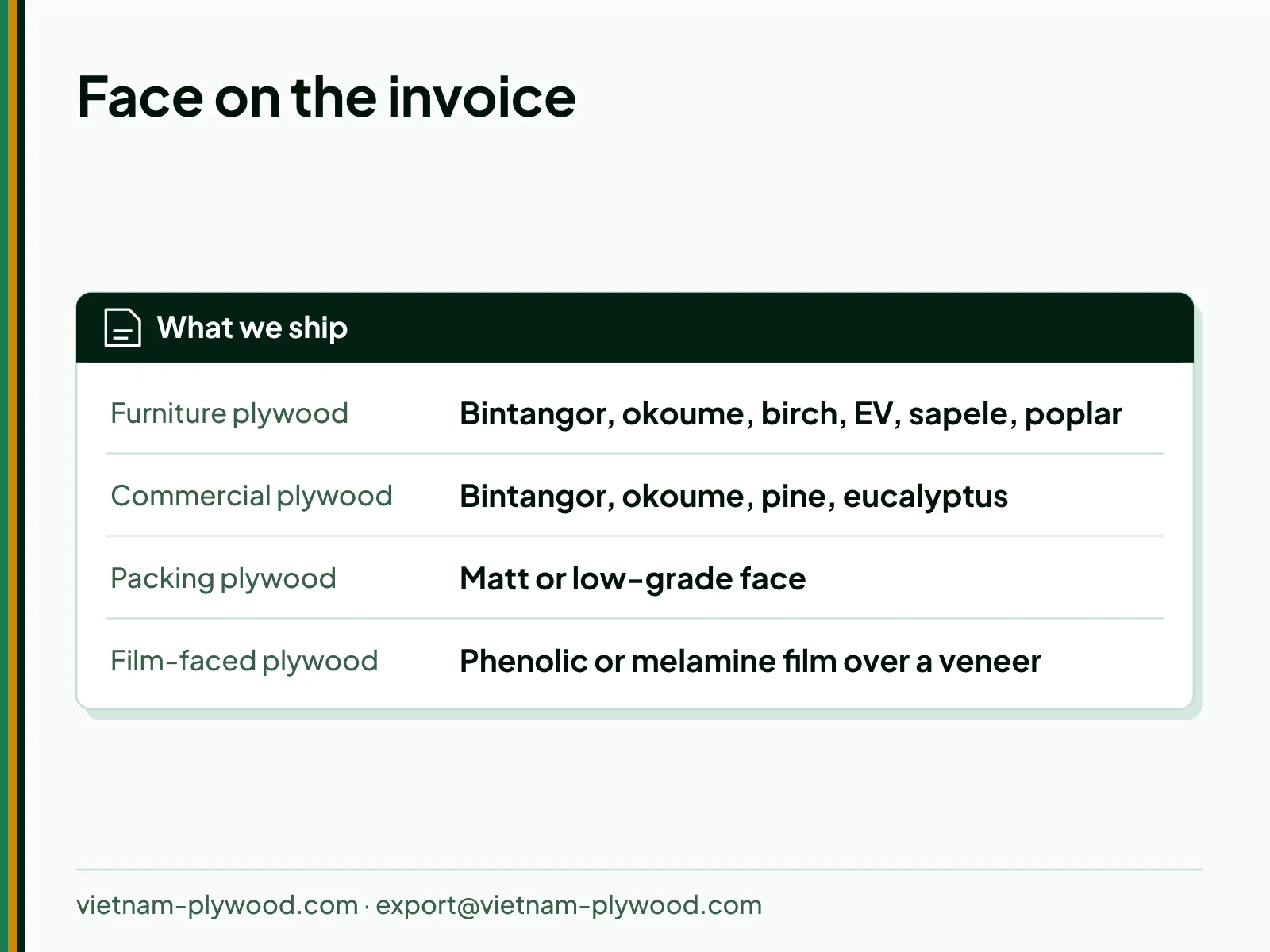
What decides the code is the face. Plywood sits in HS heading 4412, and the subheading changes with the outer ply: a tropical face such as okoume, sapele, bintangor or gurjan (traded as keruing), a named temperate hardwood face such as birch, eucalyptus or poplar, or a coniferous face such as pine. Engineered veneer and matt (unfaced raw core) need their own classification note on the invoice.
| What we ship | Face on the invoice | What the customs broker checks |
|---|---|---|
| Furniture plywood | bintangor, okoume, birch, EV, sapele, poplar | outer-ply species, sanded, emission class |
| Commercial plywood | bintangor, okoume, pine, eucalyptus | outer-ply species, glue |
| Packing plywood | matt or low-grade face | whether the panel is classed as plywood or as a wood article |
| Film-faced plywood | phenolic or melamine film over a veneer | the veneer under the film decides the subheading |
The preference only works with proof. The Access2Markets EVFTA page (2026) says “Importers can claim preferential tariff treatment based on an origin declaration provided by the exporter”, and for Vietnamese goods it adds that a self-declaration by any exporter up to €6,000 is “not yet the case”. In practice an EU lot ships with a certificate of origin issued by the Vietnamese authorities.
⚠️ Important: Access2Markets (2026) says a certificate of origin “shall be issued as soon as possible but not later than 3 working days after the date of export (the declared shipment date)”. Approve the certificate draft with the other documents so it is not late.
What certificates are needed to import plywood into the EU?
Four documents cover what certificates are needed to import plywood into the EU: a proof of origin, a due diligence file, a Declaration of Performance for construction products and an emission test report for furniture panels. The FSC claim is optional and goes on the sales documents when the order asks for it.
Certificates such as FSC, CARB P2, ISO 9001 and CE belong to the member factories, and they are shown with factory details masked, on request. The table matches each paper to the line that needs it.
| Document | Furniture line | Commercial and packing line | Construction line | Who uses it in the EU |
|---|---|---|---|---|
| Commercial invoice, packing list, B/L | yes | yes | yes | customs broker, carrier |
| Certificate of origin (EUR.1 for EU lots) | yes | yes | yes | customs, for the EVFTA rate |
| Phytosanitary and fumigation papers | yes | yes | yes | port health, packaging user |
| EUTR/EUDR file set | yes | yes | yes | the importer’s due diligence |
| Emission certificate or test report | yes | when ordered | when ordered | furniture maker, market authority |
| DoP and CE documents | no | no | where used as a construction product | contractor, market authority |
| FSC claim on sales documents | when ordered | when ordered | when ordered | the buyer’s chain of custody |
| Insurance | under CIF | under CIF | under CIF | buyer, bank |
Each specification in the order is checked against this list at quotation, so the document set is fixed before production starts, not after loading.
Does construction plywood from Vietnam need CE marking and a DoP in the EU?
Construction plywood needs a Declaration of Performance and CE marking when it is placed on the EU market as a construction product covered by the harmonised standard for wood-based panels. The Commission’s CPR page (2026) describes the Construction Products Regulation as rules that give “a common technical language to assess their performance”.
Article 4 of Regulation (EU) No 305/2011, read on legislation.gov.uk, says “the manufacturer shall draw up a declaration of performance when such a product is placed on the market”. That is the producing factory’s document, issued for the exact product on the order, and it is the paper a contractor or a market surveillance authority asks for.
Where a notified body is involved, the Your Europe CE marking page (2026) explains that “A notified body is an independent organisation authorised by an EU country to assess product compliance when required by legislation”. The DoP for our construction line is shown with factory details masked, on request.
Two limits apply to any HCPLY construction sheet. A structural grade is offered only against a test report the buyer accepts, and film-faced formwork used as temporary works is a case to settle with your national authority before ordering. Many formwork yards ask for the DoP anyway, because their customers do.
Film-faced panels are described by film weight: 120 g/m² standard, 135 g/m² premium, 220 g/m² anti-slip only. Reuse comes with its condition: with proper handling, a release agent on every pour and sealed edges (cut edges included), melamine-glue film-faced about 12–15 pours, phenolic-glue up to about 25 pours.
What emission class do EU furniture buyers need?
Furniture panels placed on the EU market since 6 August 2026 must meet the REACH formaldehyde limit for wood-based articles, which is half the old E1 ceiling. Glue and emission are two separate fields on the order: the glue is MR or WBP, the emission class is E0, E1 or E2.
UL Solutions (2023) summarises the restriction: formaldehyde “shall not be placed on the market in articles after Aug. 6, 2026” when the test chamber concentration exceeds 0.062 mg/m³ for furniture and wood-based articles. The furniture research body FIRA (2026) puts it against the old classes: “E05 products have a formaldehyde emission limit of 0.062 mg/m³, which aligns with the limit adopted in AnnexXVII for wood-based articles.”
FIRA gives E1 as up to 0.124 mg/m³. An E1 class on the invoice is therefore no longer proof for an EU furniture panel; the paper that counts is a chamber test report for the agreed build that shows the 0.062 mg/m³ result.
Our furniture plywood is pressed in E0 or E1 on styrax or eucalyptus cores. Order the emission class and the test report as two written lines, and ask for the report on the build you buy, with the same core, glue and thickness.
What EUDR file does a plywood shipment from Vietnam need?
A plywood shipment released from 30 December 2026 needs a due diligence statement filed by the first EU operator, with species, quantity and plot geolocation, and its reference number on the customs declaration. Until that date the EU Timber Regulation applies, and the same file set travels with each EU lot.
The European Commission (2026) states the EUDR “will apply from 30 December 2026 for large and medium-sized operators and for micro and small operators already covered by the EU Timber Regulation”. Plywood is already covered by that Regulation, so small importers of plywood do not get the June 2027 date.
The Timber Regulation still governs lots placed on the market now. Article 4 of Regulation (EU) No 995/2010, on legislation.gov.uk, reads: “The placing on the market of illegally harvested timber or timber products derived from such timber shall be prohibited.” The Commission’s EUDR page (2026) adds that the new Regulation “repeals the EU Timber Regulation (EUTR), with transitional provisions applying to certain timber and timber products”.
The filing sits with the importer. The Commission’s EUDR roles page (2026) says the upstream operator is “the person (including companies) who imports relevant products into the EU under the customs procedure ‘release for free circulation’”. Where every input comes from a low-risk country, the Commission notes that “These lighter obligations when sourcing from low-risk countries are known as simplified due diligence”.
The statement itself, field by field, is a separate subject. Here the point is the order: the core species and the face species each need their source in the file, which matters most for birch faces, as the next section shows.
Does the birch plywood anti-dumping duty touch a Vietnamese order?
The EU anti-dumping duty on birch plywood covers Russian origin and, since 2024, imports from Kazakhstan and Türkiye; Vietnam is not named. The European Commission (2024) wrote: “Today, the European Commission has extended anti-dumping measures on imports of birch plywood from Russia to imports from Kazakhstan and Türkiye.”
The same notice explains that the duties were “being circumvented by imports transhipped from Russia to Kazakhstan and Türkiye, or sent for final completion to these countries”. An importer of birch-faced panels from any country should expect origin questions and keep the answer ready.
We do not press birch-core plywood. Our birch is a face, in grades D/E/F, laid over a Vietnamese styrax or eucalyptus core. On an EU order the invoice should say exactly that, and the EUTR/EUDR file set should carry the face veneer’s species and source next to the core’s.
Can a mixed container of plywood clear EU customs on one set of documents?
Yes. One commercial invoice and one packing list can carry each specification as its own line with its CN code and net weight, the certificate of origin lists the items, and the Commission confirms that several due diligence reference numbers can go on one customs declaration.
The Commission’s due diligence guidance (2026) states: “It is equally possible to include multiple DDS reference numbers/ declaration identifiers in one customs declaration.” It also confirms that “A single due diligence statement (DDS) can cover multiple physical batches or shipments of relevant products.”
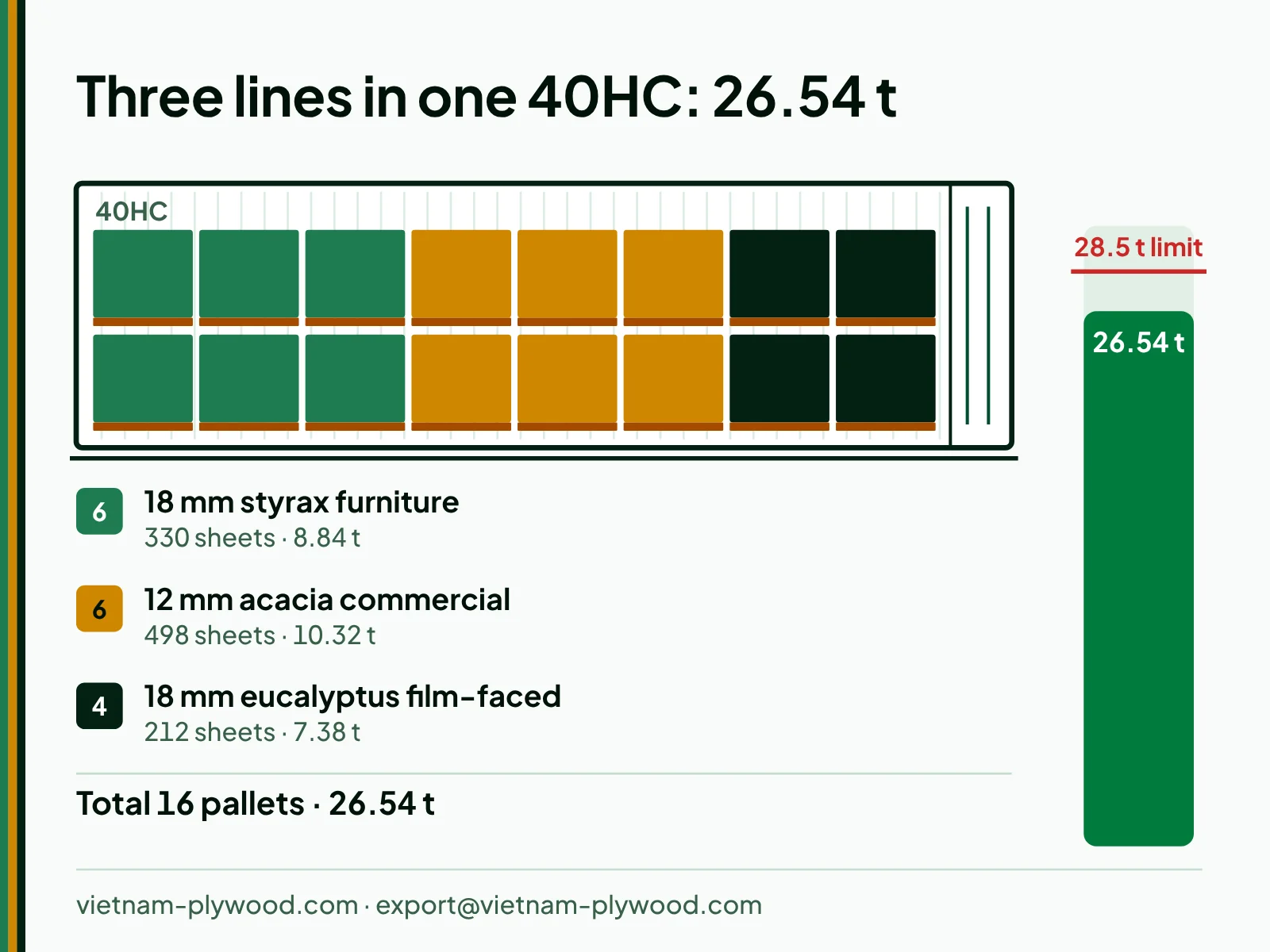
A three-line mix in one 40HC, 1220×2440 mm, using the 16-pallet count and the 28.5 t payload limit:
| Item | Line and core | Pallets | Sheets per pallet | Sheets | m³ | Tonnes |
|---|---|---|---|---|---|---|
| 18 mm sanded, E1 | furniture, styrax 500 kg/m³ | 6 | 1000 ÷ 18 = 55 | 330 | 17.68 | 8.84 |
| 12 mm commercial, MR | commercial, acacia 580 kg/m³ | 6 | 1000 ÷ 12 = 83 | 498 | 17.79 | 10.32 |
| 18 mm film-faced | construction, eucalyptus 650 kg/m³ | 4 | 970 ÷ 18 = 53 | 212 | 11.36 | 7.38 |
| Total | 16 | 1,040 | 46.83 | 26.54 |
At 26.54 t the mix sits under the 28.5 t limit with headroom for the film, pallets and straps, which the core-density formula does not count. A full single-spec 18 mm container holds 990, 880 or 795 sheets on styrax, acacia or eucalyptus; the container loads page works out every thickness.
The quantity on the due diligence statement uses the same arithmetic. The Commission’s guidance says “the quantity is to be expressed in kilograms of net mass”, so the packing list weight per line becomes the figure the importer files.
How can I reduce the cost of importing plywood from Vietnam to the EU?
To reduce cost of importing plywood from Vietnam to EU ports, fill the container close to its payload, keep the EVFTA preference, buy the line your use needs and keep the container moving at the port. Indicative starting prices are from US$250/m³ FOB Hai Phong (October 2026) for commercial plywood and from US$350/m³ FOB Hai Phong (October 2026) for furniture plywood.
Ordered by their effect on the landed cost:
- Line and build. Full stitched, sanded furniture cores cost more than acacia commercial cores; WBP glue costs more than MR. Indoor packaging needs neither the sanded tolerance nor the 72-hour boil glue.
- Container fill. The minimum order is one 40HC, and specifications can be mixed within the payload limit. A container shipped half full pays the same freight for fewer cubic metres.
- Origin proof. A missing or late certificate of origin moves the lot to the third-country rate.
- Port time. A container waiting for a due diligence reference or a corrected invoice pays storage for every day it stands.
- Delivery term. FOB Hai Phong, CFR (CNF) or CIF. FOB lets your forwarder buy the freight; CIF puts freight and insurance in one price.
Freight itself moves by carrier and season; current rates by port are on our plywood freight rates from Vietnam page. Days at sea from Hai Phong are 25–35 to the Mediterranean and 30–40 to Northern Europe, by carrier and route.
What can a buyer witness at the producing factory before an EU lot ships?
A buyer or inspector can witness, at the producing factory, the checks that later back the EU papers: thickness and size against the ordered tolerance, the glue bond boil test for the glue class, and the pallet and sheet count that becomes the packing list and the net weight on the due diligence statement.
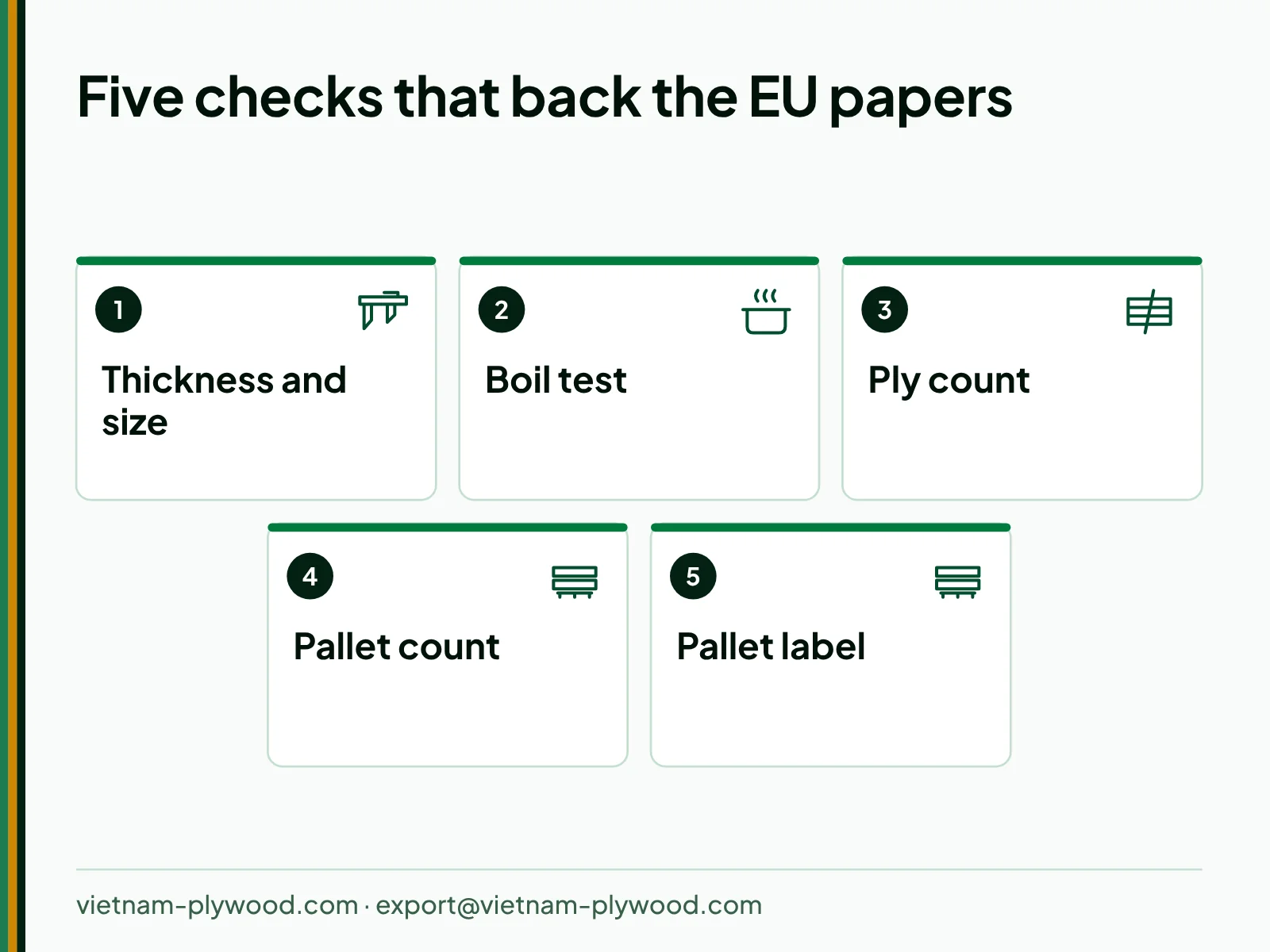
The check strip for one EU lot:
- Thickness and size. Caliper readings against ±0.2 or ±0.3 mm for sanded furniture panels, ±0.5 mm for commercial and film-faced, and ±2 mm on length and width.
- Glue bond. Samples cut for the 12-hour boil (MR) or the 72-hour boil (WBP), matching the glue line on the invoice.
- Core and plies. An 18 mm sheet shows 11–13 plies, depending on core veneer thickness of 1.4–2.0 mm.
- Pallet count. Sheets per pallet and pallets per container, read against the packing list draft.
- Marking. Each pallet label matches an invoice line, so customs can match the goods to the CN code.
Buyers visit the factory office and inspect goods at the producing factory. The same list, run again at the EU warehouse, closes the loop with the arrival check.
Specification lines to send for an EU quotation
Send these lines for each item in the container, plus the destination port. HCPLY replies with the line that presses each item and the document set for the lot.
Application:        furniture carcass / crate / concrete formwork
Line and core:      furniture, styrax | commercial, acacia | construction, eucalyptus
Glue:               MR (12-hour boil) | WBP (72-hour boil)
Emission:           E0 | E1, with chamber test report for the EU limit
Face and grade:     bintangor B | okoume A | birch D/E/F | film 120 g/m²
Thickness:          18 mm, tolerance ±0.3 mm (sanded) | ±0.5 mm
Size:               1220 x 2440 mm | 1250 x 2500 mm
Quantity:           pallets per item, one 40HC, mixed within 28.5 t
Origin and file:    EUR.1, EUTR/EUDR file set, DoP if construction use
Delivery:           FOB Hai Phong | CFR | CIF, destination port
The next step is a factory visit: book it with Lucy at export@vietnam-plywood.com or through the contact page, and inspect your first EU lot at the producing factory before it is loaded.