





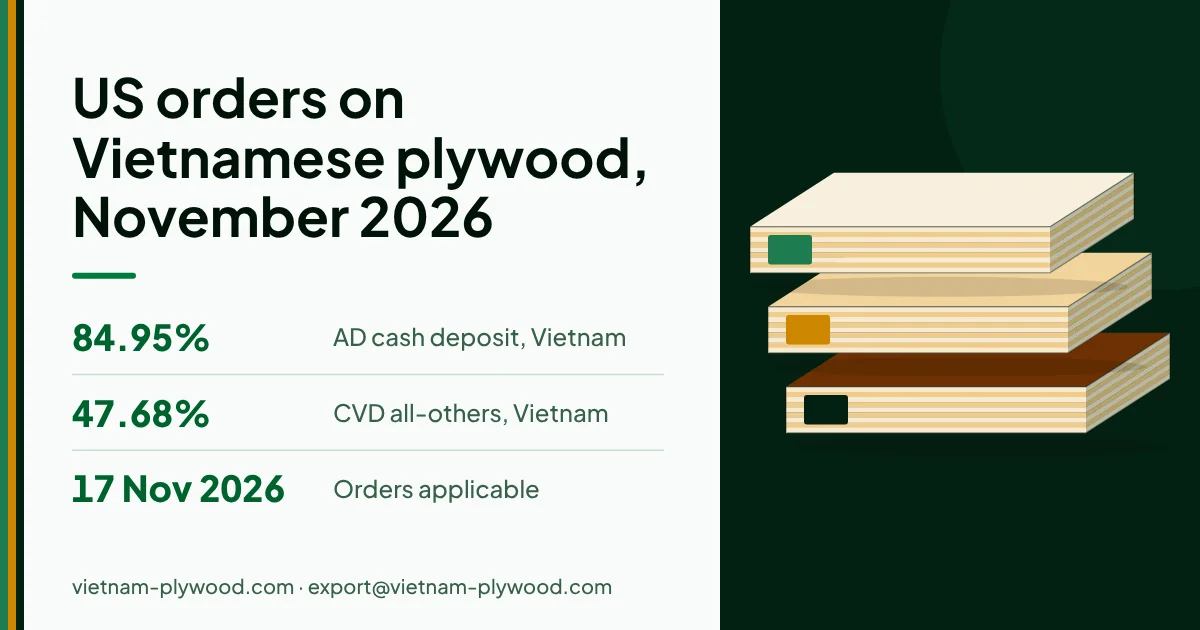
The Vietnam plywood anti dumping case has ended in orders: since 17 November 2026, hardwood and decorative plywood from Vietnam enters the US under antidumping and countervailing duty orders, and HCPLY quotes every US-bound product against them. Misreading it costs cash at the port: deposits of 84.95% plus 47.68% of entered value, or China rates on an entry without the right certification.
This page covers the three US actions a Vietnamese plywood entry meets, the documents each one asks for, and how our quotes state the status per product group. The wider import route, from booking to customs, sits on the parent page, how to import plywood from Vietnam.
What is the Vietnam plywood anti dumping duty in the US today?
The US Department of Commerce published antidumping duty orders on hardwood and decorative plywood from China, Indonesia and Vietnam in the Federal Register on 17 November 2026. For Vietnam, every exporter in the order’s table and the Vietnam-wide entity carry a 90.12% weighted-average dumping margin and an 84.95% cash deposit rate after subsidy offsets.
The antidumping duty order (Federal Register, 17 November 2026) states the action in one line: “Commerce is issuing antidumping duty (AD) orders on hardwood and decorative plywood from the People’s Republic of China (China), Indonesia, and the Socialist Republic of Vietnam (Vietnam).” The Vietnam case number is A-552-851.
A countervailing duty order was published the same day under case number C-552-852. Its all-others rate for Vietnam is 47.68% ad valorem, which applies to every Vietnamese producer or exporter not named in its table. The two deposits are separate: an importer of in-scope plywood from an all-others exporter posts both at entry, 132.63% of entered value in total.
These are cash deposits, not final duties. Commerce sets the final amount for each entry later, in an administrative review or at liquidation. A deposit can rise or fall at that stage, which is why a landed-cost sheet should carry the deposit as cash out and the final duty as an open item.
Which US actions apply to plywood shipped from Vietnam?
Three actions apply, and they answer different questions. The 2018 orders cover hardwood plywood from China. The 2023 circumvention determination decides when panels completed in Vietnam count as Chinese. The 2026 orders cover hardwood and decorative plywood made in Vietnam.
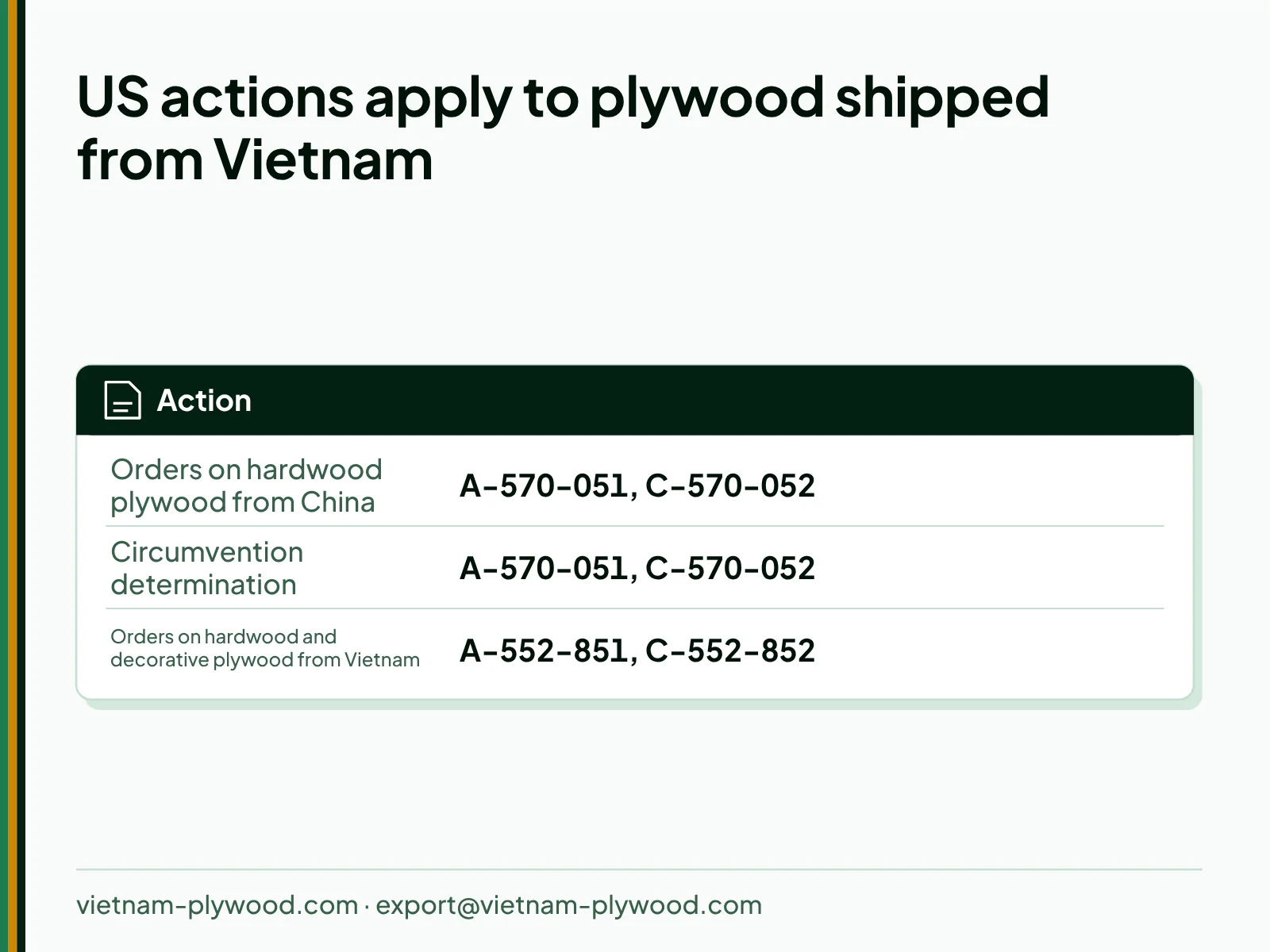
| Action | Case numbers | Published | What it covers | Rate stated in the notice |
|---|---|---|---|---|
| Orders on hardwood plywood from China | A-570-051, C-570-052 | January 2018 | Hardwood plywood made in China | China-wide AD 183.36%; CVD all others 22.98% (as stated in the 2023 notice) |
| Circumvention determination | A-570-051, C-570-052 | 20 July 2023 | Plywood completed in Vietnam from Chinese face, back or core inputs in five scenarios | China rates, unless certified out |
| Orders on hardwood and decorative plywood from Vietnam | A-552-851, C-552-852 | 17 November 2026 | Hardwood and decorative plywood made in Vietnam | AD margin 90.12%, cash deposit 84.95%; CVD all others 47.68% |
The 2026 scope removes any overlap between the first and third lines. It excludes “hardwood plywood subject to the antidumping and countervailing duty orders on hardwood plywood from China.” A panel therefore falls under one set of orders, not both: Chinese-input panels under the China orders, Vietnamese-origin panels under the Vietnam orders.
Since November 2026 the circumvention certification no longer separates dutiable from duty-free plywood. It decides which set of rates applies. That shift is the main change buyers who imported under the 2023 regime need to absorb.
What is the status of the US AD/CVD case on plywood from Vietnam?
The investigation is complete and the orders are in force. Petitions were filed in 2025, Commerce made final determinations on 21 July 2026, the US International Trade Commission (ITC) found injury in September 2026, and Commerce published both orders on 17 November 2026.
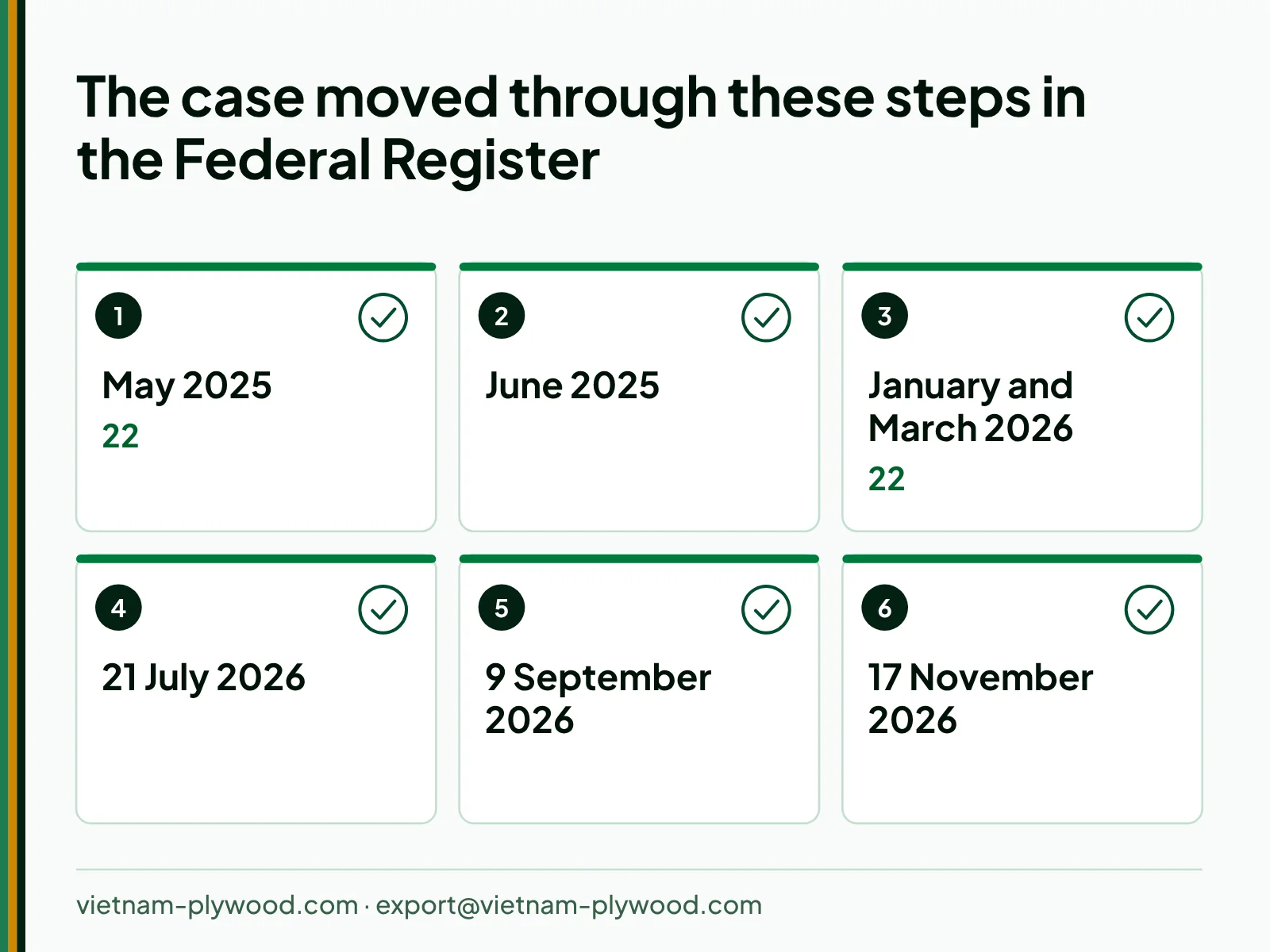
The case moved through these steps in the Federal Register:
- May 2025. The ITC instituted the investigations effective 22 May 2025, after petitions by a coalition of US hardwood plywood producers.
- June 2025. Commerce initiated the antidumping and countervailing duty investigations.
- January and March 2026. Preliminary countervailing duty determinations (22 January) and preliminary antidumping determinations (2 March) started provisional cash deposits.
- 21 July 2026. Final affirmative determinations for Vietnam in both investigations.
- 9 September 2026. The ITC published its final determinations.
- 17 November 2026. Antidumping and countervailing duty orders issued.
The ITC’s final determinations (Federal Register, 9 September 2026) found “that an industry in the United States is materially injured by reason of imports of hardwood and decorative plywood (excluding all softwood structural plywood) from China, Indonesia, and Vietnam.” The same notice terminated the investigations on stamped and certified softwood structural plywood and on structural downfall panels as negligible.
Provisional deposits did not run without a break. The antidumping order explains that the extended provisional period ended on 29 August 2026 and that entries from then until the ITC notice are liquidated without antidumping duties. Deposits resumed on the date the ITC final determinations were published. A US customs broker should check each 2026 entry date against those windows.
Is there a countervailing duty on hardwood plywood from Vietnam?
Yes. The countervailing duty order (Federal Register, 17 November 2026) sets a subsidy rate of 47.68% ad valorem for Vietnam, both for the one examined exporter and for all others.
The order states that “CBP must require, at the same time as importers would normally deposit estimated duties on this merchandise, a cash deposit equal to the rates noted below.” The deposit is posted with the entry summary, alongside the antidumping deposit and any ordinary duties.
The antidumping cash deposit of 84.95% is already lower than the 90.12% margin. The antidumping order explains why: the cash deposit equals the margin “with offsets for export subsidies where appropriate.” Do not subtract the countervailing rate again on your landed-cost sheet; the offset is already in the 84.95% figure.
For importers who also buy from other origins, the same order sets countervailing rates for China and Indonesia. Indonesia’s all-others rate is 40.87% and China’s is 88.96%. Origin, not the port of loading, decides which line applies.
What does the scope of the Vietnam orders cover?
The scope covers flat plywood and veneered panels with a face or back veneer of hardwood, softwood or bamboo, whatever the core and whatever the surface covering. The order states: “A hardwood and decorative plywood panel must have at least either the face or back veneer composed of one or more species of hardwood, softwood, or bamboo, regardless of any surface coverings.”
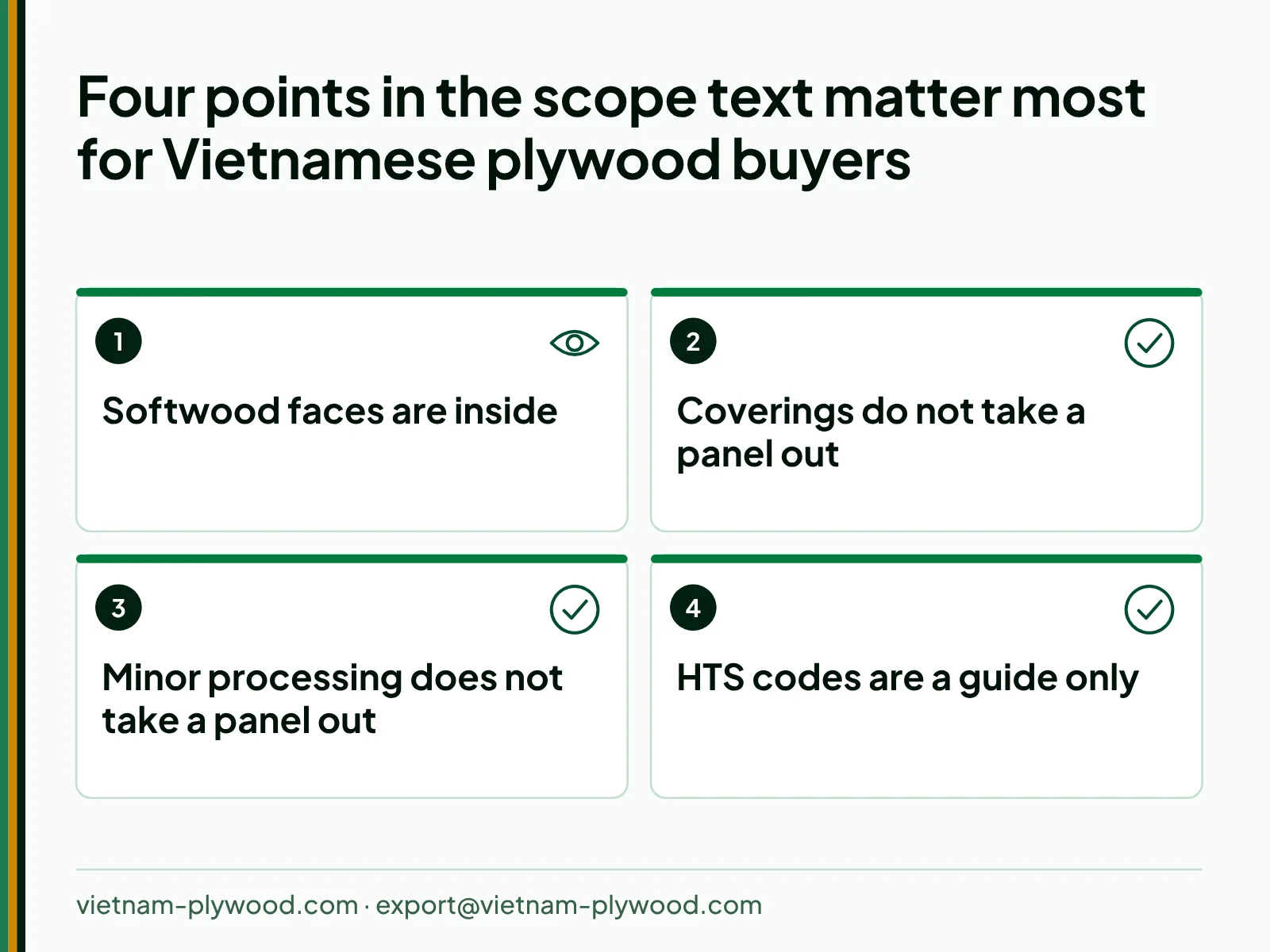
Four points in the scope text matter most for Vietnamese plywood buyers:
- Softwood faces are inside. A pine face is a softwood veneer, so a pine-faced panel is in scope.
- Coverings do not take a panel out. Paints, stains, paper, high pressure laminate, medium density overlay and phenolic film are all listed as surface coverings within the scope.
- Minor processing does not take a panel out. Trimming, cutting to size, notching, punching and drilling leave the panel in scope, even when done in a third country.
- HTS codes are a guide only. The order says “The HTSUS subheadings are provided for the convenience of the U.S. government and customs purposes, and do not define the scope of the orders.”
The exclusions are narrow. They include structural plywood certified, manufactured and stamped to PS 1-22 or PS 2-18, structural downfall panels from certified facilities, cork-faced products, non-flat shapes, solid bamboo, multilayered wood flooring, assembled and ready-to-assemble furniture and kitchen cabinets as defined, finished table tops and countertops, certain laminated veneer lumber door and window parts, and a defined Phenolic Film Faced Plyform.
The Plyform exclusion has three conditions. The panel needs an “Exterior” or “Exposure 1” bond classification as defined by The Engineered Wood Association, an opaque phenolic film on both faces at the weight stated in the notice, and an opaque moisture-resistant coating on the edges. Read the full scope text in the order’s appendix before you rely on any exclusion.
How do our quotes state the US case status for each product group?
Every US-bound quotation from us carries one status line per product group: the order it falls under, the case numbers, and the documents the entry needs. The line follows the scope text and the producing line, not the product name.
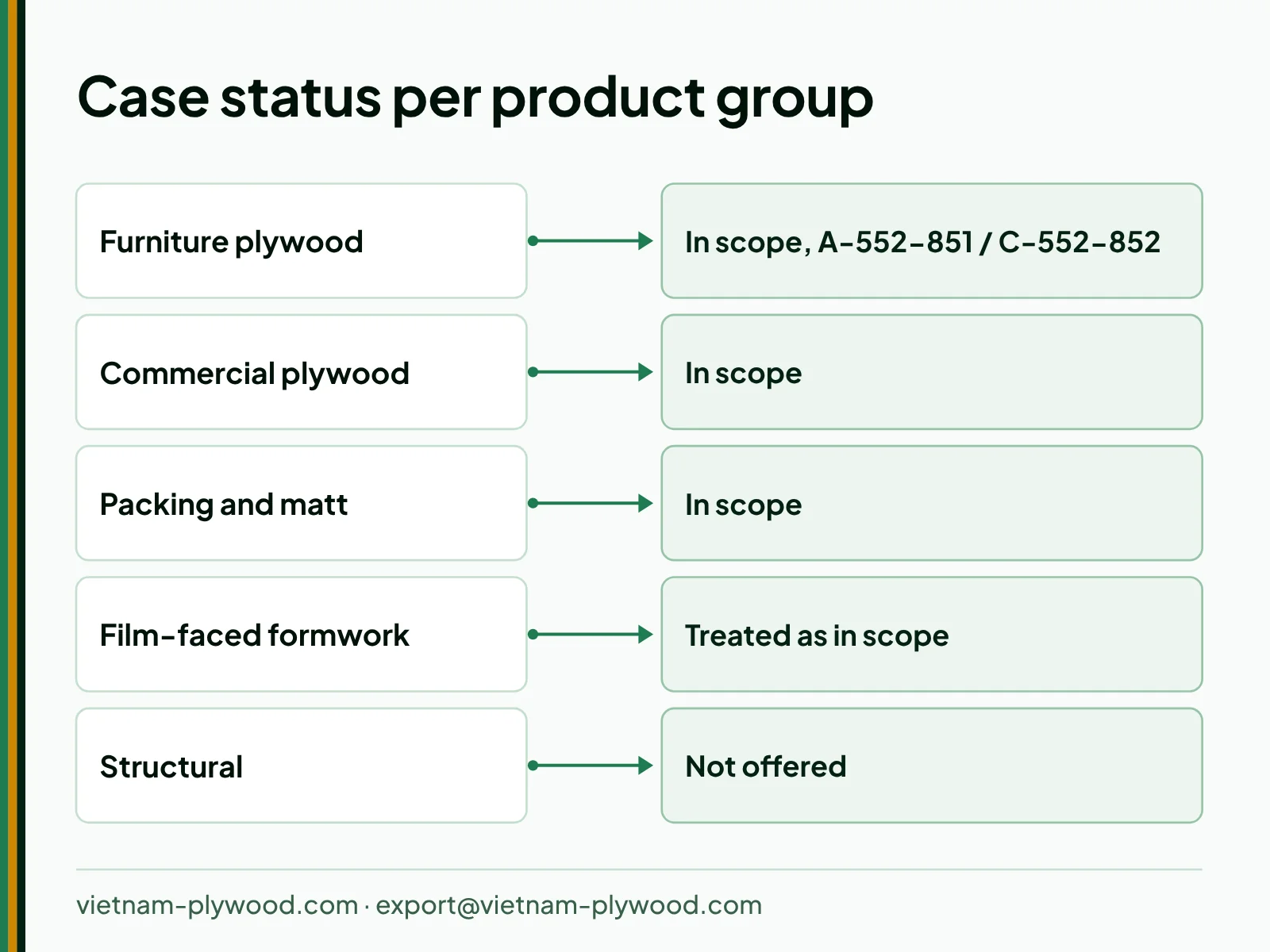
| Product group | Our producing line | Status line on our quotation | What would change it |
|---|---|---|---|
| Sanded furniture plywood (bintangor, okoume, EV, birch, sapele faces; styrax or eucalyptus core) | Furniture line | In scope, A-552-851 and C-552-852; Vietnamese core; exporter certification under the 2023 determination | A Commerce scope ruling on the specific build |
| Commercial plywood (acacia core, MR glue, wood face) | Commercial and packing line | In scope, A-552-851 and C-552-852; exporter certification | A scope ruling |
| Packing plywood and matt (unfaced raw core) | Commercial and packing line | In scope; a core veneer at the face is still a wood veneer | A scope ruling |
| Film-faced formwork (phenolic or melamine film, acacia or eucalyptus core) | Construction line | Treated as in scope; Plyform exclusion not claimed | A scope ruling or a test report the buyer accepts on every exclusion condition |
| Structural panels | Not offered for the US | No PS 1 or PS 2 stamp on our panels, so no structural exclusion | Not applicable |
Our film-faced panels carry film of 120 g/m² standard, 135 g/m² premium or 220 g/m² anti-slip. Film weight is only one of the three Plyform conditions, and the bond classification condition refers to an association’s definition our panels do not carry. A quotation that called them excluded would put the importer’s deposit at risk, so the status line says “treated as in scope” until a scope ruling says otherwise.
The quotation also names the line that presses each product. For an importer, that matters at entry: the exporter certification and its supporting records must match the producing factory and the inputs it used. The furniture plywood page shows the builds of our furniture line, and the choice between packing and commercial builds is set out on packing or commercial plywood.
What circumvention certification does a US plywood entry from Vietnam need?
Under Commerce’s 2023 circumvention determination, an importer who claims that plywood completed in Vietnam used none of the five Chinese input scenarios completes an importer certification, and the exporter completes an exporter certification and supplies it with its supporting documents. Neither is filed with the entry; both must be produced on request.
The 2023 final circumvention determination (Federal Register, 20 July 2023) covers plywood “completed in the Socialist Republic of Vietnam (Vietnam) using plywood inputs and components (face veneer, back veneer, and/or either an assembled core or individual core veneers) manufactured in the People’s Republic of China (China).” The five scenarios all involve core components made in China: assembled cores, veneer core platforms, glued multi-ply core panels or individual core veneers.
The timing rule is set in the same notice: “importers should complete the required certification at or prior to the date of entry summary, and exporters should complete the required certification and provide it to the importer at or prior to the date of shipment.”
Four practical points from that notice:
- The importer signs its own certification. A customs broker can supply the entry summary number, but the notice does not allow that customs broker to certify for the importer.
- The exporter that made the sale to the US signs the exporter certification. On our orders, that is the export end we run.
- Records are kept for the later of five years from entry or three years after any related US court case ends.
- No certification means China rates. CBP collects deposits at the China-wide antidumping rate and the Chinese all-others countervailing rate where the China orders potentially apply.
Our cores are acacia, eucalyptus and styrax grown in Vietnam. That places our panels outside the five Chinese core scenarios and inside the 2026 Vietnam orders. The certification is what proves the first half of that sentence at the US port.
Which documents go with a US-bound container?
A US entry of our plywood draws on two sets of papers: the standard shipping documents and the case documents. The case documents tie the goods on the invoice to the scope text and the origin claim.
The standard set per shipment is the commercial invoice, packing list, B/L, certificate of origin, phytosanitary and fumigation papers and insurance under CIF. After loading, the draft shipping documents come to you for approval. For the US, the order’s certificate documents include the emission certificate for the agreed build, since CARB P2 / TSCA Title VI is a US limit with third-party certification. Certificates belong to the member factories and are shown with factory details masked, on request.
| Document | Who prepares it | When | Why the US entry needs it |
|---|---|---|---|
| Commercial invoice with product group per line | Exporter | With the draft documents | Entered value for the cash deposits; description that matches the scope review |
| Packing list by specification | Exporter | With the draft documents | Quantities per line, matched to the invoice |
| Certificate of origin | Exporter | Before shipment | Vietnamese origin claim |
| Exporter certification under the 2023 determination | Exporter that made the sale to the US | By the date of shipment | Proves no Chinese input scenario |
| Importer certification under the 2023 determination | Importer | By the date of entry summary | Importer’s own claim; not signed by the customs broker |
| Emission certificate and test reports for the build | Member factory, masked on request | With the order documents | CARB P2 / TSCA Title VI compliance |
| Status line from our quotation | HCPLY | At quotation | Records which order and case numbers the importer was told apply |
Our import documents guide explains each standard document in turn. The US route, from Hai Phong to the US West Coast in 20–30 days at sea or the US East Coast in 35–45 days at sea, is covered on importing plywood from Vietnam to the USA.
What happens when CBP holds a plywood container in an EAPA evasion investigation?
CBP can open an Enforce and Protect Act (EAPA) investigation when an allegation or referral reasonably suggests that goods entered through evasion. Within a fixed statutory schedule it can suspend liquidation, demand a bond or cash deposit, and finally determine whether duties were evaded.
The statute is 19 U.S.C. 1517, added in 2016. It defines evasion as entry “by means of any document or electronically transmitted data or information, written or oral statement, or act that is material and false, or any omission that is material,” that reduces or avoids antidumping or countervailing duties or cash deposits.
The EAPA statute (19 U.S.C. 1517) sets the schedule:
- Initiation. CBP initiates an investigation within 15 business days of receiving a qualifying allegation or referral.
- Interim measures. “Not later than 90 calendar days after initiating an investigation,” CBP decides whether there is reasonable suspicion of evasion. If so, it suspends liquidation of entries made since initiation and can require “a single transaction bond or additional security or the posting of a cash deposit.”
- Determination. CBP determines evasion within 300 calendar days of initiation, extendable in complex cases.
- Appeal. An importer found to have evaded, or the party that filed the allegation, can ask for administrative review within 30 business days and then seek judicial review.
For plywood from Vietnam, the typical allegation is Chinese-input panels entered as Vietnamese origin, or in-scope panels entered as excluded. The defence is the record: certifications signed on time, production and veneer records from the producing factory, and an invoice description that matches the goods in the container. A buyer who receives an EAPA questionnaire should hand it to trade counsel at once and ask the exporter for its records the same day.
How do the orders change the landed cost of a mixed container?
The cash deposits apply to the entered value of every in-scope line, so a mixed container carries the same two rates on each in-scope product. Specifications can be mixed in a container within the payload limit of 28.5 t for a 40HC, and each specification needs its own invoice line.
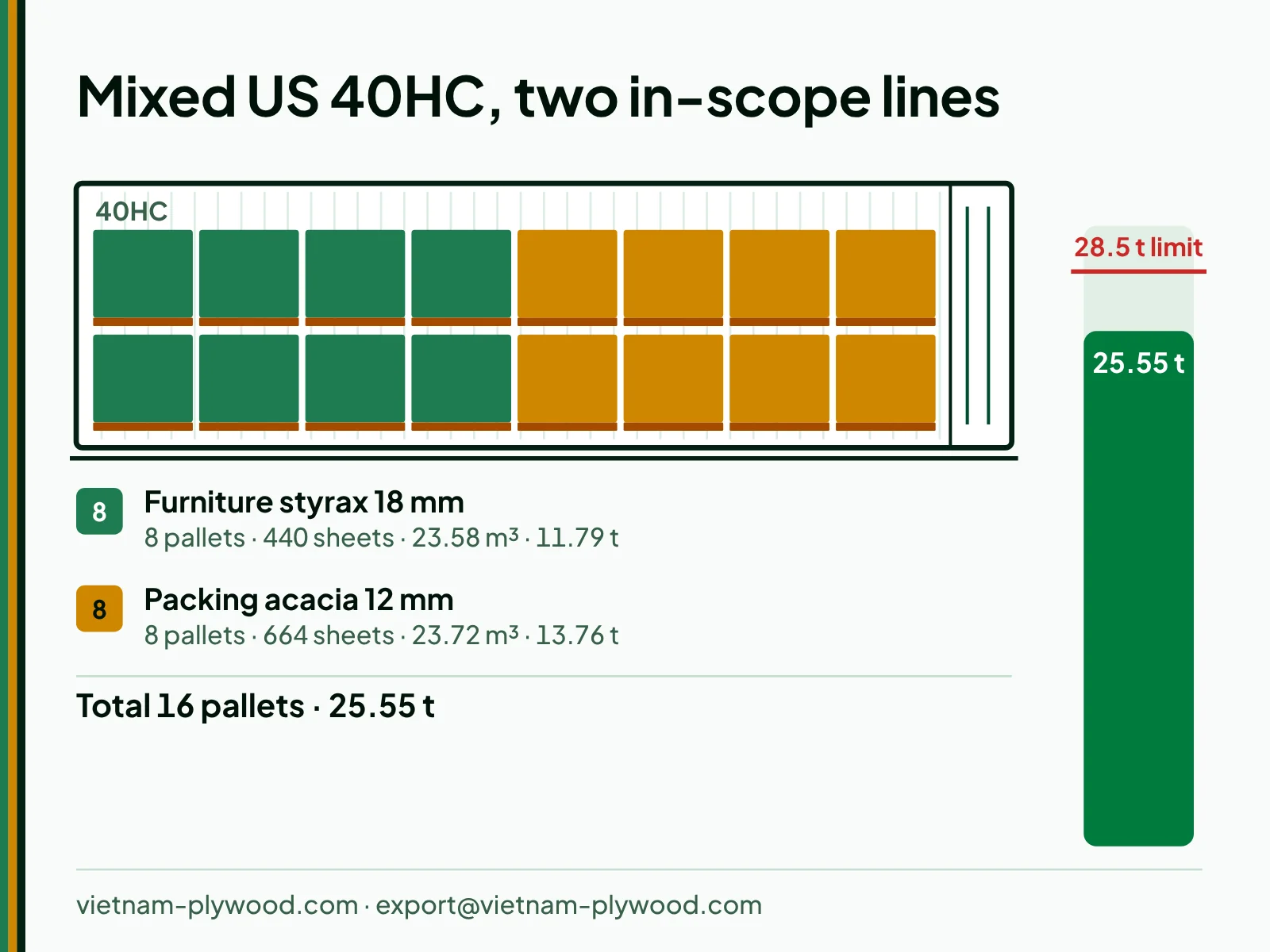
A worked mix at 1220×2440 mm, using the pallet stack heights in our loading data:
Furniture, styrax core, 18 mm: floor(1000 ÷ 18) = 55 sheets × 8 pallets = 440 sheets
  440 × 1.22 × 2.44 × 0.018 = 23.58 m³ × 500 kg/m³ = 11.79 t
Packing, acacia core, 12 mm: floor(1000 ÷ 12) = 83 sheets × 8 pallets = 664 sheets
  664 × 1.22 × 2.44 × 0.012 = 23.72 m³ × 580 kg/m³ = 13.76 t
Total: 16 pallets, 1,104 sheets, 47.30 m³, 25.55 t (payload limit 28.5 t)
Deposits on an all-others entry: 84.95% (AD) + 47.68% (CVD) of each line's entered value
Both lines fall inside the scope, so the deposit rate is the same on each. What differs is the entered value per line, and that is what your customs broker needs on the invoice. Our indicative prices are from US$250/m³ FOB Hai Phong (October 2026) for commercial plywood and from US$350/m³ FOB Hai Phong (October 2026) for furniture plywood; the entered value your customs broker declares follows the actual contract price.
The full cost build, with freight, insurance, ordinary duty and the deposits, is set out in the plywood landed cost calculation for importers. How pallets of different builds share one container is covered in mixed container loads of plywood, and full-load counts per thickness sit on the container loading calculator.
What should a US buyer settle before the first order?
Settle four things before the deposit: the order each product falls under, the documents each party signs, the deposit cash you will post at entry, and the review risk you are carrying.
- Scope review per product group. Use the status line on our quotation as the starting point and have your customs broker or trade counsel confirm it against the order’s scope text.
- Certification plan. Agree that the exporter certification arrives by the date of shipment and that your own certification is signed by entry summary.
- Deposit cash. Budget the antidumping and countervailing deposits on entered value, payable with the entry summary.
- Review exposure. Final duties are set later and can differ from the deposits. Your purchase contract should say how that risk is shared, if at all.
Other US measures sit outside these orders, such as additional duties under Chapter 99 of the Harmonized Tariff Schedule. Your customs broker reads their current status at entry; this page does not state them. Buyers comparing the US with the European Union route can read importing plywood from Vietnam to the EU, where antidumping orders on Vietnamese plywood are not part of the entry.
Write the product lines for your first US order in this form:
Application:          kitchen cabinet carcass / crating / concrete formwork
Line and core:        furniture line, styrax core / commercial and packing line, acacia core / construction line, eucalyptus core
Glue:                 MR (12-hour boil) or WBP (72-hour boil)
Emission:             CARB P2 / TSCA Title VI, third-party certified
Face and grade:       e.g. birch D, okoume B, pine; or film 120 / 135 / 220 g/m²
Thickness, tolerance: e.g. 18 mm, ±0.3 mm sanded / ±0.5 mm
Size:                 1220×2440 mm or custom cut
Quantity:             m³ and sheets per line, one 40HC minimum, mixed allowed
Destination port:     US port; FOB Hai Phong, CFR (CNF) or CIF
US case status:       A-552-851 / C-552-852 status line per product group
Email those lines to Lucy at export@vietnam-plywood.com or use the contact page, and ask for a sample set of the US builds. Each sample comes with the status line it would carry on a quotation, so your customs broker can review scope before the first container is booked.