





How long does shipping from Vietnam to Europe take?
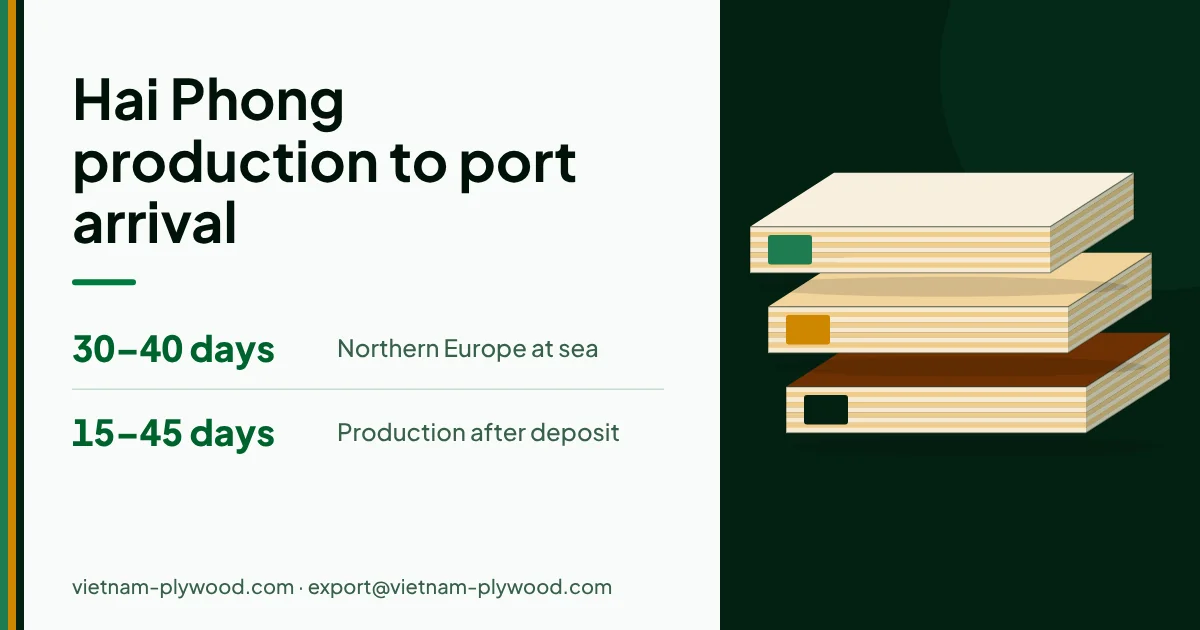
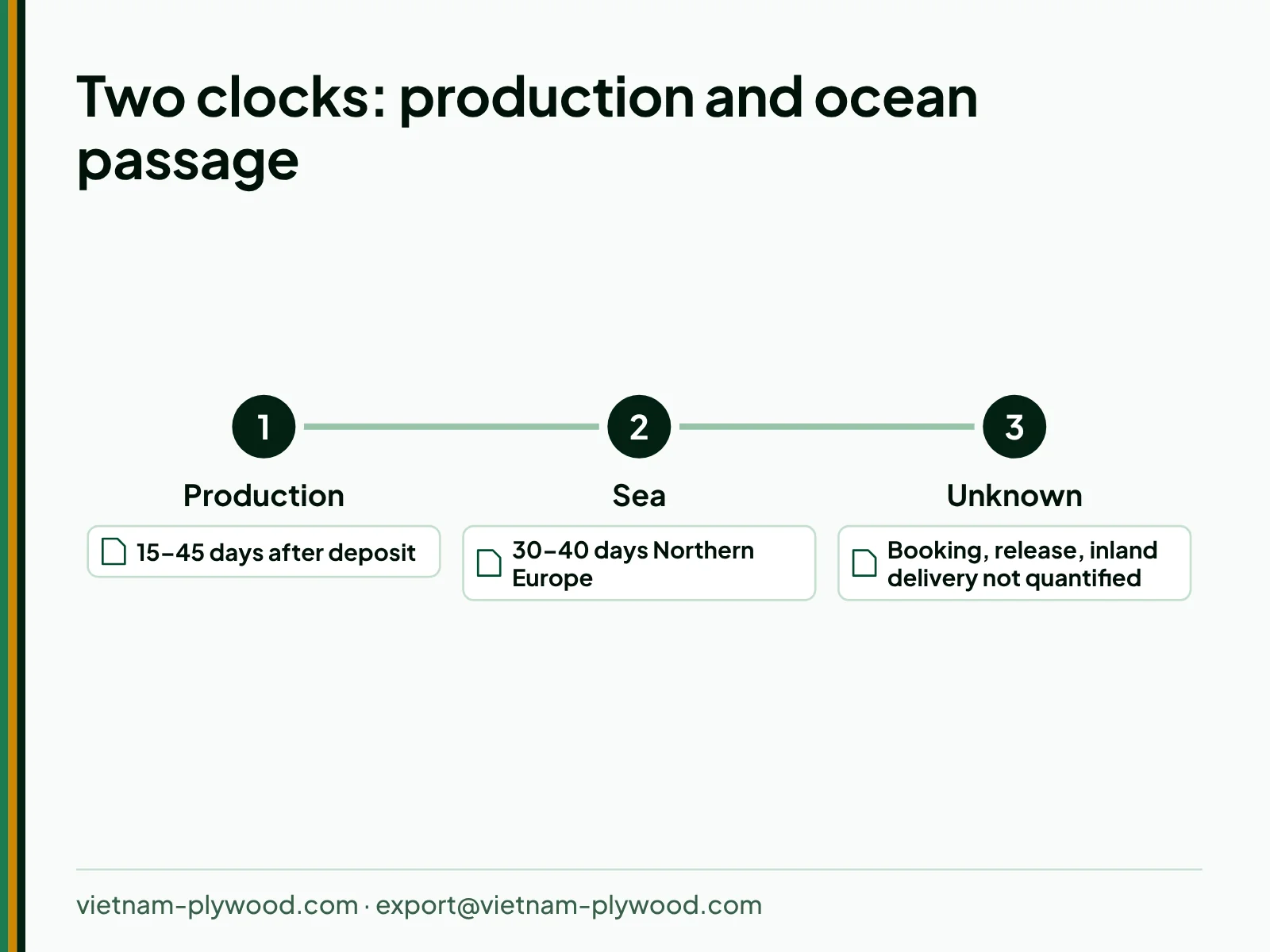
Sea freight from Hai Phong to Northern Europe takes 30–40 days at sea, while Mediterranean routes take 25–35 days, depending on carrier and route. For a made-to-order plywood shipment, add HCPLY production of 15–45 days from the 30% deposit, set by order size, line loading and the contract. These are separate clocks: neither includes a promised customs-release or inland-delivery date.
For a Northern European purchase, the arithmetic gives 45–85 days from deposit to the end of the sea leg, before any unquantified waiting between production completion and vessel departure. The low and high ends combine different conditions; they are planning boundaries, not a dated sailing commitment. A missed vessel can move the receiving plan even when plywood passes inspection on time.
The plywood import process begins with a written build and a named destination port. HCPLY manufactures through our three factories in Phu Tho and Hai Phong and ships the finished order FOB Hai Phong. A buyer should obtain a vessel-specific estimated departure and arrival from the carrier or forwarder before fixing a downstream installation slot.
What are the sea transit ranges by destination?
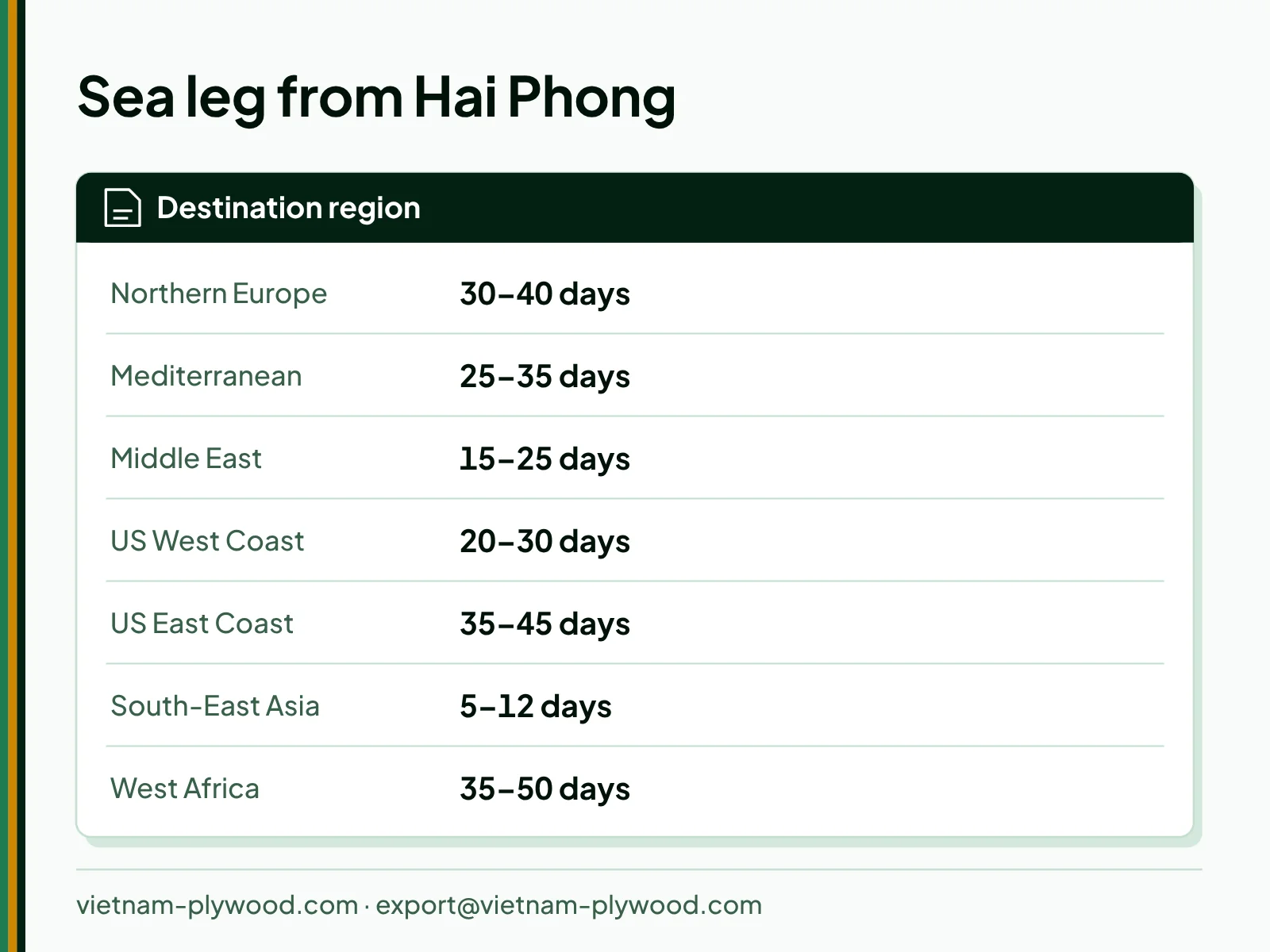
Use the regional sea-time ranges below as a first budget for the ocean leg. They are days at sea from Hai Phong, by carrier and route; they are not port-to-door transit promises.
| Destination region | Sea leg from Hai Phong | What the range does and does not establish |
|---|---|---|
| Northern Europe | 30–40 days | Starting point for Rotterdam and Felixstowe planning; no port-specific figure |
| Mediterranean | 25–35 days | Regional estimate; terminal and final-port routing still need checking |
| Middle East | 15–25 days | Starting point for Jebel Ali; no port-specific figure |
| US West Coast | 20–30 days | Ocean segment, excluding import release |
| US East Coast | 35–45 days | Ocean segment, excluding import release |
| South-East Asia | 5–12 days | Regional reference only |
| West Africa | 35–50 days | Regional reference only |
The destination label matters. A Northern Europe range cannot establish a particular week’s Rotterdam vessel, and a Mediterranean range cannot be applied automatically to every European port. Ask whether the proposed service calls directly or transfers the container at another hub. The forwarder’s booking details should identify the discharge port and any onward movement.
How long does sea freight take from Hai Phong to Rotterdam?
For Rotterdam, use 30–40 days at sea to Northern Europe as the available planning range, then request the actual Hai Phong–Rotterdam schedule. We use the Northern Europe range until the carrier provides a Rotterdam-specific itinerary. A quote that says only “Europe” is insufficient to date a receiving dock.
Record the vessel, voyage, estimated time of departure (ETD), estimated time of arrival (ETA), transshipment points if any, and the date the container must be ready for loading. If the service changes, revise the arrival estimate rather than retaining the old transit interval. The same discipline applies to the secondary phrase shipping time from Hai Phong to Rotterdam port: a port-specific timetable is an input still needed.
For European import planning, the European Commission’s 2026 Import Control System 2 guidance says operators bringing goods into or through the European Union must provide safety and security data through an Entry Summary Declaration. That filing is a separate milestone from the ship’s arrival. The EU plywood import requirements belong on the importer’s parallel checklist.
What is the sea freight transit time to Felixstowe?
Felixstowe is a Northern European port, so 30–40 days at sea is the regional starting point for a Hai Phong shipment. Ask the carrier for a Felixstowe-specific sailing time. Do not turn the regional interval into a named-carrier promise.
The United Kingdom has its own import workflow. The UK government’s 2026-accessed customs-clearance steps state that a business importing into England, Wales or Scotland needs a GB Economic Operators Registration and Identification number. That page also distinguishes customs declaration, possible inspection, tax payment and release. Each can affect when a container is usable after discharge.
For plywood-specific UK preparation, read the UK import checklist while requesting the sailing. A distributor with a fixed warehouse appointment should record two dates: the carrier’s port ETA and the separately agreed warehouse delivery date. They are not interchangeable.
How long does plywood take to reach Jebel Ali?
For Jebel Ali, use 15–25 days at sea from Hai Phong as the Middle East regional range. It is a regional estimate, not a verified port-pair sailing time. A buyer should request the carrier’s Jebel Ali ETA, transshipment details and destination-terminal arrangements.
A shipment of packing panels can leave the producing factory after the agreed specification is completed and checked. The commercial and packing line uses an acacia core, MR glue and an unsanded or light-sanded finish. Its factory-ready date starts the booking conversation; the regional 15–25 days starts only when the ocean leg begins.
For an order quoted CFR (CNF) or CIF, identify which named port the freight arrangement covers. Neither term alone supplies a vessel schedule or an inland delivery date. The buyer’s customs representative should identify local import steps separately.
How long does plywood shipping take to the USA?
The sea leg is 20–30 days to the US West Coast or 35–45 days to the US East Coast, by carrier and route. Add production separately, then obtain a port-specific sailing before allocating stock to customers. The regional bands do not establish a Los Angeles, New York or other named-port ETA.
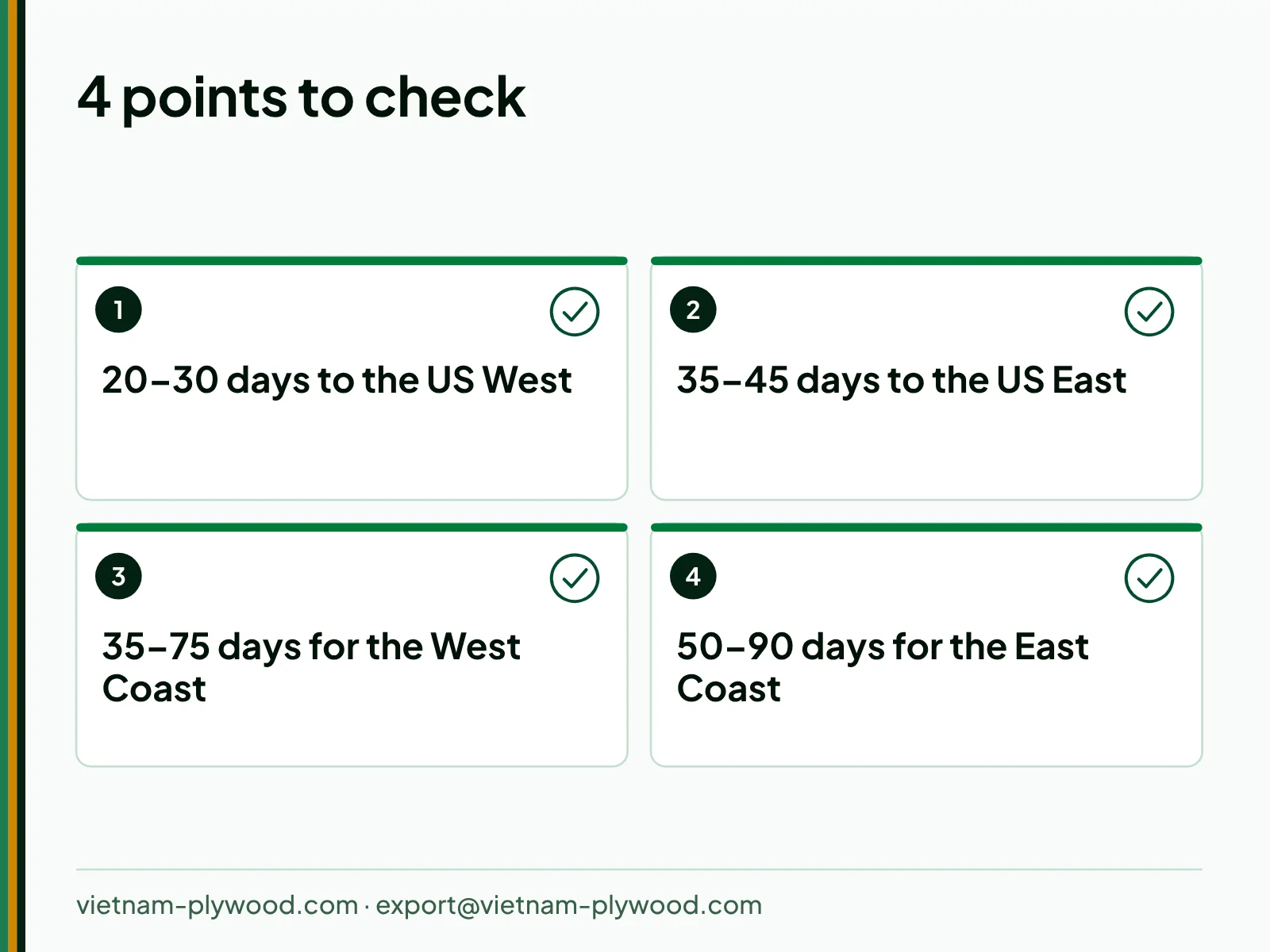
The production range of 15–45 days produces a simple ocean-end planning span of 35–75 days for the West Coast or 50–90 days for the East Coast, measured from deposit and excluding unquantified waiting between stages. These calculated spans are not delivery commitments.
The importer should also check classification, duties and admissibility independently. Our US duties overview addresses that separate decision. Cargo arriving at a US port is not automatically released for sale or warehouse delivery. Do not substitute the ocean ETA for the date a distributor can unload usable stock.
How do carrier and route change the arrival date?
Carrier selection changes the arrival estimate through the actual service, intermediate calls and available vessel departure. A transshipment service introduces a connection between vessels; the receiving schedule must use the booked itinerary rather than a generic regional average.
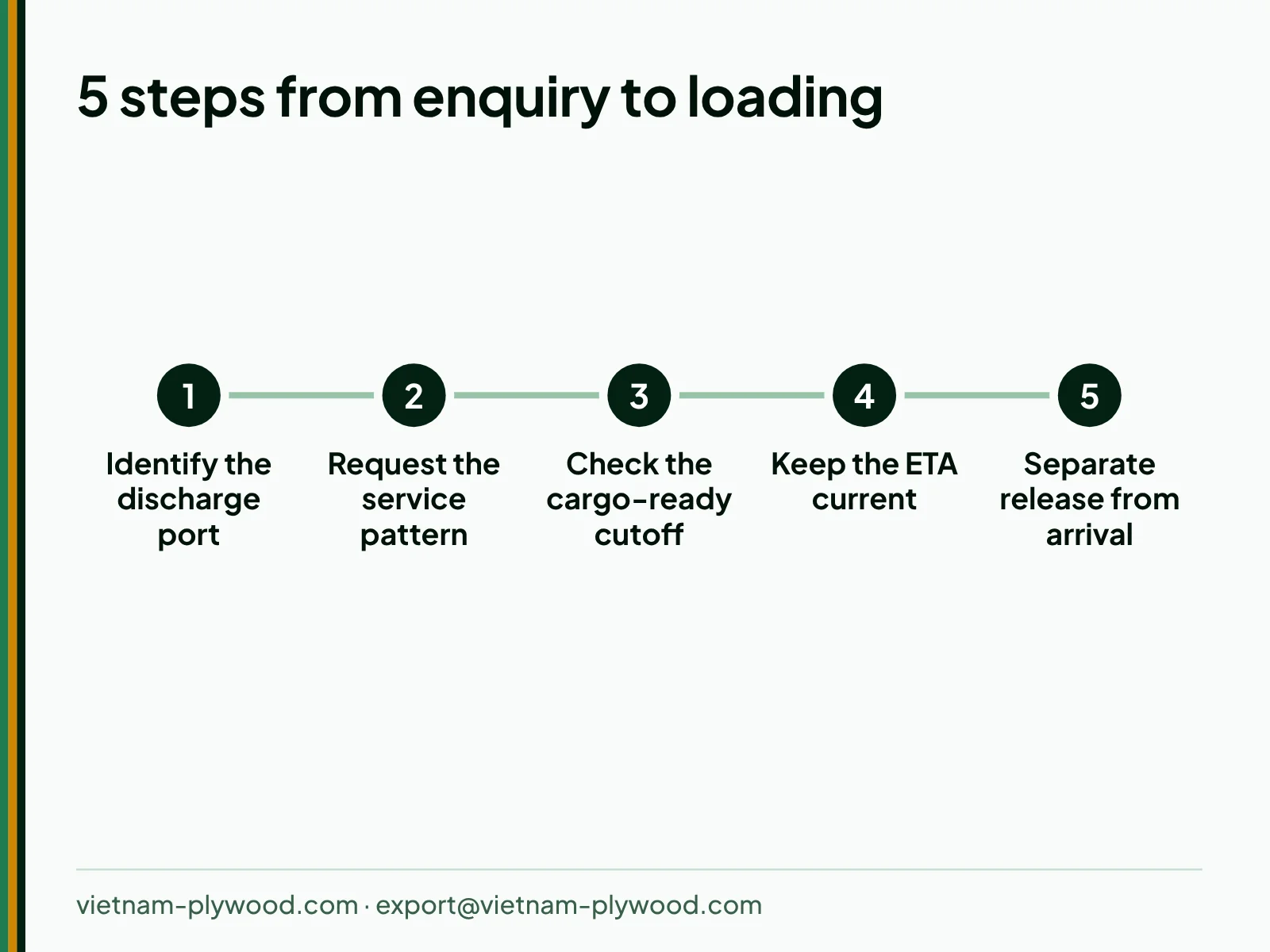
- Identify the discharge port. Rotterdam, Felixstowe and Jebel Ali need separate booking checks, even when a regional band is available.
- Request the service pattern. Record direct calls or transshipment, plus the carrier’s named voyage.
- Check the cargo-ready cutoff. A factory-complete date that misses the carrier’s loading cutoff cannot be treated as that sailing’s departure.
- Keep the ETA current. Compare each carrier update against the receiving plan and communicate changes to the importer.
- Separate release from arrival. Add destination customs, terminal handling and inland transport only when actual arrangements and dates are known.
Air express delivery estimates describe a different shipping mode from a 40HC sea container of plywood. Compare ocean transit only against ocean services, and ask the carrier for the actual vessel itinerary before assigning a receiving date.
How do I add production lead time to transit time?
Start with the agreed production clock: 15–45 days after the 30% deposit, depending on quantity, production conditions and agreement. Then add the applicable sea-time band, leaving space for booking and destination steps that have no approved numerical duration.
- Fix the build. Record core, face, grade, glue, emission class, thickness, tolerance, size and quantity. Different specifications can require different production planning.
- Mark the deposit date. Use the actual receipt and the production term in the agreement as the starting reference.
- Obtain the producing factory’s completion estimate. The line handling the specified panel determines its manufacturing checkpoint.
- Arrange inspection and loading. Buyers can inspect goods at the producing factory. Record completion, accepted inspection and container-ready status independently.
- Book the sea service. Add the actual sailing interval to the vessel departure, not automatically to the deposit date.
- Plan destination release. The importer owns the receiving and customs milestones after the vessel reaches the port.
For example, the broad Northern Europe calculation is 15 + 30 = 45 days at one end and 45 + 40 = 85 days at the other. That arithmetic assumes the sea leg follows production without an unmeasured gap. Any booking wait, inspection hold, transfer or destination clearance must be added as a separately evidenced item.
The European Commission’s importation guidance, accessed in 2026, says goods must be cleared by customs before entering the European single market. Accordingly, a port ETA cannot stand in for the customer’s available-stock date.
Which factory line sets the date for a mixed container?
The last line to finish an accepted lot sets the earliest complete-container readiness date when furniture, packing and construction panels share a 40HC. HCPLY allocates each specification to the producing factory, rather than assuming every line completes on the same day.
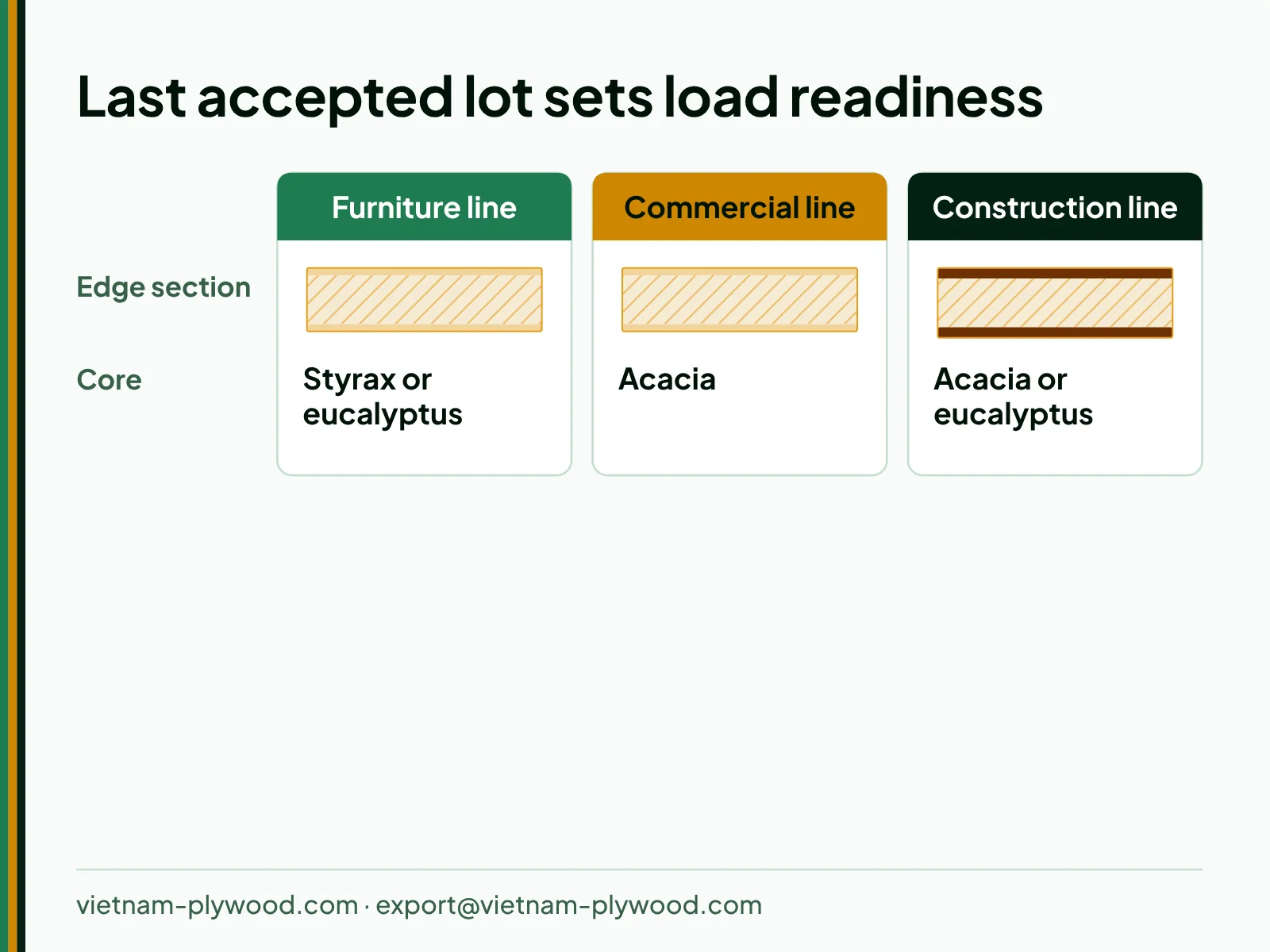
| Order component | Producing line and core | Build and check affecting readiness | Mixed-load scheduling consequence |
|---|---|---|---|
| Cabinet-facing plywood | Our furniture line: styrax or eucalyptus | Full-stitched, sanded; E0/E1; ordered thickness tolerance ±0.2 or ±0.3 mm | Wait for the specified face, sanding and thickness inspection |
| Packing panels | Our commercial and packing line: acacia | MR glue; unsanded or light-sanded; packing tolerance ±0.5–1.0 mm | Wait for packing dimensions and count acceptance |
| Concrete-formwork panels | Our construction line: acacia or eucalyptus | Phenolic or melamine film; unsanded; film-faced tolerance ±0.5 mm | Wait for film, edge and thickness acceptance |
A mixed specification is allowed within the 28.5 t 40HC payload limit. The last accepted production lot, the loading appointment and the carrier cutoff jointly decide whether the container catches the planned vessel. A partial lot ready early cannot create an earlier departure for panels still under production.
At the producing factory, the buyer or inspector can witness thickness measurements against the order, face or film condition, pallet counts and loading identification. The production line is also the place to match the physical goods to the packing list before sealing the container. Our furniture plywood page covers the cabinet-facing specification; the cross-line comparison covers the build differences.
Can furniture, packing and film-faced plywood share the payload?
Yes. The minimum order is one 40HC, and one container can carry several specifications as long as the payload limit holds. The shipment still needs a load plan based on dimensions, core density and pallet arrangement; a sheet count alone cannot establish safe payload.
For a single-core illustration at 18 mm and 1220 × 2440 mm, our loading figures give 990 styrax sheets, 880 acacia sheets or 795 eucalyptus sheets in their respective full-container arrangements. Those are alternative homogeneous examples, not three allocations to add together. The container-load calculation owns the detailed sheet-count method.
At 18 mm and 1220 × 2440 mm, sheet weights are 26.79 kg for styrax (500 kg/m³), 31.08 kg for acacia (580 kg/m³) and 34.83 kg for eucalyptus (650 kg/m³). The corresponding full 40HC loads are 990 sheets and 26.52 t, 880 sheets and 27.35 t, and 795 sheets and 27.69 t. For a mixed load, request an itemized loading plan showing the weight of each lot and pallets against the 28.5 t payload limit.
A construction lot with eucalyptus core can consume more of the payload than the same number of styrax-core furniture sheets. The last line’s completion date controls readiness, while the combined mass controls what can travel in that container. Neither calculation creates an exact sailing date without a booking.
Which documents should be ready before the vessel arrives?
The export set must identify the actual shipment and support the importer’s filing. HCPLY handles specification, on-site quality control, documents and loading, with draft shipping documents sent to the buyer for approval after loading.
The shipment documents are the commercial invoice, packing list, bill of lading (B/L), certificate of origin, phytosanitary and fumigation papers, insurance under CIF, and the agreed certificate documents. For EU lots, the set also includes EUR.1 and the EUTR/EUDR file set. Any FSC claim on sales documents, emission certificate or test report must match the agreed build; member-factory certificates can be shown with factory details masked, on request.
The European Commission’s 2026 ICS2 instructions require pre-arrival safety and security data and explain that incomplete declarations can delay entry processing. The certificate-of-origin explanation helps buyers separate origin evidence from the vessel’s ETA. Agree with the importer and its filing party who supplies each data field, and review document drafts before a discrepancy becomes a clearance problem.
What should the buyer ask before approving the delivery plan?
Ask for a factory-ready date, booked voyage and port ETA as three distinct entries. A schedule containing only one total-day number hides which step can move.
- Which factory line is producing each ordered specification, and when will each lot be available for inspection?
- If the container mixes products, which lot is expected to finish last?
- What is the named carrier, voyage, loading cutoff, transshipment route and destination port?
- Is the ETA the discharge-port arrival, customs release or warehouse delivery date?
- Who reviews the invoice, packing list, B/L and destination filing data?
- What event triggers an updated ETA if the vessel or booking changes?
We ship FOB Hai Phong, or CFR (CNF) or CIF to your port. The agreed term should be written beside the named destination and the responsible party for each transport stage. For payments, the stated arrangement is a 30% deposit and a 70% balance against the scanned B/L, by T/T or irrevocable L/C at sight. Neither payment milestone is proof of customs release.
For a firm buying schedule, send the specification and receiving-port requirements to Lucy at export@vietnam-plywood.com. The final confirmation must come from the actual production and shipping arrangement, not the regional bands alone.
What specification should I send to date a shipment?
Send the application and build first, then the container quantity and destination port. A factory visit lets the buyer inspect the production line and the goods that will form the shipment.
Application: cabinet panels / packing / concrete formwork
Producing line or core: furniture—styrax; packing—acacia; construction—acacia
Glue: MR melamine / WBP phenolic (select for each item)
Emission: E0 / E1 / E2 (specify separately from glue)
Face and grade: bintangor A/B / matt / 120 g/m² film (as applicable)
Thickness and tolerance: 18 mm; ±0.2 mm furniture / ±0.5 mm film-faced (as ordered)
Sheet size: 1220 × 2440 mm
Quantity: itemized sheets and total 40HC loading plan
Destination port: Rotterdam / Felixstowe / Jebel Ali / named US port
Requested carrier voyage or delivery window: specify
Next step: Book a factory visit to inspect the producing line and discuss the shipment-ready checkpoint with Lucy.