





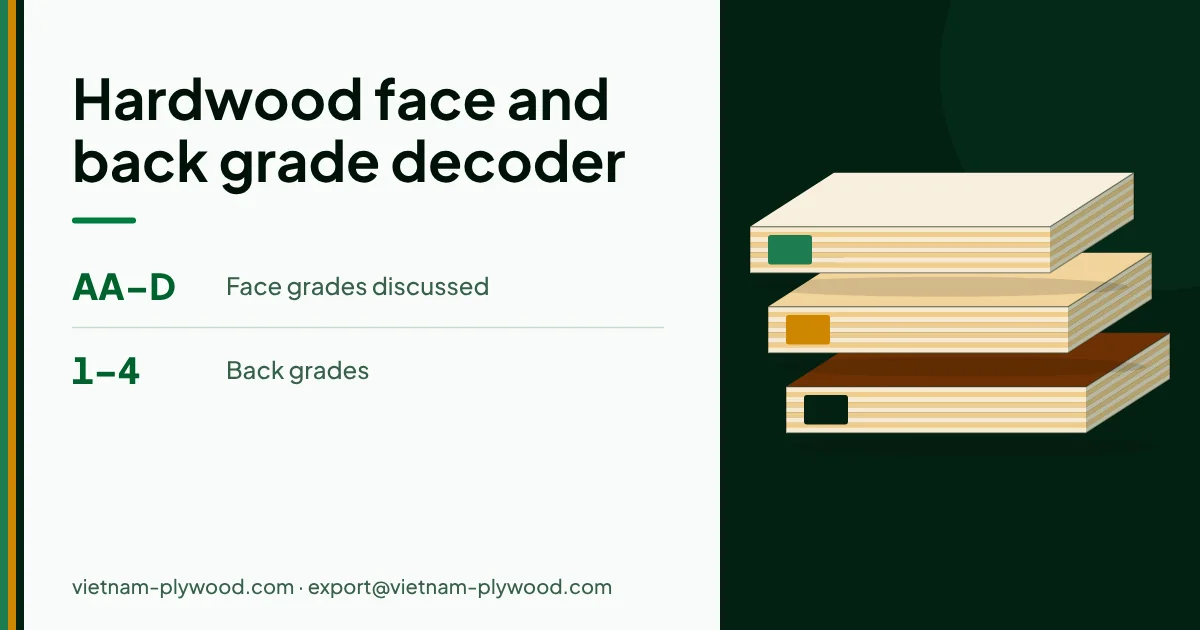
Grades of hardwood plywood are specified by visible face quality and reverse-side quality under ANSI/HPVA HP-1. Choosing the wrong pairing can increase finishing costs or cause a cabinet shipment to be rejected. HCPLY builds birch-faced and other decorative panels on our furniture line, with face appearance agreed through samples and written inspection criteria.
What are the grades of hardwood plywood under ANSI/HPVA HP-1?
The grades of hardwood plywood describe the decorative face and back separately. ANSI/HPVA HP-1 is the American National Standard for Hardwood and Decorative Plywood; it addresses veneer appearance alongside construction, dimensions, bonding and marking. A letter alone cannot tell a cabinet purchaser whether the core, glue or emissions meet the order.
The 2024 edition is listed as current by the NBS standards publication index, which records its approval on August 20, 2024. The US Environmental Protection Agency’s 2025 Title 40 CFR Part 770 separately regulates formaldehyde emissions for covered composite wood products. A veneer appearance designation does not replace that regulatory requirement.
Start with the face that customers see, then select the back needed for the finished cabinet. The broader face veneer category covers other veneer-selection questions.
What do AA, A, B, C and D face grades mean?
AA through D describe a progression from highly selected decorative surfaces toward faces with more visible natural characteristics and permitted repairs. Exact allowances are species-specific and edition-specific; a buyer should use the applicable HP-1 table rather than a universal knot-size rule.
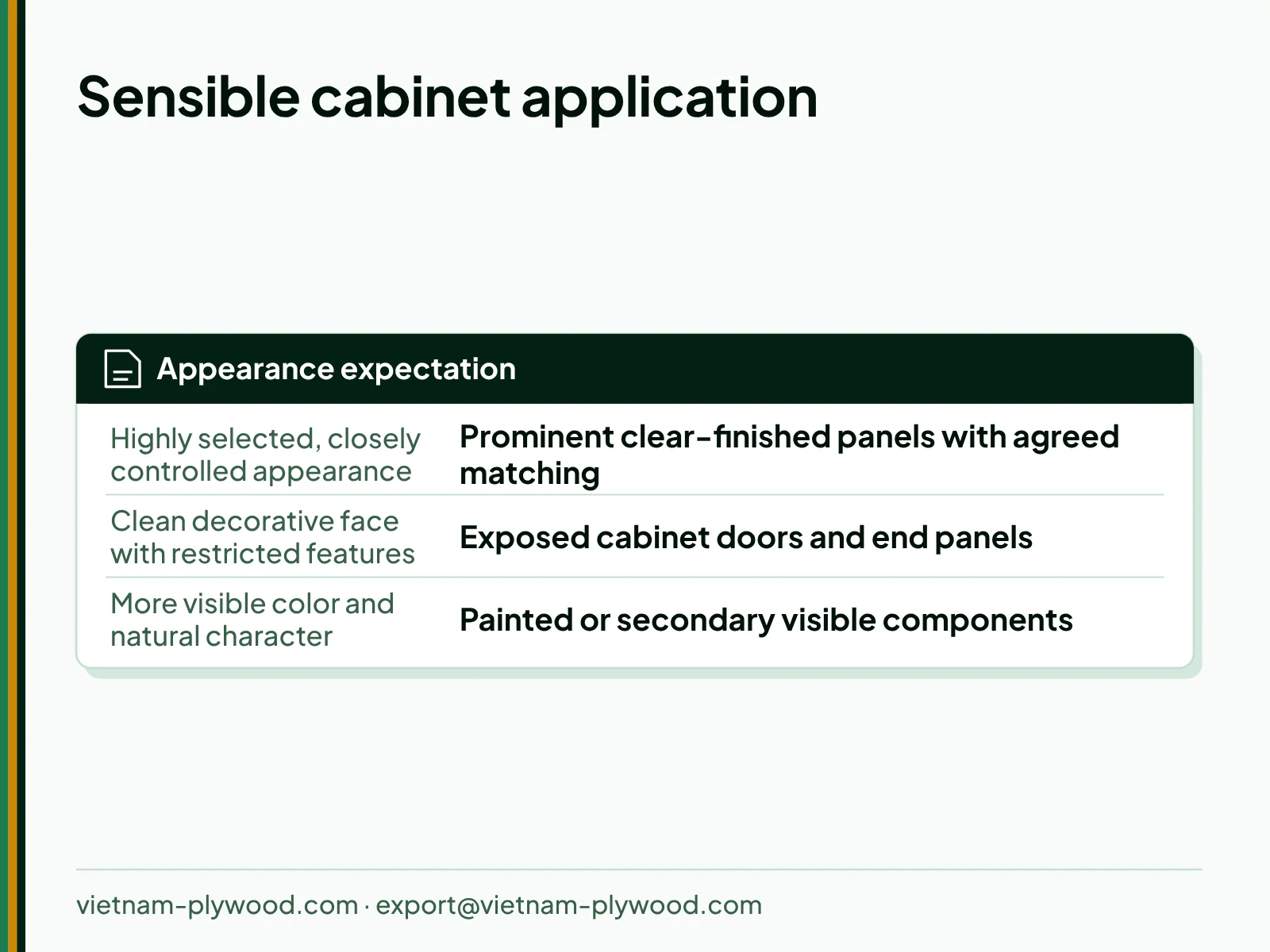
| Face designation | Appearance expectation | Sensible cabinet application |
|---|---|---|
| AA | Highly selected, closely controlled appearance | Prominent clear-finished panels with agreed matching |
| A | Clean decorative face with restricted features | Exposed cabinet doors and end panels |
| B | More visible color and natural character | Painted or secondary visible components |
| C | More pronounced features and repairs | Concealed or finish-covered surfaces |
| D | Lower appearance selection | Hidden applications where the written criteria allow it |
These are purchasing interpretations, not a substitute for the standard’s species tables. Clear coating exposes color variation that paint can cover.
For a side-by-side visual purchasing method, use the plywood face grade comparison chart. Set the acceptable patches, open defects, color range and matching pattern before the first production lot.
What do back grades 1, 2, 3 and 4 mean?
Back grades describe the reverse veneer, with 1 representing the higher appearance selection and 4 allowing a less decorative surface. The back still needs a written acceptance standard when cabinet interiors, shelving undersides or exposed edges remain visible.
A grade 1 back makes sense when both sides appear in the finished installation. Grade 2 can suit a cabinet panel with a visible front and a less prominent reverse. Grades 3 and 4 belong in more concealed positions when the permitted defects fit the intended finish.
Do not infer a back’s flatness, bond quality or emission status from its numeral. Those are separate specification fields. Distinguish HPVA letter-plus-number notation from BB/CC letter-pair descriptions used in other markets.
What do B2 plywood and C2 plywood mean on a US order?
B2 means a B face paired with a grade 2 back; C2 means a C face paired with a grade 2 back. The first character refers to the front surface, and the numeral describes the reverse. Neither designation identifies the species of the core.
B2 can be a useful shorthand for painted cabinet cases or secondary visible surfaces. C2 is possible as a notation, but the buyer should explain why a lower-appearance face is paired with a more selected back. The face and back must be judged against the named edition and species criteria.
An order reading “18 mm B2 plywood” omits core, sanding, glue, emissions, dimensions and acceptance samples. Specify these for inspection.
Which Vietnamese faces correspond to HPVA birch plywood?
Our furniture line can build birch-faced plywood over styrax or eucalyptus core, with full stitched construction and sanding. We also work with bintangor, okoume, engineered veneer, gurjan, pine, poplar, eucalyptus and sapele faces. A face name describes the decorative veneer; it does not change the core species.
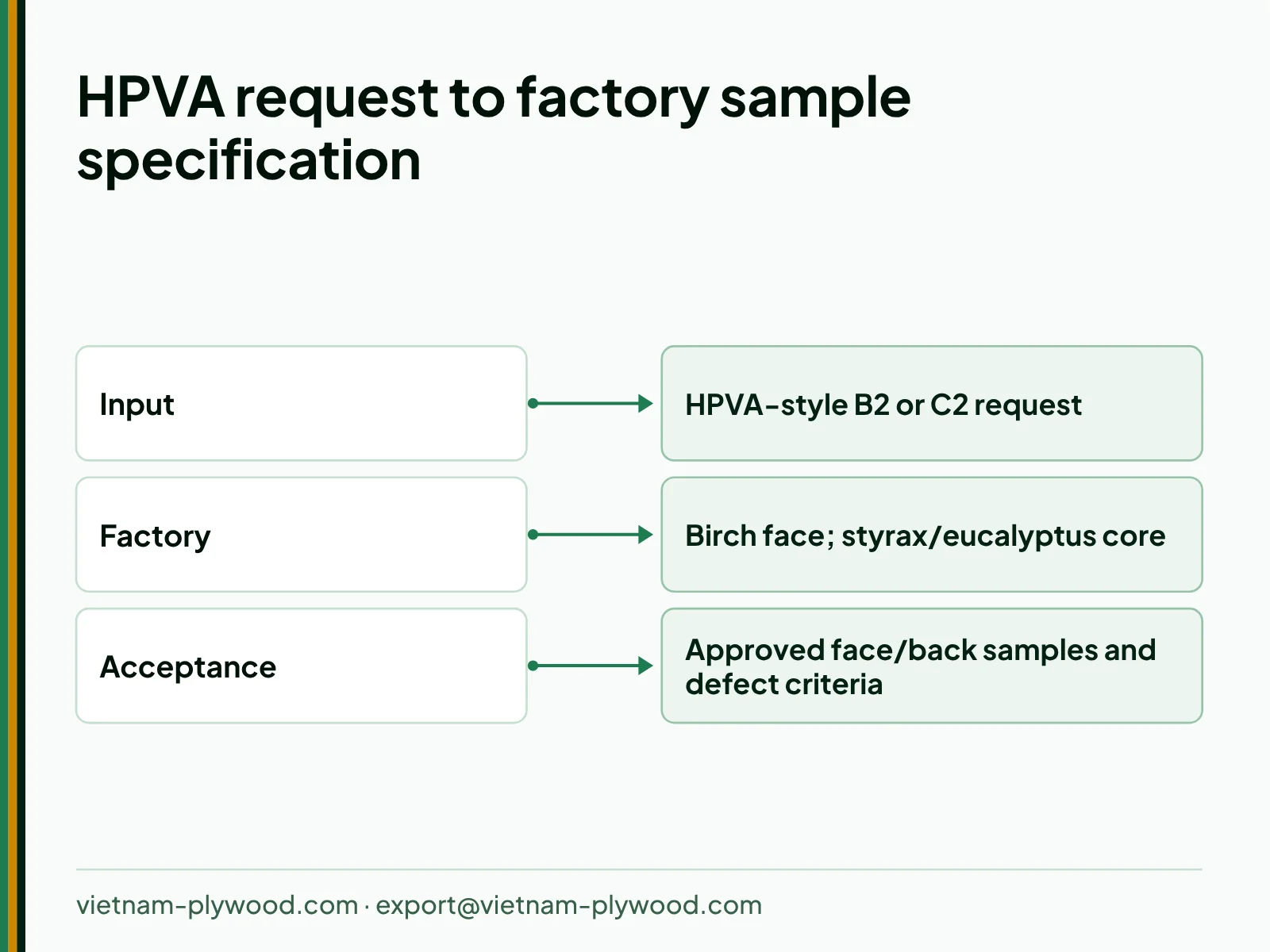
HCPLY’s house face descriptions are A/B, while birch is described with D/E/F face grades. Those local designations are not automatic equivalents of HPVA AA, A, B, C or D. A buyer asking for “HPVA birch B2” should specify the desired visible result and send approved reference samples for the front and reverse.
A common face veneer thickness is 0.2–0.4 mm. Inspect repairs and grain matching after sanding. Furniture plywood can be specified around the actual cabinet finish rather than an unsupported stamp conversion.
How would the same 18 mm requirement differ across our lines?
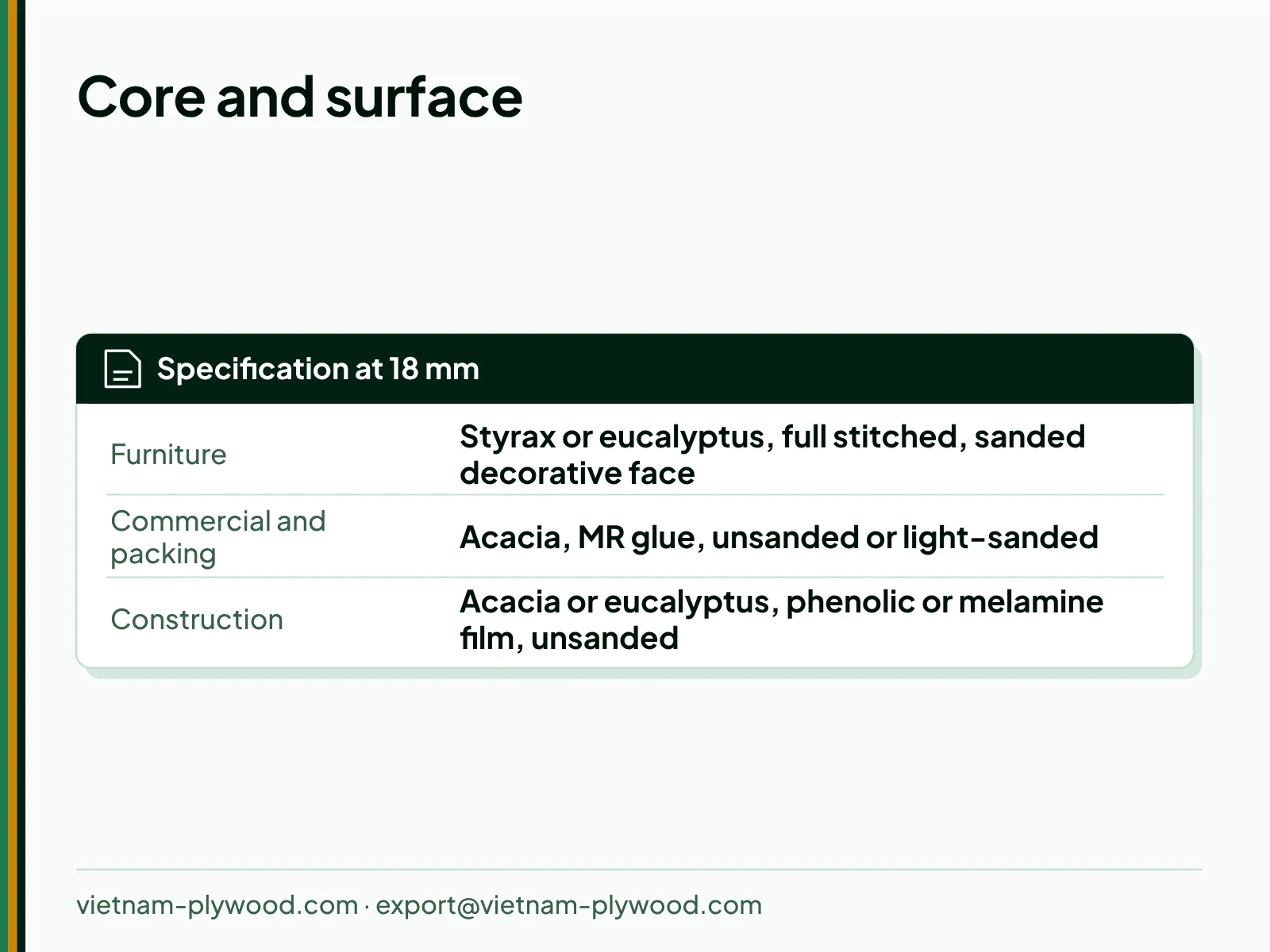
An 18 mm decorative cabinet sheet belongs on our furniture line. Our commercial and packing line makes acacia-core boards with MR glue and unsanded or light-sanded surfaces; our construction line presses film-faced boards for formwork. Their surface priorities differ even when the nominal thickness matches.
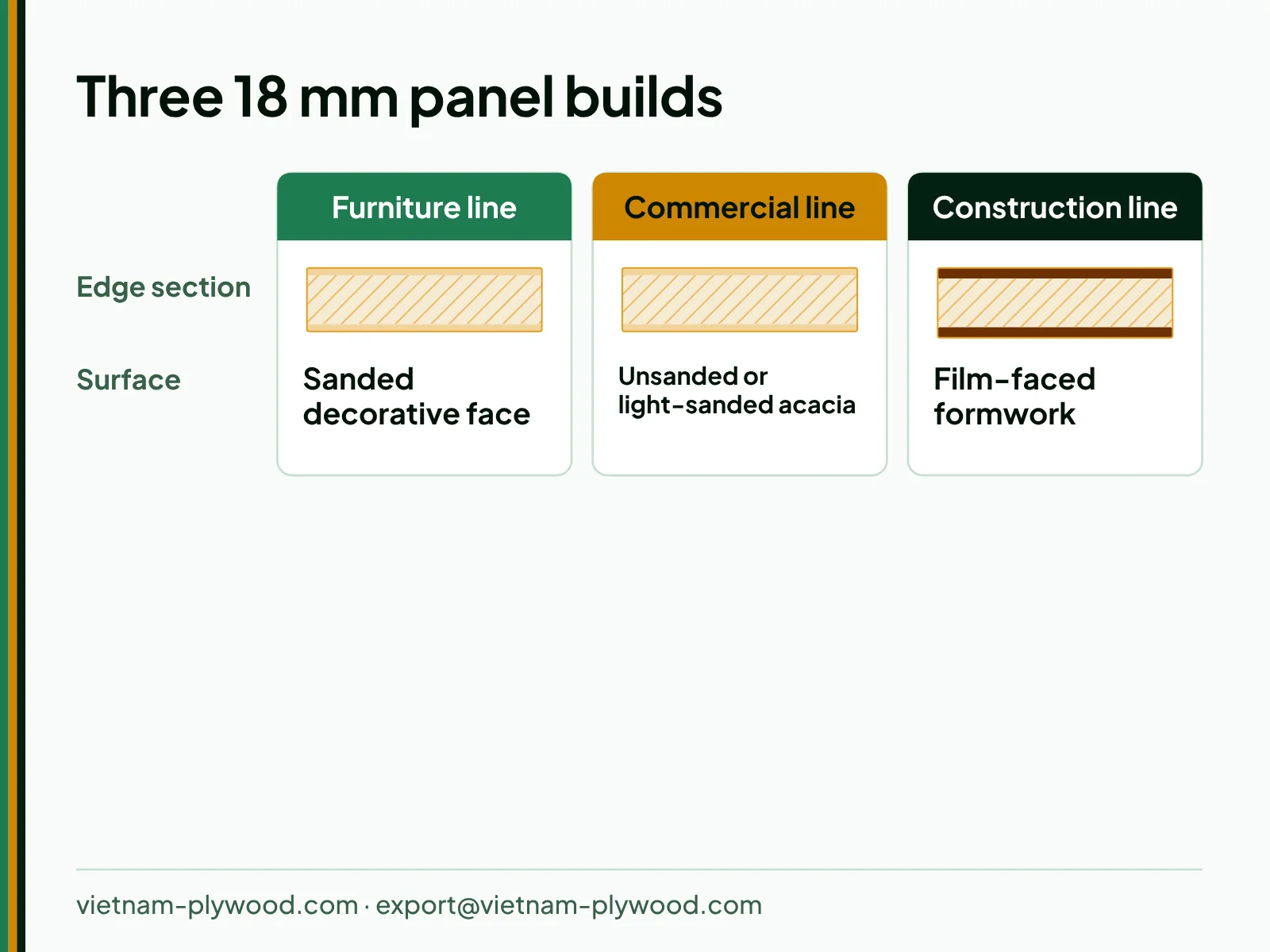
| Specification at 18 mm | Core and surface | Ordered thickness tolerance | Appropriate use |
|---|---|---|---|
| Furniture | Styrax or eucalyptus, full stitched, sanded decorative face | ±0.2 or ±0.3 mm | Cabinet machining and visible panels |
| Commercial and packing | Acacia, MR glue, unsanded or light-sanded | ±0.5 mm commercial; ±0.5–1.0 mm packing | General commercial work and packing |
| Construction | Acacia or eucalyptus, phenolic or melamine film, unsanded | ±0.5 mm | Concrete formwork |
The same visual grade request cannot be transferred to a film surface. For broader selection, compare grades across factory lines. HCPLY does not press MDF, OSB, chipboard, blockboard or birch-core plywood.
Which specifications sit outside the HPVA appearance code?
A cabinet panel needs an independent core, bond, emission and dimensional specification. Our furniture line uses styrax or eucalyptus core with E0 or E1 emission classes. Glue type and emission class must be written as different fields: MR refers to melamine glue, while WBP refers to phenolic weather-and-boil-proof glue.
Available thicknesses run from 3 to 40 mm, with 18 mm a common cabinet choice. Standard sheet sizes include 1220 × 2440 mm and 1250 × 2500 mm; custom cutting is available. Specify the sanded tolerance for the selected thickness and the length-and-width tolerance of ±2 mm.
For US orders, the EPA’s 2025 CFR Part 770 distinguishes emissions compliance from decorative appearance grading. Ask for the relevant member-factory emission documentation and third-party certification where required. Factory certificates and documents are shown with factory details masked, on request. For sanding-related choices, see sanded versus unsanded plywood.
Does Vietnamese plywood carry an HPVA stamp or certificate?
HCPLY panels do not carry an HPVA certificate or grade stamp. A purchaser should not interpret a birch face, an A/B house grade or a photographed sample as evidence of HPVA certification. An agreed appearance specification is the practical acceptance basis for this export build.
A formal HPVA designation has meaning only when its standard edition, species and grading rules are used correctly. If a project contract requires third-party HPVA marking, this product should not be substituted on the strength of a visual resemblance. The APA plywood grade stamp explanation also clarifies why unrelated panel marking systems cannot be exchanged.
What can an inspector check at the producing factory?
A buyer can witness face-and-back sorting against the approved reference samples at the producing factory. Check a representative selection from the actual order, recording defects on both surfaces and identifying the accepted lot. Photograph any disputed repair or color mismatch beside its agreed sample.
Next, measure thickness at agreed panel positions, check length and width, and inspect the sanded face after pressing. Record the declared core species and construction against the order; inspect edges for visible gaps. The inspection record should identify the inspected lot and the disposition of nonconforming sheets.
Buyers can visit the factory office and inspect goods where the order is produced. This supports repeatable appearance across shipments.
What replaces a grade stamp in the import order?
The signed specification and approved face/back samples replace an unsupported HPVA stamp claim. Write the exact visual criteria, core, glue, emission class and tolerance into the purchase order. The producing factory then has an acceptance reference for production and pre-shipment inspection.
The commercial invoice and packing list identify the shipped goods; the order’s agreed test reports and emission certificate cover the applicable technical requirements. After loading, the draft shipping documents come to you for approval. The inspection record and approved samples remain the comparison evidence for appearance.
Avoid an undefined “AA plywood” or “C2 birch” order. For timing decisions, consult plywood production lead time. HCPLY coordinates specifications, on-site QC, documentation and loading.
How does a cabinet order fit a container?
An 18 mm, 1220 × 2440 mm styrax-core panel weighs 26.79 kg in the core-density calculation. The corresponding full 40HC lookup is 990 sheets, 53.05 m³ and 26.52 t. The eucalyptus-core alternative weighs 34.83 kg per sheet, with 795 sheets and 27.69 t in the lookup.
Specifications can be mixed within a 40HC payload limit of 28.5 t. A buyer combining decorative builds should calculate each specification’s sheet weight and pallet allocation rather than adding two full-load sheet counts. The container load calculation owns the detailed packing question.
What should a cabinet buyer send for a quotation?
A usable request names the cabinet application, visible face and back acceptance, core construction and the destination port. A higher-selected decorative face costs more to sort than a less selective face; full stitched and sanded construction also changes the build. Our furniture plywood starts from US$350/m³ FOB Hai Phong (October 2026), with the exact quotation based on the written specification.
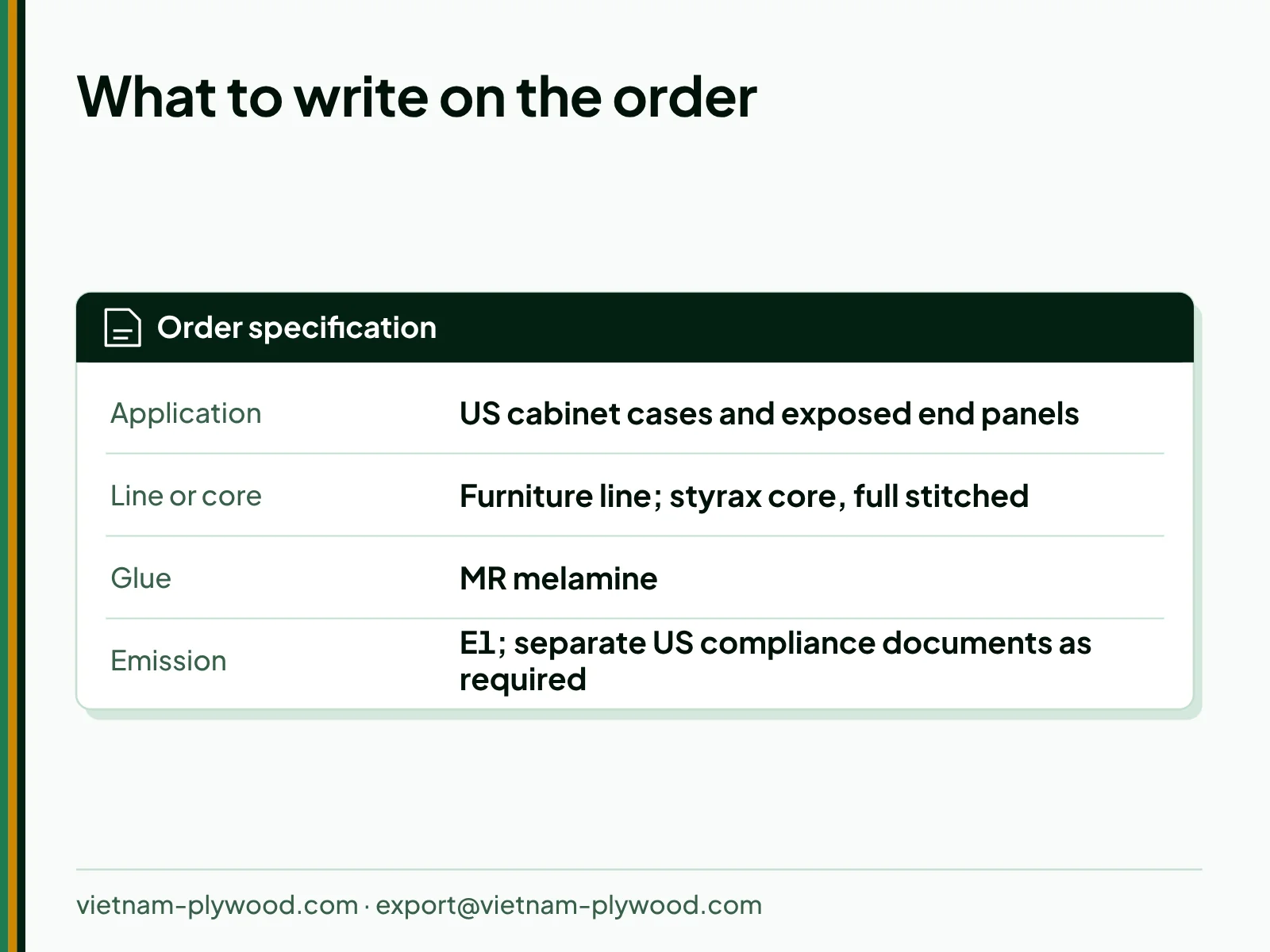
Use this editable request as the starting point:
Application: US cabinet cases and exposed end panels
Line or core: Furniture line; styrax core, full stitched
Glue: MR melamine
Emission: E1; separate US compliance documents as required
Face and grade: Birch face; approved front/back samples and defect criteria
Thickness and tolerance: 18 mm; sanded ±0.2 mm
Size: 1220 × 2440 mm; length/width ±2 mm
Quantity: One 40HC; specify sheet counts by build
Destination port: [buyer to enter]
Book a factory visit with Lucy through contact to review the reference samples and witness the inspection method before ordering.