






HCPLY ships plywood from Vietnam to the UK with a panel-specific document trail: timber legality evidence, customs papers, and product evidence matched to its intended use. A wrong classification or unsupported conformity claim can hold a load, add storage charges, or leave a distributor unable to sell it. This is how to import plywood from Vietnam to the UK from specification to release at the destination port.
How to import plywood from Vietnam to the UK?
Start by specifying the plywood and its UK end use, then establish the importer’s timber due-diligence responsibilities, tariff classification, product evidence and shipping terms. Inspect the agreed build at the producing factory before loading. Finally, reconcile the shipping documents with the UK declaration and retain the supporting records after release.
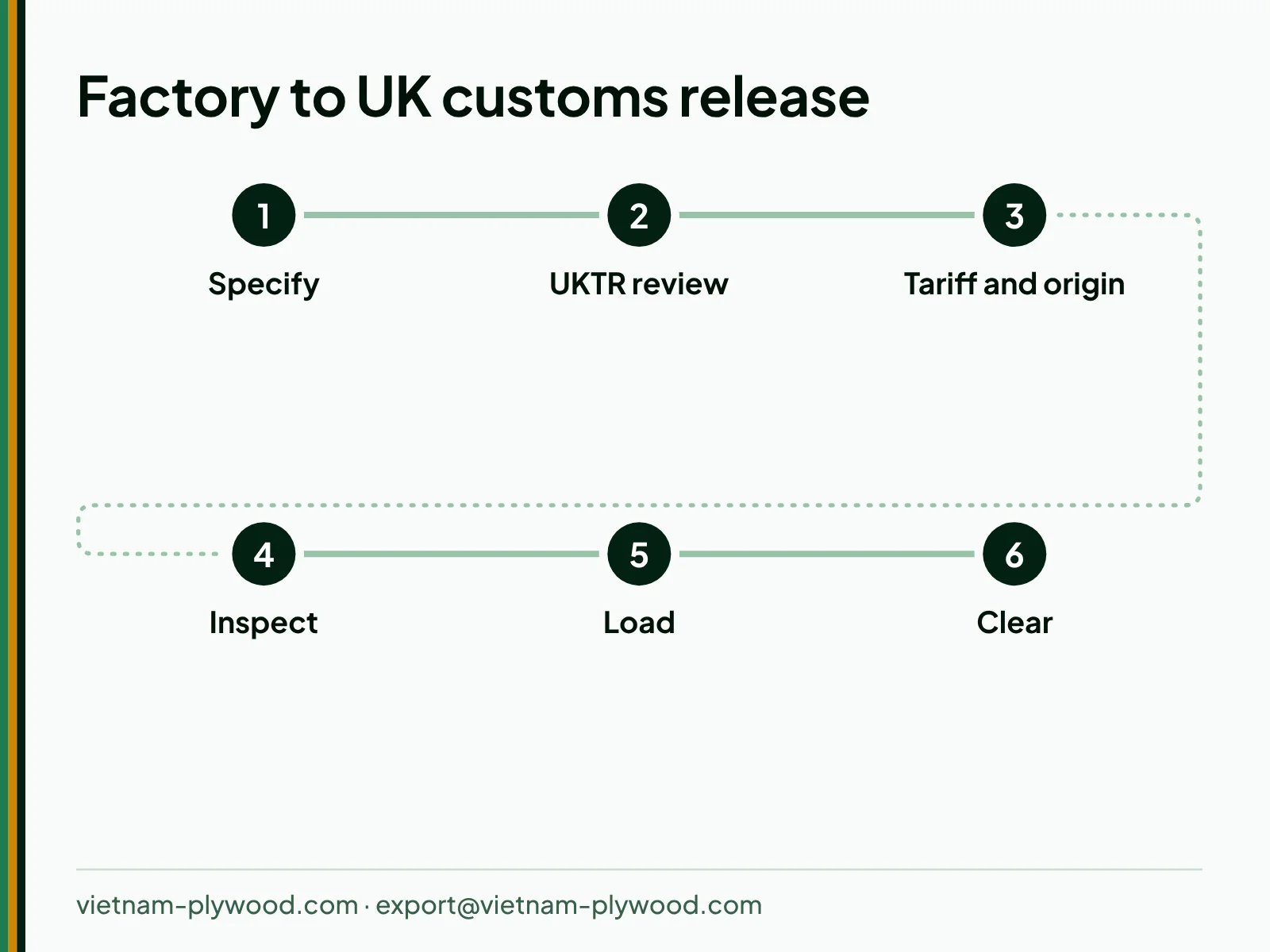
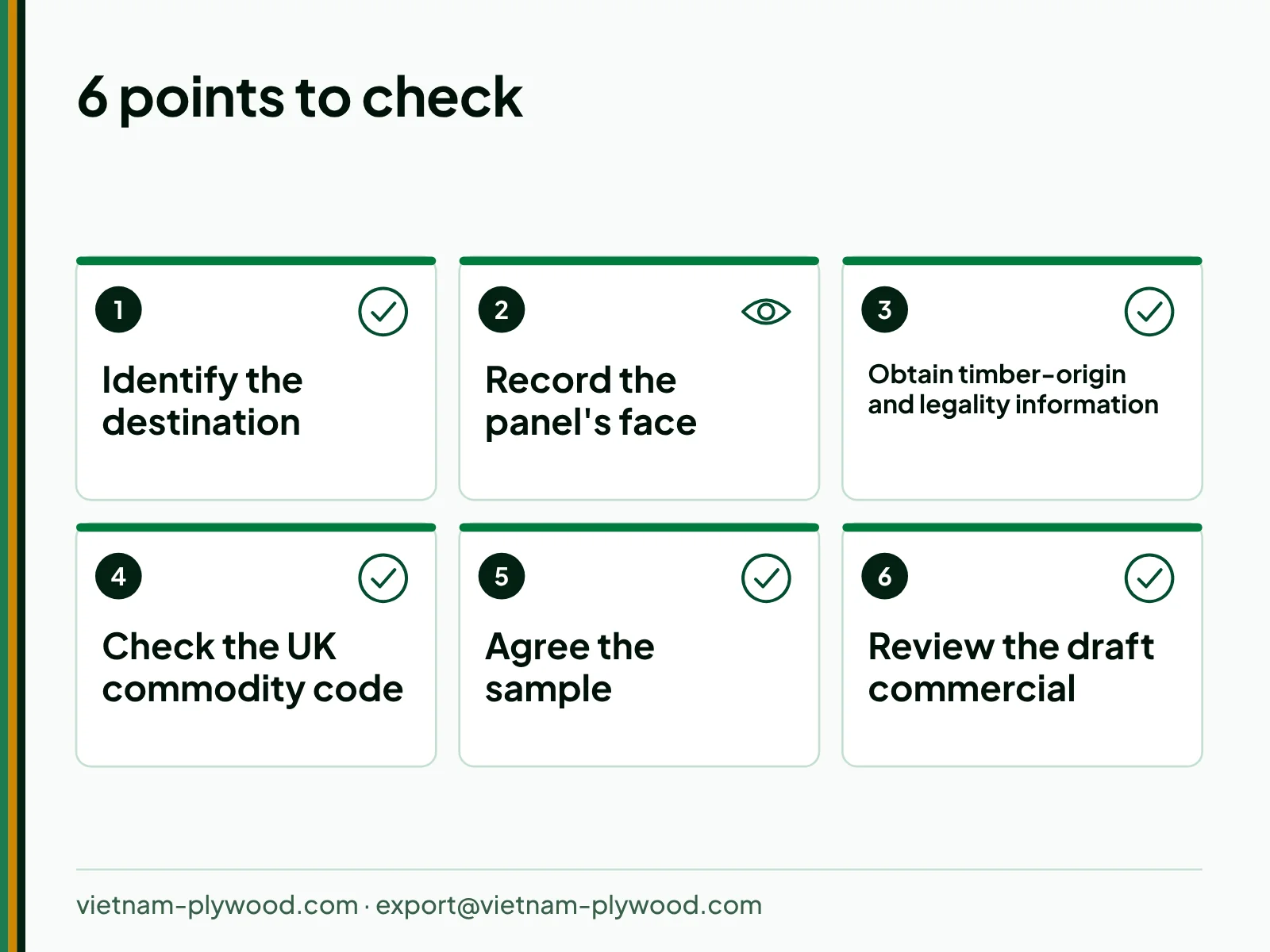
- Identify the destination: Great Britain (England, Scotland or Wales) or Northern Ireland. Their timber and product rules are not identical.
- Record the panel’s face, core, glue, emission class, thickness, tolerance, dimensions and intended application.
- Obtain timber-origin and legality information early enough for the UK importer to assess risk.
- Check the UK commodity code, applicable duty, origin rules and any product-specific requirements.
- Agree the sample, factory inspection, load plan and shipment terms before production.
- Review the draft commercial and transport documents after loading, then arrange UK import clearance.
For the broader buying sequence, see how to import plywood from Vietnam. This UK route adds a critical distinction: a panel for cabinet carcasses does not have the same product-marking question as a panel marketed for structural building use.
Which producing line fits the UK order?
The intended application determines which HCPLY line presses the panel and what evidence the importer should request. Our three factories are in Phu Tho and Hai Phong; goods leave the producing factory directly for export through Hai Phong.
| Same 18 mm thickness, different use | Producing line and build | What to inspect | UK documentation focus |
|---|---|---|---|
| Cabinet or furniture components | Our furniture line: full-stitched, sanded styrax or eucalyptus core; E0/E1 emission class | Surface, core stitching, ordered ±0.2 or ±0.3 mm tolerance | Emission test evidence and buyer specification |
| Crates, industrial packing | Our commercial and packing line: acacia core, MR glue, unsanded or light-sanded; packing tolerance ±0.5–1.0 mm | Core gaps, thickness, package identification | Timber legality, commercial description and packing list |
| Formwork or construction | Our construction line: acacia or eucalyptus core, phenolic or melamine film; ±0.5 mm tolerance | Film, edges, core and thickness | Intended-use assessment; construction conformity evidence only when applicable |
Compare grades across factory lines. A product is named by its face; density follows its core. For instance, a birch-faced furniture sheet is not a birch-core sheet. HCPLY does not press birch-core plywood, medium-density fibreboard (MDF), oriented strand board (OSB), chipboard or blockboard. An importer should keep those distinctions in the purchase order and customs description.
Does plywood from Vietnam need UKTR due diligence?
Yes, relevant plywood first placed on the Great Britain market falls within the UK Timber Regulations (UKTR) framework, and the operator must exercise due diligence. The Office for Product Safety and Standards and Defra’s 2025 guidance explains that the UKTR applies in Great Britain and covers timber products including composites. UK timber regulation guidance sets out the operator and trader obligations.
For a UK importer placing timber on the market for the first time, a purchase invoice alone is insufficient. Build a documented system around information gathering, risk assessment and risk mitigation where the identified risk is not negligible. Collect the species and harvest-origin information, supplier and supply-chain identities, quantities, legality documents and records that allow a specific lot to be traced. Ask for explanations where species, harvest locations or chain-of-custody records do not align.
Northern Ireland is a separate destination decision. Defra’s November 2026 Northern Ireland EUDR guidance says the EU Deforestation Regulation (EUDR) will apply there, replacing the earlier EU timber regime, while EUDR does not apply in Great Britain. Check the applicable implementation date and operator category before committing an NI shipment. Do not substitute an EU-oriented document folder for the Great Britain UKTR process.
When does imported plywood need UKCA or CE marking?
Construction marking is a question of intended use and the applicable construction-products rules, rather than a blanket requirement for every plywood sheet. The UK government’s 2025 construction products guidance states that CE marking continues to be recognised for construction products in Great Britain and UKCA marking can also be used where its requirements are met.
For a panel marketed for structural use in a building, the importer must establish whether a designated or harmonised product standard applies, what declared performance is required, and which conformity assessment route is valid. Request the relevant declaration, assessment and traceable product identification before placing such goods on the market. Do not infer structural status from film weight, glue name or a sales description.
Film-faced formwork panels used as temporary shuttering do not automatically acquire a structural building-product designation. Conversely, calling a permanent structural panel ‘general plywood’ does not remove applicable obligations. The project specification, market placement and regulatory scope decide the paperwork.
Member-factory CE materials, where relevant, are shown with factory details masked, on request; the buyer should check their applicability to the exact build and intended use. A structural grade must be evaluated against a test report the buyer accepts. Northern Ireland has separate construction-products rules, so a GB marking decision should not be copied across without review.
What emission papers do UK furniture panels need?
Furniture buyers should request a test report identifying the actual panel build, emission class, test method, testing body and report scope. The UK’s Health and Safety Executive explains in its woodworking FAQs that wood-based panels can emit formaldehyde and distinguishes E1 and E2 classes. The guidance also distinguishes construction-panel marking from other emission labelling schemes.
For furniture plywood, our furniture line offers E0/E1 emission classes and a full-stitched, sanded core. The purchase order should specify the class and accepted test method, then match the resulting report to the face, core, glue and production lot. A class name printed on a quotation is not the same as a laboratory result for the agreed product.
Glue performance and emission performance are separate fields. Melamine glue is described as MR with a 12-hour boil condition; phenolic glue is WBP with a 72-hour boil condition. Neither designation proves an emission class. CARB P2 and TSCA Title VI concern a US emissions regime and third-party certification; they should not be presented as automatic UK compliance.
What documents are needed to ship plywood from Vietnam to the UK?
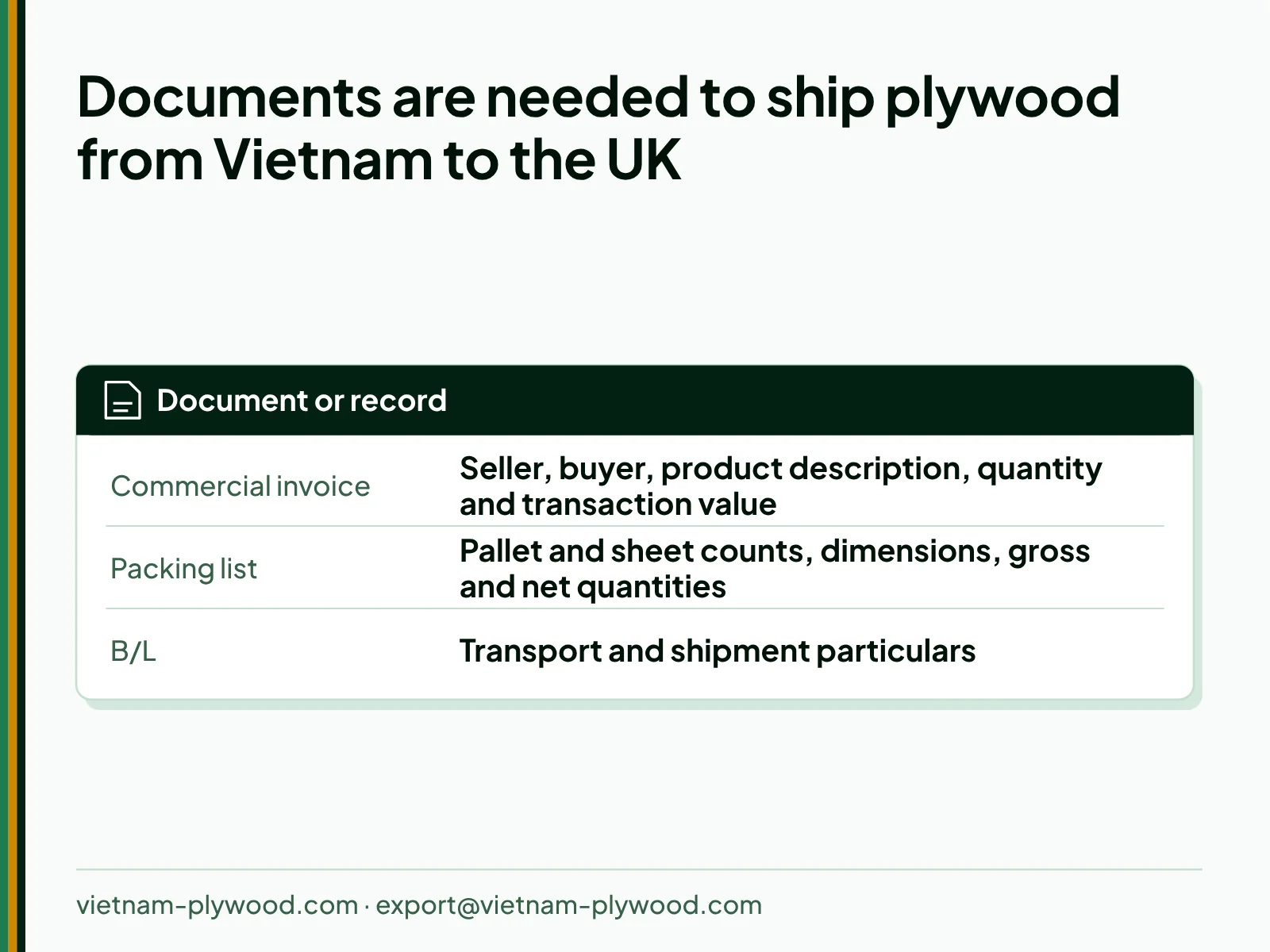
The shipment file starts with the commercial invoice, packing list, bill of lading (B/L) and origin evidence, then adds product-specific and timber-legality records. It is useful to separate customs documents from technical documents: both can be requested during an import, but they answer different questions.
| Document or record | Main purpose | Buyer check before release |
|---|---|---|
| Commercial invoice | Seller, buyer, product description, quantity and transaction value | Match contract and customs declaration |
| Packing list | Pallet and sheet counts, dimensions, gross and net quantities | Match factory marks and physical load |
| B/L | Transport and shipment particulars | Match consignee, ports and container details |
| Certificate or proof of origin | Origin evidence for the relevant claim | Check form against the applicable UK agreement |
| Phytosanitary and fumigation papers | Shipment treatment or plant-health documentation as arranged | Check what the shipment and UK authorities require |
| Insurance document | Cover under CIF shipment | Match insured goods and voyage |
| UKTR supporting file | Harvest legality and traceability assessment inputs | Check supplier, species, origin and lot linkage |
| Agreed test and certificate documents | Emission or construction-related evidence for the specific build | Check product scope and validity |
HCPLY prepares the export-side paperwork and sends draft shipping documents to the buyer for approval after loading. The importer or appointed customs agent uses the final information for UK clearance; import declarations and any UK-side approvals are separate from the exporter’s shipping packet.
For a UK shipment, check the applicable preferential-origin rules and acceptable proof separately; EUR.1 is included in our export documentation for EU lots. HM Revenue & Customs’ 2025 preferential duty guidance requires correct classification, origin eligibility and acceptable proof. The UK-Vietnam agreement is in effect according to the Department for Business and Trade’s UK-Vietnam trade guidance, last updated in 2023.
How should the UK importer classify plywood and claim duty preference?
Classify the exact finished plywood under the UK tariff, then verify its origin qualification and duty rate for the date of entry. The broader heading for plywood is 4412, but the correct UK subheading turns on face species and construction; a core name alone cannot settle it.
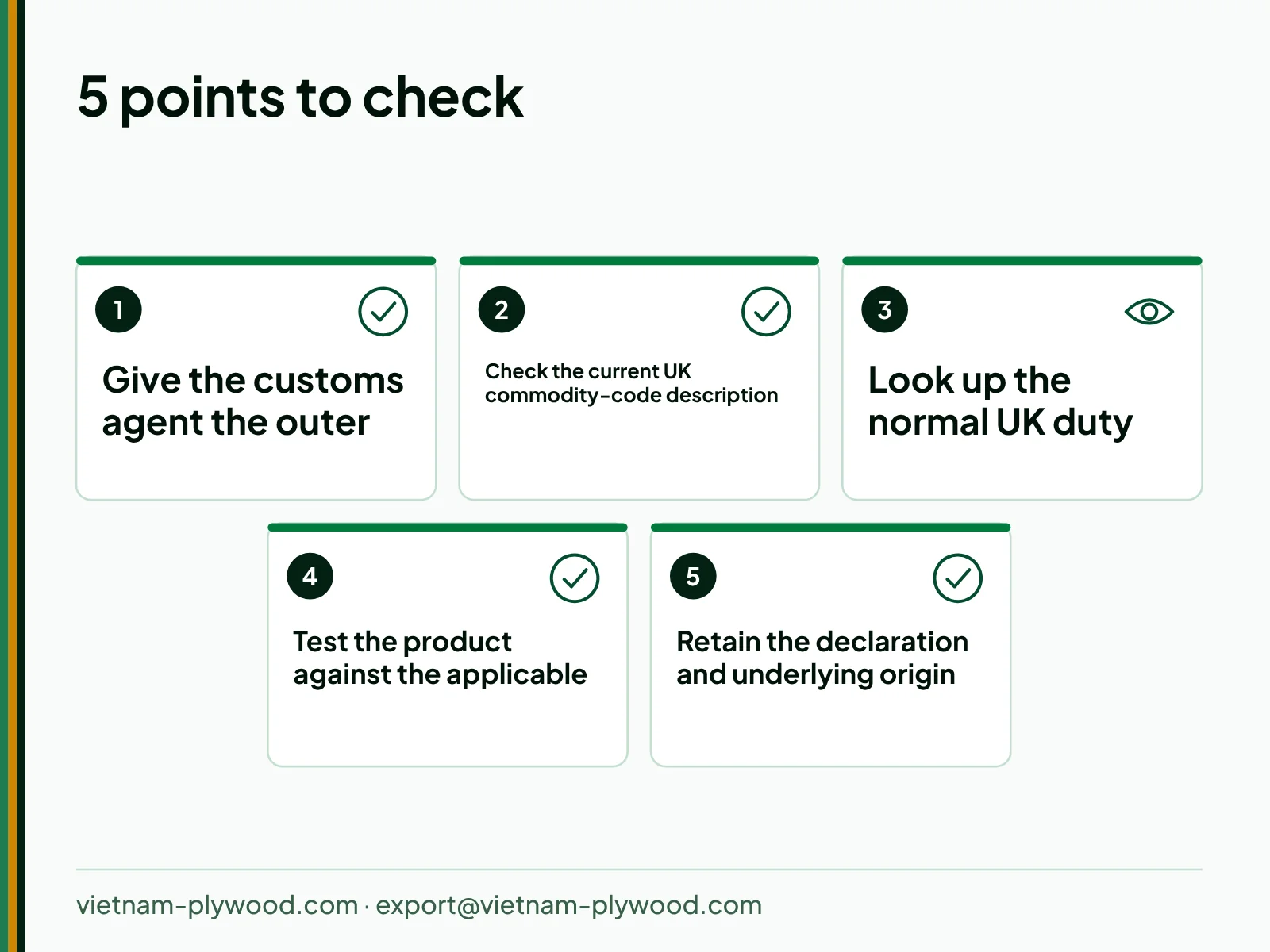
- Give the customs agent the outer face species, core construction, number of plies, thickness and whether a film or other surface is present.
- Check the current UK commodity-code description against those facts rather than reusing an EU TARIC code.
- Look up the normal UK duty and the preferential rate, if any, under the UK-Vietnam agreement.
- Test the product against the applicable rule of origin and obtain the accepted proof before making a preference claim.
- Retain the declaration and underlying origin records for the required retention period.
HMRC’s 2025 guidance states that an importer claiming preference must retain the declaration, origin proof and supporting documents for at least four years. A certificate of origin does not, by itself, establish eligibility if the product-specific origin rule is not met. Do not budget a zero duty rate until the precise code and origin conditions have been checked.
How do factory inspection and loading connect to the papers?
Inspect the agreed physical build and pallet identities before the exporter closes the load. A buyer or independent inspector can witness thickness readings, surface and edge condition, core construction at a sample cut, film condition where applicable, and pallet counts at the producing factory.
The order should state the inspection method and acceptance criteria in advance. For sanded furniture panels, the ordered thickness tolerance is ±0.2 or ±0.3 mm; for commercial and film-faced panels it is ±0.5 mm, while packing panels are ±0.5–1.0 mm. Length and width tolerance is ±2 mm. The inspection report should identify the tested lot and measuring method rather than relying on an isolated photograph.
See arrival inspection for the receiving check. Link each accepted pallet to the packing list and commercial invoice description. If the furniture order requires an emission report, match its panel composition to the inspected batch. If a construction use calls for conformity evidence, reconcile that documentation before dispatch rather than attempting to resolve it after arrival.
Can a UK order combine panel types in one 40HC?
Yes. The minimum order is one 40HC, and one container can carry several specifications as long as the payload limit holds. The 40HC payload limit is 28.5 t; pallet quantities depend on core density, sheet dimensions, thickness and stacking height.
For 18 mm sheets measuring 1220 × 2440 mm, the calculated single-core reference loads are 990 styrax sheets, 880 acacia sheets or 795 eucalyptus sheets. Those totals correspond to 18 pallets and 26.52 t, 16 pallets and 27.35 t, and 15 pallets and 27.69 t respectively. They are separate reference configurations, not quantities to add together.
For a mixed shipment, request a pallet-by-pallet loading plan showing each specification, sheet count, core and total weight. Check the plan against the 28.5 t payload limit before loading. Styrax is 500 kg/m³, acacia 580 kg/m³ and eucalyptus 650 kg/m³.
For example, 18 mm styrax sheets at 1220 × 2440 mm weigh 26.79 kg each; acacia sheets of the same dimensions weigh 31.08 kg each. Mixing the two changes the load mass even when the sheet count is unchanged. Use the container packing calculation for full loading arithmetic and mixed-container arrangements for purchase planning.
Which shipping term and route should the buyer choose?
Choose FOB Hai Phong, CFR (CNF) or CIF in the contract and state the named destination port. FOB Hai Phong assigns the buyer the onward freight arrangement under the agreed term; CFR includes the contracted sea carriage, while CIF also includes the insurance arrangement under that term. Clarify local handling, customs clearance and delivery beyond the port separately.
For Northern Europe, the sailing reference is 30–40 days at sea from Hai Phong, by carrier and route. That is a regional sea-transit range, not a promised UK-port arrival date or door-to-door delivery estimate. Port calls, transshipment, discharge and clearance must be planned separately. See Hai Phong transit times for the route context.
Factory lead time runs 15–45 days from receipt of the 30% deposit; the exact figure depends on order size, line loading and what the contract fixes. The remaining 70% is paid on the scan of the bill of lading, by T/T, or by irrevocable sight L/C. Samples cost nothing: a first-time buyer pays the courier, and that charge comes off the first confirmed order.
An indicative commercial plywood starting point is from US$250/m³ FOB Hai Phong (October 2026). This is a dated starting point, not a UK landed price. The indicative furniture plywood starting point is from US$350/m³ FOB Hai Phong (October 2026); the final quotation follows the written specification. Film-faced and other specific grades require a written-build quotation; core construction, face selection, glue, tolerance, volume and freight arrangements change the result.
What changes if the destination is Northern Ireland?
Northern Ireland requires its own timber and product-rule review before a shipment is booked. The EU deforestation regime and Northern Ireland construction-product rules differ from those applied in Great Britain, so a GB document checklist cannot be reused without adjustment.
The November 2026 Defra guidance identifies the EUDR as the incoming regime for relevant Northern Ireland products. The importer should verify the current start date, business category, due-diligence statement process and product scope against the official guidance before shipment. A Northern Ireland destination should be written explicitly on the purchase order rather than hidden under the word ‘UK’.
What should be signed off before the deposit and factory visit?
Sign off the application, build, destination and evidence requirements before placing the production order. A UK importer should be able to connect the same product description across the quotation, purchase order, inspection sheet, invoice, packing list and customs classification.
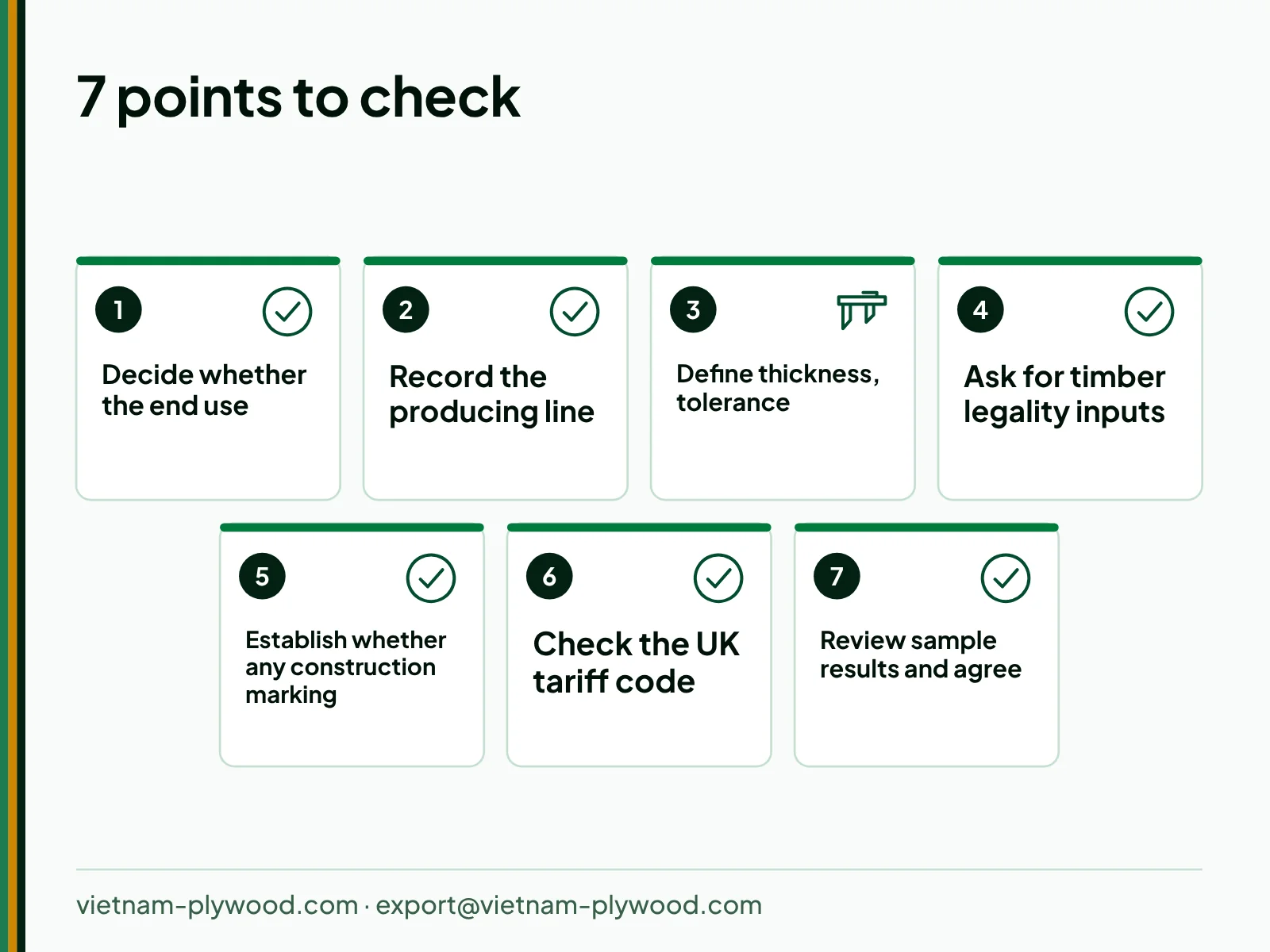
- Decide whether the end use is furniture, packing, temporary formwork or regulated structural construction.
- Record the producing line, core, face, grade, glue and emission class separately.
- Define thickness, tolerance, sheet size, quantity and the accepted inspection procedure.
- Ask for timber legality inputs and identify who performs the UKTR assessment.
- Establish whether any construction marking or emission test report is required for the specific intended use.
- Check the UK tariff code, origin eligibility, destination port and chosen trade term.
- Review sample results and agree which records will accompany the shipment.
A report or certificate should match the ordered build and its declared application. Factory-member certificates, including FSC, CARB P2, ISO 9001 and CE materials, are shown with factory details masked, on request. The existence of a document is not a substitute for checking whether its scope covers the shipment.
Send the following specification to Lucy at export@vietnam-plywood.com:
Application: UK furniture / packing / formwork / structural use (specify)
Producing line or core: furniture / commercial and packing / construction; styrax / acacia / eucalyptus
Glue: melamine MR / phenolic WBP (specify)
Emission: E0 / E1 / E2 or buyer's required test evidence
Face and grade: species or film type; face grade
Thickness and tolerance: mm; specified +/- mm
Size: length x width in mm
Quantity: sheets / pallets / 40HC allocation
Destination port: named UK port; Great Britain or Northern Ireland
Next step: book a factory visit to inspect the specified panels at the producing factory before loading.