





Glulam suits engineered beams when the project calls for rated structural timber; HCPLY supplies non-structural LVL for industrial components instead. Choosing industrial stock for a structural span can mean rejected material, replacement costs and lost installation days. This glulam vs LVL comparison separates beam design from packing runners, door stock and furniture parts.
What is the difference between glulam and LVL?
Glulam vs LVL starts with the wood layers. Glued laminated timber (glulam) bonds graded lumber laminations into engineered members, while laminated veneer lumber (LVL) bonds thin veneers with grain mainly along the member. Both can be structural when manufactured, evaluated and specified for that purpose. We make non-structural LVL for industrial components, not rated beams.
The 2019 APA structural composite lumber selection guide describes graded veneers and product-specific specification. The distinction matters because the name LVL describes a construction method, while a structural design requires documented properties for the actual product.
For adjacent product families, see our plywood types overview and LVL product page.
Glulam vs LVL: which build wins for each use?
The right choice follows the application and its required evidence, rather than a universal strength ranking.
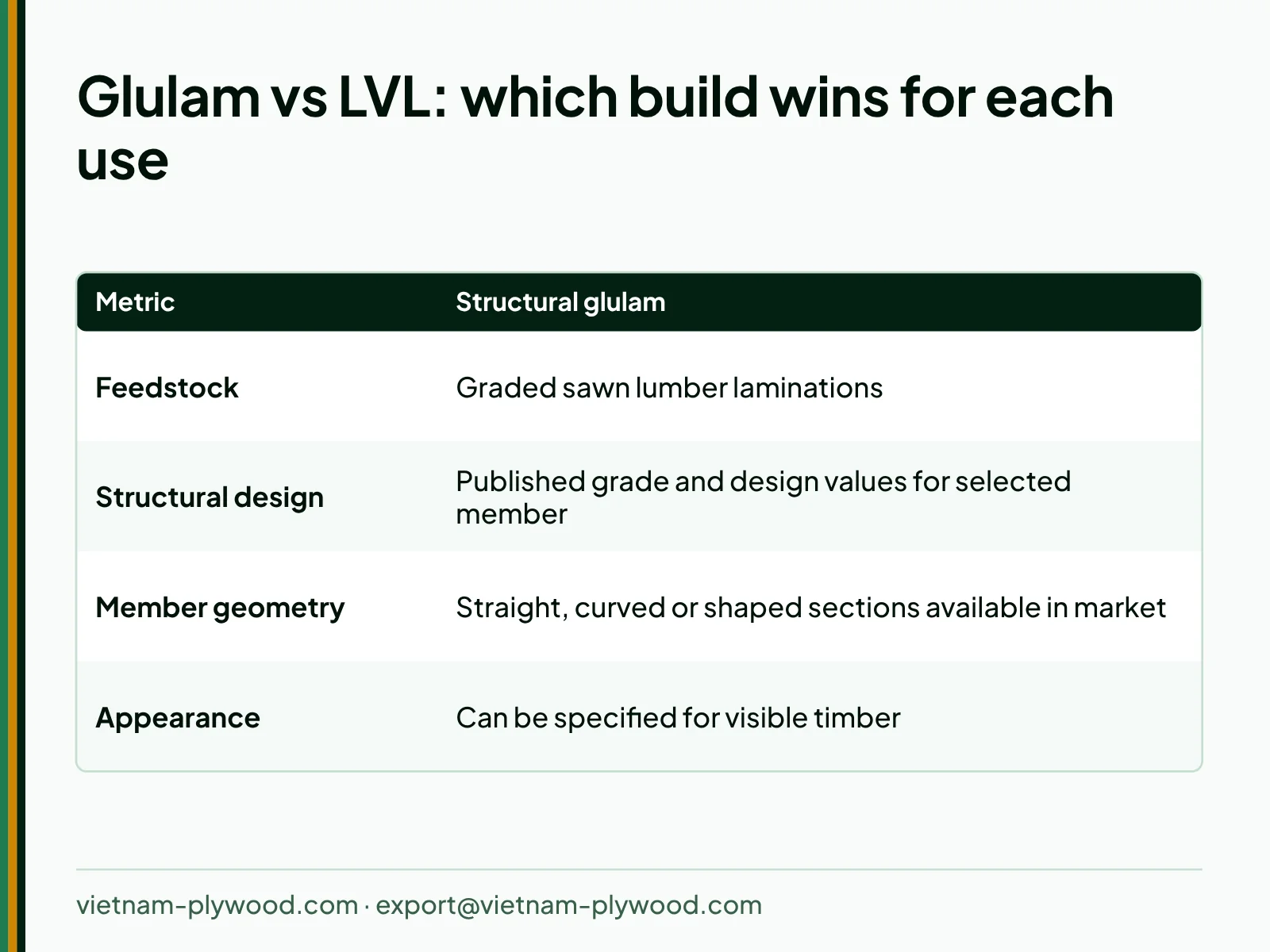
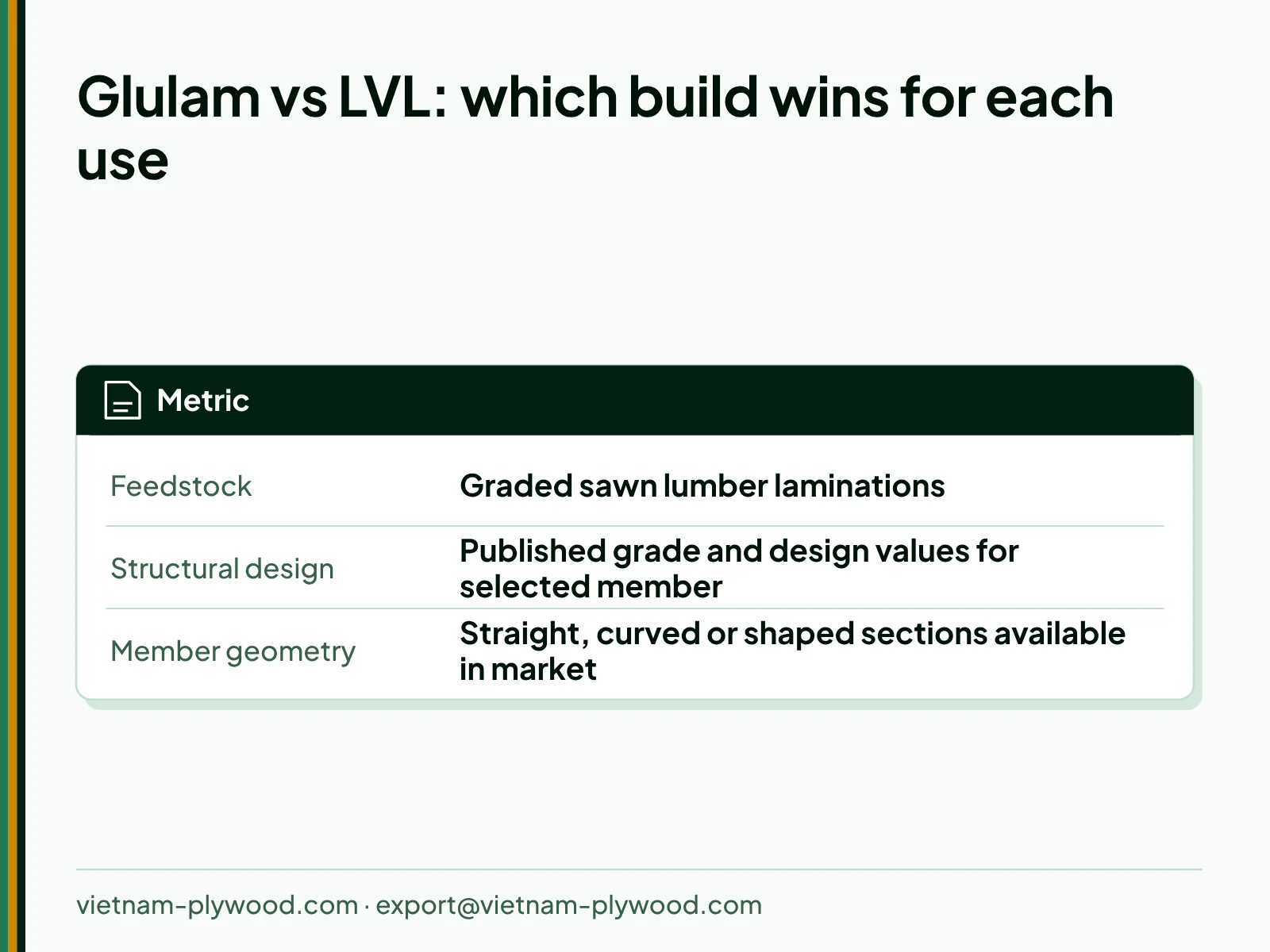
| Metric | Structural glulam | Structural LVL | our non-structural LVL | Verdict by use |
|---|---|---|---|---|
| Feedstock | Graded sawn lumber laminations | Parallel-oriented thin veneers | Veneer-based industrial stock | Glulam for specified exposed timber; industrial LVL for packing parts |
| Structural design | Published grade and design values for selected member | Product-specific design values and evaluation | No structural design values offered | Rated glulam or structural LVL for building beams |
| Member geometry | Straight, curved or shaped sections available in market | Predominantly straight sections | Straight cut industrial components | Glulam for curved architectural members |
| Appearance | Can be specified for visible timber | Usually concealed in framing | Industrial finish according to order | Glulam for exposed architecture |
| Repeatability | Engineered lumber grading and layup | Veneer grading and controlled layup | Buyer-defined dimensions and finish | Industrial LVL for repeatable non-load-rated stock |
| Moisture exposure | Select appropriate service specification | Select appropriate service specification | Select glue and handling for actual exposure | No material wins without exposure details |
| Fire design | Project-specific member and assembly design | Project-specific member and assembly design | No fire rating | Use engineered, accepted structural design |
| Purchasing basis | Structural grade, size, connection and design data | Product evaluation, grade, size and design data | Dimensions, glue, core, finish and inspection | Industrial LVL for packing and furniture components |
The 2019 APA glulam and structural composite lumber selection guides describe different specification paths for these engineered products. A material name alone cannot replace the relevant grade, design values or connection checks.
Is glulam stronger than LVL?
Neither material is automatically stronger in every beam configuration. Compare allowable bending stress, shear, modulus of elasticity, compression, section size, load duration and the applicable service conditions for the actual rated members.
A beam with higher bending strength can still fail a deflection or bearing check. A deeper section changes stiffness substantially; comparing unrelated dimensions gives a misleading result. Structural LVL can be an appropriate straight beam, while glulam often suits large or architecturally exposed sections.
For our industrial LVL, there is no structural strength ranking against glulam. The purchasing question is whether the component must carry a building design load or only serve a defined industrial assembly.
When does a beam span require structural material?
A beam span requires rated structural glulam or structural LVL whenever the member forms part of an engineered load path. Examples include roof beams, floor joists, headers over openings, and load-bearing columns or rafters.
The designer must check span, tributary loads, support conditions, deflection limits, lateral restraint, connection details and the jurisdiction’s acceptance criteria. For a roof or floor, the consequence of choosing non-structural stock can include rejection by the engineer or building inspector and replacement after delivery.
The 2019 APA structural composite lumber selection guide identifies allowable strength properties and specification guidance as key parts of structural product selection. Those are the documents a buyer should request before accepting a beam for a designed span.
Where does our non-structural LVL fit?
Our commercial and packing line makes non-structural LVL for packing runners, door stock and industrial furniture-frame parts. These applications are ordered by geometry, workmanship and exposure requirements rather than building-beam design values.
For a packing runner, state the supported package weight, contact points, handling method and whether the runner is replaceable. A buyer can then define acceptable dimensions and inspection checks without turning the material into a rated building beam.
For furniture frames and door stock, straightness, cut quality, face requirements and the next machining operation matter. Where a component will carry a person or a building load, obtain the applicable engineering approval instead of treating an industrial designation as a structural grade.
Formwork bearers require special care: temporary works can impose substantial loads. Our non-structural LVL is appropriate only for a non-load-rated auxiliary part under an accepted temporary-works plan, not as an assumed load-bearing bearer.
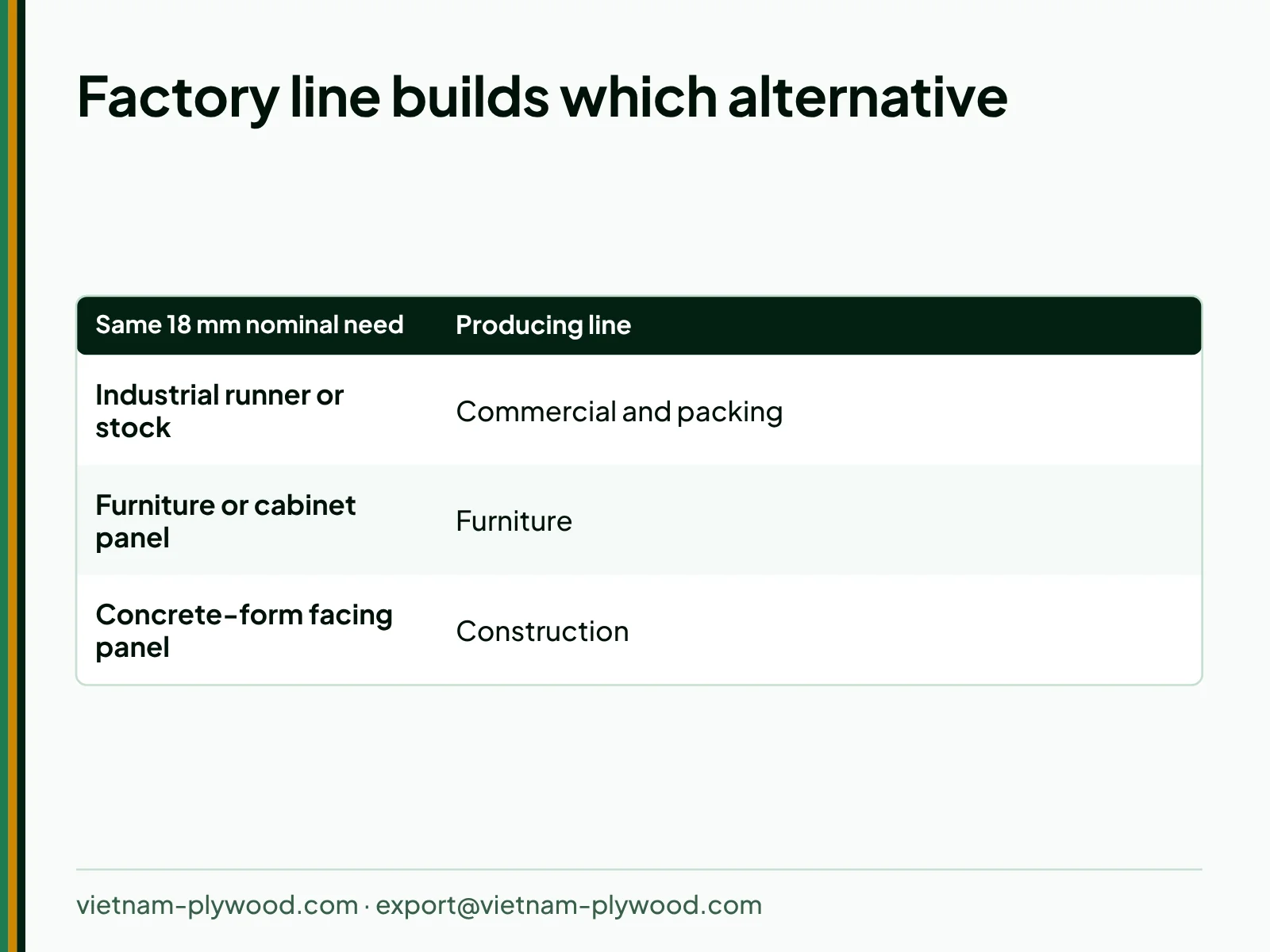
Which factory line builds which alternative?
The commercial and packing line handles our non-structural LVL, while the other lines produce different plywood constructions for their intended applications.
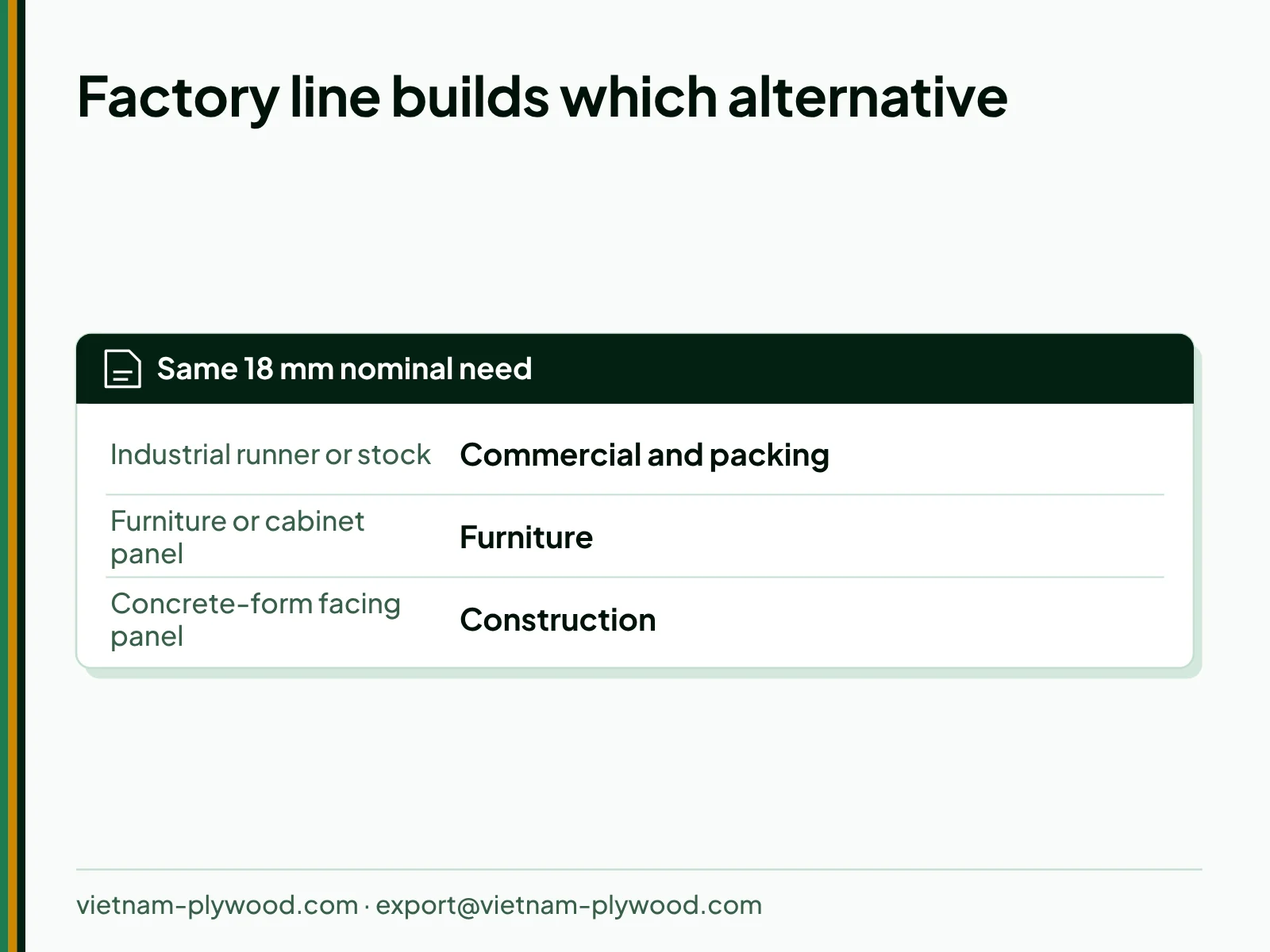
| Same 18 mm nominal need | Producing line | Core and finish | Appropriate purchasing decision |
|---|---|---|---|
| Industrial runner or stock | Commercial and packing | Acacia core, MR glue, unsanded or light-sanded | Specify non-structural component dimensions |
| Furniture or cabinet panel | Furniture | Styrax or eucalyptus core, full stitched, sanded, E0/E1 | Specify panel finish and thickness tolerance |
| Concrete-form facing panel | Construction | Acacia or eucalyptus core, phenolic or melamine film, unsanded | Specify film-faced panel for form contact |
These are different builds, even when a purchase order lists the same nominal thickness. Our factory-line comparison explains how the specification changes between them. See also core selection and product classification.
What should an inspector witness at the producing factory?
An inspector should match the industrial LVL lot to its approved specification before loading. Begin with the written drawing, target section and permitted dimensional deviations; then check the finished stock against them.
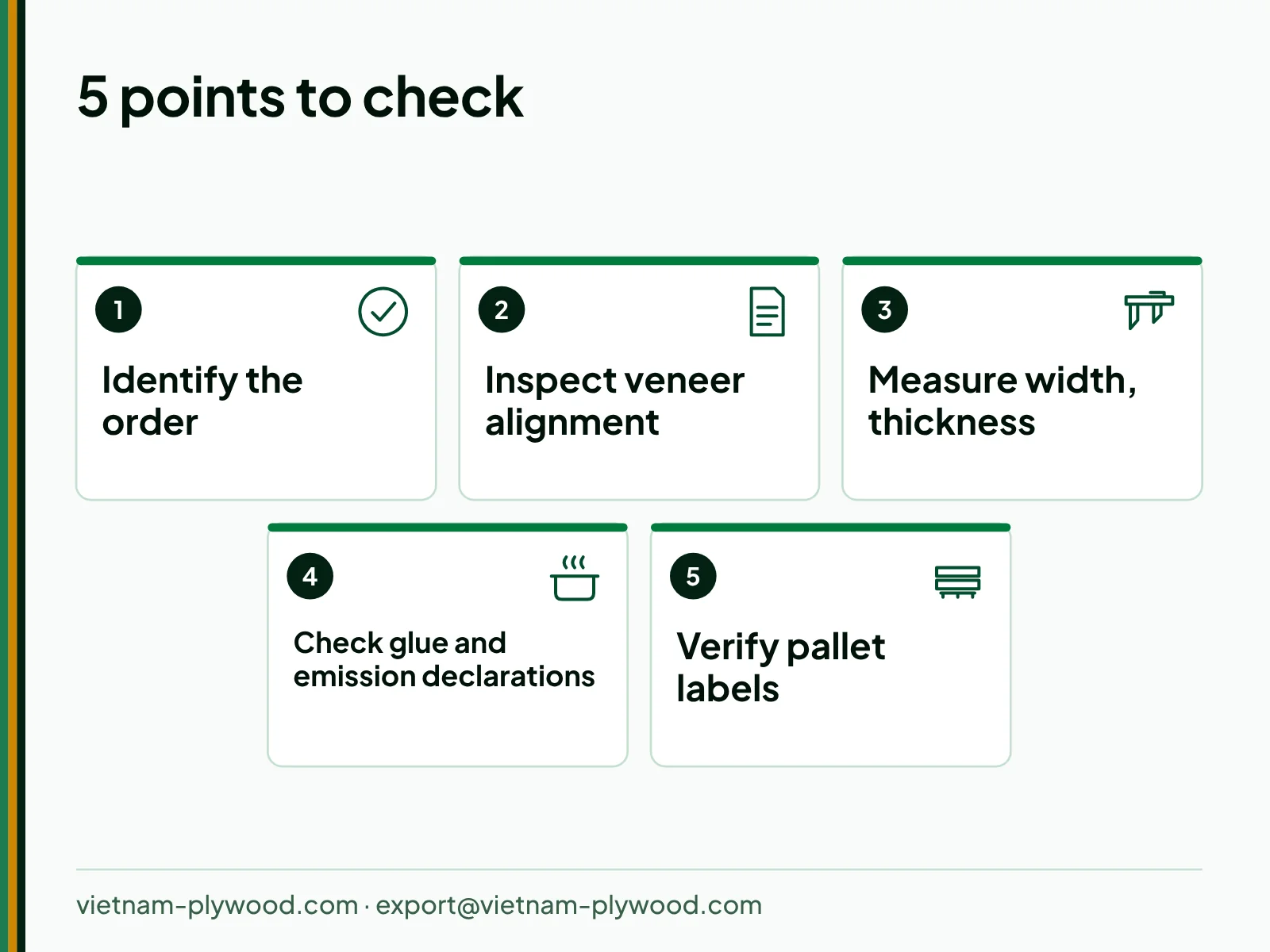
- Identify the order, lot and intended non-structural application at the producing factory.
- Inspect veneer alignment, visible joints, edges and surface condition on selected pieces.
- Measure width, thickness, length and straightness using the agreed sampling plan.
- Check glue and emission declarations as separate specification fields, alongside available order-specific test reports.
- Verify pallet labels, piece counts and packing against the draft packing list.
A visual inspection cannot establish structural design values. For a building beam, the buyer needs the structural manufacturer’s applicable grade, design documentation and acceptance evidence. Our quality-related build comparison shows why different orders call for different checks.
Can industrial LVL share a container with plywood?
Industrial LVL can be ordered alongside other specifications within the one-40HC minimum order, provided the loading plan respects the 28.5 t payload limit. The LVL quantity and mass must be established from its approved dimensions and packing data before allocation.
For a concrete comparison, 18 mm, 1220 × 2440 mm acacia-core plywood is listed at 880 sheets, 47.15 m³ and 27.35 t for a full 40HC load. For a mixed shipment, reduce the plywood allocation to accommodate LVL pieces, pallets and safe physical stowage.
A mixed load therefore needs a piece-by-piece weight and stowage schedule. The container packing reference covers the plywood load calculation; industrial LVL weights require the actual ordered section and packing details.
How do cost and handling compare?
Industrial LVL should be quoted from the required section, veneer construction, glue, machining and packing method. Structural LVL adds grading, performance documentation and acceptance requirements; glulam adds graded lumber laminations, structural layup and potentially shaped fabrication. Those extra processes typically make a rated or custom structural member more costly to produce than plain industrial stock, although a supplier’s actual quotation decides the purchase price.
A straight industrial runner is easier to specify by a cut list than an exposed curved beam. Large structural members can also require different lifting, protection, fastening and site handling. Do not substitute a cheaper industrial component for a rated beam to reduce the material line item.
We quote non-structural LVL against a written specification. The decision should include machining waste, rejection risk, freight mass and the cost of obtaining the required structural evidence from a structural supplier.
Which papers matter for export and acceptance?
The export documents identify the goods shipped; structural acceptance requires a separate product-specific evidence trail from the structural manufacturer. For our industrial LVL, the shipment’s commercial invoice and packing list identify the ordered description and quantity, with the bill of lading covering transport.
Our export documentation also includes the certificate of origin, phytosanitary and fumigation papers, insurance under CIF and order-specific certificate documents where agreed. EU lots include the EUTR/EUDR file set and EUR.1 where applicable. After loading, the draft shipping documents come to you for approval.
Member-factory certificates such as FSC, CARB P2, ISO 9001 or CE, and relevant EUDR/EUTR documents, are shown with factory details masked, on request. They do not turn industrial LVL into a structural beam. For exposed finish alternatives, review prefinished plywood options and wood veneer selection.
Do you supply structural LVL or glulam beams?
No. We supply non-structural LVL through our commercial and packing line; we do not supply structural LVL or glulam beams. For a load-bearing beam, obtain a structural product with the accepted grade, design values and engineering documentation.
We can discuss industrial stock for furniture frames, door components and packing runners. Formwork-related enquiries must distinguish auxiliary stock from engineered load-bearing members. A request described simply as an “LVL beam” needs its end use clarified before a quotation is prepared.
For the industrial product range, consult our LVL supplier details. The next purchasing step is to send the application and drawing, not a structural span calculation for an item outside our range.
What specification should an industrial buyer send?
Send an application-specific specification that identifies non-structural use and the inspection criteria. The producing factory can then prepare a build and packing plan around the actual component instead of a generic beam label.
Application: non-structural packing runner / door stock / furniture frame
Line or core: commercial and packing line / acacia
Glue: MR (melamine) or agreed requirement
Emission: E0 / E1 / E2 as ordered, separate from glue
Face and grade: industrial finish; state any face requirement
Thickness and tolerance: drawing value and agreed tolerance
Size: cut-section width x length, with drawing reference
Quantity: pieces and packing configuration; minimum one 40HC
Destination port: [port and country]
Book a factory visit with Lucy at export@vietnam-plywood.com to inspect the proposed industrial build and its packing at the producing factory.