





Is FSC certification mandatory for EU plywood imports?
No. Forest Stewardship Council (FSC) certification is voluntary for EU plywood imports, while the EU Deforestation Regulation (EUDR) creates legal duties for products within its scope. HCPLY separates the optional FSC claim from the mandatory regulatory evidence. Confusing the two can delay customs clearance, trigger extra document work or cause a buyer to reject a load.
A purchaser can require FSC under a private procurement contract even though EU law does not require an FSC label. Ask the purchasing team whether the purchase order demands an FSC claim, and ask the EU importer which EUDR records its operator role requires. The EU plywood due-diligence overview covers the wider import workflow.
The European Commission’s 2026 EUDR overview describes the legal market-access tests.
What is the difference between FSC and EUDR?
FSC is a voluntary forest and chain-of-custody certification system; EUDR is an EU market-access regulation with obligations assigned to specific supply-chain actors. The practical distinction is the document requested, the person responsible and the decision being made.
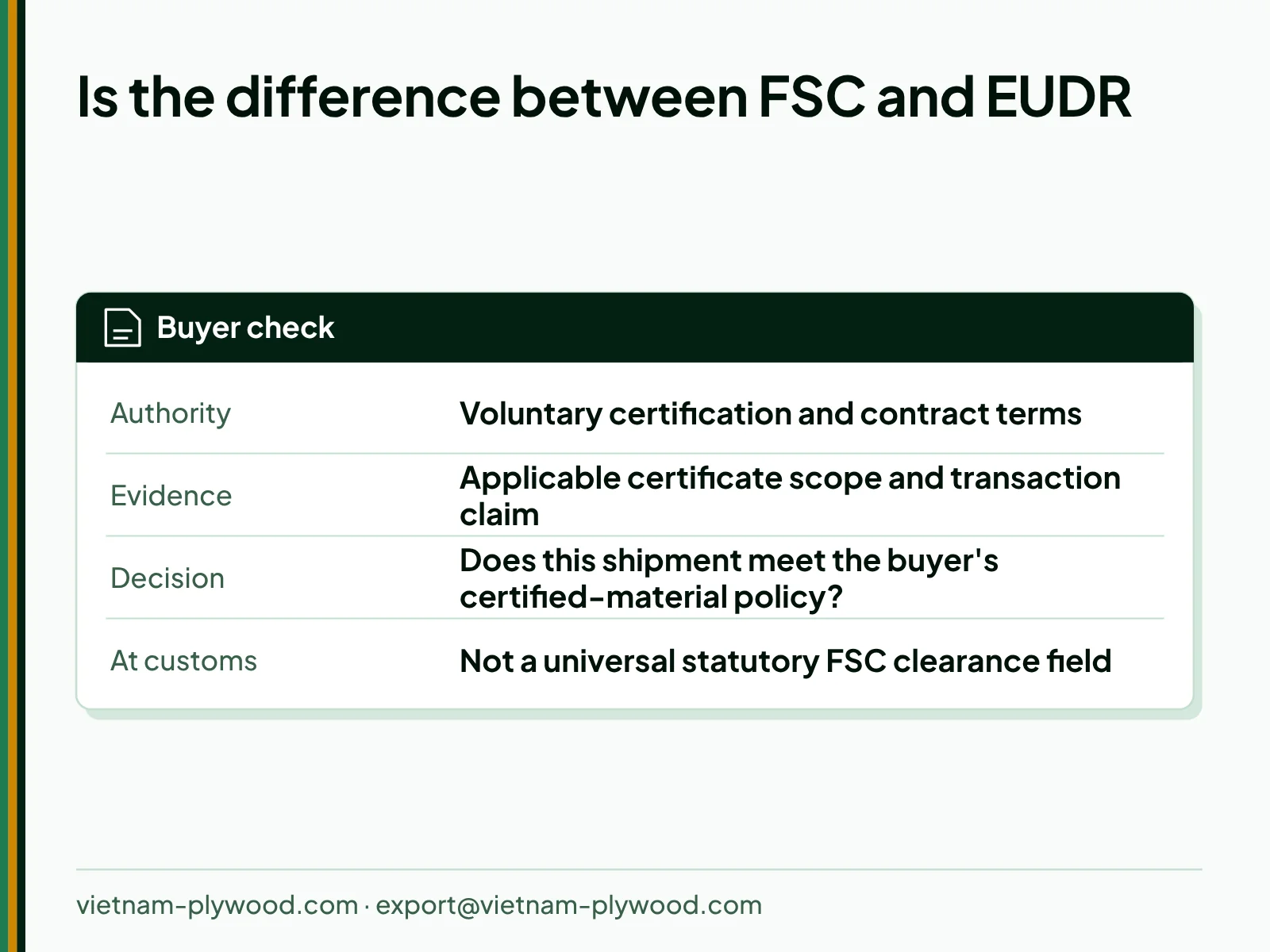
| Buyer check | FSC claim | EUDR compliance |
|---|---|---|
| Authority | Voluntary certification and contract terms | EU legislation for covered products |
| Evidence | Applicable certificate scope and transaction claim | Origin, geolocation, legality, risk work and required declaration |
| Decision | Does this shipment meet the buyer’s certified-material policy? | Can the responsible EU operator lawfully place it on the market? |
| At customs | Not a universal statutory FSC clearance field | Relevant due-diligence reference or declaration identifier when applicable |
| At customer audit | Chain-of-custody scope, invoice claim and material records | Traceability and records matching the imported goods |
| Verdict by use | Specify FSC for certified procurement | Complete EUDR work for regulated EU market entry |
The Forest Stewardship Council’s 2026 implementation guide explains that certification supports compliance work but does not transfer legal responsibility. A buyer should therefore assess both requirements independently.
Does FSC mean EUDR compliant?
No. An FSC claim can support traceability and risk assessment, but certification alone does not establish EUDR compliance. An EU operator still needs the information and procedures applicable to its role, including harvest location and legality evidence.
For plywood, a chain-of-custody record answers whether a certified claim passes through the relevant transactions. An EUDR record instead connects the wood input to harvest plots, species, country of production and regulatory risk checks. Those records should describe the same physical lot, even when held in separate systems.
The 2026 FSC guide states that core certification provides supporting evidence and infrastructure rather than a legal substitute for due diligence. Ask which FSC documents support each EUDR data field.
Which document does an EU customs check ask for?
For a covered import once the applicable EUDR duties take effect, the EU customs declaration needs the due-diligence statement (DDS) reference number or applicable simplified-declaration identifier. Customs clearance does not universally require an FSC certificate.
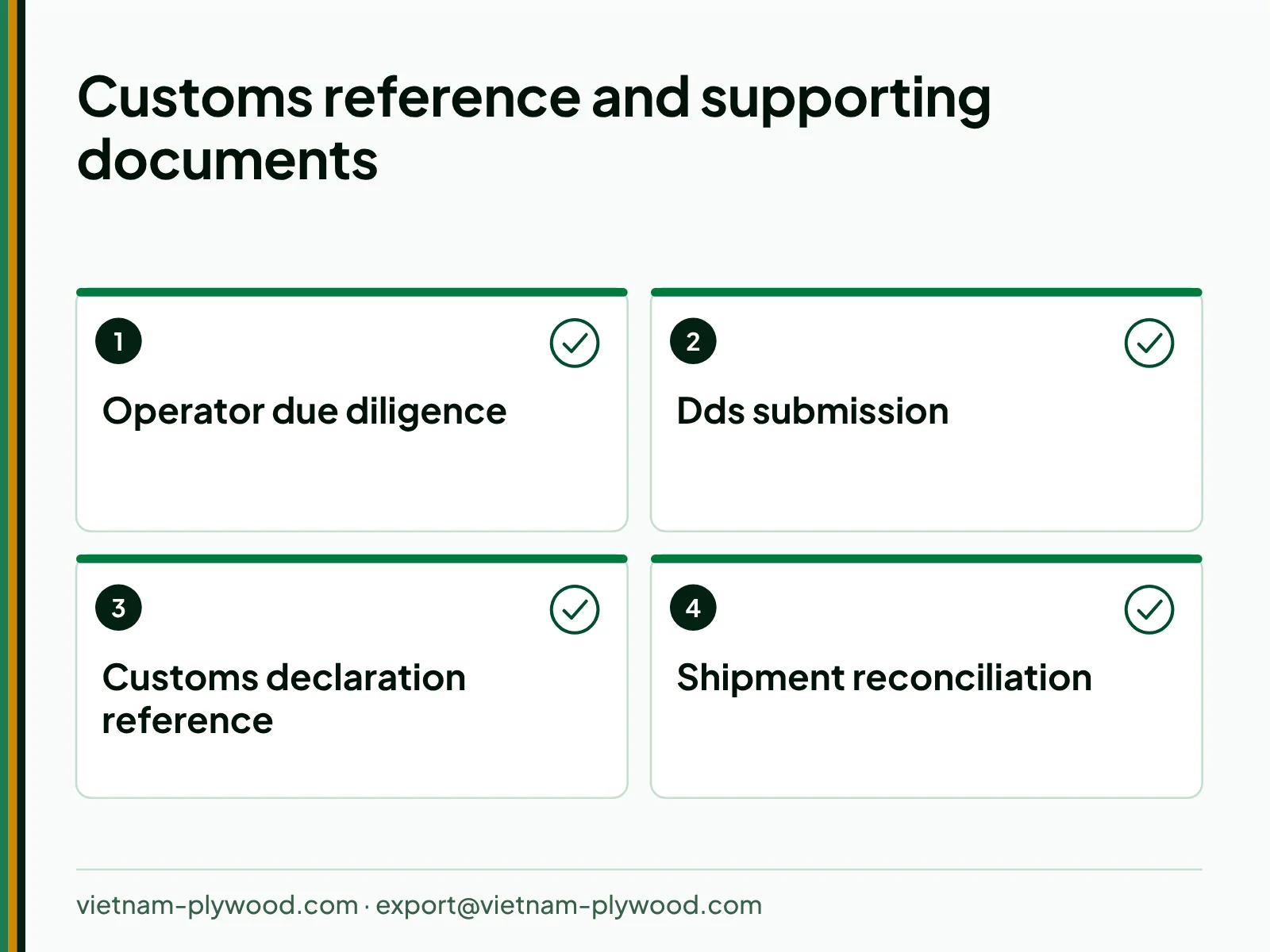
The European Commission’s due-diligence guidance says the reference or identifier must be available before the customs declaration is lodged. Its TRACES submission guide explains where the reference enters the customs supporting-document field.
The customs declarant also handles normal import information, including the commodity classification and operator identification. The European Commission’s customs operations guidance identifies the customs declaration as the formal record of imported goods and the Economic Operators Registration and Identification number as mandatory for EU customs operations. Match the declaration to the actual shipment documents.
When do the EUDR import duties begin?
The European Commission’s 2026 implementation timetable sets 30 December 2026 for medium and large operators and for micro or small operators already covered by the EU Timber Regulation. Most other micro and small operators have a 30 June 2027 application date. The date follows operator category and product scope.
Plywood importers should identify their own EU legal entity and applicable start date before booking. The EU Timber Regulation remains relevant under transitional provisions, so an upcoming EUDR date does not remove existing timber legality duties.
The Commission’s EUDR timetable distinguishes these dates. Record the operator category and planned customs entry date in the order file, then check any regulatory updates before filing.
Which document does a customer audit ask for?
A customer audit asks for evidence against the customer’s purchasing specification, which can include an FSC claim and a separate EUDR traceability package. The audit team should be able to match the order, producing factory, lot and shipping records.
For an FSC purchase, request the relevant member-factory certificate scope, its validity for the product and the agreed claim on sales documents. Certificates held by member factories are shown with factory details masked, on request. The commercial invoice should carry the agreed claim where applicable; a certificate image alone does not identify the delivered batch.
For EUDR, request the traceability information needed by the EU operator, including wood species, harvest location, legal origin and supporting supplier records. Compare the species and volume on the order with the origin file. The Vietnam timber sources page explains the material-origin questions worth resolving before production.
Can one plywood order carry both an FSC claim and an EUDR file?
Yes. An order can carry an FSC claim where the producing line holds the applicable scope and the transaction qualifies, alongside the EUTR/EUDR file set for an EU lot. The two records answer different questions and should identify the same goods.
HCPLY’s three factories in Phu Tho and Hai Phong have different production roles. The order is made at the producing factory, with specification, on-site quality control, export documents and loading coordinated end to end. Buyers can inspect goods at that factory and meet at its factory office.
Before accepting an FSC-priced specification, ask which member factory will produce it and what claim can appear on the sales documents. For an EU order, align the wood-origin evidence with the actual material inputs before production.
How do the factory lines change the paperwork?
The line determines the plywood build and which member-factory certificate scope must be checked. Common thickness does not make the products interchangeable.
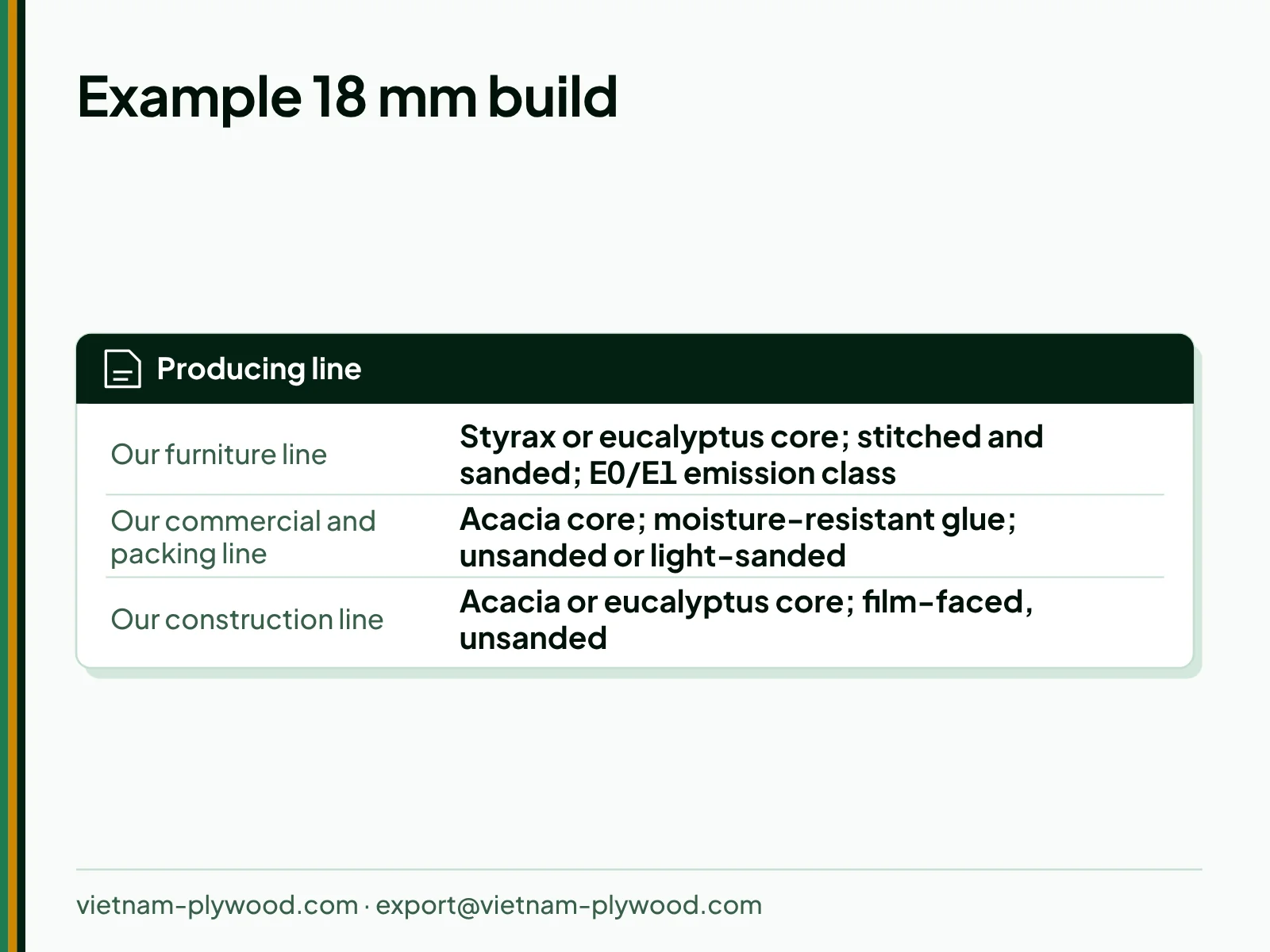
| Producing line | Example 18 mm build | Factory check tied to records |
|---|---|---|
| Our furniture line | Styrax or eucalyptus core; stitched and sanded; E0/E1 emission class | Match face, core, thickness and certificate scope |
| Our commercial and packing line | Acacia core; moisture-resistant glue; unsanded or light-sanded | Match acacia origin and packing-grade description |
| Our construction line | Acacia or eucalyptus core; film-faced, unsanded | Match film specification, core origin and lot identity |
A furniture plywood order and a commercial or packing plywood order need distinct descriptions even if both are 18 mm. The factory-line comparison shows the construction differences. HCPLY does not manufacture birch-core plywood.
What can an inspector witness at the producing factory?
An inspector can check the panel identification and production records against the paperwork that will accompany the shipment. Arrange this check before loading so a mismatch can be corrected at its source.
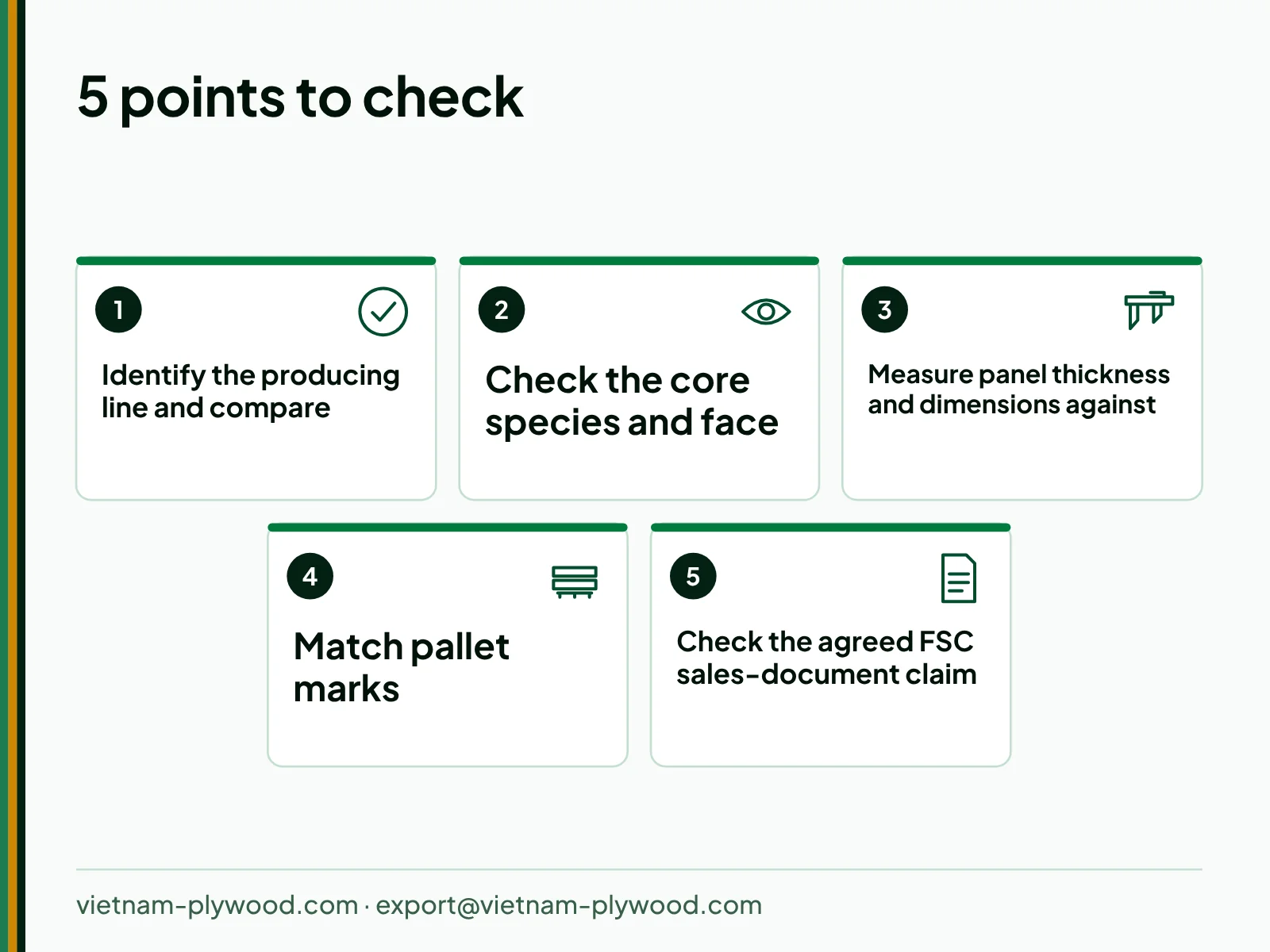
- Identify the producing line and compare the order specification with the production lot.
- Check the core species and face designation against material records and the traceability file.
- Measure panel thickness and dimensions against the agreed tolerances; for example, furniture sanded thickness can be ordered at ±0.2 or ±0.3 mm, while commercial and film-faced thickness is ±0.5 mm.
- Match pallet marks, quantities and packing list entries to the inspected goods.
- Check the agreed FSC sales-document claim, if any, against the applicable member-factory scope and reconcile the EU origin records.
This is a physical and document consistency check. It helps the buyer find discrepancies before the goods leave the factory; the EU operator remains responsible for its regulatory submissions.
How do mixed specifications affect an EU traceability file?
Mixed specifications can share a 40HC container within its 28.5 t payload limit, but each distinct wood input still needs a traceable lot description. Separate pallet and invoice lines make an audit easier than a generic container-level label.
For 18 mm, 1220 × 2440 mm panels, the factory loading lookup gives 990 styrax-core sheets at 26.52 t, 880 acacia-core sheets at 27.35 t, or 795 eucalyptus-core sheets at 27.69 t for full single-core loads. These full loads are alternatives. A mixed load requires recalculating total weight from its actual quantities and cores; see container loads.
Use the packing list to map pallet groups to the production records and EUDR material file. Retain separate origin evidence for different wood inputs.
What belongs in the EU shipment document set?
The EU shipment set connects the commercial transaction, shipment identity, agreed certification claims and timber-origin evidence. Keep the relevant records aligned rather than attaching unrelated certificates.
HCPLY prepares the commercial invoice, packing list, bill of lading (B/L), certificate of origin including EUR.1 for EU lots, phytosanitary and fumigation papers, and insurance under CIF. Agreed certificate documents can include an FSC claim on sales documents, emission certificates and test reports for the ordered build; EU lots also carry the EUTR/EUDR file set. After loading, the draft shipping documents come to you for approval.
The EU operator uses its own due-diligence process and information system to submit the required statement. The DDS reference comes from the EU filing. For related future product-data requirements, see digital product passports for wood.
What should an importer specify before placing the order?
Write the FSC requirement as an explicit transaction claim and the EUDR requirement as a separate origin-evidence deliverable. Agree who checks each record and when the EU operator needs it for its customs filing.
Ask for the producing factory’s applicable certificate scope, the core species and harvest-origin records needed for the lot. Check the expected entry date against the EUDR timetable and verify that the declared product classification matches the goods. If the buyer needs certified material, make the FSC claim part of the written order rather than assuming every panel carries it.
For quotation and document coordination, send Lucy at export@vietnam-plywood.com the following specification. Request the spec sheet as the next step.
Application: EU import for distribution / furniture / packing / formwork
Line or core: furniture / commercial and packing / construction; core species
Glue: melamine MR / phenolic WBP as ordered
Emission: E0 / E1 / E2 as ordered
Face and grade: species or film specification; grade
Thickness and tolerance: mm; permitted deviation
Size: length × width in mm
Quantity: sheets and container allocation
Destination port: EU port and country
FSC claim requested: exact purchasing requirement, if applicable
EUDR origin file: species, harvest-location and legality records for the lot