






A digital product passport for furniture will connect finished products to regulated electronic records, while HCPLY supplies order-linked plywood facts. Incorrect species, glue or batch data can delay a buyer’s compliance review and require costly document corrections. The digital product passport furniture discussion should start with records the producing factory can actually verify.
What is the digital product passport furniture framework?
A digital product passport for furniture is an electronic product record whose mandatory fields will be set by European Union product-specific rules. It connects a finished furniture item or model to structured information through a data carrier. For a cabinet maker, the practical starting point is reliable records for every incoming panel specification and production lot.
The European Parliament and Council’s 2024 Ecodesign Regulation (ESPR) defines the passport framework. Article 9 leaves the data fields, access permissions and model, batch or item level to delegated acts. The passport therefore cannot yet be reduced to a universal furniture checklist.
A furniture producer assembling plywood, fittings and finishes will need to reconcile supplier evidence with the finished product record. HCPLY can supply the panel-side specification and shipment evidence; the furniture business placing the finished item on the EU market manages the applicable passport obligations. A wrong panel identity or unmatched lot can cause document rework, delay acceptance and add inspection costs.
When does ESPR apply to wood products?
ESPR is already a framework law, but a furniture passport becomes compulsory only under applicable product-specific measures and their compliance dates. The European Commission’s Digital Product Passport page identifies 2028 as the indicative year for adopting furniture-specific rules, rather than a blanket 2028 compliance deadline.
The Commission’s Digital Product Passport FAQ explains that inclusion in the working plan starts an assessment, rather than automatically imposing a passport. The subsequent act must establish the covered products, data requirements and timetable. The Commission also describes a transition period after adoption.
A cabinet made from plywood and a standalone plywood sheet should not automatically be assigned identical passport duties. Product classification and the eventual delegated act determine coverage. Buyers can prepare traceable inputs now without claiming that a final dpp plywood schema exists.
What data will a plywood supplier have to provide?
The mandatory supplier contribution will follow the furniture measure’s final data model and the commercial responsibilities agreed with the furniture producer. A sensible procurement record already distinguishes panel identity, material composition, origin, manufacturing evidence and the finished-product information held elsewhere.
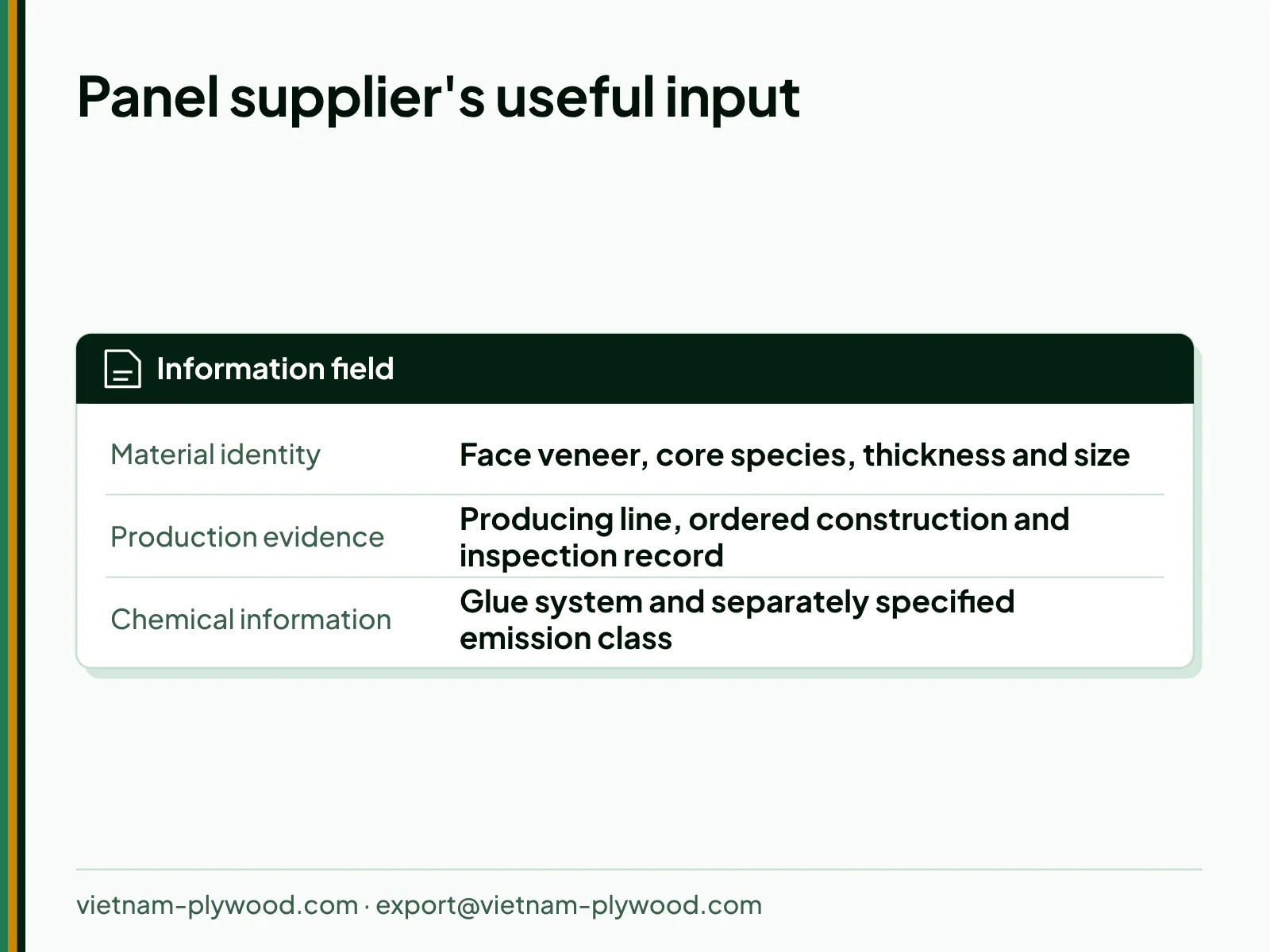
| Information field | Panel supplier’s useful input | Furniture maker’s additional task |
|---|---|---|
| Material identity | Face veneer, core species, thickness and size | Associate panels with furniture model or batch |
| Production evidence | Producing line, ordered construction and inspection record | Link incoming lots to finished units |
| Chemical information | Glue system and separately specified emission class | Assess finished product’s applicable requirements |
| Origin and traceability | Wood-source records and EU due-diligence file where relevant | Reconcile all components and supplier records |
| Supporting documents | Agreed test reports and shipment references | Maintain the final passport and access permissions |
The 2024 ESPR Annex III includes potential identifiers, commodity codes and compliance documentation. These are possible data elements, not a published mandatory furniture field list. Buyers should distinguish a supplier’s factual material record from any future passport data format.
Which plywood data can the producing factory already hand over?
Our furniture line can record the ordered face, core, glue, emission class, dimensions and tolerance as the panel specification. For example, a styrax-core furniture panel with an okoume face remains identified by its face, while the core determines the density used for load planning.
Our furniture line uses full-stitched, sanded styrax or eucalyptus cores with E0 or E1 emission classes. An order can specify a 0.2–0.4 mm common face veneer, an A/B face grade where applicable, and sanded thickness tolerance of ±0.2 or ±0.3 mm as ordered. Glue and emission must occupy separate fields: melamine MR and phenolic WBP describe glue systems, while E0 and E1 describe emission classes.
HCPLY manages specification, on-site quality control, export papers and loading. The buyer can inspect the goods at the producing factory and compare panel markings or pallet identification with the approved order specification. This provides a concrete chain from purchased material to the buyer’s incoming inventory record.
How do the three production lines differ for passport inputs?
The ordered construction determines which factory presses the panels and which data fields need special attention. The same nominal 18 mm thickness can represent three different purchasing specifications.
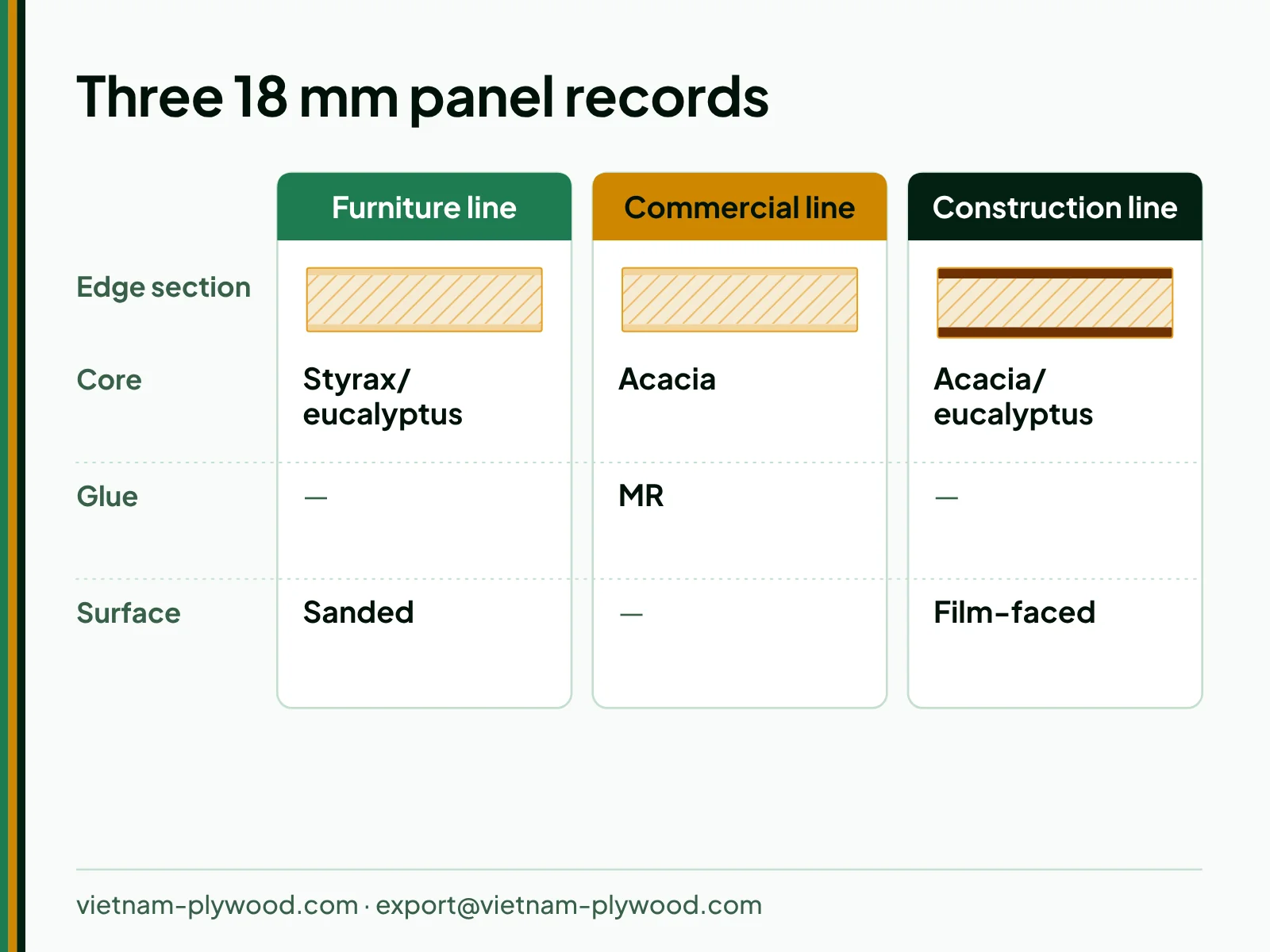
| 18 mm example | Core and build | Surface and tolerance | Likely buyer record |
|---|---|---|---|
| Furniture | Styrax or eucalyptus, full stitched | Sanded veneer face; ±0.2 or ±0.3 mm as ordered | Decorative face, emission class, cabinet application |
| Commercial and packing | Acacia, MR glue | Unsanded or light-sanded; commercial ±0.5 mm | Packing use, acacia core, glue specification |
| Construction | Acacia or eucalyptus | Film-faced, unsanded; ±0.5 mm | Film weight, glue and formwork application |
The construction line uses phenolic or melamine film, including anti-slip film. Its standard film is 120 g/m², premium film 135 g/m² and anti-slip film 220 g/m². Those film descriptions should not be copied into a furniture veneer-face field. The comparison of plywood grades across factory lines helps procurement teams distinguish builds that share dimensions.
How does the digital product passport relate to the EUDR file?
The EU Deforestation Regulation (EUDR) addresses commodity origin and due diligence, while the digital product passport addresses product information under the applicable product rules. They can draw on overlapping species and origin records without becoming the same legal document.
The European Parliament and Council’s 2023 EUDR, consolidated in 2026, specifies information on wood species, country of production and geolocation of production plots for covered products. A factory’s general country-of-origin statement alone does not replace the relevant plot-level evidence.
For EU lots, the shipment documentation includes an EUTR/EUDR file set. The buyer should match that file to the ordered panel construction and the material lot referenced in its internal bill of materials. Our EUDR due-diligence guide for plywood importers addresses that separate legal workflow; Vietnam plywood timber sources explains the origin questions behind a wood-species entry.
How should a cabinet maker structure a panel record?
A panel record should preserve the ordered specification and an unambiguous link to the shipment that supplied it. A practical schema separates facts confirmed at production from fields awaiting the furniture-specific delegated act.
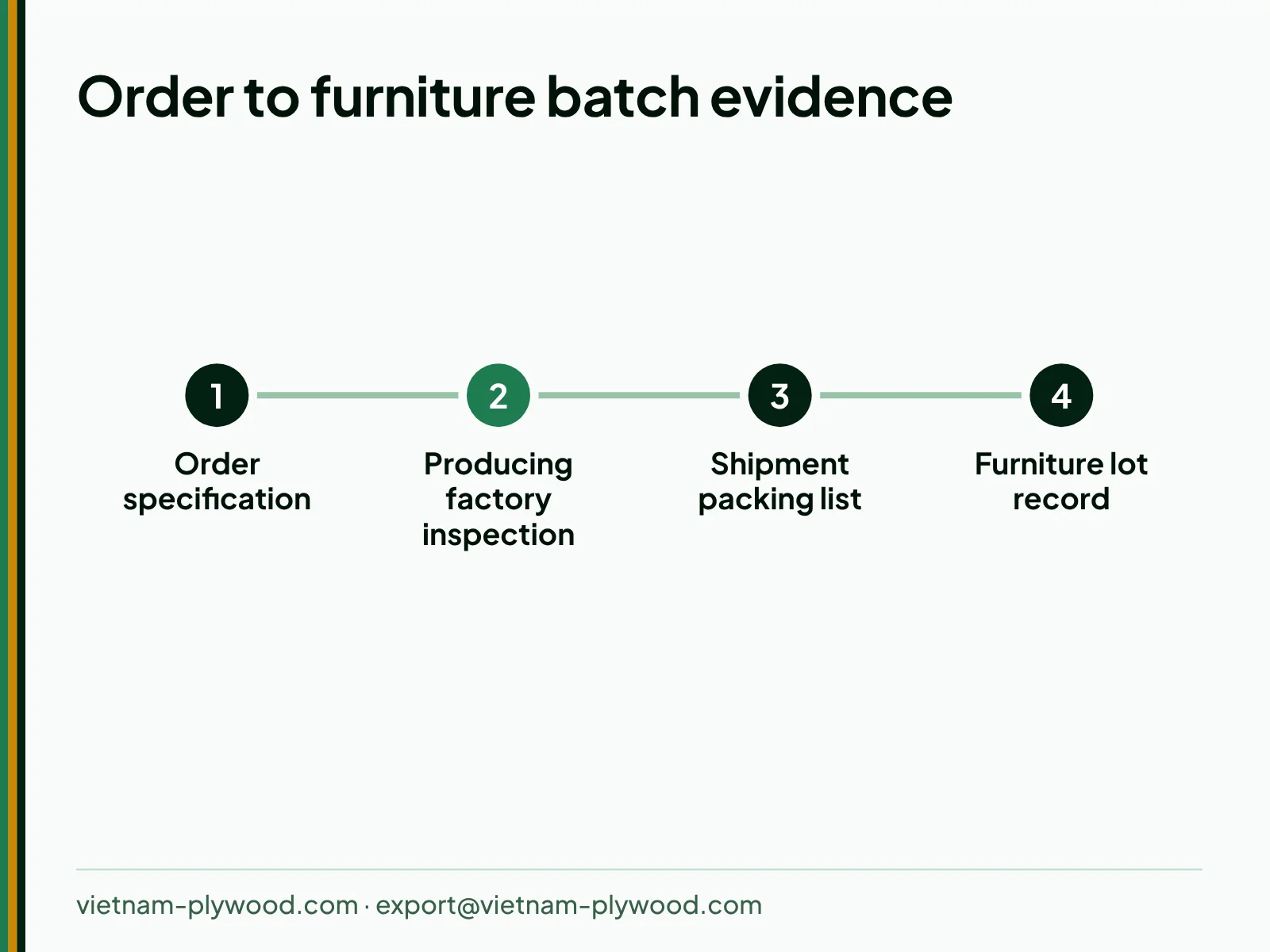
- Assign an internal panel specification ID and link it to the purchase order.
- Record face species and grade separately from core species and construction.
- Store glue type, emission class, nominal thickness, tolerance and sheet dimensions as individual fields.
- Attach the producing-factory inspection record and the relevant test or certificate documents for the agreed build.
- Connect the pallet or shipment reference to the furniture production lot consuming those sheets.
- Map fields into the future furniture passport only after the final regulatory data requirements are published.
For a 1220×2440 mm, 18 mm styrax-core sheet, the planning weight is 26.79 kg. That number describes the specified core-density calculation, not the weight of a completed cabinet. Recording the exact material specification prevents a later substitution from silently inheriting the original documentation.
Can different panel specifications share a shipment?
Specifications can be mixed in a 40HC container within the 28.5 t payload limit. That gives a furniture buyer room to coordinate multiple panel builds while preserving separate specification and lot records.
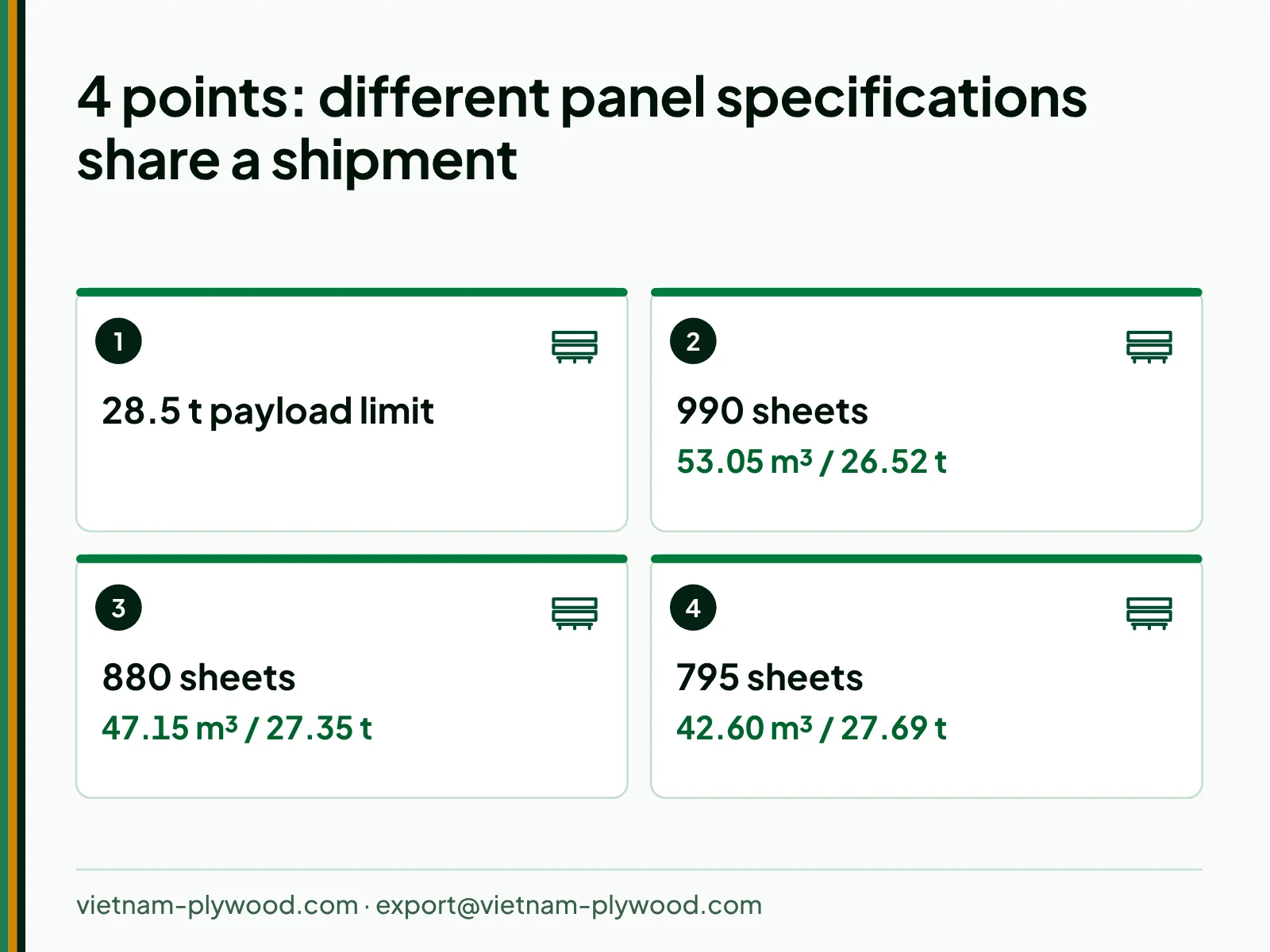
For the 1220×2440 mm, 18 mm reference, a full styrax-core load is 990 sheets, 53.05 m³ and 26.52 t. An acacia-core reference load is 880 sheets, 47.15 m³ and 27.35 t; eucalyptus-core is 795 sheets, 42.60 m³ and 27.69 t. These are distinct full-load lookups, not quantities to add together.
A mixed order needs its own weight calculation and a packing list identifying the individual builds. The container-load calculation page owns the detailed loading question. This shipment-level distinction is useful when the cabinet maker must connect each incoming material batch to a finished product record.
What can an inspector witness at the factory?
An inspector can compare the physical panels and the agreed order against the factory’s production and loading records. The check should focus on evidence the finished-furniture producer can reuse.
At the producing factory, buyers can inspect the face veneer designation, core construction at a cut edge, measured thickness, sanding and pallet segregation. For an 18 mm panel, the ordered ply construction can be checked against the stated 11–13 plies, with actual count driven by core veneer thickness. Thickness measurements should be assessed against the tolerance selected on the order.
For document review, the buyer can request applicable member-factory FSC, CARB P2, ISO 9001 or CE materials, shown with factory details masked, on request. The relevant certificate or test evidence must be assessed for the agreed product and order; a generic label is not a substitute for the specified emission field. This inspection records what was actually supplied.
Which export documents connect the panel to the buyer?
The packing list and commercial invoice connect the ordered panel descriptions and quantities to the shipment. The bill of lading (B/L) then ties that shipment to its transport record.
Depending on the order and destination, the export file includes the certificate of origin (EUR.1 for EU lots), phytosanitary and fumigation papers, insurance under CIF, and agreed certificate documents such as an FSC claim on sales documents, emission certificate or test reports. After loading, the draft shipping documents come to you for approval.
These records are useful evidence inputs for material traceability, although they are not themselves a finished-furniture passport. HCPLY ships FOB Hai Phong, with CFR (CNF) and CIF also available. Buyers specifying several panel types can review one supplier for several plywood types before assigning internal material codes.
What remains undecided in the furniture passport rules?
The exact furniture passport fields, identifier granularity, access rights and binding start date await the applicable delegated act. Procurement teams should avoid paying for a fixed template presented as a final EU furniture requirement.
The 2024 ESPR requires the delegated act to specify whether a passport is maintained at model, batch or item level. The European Commission’s 2026 economic-operator guidance likewise assigns creation and accuracy responsibilities to the economic operator placing the regulated product on the EU market. A plywood supplier can contribute verified input data but does not choose the legal scope for the finished furniture.
Likewise, an EU digital product passport timber request should distinguish existing EUDR due diligence from proposed future passport fields. Request both data sets by their proper names and record any gap. This approach leaves the material record usable even when the regulatory schema changes.
What should buyers send with a panel-data request?
Send the complete panel specification, the intended furniture application and the documents needed for the buyer’s traceability system. The request should identify the desired data fields rather than ask for a generic passport certificate.
For furniture plywood, the indicative starting price is from US$350/m³ FOB Hai Phong (October 2026). Face selection, core construction, sanding, thickness tolerance and order mix affect the final quotation. Minimum order is one 40HC; specifications can be mixed within the payload limit. Production is 15–45 days from the 30% deposit, set by order size, line loading and the contract. Balance is 70% on the scanned bill of lading, by T/T or irrevocable sight L/C.
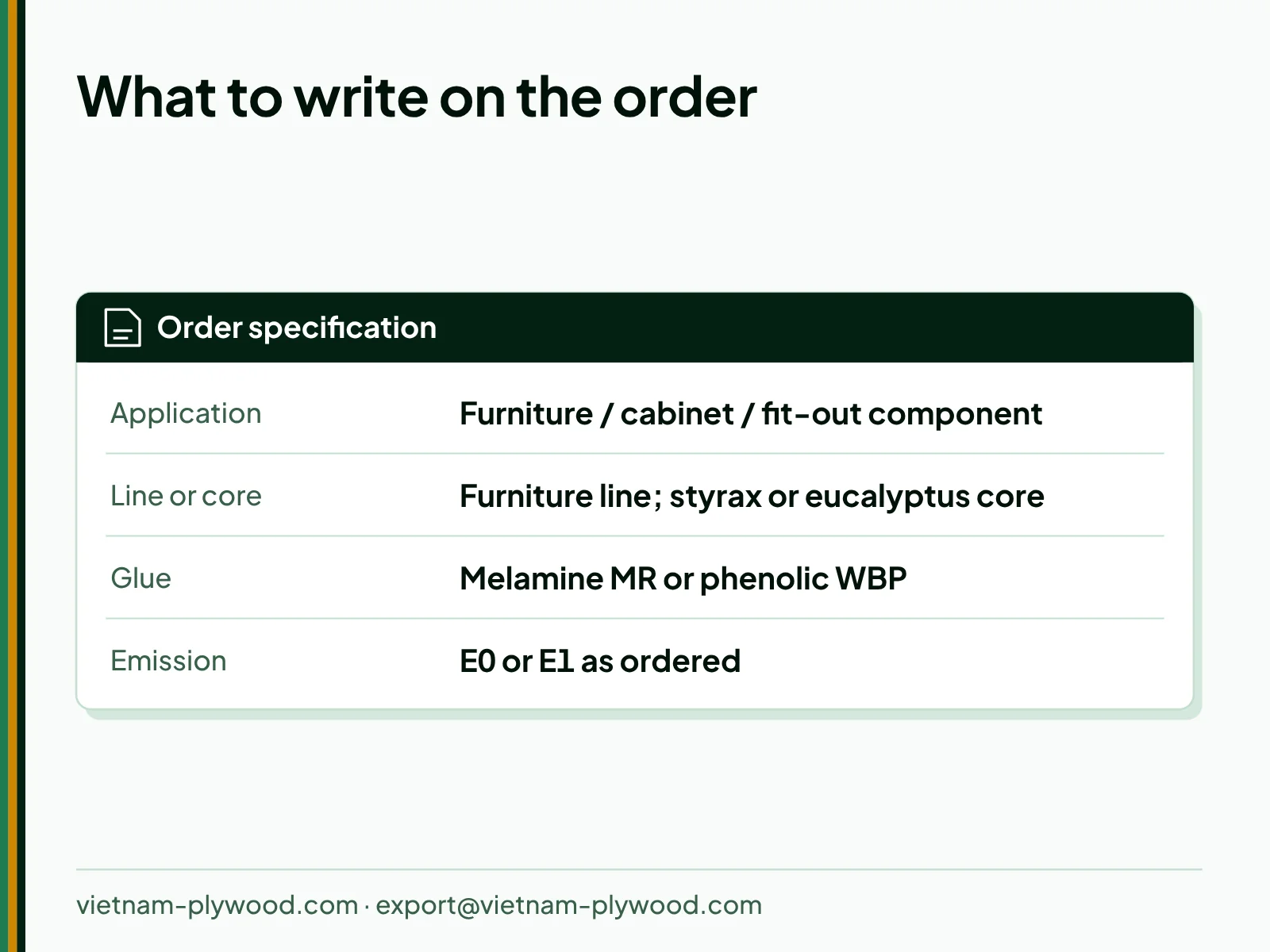
Use the furniture plywood specification page to choose the panel build, then send the following lines to Lucy at export@vietnam-plywood.com.
Application: furniture / cabinet / fit-out component
Line or core: furniture line; styrax or eucalyptus core
Glue: melamine MR or phenolic WBP
Emission: E0 or E1 as ordered
Face and grade: species; A/B grade where applicable
Thickness and tolerance: ___ mm; ±0.2 or ±0.3 mm as ordered
Size: ___ × ___ mm
Quantity: ___ sheets / ___ m³; mixed specifications if needed
Destination port: ___
Next step: request the panel specification sheet with the order-linked data fields needed for your furniture record.