






Vietnam forestry supplies plantation timber for plywood cores, with source records linking veneer purchases to finished shipments. An incorrect species or incomplete origin trail can delay an importer’s clearance and create costly rework. HCPLY builds furniture, commercial and construction plywood in Phu Tho and Hai Phong; the source of each core and face lot must be identified from the order records.
Where is Vietnam forestry timber grown for plywood?
Vietnam’s plantation timber comes from several forest-growing belts, including northern uplands and central provinces. For plywood procurement, the useful question is the origin of the actual veneer lot, rather than the province printed on a factory address. HCPLY presses plywood at producing factories in Phu Tho and Hai Phong, but a factory location alone does not identify a harvest plot. The buyer needs a documented path from timber origin to the finished shipment.
Northern upland plantation districts include areas around Phu Tho and neighboring provinces; central Vietnam also has substantial plantation activity. Acacia growing regions in Vietnam span more than one province, and veneer can travel before pressing. The harvesting locality, veneer supplier, receiving factory and finished-panel lot therefore need separate fields in the origin record.
Vietnam forestry statistics describe a national resource, while an import declaration concerns particular goods. The distinction matters when an importer must resolve a missing plot reference before customs clearance. A regional map is useful for planning collection, but it cannot replace the supporting origin documents for the veneers actually used.
Is Vietnamese plywood made from plantation timber?
Plantation timbers, particularly acacia and eucalyptus, are important inputs to Vietnamese plywood. The plantation origin of a specific shipment still needs to be documented from its purchased timber or veneer lots. Do not infer plantation origin solely from the species, a finished panel’s appearance, or a general description of forestry in Vietnam.
The 2026 industry overview published by Vietnam Plywood describes smallholder plantation supply and distinguishes shorter pulpwood rotations from logs retained for veneer. The plantation source matters to a plywood buyer because small-diameter timber can change peeling yield and veneer sorting. The producing factory assesses veneer dimensions, defects and core construction before selecting material for a particular order.
A plantation record should identify the growing location and harvest rights or lawful supply route. A supplier invoice can help follow commercial custody, but an invoice without the underlying origin connection leaves a gap. Ask for the specific documents tied to the input batch, not a generic statement that Vietnamese wood comes from plantations.
Which regions grow acacia for plywood cores?
Acacia is grown across northern and central Vietnamese plantation areas, rather than in a single national production zone. For a Phu Tho or Hai Phong order, a buyer should ask which district and supplier supplied the veneer batch. Regional availability and the factory’s purchasing route are different facts, and the latter must be established from order records.
Central plantation areas are discussed in the forestry article published by FOMEX, which also notes that early harvesting can yield smaller logs. Its discussion of Nghe An and Quang Tri illustrates regional supply networks, not the sourcing of any HCPLY shipment. The northern production location similarly does not establish that every acacia core originated nearby.
A practical sourcing worksheet lists province, district, supplier, species, harvest evidence, receipt date and veneer-lot reference. Keep a separate entry for each source when multiple origins feed a pressing batch. That structure makes a mixed-origin shipment easier to examine than a single country-of-origin line.
Which plantation source feeds each factory line?
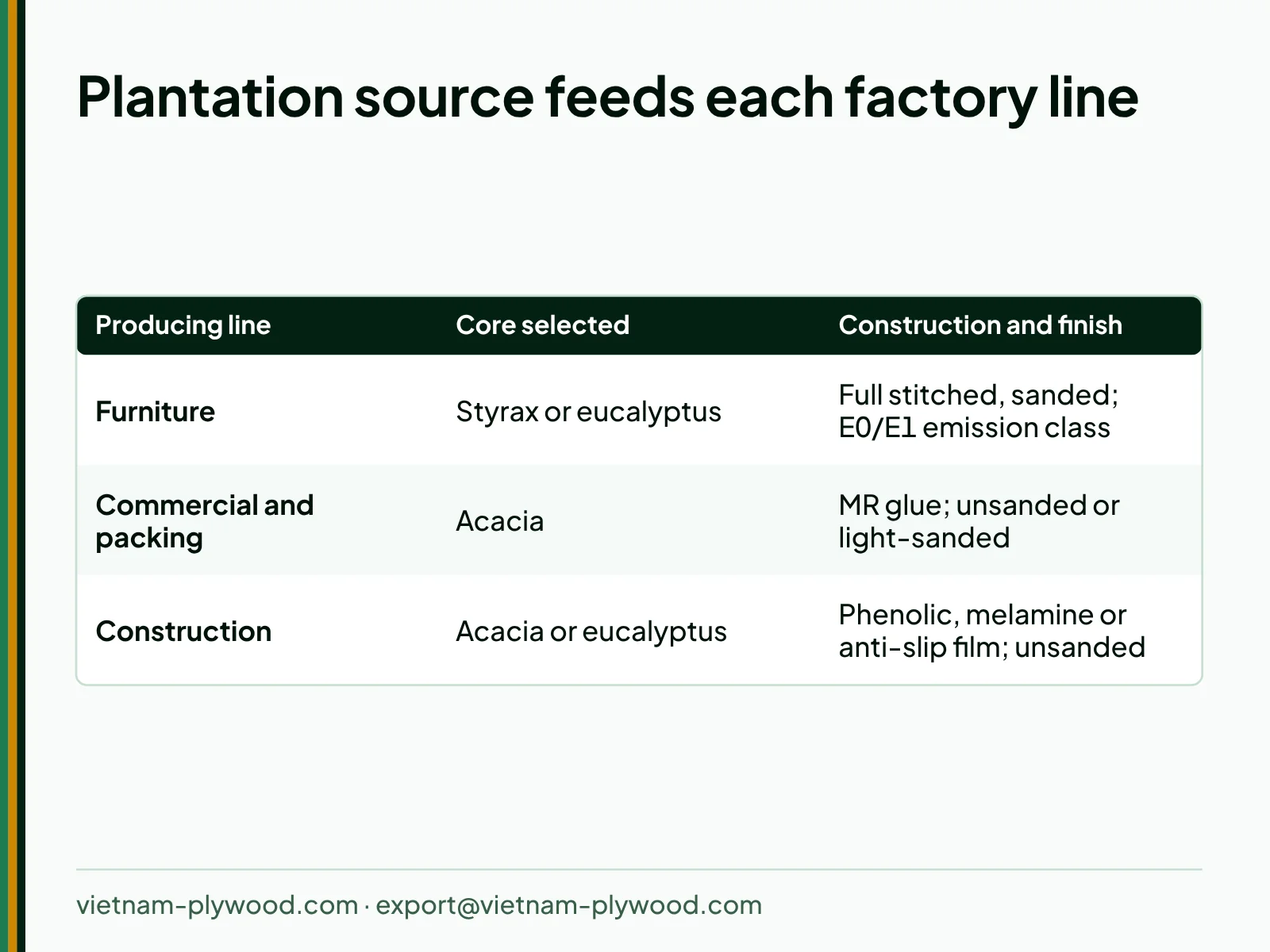
The actual plantation-to-line allocation must be read from the receiving and production records for the order. Our furniture line uses styrax or eucalyptus cores; our commercial and packing line uses acacia cores; our construction line uses acacia or eucalyptus cores. Those core choices describe manufacturing specifications, not fixed commitments to any named growing district.
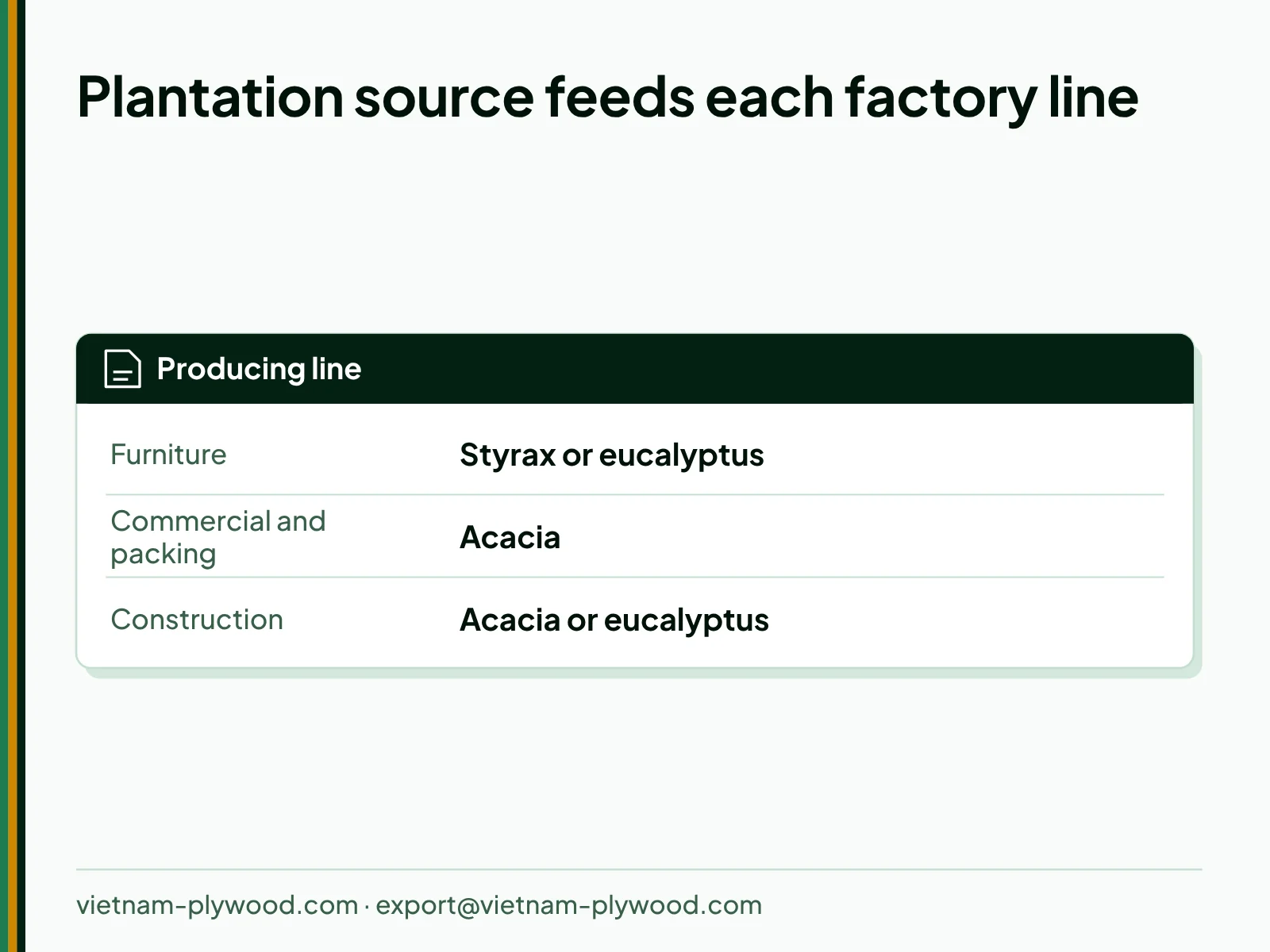
| Producing line | Core selected | Construction and finish | Origin question for the buyer |
|---|---|---|---|
| Furniture | Styrax or eucalyptus | Full stitched, sanded; E0/E1 emission class | Which input lots supplied the selected core? |
| Commercial and packing | Acacia | MR glue; unsanded or light-sanded | Which acacia receipts entered this pressing lot? |
| Construction | Acacia or eucalyptus | Phenolic, melamine or anti-slip film; unsanded | Which core receipts support the film-faced batch? |
The same nominal 18 mm sheet can therefore represent different timber inputs and manufacturing routes. Density follows the core rather than the face: styrax 500 kg/m³, acacia 580 kg/m³ and eucalyptus 650 kg/m³. A bintangor or okoume face name alone does not identify the core’s forest origin.
HCPLY allocates the order to the producing factory that matches the written specification. For eucalyptus-core applications, compare the intended use with our eucalyptus plywood specification. Ask for core species and face species as separate order fields, since each can have a distinct supply chain.
How do core and face origin records follow a shipment?
Core and face veneer need parallel origin trails that meet at the finished production lot. A veneer face can be a different species from the core, and a panel named after its face does not establish where its core grew. This is particularly relevant to bintangor, okoume, engineered veneer and other decorative finishes.
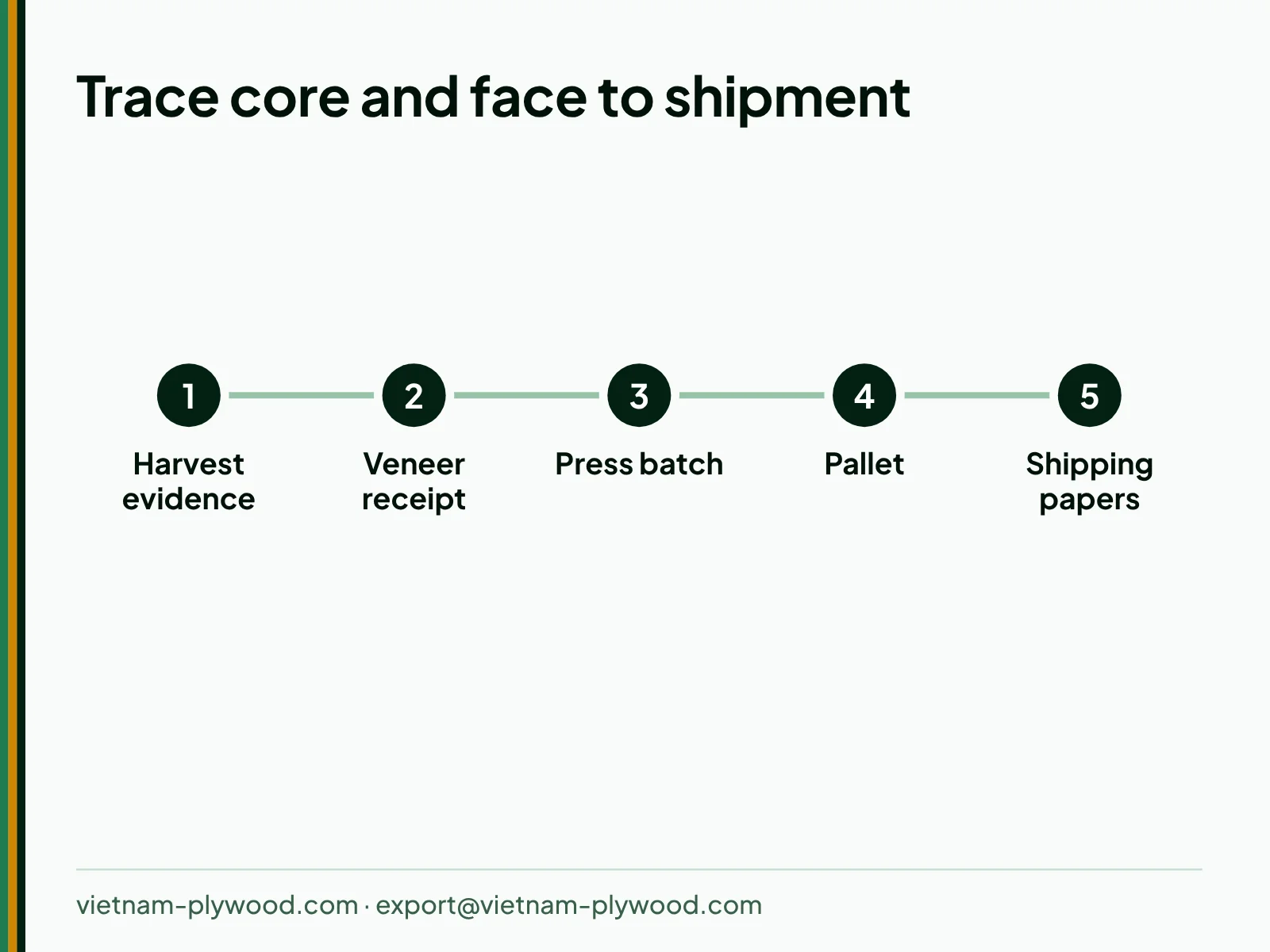
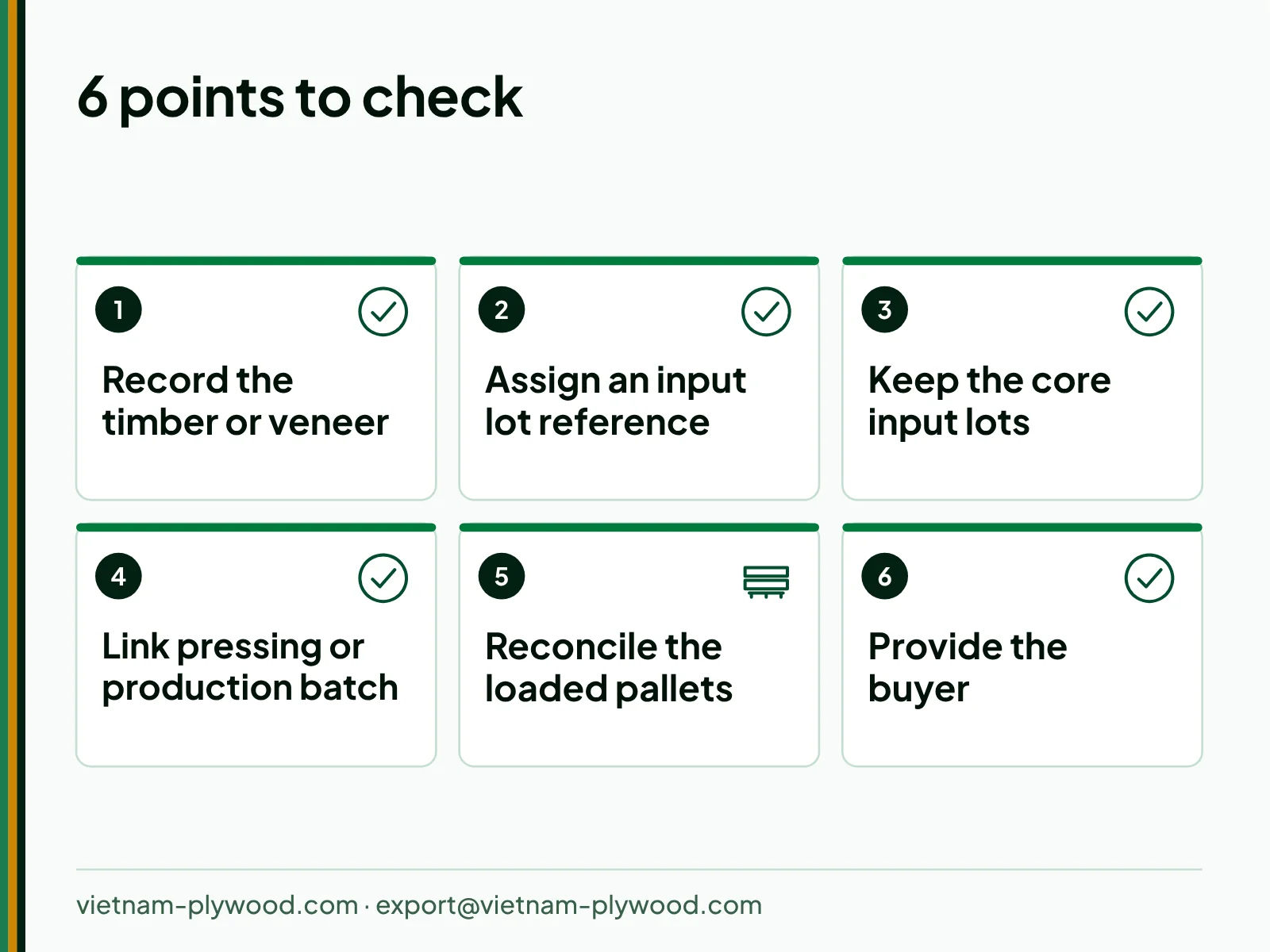
- Record the timber or veneer supplier, declared species, origin locality and supporting harvest or purchase documents.
- Assign an input lot reference when the producing factory receives and checks the material.
- Keep the core input lots distinct from the face veneer lots in the manufacturing record.
- Link pressing or production batch identifiers to the finished pallets and packing list.
- Reconcile the loaded pallets, commercial invoice and bill of lading with the order’s origin evidence.
- Provide the buyer with the applicable supporting files for its import-country due-diligence review.
The chain is only as informative as its weakest transition. If a veneer supplier combines material before delivery, the supporting list of contributing sources matters. An origin spreadsheet that simply repeats the factory’s address cannot answer where the trees grew.
At the producing factory, the buyer or inspector can compare receipt labels with batch records, examine the declared core at an exposed panel edge, and match finished pallet marks to the packing list. Visual inspection can distinguish construction details; documentary checks establish harvest origin. These are complementary checks.
What evidence belongs in an EU deforestation file?
An EU Deforestation Regulation (EUDR) file addresses the origin of relevant wood inputs, their legality and the applicable deforestation requirements. Regulation (EU) 2023/1115, as amended and published on EUR-Lex in 2025, requires information about the geolocation of relevant production plots. The regulation also addresses production timing, suppliers and evidence of lawful production.
For a plywood order, start with the core and face input lists, then connect each input to its source plot information and the applicable legal-origin documents. Where several plots contributed wood, the relevant plot records cannot be replaced by one factory coordinate. A shipment’s certificate of origin addresses trade origin and should not be confused with the plot-level data required for deforestation due diligence.
The EU plywood due-diligence guide explains the importer workflow. The regulation’s consolidated EUR-Lex text provides the legal baseline; buyers should apply the version in force when placing goods on the EU market. HCPLY’s EU shipment document set includes the EUTR/EUDR file set and EUR.1 for EU lots.
Factory-held FSC, CARB P2, ISO 9001 and CE certificates are shown with factory details masked, on request. A certificate can support a particular question within a sourcing review, but its scope and the lot’s source evidence should be examined separately. For information systems that could carry material identifiers forward, see digital product passports for wood.
What goes into a US Lacey Act origin file?
A US Lacey Act review focuses on lawful harvest and the information required for the particular imported product. The importer should establish the botanical identity and country of harvest of wood inputs, together with supplier and legality records. The exact declaration requirements follow the product classification and current US rules.
For a mixed-species plywood panel, the face and core should not be collapsed into one generic species entry. Record the species identified by suppliers, the declared harvest country and the documents supporting that identification. Keep shipment references consistent across supplier papers, production records and the importer’s declaration preparation.
A country-of-manufacture statement is useful for customs paperwork, but it does not answer every question about the country where the wood was harvested. If a face veneer has a separate origin, its evidence belongs in the same shipment-level review. Buyers should resolve uncertain botanical names before finalizing an import filing.
How do core choices change container planning?
Core density changes the weight of a plywood shipment even when the panel dimensions are identical. At 18 mm and 1220 × 2440 mm, the reference sheet weights are 26.79 kg for styrax, 31.08 kg for acacia and 34.83 kg for eucalyptus. These figures exclude film weight.
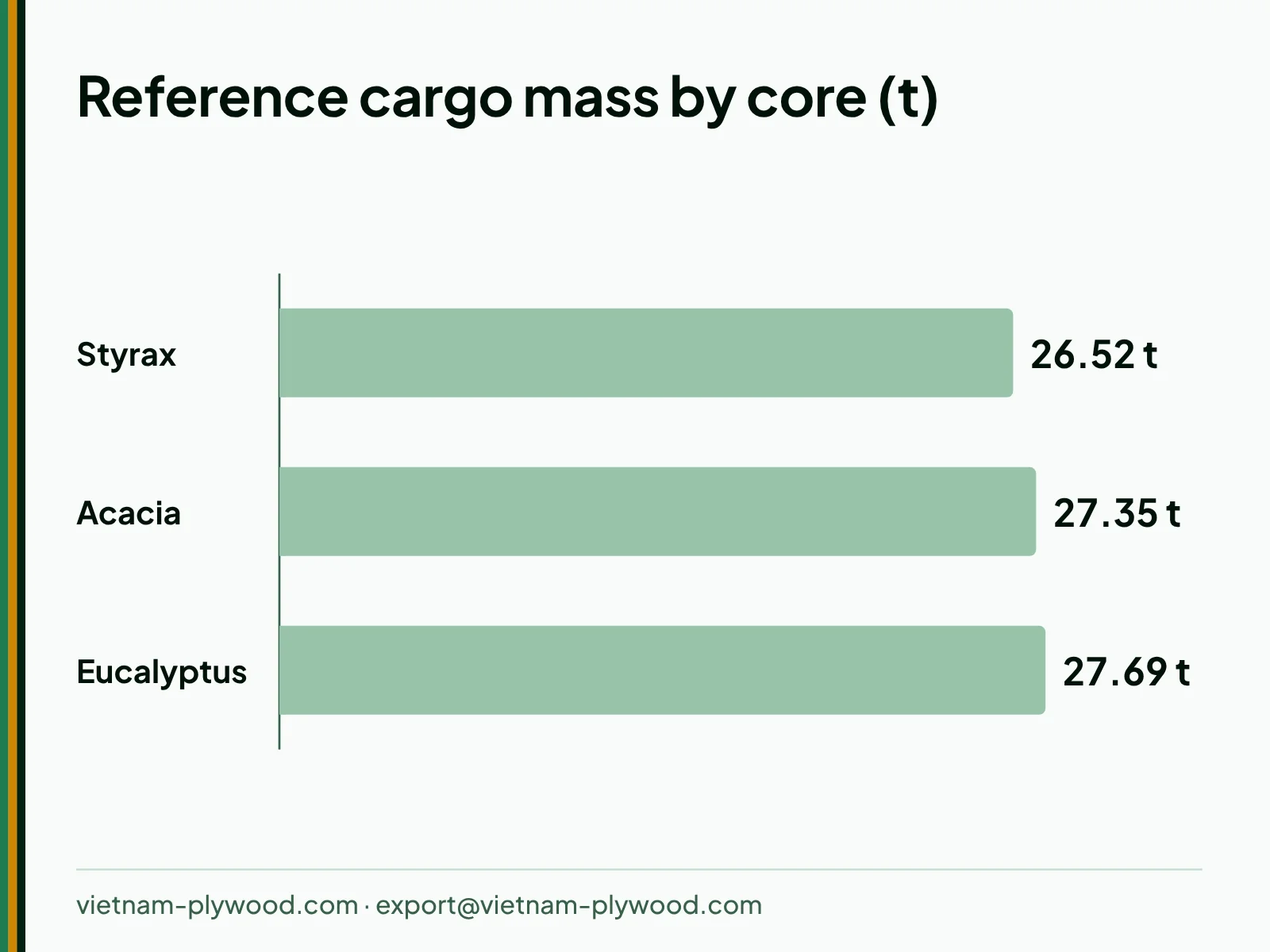
| Core | 18 mm sheets per 40HC | Reference volume | Reference cargo mass |
|---|---|---|---|
| Styrax | 990 | 53.05 m³ | 26.52 t |
| Acacia | 880 | 47.15 m³ | 27.35 t |
| Eucalyptus | 795 | 42.60 m³ | 27.69 t |
The 40HC payload limit is 28.5 t. Specifications can be mixed in a container within that limit, so a furniture-core batch and an acacia packing batch can be planned together against their combined mass. The mixed-container specification guide covers that purchasing option, while container loading quantities owns the full loading calculation.
For mixed loads, put each line’s thickness, dimensions, core and quantity on the packing plan. A volume-only estimate can obscure the weight difference between styrax and eucalyptus. The producing factory’s pallet count must also be reconciled with the final loading list.
Which factory checks can an inspector witness?
An inspector can witness receipt-to-batch reconciliation, core identification and finished-pallet traceability at the producing factory. Start with the written specification and the input lot register, then follow the batch to pressing and packing. This is more informative than checking a decorative face alone.
For our furniture line, examine full-stitched core construction and sanded thickness against the ordered ±0.2 or ±0.3 mm tolerance. For commercial plywood, check the acacia core, MR-glue build and ±0.5 mm thickness tolerance; packing tolerance is ±0.5–1.0 mm. For the construction line, check the selected acacia or eucalyptus core, film specification and ±0.5 mm tolerance.
A buyer can also compare veneer receipt documents with the claimed species and origin in the batch register. A physical panel check cannot establish plot geolocation, so the paperwork needs its own review. Ask the inspector to note any missing link between supplier batch, factory receipt, production lot and pallet label.
Our three factories receive buyers at the factory office and support goods inspection at the producing factory. HCPLY handles specification, on-site quality control, shipping documents and loading for the export order.
Which export documents carry origin information?
The shipment document set connects the commercial goods to the buyer’s supporting origin review. It includes the commercial invoice, packing list, bill of lading, certificate of origin, phytosanitary and fumigation papers, and the order’s applicable certificate documents. Insurance is included under CIF, with the EUTR/EUDR file set for EU lots.
The certificate of origin identifies the trade-origin declaration, while the timber-origin evidence tracks the source of the wood. A packing list identifies the shipped pallets and quantities, allowing the importer to relate the file to the actual load. The supporting material should reference the relevant order, production batch or shipment rather than a disconnected sample.
After loading, the draft shipping documents come to you for approval. For distributor replenishment across specifications, see plywood supply programmes. We ship FOB Hai Phong, or CFR (CNF) or CIF to your port, with each order produced and shipped from its assigned factory.
What should a buyer request before approving a source?
Request a written material specification and a traceability checklist before production. The specification should identify the application, core, face, glue and emission class separately. The checklist should name the documents that connect each material input to the finished shipment.
For a furniture order, ask whether the chosen styrax or eucalyptus core meets the required weight and machining needs. For packing, describe the load-bearing and surface requirements so the acacia build is selected correctly. For construction, state the film type and expected site conditions without treating a film label as evidence of structural performance.
The buyer should also decide which import regime applies and what records must be available for review. An EU request for plot data and a US request for species and harvest-country details have overlapping inputs but different filing steps. Give the producing factory the checklist early enough for material receipt records to be linked to the order.
What specification should be sent for a sample set?
Send one complete specification that ties the plywood build to the requested origin evidence. Include the core and face species separately, the intended destination and the documentation required for the import review. A precise request allows the producing factory to select the appropriate manufacturing line and prepare a relevant sample.
Application: furniture cabinets / commercial packing / formwork
Producing line or core: furniture—styrax or eucalyptus / commercial—acacia / construction—acacia or eucalyptus
Glue: melamine MR or phenolic WBP, as specified
Emission: E0 / E1 / E2, as ordered
Face and grade: species and A/B grade (birch face D/E/F)
Thickness and tolerance: ___ mm; ordered line tolerance ___ mm
Sheet size: ___ × ___ mm
Quantity: ___ sheets / ___ 40HC
Destination port: ___
Origin records requested: core and face source-lot links; applicable EU or US evidence
Ask Lucy at contact or export@vietnam-plywood.com for a sample set against that written specification.