





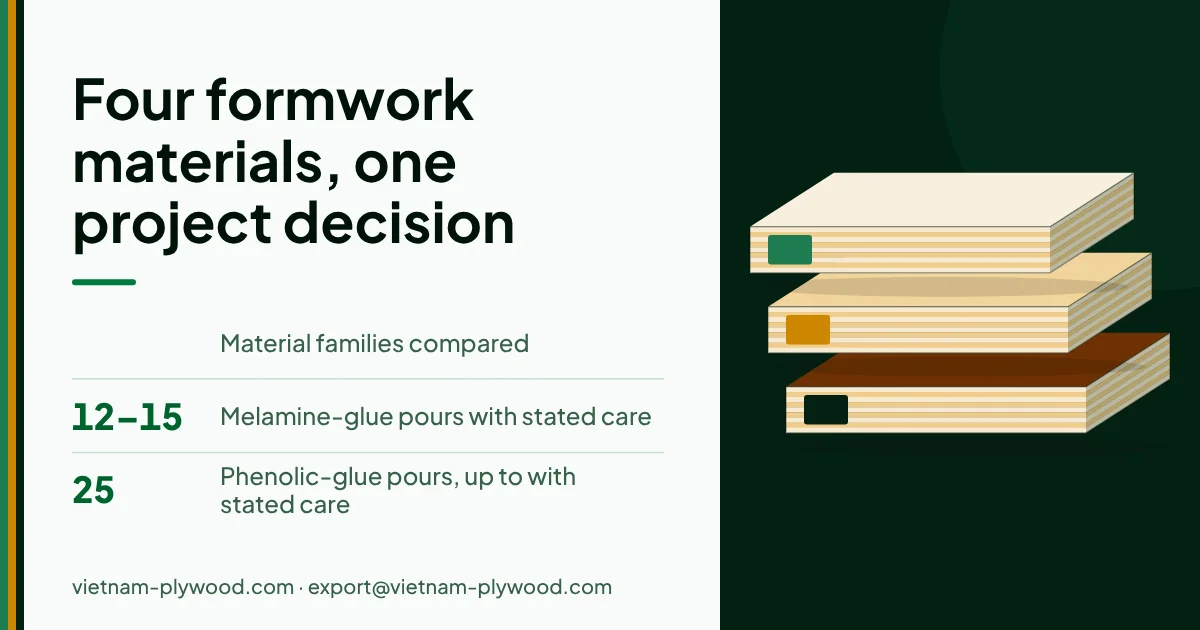
Which materials for concrete forms fit each job?
Materials for concrete forms fall into cut-to-fit plywood and timber, reusable metal systems, and modular plastic or specialist molds. Film-faced plywood is often the practical face for changing wall dimensions and mixed projects; steel and aluminium suit repeat layouts, while plastic fits light modules. Compare the total forming system, not the sheet alone.
HCPLY makes film-faced plywood on our construction line for contractors, formwork yards and importers. A wrong system choice can add lifting cost, delay stripping cycles or leave a concrete finish that needs repair. Start with formwork fundamentals before setting the facing specification.
What are two types of formwork?
The two broad types are temporary, removable formwork and permanent, stay-in-place formwork. Removable systems include timber-framed plywood, steel gangs, aluminium kits and reusable plastic modules. Permanent forms remain part of the completed assembly and require a separate design assessment.
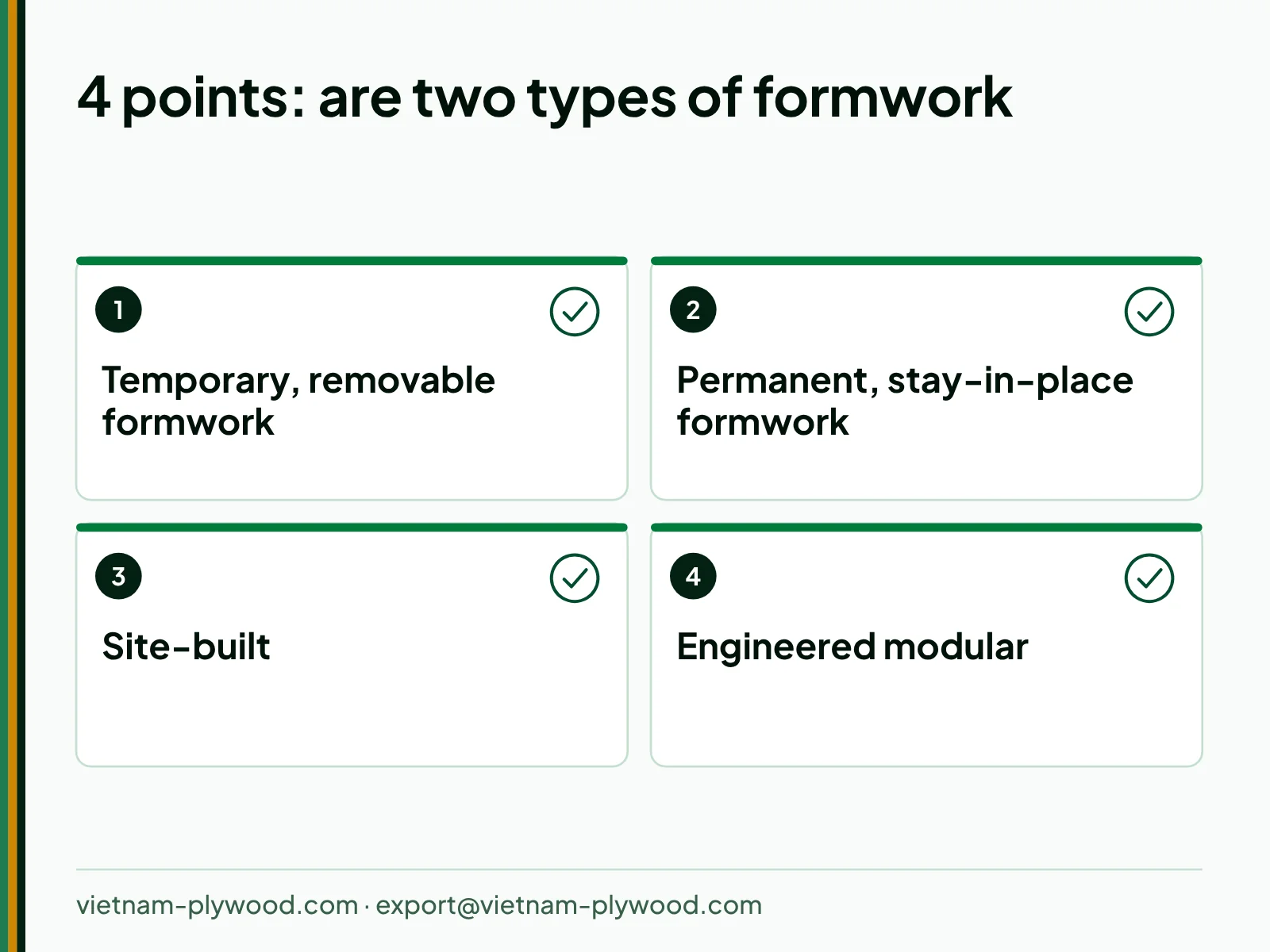
A second useful classification is site-built versus engineered modular formwork. Site-built timber and plywood adapt to unusual geometry; modular systems reward repeated dimensions. These classifications describe construction methods, while plywood, steel, aluminium and plastic describe materials.
How do plywood, steel, aluminium and plastic compare?
The deciding metrics are planned pours, face finish, panel handling, shape changes and whole-system cost. A smooth face is possible with several materials, but joints, release practice and damage determine the actual result.
| Material | Reuse metric | Finish and geometry metric | Handling and investment metric | Verdict by use |
|---|---|---|---|---|
| Film-faced plywood | HCPLY melamine-glue about 12–15 pours; phenolic-glue up to about 25, with proper handling, release agent on every pour and sealed edges including cuts | Smooth film face; sheets cut for infill and changing layouts | Replaceable facing; cutting and edge resealing needed | Changing walls, slabs and framed infill |
| Steel | Repeated cycles can justify a long service life; request system-specific evidence | Rigid repeatable faces; custom changes require fabrication | Heavy gangs can need lifting equipment and higher initial investment | Large repeated walls and infrastructure |
| Aluminium | High repetition potential; obtain the kit supplier’s cycle and repair data | Accurate repeated modules; awkward late layout changes | Lighter than comparable steel components, but kit investment remains significant | Repeated floors and apartment plans |
| Plastic modules | Cycle life depends on resin, locking details and site conditions | Suitable for repeated small modules; thermal movement needs review | Light handling; fixed module dimensions limit changes | Small repetitive forms and wet locations |
No metal or plastic cycle count is interchangeable with a plywood pour estimate. Compare cost per acceptable pour after accounting for labour, cranes, storage, repairs and discarded panels. See the focused aluminium versus plywood comparison.
When does film-faced plywood win on finish?
Film-faced plywood works well when the specification calls for a relatively smooth concrete face across changing dimensions. A consistent film, tight joints and clean stripping matter as much as the panel’s nominal thickness.
Our construction line uses phenolic or melamine film over acacia or eucalyptus cores. Film options are 120 g/m² standard, 135 g/m² premium and 220 g/m² for anti-slip only. Anti-slip is a textured working surface; it is not the first choice for a smooth visible concrete face.
For architectural concrete, agree on a sample pour, joint pattern and allowable marks before releasing a full order. Board-formed concrete finishes follow a different visual specification and should be assessed separately.
How many pours should the buyer budget?
Budget pours from the actual handling plan and the chosen glue system. With proper handling, a release agent on every pour and sealed edges including cut edges, HCPLY melamine-glue film-faced plywood gives about 12–15 pours; phenolic-glue reaches up to about 25 pours.
Those counts describe the stated site-care conditions, rather than an automatic outcome from film weight. Poor stacking, unsealed cuts, abrasive stripping and damaged faces reduce usable cycles. A yard should record accepted concrete faces and panel condition after each strip, then compare its own cost per accepted pour against a metal or plastic system.
For a metal kit, ask about replacement skins, damaged corners, tie-hole wear and lifting hours. For plastic modules, ask how locking tabs, heat exposure and surface scratches affect the finish.
What thickness, face and core should be specified?
Specify panel thickness against the engineer’s support spacing and wet-concrete pressure. HCPLY offers thicknesses from 3–40 mm, with common choices including 12, 15, 18 and 21 mm; thickness alone does not establish an allowable span.
Construction panels have an unsanded acacia or eucalyptus core and a film face. The thickness tolerance is ±0.5 mm, while length and width tolerance is ±2 mm. Standard dimensions include 1220×2440 and 1250×2500 mm, with custom cutting available.
For glue, choose melamine (MR, 12-hour boil) or phenolic (weather and boil proof, WBP, 72-hour boil). Glue selection and emission class are separate specification fields. When visible concrete is involved, record the film type, joint layout and intended release agent alongside the structural formwork design.
Which factory line makes the facing?
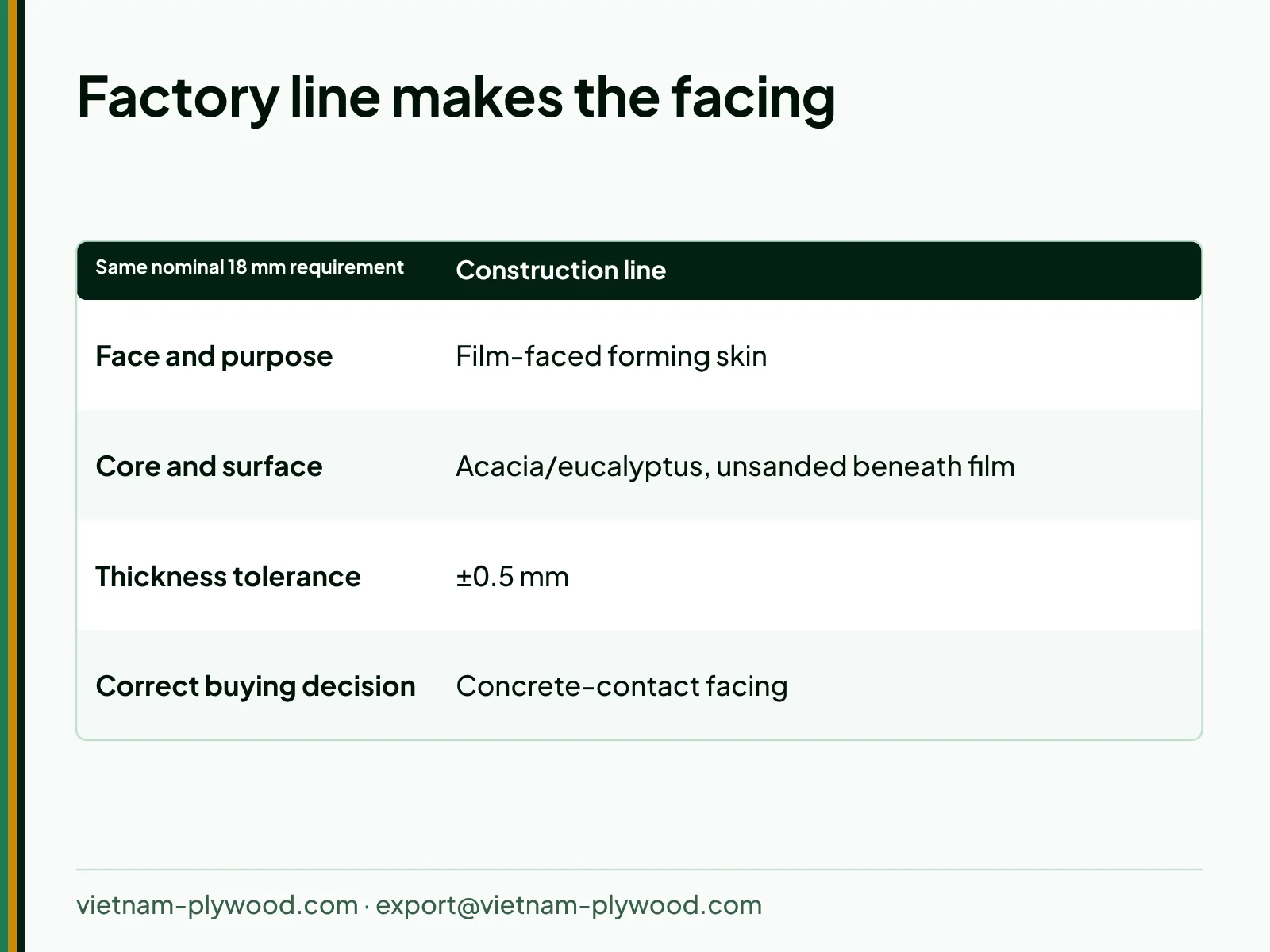
Our construction line presses film-faced panels with acacia or eucalyptus cores. Our furniture line instead makes full-stitched, sanded styrax- or eucalyptus-core plywood for furniture applications. Our commercial and packing line makes acacia-core, MR-glued, unsanded or light-sanded panels for commercial and packing uses.
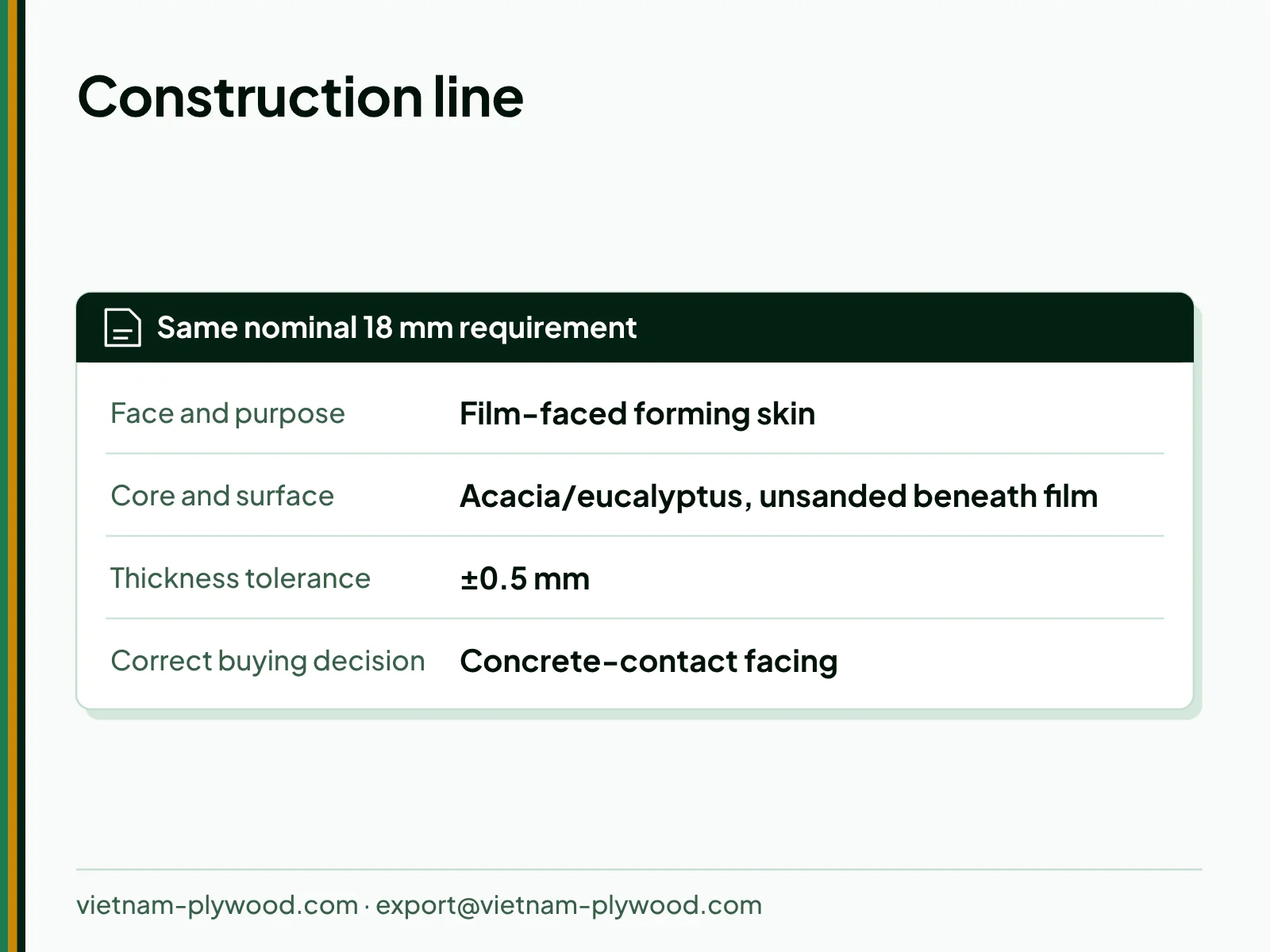
| Same nominal 18 mm requirement | Construction line | Furniture line | Commercial and packing line |
|---|---|---|---|
| Face and purpose | Film-faced forming skin | Decorative veneer for furniture | Raw commercial or packing face |
| Core and surface | Acacia/eucalyptus, unsanded beneath film | Styrax/eucalyptus, full stitched and sanded | Acacia, unsanded or light-sanded |
| Thickness tolerance | ±0.5 mm | ±0.2 or ±0.3 mm as ordered | Commercial ±0.5 mm; packing ±0.5–1.0 mm |
| Correct buying decision | Concrete-contact facing | Cabinet and furniture components | Packing and commercial panels |
This distinction matters when an importer consolidates different applications. Compare builds across factory lines before approving mixed specifications. HCPLY does not press medium-density overlay (MDO), high-density overlay (HDO), oriented strand board (OSB), medium-density fibreboard (MDF), chipboard, blockboard, bamboo, three-ply spruce panels or birch-core plywood.
What must the formwork engineer approve?
The engineer must approve the entire forming assembly for fresh-concrete loads, bracing, deflection and stripping. A face panel specification cannot replace the system drawings.
The United States Occupational Safety and Health Administration’s 2025 Code of Federal Regulations, 29 CFR §1926.703(a)(1), requires formwork to withstand reasonably anticipated vertical and lateral loads. The same regulation requires jobsite drawings and sets inspection requirements for shoring: official 2025 regulation.
Before purchase, review pour height and rate, tie spacing, stud and waler spacing, lifting arrangements, concrete temperature and stripping sequence. Metal kits still need this review. For curved work, consider shaped timber supports, specialty fibre molds or engineered flexible facing rather than forcing flat sheets into an unsupported radius. Timber formwork options explains the framing choices.
What fits a 40HC when formwork shares a shipment?
A 40HC has a 28.5 t payload limit in HCPLY’s loading calculation. For 18 mm, 1220×2440 mm panels, the full-container lookup is 880 acacia-core sheets at 27.35 t or 795 eucalyptus-core sheets at 27.69 t; these figures exclude film weight.
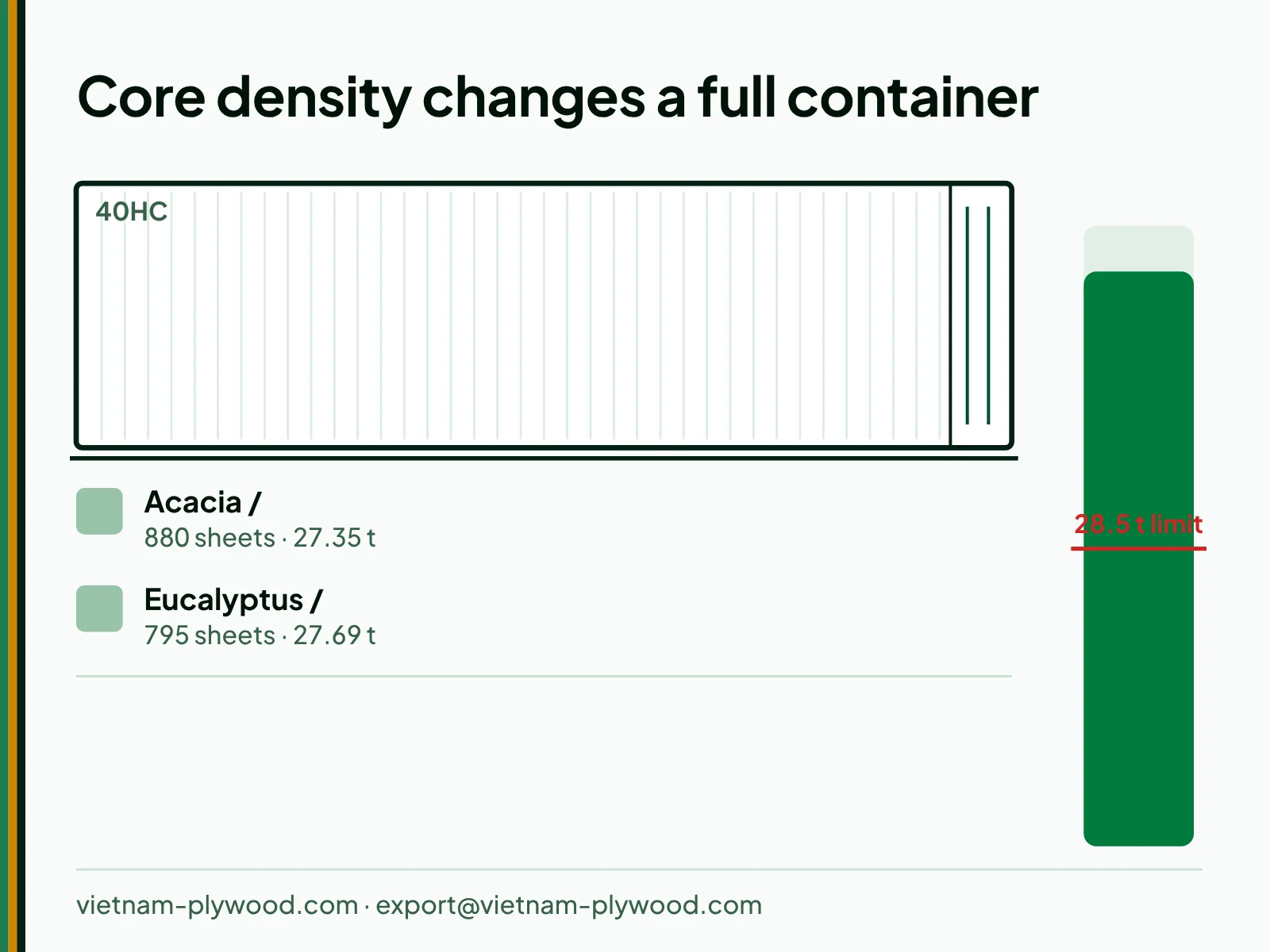
That difference makes core selection relevant to freight planning as well as handling. The acacia-core sheet weighs 31.08 kg before film, versus 34.83 kg for eucalyptus. Mixed specifications can share a container within the payload limit, but pallet allocation and final gross weight need checking against the actual mix.
The container loading calculation covers sheet counts by thickness and core. For distributors combining construction faces with other applications, plywood supply programmes explain how to organize the order.
What can an inspector witness at the producing factory?
An inspector can witness thickness checks, film appearance, edge condition, packing marks and the counted pallets at the producing factory. Agree on sampling positions and acceptance limits in the purchase specification before the visit.
Check that cut edges are sealed, that film surfaces have no visible handling damage, and that panel dimensions match the agreed drawing. Compare pallet labels against the packing list and segregate construction-facing panels from furniture or packing material.
HCPLY manages specification, on-site quality control, export documents and loading. Buyers can visit the factory office and inspect goods where their order is made. Factory certificates such as FSC, CARB P2, ISO 9001 and CE, and EUTR/EUDR documents, are shown with factory details masked, on request; applicability is assessed for the producing member factory and the agreed order.
How should a buyer compare the landed cost?
Compare total installed cost per accepted pour, with the formwork system and planned reuse stated explicitly. For film-faced plywood, film weight, glue system, core, dimensions, quantity and edge treatment drive the quotation; a phenolic-glue build costs more than a comparable melamine-glue build because of its resin and processing requirements.
Metal systems require a separate allowance for capital cost, transport, cranes, cleaning, repairs and eventual resale or storage. Plastic modules require allowances for lost fittings, damaged locks and dimensional limitations. A quoted panel price alone does not settle the choice.
HCPLY’s minimum order is one 40HC. Factory lead time runs 15–45 days from receipt of the 30% deposit; the exact figure depends on order size, line loading and what the contract fixes; the balance is 70% against the scanned bill of lading, by telegraphic transfer or irrevocable letter of credit at sight. We ship FOB Hai Phong, or CFR (CNF) or CIF to your port. Free samples are available; new buyers book their courier, and that cost can be credited against a real order.
Which documents and final details close the order?
The packing list identifies the shipment quantities and builds, while the agreed test reports address the ordered panel specification. Each shipment uses a commercial invoice, packing list, bill of lading, certificate of origin, phytosanitary and fumigation papers, plus applicable order certificates. EU lots include EUR.1 and the EUTR/EUDR file set; CIF shipments include insurance. After loading, the draft shipping documents come to you for approval.
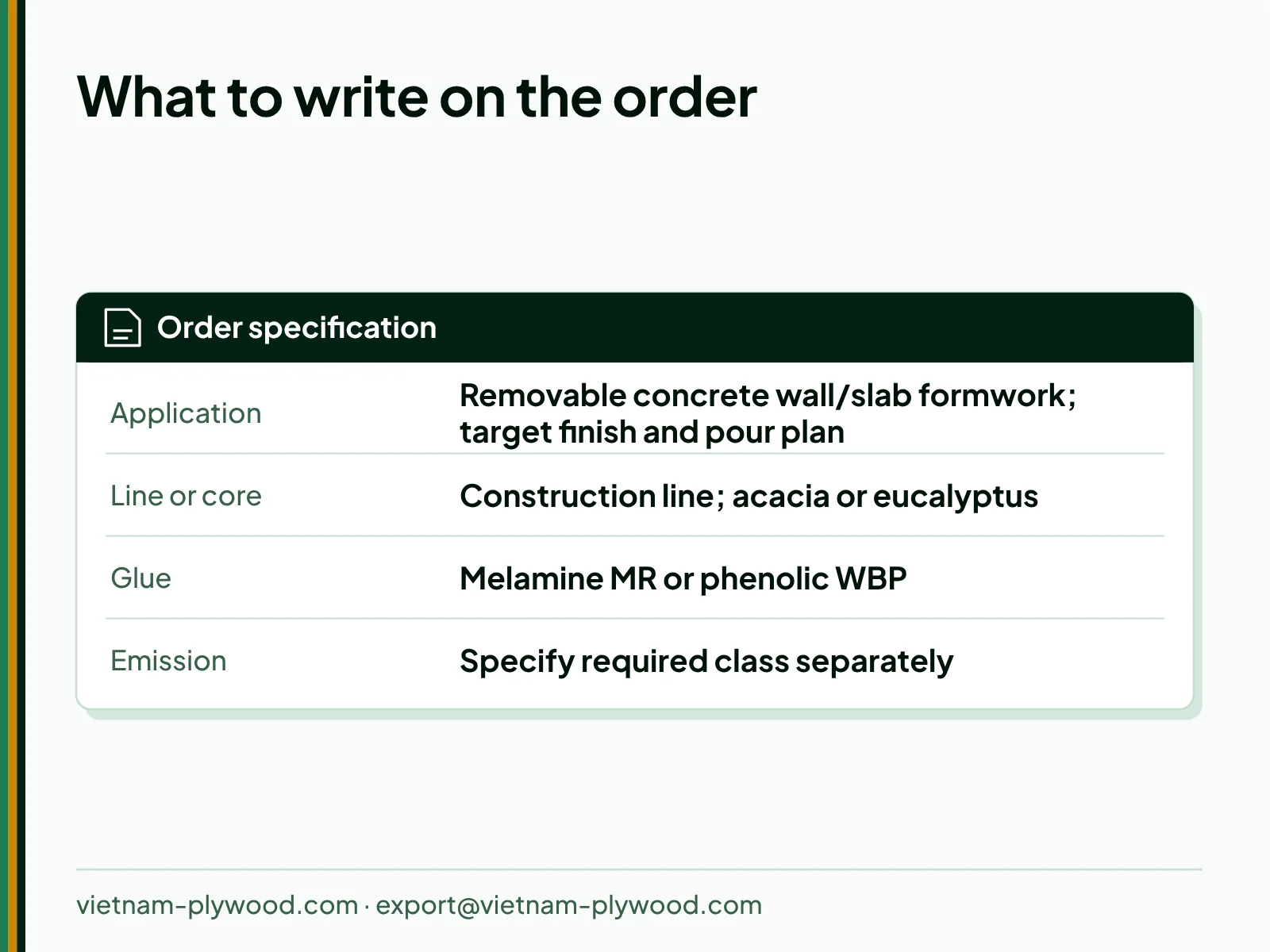
Send the specification below to Lucy at export@vietnam-plywood.com, or use the formwork enquiry form. A construction-facing quotation should identify the actual project geometry and acceptance checks, rather than relying on a generic material label.
Application: removable concrete wall/slab formwork; target finish and pour plan
Line or core: construction line; acacia or eucalyptus
Glue: melamine MR or phenolic WBP
Emission: specify required class separately
Face and grade: film-faced; 120 or 135 g/m²; agreed face acceptance
Thickness and tolerance: 18 mm; ±0.5 mm (or specify another thickness)
Size: 1220×2440 mm (or specified drawing)
Quantity: sheets and pallet mix; minimum one 40HC
Destination port: [port and country]
Next step: Book a factory visit to review the film face and inspect the producing factory before approving the order.