





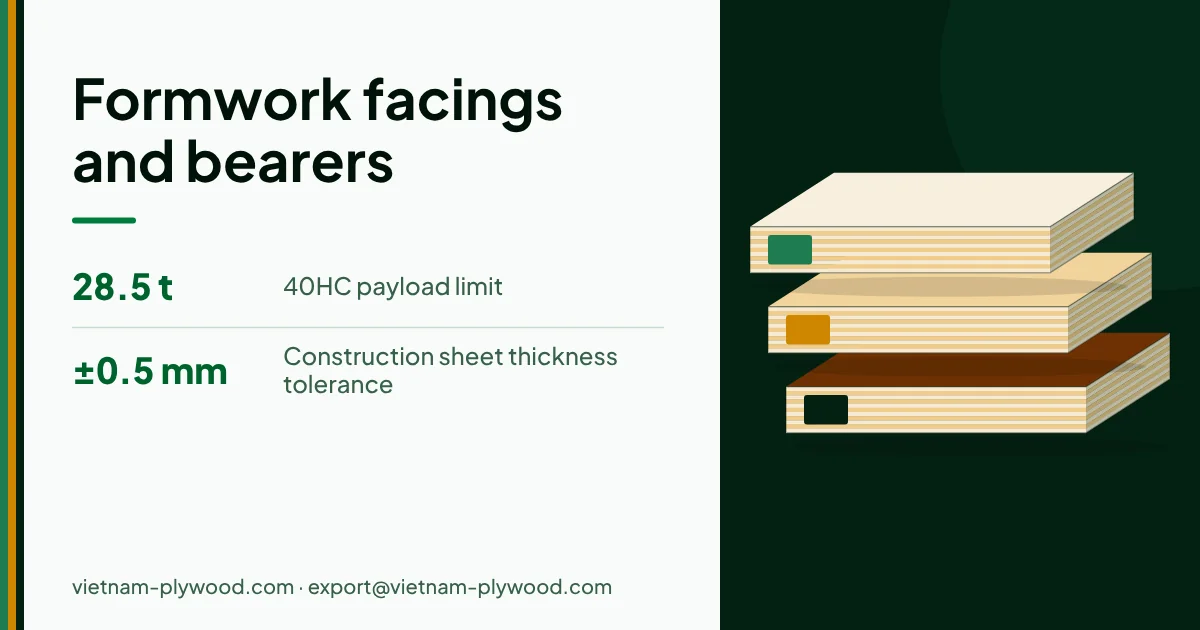
Wood shuttering moves from site-cut boards to factory-made film-faced panels when regular concrete-contact bays need consistent dimensions. Choosing a facing as if it were a structural bearer can cost a rejected load, rework and lost site days. HCPLY separates the sheet facing from the timber support specification so contractors and importers can buy each against its actual duty.
What wood shuttering should a contractor specify?
Wood shuttering should be specified as a system of concrete-contact facings, supporting bearers and bracing, rather than as a single wood grade. Site-cut boards remain useful for irregular work; factory-made film-faced plywood provides repeatable facing dimensions; laminated veneer lumber (LVL) can be considered for engineered bearers where the design and test evidence support it. The right choice follows the pour geometry, support spacing, finish and handling cycle.
A vague request for “shuttering wood” leaves the supplier guessing whether the order needs facing sheets or load-bearing members. A facing panel and a bearer do different jobs. Their material specifications and acceptance checks must therefore be separate.
Start with the formwork system and its components. Record the concrete pressure and project engineer’s design requirements before choosing the facing thickness or bearer section. HCPLY’s construction line makes film-faced plywood facings; the commercial and packing line is the route identified for an LVL bearer enquiry, with section and performance evidence to be agreed before it becomes an order.
What is the difference between timber and plywood in formwork?
Sawn timber is a solid-wood member or board; plywood is a cross-laminated veneer panel. In timber formwork, the former can act as a stud, waler, bearer or site-cut facing, while the latter is normally ordered as a sheet facing. Neither material name establishes allowable load by itself.
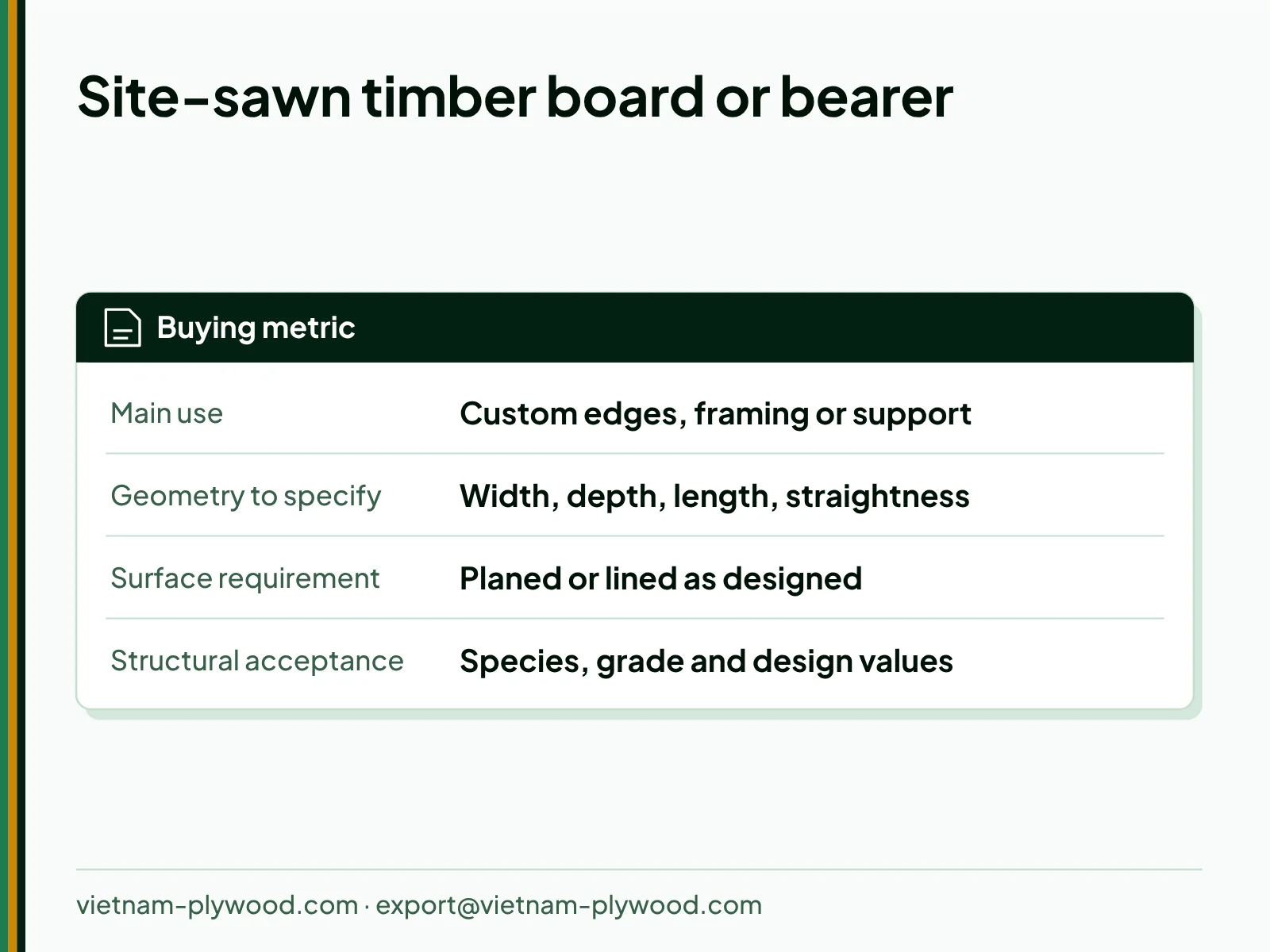
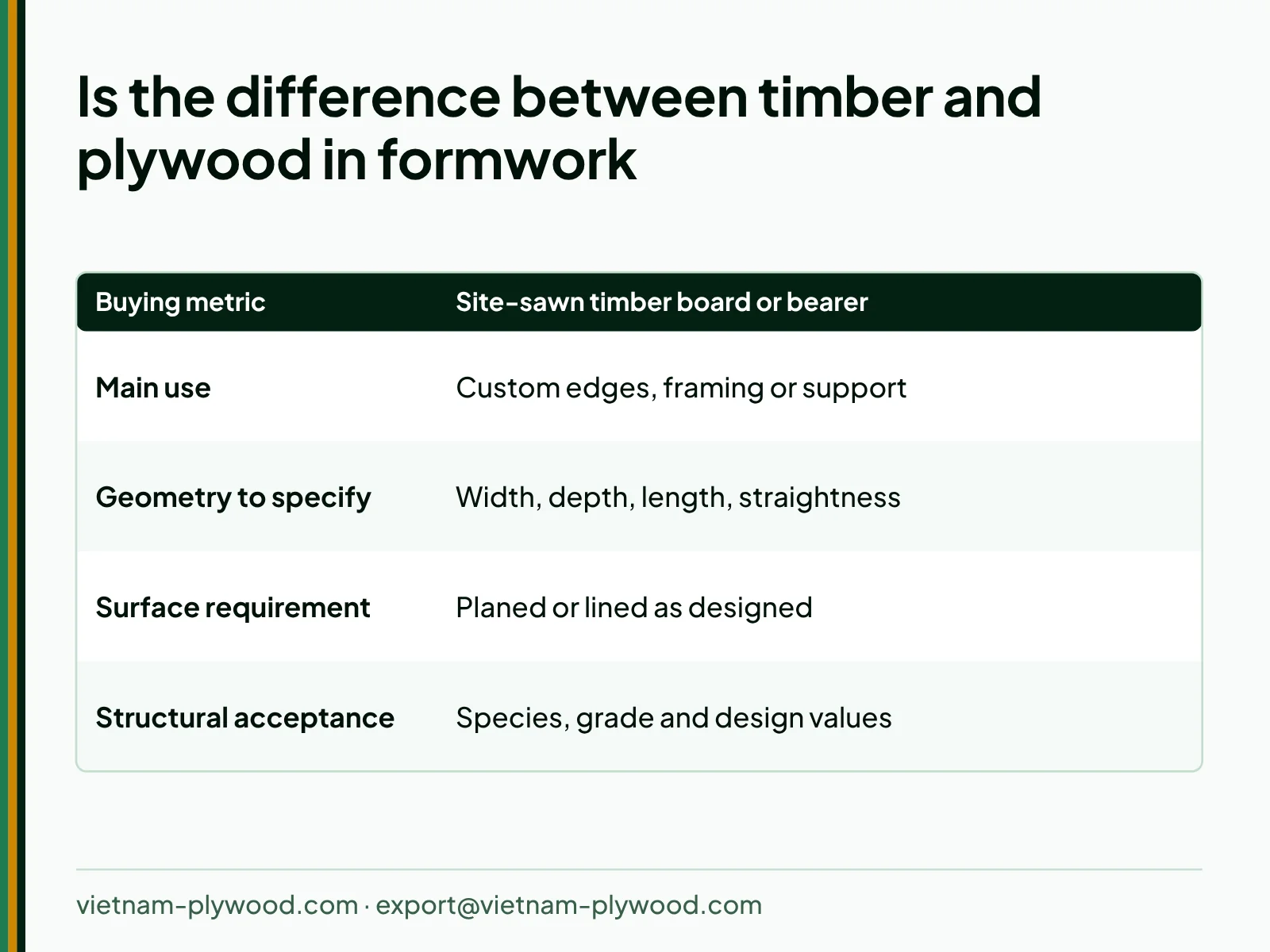
| Buying metric | Site-sawn timber board or bearer | Film-faced plywood facing | LVL bearer proposal |
|---|---|---|---|
| Main use | Custom edges, framing or support | Concrete-contact sheet | Engineered linear support |
| Geometry to specify | Width, depth, length, straightness | Length, width, thickness, squareness | Section, length, straightness |
| Surface requirement | Planed or lined as designed | Film face and sealed edges | Bearing faces and end condition |
| Structural acceptance | Species, grade and design values | Facing span and deflection design | Verified bending, shear and bearing values |
| Verdict by use | Choose for site-cut details | Choose for repeated sheet bays | Consider for designed bearers only |
Plywood face selection does not replace the contractor’s formwork calculations. The plywood versus aluminium comparison covers another common system-level decision. A timber-versus-plywood comparison is meaningful only after the intended position in the form has been identified.
Which site-cut boards do film-faced panels replace?
Film-faced panels replace site-cut timber planks used as the broad concrete-contact skin on regular wall, column and slab bays. They do not replace the studs, ties, shores or bracing that support that skin. The main gain is a specified sheet format that the yard can cut to its panel schedule.
Our construction line presses acacia-core or eucalyptus-core film-faced plywood, with phenolic or melamine film. Standard film weight is 120 g/m²; premium film is 135 g/m². The 220 g/m² film belongs to anti-slip surfaces, which should be specified for walking or traction applications rather than assumed to improve a concrete-contact finish.
For exposed concrete, agree the finish sample, joint layout, fastener pattern and release-agent practice. Film-faced sheets can reduce the number of board joints in a large bay, but the concrete finish still reflects installation, vibration and joint sealing. See the film-faced plywood product specification for the facing build.
What type of wood is best for formwork?
The appropriate wood is the one whose measured properties meet the position in the designed formwork. For a facing, compare film condition, core construction, thickness and supported span. For a bearer, compare certified design values, section geometry, moisture exposure and connection details. Species names alone cannot answer either question.
HCPLY uses acacia core at 580 kg/m³ and eucalyptus core at 650 kg/m³ for construction facings. These are core densities, not ratings for a formwork span. An 18 mm sheet has 11–13 plies, according to the veneer thickness used. The construction sheet thickness tolerance is ±0.5 mm, while length and width tolerance is ±2 mm.
The commercial and packing line works with acacia core and moisture-resistant (MR) glue. It is a different specification route from the construction facing line. For an LVL request, require a separate layup description, section drawing and accepted strength report before assigning it a bearer duty. A conventional plywood sheet is not automatically an LVL beam.
Which factory line makes each wood part?
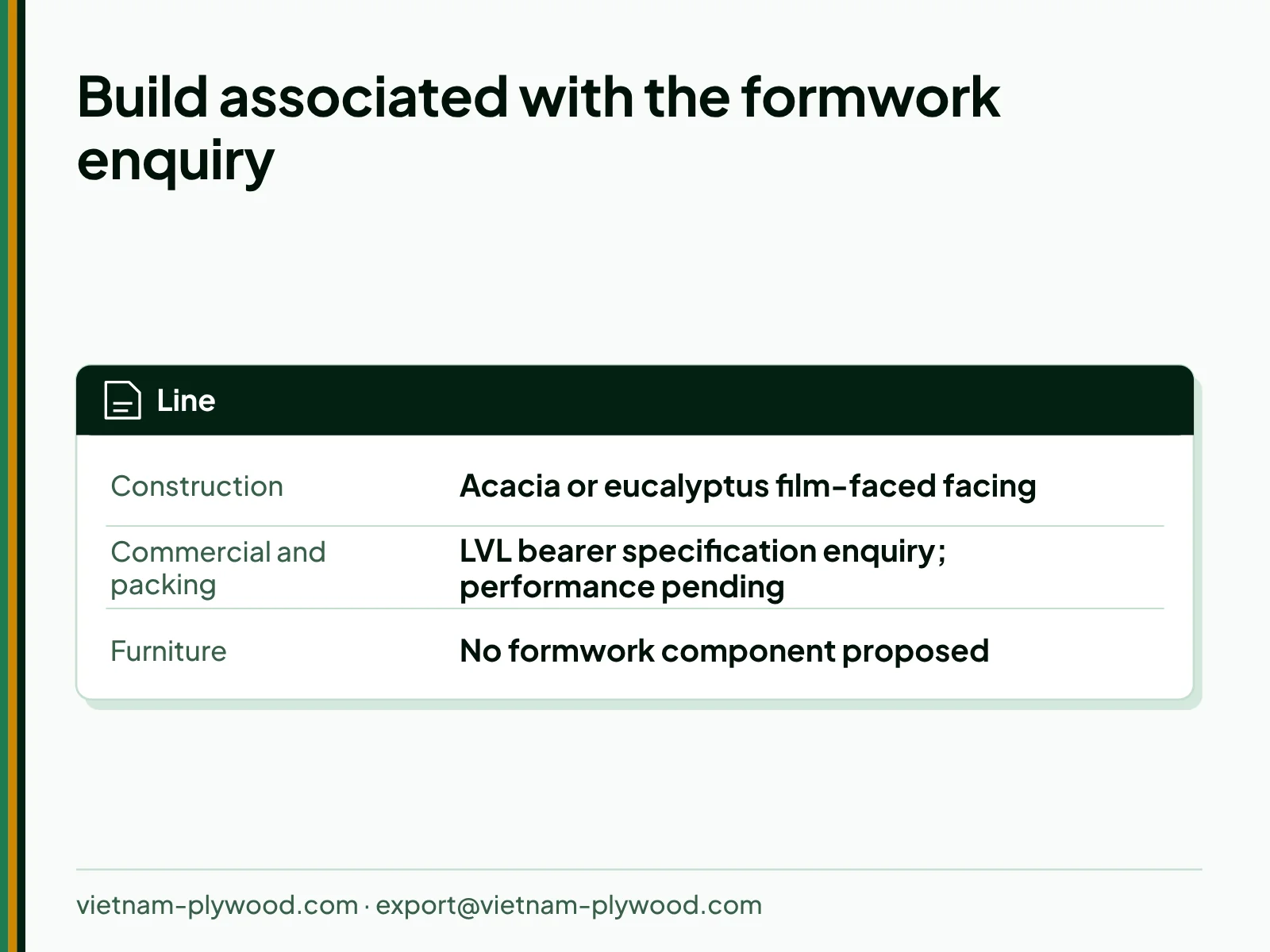
Our construction line makes the film-faced facing; our commercial and packing line handles the separate acacia-based bearer enquiry. Our furniture line instead makes sanded, full-stitched interior plywood with styrax or eucalyptus core and E0/E1 emission classes. These lines are distinguished by product duty rather than by a shared thickness label.
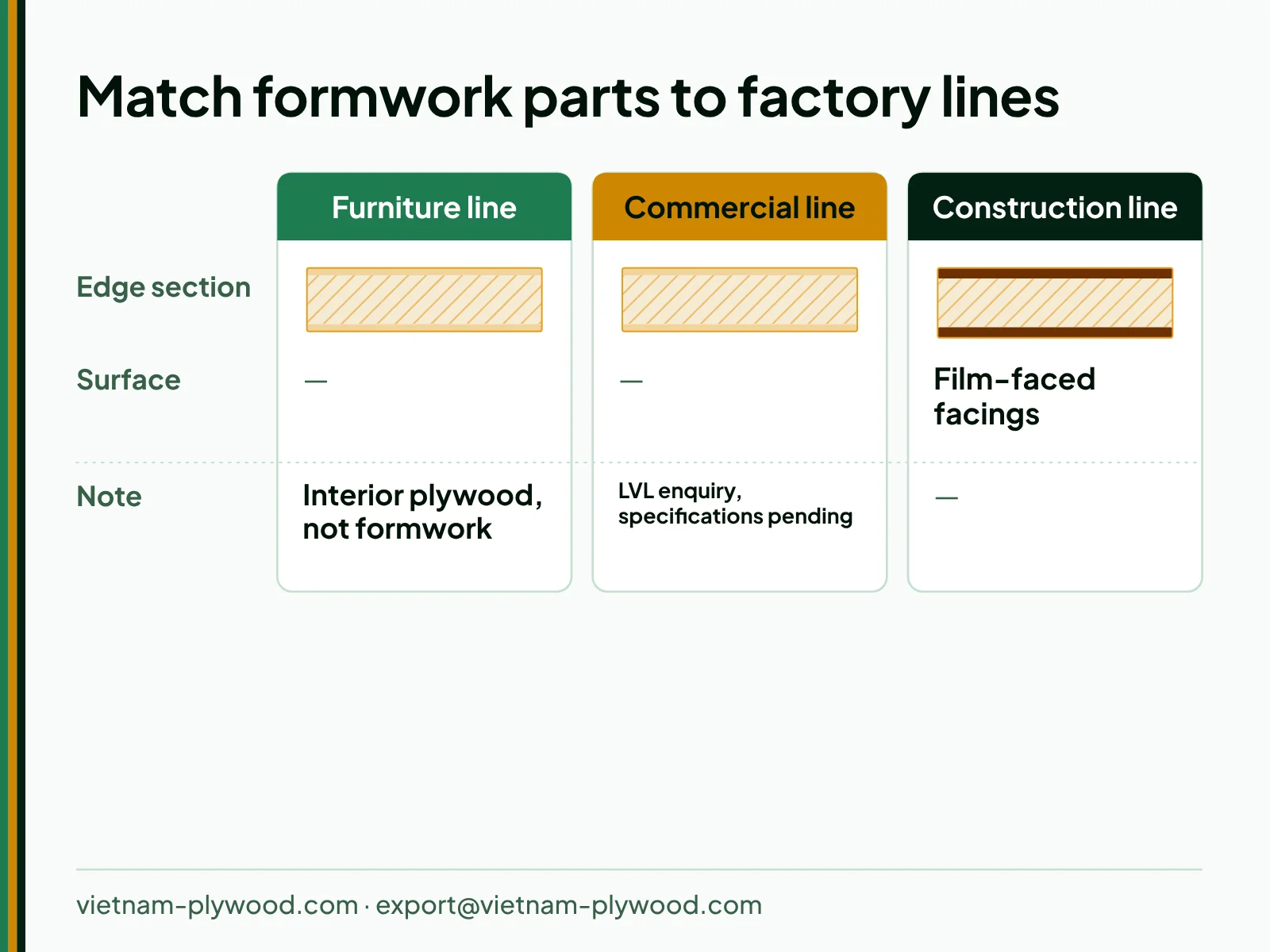
| Line | Build associated with the formwork enquiry | Alternative made on that line | Buyer check |
|---|---|---|---|
| Construction | Acacia or eucalyptus film-faced facing | Anti-slip film panel | Film, thickness, edge condition |
| Commercial and packing | LVL bearer specification enquiry; performance pending | Acacia-core packing or commercial plywood | Section documents and test evidence before acceptance |
| Furniture | No formwork component proposed | Full-stitched sanded furniture plywood | Face and sanding quality for furniture orders |
At the producing factory, a buyer can witness caliper checks across selected sheets, inspect film adhesion and cut edges, and compare pallet marks with the packing list. Bearer inspections need section dimensions, straightness, identification and the agreed mechanical test report. Buyers visit the factory office and inspect at the producing factory.
Can LVL replace sawn timber bearers?
LVL can replace a sawn timber bearer only when an engineer checks the proposed member against the required loads, span, deflection, bearing and connection conditions. LVL is assembled from bonded veneers with a controlled grain orientation; that does not establish an interchangeable size or a permissible working load.
A purchasing specification should request the LVL section, length, layup, adhesive, moisture condition, tolerances and characteristic design values. The acceptance package should identify the test method and independent report accepted by the buyer. Do not substitute an LVL section for a sawn bearer by matching depth alone.
For reusable forms, inspect end protection, damage at supports and drilled connections. Repeated wetting and handling matter alongside the original material properties. The engineer should also decide whether the bearer is a primary support or a secondary joist, because the load path and inspection frequency differ.
Can film-faced facings and LVL bearers share one container?
Yes, mixed specifications can load in one 40HC within its 28.5 t payload limit, provided the LVL dimensions and actual shipment mass are included in the load plan. The facing quantity can be established first; the remaining mass allowance then bounds the bearer allocation. Pallet footprint and safe stowage also govern the arrangement.
For 18 mm, 1220 × 2440 mm facings, the acacia lookup gives 31.08 kg per sheet, 55 sheets per pallet and 880 sheets in a full facing-only 40HC, representing 27.35 t. Eucalyptus at the same dimensions gives 34.83 kg per sheet and 795 sheets, or 27.69 t, in its full facing-only load. These figures exclude film weight.
A mixed shipment must reduce the facing count to reserve payload and floor space for bearers. For example, one acacia facing pallet represents 55 sheets at 31.08 kg each, or 1,709.4 kg of core-based sheet mass. The exact LVL pallet mass and dimensions are required before a mixed quantity can be stated. The container loading reference owns the full-sheet loading calculations.
Which glue and film should a formwork order use?
Specify the bond and surface separately: the film is the contact layer, while the glue joins the veneers. The construction line offers melamine glue classified as MR with a 12-hour boil description, or phenolic glue described as weather and boil proof (WBP) with a 72-hour boil description. Those process descriptors are not structural design values.
With proper handling, a release agent on every pour and sealed edges including cut edges, melamine-glue film-faced plywood gives about 12–15 pours; phenolic-glue film-faced plywood reaches up to about 25 pours. These conditions belong in the yard’s handling instructions. A damaged edge or face can shorten the useful cycle irrespective of glue selection.
Specify emission class as a separate field from glue. E0, E1 and E2 are emission classes; a US-bound order that requires CARB P2 or TSCA Title VI needs the applicable third-party certification documents for the agreed build. Do not infer emission class from a phenolic or melamine glue name.
What other wooden formwork panels are on the market?
The market includes site-cut boards, film-faced plywood, resin-coated panels, plastic-faced plywood, three-ply solid-wood shuttering panels and medium- or high-density overlay sheets. These products differ in facing chemistry, substrate and intended reuse cycle; their names alone do not show equivalent performance.
Polypropylene-coated plywood is often discussed as a higher-protection facing option. Its coating is distinct from the phenolic or melamine film used on our construction line. HCPLY does not press medium-density overlay (MDO), high-density overlay (HDO) or three-ply spruce shuttering panels. They are comparison categories rather than alternative offers from this line.
A buyer comparing panel types should ask for the core construction, coating weight or coating system, bond specification, dimensional tolerance and a sample of the resulting concrete surface. For a tight budget, compare expected cost per accepted pour rather than buying on the first sheet price alone.
How should a yard inspect wood formwork on arrival?
Inspect the facing as a finished component and the bearer as a load-bearing member with its own identification. A clean film face cannot compensate for a missing structural report on a proposed bearer. Set the acceptance sampling method in the purchase order before production.
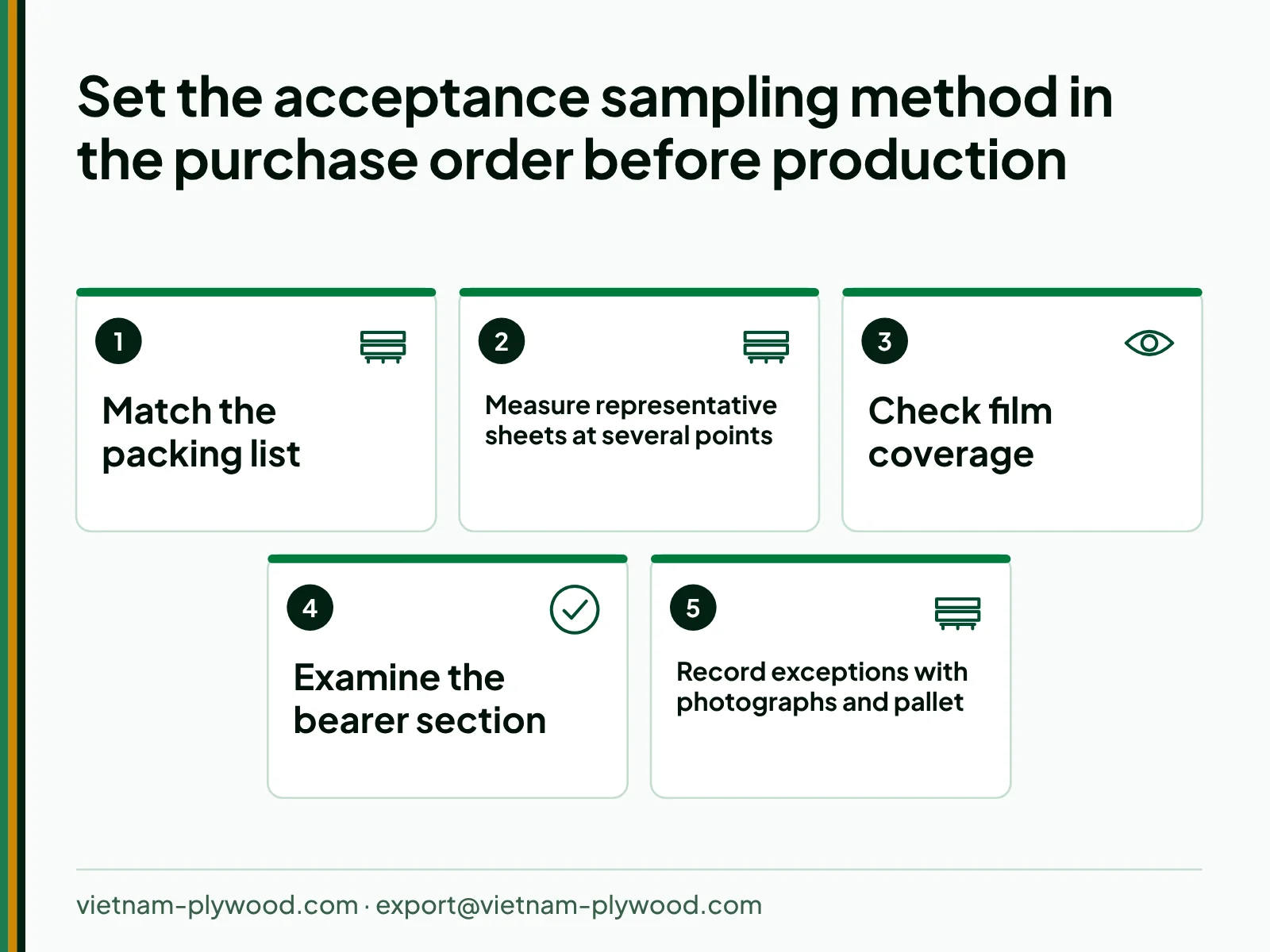
- Match the packing list, pallet labels, thickness and dimensions to the agreed specification.
- Measure representative sheets at several points and inspect corners, cuts and edge sealing.
- Check film coverage, face damage and the condition of stacked sheets.
- Examine the bearer section, straightness and traceability to the accepted test documents.
- Record exceptions with photographs and pallet references before releasing the material to site.
For construction sheets, the stated thickness tolerance is ±0.5 mm and plan-size tolerance is ±2 mm. These are manufacturing tolerances, not permission to exceed the project’s designed formwork deflection. Agree a separate acceptance rule for LVL section dimensions because the plywood tolerance does not establish it.
What documents matter for an imported formwork order?
The shipment file identifies the goods, origin, carriage and agreed material evidence. HCPLY manages specification, on-site quality control, documents and loading, with dispatch directly from the relevant factory. The export documents include commercial invoice, packing list, bill of lading, certificate of origin, phytosanitary and fumigation papers, and order-specific certificate or test documents.
For European Union lots, the set includes EUR.1 and the EUTR/EUDR file. Insurance documents accompany CIF shipments. After loading, the draft shipping documents come to you for approval. Factory-held FSC, CARB P2, ISO 9001 and CE documents are shown with factory details masked, on request, where relevant to the agreed product and market.
For the regulatory distinction, the European Parliament and Council’s 2011 Construction Products Regulation, Article 4 ties a declaration of performance to a construction product covered by a harmonised standard or European Technical Assessment. A buyer should identify the applicable intended use and evidence before asking for a structural declaration. No formwork strength classification follows automatically from a commercial invoice.
How does a buyer turn this into a trial order?
Start with a drawing of the concrete-contact bays and a separate schedule of the support members. For the facings, state core, film, bond, thickness, tolerance, panel size and quantity. For bearers, add section dimensions, load case, performance report and the engineer’s acceptance criteria.
The minimum order is one 40HC, and specifications can be mixed within the payload limit. Factory lead time runs 15–45 days from receipt of the 30% deposit; the exact figure depends on order size, line loading and what the contract fixes. The 70% balance is against the scanned bill of lading, by telegraphic transfer (T/T) or irrevocable letter of credit at sight. We ship FOB Hai Phong, or CFR (CNF) or CIF to your port.
Samples are free; a first-time buyer pays the courier, and that charge comes off the first confirmed order. For a cross-line order, review grades across factory lines and combined plywood specifications. Send the completed schedule to Lucy at HCPLY at export@vietnam-plywood.com.
Application: concrete wall/slab facing and designed bearer positions
Line or core: construction / acacia or eucalyptus facing; commercial-line LVL enquiry
Glue: melamine MR or phenolic WBP; bearer adhesive to specify
Emission: E0 / E1 / E2 or destination requirement, separate from glue
Face and grade: phenolic or melamine film; agreed face inspection standard
Thickness and tolerance: facing ___ mm, ±0.5 mm; LVL section/tolerance ___
Size: facing ___ × ___ mm; LVL section × length ___
Quantity: ___ facing sheets and ___ LVL members, total loaded mass ___ t
Destination port: ___; delivery term: FOB Hai Phong / CFR / CIF
Next step: plan a trial container against the signed facing and bearer schedules.