





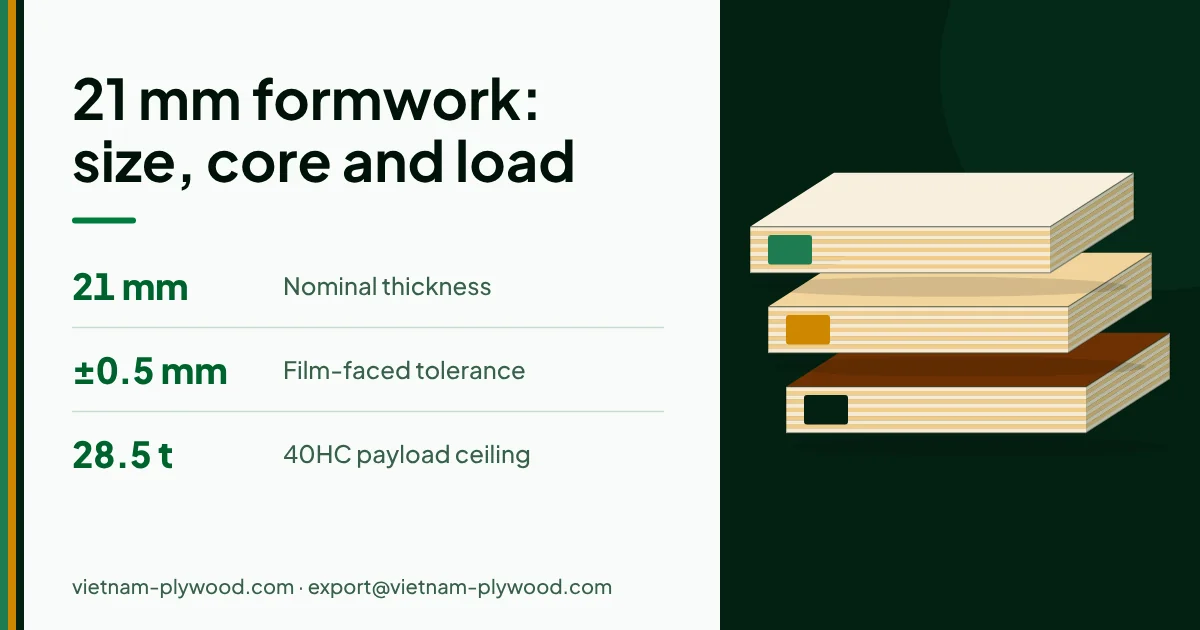
21mm film faced plywood is a 21 mm nominal formwork panel built with a specified hardwood core, glue and film for slab and wall work. Choosing the wrong core, bond or sheet format can add handling cost, delay a pour or cause a rejected load. HCPLY presses the film-faced build on our construction line, with 1250 × 2500 and 1220 × 2440 mm formats available.
Which 21mm film faced plywood sizes can we press?
We offer 21mm film faced plywood in 1250 × 2500 mm and 1220 × 2440 mm formats on our construction line. Both are ordered at a nominal 21 mm thickness with a ±0.5 mm tolerance; length and width tolerance is ±2 mm. Select the format from the formwork drawings before requesting a quotation.
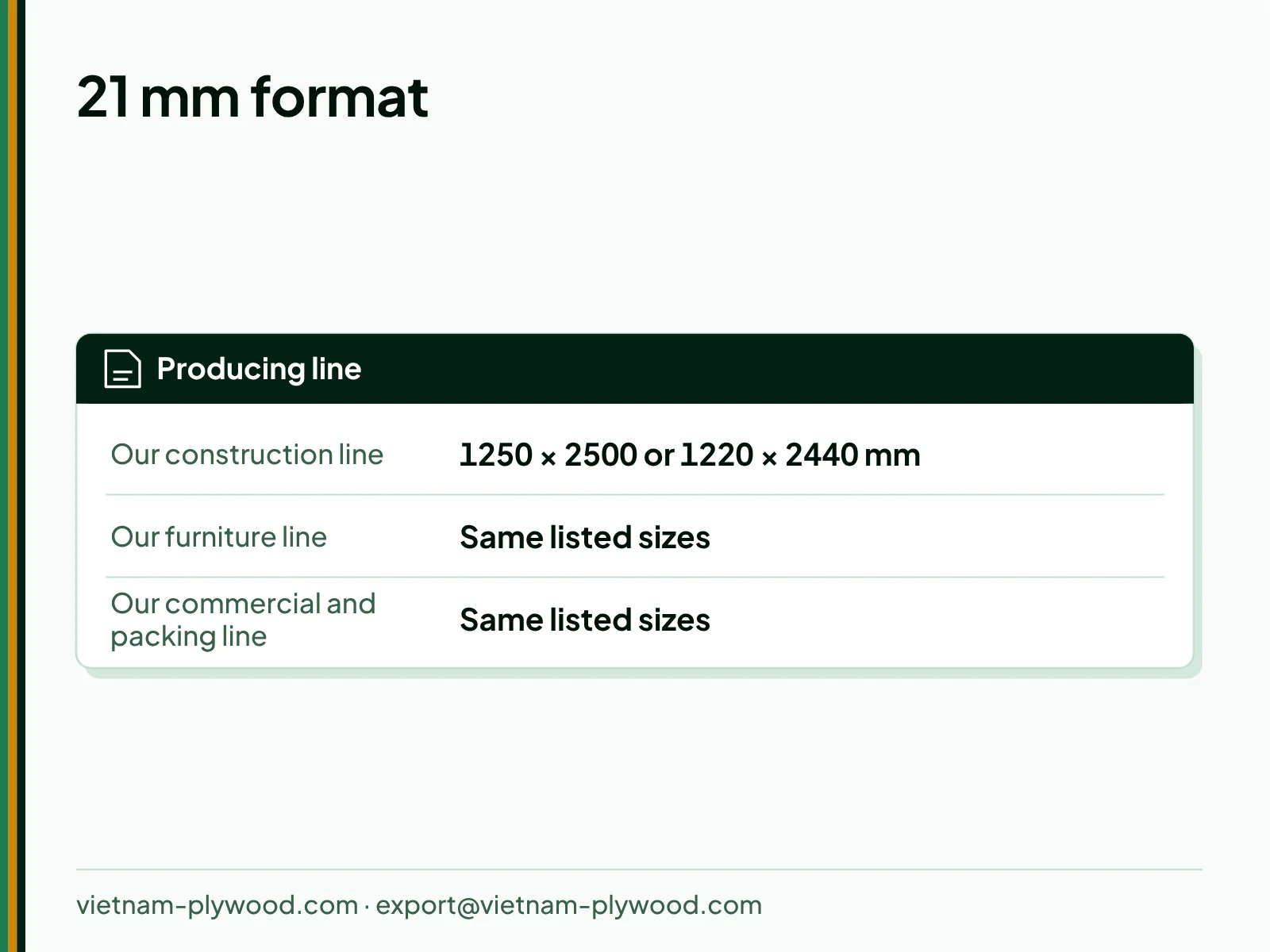
| Producing line | 21 mm format | Core and face | Thickness tolerance | Intended purchase |
|---|---|---|---|---|
| Our construction line | 1250 × 2500 or 1220 × 2440 mm | Acacia or eucalyptus; smooth film or anti-slip film | ±0.5 mm | Slab and wall formwork |
| Our furniture line | Same listed sizes, ordered as a furniture build | Full-stitched styrax or eucalyptus; sanded veneer face | ±0.2 or ±0.3 mm as ordered | Furniture components, without formwork film |
| Our commercial and packing line | Same listed sizes, ordered as a commercial or packing build | Acacia; unsanded or light-sanded raw/veneer face | Commercial ±0.5 mm; packing ±0.5–1.0 mm | Packaging and general commercial work |
These are three different constructions at the same nominal thickness. The furniture and commercial lines do not substitute for a film-faced slab panel. Other listed cutting formats include 1220 × 2135, 1220 × 1830, 915 × 2440, 915 × 2135 and 915 × 1830 mm; custom cutting is available. The 1250 × 2500 format offers a larger face area than 1220 × 2440 mm. The larger panel reduces the number of panel joints for the same covered area, where the layout permits it.
For the wider selection of nominal sizes and tolerances, see film-faced plywood thickness and sizes.
Why specify 21 mm for European slab formwork?
A 21 mm panel gives formwork designers a thicker plywood option where support spacing, fresh-concrete pressure and handling loads call for it. It is a common commercial choice for European-format slab systems, but thickness alone cannot establish a permissible span or structural rating. The temporary-works design must set the load case and support layout.
A contractor comparing 18 and 21 mm should start with the formwork supplier’s design tables and the accepted test report for the proposed build. A nominal thickness difference changes material volume and dead load, yet veneer quality, glue bond, grain direction and actual bending properties also matter. Do not transfer span tables from a birch-core panel to an acacia-core or eucalyptus-core panel without suitable evidence.
A 21 mm panel can be preferable when the approved formwork design requires that thickness; an 18 mm panel can be more economical and easier to handle when the design accepts it. Neither thickness gives a universal number of allowable pours. Our 18 mm film-faced plywood comparison covers the lighter option. For procurement across several pours or sites, use the project’s actual handling and inspection rules rather than an assumed performance figure.
What core, glue and film make the 21 mm panel?
Our construction line presses film-faced panels with an acacia or eucalyptus core and an unsanded substrate. Acacia has a reference core density of 580 kg/m³; eucalyptus is 650 kg/m³. Density follows the core, not whether the surface looks black, brown or patterned.
Specify melamine glue as MR with a 12-hour boil description, or phenolic glue as WBP with a 72-hour boil description. Specify the agreed bond test method and acceptance limits separately from these glue descriptions. The MR hot-press range is 110–120 °C; the WBP range is 130–145 °C. The requested bond test method and acceptance limits belong in the agreed inspection plan.
Smooth phenolic or melamine film is available at 120 g/m² standard or 135 g/m² premium. Anti-slip film is 220 g/m² only. A 21mm black film faced plywood description identifies an appearance, but it does not define the core, glue or emission class. Film weight measures surface overlay mass per square metre, not panel thickness or core density.
Emission class is a separate specification field: E0, E1 or E2. Do not read E1 as a glue type. A buyer asking for 21mm phenolic film faced plywood should write both the film choice and phenolic WBP glue explicitly, since the film and adhesive serve different functions. The construction plywood product specification gives the broader line context.
What does one 21 mm sheet weigh by core?
For 1220 × 2440 × 21 mm panels, the nominal acacia sheet weight is 36.26 kg and the eucalyptus sheet weight is 40.63 kg, excluding film weight. The core determines the density; a black film surface does not identify the wood beneath it.
| Core | Density | 1220 × 2440 × 21 mm | 1250 × 2500 × 21 mm |
|---|---|---|---|
| Acacia | 580 kg/m³ | 36.26 kg/sheet | Request a measured sheet weight for the ordered build |
| Eucalyptus | 650 kg/m³ | 40.63 kg/sheet | Request a measured sheet weight for the ordered build |
The 1220 × 2440 figures are nominal panel weights without film. For 1250 × 2500 mm orders, ask the producing factory for the measured sheet weight and pallet tare before agreeing the loading plan. Use the packing list and actual gross weights for transport paperwork.
A competing 21 mm birch-core product can have a different stated weight. We do not press birch-core plywood; birch is a possible face veneer on other builds. Compare core species and measurement basis before treating two weight figures as equivalent.
How many 21 mm sheets fit in a 40HC?
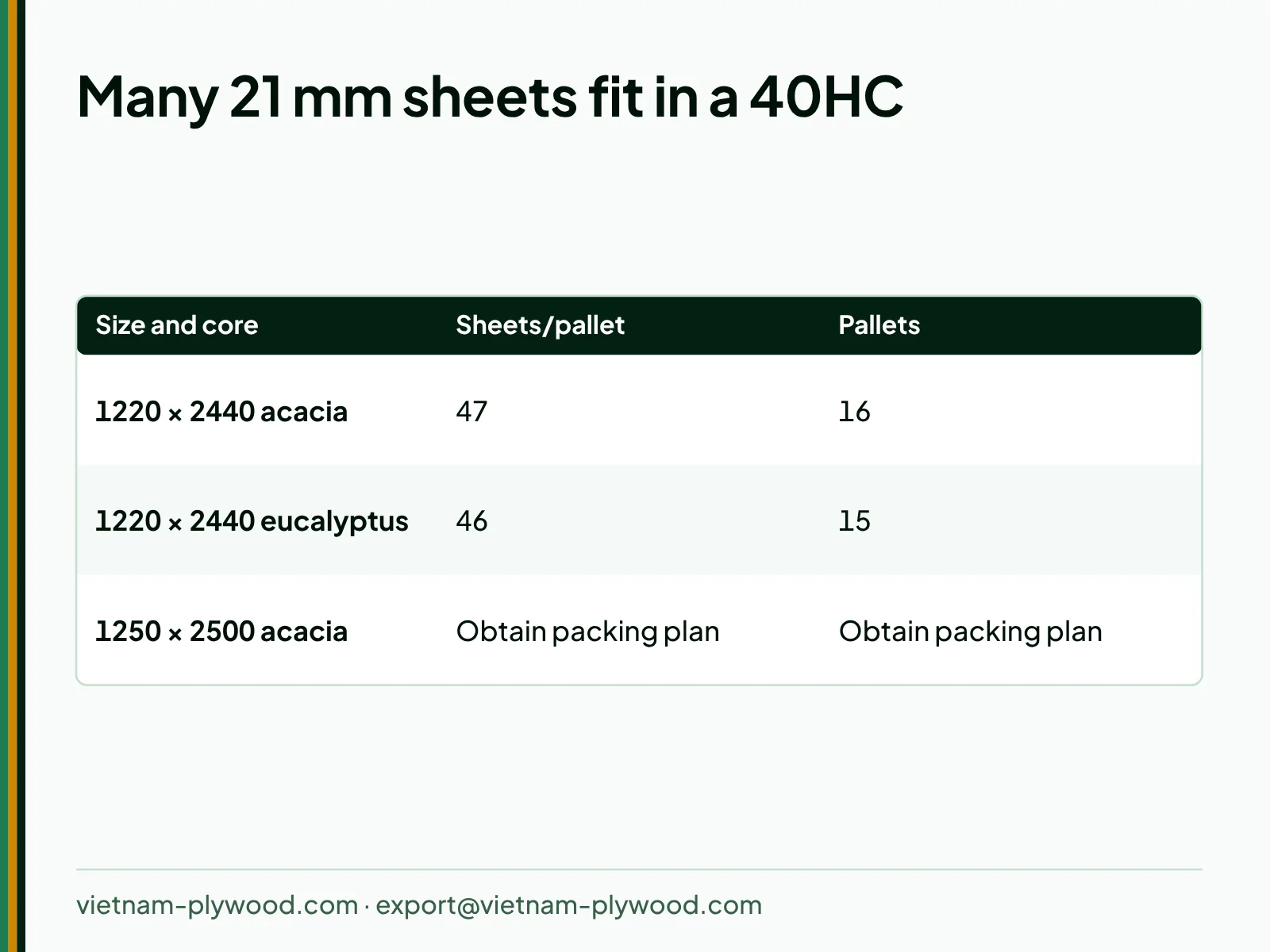
For 1220 × 2440 × 21 mm sheets, a nominal full 40HC load is 752 acacia sheets or 690 eucalyptus sheets. These are the listed core-specific pallet loads; the payload limit is 28.5 t. Final loading also accounts for pallet and packaging mass.
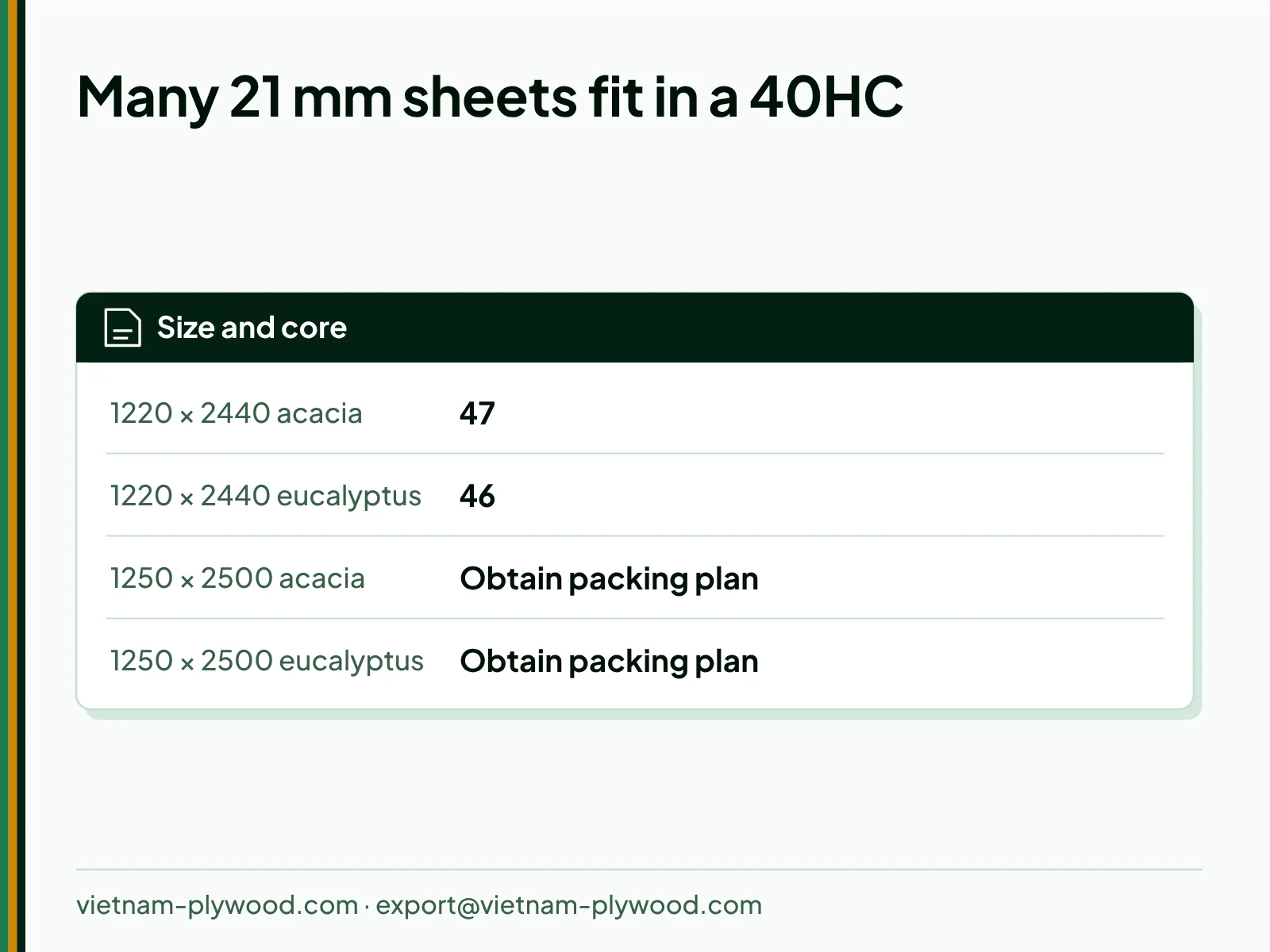
| Size and core | Sheets/pallet | Pallets | Sheets/40HC | Nominal panel volume | Nominal panel mass |
|---|---|---|---|---|---|
| 1220 × 2440 acacia | 47 | 16 | 752 | 47.01 m³ | 27.27 t |
| 1220 × 2440 eucalyptus | 46 | 15 | 690 | 43.13 m³ | 28.04 t |
| 1250 × 2500 acacia | Obtain packing plan | Obtain packing plan | Obtain verified count | Obtain verified volume | Obtain verified mass |
| 1250 × 2500 eucalyptus | Obtain packing plan | Obtain packing plan | Obtain verified count | Obtain verified volume | Obtain verified mass |
The 1250 × 2500 format requires its own approved stack and gross-weight plan. Ask for pallet tare, measured gross weight, stack height and the final packing list before accepting a quantity. The loading team checks container payload before sealing.
For the detailed container-loading method, see 40HC plywood packing and loads.
Can 21 mm travel with 18 mm or anti-slip panels?
Yes. The minimum order is one 40HC, and one container can carry several specifications as long as the payload limit holds. A practical mixed load can pair 21 mm smooth-film slab panels with 18 mm panels or 220 g/m² anti-slip panels, provided the packing plan keeps stacks stable and the measured gross payload within 28.5 t.
For planning, the listed 1220 × 2440 × 21 mm acacia sheet weighs 36.26 kg, while the 18 mm acacia sheet weighs 31.08 kg. Eucalyptus weighs 40.63 kg at 21 mm and 34.83 kg at 18 mm. Give the producing factory quantities for each build and request a mixed-pallet plan showing individual stack weights, pallet tare and total payload. Anti-slip film uses a 220 g/m² overlay; its weight is separate from the core-based sheet figures.
Our construction line makes the formwork and anti-slip builds. The producing factory prepares the loading plan and records the actual quantities on the packing list. Mixed orders should label each stack by size, thickness, core, glue and film so the receiving yard can separate them.
How should the formwork face and edges be specified?
Choose smooth 120 g/m² film for a standard specified finish, 135 g/m² for a heavier smooth overlay, or 220 g/m² anti-slip film where traction is the design purpose. Film weight alone cannot establish concrete surface quality or slip resistance. The panel face must match the intended contact surface and handling conditions.
Ask the factory inspector to check the film for visible breaks, pinholes, wrinkles and edge damage before packing. Inspect the corners and cut edges after cutting; exposed veneer is a route for moisture ingress. Record edge-sealing requirements in the purchase specification and apply sealing again to cut edges on site.
With proper handling, a release agent on every pour and sealed edges (cut edges included), melamine-glue film-faced panels give about 12–15 pours; phenolic-glue panels give up to about 25 pours. These figures require the stated handling, release-agent and edge-sealing conditions. Cleaning, storage, concrete chemistry and stripping practice can reduce service life. A yard should inspect after each stripping cycle and remove damaged sheets from the next pour.
Do not treat an embossed anti-slip face as a substitute for a smooth concrete-contact face. Anti-slip panels belong where the specified walking or working surface needs texture; actual traction needs the test method and conditions agreed by the buyer.
What can an inspector witness at the producing factory?
An inspector can witness thickness measurements, face and edge checks, pallet identification and loading at the producing factory. HCPLY coordinates the on-site quality-control plan and export paperwork; the actual build is pressed on our construction line in the factory allocated to the order.
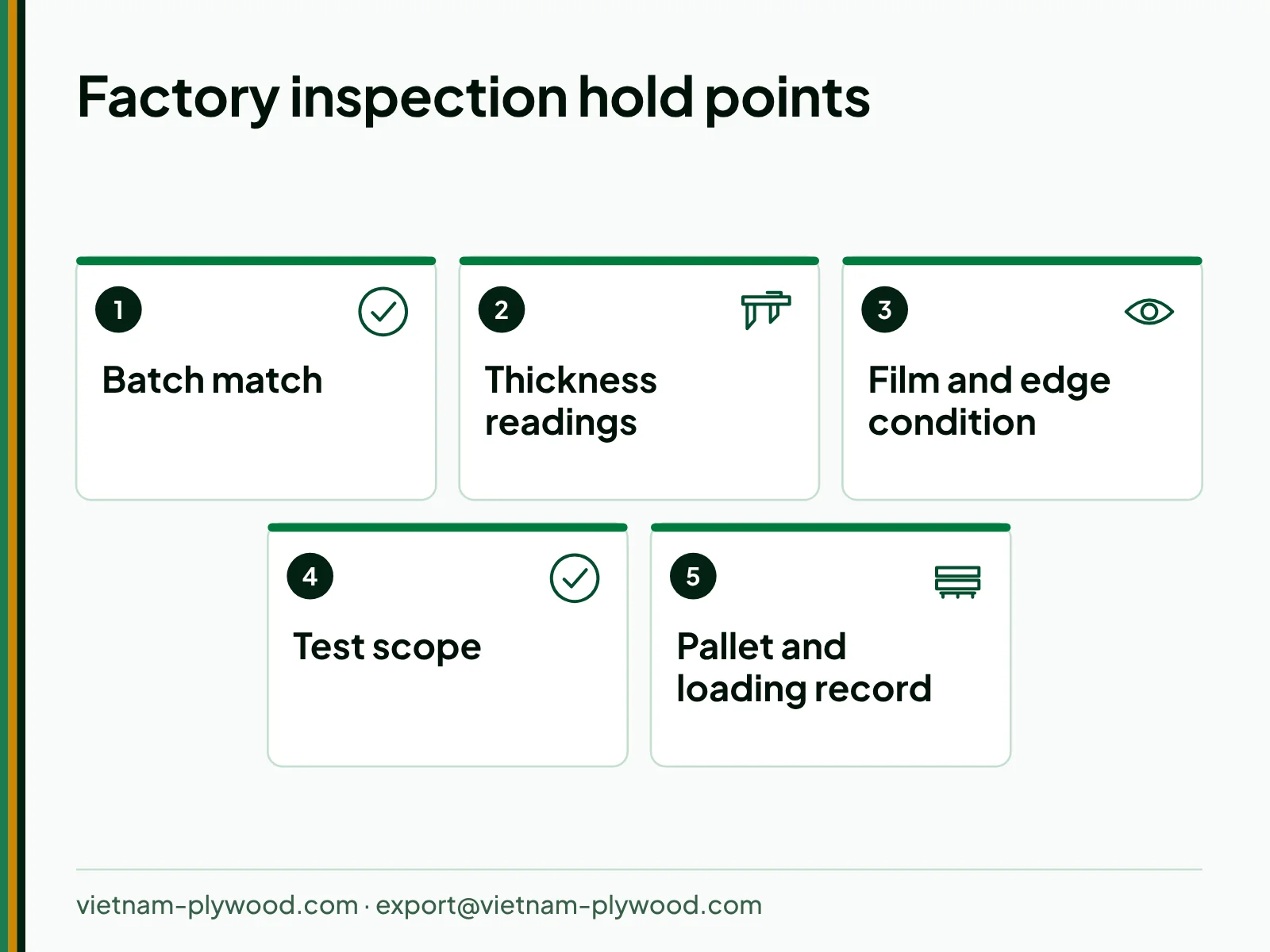
- Match the purchase specification to the production batch: nominal 21 mm, tolerance ±0.5 mm, core species, glue, emission class and film weight.
- Measure panels at agreed locations with a calibrated gauge and record individual readings, rather than accepting a single average.
- Check the film surface, corners and cut edges; inspect visible veneer gaps or overlap where accessible.
- Review the factory’s agreed glue-bond and other test reports against the buyer’s acceptance criteria and batch identification.
- Count and label pallets, check actual gross weight and reconcile the loading record with the draft packing list.
Core veneer thickness is 1.4–2.0 mm, so ply count depends on the lay-up. An 18 mm build has 11–13 plies; specify the approved lay-up for 21 mm separately. A claim that every 21 mm panel must have 13 or 15 plies is unsupported for this particular build. The inspector should verify the approved construction rather than infer it from thickness alone.
Buyers can visit the factory office and inspect the goods at the producing factory. Arrange the visit and hold points before the batch is packed, particularly when the contract calls for third-party tests.
Which CE and test documents accompany an EU order?
CE-related documents and test reports must be tied to the actual member factory and agreed panel build. They are not blanket certificates for every 21 mm sheet. We can show member-factory FSC, CARB P2, ISO 9001 and CE certificates, plus EUDR/EUTR documents, with factory details masked, on request.
The European Commission’s construction-products harmonised-standards page, updated with a 2026 implementing-decision amendment, identifies Regulation (EU) No 305/2011 and directs readers to the declaration-of-performance and CE-marking framework: European Commission construction-products standards. The precise applicable EU regime, harmonised technical specification, intended use and required declarations must be checked for the shipment and placement date; a supplier’s CE certificate image by itself does not settle the buyer’s compliance duty.
Request the named producing factory’s applicable declaration or test documentation for the intended use, and match product identification, report scope and declared characteristics to the offered batch. If a project demands a structural grade, supply only against a test report the buyer accepts. No untested structural performance or fire rating is represented for these panels.
The shipment document set includes commercial invoice, packing list, bill of lading (B/L), certificate of origin (EUR.1 for EU lots), phytosanitary and fumigation papers, plus the order’s certificate documents and the EUTR/EUDR file set for EU lots. Insurance is included under CIF. After loading, the draft shipping documents come to you for approval. A report and a shipping document answer different questions: one concerns the tested build; the other identifies and moves the actual consignment.
What determines the quotation for 21 mm formwork plywood?
The largest price drivers are core and lay-up quality, glue system, film weight and finish, followed by size mix, order quantity and destination terms. A tighter core construction takes more preparation than loose-laid veneers. Phenolic WBP bonding and a 135 g/m² smooth film or 220 g/m² anti-slip film represent different material inputs from an MR build with standard 120 g/m² film.
Request a written quotation for the specified 21 mm film-faced build. Ask for a quotation against one written build instead of comparing an unspecified price per cubic metre. Include the accepted test method, target formwork use and any special edge treatment so competing offers have the same scope.
Factory lead time runs 15–45 days from receipt of the 30% deposit; the exact figure depends on order size, line loading and what the contract fixes. The remaining 70% is paid on the scan of the bill of lading, by T/T, or by irrevocable sight L/C. We ship FOB Hai Phong, or CFR (CNF) or CIF to your port. Samples cost nothing: a first-time buyer pays the courier, and that charge comes off the first confirmed order.
The production lead-time explanation covers scheduling variables. For contractors coordinating several site deliveries, plywood supply for construction projects addresses procurement planning.
What should the purchase specification say?
A purchase specification should identify the panel’s use, factory line, core, glue, emission class, film and dimensions before quantities or price are discussed. Put 21 mm and its ±0.5 mm tolerance on the same line, and state whether 1250 × 2500 or 1220 × 2440 mm is required.
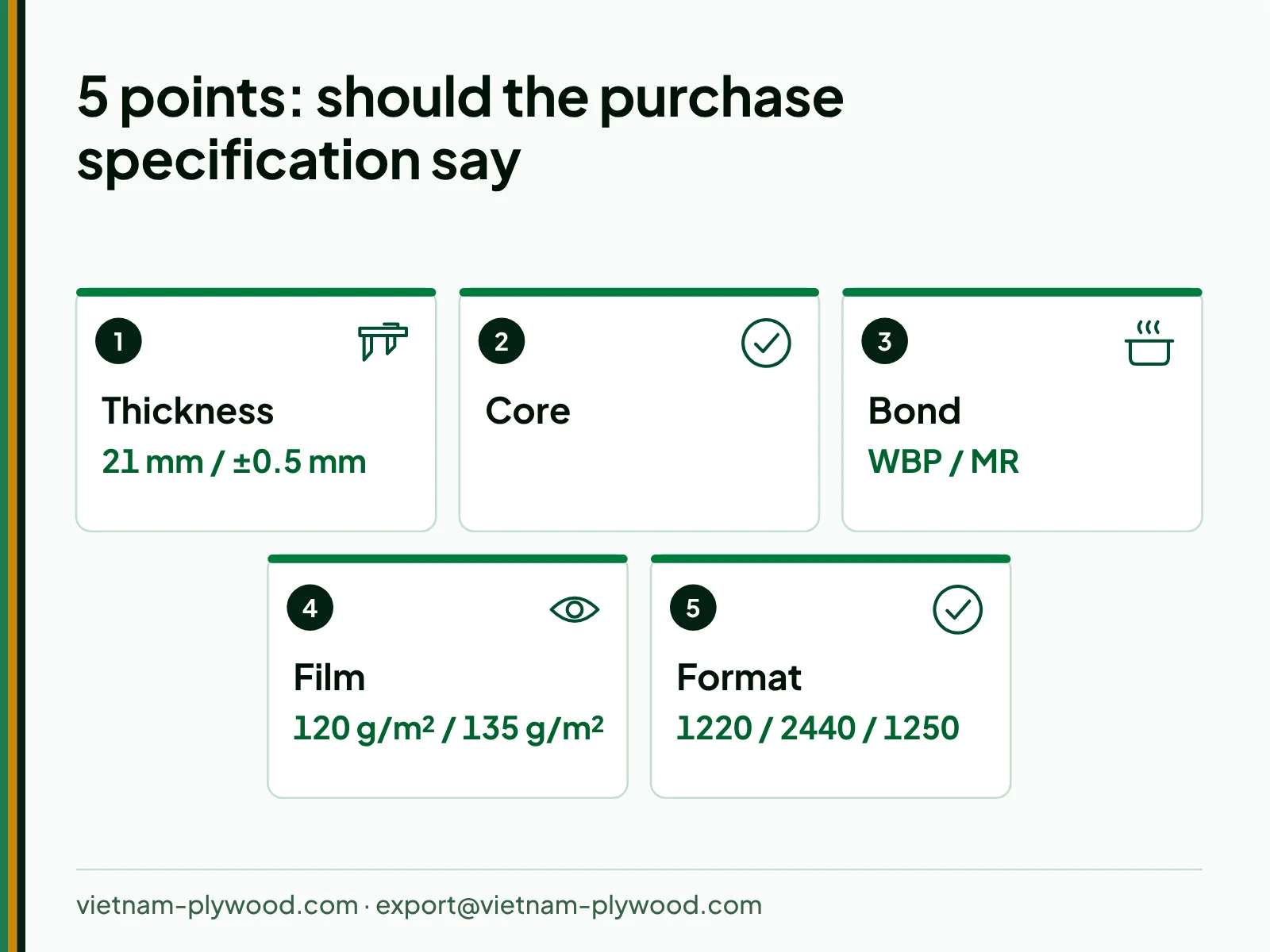
For a receiving-yard check, keep the following details visible on each pallet label and its matching packing-list entry:
- Thickness: Identify the 21 mm build and its ±0.5 mm tolerance.
- Core: Mark acacia or eucalyptus for each pallet.
- Bond: Record phenolic WBP or melamine MR as ordered.
- Film: Distinguish 120 g/m² standard, 135 g/m² premium and 220 g/m² anti-slip panels.
- Format: Identify 1220 × 2440 or 1250 × 2500 mm sheets.
Write the acceptance criteria for bond testing, surface defects, edge treatment and the applicable EU documents into the order. For a mixed container, give separate line items for each 18 mm, 21 mm and anti-slip build. Require a preliminary payload calculation and then the actual loading record; a spreadsheet maximum does not replace the container’s verified gross mass.
We manage specification, on-site QC, documents and loading for exports from our three factories in Phu Tho and Hai Phong, with each order shipped directly from the factory suited to its specification. Construction plywood capacity is up to 140 containers a month; furniture and commercial plywood up to 100 containers a month.
How do you start a 21 mm trial container?
Send Lucy a line-by-line build and destination port so the producing factory can assess the specification, proposed inspection and loading arrangement. A trial container can carry more than one approved construction build, provided the final payload and packing layout are accepted.
Application: European slab formwork; project support layout and acceptance criteria attached
Line or core: construction line; acacia core (or eucalyptus core)
Glue: phenolic WBP (72-hour boil description) or melamine MR (12-hour boil description)
Emission: E1 (or specify required class)
Face and grade: smooth 120 g/m² film / 135 g/m² film / 220 g/m² anti-slip film; agreed appearance criteria
Thickness and tolerance: 21 mm ±0.5 mm
Size: 1250 × 2500 mm or 1220 × 2440 mm; length/width ±2 mm
Quantity: sheets per build, pallet plan and mixed 18 mm lines if needed; one 40HC minimum
Destination port: [port, country]; delivery term FOB Hai Phong / CFR (CNF) / CIF
Tests and documents: accepted methods, producing-factory records and applicable EU paperwork
Plan a trial container with Lucy or email export@vietnam-plywood.com.