





What sizes and builds can 18mm film faced plywood use?
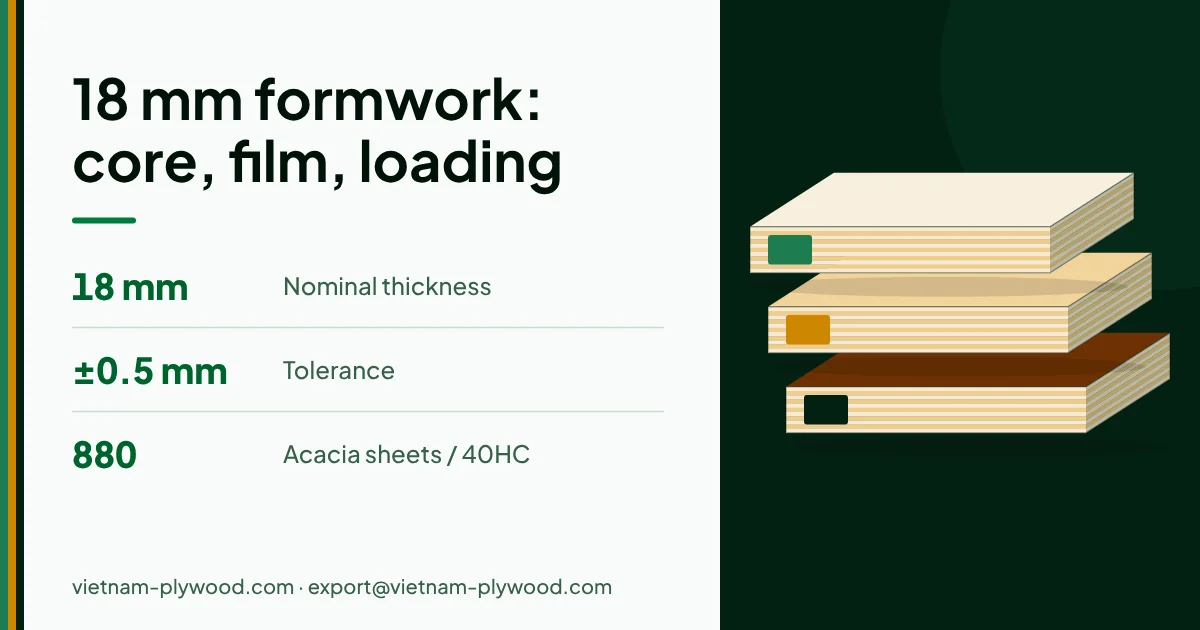
18mm film faced plywood is a nominal 18 mm construction panel, available from HCPLY with acacia or eucalyptus core, selected glue and film, and a finished thickness tolerance of ±0.5 mm. Choosing the wrong core, bond or surface can mean rejected sheets, damaged form faces or extra handling costs.
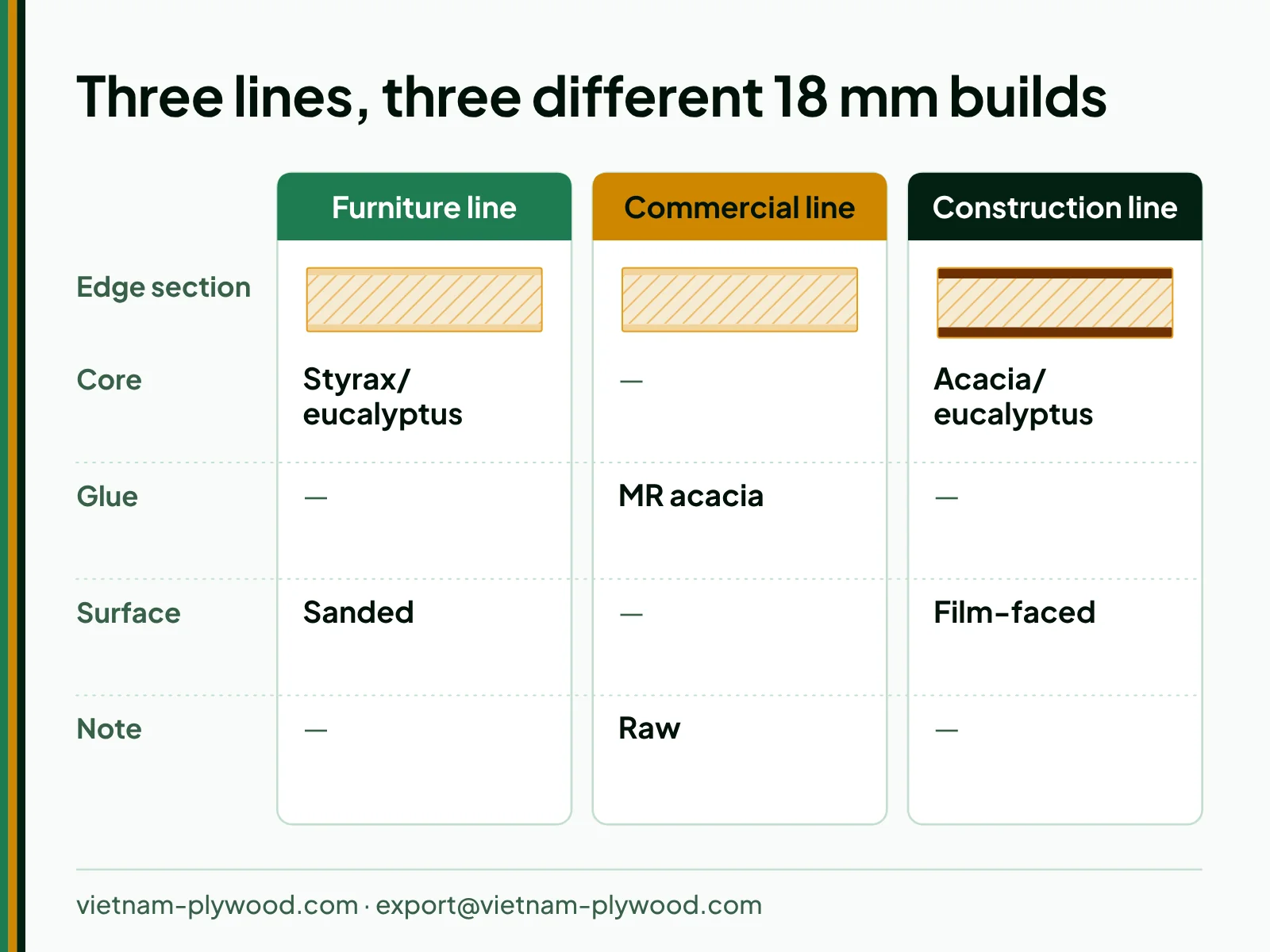
| Producing line | Typical 18 mm build | Core and finish | Thickness tolerance | Suitable purchase |
|---|---|---|---|---|
| Our construction line | Film-faced formwork | Acacia or eucalyptus; phenolic or melamine film; unsanded | ±0.5 mm | Slabs, walls and reusable forms |
| Our furniture line | Veneer-faced furniture panel | Styrax or eucalyptus; full stitched, sanded; E0/E1 | ±0.2 or ±0.3 mm as ordered | Cabinet and furniture components |
| Our commercial and packing line | Raw commercial or packing panel | Acacia; MR glue; unsanded or light-sanded | ±0.5 mm commercial; ±0.5–1.0 mm packing | Crates and commercial uses |
All three lines can make an 18 mm panel, but only our construction line presses the film-faced formwork specification. Each order ships directly from its producing factory.
| Nominal sheet size | Thickness | Ordering note |
|---|---|---|
| 1220 × 2440 mm | 18 mm | Reference for weight and loading below |
| 1250 × 2500 mm | 18 mm | Different pallet stack limits |
| 1220 × 2135 mm | 18 mm | Specify finished dimensions |
| 1220 × 1830 mm | 18 mm | Specify cut-edge sealing |
| 915 × 2440 mm | 18 mm | Confirm pallet plan |
| 915 × 2135 mm | 18 mm | Confirm pallet plan |
| 915 × 1830 mm | 18 mm | Confirm pallet plan |
Length and width tolerance is ±2 mm; custom cutting is available. Use the agreed size and core when requesting packed-weight and pallet details. For adjacent thickness choices see film-faced plywood thicknesses and sizes.
Why do formwork buyers specify 18 mm so often?
18 mm offers a familiar specification point for comparing formwork builds, but no verified sales ranking establishes it as the most ordered thickness. It sits between thinner 12 and 15 mm sheets and thicker 21 mm sheets in the available construction range. A buyer should select it from the formwork design and support spacing, rather than treating nominal thickness as a load rating.
The project designer must establish concrete pressure, span, support layout, deflection limits and expected stripping conditions. Thickness alone does not establish bending capacity.
The US Occupational Safety and Health Administration’s 1996 construction rule, reproduced by Cornell Law School, 29 CFR 1926.703(a)(1), requires formwork to support reasonably anticipated vertical and lateral loads without failure. That is a design and jobsite requirement, not a certification or structural rating for these sheets.
For a procurement comparison, keep the span and loading assumptions fixed, then compare the offered core, ply construction, bond and test report. Ask the engineer to approve the panel build for the intended form system.
Which core and glue suit repeated concrete pours?
Acacia and eucalyptus are the two construction-line cores; the glue choice controls bond specification while the core controls the density basis. At 18 mm, the stated veneer thickness range of 1.4–2.0 mm produces 11–13 plies. Specify the internal joint construction rather than relying on ply count alone.
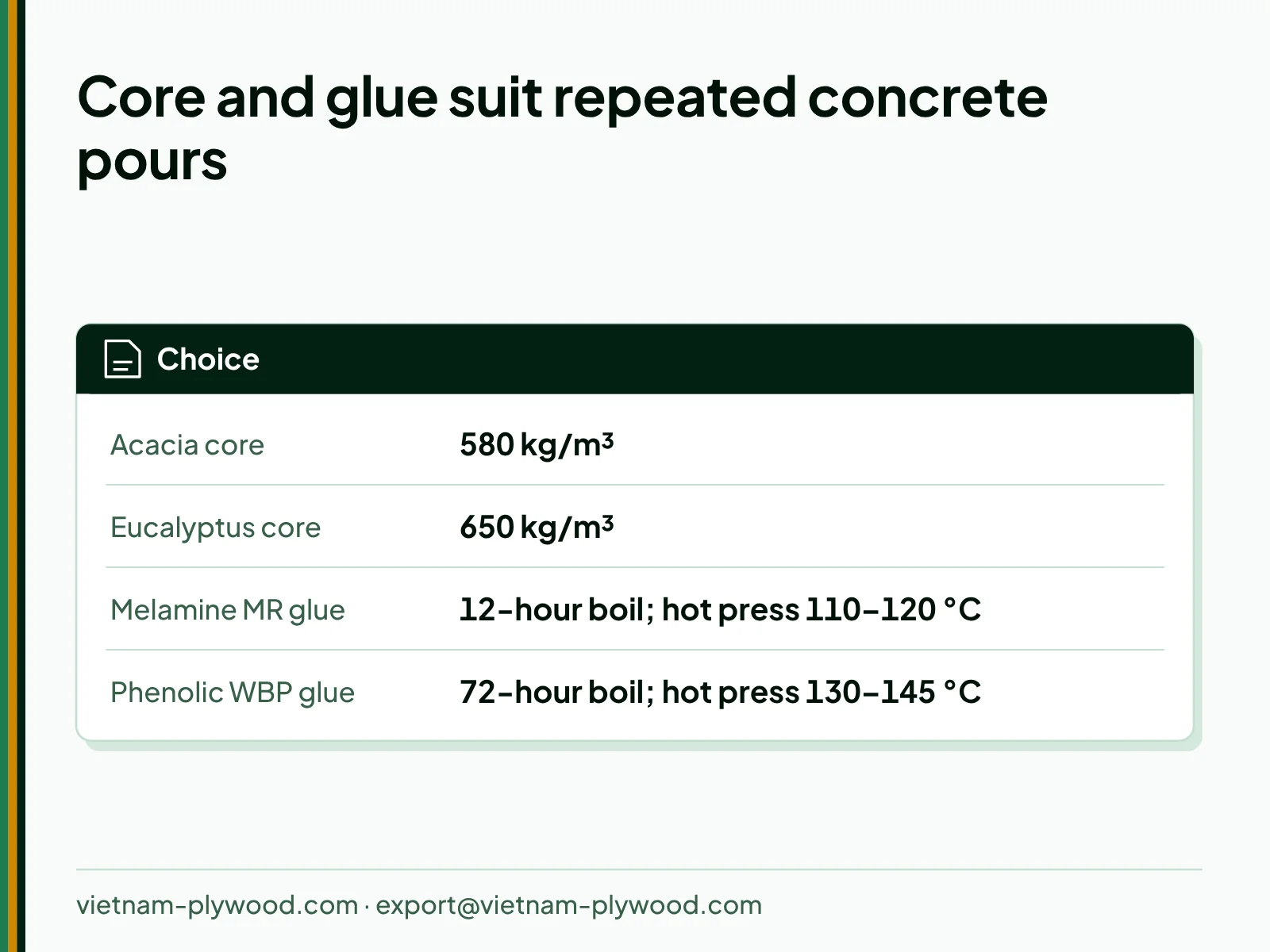
| Choice | Stated metric | Procurement implication | Verdict by use |
|---|---|---|---|
| Acacia core | 580 kg/m³ | Lower calculated sheet mass than eucalyptus | Useful where handling weight matters |
| Eucalyptus core | 650 kg/m³ | Higher calculated sheet mass | Compare against required test evidence for demanding forms |
| Melamine MR glue | 12-hour boil; hot press 110–120 °C | Different bond specification from phenolic | Consider for controlled reuse plans |
| Phenolic WBP glue | 72-hour boil; hot press 130–145 °C | Higher stated boil endurance | Prefer when repeated wet exposure is central |
MR means moisture-resistant; WBP means weather-and-boil-proof. These boil descriptions are build specifications, not a promise that a panel will survive any jobsite exposure. Melamine film and melamine glue are separate choices: an order can specify each field independently.
Core construction runs from full stitched, to stitched outer layers with edge-trimmed inner veneers, to finger-jointed, to loose-laid. Cut-edge inspection reveals gaps and joint patterns. For repeated pours, request the intended core assembly and agreed bond test report before production.
The term phenolic ply 18mm often describes either phenolic glue or phenolic surface film. Put both on separate specification lines so the factory does not interpret one as the other.
Which film options belong on an 18 mm sheet?
Our construction line offers 120 g/m² standard film, 135 g/m² premium film and 220 g/m² anti-slip film. Film weight is the coating-paper specification; it is not panel density or proof of a particular structural grade.
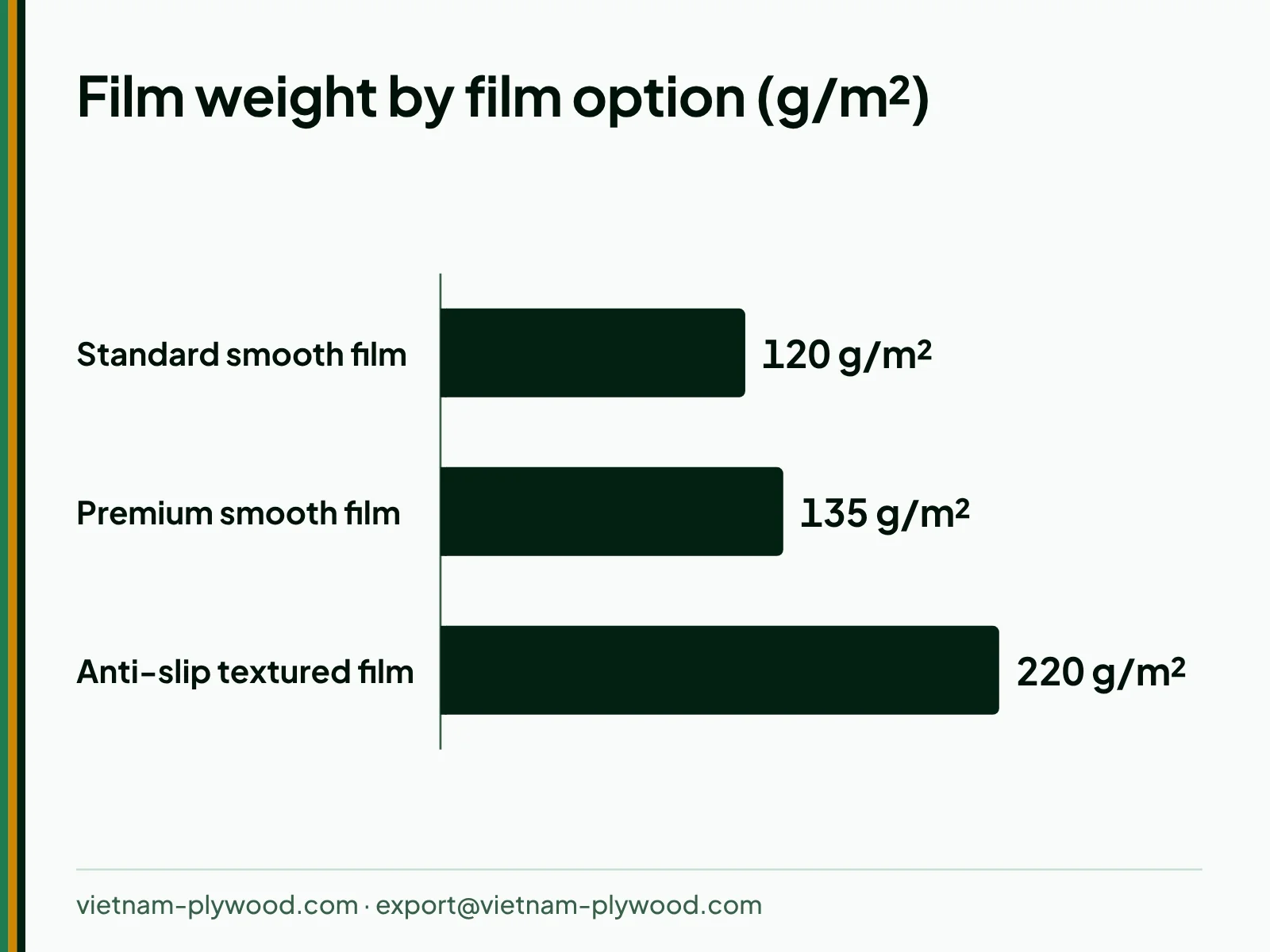
| Film option | Film weight | Surface decision | Typical buying use |
|---|---|---|---|
| Standard smooth film | 120 g/m² | Smooth concrete-contact face | Standard wall and slab forms |
| Premium smooth film | 135 g/m² | Heavier film specification | Repeated-formwork purchase where surface life matters |
| Anti-slip textured film | 220 g/m² | Traction-oriented surface | Walking or working surfaces where specified |
Black film is a surface description, not a complete specification. An enquiry for 18mm black film faced plywood should still state core, glue, film weight, face arrangement and edge treatment. Likewise, mesh plywood 18mm and anti slip plywood 18mm should name the textured film and the surface that needs it.
Do not treat anti-slip film as a substitute for an engineered working-platform design. The requested slip performance needs an accepted test report for the intended use. A phrase such as anti slip phenolic birch plywood 18mm can refer to another manufacturer’s product: Our construction line does not press birch-core plywood. Birch can be a face veneer on other plywood builds, but that does not change the construction core.
A request for dynea film plywood 18mm should identify the actual film specification and documentary evidence; a trade name by itself does not establish the film supplied. Film-faced panels are distinct from melamine decorative faces, high-pressure laminate and medium- or high-density overlay panels; those are not offered as our product lines.
How much does an 18 mm film-faced sheet weigh?
At 1220 × 2440 × 18 mm, an acacia-core sheet is listed at 31.08 kg and a eucalyptus-core sheet at 34.83 kg, using the acacia and eucalyptus core densities. These are geometric planning weights before pallet, wrapping and other packaging, not a measured scale ticket.
The standard 1220 × 2440 mm weight table lists 31.08 kg for acacia and 34.83 kg for eucalyptus. Use the measured packed weight for transport release.
| Size and core | Weight basis | Sheet weight |
|---|---|---|
| 1220 × 2440 × 18 mm, acacia | Standard weight table | 31.08 kg |
| 1220 × 2440 × 18 mm, eucalyptus | Standard weight table | 34.83 kg |
Film and packaging must be considered when verifying loaded gross weight. For 18mm film faced plywood weight, always attach the sheet dimensions and core species to the figure.
A buyer can witness selected sheets being weighed at the producing factory and compare those measurements with the packing list. Record the sample selection and scale reading rather than treating a calculated value as an inspection result.
How many 18 mm sheets fit one 40HC?
For 1220 × 2440 × 18 mm sheets, the standard pallet plan gives 880 acacia-core or 795 eucalyptus-core sheets per 40HC, under its pallet and stack assumptions. These are single-build planning counts, with a 28.5-tonne payload ceiling that still requires a final loaded-weight check.
The standard acacia plan lists 16 pallets with 55 sheets per pallet; eucalyptus lists 15 pallets with 53 sheets per pallet.
| Core | Pallets | Sheets per pallet | Total sheets | Nominal volume | Calculated panel mass |
|---|---|---|---|---|---|
| Acacia | 16 | 55 | 880 | 47.15 m³ | 27.35 t |
| Eucalyptus | 15 | 53 | 795 | 42.60 m³ | 27.69 t |
Both calculated masses exclude pallets and packing materials. An apparent panel-only total below 28.5 t is not permission to load beyond the payload limit. The actual packing arrangement, pallets, protective materials and verified gross mass control release.
For the wider calculation and alternative dimensions, use the container-load calculator and packing reference. Keep the container count here tied to this exact 18 mm build rather than applying it to every film-faced specification.
Can 18 mm share a container with 12, 15, 21 mm or anti-slip?
Yes. Specifications can be mixed in one 40HC within the 28.5 t payload limit, provided the pallet layout and actual weights are checked. An anti-slip face can be another specification in the same shipment, with its own film weight and quantity on the packing list.
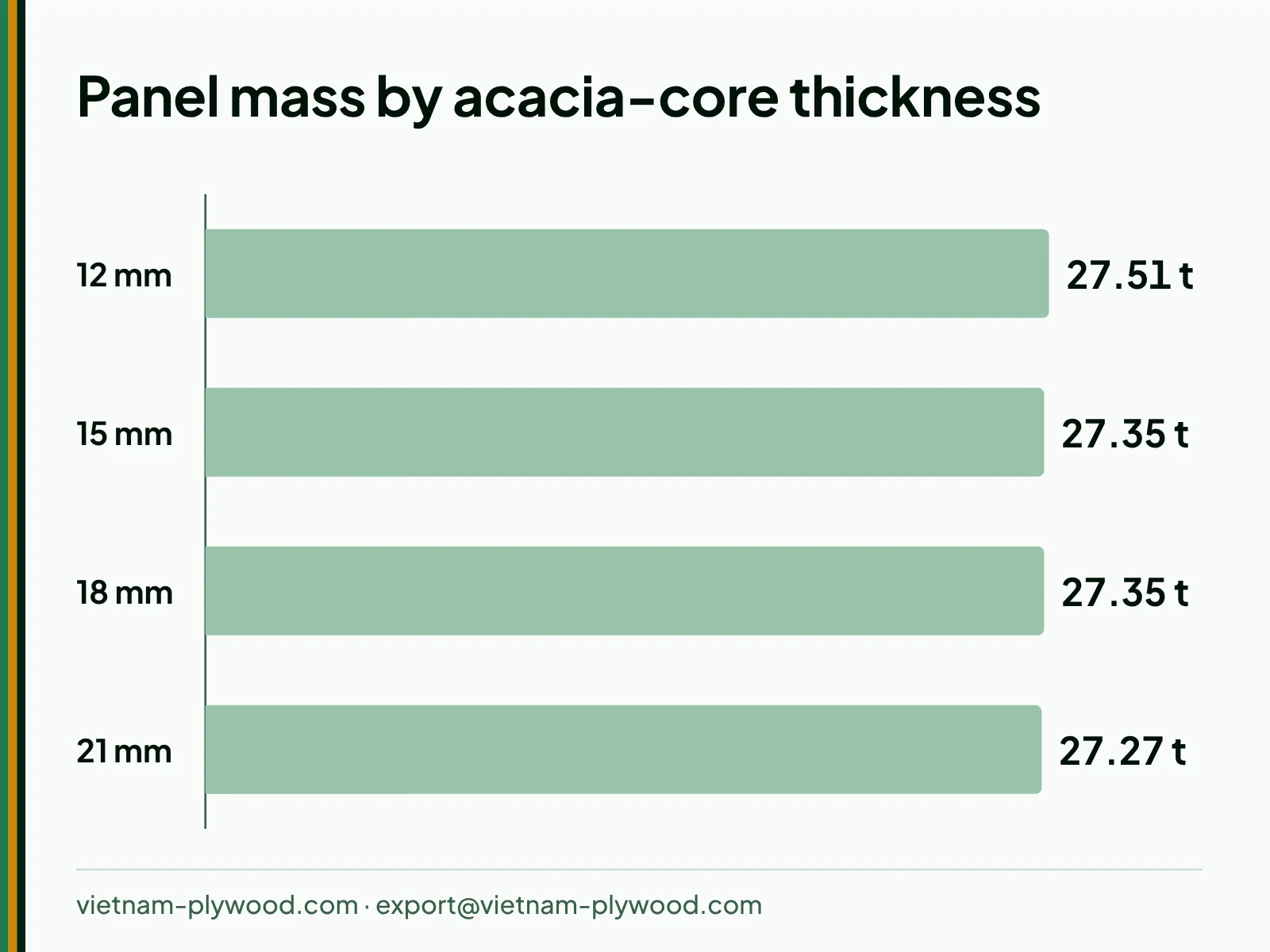
For 1220 × 2440 mm acacia-core panels, the standard full-container reference lists 18 mm at 880 sheets and 27.35 t, 12 mm at 1328 sheets and 27.51 t, 15 mm at 1056 sheets and 27.35 t, and 21 mm at 752 sheets and 27.27 t. These are separate full-load references, not additive quantities.
| Acacia-core thickness | Full 40HC reference | Panel mass | Mixed-order instruction |
|---|---|---|---|
| 12 mm | 1328 sheets | 27.51 t | Allocate pallets in the packing plan |
| 15 mm | 1056 sheets | 27.35 t | Allocate pallets in the packing plan |
| 18 mm | 880 sheets | 27.35 t | Allocate pallets in the packing plan |
| 21 mm | 752 sheets | 27.27 t | Allocate pallets in the packing plan |
For a mixed order, request a pallet-by-pallet stuffing plan and actual packed gross weights before approval. Specify anti-slip sheets separately with their 220 g/m² film and agreed quantity.
List each build separately on the packing list. For the thicker alternative, see 21 mm film-faced plywood. Distributors planning recurring mixed loads can also use plywood supply programmes.
What is checked before loading at the producing factory?
The buyer or appointed inspector can check dimensions, faces, edges, core construction, labels and the agreed documents before a load is released. HCPLY coordinates on-site quality control at the factory making the order, where buyers can inspect goods and visit the factory office.
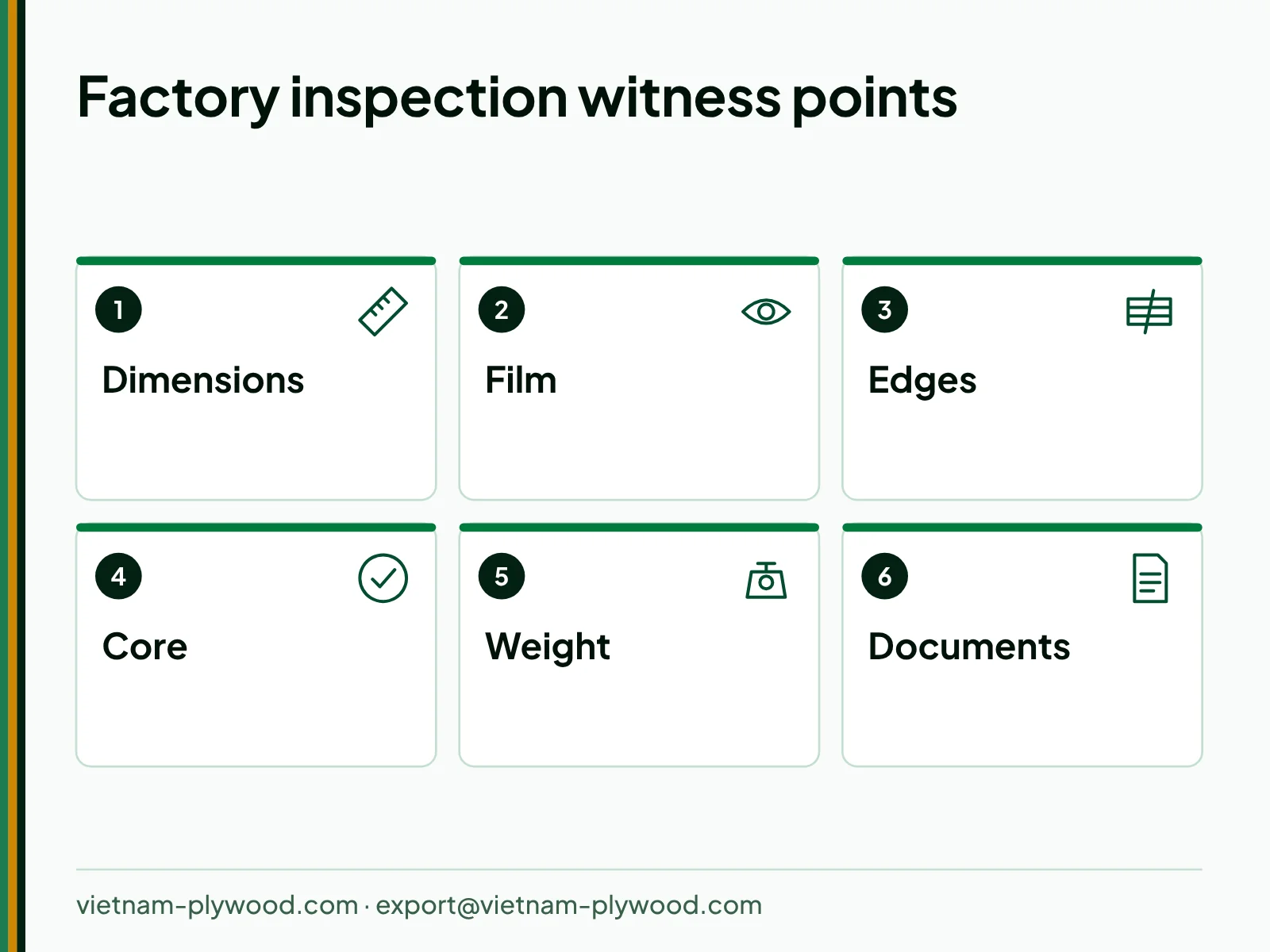
- Select cartons or pallets across the completed lot and identify the specification represented by each sample.
- Measure finished thickness at agreed positions against 18 mm ±0.5 mm, then check length and width against ±2 mm.
- Examine both film faces for visible tears, blisters, surface contamination and the ordered smooth or textured treatment.
- Inspect edges and any cut edges for continuity of sealing, gaps, joint patterns and handling damage.
- Review the stated acacia or eucalyptus core, 11–13-ply construction and ordered glue field against the approved sample.
- Review the agreed test reports and member-factory documents; compare pallet marks and counts with the draft packing list.
- Witness representative weighing and loading checks, recording the actual packed weight against the container payload ceiling.
These are proposed witness points, not claims that a particular batch has passed them. Any acceptance sampling plan, measurement method or rejection threshold beyond the published tolerances belongs in the purchase specification.
For US jobs, the OSHA 1926.703 rule also calls for shoring equipment inspections before erection and around concrete placement. Factory sheet checks do not replace the contractor’s formwork and shoring inspection duties. Record the inspected lot and measurements.
How do film, glue and handling affect reuse?
With proper handling, a release agent on every pour and sealed edges (cut edges included), melamine-glue film-faced panels are described at about 12–15 pours and phenolic-glue panels at up to about 25 pours. These conditional figures are planning guidance, not a minimum service-life promise.
Release agent, stripping methods, concrete mix, impact damage and edge resealing all affect the outcome. A panel removed without damage can still lose surface quality as the film wears. Contractors should agree the finish acceptance level and inspection routine for each reuse cycle.
Use the agreed test report when comparing a panel against an external formwork specification. Review the bond and surface requirements separately from the jobsite reuse record.
A test report accepted by the buyer is required before applying any structural-grade or marine designation. Keep the bond and surface requirements in the written order, and review jobsite performance separately from the initial factory inspection.
Which terms and documents should be on the order?
Identify every build and destination-specific document in the order. HCPLY manages the export specification, on-site checks, documents and loading, with shipments leaving the producing factory under the agreed delivery term.
Minimum order: one 40HC; one container can carry several specifications as long as the payload limit holds. Production: 15–45 days from the 30% deposit, set by order size, line loading and the contract. The remaining 70% is paid on the scan of the bill of lading, by T/T, or by irrevocable sight L/C. Shipping: FOB Hai Phong, or CFR (CNF) or CIF to your port.
Samples: free; a first-time buyer pays the courier, and that charge comes off the first confirmed order. Request a written quotation for the specified film-faced build. The primary cost drivers to specify are core and internal construction, phenolic versus melamine glue, film weight, finish and size; a higher-specification bond and heavier film typically require more material input than their lighter alternatives, but no unverified price difference is quoted.
The shipment file includes the commercial invoice, packing list, bill of lading (B/L), certificate of origin, phytosanitary and fumigation papers, insurance under CIF, and agreed certificates or test reports. EU lots include EUR.1 and the EUTR/EUDR file set where applicable. After loading, the draft shipping documents come to you for approval.
Member-factory FSC, CARB P2, ISO 9001 and CE certificates, and EUDR/EUTR documents, are shown with factory details masked, on request. Certificate claims must match the producing factory and the agreed build; the presence of a document does not establish a universal panel approval.
For scheduling see plywood production lead time.
What do common 18 mm trade names actually mean?
Trade names often identify only thickness, colour or intended application; none is a complete acceptance specification. Translate each phrase into measurable fields before asking the factory to quote.
| Enquiry wording | What to write instead |
|---|---|
| 3/4 form plywood or 3/4 concrete form plywood | Nominal 18 mm or a separately agreed imperial thickness; do not assume exact equivalence |
| Slab formwork plywood 18mm | 18 mm formwork panel plus engineer-approved support and loading design |
| Melamine film faced plywood vietnam 18mm | Melamine film choice, separate glue choice, core and tolerances |
| 18mm phenolic plywood | Specify whether phenolic describes the glue, the film or both |
| Mesh plywood 18mm | Textured 220 g/m² anti-slip film and the required face arrangement |
| Formwork plywood 18mm | Core, glue, film, thickness, dimensions, test evidence and quantity |
The name film faced plywood 18mm does not specify core density. A description of 3/4 form plywood also needs a measurement convention: 3/4 inch equals 19.05 mm, which is different from nominal 18 mm. Do not replace one on an approved drawing without engineering approval.
An enquiry for melamine film faced plywood 18mm should state whether melamine is the surface film, the glue, or both. Keeping those fields distinct avoids a technically different order being accepted under a familiar trade name.
What specification should the buyer send for a trial container?
Send a line-by-line build, inspection and loading brief for a trial container. Include the job application, actual thickness tolerance, panel dimensions and core so that a quoted film-faced product can be checked against the intended use.
Application: slab and wall formwork; engineer-approved design separately
Producing line / core: our construction line / acacia or eucalyptus
Glue: melamine MR (12-hour boil) or phenolic WBP (72-hour boil)
Emission: E0 / E1 / E2 as ordered; evidence required if specified
Face and grade: smooth film 120 or 135 g/m²; or anti-slip film 220 g/m²
Thickness and tolerance: nominal 18 mm, ±0.5 mm
Size: 1220 × 2440 mm, length and width ±2 mm
Quantity: number of sheets by core, glue and film; 40HC payload ≤28.5 t
Destination port: [insert buyer's port]
Inspection: agreed sampling, cut-edge sealing, packed weight and reports
Send the completed brief to Lucy at export@vietnam-plywood.com through contact. The next step is to plan a trial container with the selected core, film and inspection points.