





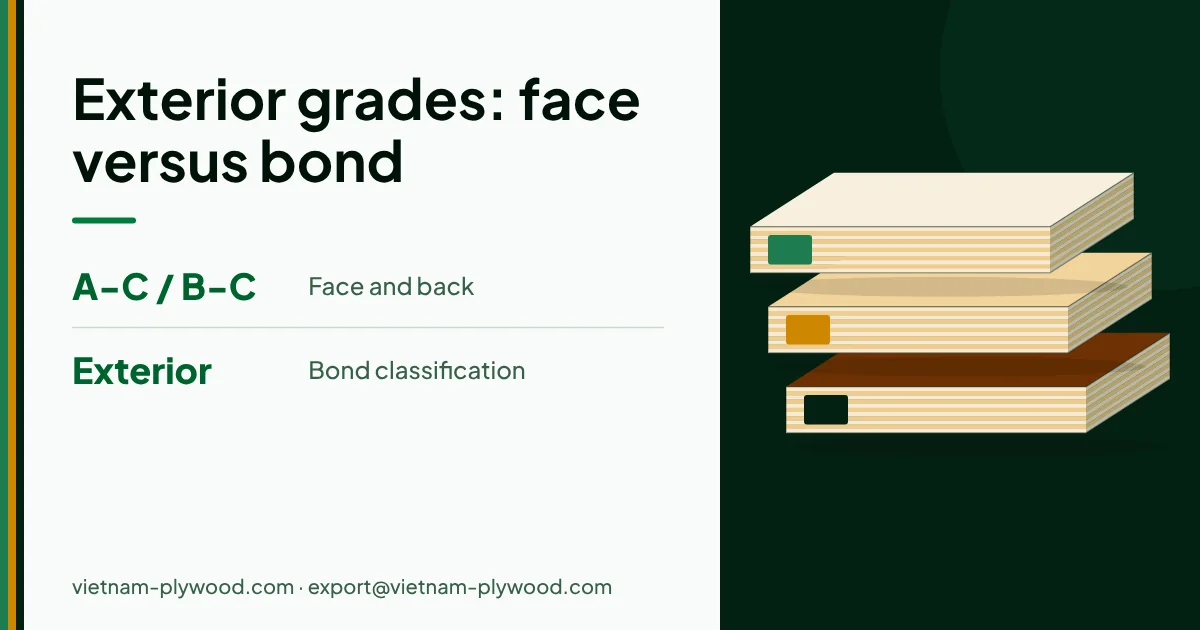
Exterior plywood grades combine visible veneer letters with a separately verified exposure classification. Choosing the wrong combination can mean rejected loads, extra finishing costs or delays at inspection. HCPLY helps importers distinguish the grades of exterior plywood from the glue, core and evidence needed for the intended application.
What are the grades of exterior plywood?
The grades of exterior plywood describe two separate decisions: the face and back veneer appearance, and the panel’s exposure classification. A-C and B-C identify surface grades; Exterior describes a bond classification supported by panel construction and testing. ACX, BCX and CDX are shorthand labels that require the actual product marking or specification before acceptance.
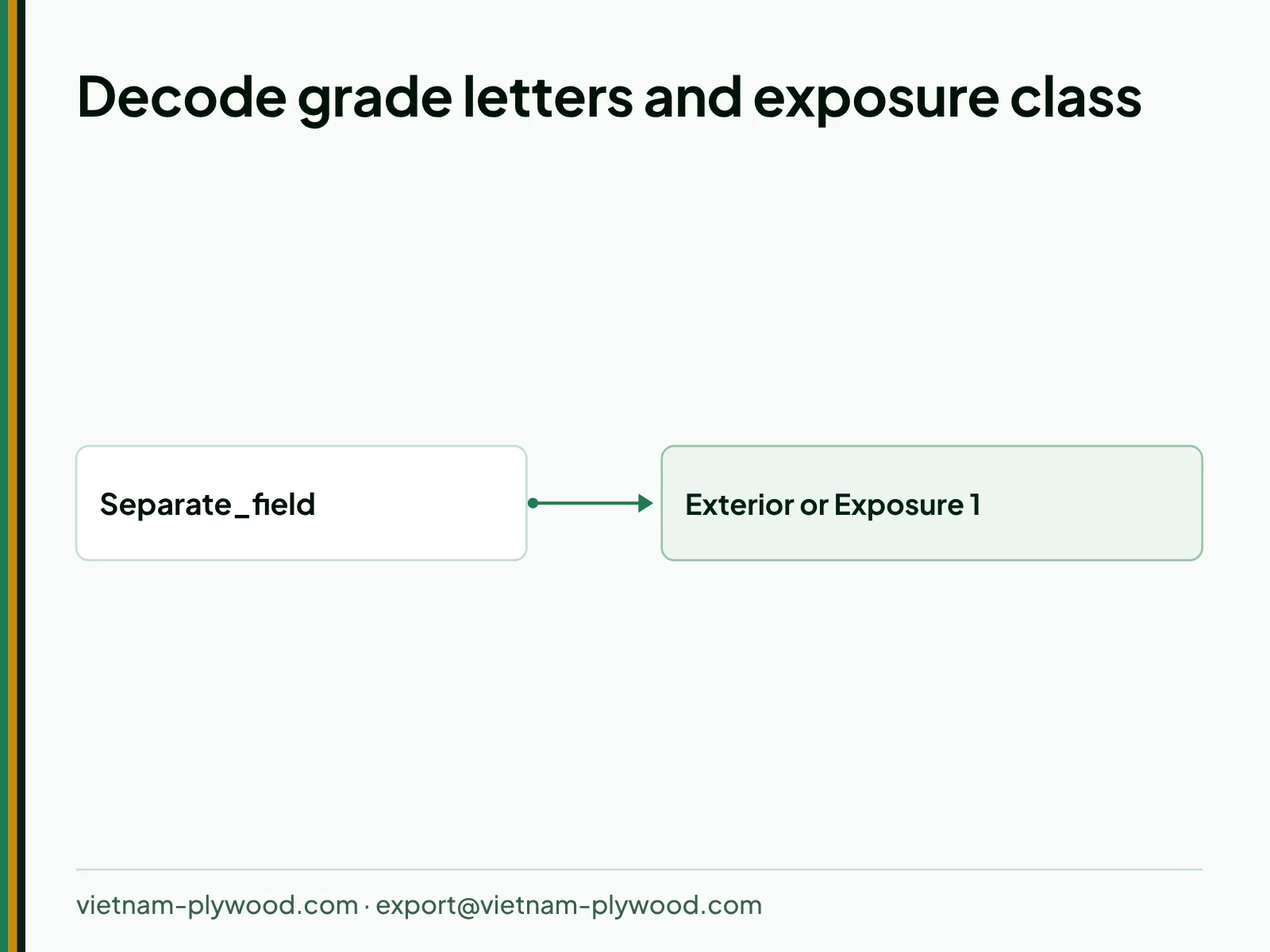
Specify both the exposed surface and the documented bond performance, then decide how the panel will be finished and protected.
The face veneer category covers species and visible-grade selection. For an export order, the most useful first distinction is whether the buyer wants an appearance panel with exterior bonding, a construction panel, or a utility panel that will be covered. Those products have different factory routes and inspection criteria.
What does AC plywood mean?
AC plywood means a panel with an A-grade face and a C-grade back in the North American veneer-letter convention. The A face is intended for a smoother visible finish, while the C back permits more visible natural characteristics and repairs. The letters alone say nothing definitive about the adhesive bond classification.
A-C exterior plywood combines that appearance description with an Exterior bond classification when the panel is made and verified to the applicable standard. ACX is a market abbreviation; the X must be interpreted through the product’s actual exposure marking rather than treated as a universal guarantee of permanent outdoor use.
For cabinet and fit-out purchasing, write the finish requirement in observable terms: permitted patches, open defects, sanding, veneer species and which face will be visible. Our plywood face-grade comparison chart explains the inspection vocabulary used for visual acceptance.
What is the difference between A-C and B-C exterior plywood?
A-C and B-C exterior plywood primarily differ in the finish expected on the face veneer. The C back can serve a concealed side in both builds. If both are independently verified to the same Exterior bond classification, the letter difference alone does not establish a difference in water resistance or load capacity.
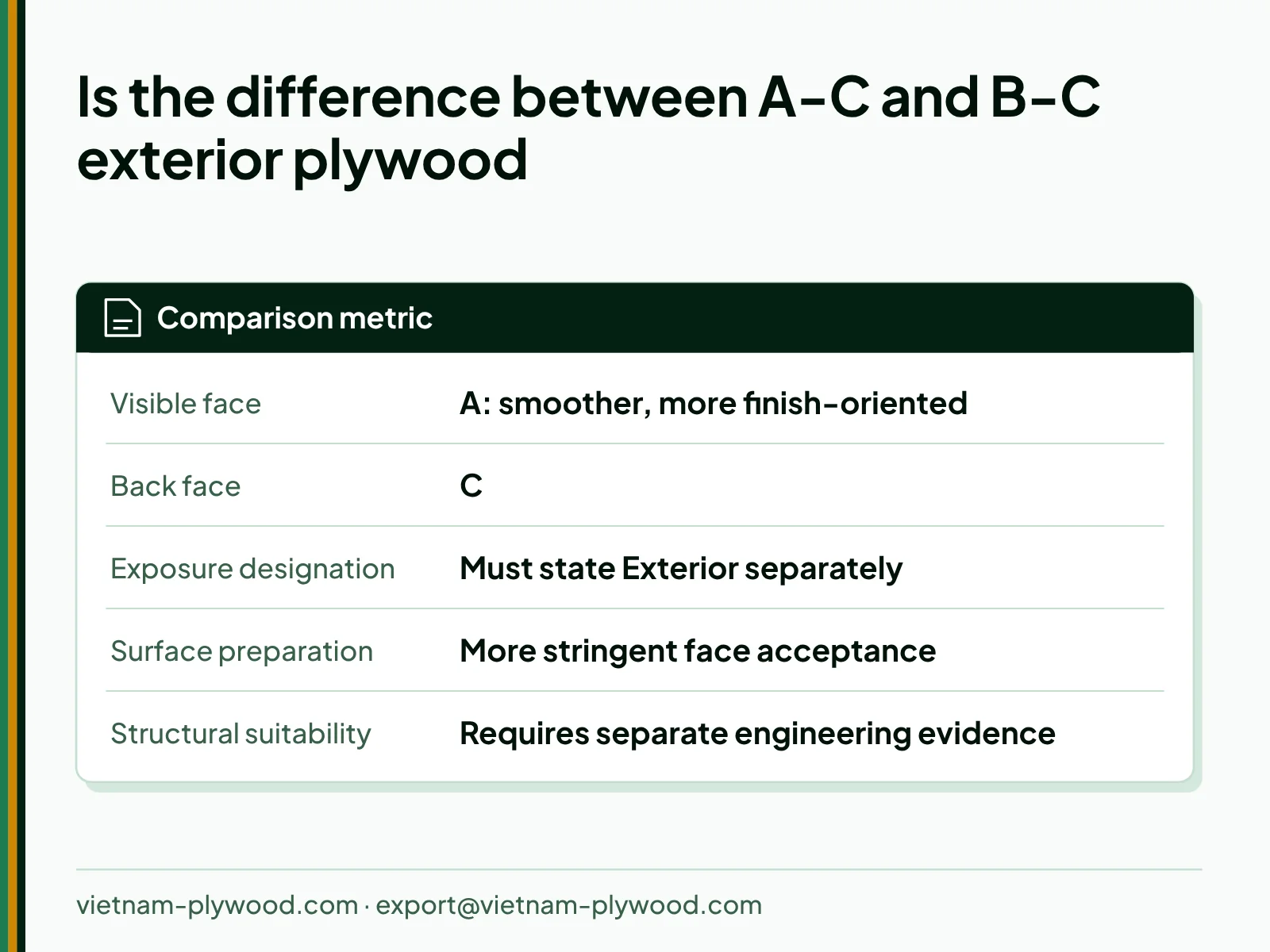
| Comparison metric | A-C Exterior | B-C Exterior | Buying verdict |
|---|---|---|---|
| Visible face | A: smoother, more finish-oriented | B: more permitted repairs and visible characteristics | A-C for a high-visibility painted face; B-C for a less demanding finish |
| Back face | C | C | Neither wins when the back is concealed |
| Exposure designation | Must state Exterior separately | Must state Exterior separately | Tie only when the documented classification matches |
| Surface preparation | More stringent face acceptance | More allowance for cosmetic repairs | Specify sample approval before choosing |
| Structural suitability | Requires separate engineering evidence | Requires separate engineering evidence | Neither letter pair proves a span or design load |
For alternative letter conventions, see BB/CC plywood letter pairs.
What makes plywood exterior rated: glue or face?
Exterior rating requires the prescribed bond performance and qualifying panel construction; a decorative face grade alone cannot supply it. A suitable adhesive is necessary, but calling an adhesive weatherproof is not a substitute for a tested panel classification.
APA – The Engineered Wood Association explains in its current plywood guidance, which references the 2022 PS 1 standard, that Exterior panels withstand repeated wetting and drying, while Exposure 1 panels address temporary construction moisture. APA also states that C is the lowest veneer grade permitted in Exterior plywood under its classification. Read the APA plywood technical guidance when specifying a North American rated product.
At HCPLY, glue and emission class are separate order fields. Our phenolic glue is designated WBP (weather and boil proof), with a 72-hour boil description; melamine MR glue has a 12-hour boil description. These are our build descriptors, not automatic APA Exterior classifications. E0, E1 and E2 describe emission classes, not water resistance. A buyer seeking an exterior rated plywood claim must identify the applicable test report and acceptance standard before production.
Neither a phenolic bond nor a fine face makes wood immune to fungal decay. A panel kept wet for long periods presents a different risk from a panel that dries between exposures.
How should BCX and CDX be read?
BCX and CDX should be decoded from the grade stamp or written specification, especially the actual exposure classification. B-C describes face and back veneer quality. C-D describes a more utilitarian face/back combination, while the familiar CDX construction product is typically Exposure 1 rather than a permanent Exterior panel.
The BCX plywood meaning article examines that shorthand in detail; APA plywood grade stamps covers the North American marking fields. HCPLY does not apply APA or PS 1 stamps to its panels. For a buyer requiring that marking, the procurement specification must call for a product supplied with the required independent evidence.
Which exterior face grades can our factories offer?
Our furniture line can build sanded panels with A/B face selections, while the construction line presses film-faced panels for formwork. Our commercial and packing line builds acacia-core utility panels with MR glue and unsanded or light-sanded surfaces. An exterior WBP appearance enquiry therefore starts by specifying the face and phenolic bond together, rather than assuming every factory line produces the same article.
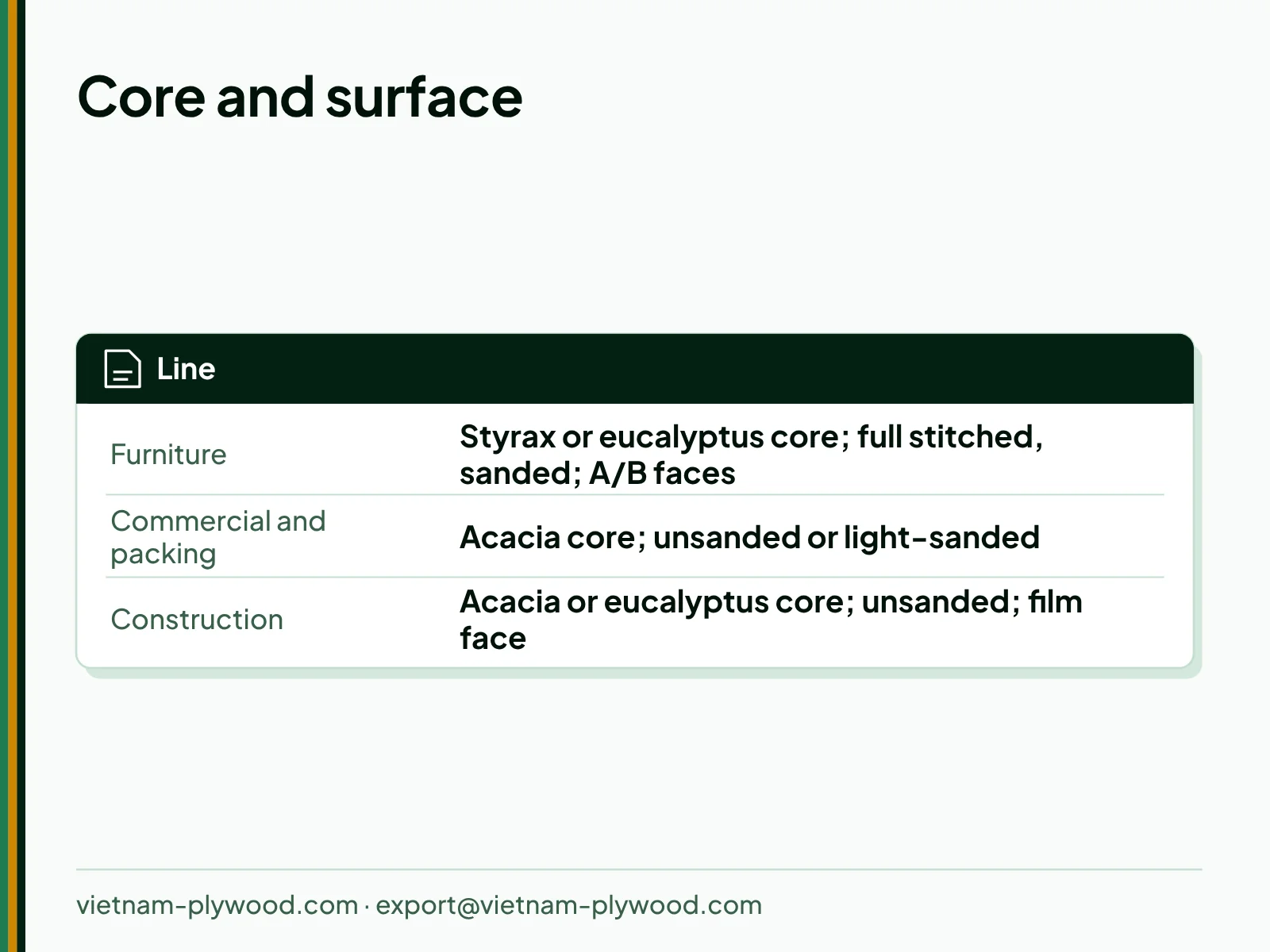
| Line | Core and surface | Adhesive or surface route | Appropriate enquiry |
|---|---|---|---|
| Furniture | Styrax or eucalyptus core; full stitched, sanded; A/B faces | E0/E1 emission selection; exterior bond requires an agreed build and evidence | Visible cabinet or fit-out face with a defined finish |
| Commercial and packing | Acacia core; unsanded or light-sanded | MR glue | Covered utility and packing applications, rather than a permanent-exposure claim |
| Construction | Acacia or eucalyptus core; unsanded; film face | Phenolic or melamine film and specified glue | Formwork surface and repeated pour handling |
HCPLY offers bintangor, okoume, engineered veneer (EV), gurjan, pine, poplar, eucalyptus, birch and sapele faces. The usual face veneer thickness is 0.2–0.4 mm. Our face grades are A/B, while birch is offered as D/E/F; these are our sales-grade conventions and must not be presented as identical to North American A-C or B-C grades.
The exterior plywood supplier page covers the product enquiry route. Melamine, high-pressure laminate and laminate faces are material topics rather than HCPLY production lines; we do not press medium-density fibreboard, oriented strand board, chipboard, blockboard, bamboo panels, medium-density overlay or high-density overlay.
Which thickness and core details belong in the order?
Specify nominal thickness, tolerance, panel size, core species and construction before approving an exterior plywood sample. For HCPLY, thickness runs from 3–40 mm; common orders include 9, 12, 15, 18, 21 and 25 mm. Standard 1220×2440 mm and 1250×2500 mm formats are available, with custom cutting as an option.
A sanded furniture panel can be ordered at ±0.2 or ±0.3 mm thickness tolerance. Commercial and film-faced panels use ±0.5 mm, while packing panels use ±0.5–1.0 mm. Length and width tolerance is ±2 mm. At 18 mm, core veneer thickness of 1.4–2.0 mm gives 11–13 plies; the actual lay-up belongs on the sample record.
Styrax is 500 kg/m³, acacia 580 kg/m³ and eucalyptus 650 kg/m³. Our preferred construction for a visible face is full stitched; other constructions include stitched outer layers with edge-trimmed inner layers, finger-jointed and loose-laid. Buyers should inspect core gaps at the cut edge and agree their tolerance before a batch is pressed.
Which exterior claims need a test report before ordering?
An exterior performance claim needs a report that matches the intended market, product construction and exposure class. Structural capacity, marine suitability and named standards require separate evidence; appearance letters cannot substitute for those documents.
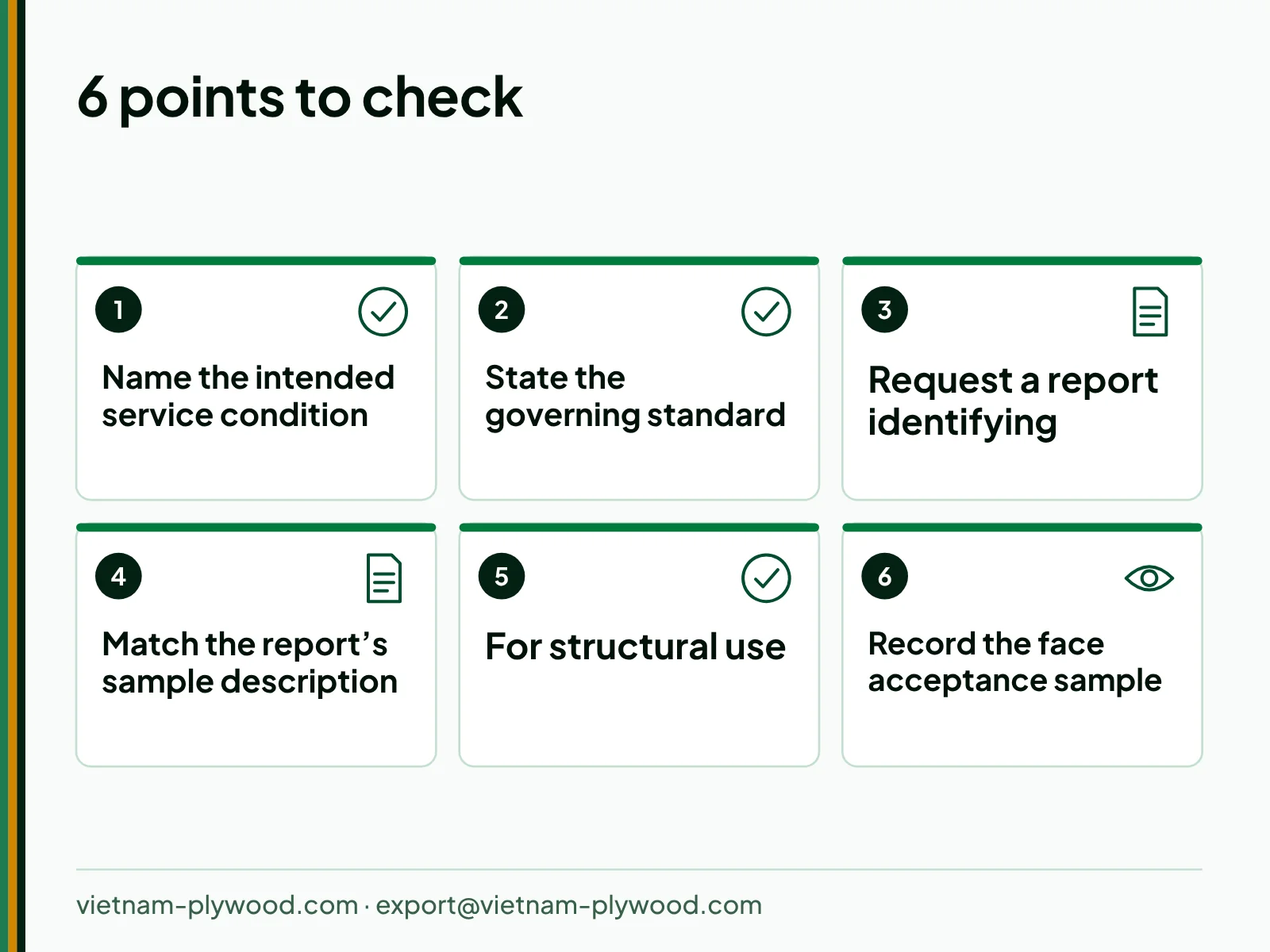
- Name the intended service condition: sheltered humidity, occasional wetting or long-term exterior exposure.
- State the governing standard and edition, with the bond test method and acceptance criterion.
- Request a report identifying the tested product build, thickness and adhesive system.
- Match the report’s sample description against the production sample and purchase order.
- For structural use, obtain the accepted strength and span evidence independently of the bond result.
- Record the face acceptance sample and edge-sealing or finishing requirements in the order.
For marine or BS 1088 descriptions, HCPLY discusses supply only against a test report the buyer accepts. The same evidence rule applies to any proposed structural grade. Neither a boiling-time label nor an attractive veneer can establish those designations.
Certificates for the member factories, including FSC, CARB P2, ISO 9001 and CE where applicable, and EUDR/EUTR documents are shown with factory details masked, on request. The precise order’s certificate documents and agreed test reports belong with its export paperwork. A US emission requirement under CARB P2 or TSCA Title VI is distinct from the adhesive’s moisture-bond performance.
Can exterior panels share a shipment with other specifications?
A mixed-specification 40HC shipment can combine agreed panels within the 28.5 t payload limit. The packing calculation must use each core density, sheet thickness, pallet arrangement and the actual specification mix; a face name does not determine weight.
For illustration, at 18 mm and 1220×2440 mm, a full 40HC of styrax-core panels is 990 sheets, 53.05 m³ and 26.52 t. Acacia-core panels are 880 sheets, 47.15 m³ and 27.35 t; eucalyptus-core panels are 795 sheets, 42.60 m³ and 27.69 t. These are separate full-container reference loads, with film weight excluded. The container packing reference owns the detailed loading method. Buyers can combine appearance panels and utility specifications in one 40HC order when the payload and packing plan permit.
What can an inspector witness at the producing factory?
An inspector can compare the approved face sample, measured thickness, cut-edge lay-up and order labels against the actual production batch. HCPLY manages specification, on-site quality control, documents and loading; the buyer inspects goods at the producing factory and visits the factory office.
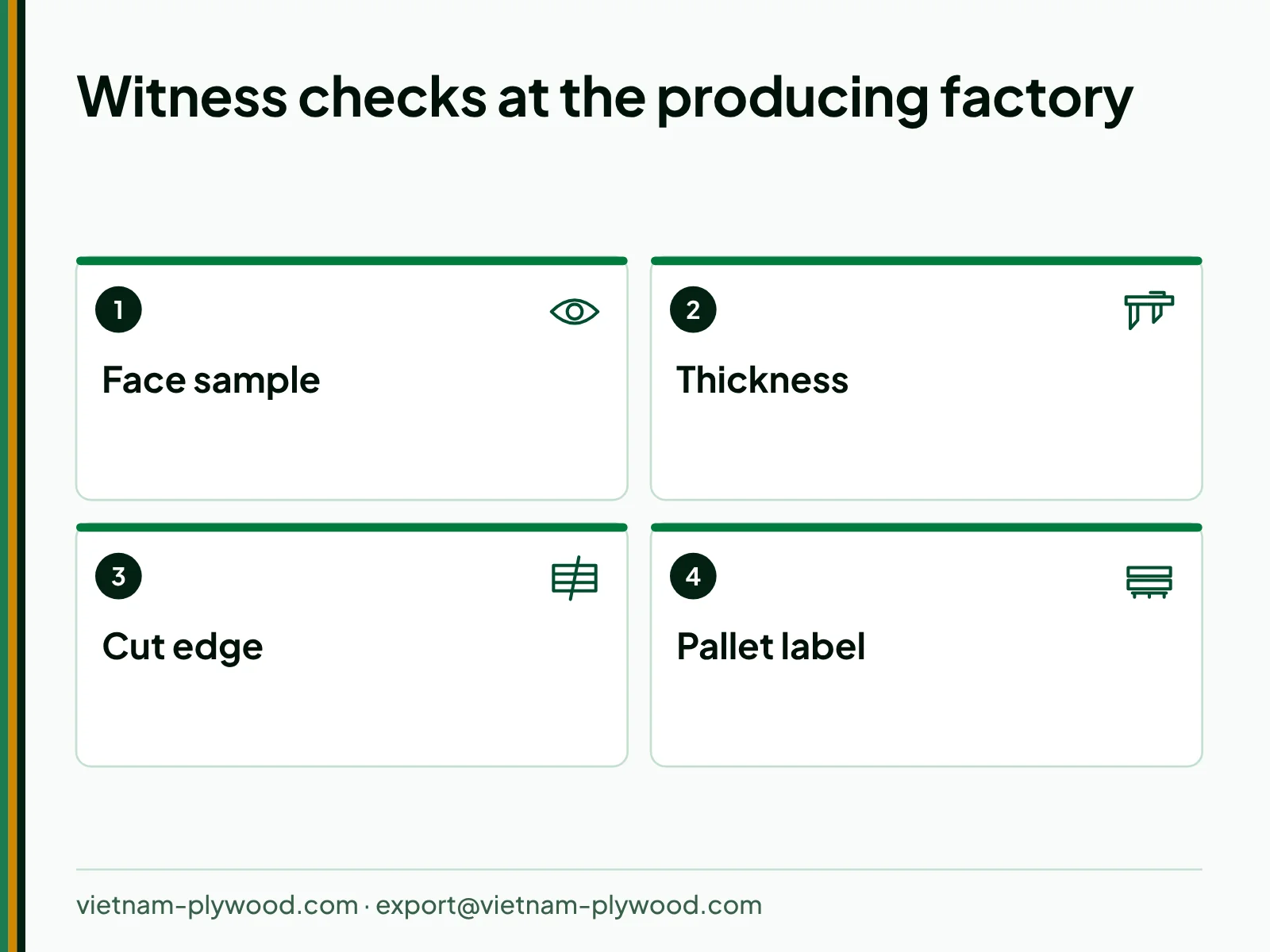
At the press and finishing stages, the inspector should record the adhesive identification, sample traceability, face/back grade, core species and dimensions. At the stacking stage, check pallet identification, visible damage, edge condition and the count against the packing list. Our furniture line uses full stitched, sanded cores for appearance work. A film-faced enquiry belongs to our construction line, where film weight is 120 g/m² standard, 135 g/m² premium or 220 g/m² for anti-slip film. These are distinct surface products with their own acceptance criteria; they should not be marketed as interchangeable A-C or B-C veneer grades.
How should an importer approve the order and documents?
Approve a written build, physical sample and evidence list before production. The minimum order is one 40HC, with mixed specifications allowed within the payload limit. Factory lead time runs 15–45 days from receipt of the 30% deposit; the exact figure depends on order size, line loading and what the contract fixes. The remaining 70% is paid on the scan of the bill of lading, by T/T, or by irrevocable sight L/C.
We ship FOB Hai Phong, or CFR (CNF) or CIF to your port. The shipment paperwork includes commercial invoice, packing list, bill of lading, certificate of origin, phytosanitary and fumigation papers, insurance under CIF, and agreed certificates and test reports. EU lots include EUR.1 and the EUTR/EUDR file set. After loading, the draft shipping documents come to you for approval.
Price should be quoted against the written specification: adhesive and test requirements drive the bond-related work, while veneer appearance, full stitched construction, sanding and thickness tolerance add finishing demands. A more selective visible face costs more to prepare than a utility surface of otherwise comparable construction. For distributor scheduling and recurring specifications, see plywood supply programmes.
What should the buyer send for an exterior plywood sample?
Send the intended application, exposure class, face appearance and accepted test standard together. Lucy can then route the enquiry to the relevant production line and prepare a sample set with the right visible face and core details.
HCPLY ships from the producing factory through FOB Hai Phong and manages the export documentation.
Application: exterior-facing cabinet / covered fit-out / other specified use
Line or core: furniture line; styrax or eucalyptus core
Glue: phenolic WBP; requested bond test and acceptance standard
Emission: E0 or E1 as ordered
Face and grade: named veneer; approved A/B sample; face/back acceptance
Thickness and tolerance: 18 mm; +/-0.2 mm or +/-0.3 mm as ordered
Size: 1220 x 2440 mm
Quantity: one 40HC; list any mixed specifications
Destination port: [buyer to specify]
Ask Lucy at export@vietnam-plywood.com for a sample set through the contact page.