





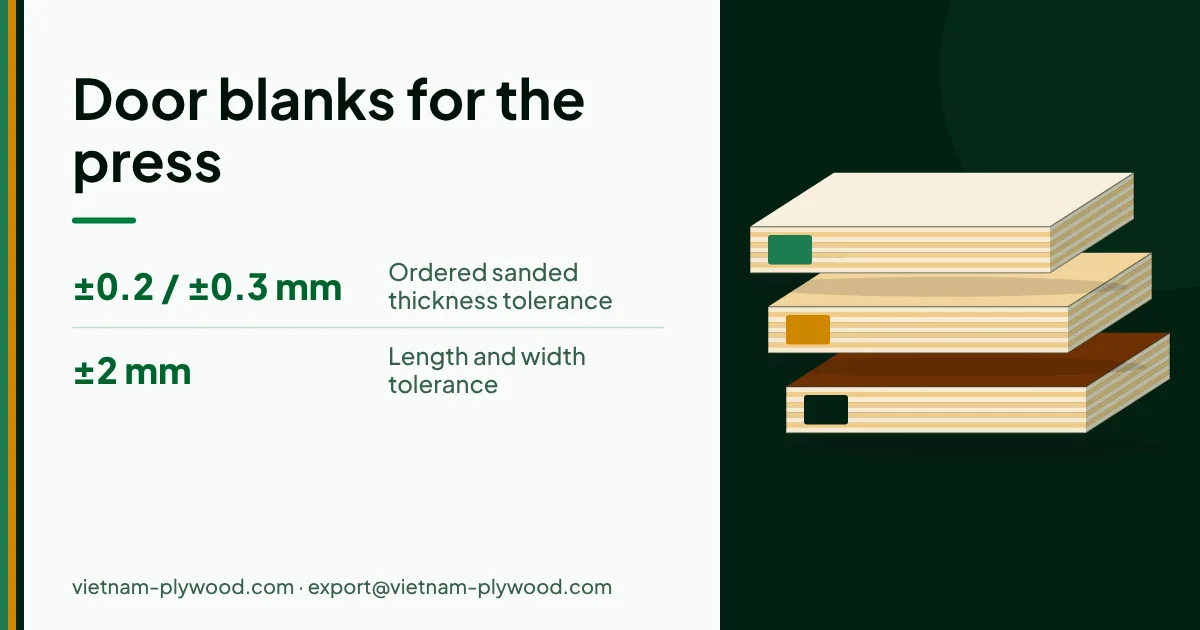
HCPLY supplies sanded plywood components for flush plywood doors to the thickness and cut-size specification a door press accepts. A wrong thickness band or unstable blank can waste adhesive, press time and finished door stock. The buyer should specify the incoming panel separately from the completed door assembly.
What plywood is used in flush plywood doors?
Flush plywood doors use a balanced panel assembly whose core, skins, adhesive and press schedule suit the door maker’s design. A plywood door blank can be a sanded core panel intended for further facing, while a finished door leaf includes other components and processing. We supply plywood components from our furniture line; the door maker controls the complete assembly and its final performance.
For a door press, start with the required finished leaf construction. Record whether the order calls for a full plywood blank, thin facing skins, or plywood panels assembled around a separate frame. These are different purchase specifications. A nominal thickness alone does not establish how a panel will behave after lamination.
Our furniture line uses styrax or eucalyptus cores, full stitched construction, sanding and E0 or E1 emission classes. The furniture plywood range is the starting point for those components. A full stitched core offers a more controlled substrate for a visible facing than loose-laid veneers. It does not remove the need to validate the door maker’s adhesive, pressing temperature and conditioning cycle.
A plywood flush door should be evaluated as a system. The manufacturer of the assembled door selects rails, stiles, lock blocks, adhesives, skins and finish. Our component specification describes the supplied plywood, without claiming that a panel alone establishes finished-door performance.
Can blanks and core panels be cut to my door press size?
Yes. Custom cutting is available for plywood blanks and core panels, against an agreed drawing and dimensional schedule. The order should distinguish raw panel dimensions from the net dimensions entering the press, including any trimming allowance after lamination.
Standard plywood formats include 1220 × 2440, 1250 × 2500, 1220 × 2135, 1220 × 1830, 915 × 2440, 915 × 2135 and 915 × 1830 mm. Panel thicknesses run from 3 to 40 mm, with common nominal options of 3, 5, 9, 12, 15, 18, 21 and 25 mm. Those are available specification boundaries, not a promise that every cut layout has the same yield.
Send a dimensioned drawing showing grain direction, press opening, edge-trim allowance and required orientation of the face veneer. State whether sizes are measured before or after final sanding. For asymmetric door designs, mark the face that must remain visible after assembly. Our cut-to-size plywood service explains the cutting conversation in more detail.
Cutting does not establish the permissible bow, twist or residual stress of a blank. Approve a sample with the same core, thickness and facing arrangement before scaling a new press programme. Record which surfaces will receive glue and which edges remain exposed during storage.
What thickness tolerance and flatness does a door press need?
Specify the door press’s acceptable incoming thickness band and its separate flatness test. For furniture plywood, the ordered sanded thickness tolerance is ±0.2 or ±0.3 mm; length and width tolerance is ±2 mm. Neither number is a universal door-press acceptance limit.
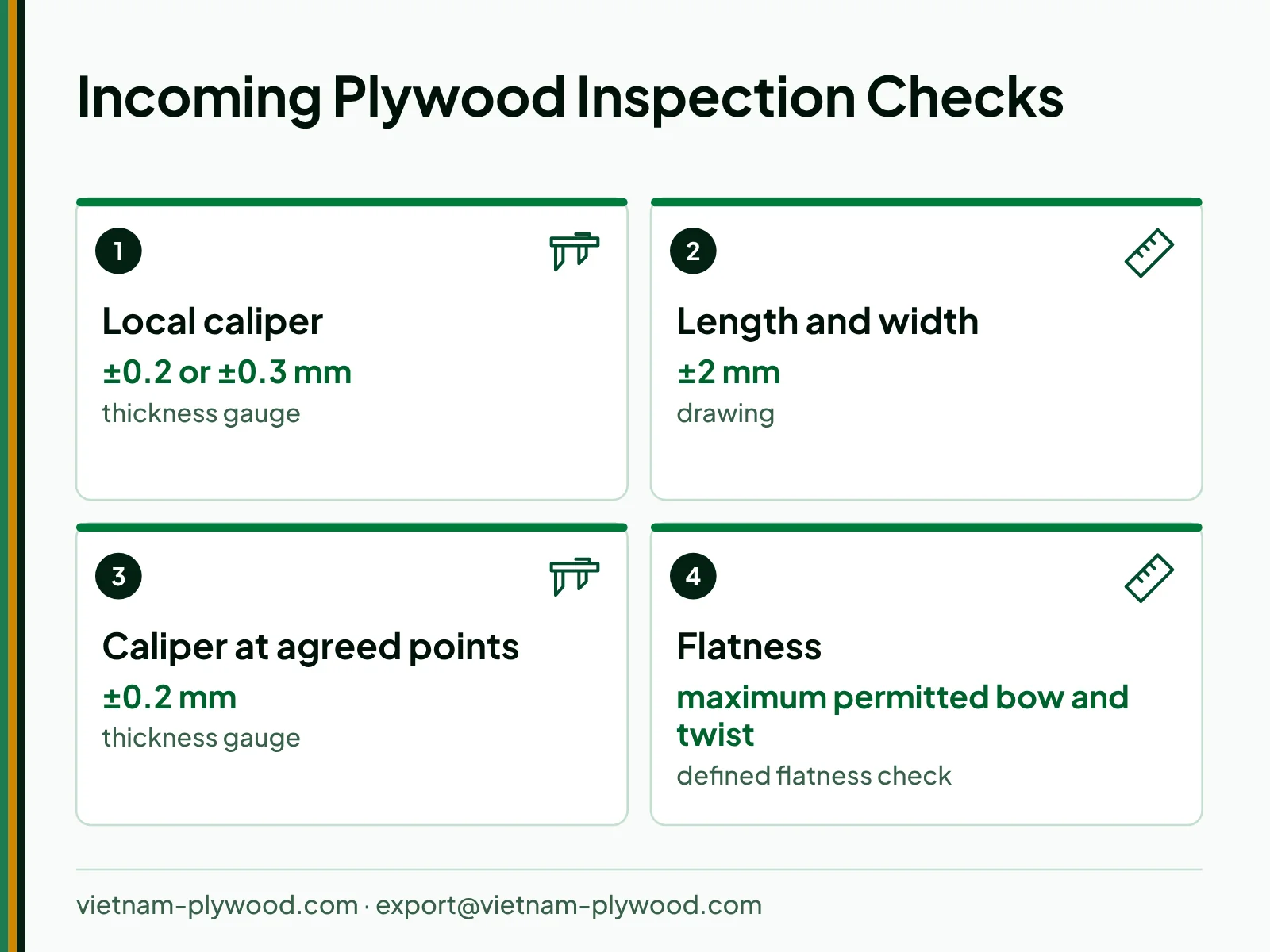
A thickness gauge measures local caliper. Flatness needs a separate agreed method: support condition, measurement positions, reference plane, maximum permitted bow and twist, and conditioning before inspection. A sheet can meet thickness tolerance while still failing the press’s flatness criterion. Conversely, a flat panel can exceed the specified caliper at an edge.
For a 12 mm nominal panel ordered at ±0.2 mm, inspect caliper against the ordered tolerance at agreed points. That check describes thickness only. It cannot predict spring-back, telegraphing of joints or a finished leaf’s flatness after the door maker adds skins.
Ask the press operator to identify the failure mode before setting a flatness limit. Uneven adhesive spread, unbalanced skins, inconsistent moisture conditioning and a misaligned stack can each distort the assembly. We can inspect the supplied component, while the buyer validates the assembled door against its production requirements.
At the producing factory, an inspector can witness caliper readings at agreed positions, compare cut dimensions with the drawing, and observe a defined flatness check on a supported panel. Record the method and readings on the inspection sheet rather than treating an unmeasured visual impression as acceptance.
Which factory line should press the door component?
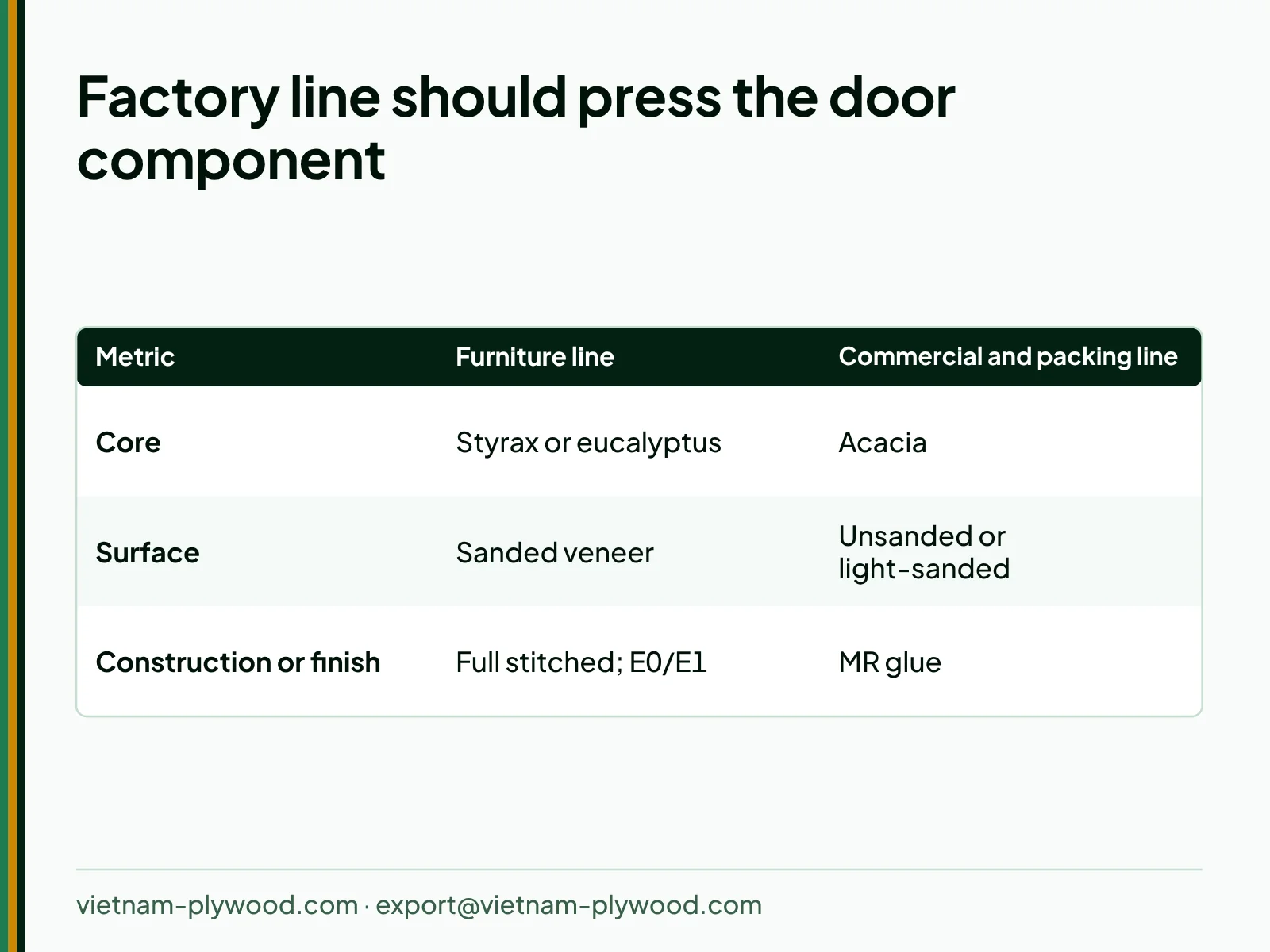
Our furniture line presses the sanded, full stitched panel intended for door-facing and blank applications. The other lines make different constructions, so specifying only “plywood” can send the purchase toward the wrong surface and tolerance.
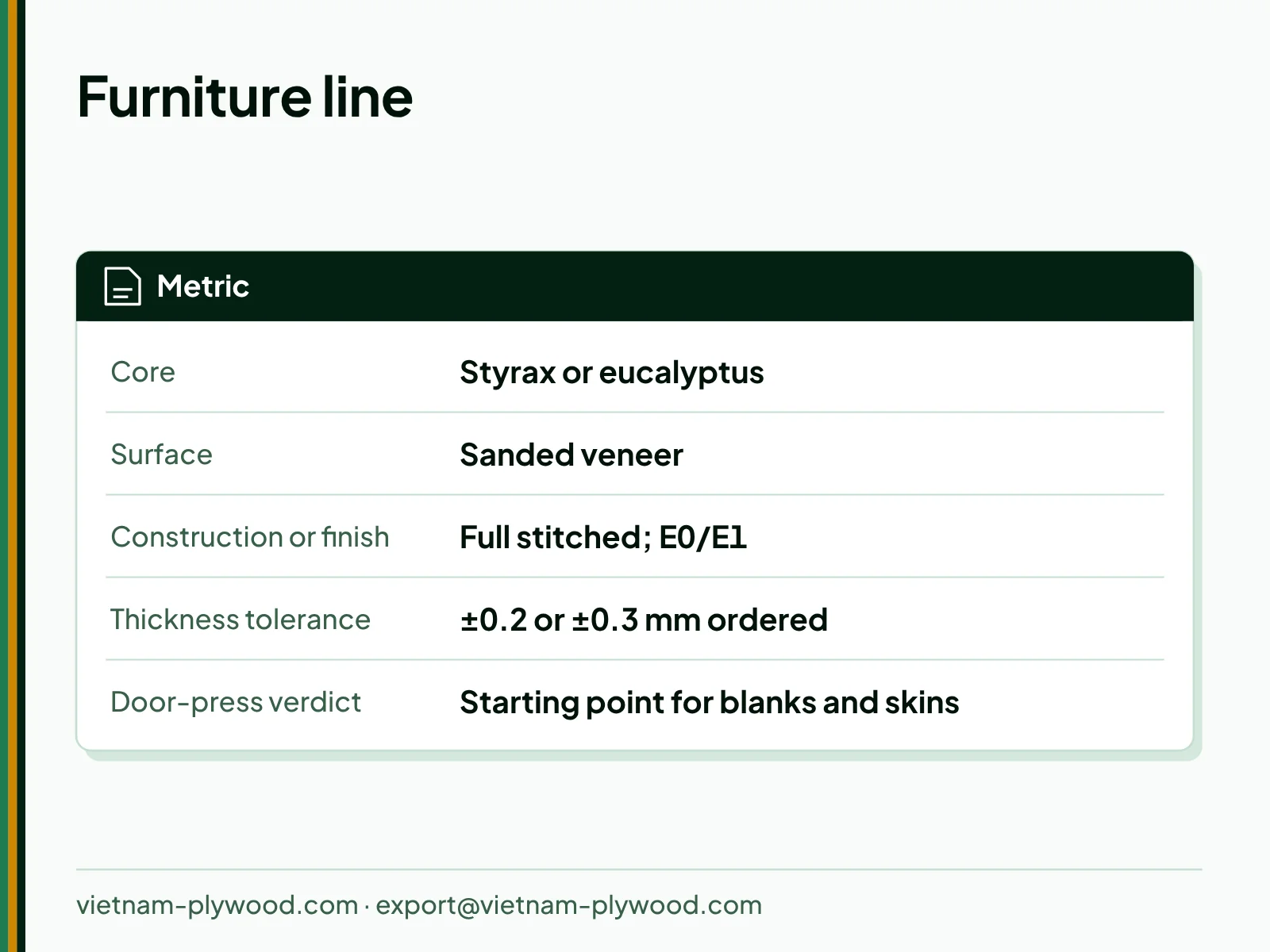
| Metric | Furniture line | Commercial and packing line | Construction line |
|---|---|---|---|
| Core | Styrax or eucalyptus | Acacia | Acacia or eucalyptus |
| Surface | Sanded veneer | Unsanded or light-sanded | Unsanded film-faced |
| Construction or finish | Full stitched; E0/E1 | MR glue | Phenolic or melamine film |
| Thickness tolerance | ±0.2 or ±0.3 mm ordered | ±0.5 mm commercial; ±0.5–1.0 mm packing | ±0.5 mm |
| Door-press verdict | Starting point for blanks and skins | Consider for protective packing, not a direct facing substitute | Formwork product, not a door skin |
A buyer who needs a visible wood veneer and a tight sanding band should write those conditions explicitly. Our commercial and packing line serves different surface expectations, while our construction line is built for film-faced formwork. This comparison concerns manufacturing fit; it is not a certification of any finished door.
A furniture component specification should identify the final use, face appearance and press-facing side. When packaging panels accompany the shipment, they need their own line item and acceptance criteria.
Which skins pair with flush door blanks?
Select a balanced skin schedule around the door maker’s core construction. Available plywood face names include bintangor, okoume, engineered veneer (EV), gurjan, pine, poplar, eucalyptus, birch and sapele. The product is named by its face; core density follows the core species instead.
Common face veneer thickness is 0.2–0.4 mm, with A/B face grades; birch uses D/E/F grades. Specify both sides separately when appearance differs. A decorative veneer can be appropriate for a paint or clear-finish programme only after the door maker approves its appearance and finishing method.
For a smooth substrate under a later decorative finish, matt plywood is an unfaced raw-core topic to compare. For thinner plywood components, review thin plywood and state the intended bending, handling and press requirements. Melamine-faced, high-pressure laminate and other laminate finishes are useful comparison topics, but they are not offered as our product lines; see the melamine-faced plywood explanation.
Avoid an unbalanced trial in which one side receives a different material, adhesive spread or pressing history without an engineering decision. The blank supplier can describe the panel’s veneers and sanding; the door maker must test the completed stack for curvature, bond and appearance. Veneer grade does not replace a flatness acceptance method.
How should glue and emission requirements be written?
Write glue type and emission class as separate fields on the purchase order. A glue designation describes the adhesive system or bond expectation, while an emission designation concerns formaldehyde release criteria. Calling a panel “E0 glue” mixes those two decisions.
Melamine glue is MR with a 12-hour boil description, while phenolic glue is WBP with a 72-hour boil description. Furniture-line emission classes are E0 and E1. The intended press process and end-market requirements should determine the ordered combination and supporting test documents.
For a United States programme, California Air Resources Board Phase 2 and Toxic Substances Control Act Title VI concern formaldehyde limits with third-party certification. They should not be inferred from an E0 or E1 description. Where relevant, request the member factory’s supporting certificate and the exact product coverage, shown with factory details masked, on request.
Ask for the adhesive field, emission field, relevant test report and sample identification on separate rows. A door maker should also test the compatibility of its own lamination adhesive with the supplied surface. The incoming plywood report cannot substitute for a test of the final assembled door.
How does door stock pack with LVL frame stock?
Door plywood and laminated veneer lumber (LVL) frame stock can be planned in one shipment only after both products’ suppliers, dimensions, packing methods and weights are documented. Plywood loading figures are available, while LVL stock dimensions and weights must come from the LVL supplier before planning the combined load.
For 18 mm plywood at 1220 × 2440 mm, sheet weights are 26.79 kg for styrax core, 31.08 kg for acacia core and 34.83 kg for eucalyptus core. These reference weights exclude film and packing materials.
At that thickness and size, the stated 40HC reference totals are 990 styrax sheets, 880 acacia sheets or 795 eucalyptus sheets. Those are alternative full-plywood examples, not quantities available after adding LVL. The 40HC payload limit is 28.5 tonnes; mixed specifications must remain within that limit. See container load calculations for the owner topic.
For a mixed proposal, obtain verified gross weights for LVL bundles, plywood pallets, dunnage and other cargo. Request a loading plan showing the combined gross cargo weight against the permissible payload. Cargo dimensions, loading sequence, axle constraints and securing arrangements also need review. An arithmetic payload fit alone does not approve a container plan.
The buyer can send a packing drawing and supplier weight schedule for LVL stock sourced separately; our plywood lines do not press LVL. Our commercial and packing plywood is a separate category when protective packaging panels are required.
Do the door blanks carry a fire-door rating?
No fire-door rating applies to our supplied plywood blanks or core panels. A fire-door rating concerns a tested door assembly and its specified components, hardware and installation conditions; a plywood component alone is not a rated door.
Do not transfer a finished-door seller’s fire-resistance description to an incoming plywood blank. Likewise, a decorative surface description does not establish a fire classification. If a project requires a rated door, the door manufacturer must specify the applicable assembly test evidence and permitted components before ordering material.
The United States Access Board’s ADA Accessibility Standards guide, consulted in 2026, distinguishes fire doors when discussing opening force for accessible doors. It states: “The maximum 5 lbf opening force applies to all accessible doors and gates except:” and lists fire doors among the exceptions. This concerns accessibility and door operation, not a fire test of plywood. Read the official Access Board guide.
A buyer should ask for the tested door-system schedule, approved core and facing construction, compatible hardware and permitted changes. If those documents do not identify the proposed plywood component, do not describe the finished assembly as rated on the basis of our material supply.
What should an incoming inspection witness?
An incoming inspection should witness the agreed panel measurements and identify the sampled production lot. At the producing factory, buyers can inspect goods and meet at the factory office. HCPLY coordinates specification, on-site quality control, documents and loading.
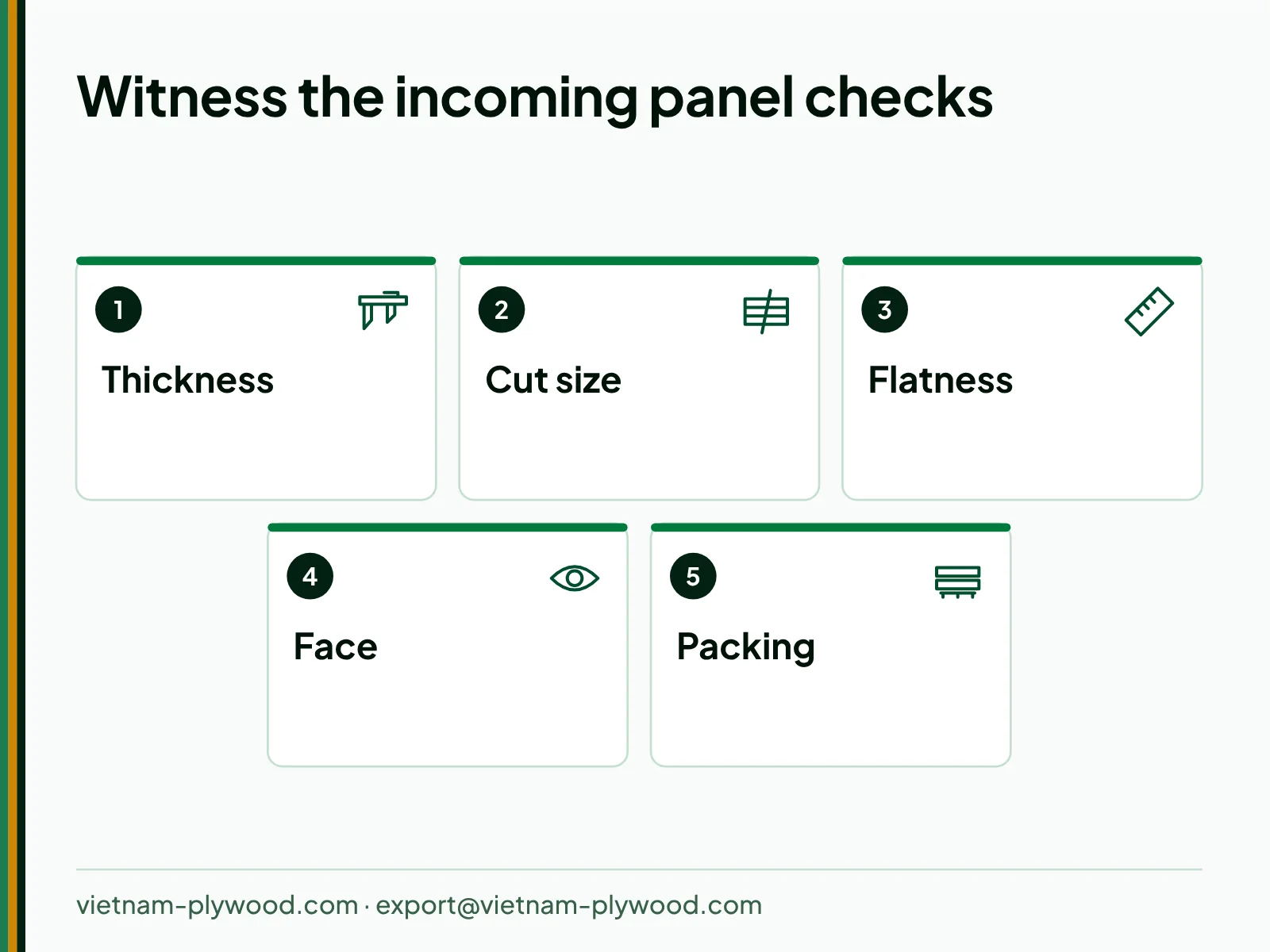
- Match the order, drawing and sample reference to the producing lot.
- Read the nominal thickness and ordered ±0.2 or ±0.3 mm sanding band from the specification.
- Measure caliper at the agreed points and record the readings, instrument and conditions.
- Check length, width and grain orientation against the cut schedule and ±2 mm size tolerance.
- Apply the agreed supported-panel flatness method, recording bow or twist against the agreed acceptance limit.
- Inspect face grade, sanding, visible joints, edge condition and packing identification.
- Segregate any disputed pieces for an agreed disposition before loading.
A visible face defect may matter to a clear-finish door but be less significant under an opaque facing. Write the intended finish into the acceptance plan. A sample approval should record both the appearance reference and the dimensional checks.
The packing list identifies shipped quantities and dimensions in the export document set. The commercial invoice and bill of lading support the transaction and carriage; an agreed test report or emission certificate addresses the specific tested claim. None of those shipping papers by itself proves press flatness.
What belongs in the door-blank purchase specification?
The purchase specification should connect the press requirement to a measurable incoming plywood component. Begin with the assembly drawing, then state core, facing, glue, emission, size, tolerance and acceptance procedure. Avoid using “door grade” as a substitute for these fields.
State whether the requested item is a plywood door blank, a core panel or a thin skin. Identify the visible face and the reverse face separately. For a plywood flush door, also describe the finishing route and whether subsequent lamination occurs at the buyer’s plant.
Where a programme needs a repeatable surface, agree a reference sample and the method for checking surface defects. For press fit, define the flatness support and measurement conditions before production. If the press needs a tighter tolerance than our ordered sanding bands, request a feasibility review and an agreed inspection method before ordering.
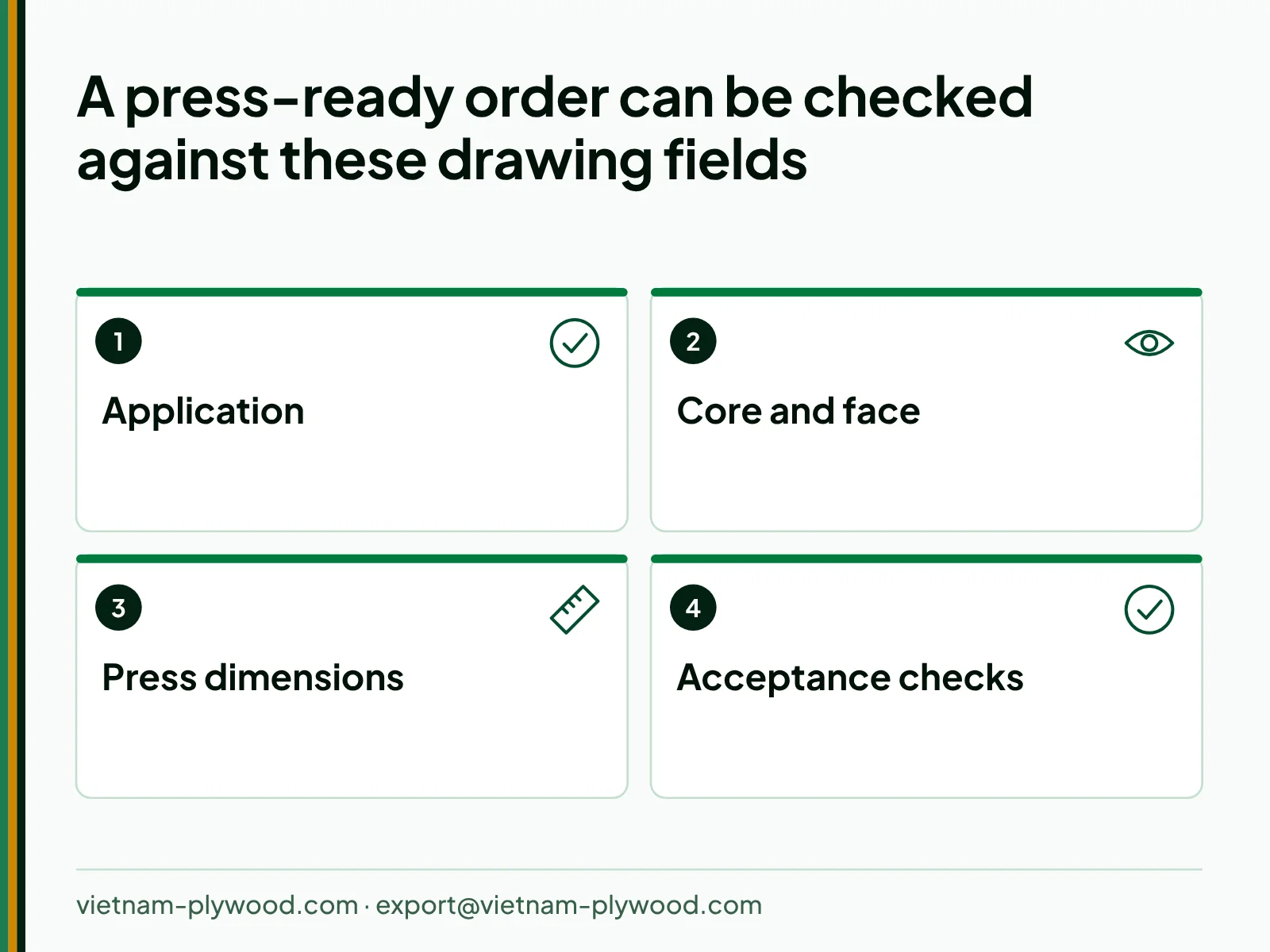
A press-ready order can be checked against these drawing fields:
- Application: Mark the item as a blank, core panel or thin skin for the intended door assembly.
- Core and face: Identify styrax or eucalyptus core, the visible veneer and the reverse face.
- Press dimensions: Record cut length, width, grain direction and edge-trim allowance.
- Acceptance checks: State the ordered sanding band, flatness support method and inspection positions.
Our three member factories operate in Phu Tho and Hai Phong. Each order is produced at the factory suited to its specification and shipped directly from there. The quotation should state the producing line and the inspection points that will be witnessed before shipment.
What are the ordering and shipping steps?
Start with a written build and trial acceptance plan, then request a quotation for the specified panel. The minimum order is one 40HC; one container can carry several specifications as long as the payload limit holds. A trial can test several approved plywood components without assuming that unverified LVL is part of our supply.
Factory lead time runs 15–45 days from receipt of the 30% deposit; the exact figure depends on order size, line loading and what the contract fixes. The remaining 70% is paid on the scan of the bill of lading, by T/T, or by irrevocable sight L/C. We ship FOB Hai Phong, or CFR (CNF) or CIF to your port. Samples cost nothing: a first-time buyer pays the courier, and that charge comes off the first confirmed order.
The shipment documents include a commercial invoice, packing list, bill of lading, certificate of origin and relevant phytosanitary and fumigation papers. Insurance applies under CIF. The order’s agreed certificate documents and test reports are added as applicable; European Union lots include the relevant EUR.1 and EUTR/EUDR file set. After loading, the draft shipping documents come to you for approval.
Ask Lucy at export@vietnam-plywood.com for a specification review through contact. Distributors coordinating repeat programmes can also review plywood supply programmes. A quoted build should be tied to the same sample and inspection schedule used by the door press.
What should be tested before a trial container?
Test the actual door-maker assembly with the proposed plywood blank and skins before committing to a repeat programme. The panel specification is only one input into the press result. Record what changes between trials so a later failure can be traced to the relevant variable.
First, press a representative assembly using the intended adhesive and facing schedule. Next, measure thickness and flatness after the agreed conditioning period. Check visible surface quality, bonding, machining at the edges and compatibility with the planned finish. Record rejected specimens and their causes without turning an isolated sample into a universal performance claim.
If the order includes several veneer faces, test each combination that changes the balance of the assembly. If a different core is proposed, repeat the press evaluation rather than relying on face appearance. The styrax and eucalyptus core densities are 580 and 650 kg/m³ respectively; that distinction affects calculated weight, but it does not establish final door stability.
Use the results to approve the purchase specification and inspection method. The next step is to plan a trial container around the agreed plywood builds, their packing weights and the buyer’s door-press acceptance record.
Application: flush-door blank / core panel / skin; final press assembly: [drawing]
Line or core: furniture line; styrax or eucalyptus; full stitched
Glue: [melamine MR / phenolic WBP as agreed]
Emission: [E0 / E1; destination-specific evidence requested]
Face and grade: [species, face grade, reverse grade, grain direction]
Thickness and tolerance: [nominal mm; ±0.2 or ±0.3 mm as ordered]
Size: [cut length × width mm; drawing; trim allowance]
Flatness acceptance: [support, measurement points, bow/twist limits, conditioning]
Quantity: [sheets and mixed-container schedule]
Destination port: [port and delivery term]
Plan a trial container using the approved panel specification and witnessed inspection method.