





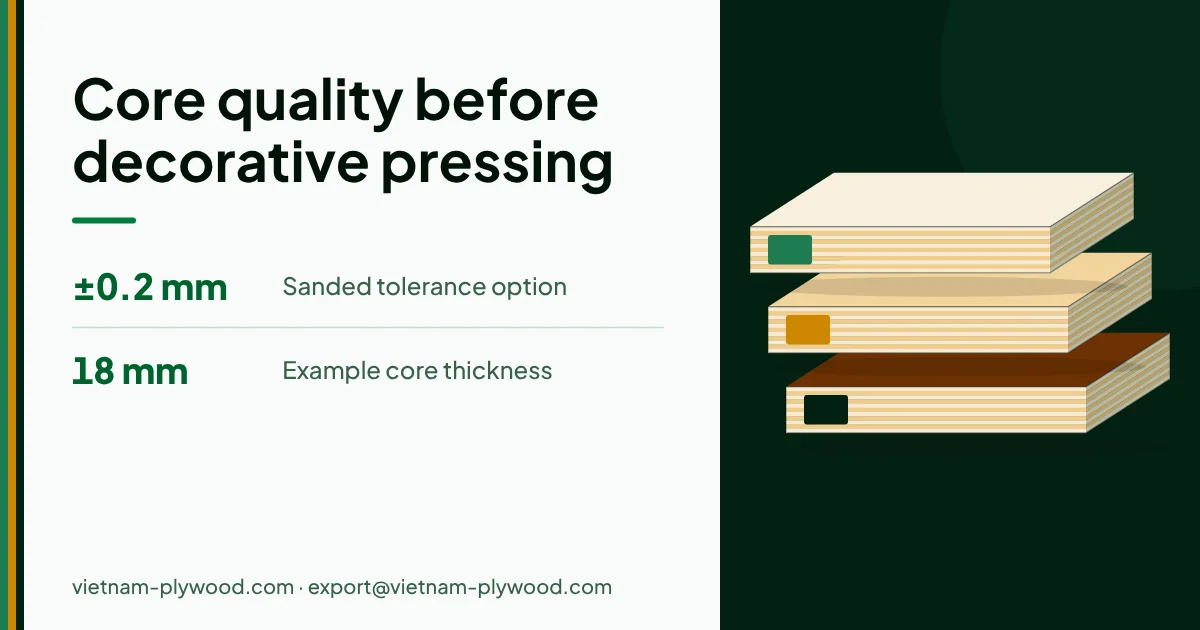
Melamine plywood succeeds when its veneer core stays flat, evenly sanded and intact beneath decorative paper. A poorly calibrated core can cost a laminator rejected sheets, rework and production time. HCPLY makes press-ready raw plywood cores on our furniture line; the buyer applies the melamine face separately. Core construction, tolerance and inspection criteria should be agreed before a trial container.
What is melamine plywood?
Melamine plywood is a veneer-core panel covered on one or both sides with resin-impregnated decorative paper, bonded by a separate laminating operation. The paper provides the visible colour and surface finish; the plywood carries the fasteners and supports the press cycle. A core with uneven thickness, open joints or unstable moisture can produce visible surface defects even when the decorative paper is sound.
In purchasing language, melamine faced plywood, melamine coated plywood and melamine ply board often refer to this finished assembly. The term “melamine plywood” can also be used loosely for plywood bonded with melamine resin but without decorative paper. Write both the core construction and the intended surface operation into the purchase specification to avoid that ambiguity.
A decorative melamine surface is distinct from high-pressure laminate (HPL), which is made separately and bonded to a substrate. The surface finish does not make a panel waterproof, fire-rated or suitable for permanent outdoor exposure. A finished panel must be assessed for its actual service environment and the performance required of its surface and core.
Does HCPLY supply the melamine face or the plywood core?
HCPLY supplies plywood cores for a buyer’s subsequent melamine-paper pressing. We do not supply melamine, HPL or laminate faces as a product line. Our furniture line produces full-stitched, sanded cores with styrax or eucalyptus veneers and an E0 or E1 emission specification. A buyer’s laminator selects the paper, surface texture, colour and pressing recipe.
For a matt raw-core order, “matt” means an unfaced plywood core; it does not describe a decorative matte melamine finish. Where a visible veneer is specified, our face options include bintangor, okoume, engineered veneer, gurjan, pine, poplar, eucalyptus, birch and sapele. The veneer face is named separately from the core species.
Our furniture plywood range is the starting point for a calibrated substrate discussion. The laminated board terminology page separates finished decorative surfaces from the plywood beneath them. The producing factory can show the core before any downstream paper application.
Which core should a melamine press use?
For a cabinet laminator seeking a uniform decorative face, a full-stitched, sanded furniture-line core is the first candidate for trials. Continuous inner veneers reduce the chance that a core gap will telegraph through a thin face. Eucalyptus provides a denser option; styrax gives a lighter panel at the same nominal dimensions.
The choice is governed by the laminator’s actual press, face paper, storage conditions and acceptance criteria. A dense core alone cannot compensate for poor calibration. A smoother face cannot compensate for internal gaps that become visible after pressing. Specify the combination and run a representative production trial before approving the shipment.
A commercial acacia core can suit a less demanding laminating job after a successful trial, especially where additional calibration is available downstream. It starts with a different surface preparation and a wider thickness tolerance. Our eucalyptus plywood page provides further context for the denser core option.
How do the three factory lines compare at 18 mm?
At 18 mm nominal thickness, the manufacturing line changes the surface preparation, core construction and permissible thickness spread. The table describes the core supplied from each line; it does not imply that any line supplies a finished melamine face.
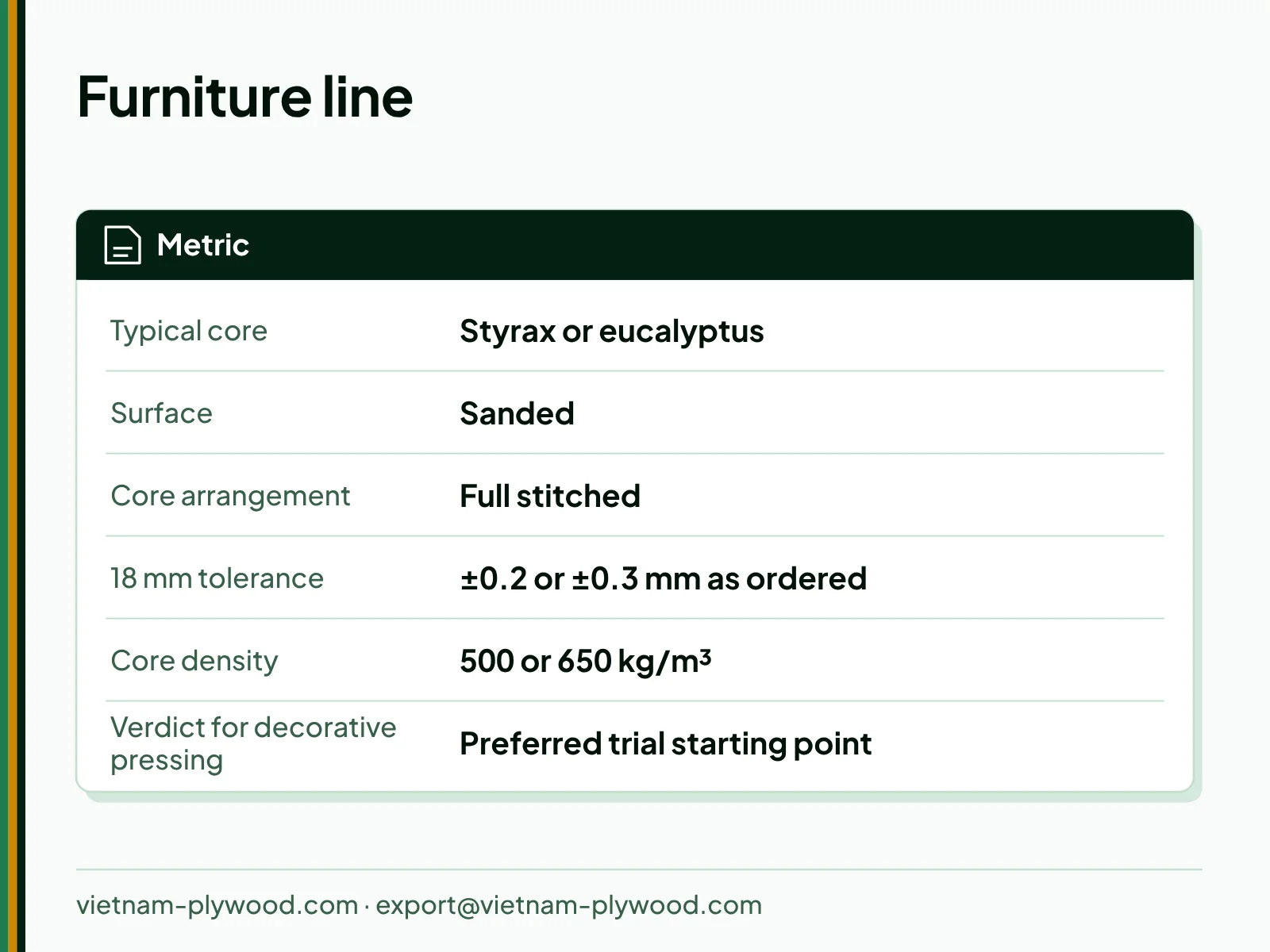
| Metric | Furniture line | Commercial and packing line | Construction line |
|---|---|---|---|
| Typical core | Styrax or eucalyptus | Acacia | Acacia or eucalyptus |
| Surface | Sanded | Unsanded or light-sanded | Unsanded, film-faced construction build |
| Core arrangement | Full stitched | Core construction selected by specification | Construction-oriented build |
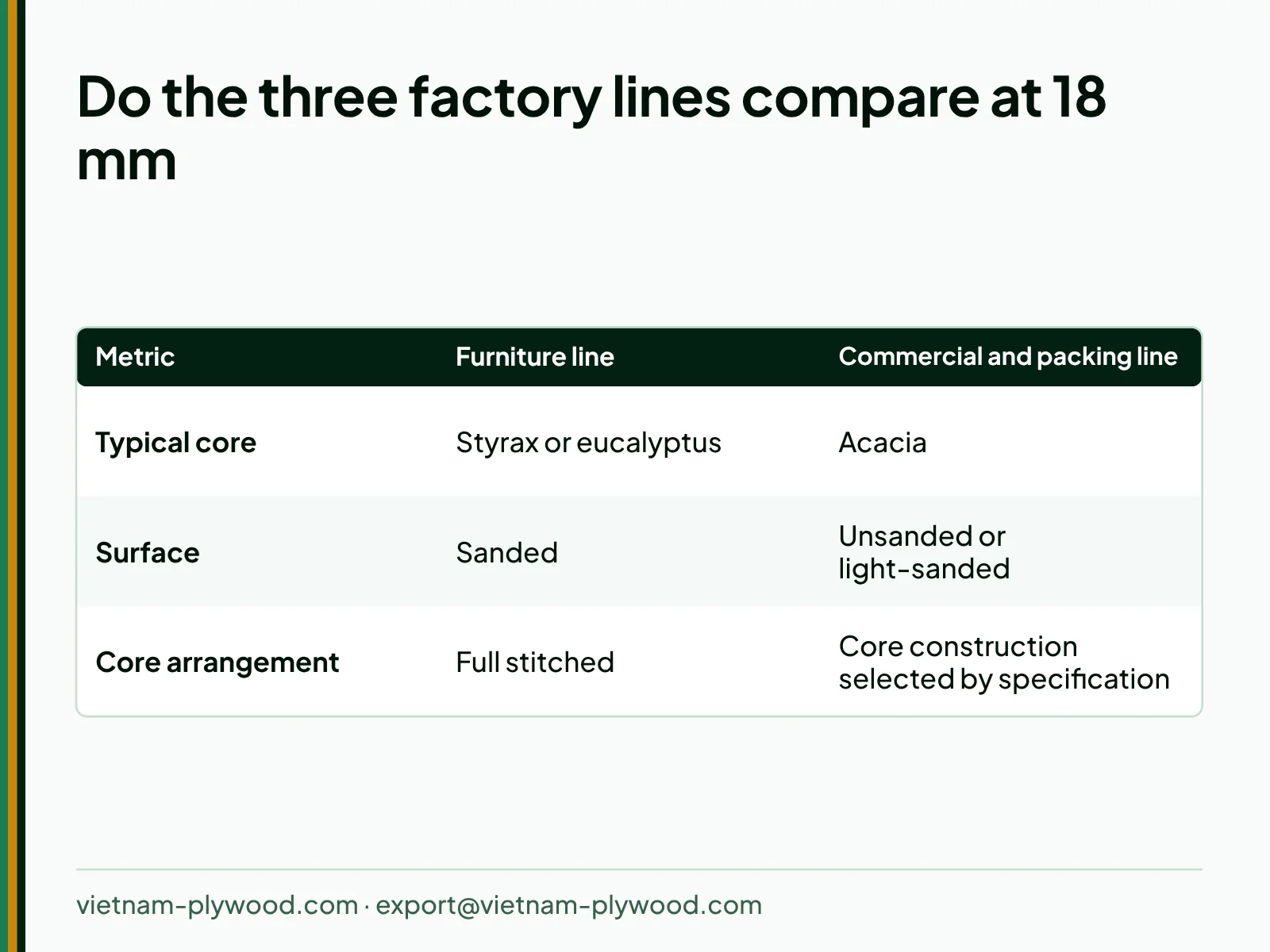
| 18 mm tolerance | ±0.2 or ±0.3 mm as ordered | Commercial ±0.5 mm; packing ±0.5–1.0 mm | ±0.5 mm |
| Core density | 500 or 650 kg/m³ | 580 kg/m³ | 580 or 650 kg/m³ |
| Verdict for decorative pressing | Preferred trial starting point | Economy trial if calibrated downstream | Choose for formwork, not decorative pressing |
Our construction line makes phenolic- or melamine-film-faced formwork panels, including anti-slip film. That film is a different construction surface from the decorative paper used on cabinet panels. The construction supply discussion addresses that use rather than cabinet laminating.
What flatness, sanding and thickness tolerance should the order state?
Specify a measurable flatness acceptance method and inspection support points, then agree the maximum bow, cup and twist for the intended press. The order should also state the moisture-conditioning procedure, sanding uniformity, surface defects allowed and whether both faces require calibration. There is no universal flatness figure in this offer; a buyer’s press trial should establish the acceptance limit.
For thickness, choose furniture-line sanded tolerance of ±0.2 mm or ±0.3 mm as ordered. Measure at agreed positions away from the edge and record the spread across the sheet, not merely its average. Length and width tolerance is ±2 mm. The core order should identify nominal thickness and whether the target is before or after any downstream sanding.
An 18 mm sheet uses 11–13 plies, depending on core veneer thickness of 1.4–2.0 mm. Ply count is therefore a construction check rather than a substitute for caliper readings. Request full-stitched cores where the face is sensitive to joint marks. The door-core supply page discusses a different machining and face requirement.
How does the plywood become a melamine-faced panel?
A finished melamine faced ply panel passes through a substrate-making stage and a separate decorative-press stage. The downstream laminator should approve the raw substrate before applying decorative paper.
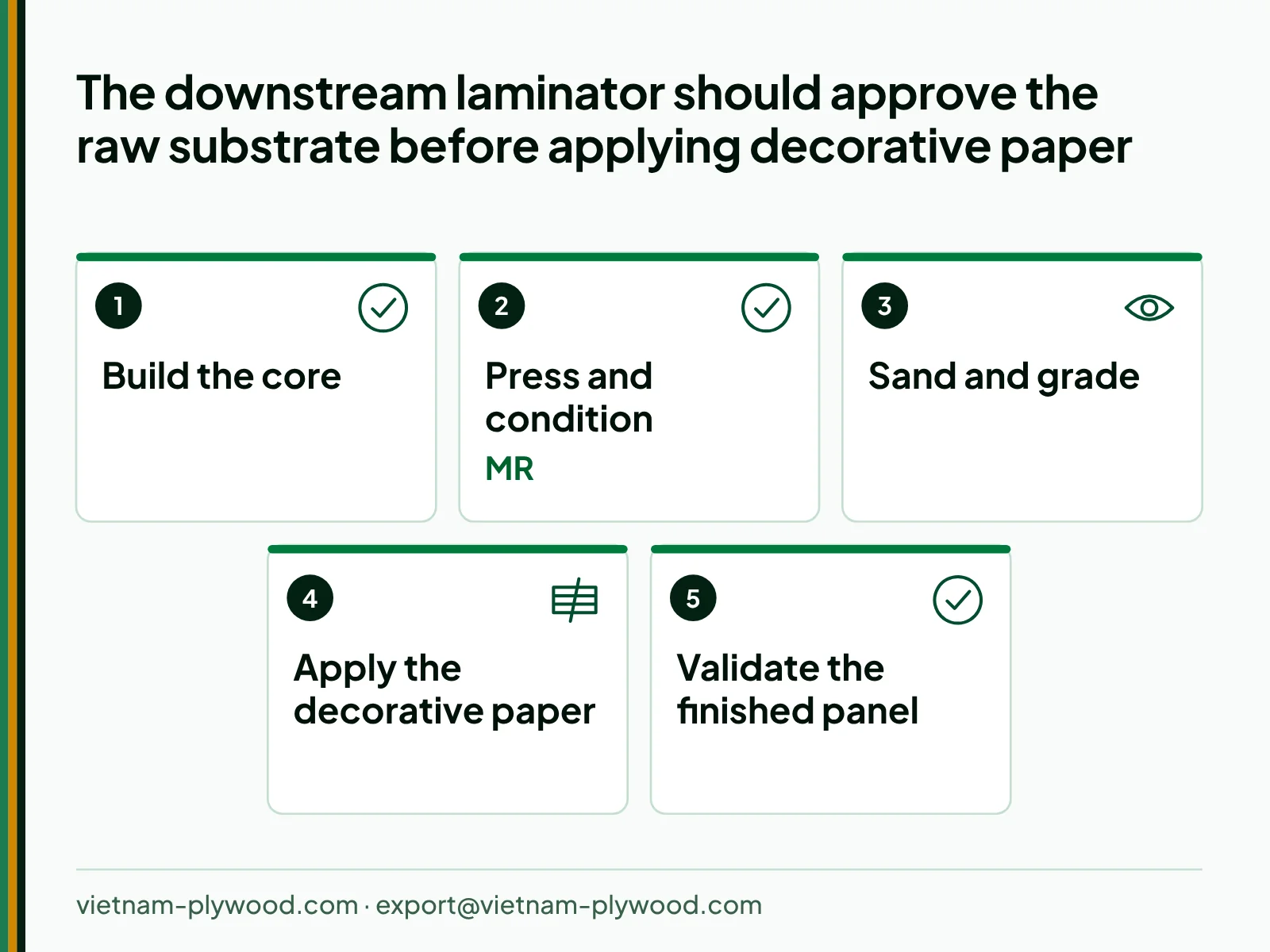
- Build the core. Veneers are assembled in cross-laminated layers with the specified core construction and glue system.
- Press and condition. The plywood is hot-pressed, then prepared for calibration and inspection. Our MR plywood press range is 110–120 °C; this is a plywood-core operation, not a decorative-paper press setting.
- Sand and grade. The furniture core is sanded to the agreed nominal thickness, tolerance and surface acceptance criteria.
- Apply the decorative paper. The buyer’s laminator selects melamine-impregnated paper and its own press cycle, then checks the finished surface.
- Validate the finished panel. The laminator checks bond, appearance, machining and service suitability against its product specification.
A melamine-glue plywood core and a decorative melamine face describe different layers. The glue system should be stated independently of the emissions class.
What sizes and loading weights matter for the core?
A melamine plywood 4x8 order commonly means a 1220 × 2440 mm core. Other available formats include 1250 × 2500, 1220 × 2135, 1220 × 1830, 915 × 2440, 915 × 2135 and 915 × 1830 mm; custom cutting is available. Available thickness spans 3–40 mm, with 18 mm a common cabinet specification.
For 18 mm, 1220 × 2440 mm raw cores, the weight is 26.79 kg per styrax sheet, 31.08 kg per acacia sheet and 34.83 kg per eucalyptus sheet. The corresponding full 40HC reference loads are 990, 880 and 795 sheets, weighing 26.52, 27.35 and 27.69 tonnes respectively. Those figures exclude any decorative paper added later.
The 40HC payload limit is 28.5 tonnes. Specifications can be mixed in a container within that limit, but the mix needs a pallet and weight calculation rather than adding the three full-load figures together. See container loading for the detailed loading topic.
What can an inspector check at the producing factory?
An inspector can witness raw-core measurements before the buyer’s decorative pressing operation. Start by identifying the producing line, order specification, lot and sheet dimensions. Then select representative sheets from separate pallets and record the results against the agreed sampling plan.
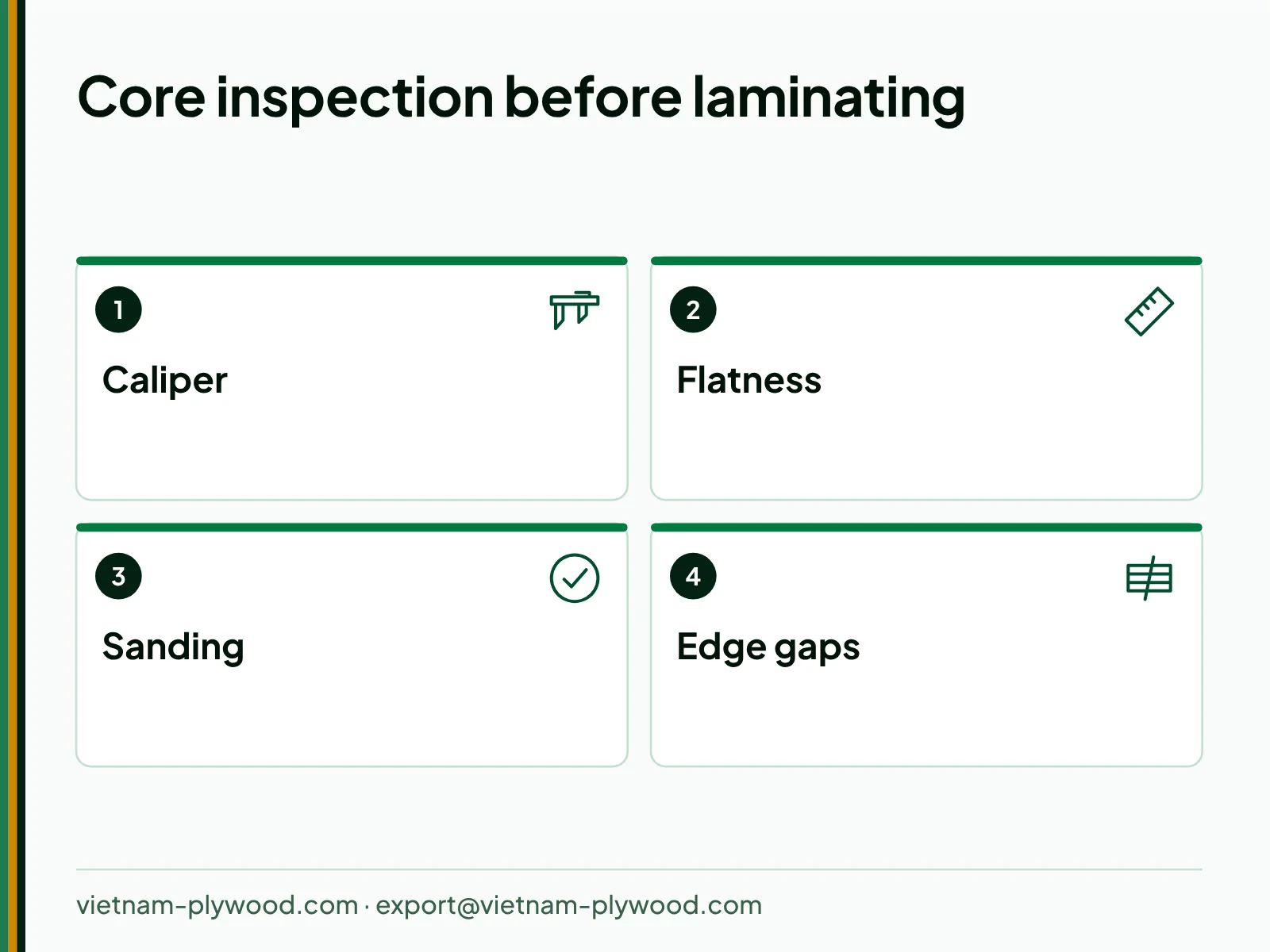
Check caliper readings across the sheet and inspect sanding scratches, face patches, splits and exposed core joints under consistent light. Examine cut edges for open gaps and compare the core arrangement with the full-stitched requirement. Lay samples on the agreed reference support to assess bow, cup and twist; record the method so buyer and factory measure alike.
Buyers visit the factory office and inspect goods at the producing factory. HCPLY manages on-site quality control, export documentation and loading. The inspection record should distinguish raw-core acceptance from any later decorative-face testing by the laminator.
Which glue and emissions documents should be requested?
Specify adhesive performance and formaldehyde emission requirements in separate fields. Our furniture cores use E0 or E1 emission specifications; melamine adhesive is an MR option with a 12-hour boil description, while phenolic adhesive is WBP, or weather and boil proof, with a 72-hour boil description. Neither adhesive label alone establishes an emissions result.
For US-bound regulated hardwood plywood, the US Environmental Protection Agency’s formaldehyde implementation FAQ explains the Toxic Substances Control Act (TSCA) Title VI requirements. The EPA states that hardwood plywood, medium-density fibreboard and particleboard are regulated product categories, with separate obligations for certain laminated products. Buyers should assess the actual finished construction and applicable exemptions with their compliance team (US EPA, formaldehyde FAQ).
Member-factory FSC, CARB P2, ISO 9001 and CE documents, and EUDR/EUTR files, are shown with factory details masked, on request. The shipment’s agreed certificate documents and emission reports belong with the commercial invoice, packing list and bill of lading. For EU lots, the file also includes the applicable EUTR/EUDR documents; the 2023 EU deforestation regulation describes information and due-diligence duties for relevant products.
What drives the price of a melamine-ready plywood core?
Full-stitched construction and tighter sanding tolerance are the strongest specification-related reasons to budget above a less-calibrated commercial core. Core species, face grade, sheet dimensions, emission documentation and order mix also affect a quotation. A eucalyptus furniture core will carry a different material and weight profile from a styrax core of the same dimensions.
Furniture plywood starts from US$350/m³ FOB Hai Phong (October 2026). Commercial plywood starts from US$250/m³ FOB Hai Phong (October 2026). These are starting prices for their respective plywood categories, not quotations for a finished decorative melamine board. A precise core quotation requires a written build, inspection criteria and destination.
The minimum order is one 40HC. Production takes 15–45 days from the 30% deposit, set by order size, line loading and the contract. The remaining 70% is paid on the scan of the bill of lading, by T/T, or by irrevocable sight L/C. We ship FOB Hai Phong, or CFR (CNF) or CIF to your port.
How should the buyer approve a trial core?
A trial should reproduce the laminator’s actual paper, press conditions and cabinet machining steps. Record pre-press thickness, flatness and moisture alongside the final surface appearance. Include a cut-edge inspection after pressing and a fastening test appropriate to the cabinet hardware.
If the trial reveals a surface shadow over an internal joint, change the core construction before changing the decorative paper. If the issue is uneven pressure contact, compare sheet calibration and support conditions. If the defect follows storage or conditioning, document handling conditions at both sites before changing the plywood build.
For a broader range of plywood specifications, see our Vietnam plywood manufacturing overview and several plywood types in one order. Free samples are available; a first-time buyer pays the courier, and that charge comes off the first confirmed order.
What should a melamine-core inquiry contain?
Send the core build and the downstream press acceptance criteria together. Separate what the plywood factory can inspect from what the laminator will test after applying paper. The specification below gives both teams a common starting document.
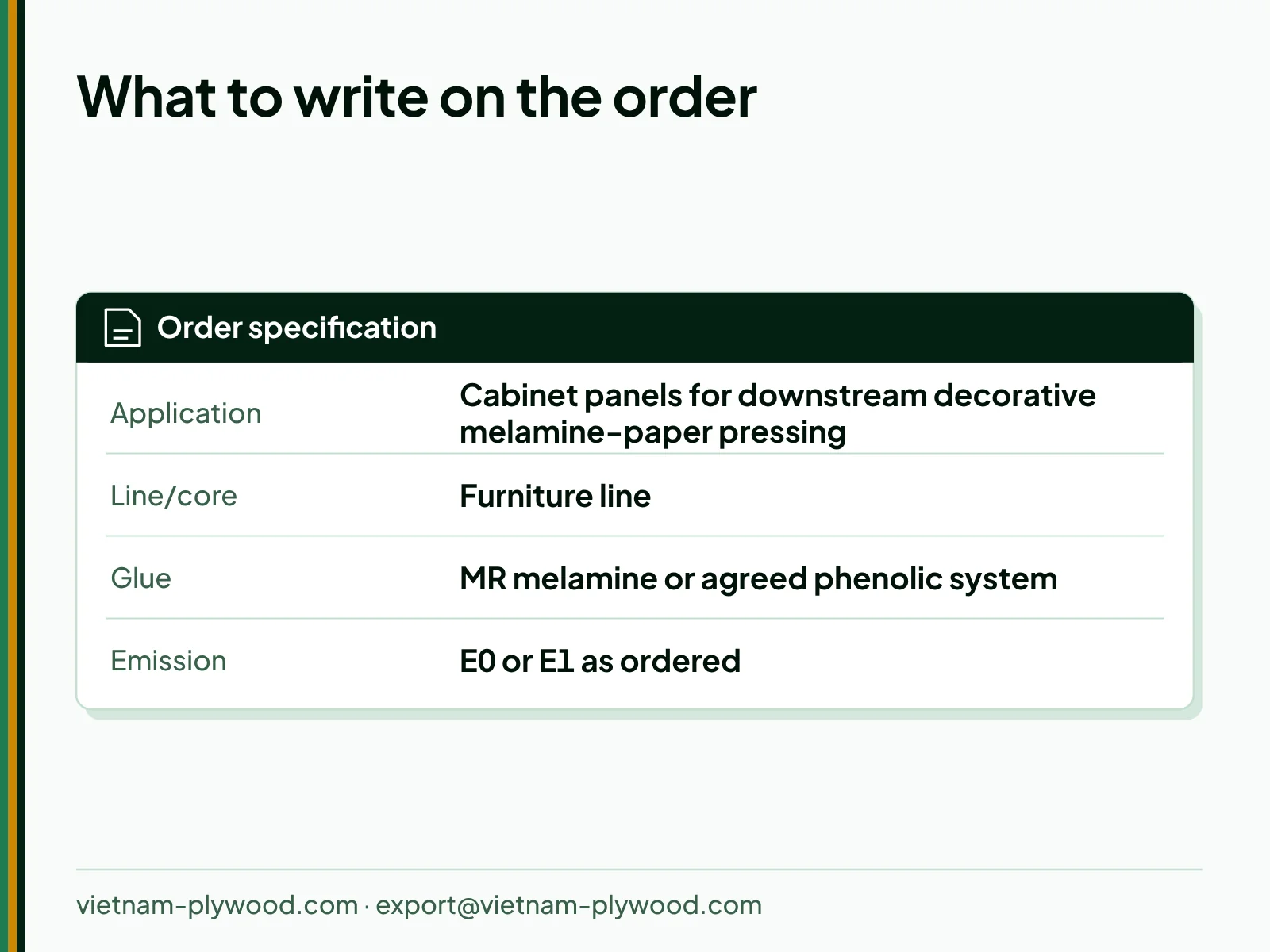
Application: cabinet panels for downstream decorative melamine-paper pressing
Line/core: furniture line; full-stitched styrax or eucalyptus core
Glue: MR melamine or agreed phenolic system
Emission: E0 or E1 as ordered; destination-specific documents stated separately
Face and grade: matt raw core, or named veneer face and agreed grade
Thickness and tolerance: 18 mm; sanded ±0.2 mm or ±0.3 mm as ordered
Flatness/sanding: agreed test setup, limits, both-face calibration and sampling plan
Size: 1220 × 2440 mm; length/width ±2 mm
Quantity: one 40HC or specified mixed-container allocation
Destination port: [insert port]
Send the completed specification to Lucy at export@vietnam-plywood.com or through contact. The next step is to plan a trial container around the laminator’s acceptance results.