





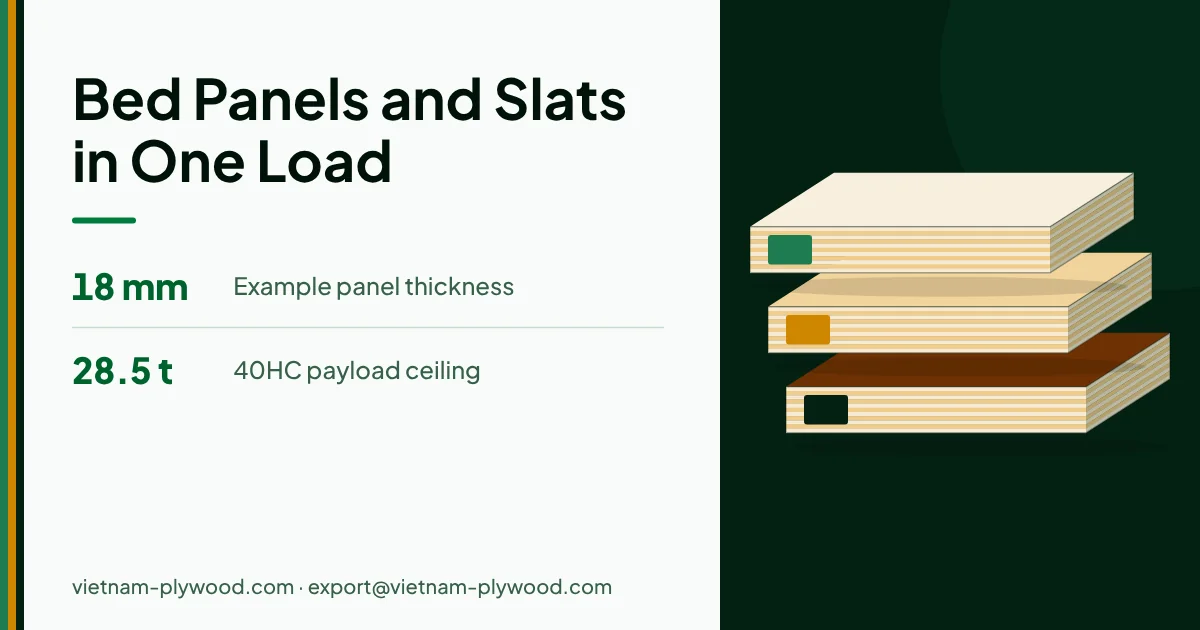
Bed plywood for commercial bed production should match each base, frame and headboard component to its support and finish requirements. A wrong core, span or thickness can mean rejected parts, rework costs and missed assembly dates. HCPLY makes furniture plywood base panels and LVL slats on its commercial line for mixed shipments against written specifications.
Which bed plywood belongs in a base or frame?
Bed plywood for a factory-made bed is usually a flat mattress-support panel, a side or end panel, or a headboard substrate. Specify each part separately because the support panel carries distributed loads while the visible headboard has different face requirements. We make these panels on our furniture line, using full-stitched, sanded styrax or eucalyptus cores. The commercial and packing line makes acacia-core packing and commercial panels; our construction line presses film-faced panels for formwork rather than decorative bed parts.
Start with furniture plywood for the panel build, then issue a cut drawing for each component. This prevents an attractive face specification from obscuring the actual support design.
What plywood thickness for bed in mm should a factory specify?
Start base-deck prototypes at 15–21 mm and headboard panels at 9–18 mm, then test the actual support span and assembly loads. These are available manufacturing thicknesses, not universal safe-span ratings. The design team must set the supported span, expected static and repeated loads, acceptable deflection and fixing pattern before approving a production thickness.
An 18 mm panel uses 11–13 plies in the stated core-veneer range. Ply count alone cannot establish a bed’s capacity: veneer quality, core gaps, glue bond, support spacing and loading direction also matter. A full-stitched core helps maintain a more continuous panel interior where fasteners and machined edges will be visible.
For lifting storage beds, include hinge loads and attachment reinforcement in the test assembly.
Our furniture line offers sanded thickness tolerance of ±0.2 or ±0.3 mm as ordered, with length and width tolerance ±2 mm. A 1220×2440 mm blank is one available size; cut-to-size plywood can reduce the cutting work at the receiving factory. Match the tolerance to hardware clearances rather than specifying an unnecessarily tight figure everywhere.
Which core suits the base and the headboard?
Styrax core at 500 kg/m³ is a lighter furniture-panel choice; eucalyptus at 650 kg/m³ is the denser alternative. These are core-density figures, not measured bending-strength values. We name a panel by its face veneer, so an okoume-faced panel can still have either core.
For large headboards, a lighter styrax-core blank can help manage component handling weight. Eucalyptus-core panels offer a different mass and fastening trial for a heavily machined assembly. Choose by the accepted prototype, edge finish and screw-holding test rather than density alone.
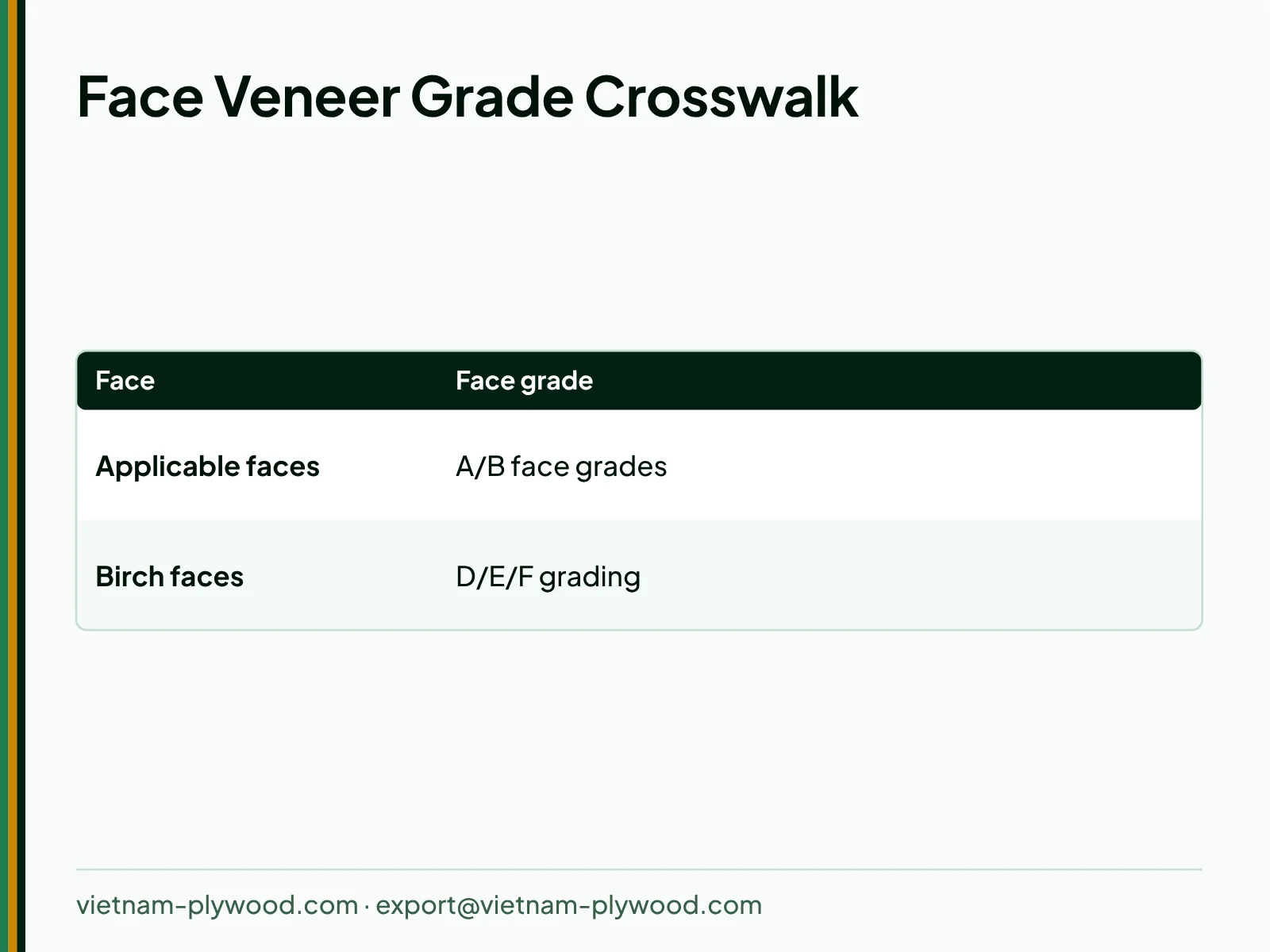
The face is a separate decision. Bintangor, okoume, engineered veneer (EV), gurjan, pine, poplar, eucalyptus, birch and sapele are listed face choices. A/B face grades are available for the applicable faces; birch faces use D/E/F grading instead. Common face-veneer thickness is 0.2–0.4 mm. For an upholstered headboard, a sanded substrate may matter more than decorative grain. For a visible headboard, agree the face sample and allowable repairs before pressing.
If the buyer specifies melamine, high-pressure laminate (HPL) or another laminate finish, treat that as a downstream finishing operation, not an HCPLY pressed product line.
How do the three production lines differ for bed parts?
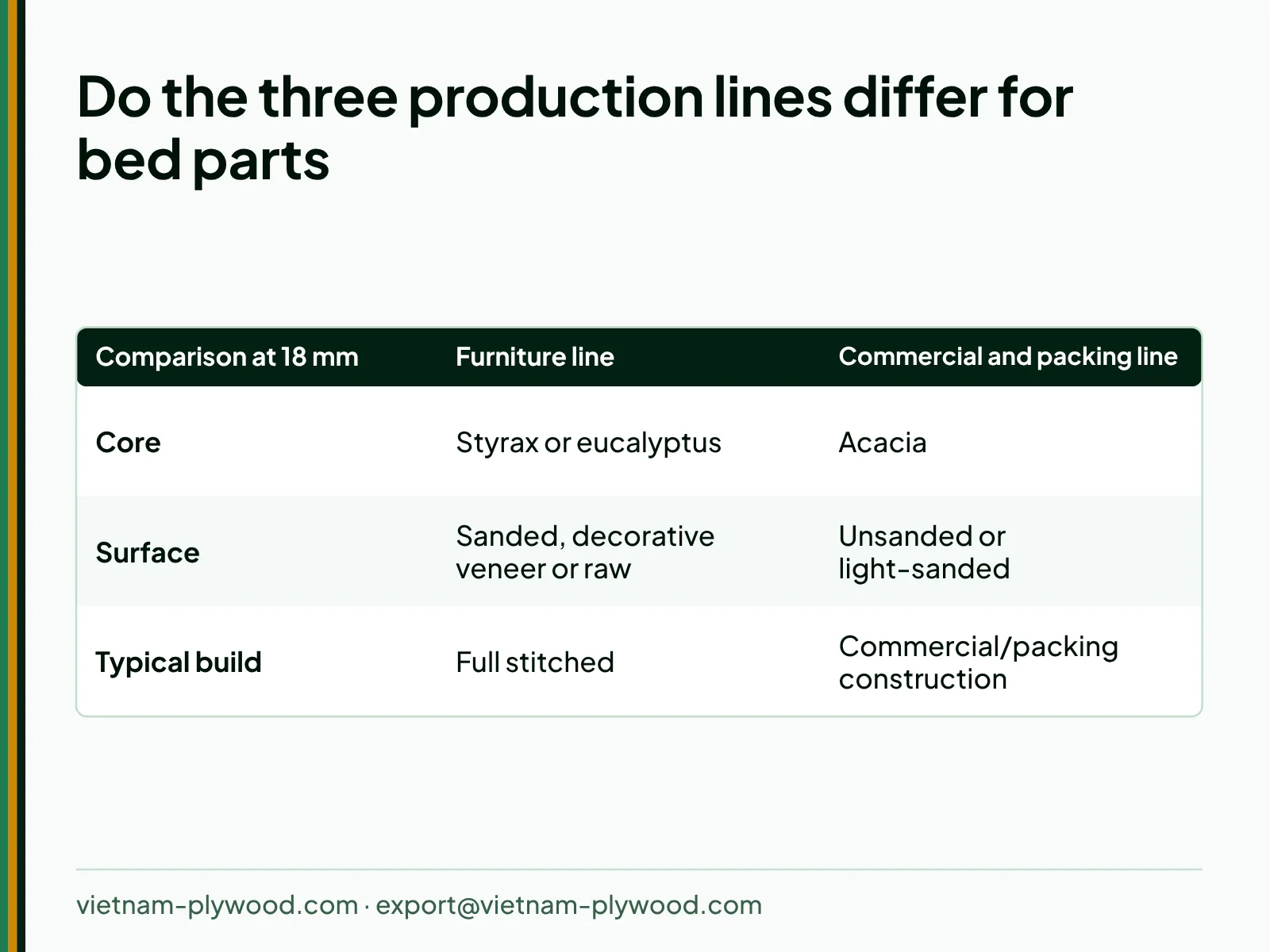
Our furniture line is the production fit for sanded bed panels and headboards. The other lines serve different uses even when the nominal thickness is identical.
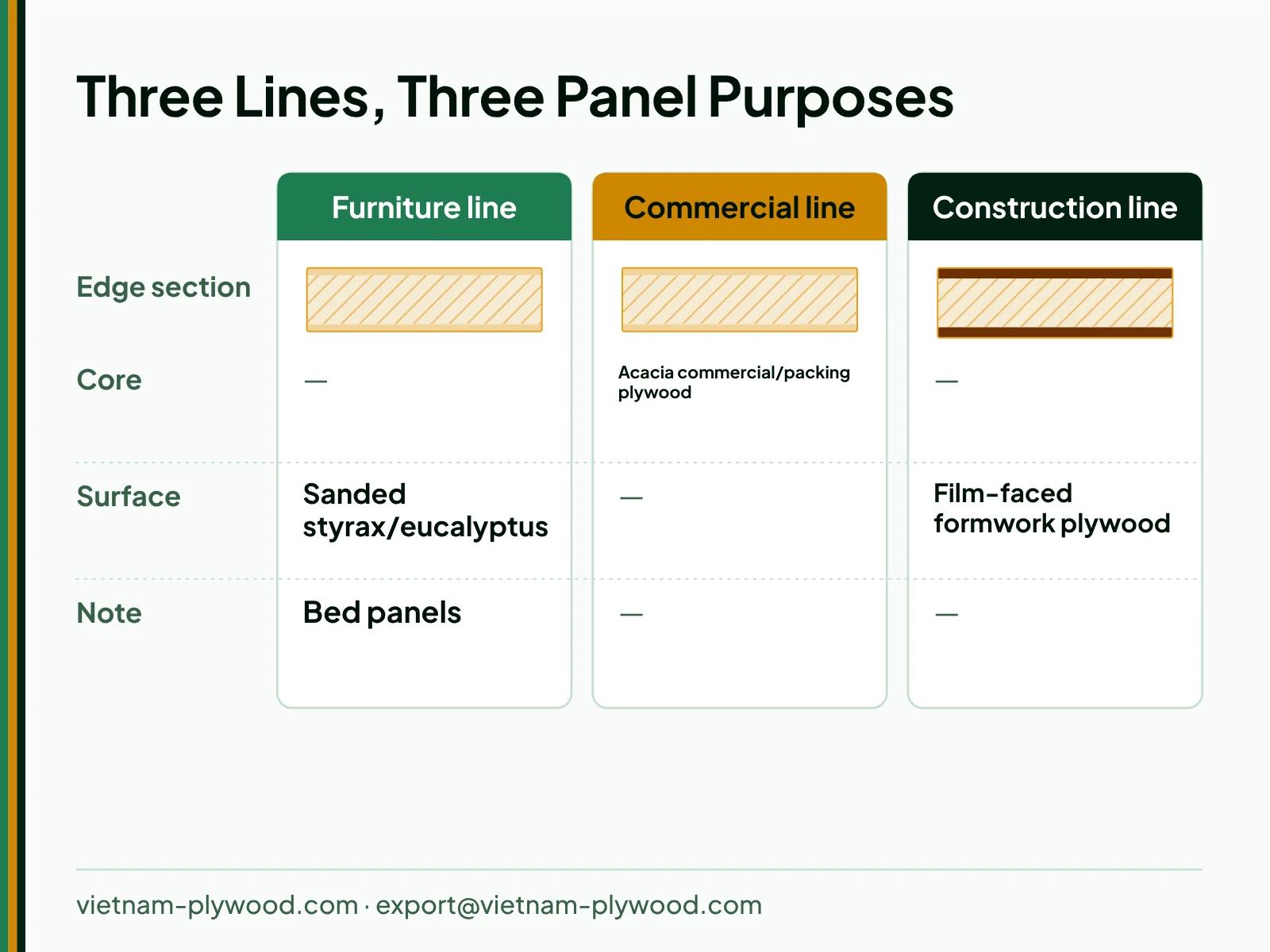
| Comparison at 18 mm | Furniture line | Commercial and packing line | Construction line |
|---|---|---|---|
| Core | Styrax or eucalyptus | Acacia | Acacia or eucalyptus |
| Surface | Sanded, decorative veneer or raw | Unsanded or light-sanded | Phenolic or melamine film |
| Typical build | Full stitched | Commercial/packing construction | Film-faced construction |
| Thickness tolerance | ±0.2 or ±0.3 mm as ordered | ±0.5 mm commercial; ±0.5–1.0 mm packing | ±0.5 mm |
| Verdict for a bed | Bed bases and headboards | Packing and non-decorative commercial use | Formwork, not the specified bed finish |
Our construction line uses 120 g/m² standard or 135 g/m² premium film, with 220 g/m² reserved for anti-slip film. Those are construction-product film weights, not furniture-face alternatives.
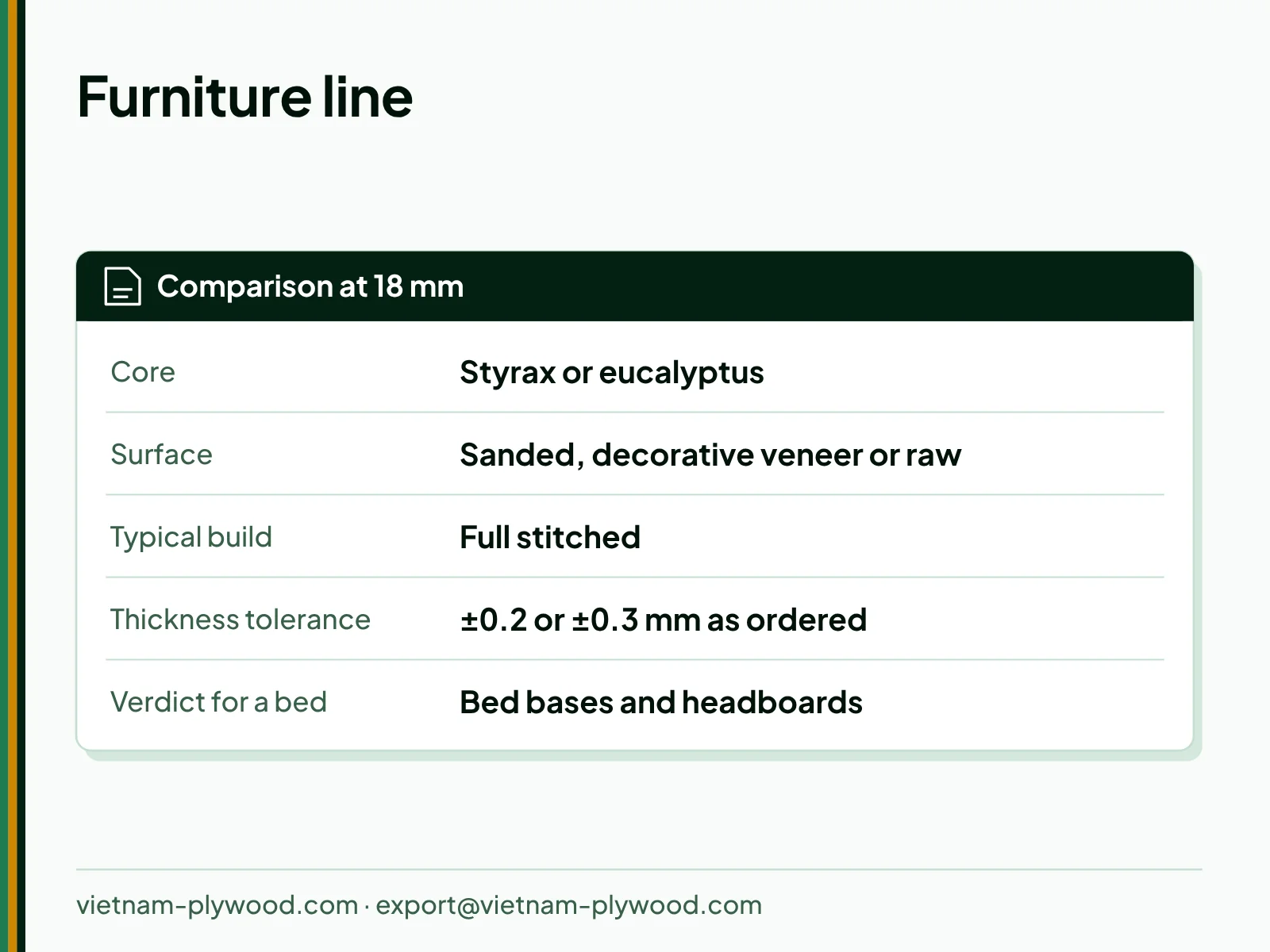
The buyer should keep each part number tied to its producing line and acceptance drawing. That gives the receiving team a clear reference for inspecting the panels after unloading.
Should bed slats be LVL or plywood?
Laminated veneer lumber (LVL) is a candidate for long, narrow bed slats because its veneer orientation and specified structural performance can be engineered for bending. Plywood is useful for broad deck panels where load spreads across a sheet. Neither label alone supplies a safe slat span or allowable load.
Our furniture line makes plywood bases and headboards, while our commercial and packing line offers LVL bed slats. Specify LVL slat length, width, thickness, veneer arrangement, support span, target deflection and acceptance test in a drawing. We quote the slats against that drawing and the intended bed assembly, without assigning a generic strength rating. Compare the two options using the same frame geometry: slat width and thickness, clear span, support count, load case, permissible deflection and fixing detail. Request a physical trial of the mattress platform, including repeated loading at the center and edges. A plywood strip cut from a wide panel must not be assigned an LVL performance rating.
The final decision belongs to the tested bed system.
Can plywood bed panels and LVL slats share one container?
Plywood bed panels from our furniture line and LVL slats from our commercial and packing line can ship together in one 40-foot high-cube container, within its 28.5 t payload limit. Set the panel pallet count first, then allocate the remaining permitted cargo weight to LVL slats using their approved dimensions, actual packed pallet weights and restraint plan. The final loading schedule records the sheet and slat quantities by part number.
For 18 mm, 1220×2440 mm furniture panels, a full panel-only 40HC holds 990 styrax-core sheets at 26.52 t or 795 eucalyptus-core sheets at 27.69 t. Reduce the panel allocation when slats are included; the slat share is calculated after the LVL dimensions and packed weights are known. Confirm pallet footprint and safe stowage as well as payload before loading. See mixed container loads and the container packing reference for the owner topic.
We coordinate the documented plywood portion from the producing factory and prepare the export shipment details. The combined packing list identifies plywood bases, headboards and LVL slats separately within the agreed container plan.
Which glue and emission specification belongs on the order?
Glue type and formaldehyde emission class are separate order fields. For the furniture panels, specify the agreed glue system and an E0 or E1 emission class independently. Melamine glue is described as moisture-resistant (MR) with a 12-hour boil condition; phenolic glue as weather-and-boil-proof (WBP) with a 72-hour boil condition. Neither description replaces a product-specific test report.
For US-bound regulated hardwood plywood, the Environmental Protection Agency’s 2025 Code of Federal Regulations, 40 CFR Part 770, applies to covered composite wood products and components. It describes third-party certification and compliance duties for covered products. Review the official 2025 regulation against the exact panel construction and transaction.
CARB Phase 2 and Toxic Substances Control Act (TSCA) Title VI refer to US emission requirements, not to a glue recipe or an E0 class. Factory certificate evidence, including FSC, CARB P2, ISO 9001 and CE where relevant, is shown with factory details masked, on request. Check the certificate scope against the ordered build; do not transfer a factory document to an unrelated part number.
What can an inspector witness at the producing factory?
An inspector can check the approved sample against face, core, thickness, cut size, edges and packing marks before the goods leave the producing factory. The inspection plan should follow the drawing for each bed component, rather than treating all plywood sheets for bed use as interchangeable.
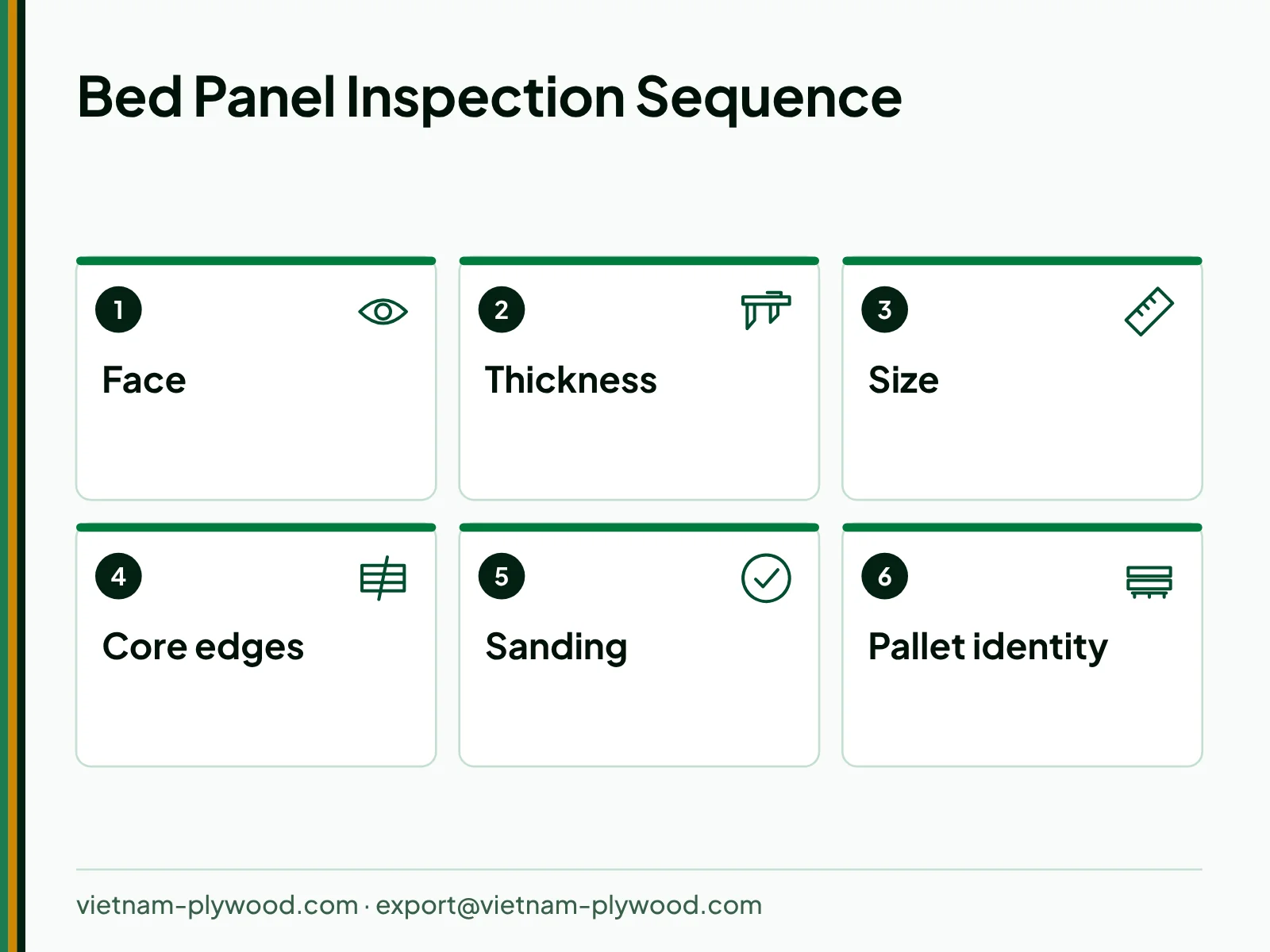
- Match the purchase part number and face-grade reference to the panel stack and approved sample.
- Measure thickness across selected locations and compare with the ordered ±0.2 or ±0.3 mm furniture tolerance.
- Measure length and width against the ordered size and ±2 mm tolerance.
- Inspect cut edges for core gaps, stitch continuity and repairs; record representative photographs.
- Check flatness, surface sanding, visible defects and trial machining against the buyer’s acceptance plan.
- Verify pallet identification, panel count and the draft packing list before loading.
For a slatted bed, test a complete assembly with its actual rail spacing and fixings. A panel-thickness reading cannot substitute for that load test. A shelving span discussion is useful background on why support spacing matters, but bed-load acceptance needs its own test conditions.
Buyers may visit the factory office and inspect at the producing factory. We handle on-site quality control, loading and the export documents for the agreed plywood shipment.
How should a bed factory compare plywood with solid wood and other boards?
Plywood gives a broad, machinable panel with a cross-laminated veneer structure. Solid wood can suit visible rails or posts, while LVL is a separate engineered-lumber option for slender members. Medium-density fiberboard (MDF), oriented strand board (OSB), chipboard and blockboard are other categories, but we do not press them.
See hardwood veneer plywood for face selection. For narrow decorative strips or backer panels, the thin plywood supplier topic addresses different machining priorities. Do not substitute a thin cosmetic panel for a load-carrying base without a validated design.
What paperwork and commercial terms follow the panels?
The export file links the ordered build to the shipment. It includes the commercial invoice, packing list, bill of lading (B/L), certificate of origin, phytosanitary and fumigation papers, plus the order’s agreed certificate documents and test reports. EU lots include EUR.1 and the EUTR/EUDR file set; CIF shipments include insurance. After loading, the draft shipping documents come to you for approval.
The minimum order is one 40HC; one container can carry several specifications as long as the payload limit holds. Factory lead time runs 15–45 days from receipt of the 30% deposit; the exact figure depends on order size, line loading and what the contract fixes. The remaining 70% is paid on the scan of the bill of lading, by T/T, or by irrevocable sight L/C. We ship FOB Hai Phong, or CFR (CNF) or CIF to your port.
Furniture plywood is quoted against the written bed-panel specification. The actual bed-panel quotation depends first on core construction and thickness, then on face grade, sanding tolerance, cutting and ordered mix. A full-stitched sanded furniture build costs more than a less-finished commercial build because its core assembly and finishing work differ. For LVL slats, send the section dimensions, length, quantity and performance requirements for a separate quotation.
See distributor supply programmes for repeat orders. Our furniture and commercial plywood capacity is up to 100 containers a month; construction plywood up to 140. Each order is produced at the factory suited to its specification and shipped directly from it.
What should a buyer settle before approving a bed-panel sample?
Approve the bed drawing, the support test and the material schedule together. A sample that looks correct on a table may still perform poorly after drilling, upholstery or repeated loading. Record the results by part number so later batches can be checked against the same acceptance criteria.
For a decorative headboard, the face sample, repair limits and finishing compatibility may decide acceptance. For a support deck, focus on clear span, deflection, fixing strength and ventilation layout. For a slat design, add slat spacing, end support and the documented properties of the chosen LVL or plywood strip.
For LVL slats, agree the drawing, required test evidence and packed pallet weights before finalizing their container share. For the plywood components, send the cut list and required documents to Lucy at export@vietnam-plywood.com. Free samples are available; a first-time buyer pays the courier, and that charge comes off the first confirmed order.
What specification should the buyer send?
Send one written schedule per part, with a drawing reference and acceptance test for the assembled bed. Identify which components are plywood panels and which are LVL slats from our commercial and packing line. Include the intended destination so document requirements can be checked with the order.
Application: bed base / headboard / side panel; drawing and support span
Line or core: furniture line; styrax or eucalyptus core
Glue: melamine MR or phenolic WBP, as agreed
Emission: E0 or E1; destination-specific evidence requested
Face and grade: named veneer; A/B (birch D/E/F) or matt
Thickness and tolerance: base 15 / 18 / 21 mm; headboard 9 / 12 / 15 / 18 mm trial; ±0.2 or ±0.3 mm
Size: 1220×2440 mm blank or attached cut-to-size drawing
Quantity: sheets by part number; LVL slats by drawing and packed weight
Destination port: [port and country]
Acceptance: approved sample, machining and assembled-bed load test
Ask Lucy for a sample set through contact using the schedule above.