





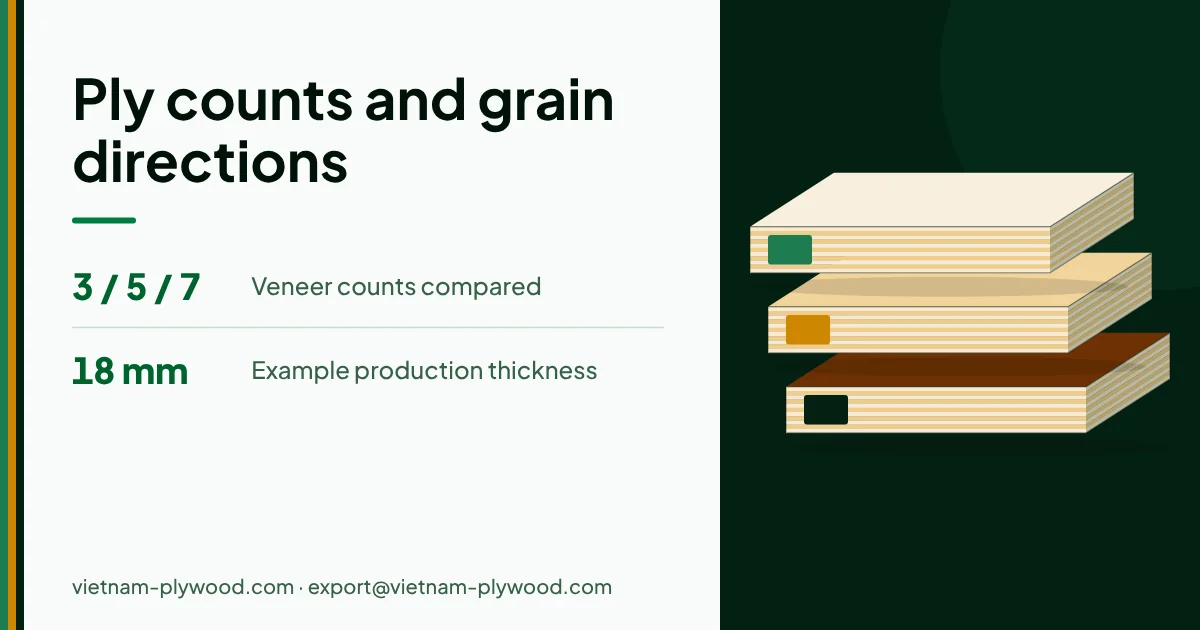
Ply count describes how many veneers make a plywood panel; it does not by itself determine which panel performs better. Choosing the wrong layup can cost HCPLY buyers a rejected cabinet-door batch or delayed production. In a 3 ply vs 5 ply plywood comparison, start with finished thickness, grain arrangement and the intended application.
What does 3 ply vs 5 ply plywood mean?
3 ply vs 5 ply plywood compares the number of bonded veneer sheets, while the actual choice also requires thickness, grain layout, core construction and glue specification. A five-ply panel has more individual veneers than a three-ply panel, but the count alone cannot establish load capacity or suitability for a cabinet door. Buyers should compare panels at equal finished thickness and with a documented layup before selecting either.
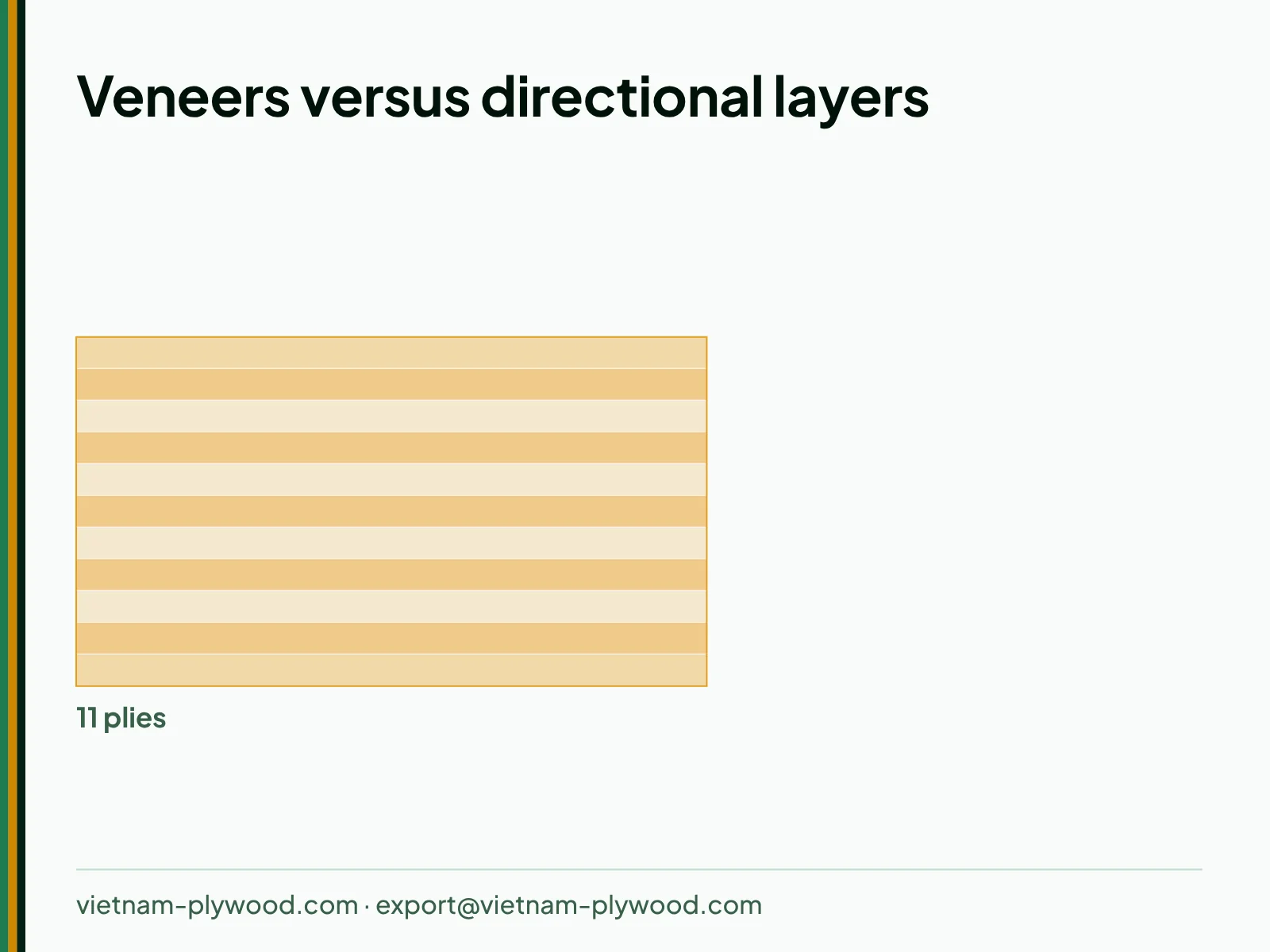
A ply is an individual veneer; a layer is a grain-direction grouping that can contain multiple parallel veneers. The APA – The Engineered Wood Association explains in its plywood technical overview (accessed 2026) that plywood is made from cross-laminated veneers bonded under heat and pressure. This explains why orientation and bonding matter alongside count. For the broader purchasing framework, see our plywood sizes and thickness specification guide.
Which count wins for each application?
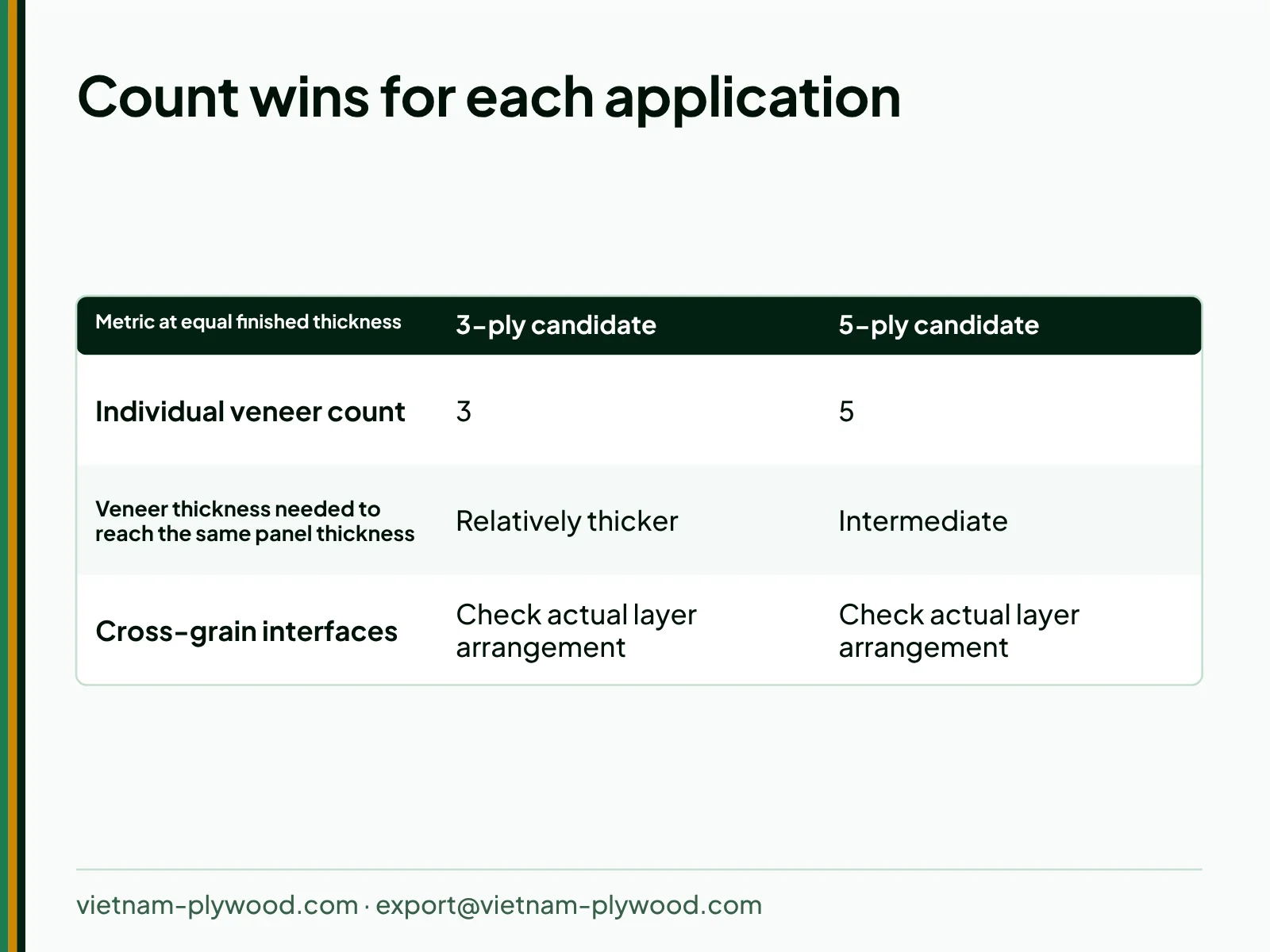
The verdict changes with the finished thickness, intended load and edge appearance. These are comparison rules for evaluating candidate constructions, not interchangeable strength ratings.
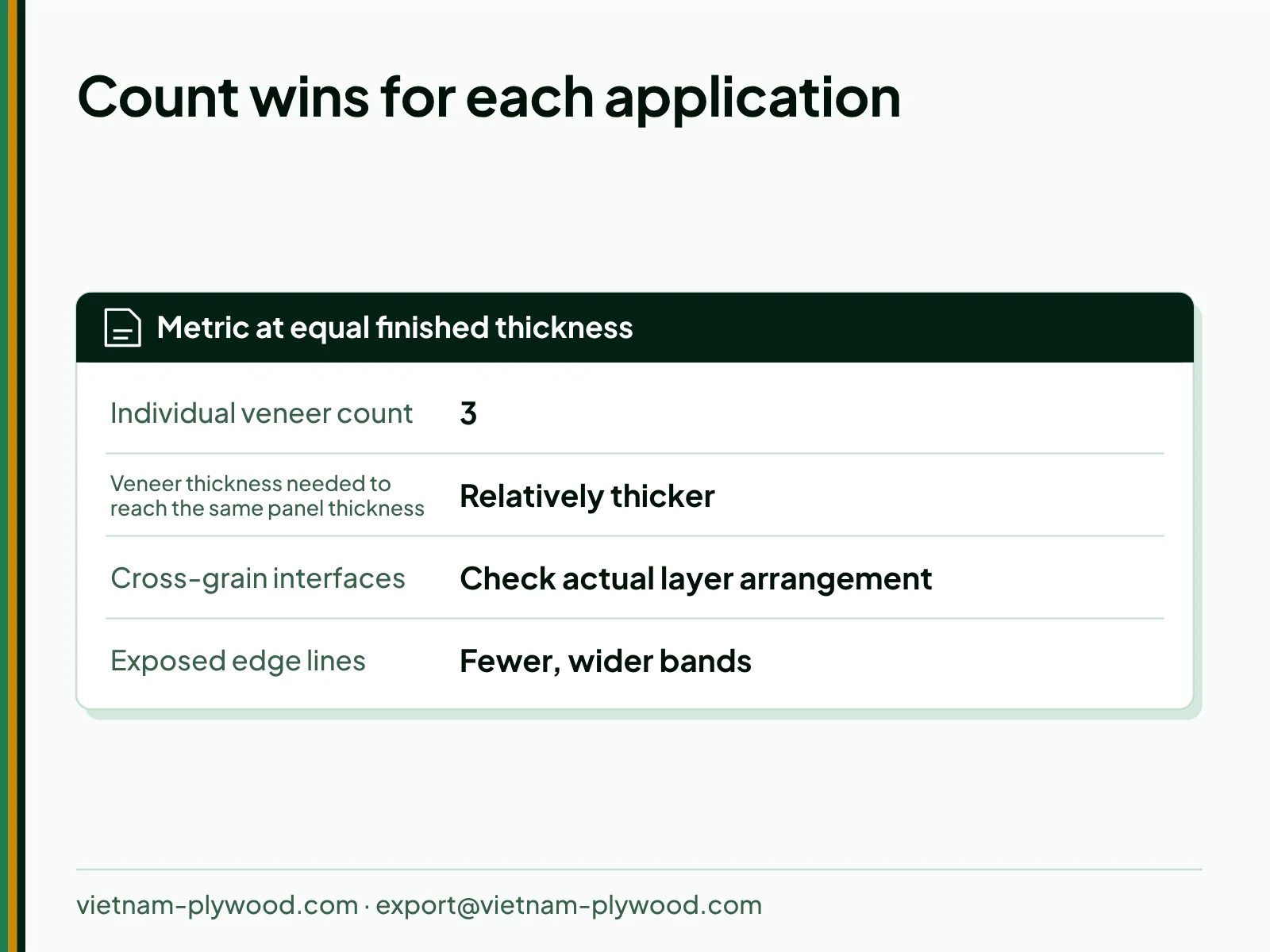
| Metric at equal finished thickness | 3-ply candidate | 5-ply candidate | 7-ply candidate | Verdict by use |
|---|---|---|---|---|
| Individual veneer count | 3 | 5 | 7 | Count describes layup; it does not establish grade |
| Veneer thickness needed to reach the same panel thickness | Relatively thicker | Intermediate | Relatively thinner | More plies can help distribute localized veneer defects, provided bonding and quality match |
| Cross-grain interfaces | Check actual layer arrangement | Check actual layer arrangement | Check actual layer arrangement | Prefer a balanced layup for flat cabinet components |
| Exposed edge lines | Fewer, wider bands | More, narrower bands | Most visible bands of these options | Select by approved door-edge sample |
| Thin backing or lining | Evaluate flexibility and fastening | Evaluate flexibility and fastening | Evaluate flexibility and fastening | Use tested sample at the specified thickness |
| Cabinet doors | Require flatness and hinge tests | Candidate for a balanced door build | Candidate for a balanced door build | Select on finished-door performance, not ply count |
| Packing and formwork | Check impact and support conditions | Check impact and support conditions | Check impact and support conditions | Specify core, adhesive and application separately |
Our how many plies in plywood page covers count at other thicknesses.
Is 3-ply or 4-ply plywood better?
Neither number is automatically better: the critical distinction is between veneer count and grain-direction layers. A four-veneer construction can contain three balanced directional layers when two adjacent veneers run parallel. Asking for “four-ply” without a layup drawing leaves that arrangement unclear.
A conventional balanced plywood layup uses alternating grain directions and symmetric faces. A buyer should request a section drawing showing every veneer, its grain direction and the face-to-back symmetry. For an interior cabinet component, compare edge voids, flatness after conditioning and the same fastening test on both candidates. A nominal ply count cannot replace those checks.
Can I use 4-ply instead of 3-ply?
A four-ply panel can replace a three-ply panel only after the proposed construction meets the same dimensional and application requirements. First establish whether the seller means four veneers or four directional layers; these descriptions are different.
Match finished thickness and tolerance, then check face quality, glue, emissions and core continuity. For a door or a panel carrying hinges, inspect screw retention and movement in a representative assembly. If the original purchase specification explicitly requires three veneers, obtain written approval for the revised layup before changing production.
What is 5-ply plywood?
5-ply plywood is a bonded panel containing five individual veneer sheets. A typical balanced five-ply arrangement alternates grain direction across the thickness, but the buyer must inspect the actual construction drawing. Five plies describe a build, not a fixed thickness or a single adhesive class.
HCPLY offers plywood thicknesses from 3–40 mm, with common sizes including 1220 × 2440 mm and 1250 × 2500 mm. An 18 mm build typically contains 11–13 plies because core veneers are 1.4–2.0 mm thick. Thus, an 18 mm request should not automatically be translated into five plies. See the separate 10 mm plywood specification and 25 mm plywood specification discussions when comparing thickness bands.
How do our three production lines approach the same order?
Each producing line builds for a different application, so a ply-count request needs its intended use attached. The following comparison shows how a common 18 mm inquiry changes by line; 18 mm uses 11–13 plies in our standard core-veneer range.
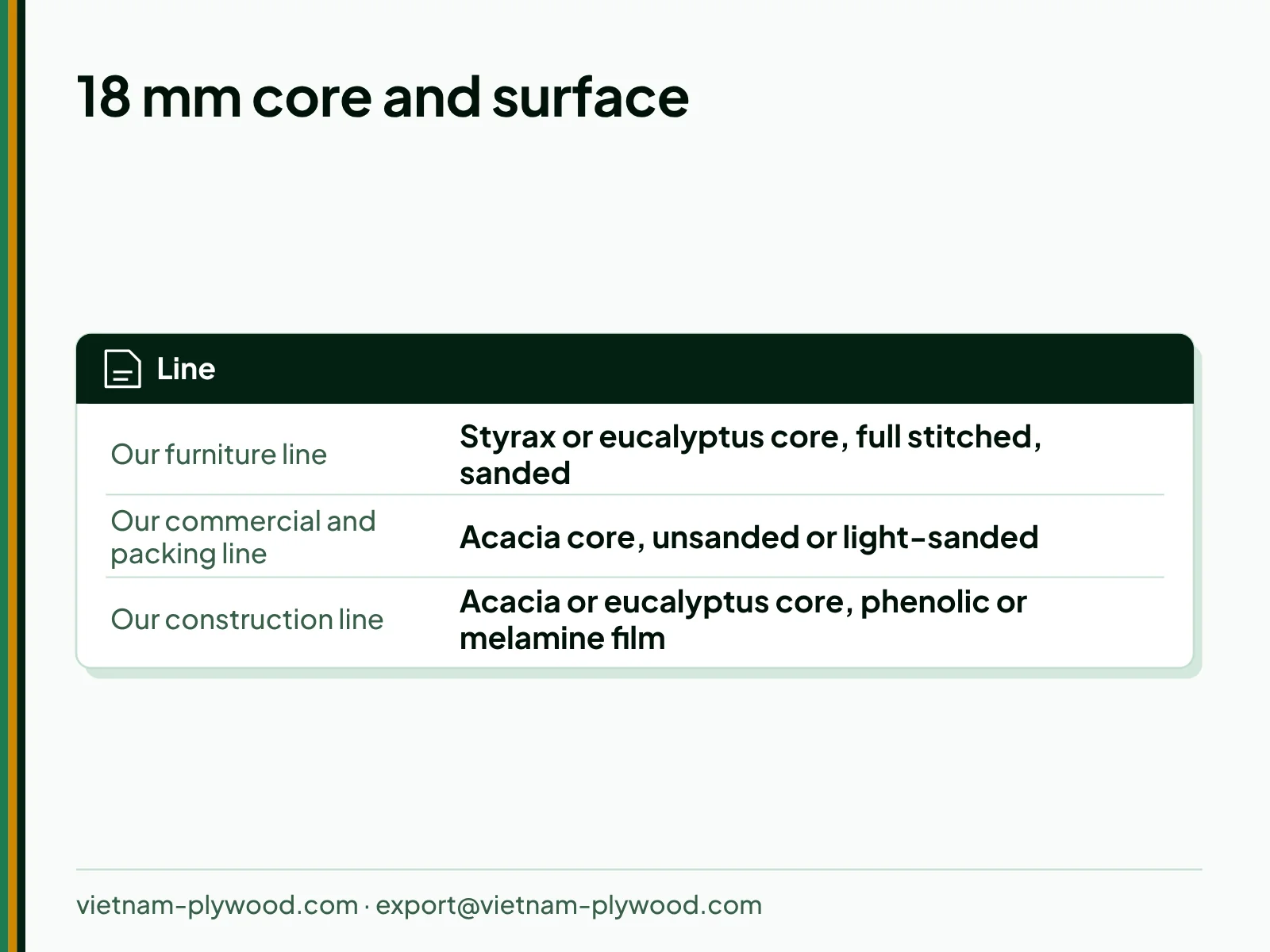
| Line | 18 mm core and surface | Glue and finish | Buyer verdict |
|---|---|---|---|
| Our furniture line | Styrax or eucalyptus core, full stitched, sanded | E0 or E1 emission class; glue specified separately | Cabinet faces, furniture components and controlled exposed edges |
| Our commercial and packing line | Acacia core, unsanded or light-sanded | Moisture-resistant (MR) glue | Crates, packing and industrial panels |
| Our construction line | Acacia or eucalyptus core, phenolic or melamine film | Film and adhesive selected for formwork | Formwork surfaces and site handling |
HCPLY produces the agreed build at the producing factory and handles specification, on-site quality control, loading and export documents. A furniture order should identify furniture plywood; an industrial order should identify packing or commercial plywood. A film-faced inquiry must also specify its film and release requirements.
Is 5-ply or 7-ply better for cabinet doors?
For cabinet doors, the better option is the panel that stays flat, holds hardware and presents the required finish after conditioning. Seven plies can offer a finer veneer distribution at equal thickness, but extra interfaces do not compensate for poor bonding or core gaps.
Ask for a trial door in the actual dimensions, with the same face veneer and edge treatment. Check hinge screw performance, bow, twist and surface telegraphing after the agreed conditioning process. Specify the face by species or finish: bintangor, okoume, engineered veneer (EV), gurjan, pine, poplar, eucalyptus, birch or sapele. A face name describes appearance; core density follows the core species. For veneer-faced panels, a 0.2–0.4 mm face is common, with A/B face grades except birch D/E/F.
Which core and adhesive details matter more than count?
Core continuity, adhesive selection and emission class often resolve a comparison that ply count leaves open. For cabinet work, a full-stitched core gives the buyer a different edge and machining proposition from finger-jointed or loose-laid construction.
Our core-construction hierarchy runs from full stitched to stitched outer layers with edge-trimmed inner veneers, then finger-jointed and loose-laid. Specify the permitted construction rather than accepting “multi-ply” as a complete description. Melamine MR glue is associated with a 12-hour boil specification; phenolic weather-and-boil-proof (WBP) glue with a 72-hour boil specification. These are adhesive descriptions, not statements that every plywood panel has passed an application-specific performance test.
Emission classes E0, E1 and E2 are separate from adhesive chemistry. CARB Phase 2 and TSCA Title VI concern US formaldehyde requirements and third-party certification. Factory certificates can be shown with factory details masked, on request; the order must identify the required documents.
How does the chosen core affect a mixed container?
At 18 mm and 1220 × 2440 mm, the core species changes the shipping weight and the practical sheet count. The 40HC payload limit is 28.5 tonnes, and the reference loading figures below exclude film weight.
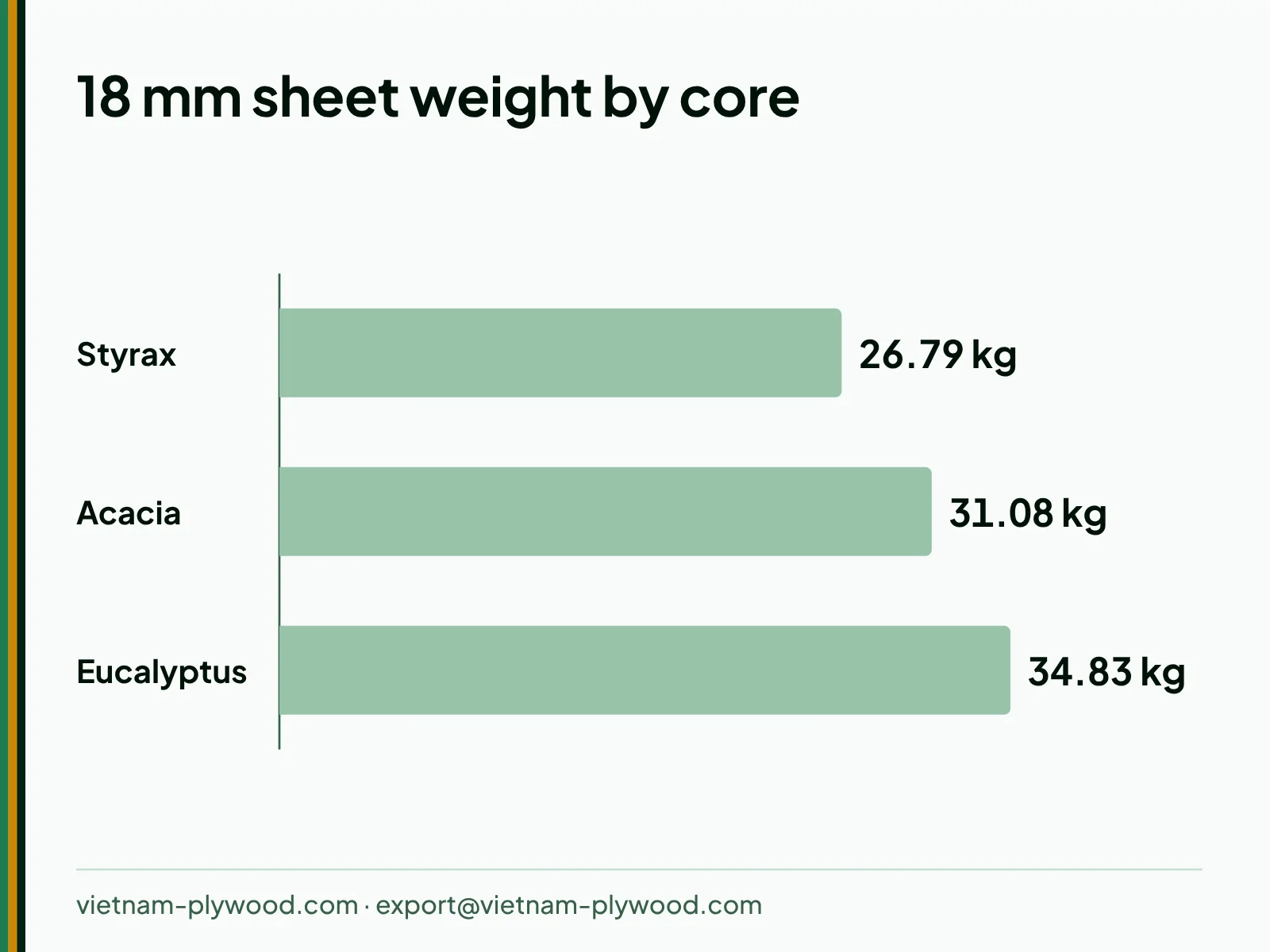
| Core | Sheet weight | Sheets per full 40HC | Cargo volume | Cargo mass |
|---|---|---|---|---|
| Styrax | 26.79 kg | 990 | 53.05 m³ | 26.52 t |
| Acacia | 31.08 kg | 880 | 47.15 m³ | 27.35 t |
| Eucalyptus | 34.83 kg | 795 | 42.60 m³ | 27.69 t |
An order can mix specifications within the payload limit. For example, replacing an acacia sheet with an eucalyptus sheet at this size and thickness adds 3.75 kg to the sheet-weight sum; final loading also follows pallet configuration. Use the mixed-container loading discussion to frame the request. The full container calculation belongs to our packing calculator.
What can an inspector check at the producing factory?
An inspector can verify the declared veneer count on a clean cut edge and compare it with the approved layup. The check covers grain direction, joints, face grade and visible voids.
For sanded furniture plywood, order thickness tolerance is ±0.2 or ±0.3 mm; commercial and film-faced plywood uses ±0.5 mm, while packing uses ±0.5–1.0 mm. Length and width tolerance is ±2 mm. Use the thickness tolerance explanation to specify the measurement method and acceptance points.
The buyer can visit the factory office and inspect goods at the producing factory. The inspection record should identify panel size, finished thickness, observed plies, face condition and any agreed test report.
How should the purchase order describe ply count?
The purchase order should state application and finished-panel performance before giving the target veneer count. A drawing of the proposed section makes a three-versus-five comparison repeatable between quotation, sample and shipment.
Specify the core, permitted joint pattern, adhesive type, emission class, face and grade, finished thickness, tolerance and dimensions. Include inspection acceptance criteria for layup, bonding and flatness. The commercial invoice and packing list in the shipment document set identify the ordered goods; any agreed test reports and emission certificates belong with the order documents. After loading, the draft shipping documents come to you for approval.
HCPLY’s indicative starting prices are from US$250/m³ FOB Hai Phong (October 2026) for commercial plywood and from US$350/m³ FOB Hai Phong (October 2026) for furniture plywood. A finer layup, full stitching, face selection and tighter sanding tolerance can increase cost; quote the finished specification rather than a ply count alone.
What should you send for a production quotation?
Send a written specification identifying the final use, preferred core and construction, and the acceptance checks. Lucy can review the build against the appropriate line and arrange a factory visit.
Application: Cabinet doors / furniture panels / packing / formwork
Line or core: Furniture—styrax or eucalyptus / packing—acacia / construction—acacia or eucalyptus
Core construction and ply layout: [drawing and permitted joints]
Glue: MR melamine or WBP phenolic [as applicable]
Emission: E0 / E1 / E2 [required class]
Face and grade: [veneer species or film specification; grade]
Thickness and tolerance: [mm; agreed tolerance]
Size: [length × width in mm]
Quantity: [sheets or m³; mixed specifications if needed]
Destination port: [port and country]
Next step: book a factory visit with Lucy at export@vietnam-plywood.com to inspect the proposed construction.