





Do I need an EUR.1 certificate for plywood from Vietnam?
For an EU shipment, an EUR.1 certificate is the standard official origin proof when Vietnamese plywood qualifies under the EU–Vietnam Free Trade Agreement (EVFTA). An eligible low-value consignment can instead use a signed origin declaration. The importer must match the proof, product classification and origin evidence before claiming preferential duty.
The phrase eur.1 certificate plywood vietnam describes a practical import decision: whether the specific goods meet the agreement’s origin rules and which document proves that status. HCPLY prepares the origin-document request against the actual goods produced and the buyer’s destination. Choosing the wrong form can mean ordinary customs duty, document correction and a delayed release.
The European Commission’s 2026 rules-of-origin guidance explains that a product must meet its agreement-specific origin rule before preferential treatment applies. Shipment from Hai Phong alone cannot establish preferential origin. Start the buying process with the Vietnam plywood import overview and agree the origin-document route before the order is pressed.
For an EU import, ask the customs broker to identify the complete commodity code and preferential measure for the destination declaration. Then match the corresponding origin criterion to the actual core, veneer, processing and supporting records. This prevents a general certificate of Vietnamese origin being mistaken for proof under EVFTA.
Which trade agreements benefit Vietnam plywood exports?
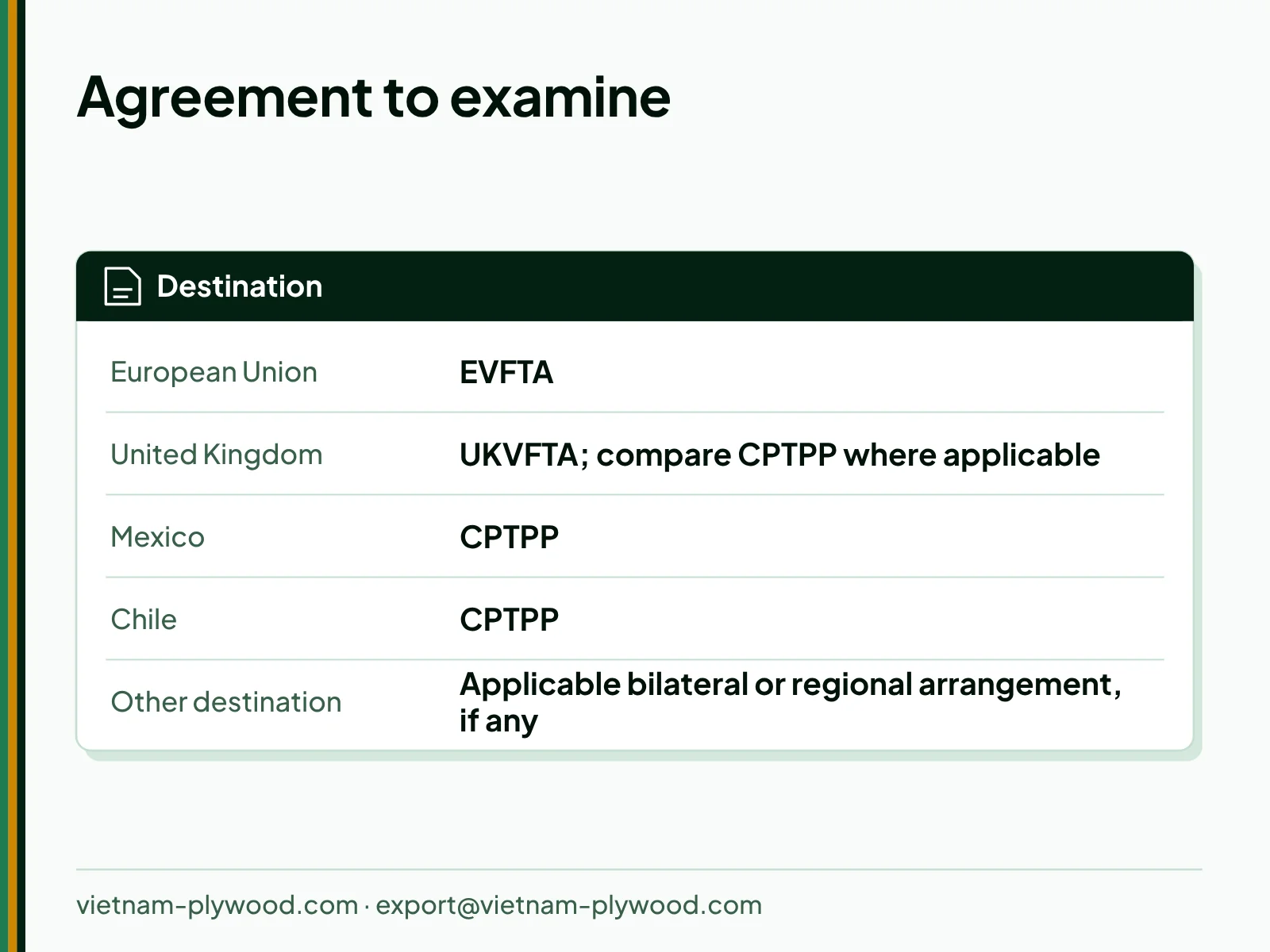
The relevant agreement follows the importing country, the plywood’s classification and the production evidence. EVFTA is the principal route for European Union buyers; the UK–Vietnam Free Trade Agreement (UKVFTA) is a separate route for British imports. The Comprehensive and Progressive Agreement for Trans-Pacific Partnership (CPTPP) is relevant to participating destinations, including Mexico and Chile.
| Destination | Agreement to examine | Origin proof to arrange | Buyer’s first check |
|---|---|---|---|
| European Union | EVFTA | EUR.1 or qualifying Vietnamese origin declaration | EU commodity code and product-specific origin rule |
| United Kingdom | UKVFTA; compare CPTPP where applicable | Proof permitted by the selected agreement | UK tariff line and selected agreement |
| Mexico | CPTPP | CPTPP certification of origin | Mexico’s tariff schedule and origin rule |
| Chile | CPTPP | CPTPP certification of origin | Chile’s tariff schedule and origin rule |
| Other destination | Applicable bilateral or regional arrangement, if any | Form specified by that arrangement | Current tariff and origin procedure |
The UK government’s 2026 Vietnam market guide identifies UKVFTA and CPTPP as agreements operating simultaneously. That does not mean their rules or evidence can be combined. The chosen preference claim must be based on one applicable arrangement and its requirements.
No single tariff percentage is correct for every plywood face and destination. The applicable tariff line, effective date and proof type must be checked for each import entry. A tariff preference concerns customs duty; import VAT, freight, trade remedies and product-compliance obligations require separate review. Use the landed-cost calculation for those other charges.
What is the difference between EUR.1 and a REX statement?
EUR.1 is an authority-issued movement certificate; a statement on origin is an exporter-made declaration under the relevant agreement. Registered Exporter (REX) status is associated with certain exporter statements, but it is incorrect to assume every Vietnamese plywood exporter uses an EU REX number for EVFTA exports.
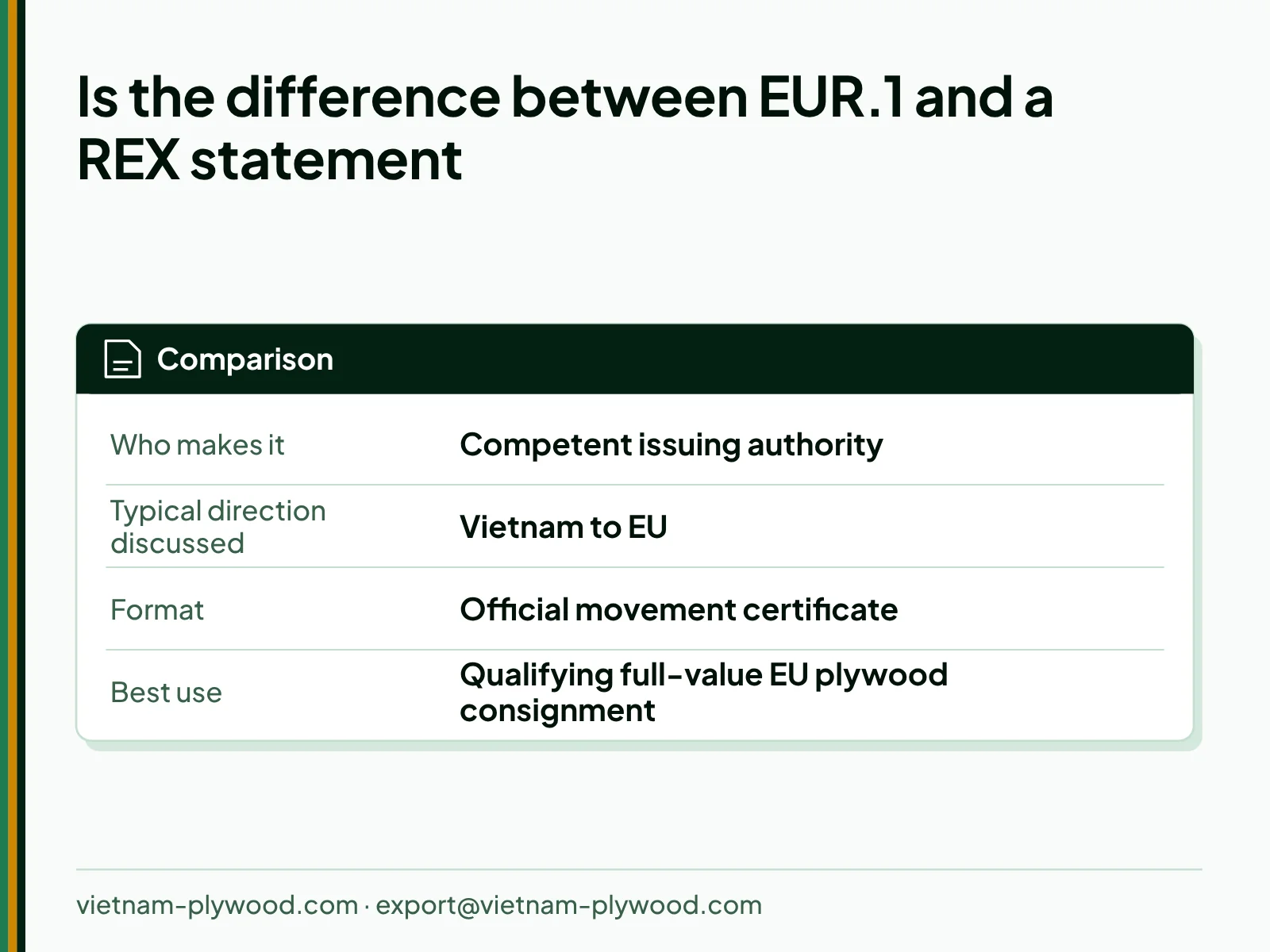
For Vietnam-to-EU goods, EVFTA permits an EUR.1 certificate and a Vietnamese exporter’s origin declaration for a consignment whose originating goods do not exceed €6,000. The European Commission’s EVFTA guidance distinguishes this direction from EU-to-Vietnam shipments, where EU registered exporters use statements on origin. The distinction is directional: paperwork for an EU exporter is not automatically paperwork for a Vietnamese exporter.
| Comparison | EUR.1 | Qualifying Vietnamese origin declaration | EU exporter REX statement |
|---|---|---|---|
| Who makes it | Competent issuing authority | Vietnamese exporter | Registered EU exporter |
| Typical direction discussed | Vietnam to EU | Vietnam to EU, within applicable value ceiling | EU to Vietnam |
| Format | Official movement certificate | Prescribed declaration on commercial document | Prescribed statement on commercial document |
| Best use | Qualifying full-value EU plywood consignment | Eligible low-value EU consignment | EU-origin goods exported to Vietnam |
A mixed full-container order will commonly exceed the low-value declaration threshold, but value must be assessed from the actual consignment. Do not split an invoice merely to fit the threshold. For the final entry, the importer should use the evidence category accepted by the destination customs authority.
Can one EUR.1 cover a mixed container?
One EUR.1 can identify multiple qualifying plywood descriptions in a consignment when the issuing authority accepts the application and each listed product satisfies the origin rules. The container’s shared seal or bill of lading does not turn non-originating goods into originating goods. Each invoice line needs a traceable description and supporting origin evidence.
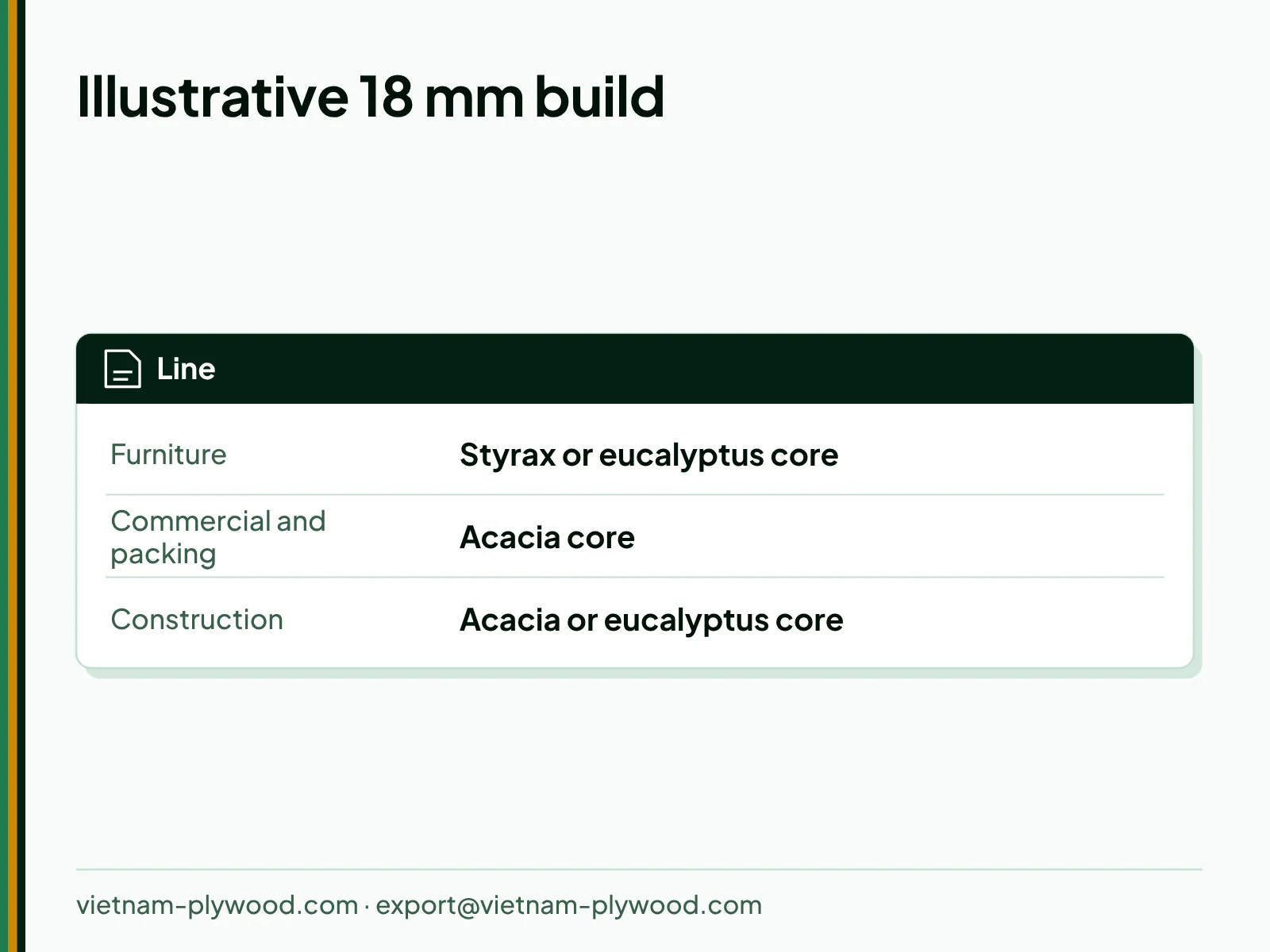
For example, an importer can specify 18 mm furniture panels and 18 mm commercial panels on separate invoice and packing-list lines. Our furniture line uses a styrax or eucalyptus core with a full-stitched, sanded build. Our commercial and packing line uses an acacia core with MR glue and an unsanded or light-sanded surface. The certificate application must follow the goods and the supporting records for each producing factory.
We prepare the invoice descriptions, packing quantities, factory production references and origin evidence for the proposed consignment. Where the destination rules permit a single proof covering the qualifying lines, the export team submits them together. Where a line fails the origin rule or the authority requests separate treatment, the paperwork must distinguish that line rather than hide it inside a total.
The order’s minimum is one 40HC; one container can carry several specifications as long as the payload limit holds. For a full 18 mm, 1220×2440 mm load, the reference quantities are 990 styrax-core sheets, 880 acacia-core sheets or 795 eucalyptus-core sheets. These are alternative full-load builds, not quantities to add together. See container-load calculations before proposing a mixed allocation.
How do our three production lines affect origin evidence?
The producing factory determines which processing and material records support each plywood description. The face names the product; the core influences density and the build. That distinction matters when a certificate application, invoice and inspection record must describe the same physical panels.
| Line | Illustrative 18 mm build | Surface and glue | Evidence an inspector can match |
|---|---|---|---|
| Furniture | Styrax or eucalyptus core | Sanded; E0/E1 emission specification | Face grade, core stitching, thickness record |
| Commercial and packing | Acacia core | MR glue; unsanded or light-sanded | Core, panel count, glue specification |
| Construction | Acacia or eucalyptus core | Phenolic or melamine film; unsanded | Film specification, core and loading marks |
For film-faced work, 120 g/m² standard film, 135 g/m² premium film and 220 g/m² anti-slip film are distinct specifications. The construction line presses these builds; the furniture line instead prepares decorative veneer faces, and the commercial line prepares packing or general commercial sheets. The origin application should follow those differences rather than use one generic product description.
Buyers can visit the factory office and inspect goods at the producing factory. An inspector can compare the purchase specification, batch identification, visible face, thickness readings, pallet marks and loading tally. Those checks support the description and traceability; customs origin eligibility also requires the applicable material and processing records. For a closer product comparison, see factory-line grades and furniture plywood.
How does the export team apply for the correct proof?
The export team assembles the origin application from the destination, invoice lines and factory records, then coordinates the issuing procedure for the selected agreement. The buyer should approve the proposed product descriptions before shipping documents are finalized.
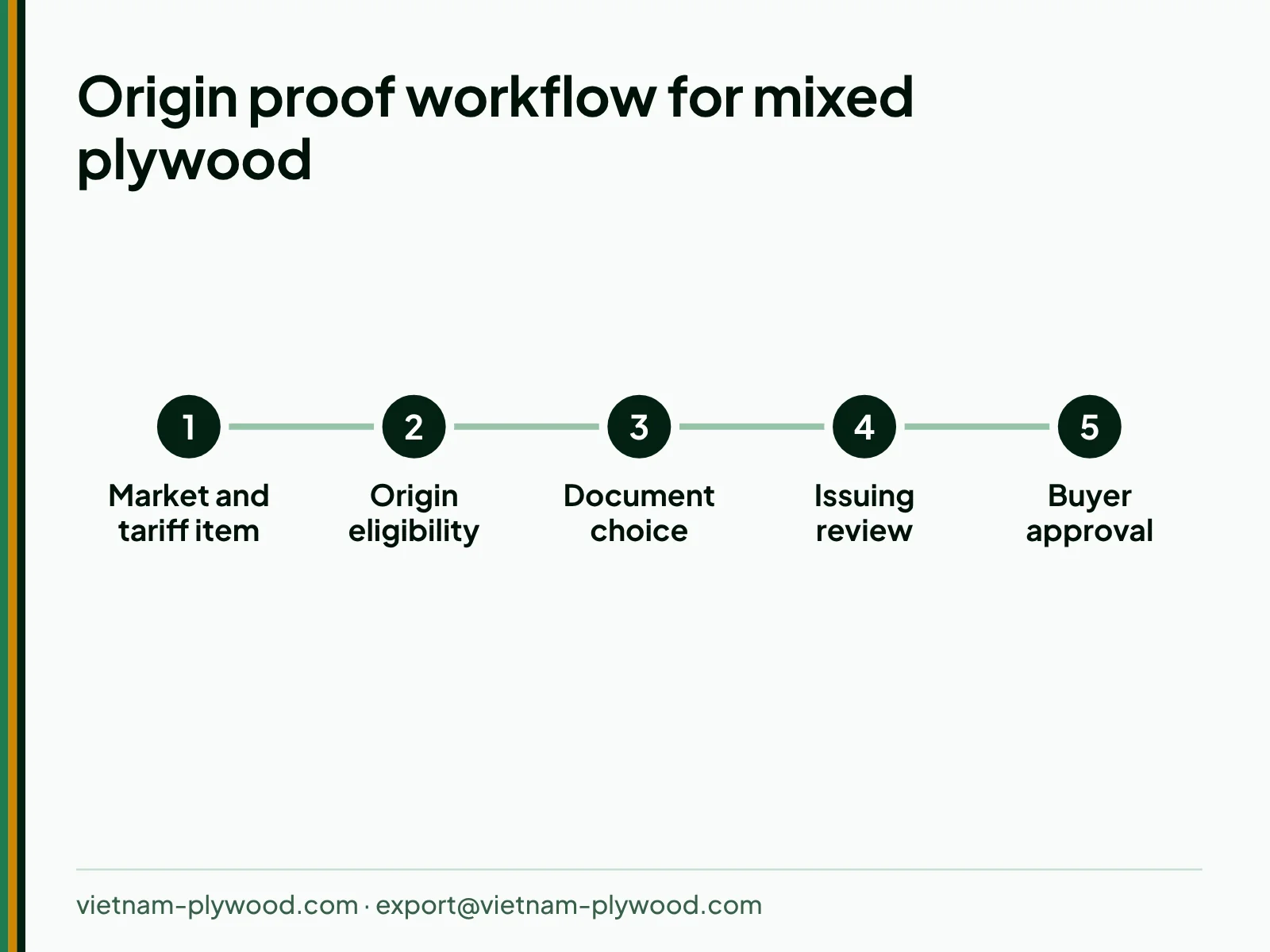
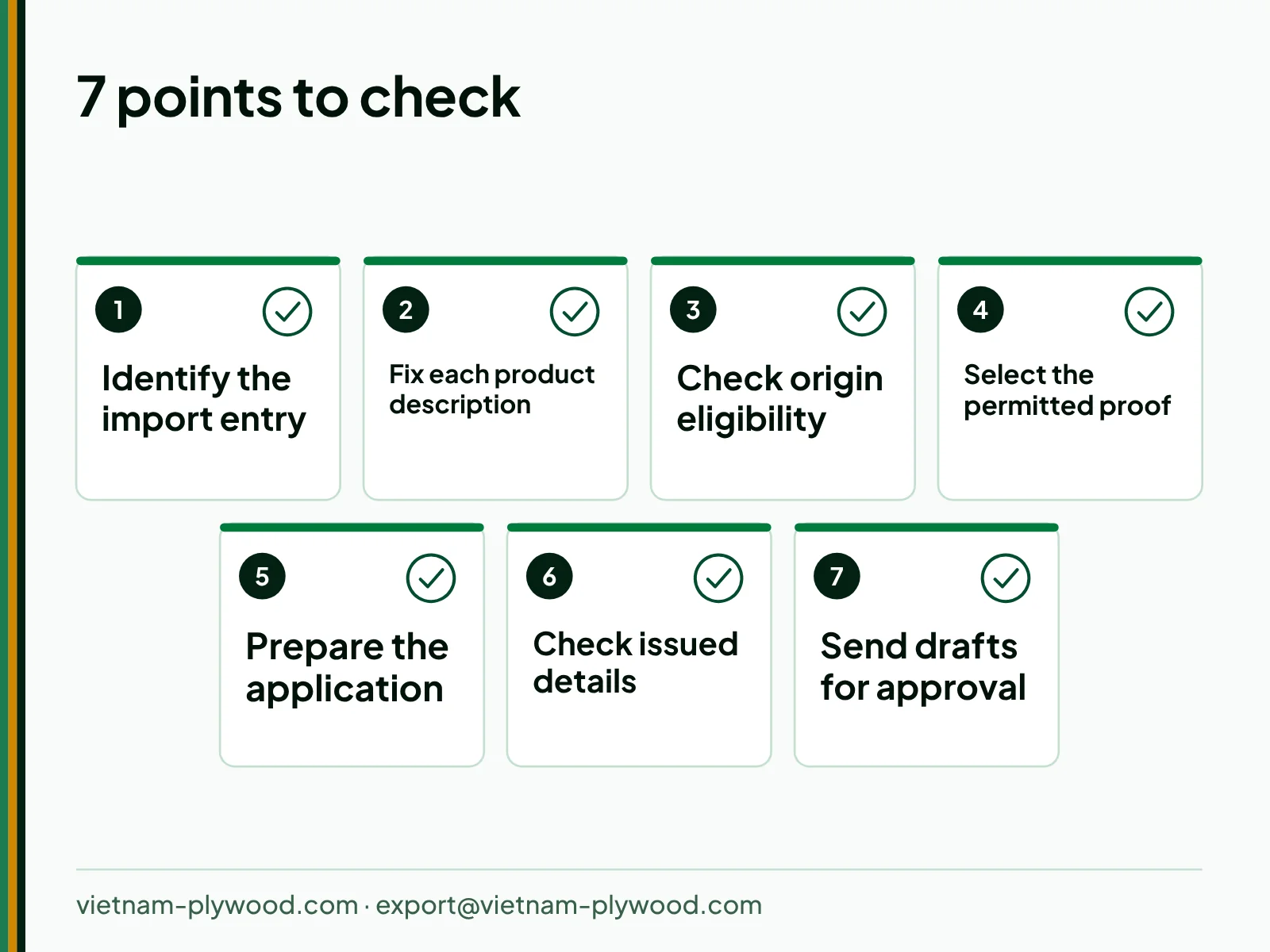
- Identify the import entry. Record destination country, discharge port, tariff classification and intended preferential agreement. The importer supplies the destination-specific classification decision.
- Fix each product description. State face and grade, core, thickness, size, glue, emission class where relevant, quantity and production line.
- Check origin eligibility. Compare material sourcing and production records with the agreement’s product-specific origin rule. Exclude any line lacking adequate support from the preference claim.
- Select the permitted proof. For EU lots, determine whether EUR.1 or a qualifying low-value origin declaration applies. Use the selected market’s separate process elsewhere.
- Prepare the application. Reconcile exporter, consignee, invoice, packing list, goods description, quantities and origin support before submission to the competent authority.
- Check issued details. Match the approved certificate or declaration to the commercial documents and import instructions. Correct discrepancies through the proper issuing channel.
- Send drafts for approval. After loading, draft shipping documents go to the buyer for approval; the buyer checks customs-entry details before final release.
The commercial invoice, packing list, bill of lading, certificate of origin, phytosanitary and fumigation papers are part of the shipment documentation. EU lots also carry the EUTR/EUDR file set; CIF shipments include insurance papers. The order’s agreed certificate documents and test reports are included as applicable. For sequencing, see plywood production lead time.
Does the UK–Vietnam FTA reduce import duty on plywood?
UKVFTA can reduce the customs duty on eligible Vietnamese plywood when the tariff line receives preference and the importer holds the proof required by that agreement. The reduction is established from the UK tariff schedule and origin rules for the exact product, rather than from the word “Vietnam” on a shipping document.
HM Revenue & Customs’ 2024 proof-of-origin guidance directs traders to check that their goods are covered by an agreement and meet its rules. It also explains that the type of proof depends on the goods and the trading route. This is why a UK importer should not simply request the EU EUR.1 procedure without identifying the UK agreement and accepted evidence.
For an 18 mm panel, identify the face species and construction before selecting the UK commodity code. The core alone does not settle the tariff classification. Then compare the preferential duty available under UKVFTA and, where relevant, CPTPP, using the same declared product and shipment date.
The resulting cost comparison belongs in the importer’s purchase model. A zero or reduced preferential customs rate does not remove freight, port charges, VAT or other applicable import measures. The shipment can be quoted FOB Hai Phong, CFR (CNF) or CIF, while the duty claim remains the importer’s customs task.
Does CPTPP cover plywood sent to Mexico or Chile?
CPTPP provides a potential preference route for qualifying Vietnamese plywood imported into Mexico or Chile. Its origin certification is distinct from EVFTA EUR.1 paperwork, and each destination applies its own tariff schedule and import procedures. A certificate intended for an EU shipment cannot be reused as a CPTPP origin certificate.
The agreement’s preference should be assessed for the importing country’s precise tariff item, the applicable staging schedule and the plywood’s production inputs. Confirm that the relevant CPTPP provisions are in force between Vietnam and the destination on the import date. Then check the agreement’s product-specific rule and the prescribed certification data.
A mixed shipment may include furniture and packing panels with different face veneers, core constructions and tariff descriptions. Each line must be assessed for origin independently even if a single CPTPP certification document lists several qualifying products. The importer should retain the certification and supporting records according to local customs requirements.
The practical order instruction is to state “CPTPP preference review” for the named destination, with a complete product breakdown. The export team can then align production records and document fields to that route. A broad request for “FTA certificate” leaves too much ambiguity for the importer and exporter.
What must the invoice and packing list show?
The invoice and packing list must make every certificate line identifiable by product, quantity and shipment reference. Customs may compare the origin proof with those documents, the physical pallets and the importer’s declaration. Consistent descriptions make that comparison possible.
Write the face species and grade separately from the core. An okoume-faced panel with acacia core should not be described simply as acacia plywood if the invoice uses the face to identify the product. Record thickness, sheet dimensions and quantity by specification; retain the relevant producing-factory records alongside the commercial documents.
A practical packing-list entry identifies pallets and sheets for each build, rather than only total cubic metres. This helps an inspector locate a product line during examination. A buyer receiving mixed specifications should also keep a separate receiving tally and use arrival inspection checks to compare the loaded and delivered goods.
Where a certificate describes multiple lines, keep its wording consistent with the commercial invoice. If the certificate includes only some eligible lines, distinguish the other goods on the invoice and in the importer’s entry. A mixed container is an operational convenience, while origin status belongs to the goods.
What happens if origin or classification is challenged?
If customs questions a preferential claim, the importer must produce the origin proof and supporting evidence required under the applicable agreement. A valid-looking certificate does not replace the underlying rule-of-origin test. Missing records or mismatched descriptions can cause verification, assessment at the ordinary rate or a correction request.
The European Commission’s 2026 origin guide describes customs verification and the possibility of standard duties when origin requirements are unmet. HMRC’s 2024 guidance similarly lists production records, invoices, accounting details and supplier declarations among supporting evidence for verification.
First isolate the questioned line: its tariff code, face, core, production batch and material origin. Compare the commercial description to the issued proof and underlying records. If the problem is clerical, follow the issuing authority’s correction procedure; if it concerns eligibility, reassess the preference claim instead of changing labels.
Anti-dumping and other trade-remedy measures are separate from preferential origin. A claim about another country’s plywood duties cannot establish the duty applicable to Vietnamese goods. Check the current measure against the exact commodity code, producer circumstances and import date. EU product compliance, including relevant CE documentation and EUDR evidence, also remains a separate gate.
What should an importer approve before loading?
The importer should approve the origin route, line descriptions and draft document fields before the goods leave the producing factory. That approval gives the export team a specific basis for assembling the final shipment file and gives the customs broker a usable entry description.
Check the destination and tariff item against the current official tariff. Identify the agreement and the exact proof type; reconcile the invoice and packing list to the order. For each mixed line, review face, core, dimensions, quantity and the supporting production records. Ask for the agreed factory certificates and test reports when the specification requires them; member-factory FSC, CARB P2, ISO 9001 and CE documents are shown with factory details masked, on request.
At the factory, witness the sheet and pallet counts and compare physical marks to the packing tally. After loading, review the draft shipping documents before approval. For EU consignments, check the EUTR/EUDR file set separately from the preferential-origin certificate. The origin proof answers a customs preference question; it does not substitute for product testing or timber due diligence.
HCPLY handles specification, on-site quality control, documents and loading through the export team. For a precise document request, send Lucy at export@vietnam-plywood.com the destination, expected product lines and agreed terms. The next step is to book a factory visit.
What specification should you send for an origin-ready order?
Send a written specification that lets the export team identify each product line and the importing market before preparing origin documents. The code block below is a starting purchase instruction; complete every field for each product in a mixed consignment.
Application: importer/distributor resale; intended end use
Line or core: furniture / commercial and packing / construction; core species
Glue: MR melamine or WBP phenolic, as specified
Emission: E0 / E1 / E2 or agreed market requirement
Face and grade: veneer species and A/B, or birch D/E/F; film weight if applicable
Thickness and tolerance: __ mm; ordered tolerance __ mm
Size: __ x __ mm
Quantity: __ sheets per specification; __ pallets total
Destination port: __; importing country __
Origin preference route: EVFTA / UKVFTA / CPTPP / other __
Import commodity code: __; requested proof type __
Book a factory visit through contact to inspect the producing line and review the shipment-document plan with Lucy.