





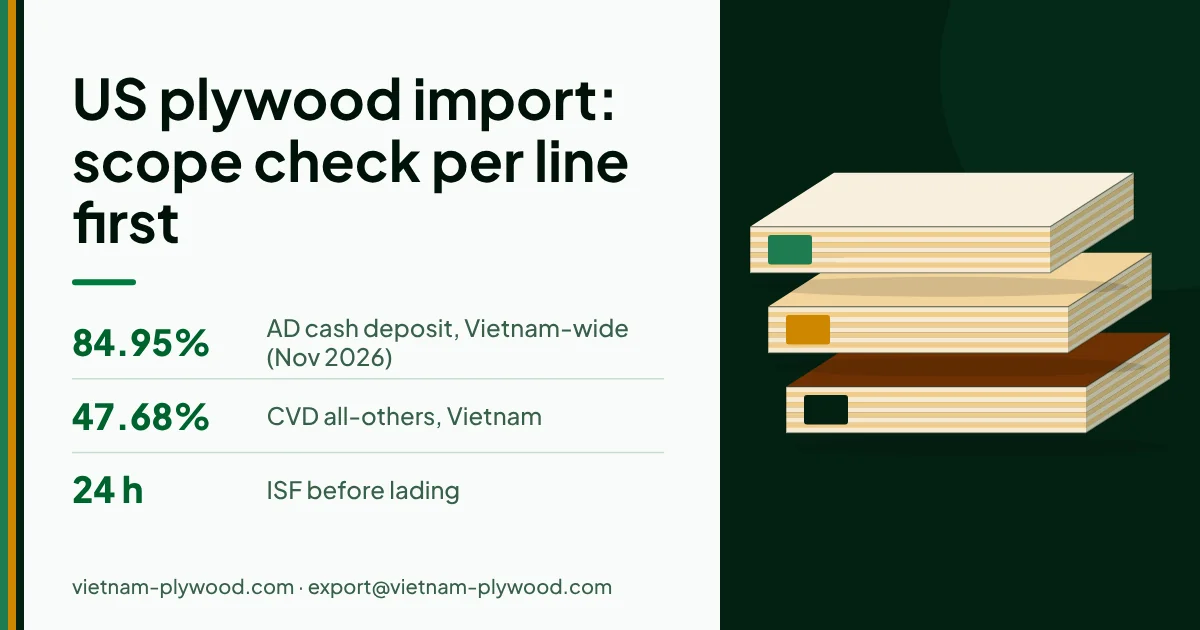
Since 17 November 2026, every wood-faced panel HCPLY presses can fall inside the US antidumping and countervailing duty orders on hardwood and decorative plywood from Vietnam, so the scope check per product comes before price. A panel entered under the wrong reading carries cash deposits at 84.95% plus 47.68% of entered value, or a later bill when the entry liquidates.
To import plywood from Vietnam to USA ports, the order of work is: scope, duty deposits, the formaldehyde paper, the Lacey species lines, the ISF, the bond, then the entry. This page takes those questions in that order, line by line across our furniture, commercial and packing, and construction lines. The general sequence for any market is on our page on how to import plywood from Vietnam.
How do I import plywood from Vietnam to USA ports?
Start with the scope of the 2026 AD/CVD orders for each panel on the order, because it sets the cash deposit at entry. Then collect the TSCA Title VI statement, the species data for the Lacey declaration and the ISF data before loading. Post a customs bond, and your licensed customs broker files the entry.
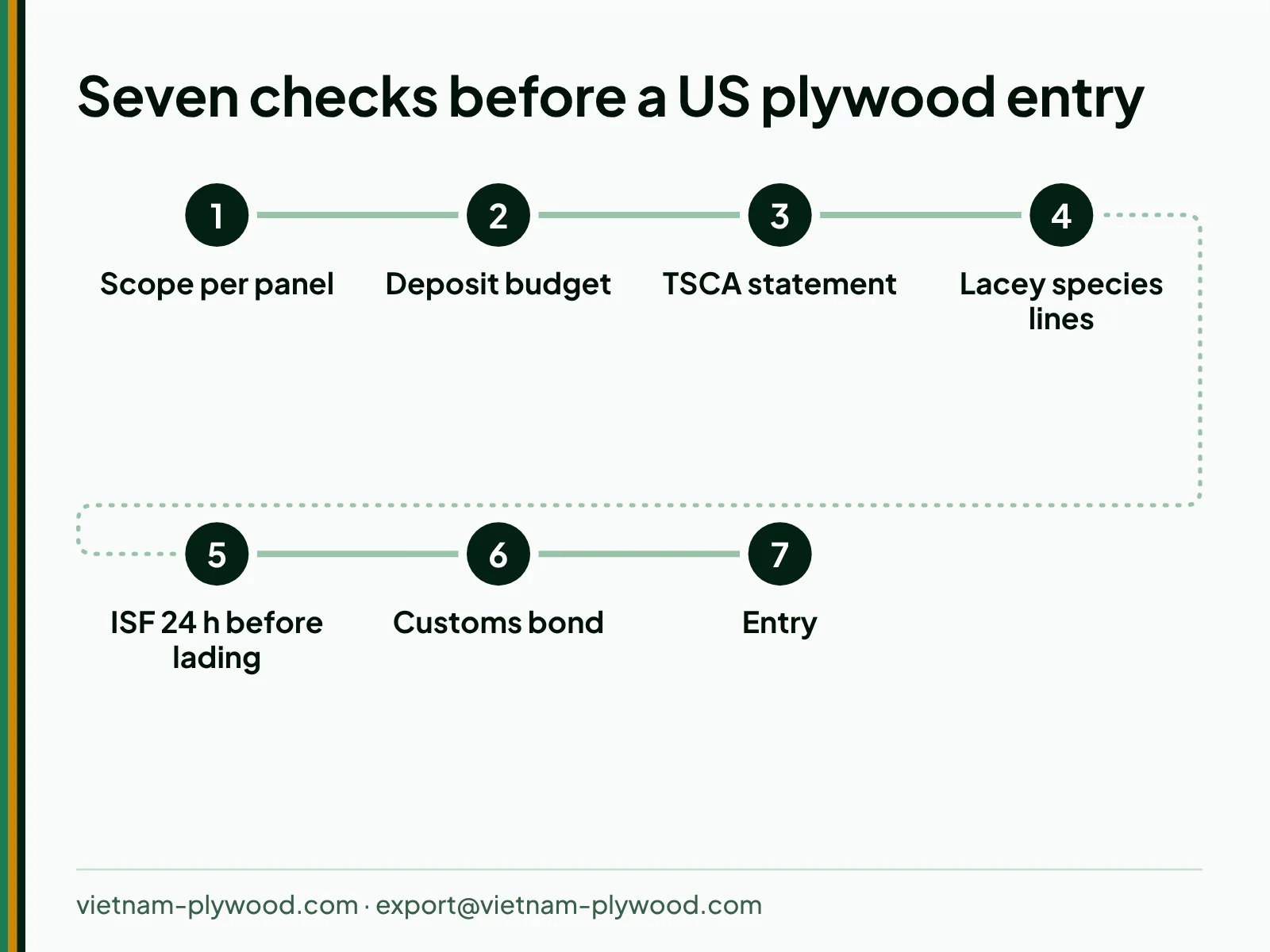
- Scope per panel. Read each line against the written scope of the orders and its exclusions.
- Deposit budget. Apply the antidumping and countervailing cash deposit rates to every in-scope line.
- Formaldehyde paper. Collect the TSCA Title VI statement for each composite wood panel line.
- Lacey data. Collect the genus, species and country of harvest for every face and core species.
- ISF data. Send seller, buyer, manufacturer, country of origin, HTSUS and stuffing data to your customs broker in time for the 24-hour rule.
- Bond. Arrange a single-entry or continuous bond before arrival.
- Entry. Your customs broker files with the invoice, packing list, B/L and certificate of origin.
Production: 15–45 days from the 30% deposit, set by order size, line loading and the contract. After loading, the draft shipping documents come to you for approval, and that draft set is where steps 3 to 5 get checked line by line.
Which panels does the 2026 AD/CVD scope cover?
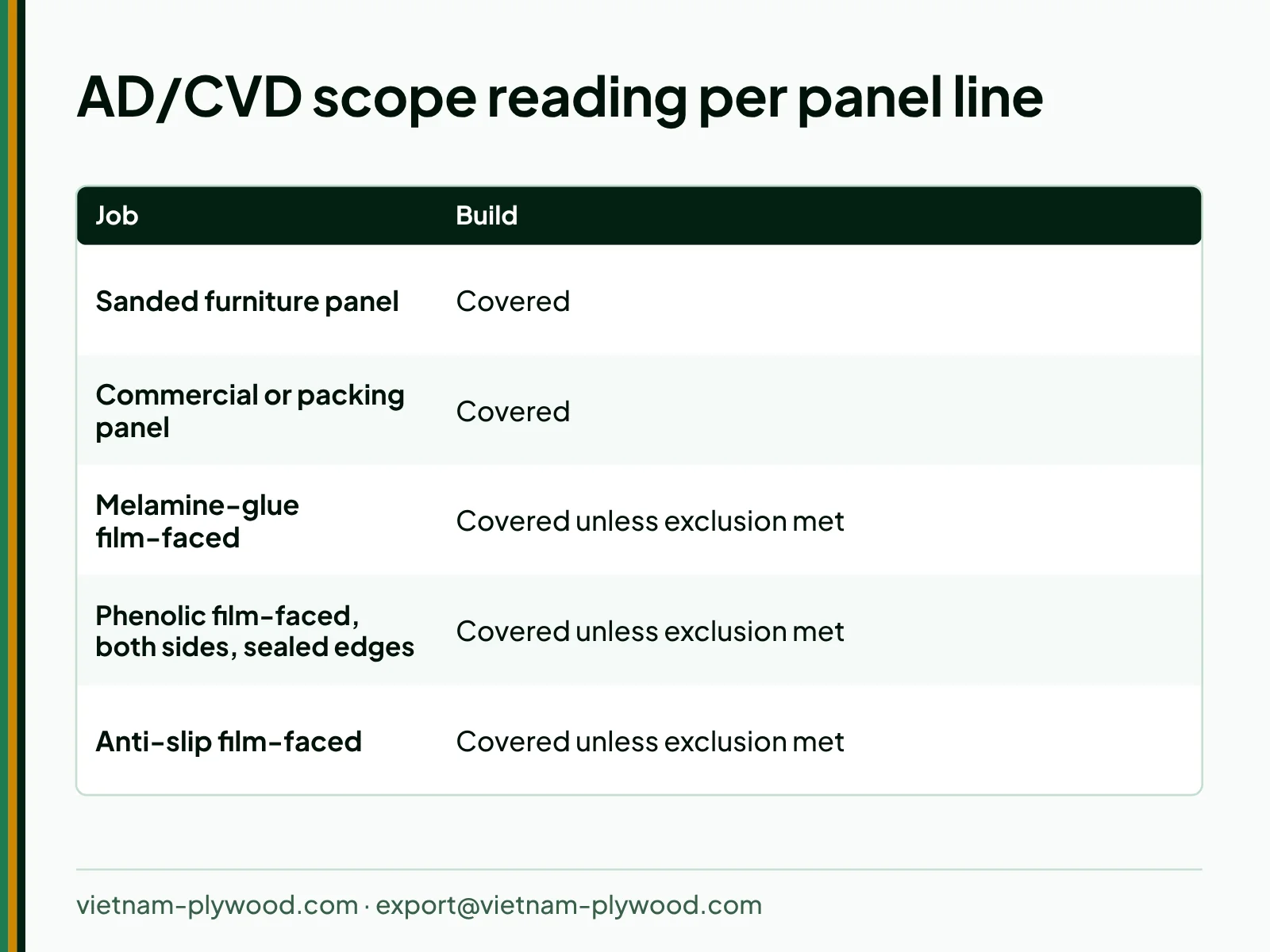
The scope covers any flat, multilayered veneered panel with a face or back veneer of hardwood, softwood or bamboo, whatever covers it. That reaches sanded furniture panels, commercial and packing panels, and film-faced panels with a wood veneer under the film. One exclusion for phenolic film-faced plyform has defined conditions.
The antidumping order of 17 November 2026, published by Commerce in the Federal Register (91 FR, 17 November 2026), states the core test: “A hardwood and decorative plywood panel must have at least either the face or back veneer composed of one or more species of hardwood, softwood, or bamboo, regardless of any surface coverings.” Its list of covered surface coverings includes paper, high pressure laminate, MDO and phenolic film.
Thickness and size do not take a panel out. The order covers plywood “without regard to dimension”, and cut-to-size or drilled panels stay covered. The HTSUS numbers listed are for convenience only; the order says “The written description of the merchandise is dispositive.”
The exclusions most relevant to Vietnamese plywood are three. Structural plywood certified and stamped to PS 1-22 or PS 2-18 is out. Hardwood plywood already subject to the 2018 orders on China is out of these orders because it is under those. Phenolic Film Faced Plyform is out when it has an “Exterior” or “Exposure 1” bond classification as defined by The Engineered Wood Association, an opaque phenolic film of at least 90 g (printed in the order as g/m3) on both face and back, and an opaque moisture-resistant edge coating.
| Panel from our lines | Face and back | Reading against the written scope | What decides it |
|---|---|---|---|
| Sanded furniture panel (furniture line) | Bintangor, okoume, EV, poplar, birch, sapele or another wood veneer | Covered | Wood face veneer; no exclusion fits |
| Commercial or packing panel (commercial and packing line) | Wood face veneer, or matt raw core | Covered | Wood veneer on face and back |
| Melamine-glue film-faced (construction line) | Film over a wood veneer | Covered unless the exclusion is met | An MR glue line is a weak basis for an “Exterior” bond claim |
| Phenolic-glue film-faced, film both sides, edges sealed (construction line) | 120 or 135 g/m² film over a wood veneer | Covered unless the exclusion is met | Bond classification evidence, film on both faces, edge coating |
| Anti-slip film-faced (construction line) | 220 g/m² anti-slip film on the face | Covered unless the exclusion is met | Same three conditions, back film included |
HCPLY does not hold an Engineered Wood Association bond classification or stamp for any panel. Whether a test report for a phenolic film-faced build satisfies the exclusion is a question for your customs counsel, or for a scope ruling from Commerce, before the order is placed. Our panels carry no PS 1 or PS 2 stamp, so the structural exclusion does not apply to them.
What duty deposits apply when the panels enter?
For every in-scope panel from a producer without its own rate, the importer deposits the Vietnam-wide antidumping rate and the all-others countervailing rate at entry, on top of normal duty. Liquidation stays suspended, so the final duty is set later in administrative reviews. Both orders were published on 17 November 2026.
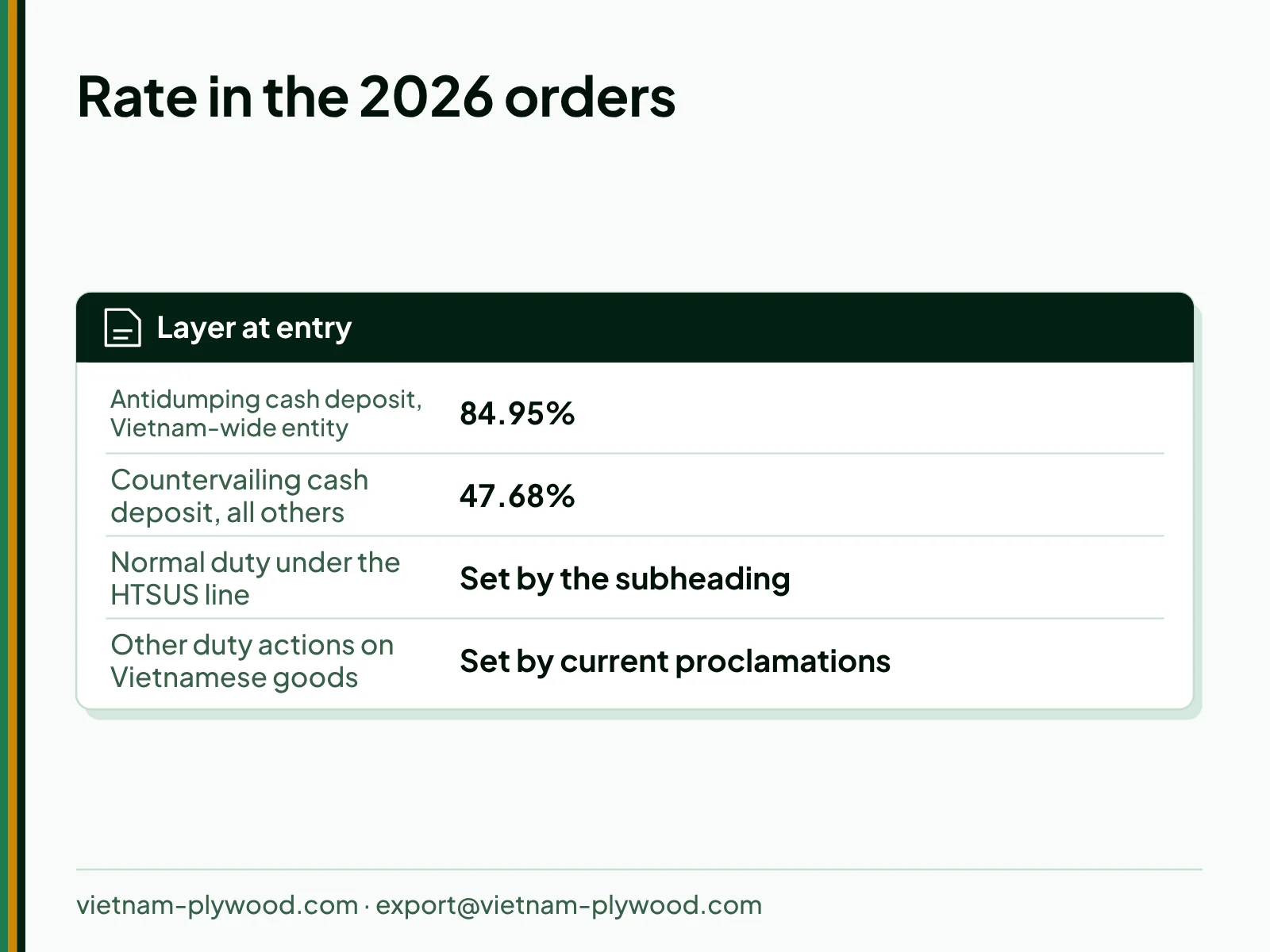
In the antidumping order, the Vietnam-wide entity carries a dumping margin of 90.12% and a cash deposit rate of 84.95% after adjustment for subsidy offsets. The order also says Commerce “intends to instruct CBP to continue to suspend liquidation on all relevant entries of hardwood and decorative plywood from China, Indonesia, and Vietnam”.
The countervailing duty order of the same date, in the Federal Register (91 FR, 17 November 2026), sets an all-others subsidy rate of 47.68% ad valorem for Vietnam. It requires that “CBP must require, at the same time as importers would normally deposit estimated duties on this merchandise, a cash deposit equal to the rates noted below.”
| Layer at entry | Rate in the 2026 orders | Applies to |
|---|---|---|
| Antidumping cash deposit, Vietnam-wide entity | 84.95% | In-scope panels from producers without a separate rate |
| Countervailing cash deposit, all others | 47.68% | In-scope panels from producers not individually listed |
| Normal duty under the HTSUS line | Set by the subheading | Every plywood line |
| Other duty actions on Vietnamese goods | Set by current proclamations | As your customs broker reads them at entry |
The deposit is a percentage of entered value, so a lower FOB value lowers the deposit in dollars but not the rate. The ITC’s final determination of September 2026 found injury from hardwood and decorative plywood but terminated the investigations on softwood structural plywood, so stamped structural panels from other origins sit outside these orders.
Who issues the TSCA/CARB document for a plywood shipment?
A third-party certifier, approved by CARB and recognised by EPA, certifies the producing factory’s panels, and the producing factory writes the compliance statement onto the shipping papers. The importer keeps those papers for three years and files the TSCA import certification. Certificates belong to the member factories and are shown with factory details masked, on request.
EPA’s page on formaldehyde emission standards for composite wood products, read in 2026, says the final rule “also established a third-party certification program for laboratory testing and oversight of formaldehyde emissions from manufactured and/or imported composite wood products”. The CARB Phase II and TSCA Title VI limits are set at identical levels. For hardwood plywood with a veneer or composite core, 40 CFR 770.10 sets the limit at 0.05 parts per million of formaldehyde.
The importer’s duty sits in 40 CFR 770.30: “Importers must demonstrate that they have taken reasonable precautions by maintaining, for three years, bills of lading, invoices, or comparable documents” with a written supplier statement of TSCA Title VI compliance. Since 22 March 2019, the same section ties importers of regulated composite wood products to the import certification rules in 19 CFR 12.
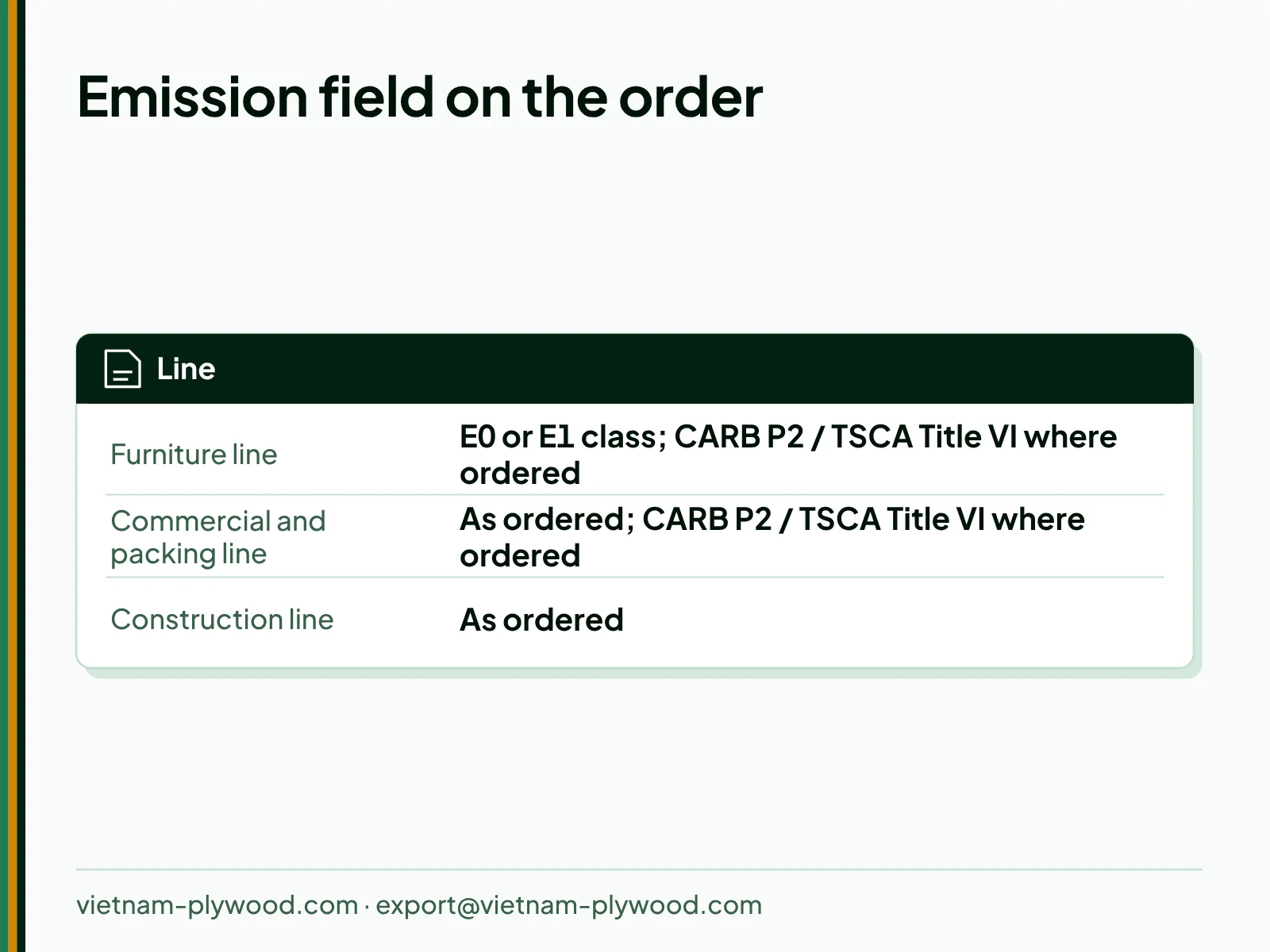
| Line | Emission field on the order | Paper that carries it |
|---|---|---|
| Furniture line | E0 or E1 class; CARB P2 / TSCA Title VI where ordered | Emission certificate of the producing factory, statement on invoice |
| Commercial and packing line | As ordered; CARB P2 / TSCA Title VI where ordered | Emission certificate, statement on invoice |
| Construction line | As ordered | Emission certificate where the panel type falls under the rule |
Glue and emission are two fields. Melamine (MR) or phenolic (WBP) is the glue; E0, E1 or E2 is the emission class; CARB P2 / TSCA Title VI is the US limit with third-party certification. Write all three on the purchase order, one line per product.
How is the Lacey declaration completed when face and core species differ?
Each species in the panel is its own line on the Lacey Act plant declaration, with its scientific name, the country where it was harvested, the value and the quantity. A faced panel therefore carries at least two species lines: one for the face and back veneer, one for the core.
The requirement is in the Lacey Act, 16 U.S.C. 3372(f): “it shall be unlawful for any person to import any plant unless the person files upon importation a declaration that contains” the scientific name, including genus and species. The declaration also needs the value of the importation, the quantity with its unit of measure, and the country from which the plant was taken. Where the species varies and is unknown, the importer names each species that may have been used.
| Panel | Species lines to declare | Country of harvest comes from |
|---|---|---|
| Okoume face, styrax core | Okoume (Aucoumea klaineana); styrax (Styrax tonkinensis) | Face log records; core harvest records in Vietnam |
| Bintangor face, eucalyptus core | Bintangor (genus Calophyllum, species from the face records); eucalyptus (species or hybrid as recorded) | Face log records; core harvest records in Vietnam |
| Film-faced, acacia core | The face veneer under the film; acacia (species or hybrid as recorded) | Veneer and core harvest records |
| Matt, acacia core | Acacia only | Core harvest records in Vietnam |
The HCPLY file from the producing factory gives you the species and country per line, written as they appear on the harvest papers. Face veneer is 0.2–0.4 mm, so it is a small share of the panel volume, but it is still a separate plant line with its own country. Your customs broker splits value and quantity across the species lines in the way your entry practice uses.
How is the ISF handled when three product lines share one container?
One ISF per bill of lading carries every product line, and each line has its own manufacturer, country of origin and six-digit HTSUS number linked at line-item level. The stuffing location and consolidator apply to the whole container. Seller, buyer, importer, consignee, manufacturer, ship-to, origin and HTSUS are due 24 hours before lading.
19 CFR 149.3 sets the link per line: “The manufacturer (or supplier), country of origin, and commodity HTSUS number must be linked to one another at the line item level.” The timing is in 19 CFR 149.2, which requires the first eight elements “no later than 24 hours before the cargo is laden aboard the vessel at the foreign port”.
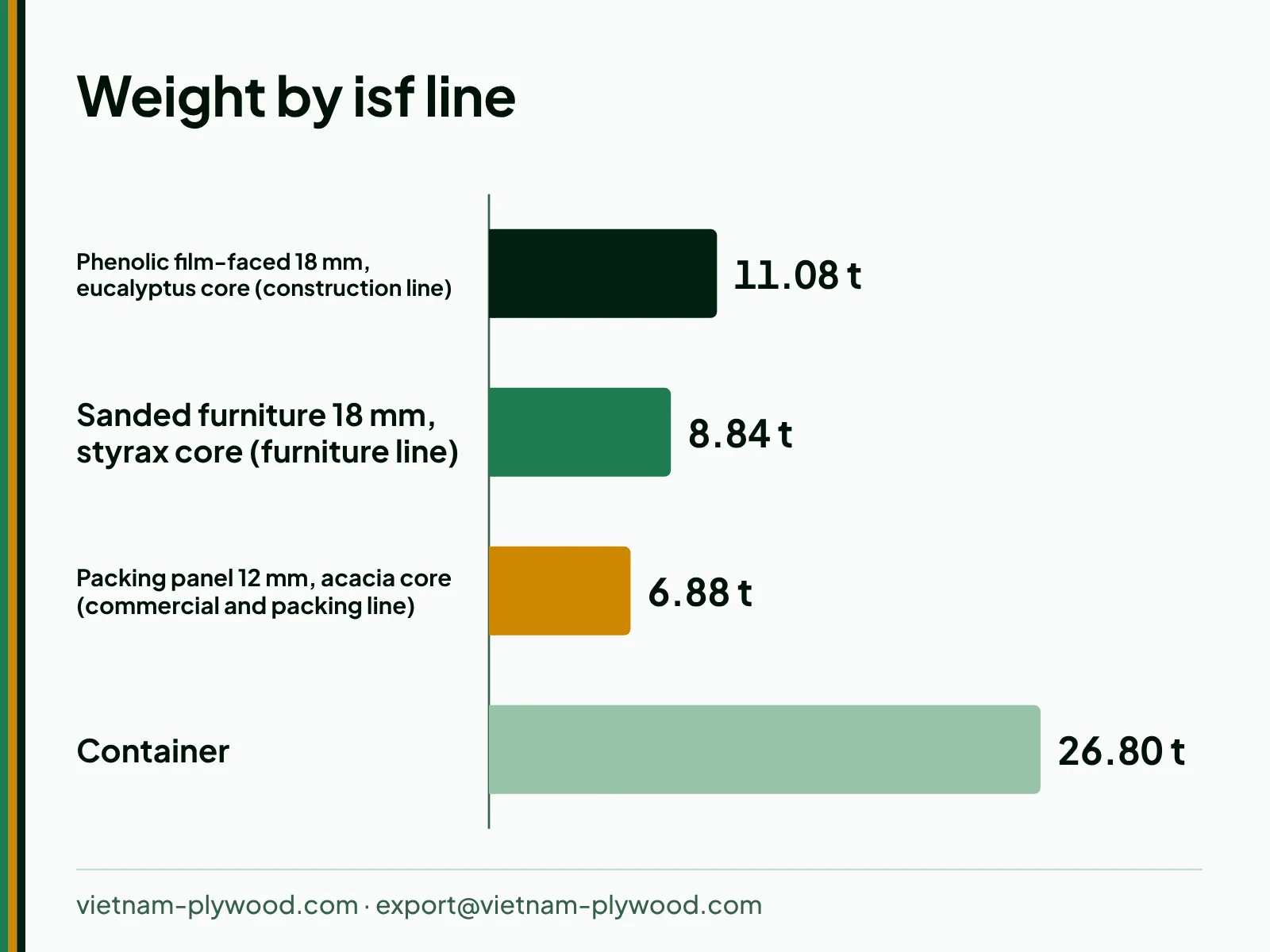
Minimum order: one 40HC; one container can carry several specifications as long as the payload limit holds. Here is a three-line US container, all 1220 × 2440 mm, checked against the 40HC payload limit of 28.5 t.
| ISF line | Pallets | Sheets per pallet | Sheets | Volume | Weight |
|---|---|---|---|---|---|
| Phenolic film-faced 18 mm, eucalyptus core (construction line) | 6 | 53 | 318 | 17.04 m³ | 11.08 t |
| Sanded furniture 18 mm, styrax core (furniture line) | 6 | 55 | 330 | 17.68 m³ | 8.84 t |
| Packing panel 12 mm, acacia core (commercial and packing line) | 4 | 83 | 332 | 11.86 m³ | 6.88 t |
| Container | 16 | — | 980 | 46.58 m³ | 26.80 t |
Sheets per pallet are the stack height (970 mm eucalyptus, 1000 mm styrax and acacia) divided by thickness, rounded down. Tonnes are cubic metres × density ÷ 1000, at 650, 500 and 580 kg/m³. The load sits 1.70 t under the limit; the mixed-load method is on our page on mixed container loads of plywood, and full-load counts per thickness are on our container loads page.
On the ISF, those three pallet groups become three line items. Each producing factory is the manufacturer on its own line, the country of origin is Vietnam on all three, and the HTSUS number follows each panel’s face. The same split runs through the invoice, the packing list and the Lacey lines, so your customs broker files one consistent data set.
Do I need a customs bond to import plywood?
Yes. Goods are not released at entry without a single-entry or continuous bond, unless a specific exception applies. With AD/CVD deposits on the line, the bond sum is a question to settle with your customs broker and surety before the first container sails.
19 CFR 142.4 states that merchandise “shall not be released from Customs custody at the time Customs receives the entry documentation” unless a single entry or continuous bond on Customs Form 301 has been filed. The bond carries the conditions of 19 CFR 113.62 and is executed by an approved corporate surety or secured by cash or US obligations.
A continuous bond suits an importer bringing in containers through the year; a single-entry bond suits a trial container. Either way, the bond and the importer of record number must exist before the ISF is filed, because the ISF asks for the importer of record number.
What freight and duty should a US importer plan for?
Plan the FOB value, ocean freight to your port, the AD/CVD cash deposits on in-scope lines, normal duty, merchandise processing and harbour fees, bond cost and the customs broker’s fee. Freight depends on the coast: days at sea from Hai Phong run 20–30 to the US West Coast and 35–45 to the US East Coast, by carrier and route.
Indicative starting prices are from US$250/m³ FOB Hai Phong (October 2026) for commercial plywood and from US$350/m³ FOB Hai Phong (October 2026) for furniture plywood. Film-faced and packing panels are quoted against the written specification; phenolic glue costs more than melamine, and a full stitched core more than a loose-laid one. We ship FOB Hai Phong, or CFR (CNF) or CIF to your port.
| Cost line | Base | Who sets it |
|---|---|---|
| FOB value | Cubic metres × quoted price per line | Quotation from the producing factory |
| Ocean freight and insurance | Per container | Carrier, or included under CFR or CIF |
| AD and CVD cash deposits | Entered value of in-scope lines | The 2026 orders |
| Normal duty | Entered value by HTSUS line | HTSUS |
| Bond, fees, customs broker | Per entry or per year | Surety, CBP, your customs broker |
Current rates per port pair are on our page on plywood freight rates from Vietnam to major ports. Density changes freight per cubic metre less than weight per container: an 18 mm sheet weighs 26.8 kg on styrax, 31.1 kg on acacia and 34.8 kg on eucalyptus.
What documents are needed to import plywood into the US?
The entry runs on the commercial invoice, packing list, B/L and certificate of origin from the producing factory, plus four US-specific data sets: the TSCA Title VI statement, the Lacey species lines, the ISF and the bond. Fumigation papers travel with the lot. Each paper lists the same product lines in the same order.
| Paper | Issued by | US step that reads it |
|---|---|---|
| Commercial invoice | Producing factory | Entry, AD/CVD scope per line, TSCA statement |
| Packing list | Producing factory | Entry, Lacey quantities, examination |
| Bill of lading | Carrier | ISF, entry |
| Certificate of origin | Issuing body in Vietnam | Origin per line |
| Emission certificate and TSCA statement | Producing factory and its certifier | TSCA records kept three years |
| Species and harvest country data | Producing factory | Lacey Act plant declaration |
| Phytosanitary and fumigation papers | Issuing body in Vietnam | Wood packaging checks |
| Test reports for the agreed build | Producing factory | Scope evidence for film-faced panels; buyer’s own specification |
How the certificate of origin is issued and what it states is on our page on the Vietnam plywood certificate of origin. For a buyer shipping the same lines to the Middle East as well, the Gulf set swaps the US data sets for attestation; see our page on importing plywood from Vietnam to the Gulf.
North American plywood certification and what our lines carry
North American structural plywood is stamped to the voluntary product standards PS 1 or PS 2, and decorative hardwood plywood is described by ANSI/HPVA HP-1. Those stamps come from the panel’s own certification body. The 2026 orders name both standards in their scope text.
Our panels carry no PS 1, PS 2 or HPVA stamp, and no structural grade is offered except against a test report the buyer accepts. What our lines carry is the build in the purchase order and its papers: the glue (MR with a 12-hour boil, or WBP with a 72-hour boil), the emission class and, where ordered, CARB P2 / TSCA Title VI certification of the producing factory. Hot pressing runs at 110–120 °C for MR and 130–145 °C for WBP.
For US buyers, the useful split is by use. Cabinet and furniture makers buy the furniture line on styrax or eucalyptus cores, full stitched and sanded, at ±0.2 or ±0.3 mm. Crate and packing buyers buy the commercial and packing line on acacia with MR glue at ±0.5–1.0 mm for packing. Concrete contractors buy the construction line with phenolic or melamine film at ±0.5 mm.
What to check at the producing factory and on arrival
Check the points that decide scope, the Lacey lines and the TSCA statement before the container is sealed, because they cannot be corrected after entry. Buyers visit the factory office and inspect goods at the producing factory, or send an inspector.
- Face and back. Confirm the face species against the Lacey line, and on film-faced panels whether film covers both face and back.
- Edges. On phenolic film-faced panels, confirm the edge coating that the exclusion text names.
- Bundle labels and pallet marks. Match each pallet to its invoice and ISF line.
- Thickness. Measure against the ordered tolerance per line.
On arrival, compare pallet marks, sheet counts and labels with the packing list before panels go into stock. The method is on our page on checking plywood on arrival.
The order lines to put in your US enquiry
Write one block per product line and add the scope reading your counsel gave for each, so the papers can follow it. The block below matches the three-line container above.
Port of discharge: Long Beach, CA        Term: FOB Hai Phong
Importer of record and bond: in place (continuous)

Line 1  Application: concrete formwork
        Line/core: construction line, eucalyptus core
        Glue: phenolic (WBP)   Emission: as ordered
        Face/back: phenolic film 120 g/m2 both sides, edges sealed
        Thickness: 18 mm +/-0.5 mm   Size: 1220 x 2440 mm
        Quantity: 6 pallets
        Scope note: exclusion claim reviewed by counsel (yes/no)

Line 2  Application: cabinet carcasses
        Line/core: furniture line, styrax core, full stitched, sanded
        Glue: as specified   Emission: E1, CARB P2 / TSCA Title VI
        Face: okoume, grade B   Lacey: face + core species, harvest countries
        Thickness: 18 mm +/-0.3 mm   Size: 1220 x 2440 mm
        Quantity: 6 pallets

Line 3  Application: export crates
        Line/core: commercial and packing line, acacia core
        Glue: MR   Emission: as ordered
        Face: packing grade, unsanded
        Thickness: 12 mm +/-0.5-1.0 mm   Size: 1220 x 2440 mm
        Quantity: 4 pallets
Send the block to Lucy at export@vietnam-plywood.com or through the contact page, and ask for the spec sheet with the document list per line.