





Plywood suppliers UK: when should a distributor import?
UK stock suppliers suit small, urgent replenishment; importing a full container suits planned, repeatable specifications and stockholding capacity. Compare landed cost per usable sheet, cash tied up until resale, incoming inspection responsibility and the time before stock reaches customers. HCPLY manufactures through three factories in Phu Tho and Hai Phong and ships the selected build from the producing factory.
For wider sourcing criteria, see our Buying Guides and Vietnam supplier evaluation guide.
UK stock versus a direct 40HC: what changes?
The buying decision turns on order size, specification control and who handles the border process. The comparison below uses a 40-foot high-cube (40HC) container as the direct-import unit.
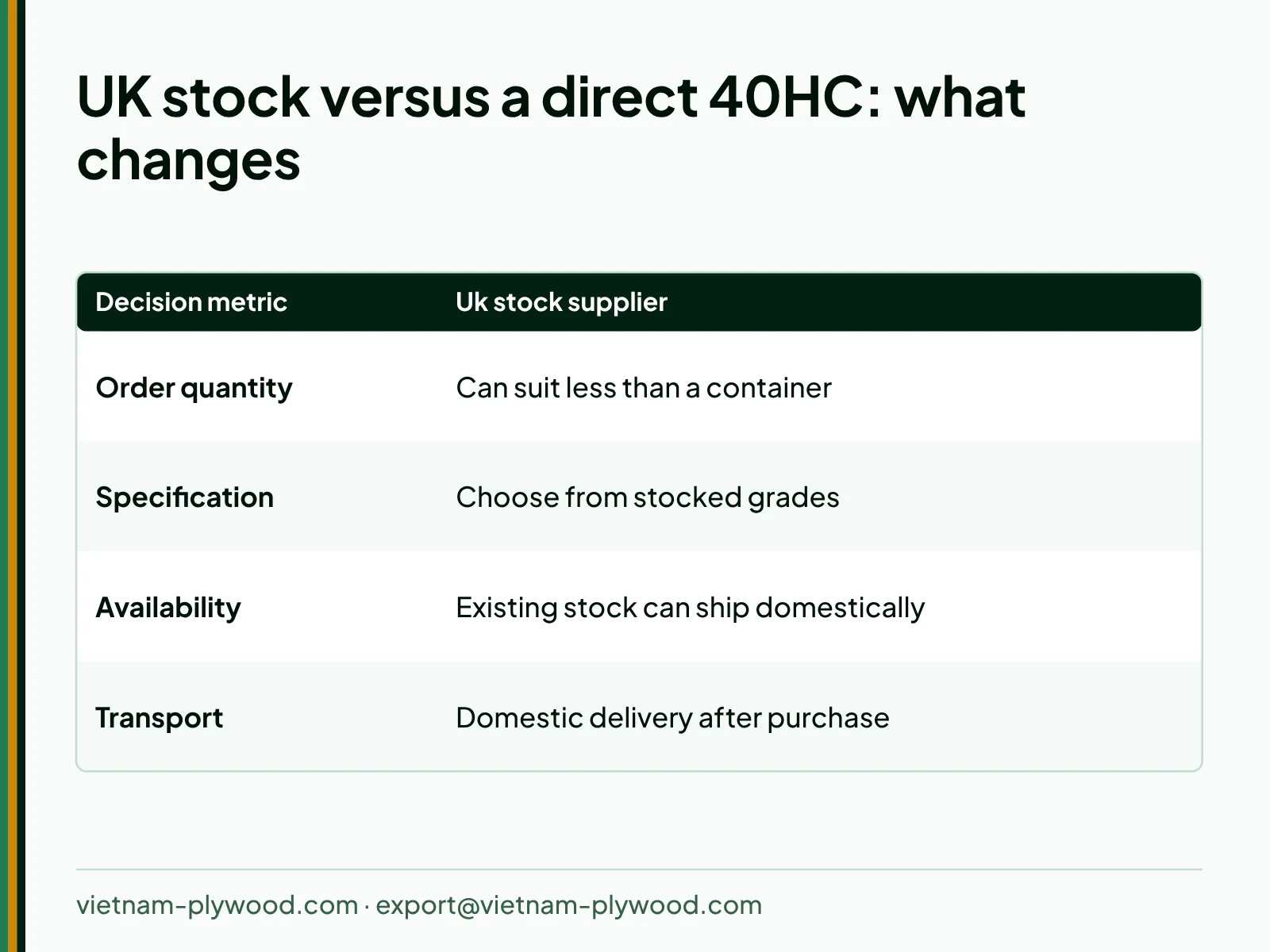
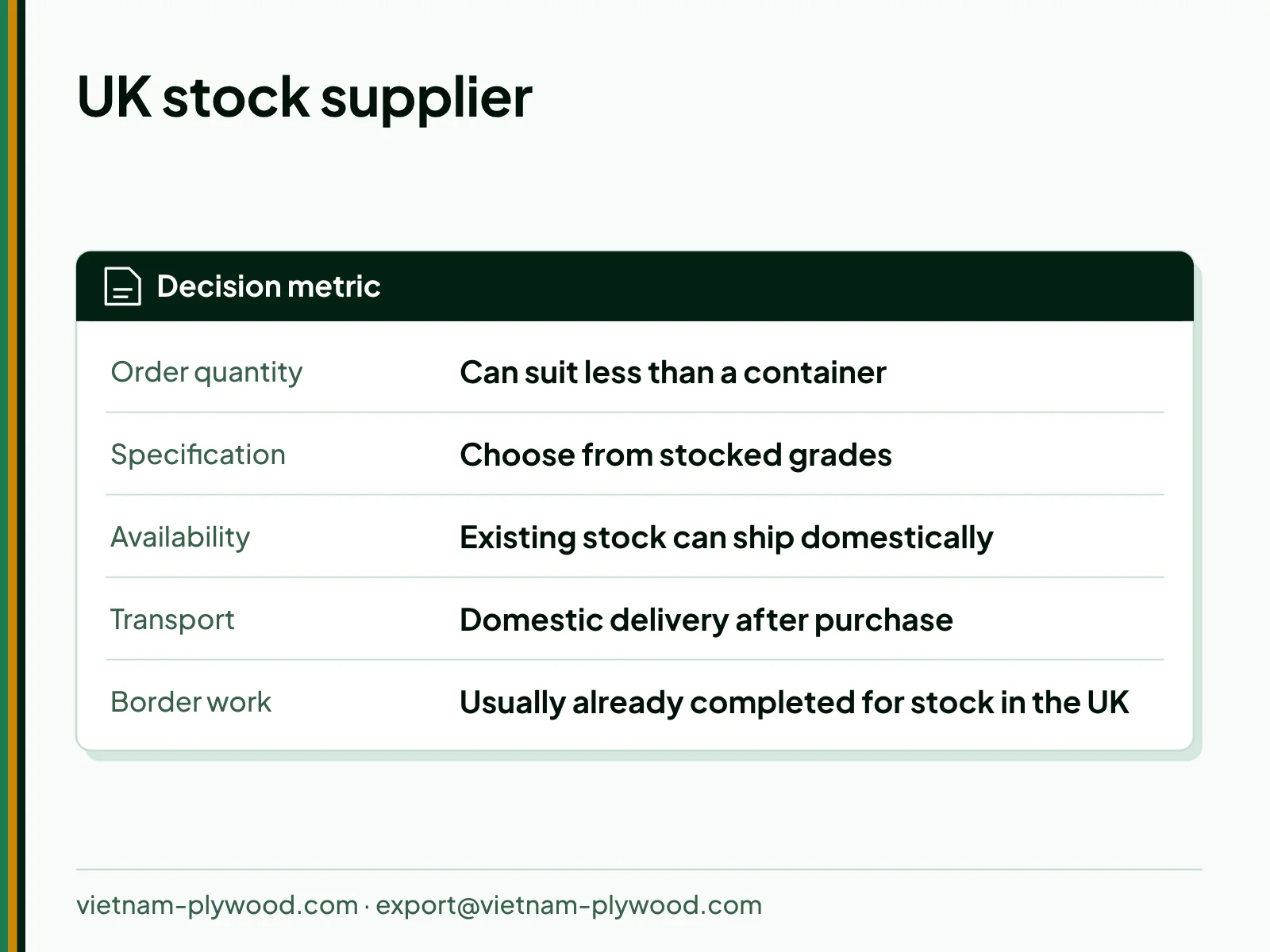
| Decision metric | UK stock supplier | Direct HCPLY import | Verdict by use |
|---|---|---|---|
| Order quantity | Can suit less than a container | Minimum one 40HC | UK stock for small top-ups; import for planned bulk |
| Specification | Choose from stocked grades | Written core, glue, face and tolerance before pressing | Import for repeatable private specifications |
| Availability | Existing stock can ship domestically | Production 15–45 days from the 30% deposit, set by order size, line loading and the contract | UK stock for urgent demand |
| Transport | Domestic delivery after purchase | Northern Europe sea passage 30–40 days from Hai Phong, by carrier and route, plus UK handling | UK stock for short notice |
| Border work | Usually already completed for stock in the UK | Buyer arranges UK import clearance and applicable compliance | UK stock for simpler administration |
| Cost comparison | Domestic quoted delivered price | Factory price plus freight, duty, VAT, clearance, inland haulage and finance | Compare landed cost per accepted sheet |
Which factory line builds each UK order?
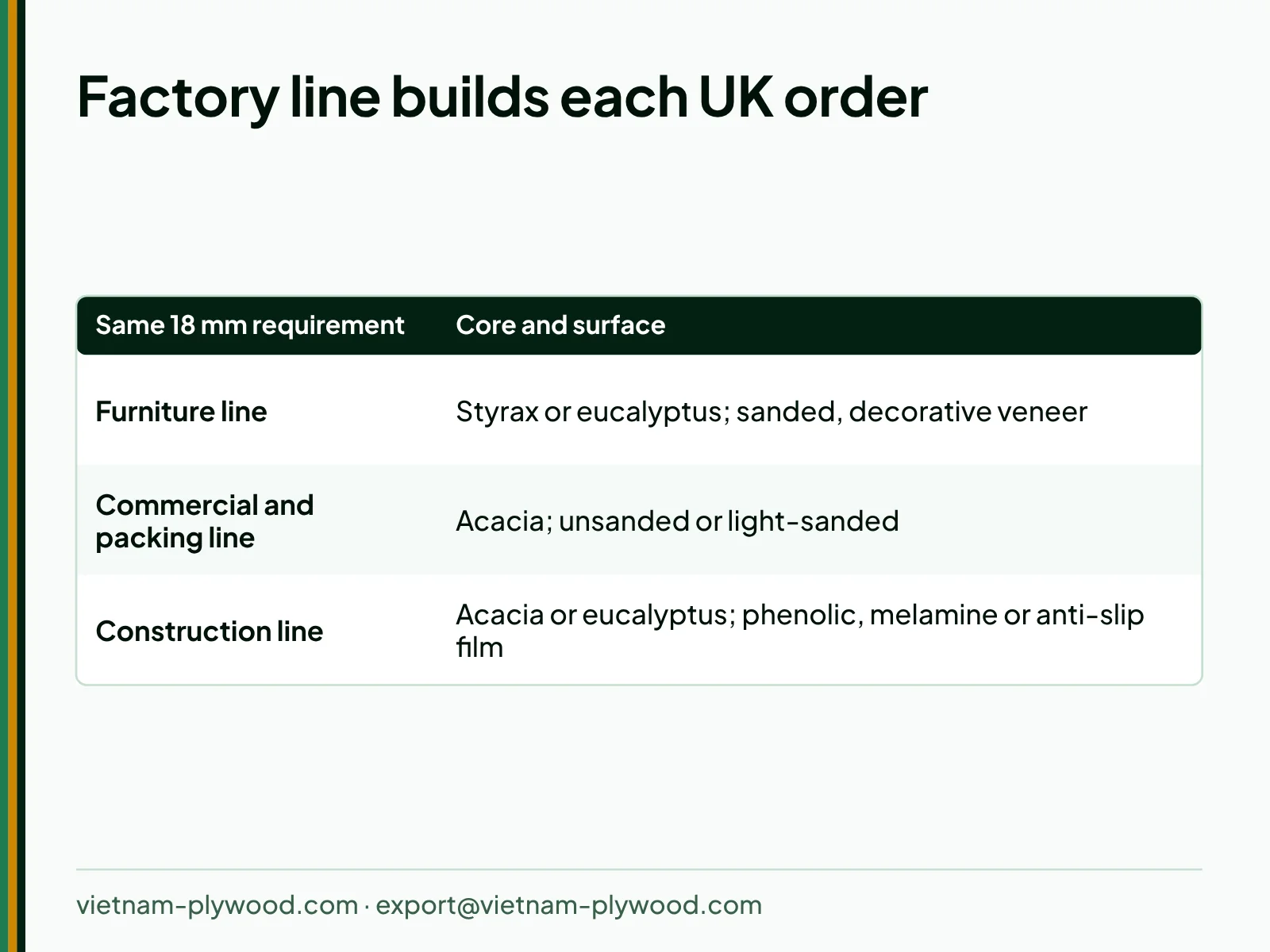
Our furniture line presses sanded, full-stitched styrax- or eucalyptus-core panels for cabinet and furniture buyers. Our commercial and packing line presses acacia-core, MR-glued panels for general commercial and packing uses. Our construction line presses film-faced panels for formwork buyers.
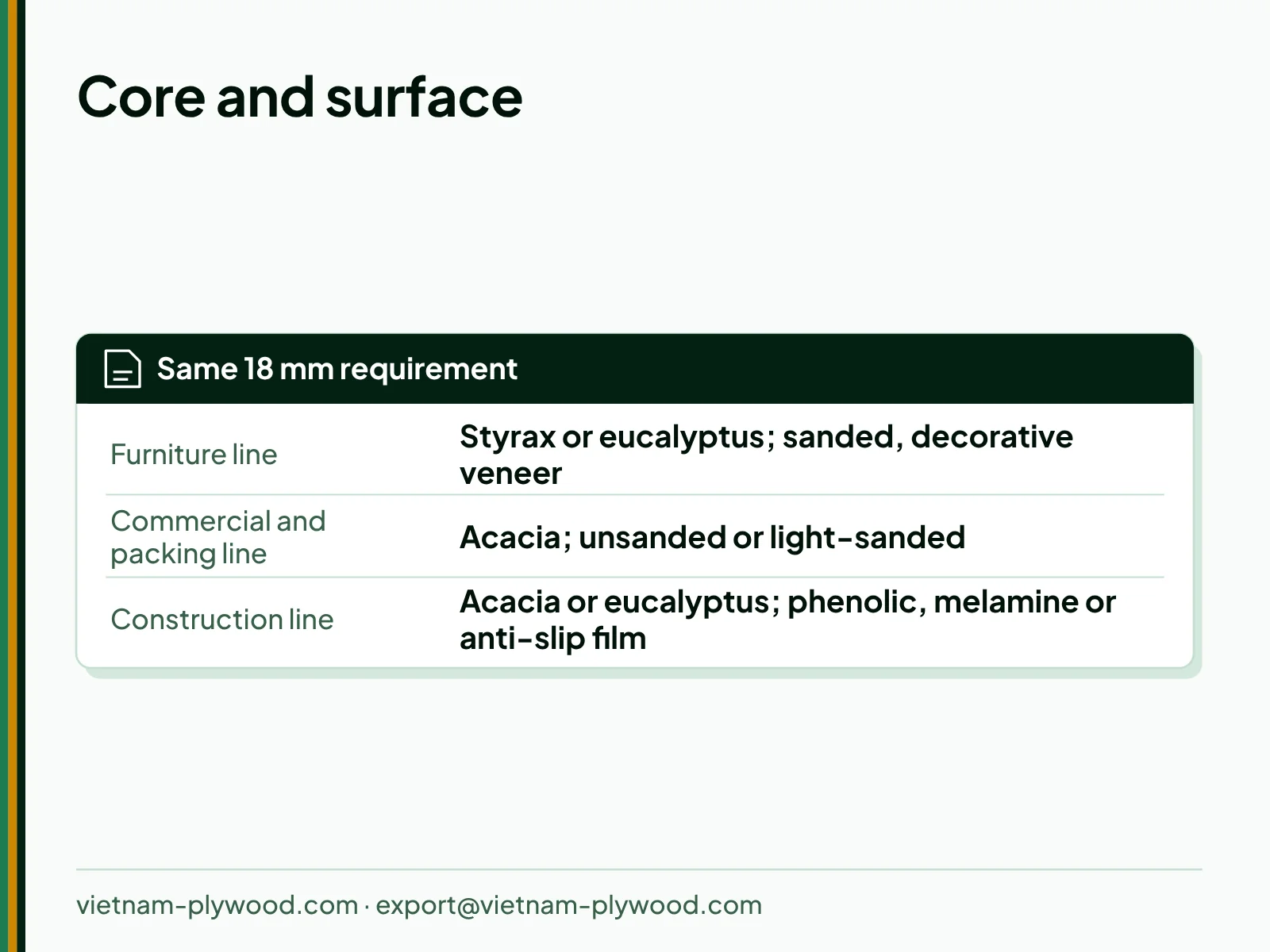
| Same 18 mm requirement | Core and surface | Thickness tolerance | UK buyer use |
|---|---|---|---|
| Furniture line | Styrax or eucalyptus; sanded, decorative veneer | ±0.2 or ±0.3 mm as ordered | Cabinet components and visible joinery |
| Commercial and packing line | Acacia; unsanded or light-sanded | Commercial ±0.5 mm; packing ±0.5–1.0 mm | Crates, backing and general commercial stock |
| Construction line | Acacia or eucalyptus; phenolic, melamine or anti-slip film | ±0.5 mm | Formwork and site boards |
For decorative builds, see furniture plywood and the several plywood types overview.
How much stock fits in one container?
An 18 mm, 1220 × 2440 mm full 40HC carries 990 styrax-core sheets, 880 acacia-core sheets or 795 eucalyptus-core sheets under the stated pallet configurations. Their respective calculated loads are 26.52 t, 27.35 t and 27.69 t, against a 28.5 t payload limit. Film weight is excluded from these calculations.
For other sizes, use the container packing reference. The corresponding sheet weights are 26.79 kg, 31.08 kg and 34.83 kg. This changes the number of saleable sheets per shipment even where thickness and footprint match. Specifications can be mixed in a container within the payload limit, but a mixed-load plan must use the actual core and pallet configuration for each item.
What does importing plywood from Vietnam cost?
Commercial plywood starts from US$250/m³ FOB Hai Phong (October 2026). Furniture plywood starts from US$350/m³ FOB Hai Phong (October 2026). These are indicative starting points, not landed UK prices; a written quotation must fix the build and shipping term.
For the same size, a full-stitched, sanded furniture build costs more to manufacture than a loose-laid, unsanded commercial build because it requires more core preparation and finishing. Higher face grades and tighter tolerance add processing and selection work. Film-faced construction grades need their own quotation based on core, glue, film and order volume.
Review quotation validity before contracting. Add ocean freight, UK port handling, customs clearance, any applicable duty, import VAT, inland delivery, inspection and finance costs. Compare the result per usable sheet after expected rejection or sorting allowances, using actual quotations rather than an assumed defect rate. HCPLY can quote FOB Hai Phong, CFR (CNF) or CIF; the UK buyer should compare the same destination and risk allocation across offers.
What should a UK buyer specify before ordering?
A purchase specification should identify the intended application before choosing the face. Specify core species and construction, adhesive, emission class, face grade, thickness tolerance and the inspection method.
For glue, melamine is MR with a 12-hour boil specification, while phenolic is WBP (weather and boil proof) with a 72-hour boil specification. Emission is a separate field: E0, E1 and E2 are emission classes, while CARB P2 and TSCA Title VI concern a US emissions limit and third-party certification. A glue description alone does not establish an emission result.
For film-faced formwork, standard film is 120 g/m², premium film 135 g/m² and anti-slip film 220 g/m². With proper handling, a release agent on every pour and sealed edges including cut edges, melamine-glue film-faced panels give about 12–15 pours and phenolic-glue panels up to about 25 pours. A request for marine, BS 1088 or a structural grade must be assessed against a test report the buyer accepts. Ask for the relevant test method and acceptance criteria in the contract.
What can the buyer inspect at the producing factory?
The buyer or appointed inspector can witness dimensions, surface grading, core construction and pallet marking at the producing factory. Buyers visit the factory office and inspect goods at the factory pressing their order.
An inspection plan can sample thickness at agreed panel locations, check length and width against ±2 mm, review face defects against the signed grade sample, and inspect exposed edges for gaps or overlaps. For furniture plywood, check sanding and the ordered ±0.2 or ±0.3 mm tolerance; for commercial and film-faced boards, check ±0.5 mm; for packing panels, check the ordered tolerance within ±0.5–1.0 mm.
Photograph pallet labels and record accepted and rejected quantities against the packing list. Where a bonding or emissions report is required, identify the laboratory report and product build in the agreement before loading. Our on-site quality control coordinates these checks with the order specification.
What UK timber and customs rules apply?
A Great Britain importer placing covered timber products on the market must perform UK Timber Regulations due diligence; buying from a UK trader shifts the buyer’s role to recordkeeping for already-placed goods. The UK Office for Product Safety and Standards and Department for Environment, Food & Rural Affairs explained this operator-versus-trader distinction in guidance updated in 2025: UK timber and FLEGT regulations.
The operator collects species, quantity, supplier, country-of-harvest and legality information, assesses illegal-harvest risk and mitigates that risk. Northern Ireland has a different timber regulatory position, so UK-wide purchasing teams should separate Great Britain and Northern Ireland routes. Check the destination regime before contracting.
For regulated wood material, the Forestry Commission’s 2025 import guidance describes phytosanitary documents and inspections. Whether a particular plywood consignment is controlled requires classification against the applicable product rules. The importer should have a customs agent check the UK commodity code, origin evidence, tariff treatment and applicable construction-product requirements rather than assuming a marking or preference from the product name.
Which documents travel with the shipment?
The commercial invoice and packing list identify the invoiced goods and physical load; the bill of lading records carriage. The shipment paperwork also includes a certificate of origin, phytosanitary and fumigation papers, and insurance under CIF.
The order’s certificate documents can include an FSC claim on sales documents, an emission certificate or agreed-build test reports. Member-factory FSC, CARB P2, ISO 9001 and CE certificates, together with EUTR/EUDR documents, are shown with factory details masked, on request. These documents must be matched to the producing factory and the actual ordered build; UK compliance remains a separate importer task.
After loading, the draft shipping documents come to you for approval. For a contract-ready sequence, use the plywood sales contract checklist.
How does a trial import move from quote to delivery?
A trial shipment begins with a signed specification and a receiving-port plan. The sequence below separates factory work from UK import tasks.
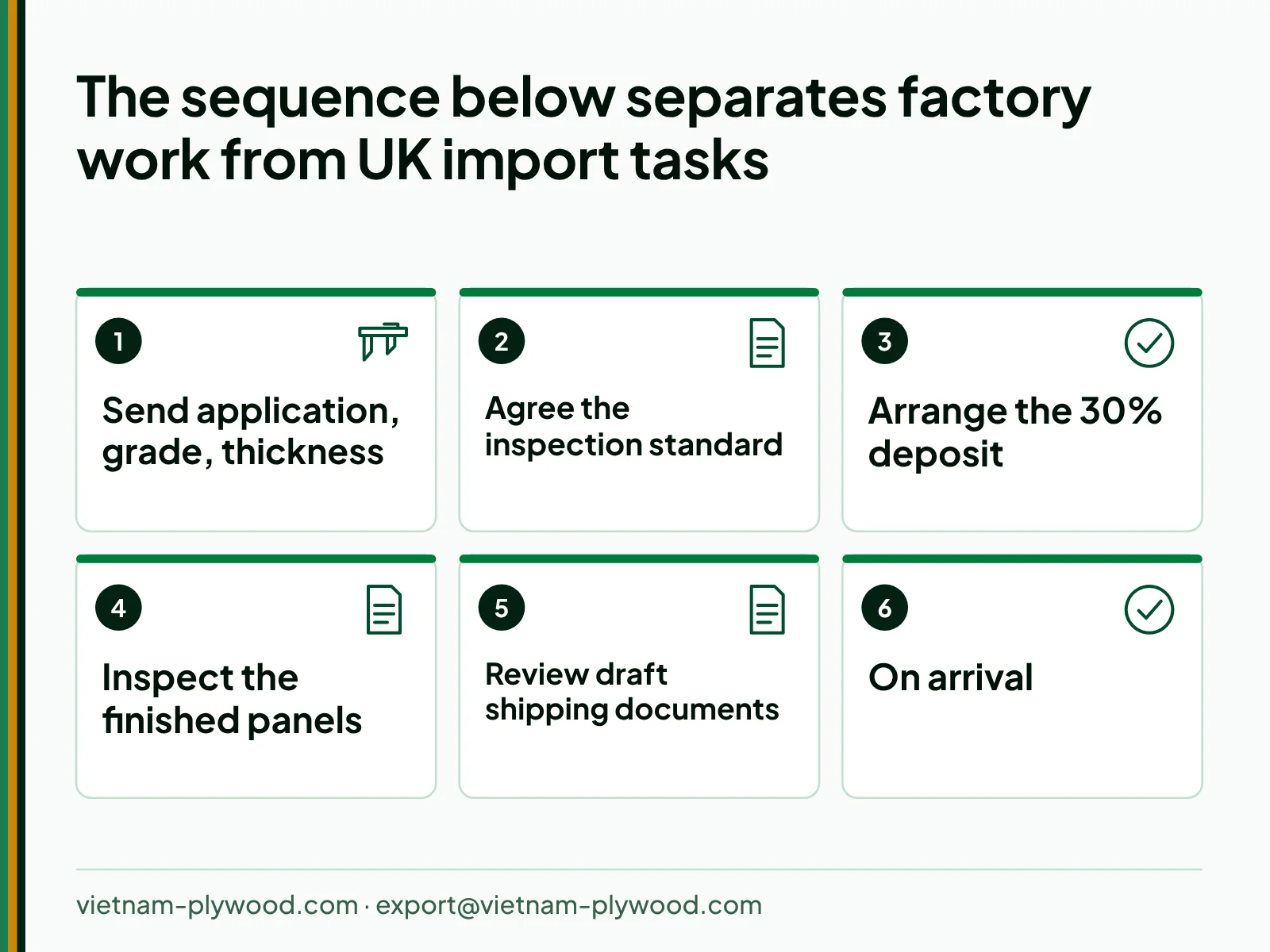
- Send application, grade, thickness, quantity and UK destination port to Lucy for a line-specific quotation.
- Agree the inspection standard, delivery term and written sales contract; review the production lead-time factors.
- Arrange the 30% deposit. Production takes 15–45 days after that deposit, depending on quantity, production conditions and agreement.
- Inspect the finished panels and approve the loading record. The remaining 70% is paid on the scan of the bill of lading, by T/T, or by irrevocable sight L/C.
- Review draft shipping documents, coordinate the carrier and complete UK customs and any applicable timber or plant-health steps.
- On arrival, check the seals, pallets, grade and quantities before releasing the lot to stock.
Samples cost nothing: a first-time buyer pays the courier, and that charge comes off the first confirmed order. Confirm the inspection appointment before production finishes.
When is a UK supplier the better decision?
The European buyers’ Vietnam guide gives further checks. Choose UK stock when the required quantity is below one 40HC, the customer needs material immediately, or the buyer cannot administer an import. Choose direct production when stock turns justify container quantities and a repeatable panel specification matters more than short-notice availability.
What should the first trial-container request contain?
A trial-container request should give enough information to price, press, inspect and load the exact panels. HCPLY coordinates specification, factory quality control, export documents and loading; Lucy is the contact at export@vietnam-plywood.com.
Application: UK distributor stock / cabinet, packing or formwork use
Line or core: furniture styrax / commercial acacia / construction acacia
Glue: MR melamine or WBP phenolic
Emission: E0 / E1 / E2 or agreed test requirement
Face and grade: species or film type; grade A/B or applicable grade
Thickness and tolerance: 18 mm; ordered line tolerance
Size: 1220 x 2440 mm
Quantity: one 40HC; specify each SKU and pallet allocation
Destination port: [UK port]
The next step is to plan a trial container against this written specification.