





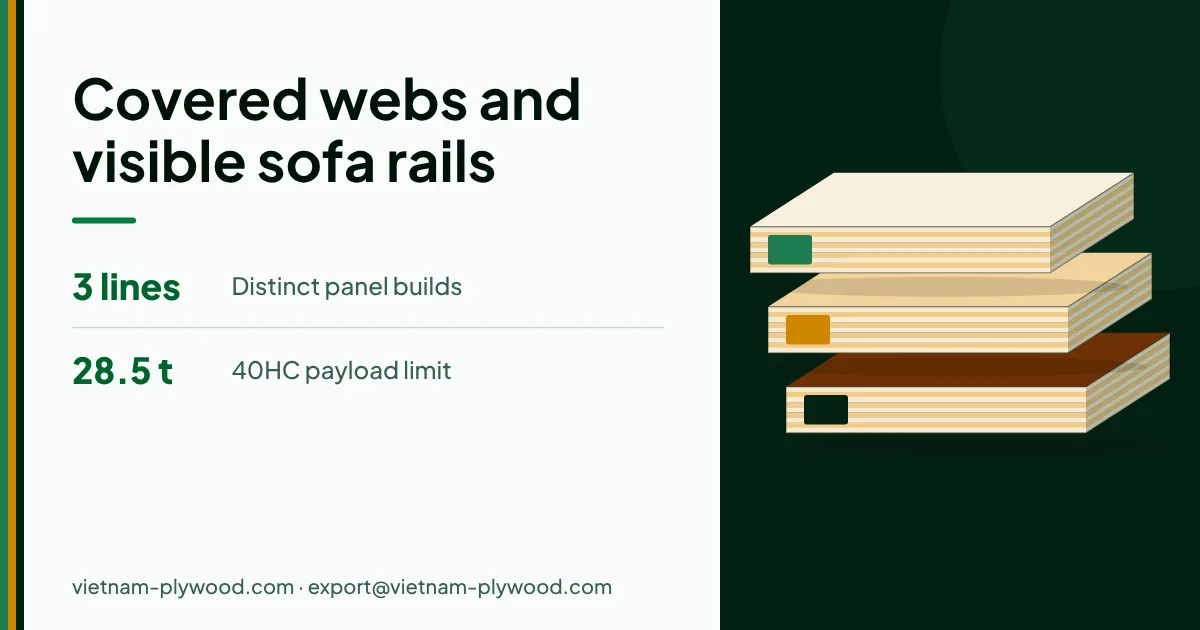
Plywood sofa frames can use commercial-grade panels beneath upholstery, with furniture-grade faces reserved for visible arms and rails. Paying for decorative veneer on hidden webs wastes budget; specifying rough edges on exposed parts can cause assembly rejects. HCPLY separates these requirements between our commercial and furniture lines so the bill of materials follows the actual sofa design.
Which plywood is used for a plywood sofa frame?
A plywood sofa frame commonly combines commercial-grade panels for concealed webs, backs and internal partitions with furniture-grade plywood where a face or edge remains visible. The right selection follows the part drawing, fastening pattern and upholstery coverage. For HCPLY, our commercial and packing line makes the concealed acacia-core panels, while our furniture line makes sanded, stitched-core panels for exposed details.
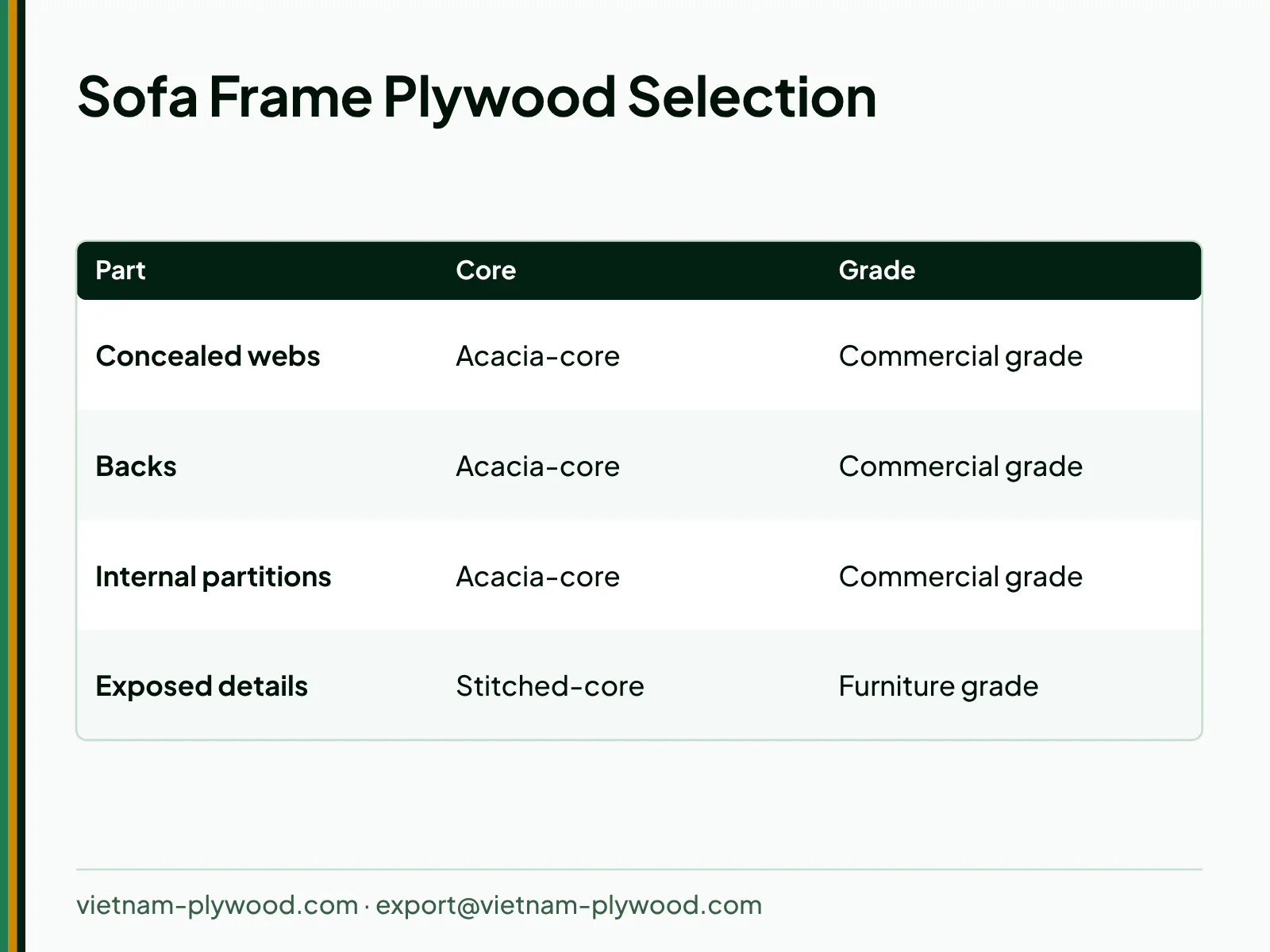
A sofa plywood frame needs more than a thickness label. Specify where fasteners enter, whether the part carries a seat load, how the upholstery is attached and which surfaces remain visible. A side web concealed by fabric has different appearance requirements from a rail visible below the cushion. The buyer’s cutting drawing should identify both.
Our furniture plywood range covers the visible-detail route; plywood furniture components describes ordering parts against a cutting specification. A finished plywood couch may hide nearly every panel, but the material schedule should still distinguish internal supports from trim.
Is commercial-grade plywood good enough for a sofa frame?
Commercial-grade plywood is a practical choice for hidden sofa components when the furniture maker has approved the design, fastener holding and load requirements. It avoids paying for a decorative face beneath upholstery. It should not be treated as an automatic structural rating: the completed furniture design and its joints still need application-specific evaluation.
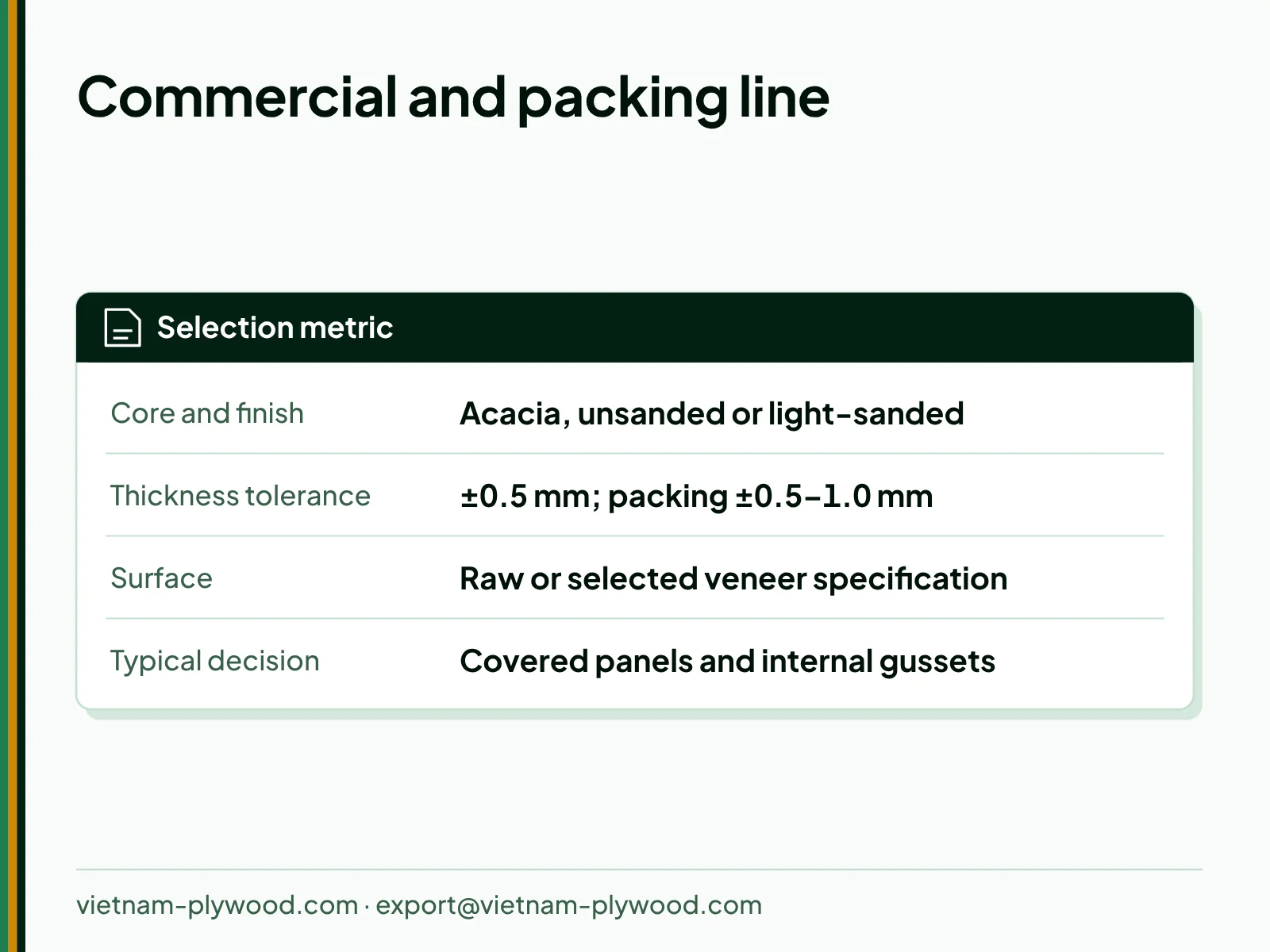
| Selection metric | Commercial and packing line | Furniture line | Construction line | Verdict for sofa use |
|---|---|---|---|---|
| Core and finish | Acacia, unsanded or light-sanded | Styrax or eucalyptus, full stitched, sanded | Acacia or eucalyptus, unsanded, film-faced | Commercial for concealed webs; furniture for visible rails |
| Thickness tolerance | ±0.5 mm; packing ±0.5–1.0 mm | ±0.2 or ±0.3 mm as ordered | ±0.5 mm | Furniture for close-fitting visible joinery |
| Surface | Raw or selected veneer specification | A/B veneer face options | Phenolic, melamine or anti-slip film | Construction film has no routine upholstery advantage |
| Typical decision | Covered panels and internal gussets | Exposed arms and decorative edges | Concrete formwork components | Avoid film specification for ordinary sofa frames |
A hidden part still needs a sound core. Core gaps near screws, loose veneer edges and inconsistent cut dimensions can cause assembly rejects even when upholstery conceals the face. Our commercial panels use acacia core and moisture-resistant (MR) glue. An appearance upgrade cannot compensate for a joint layout that splits the edge.
Ask the upholstery maker to classify each part as concealed, partly exposed or visible. That classification is more useful than calling every item in the order ‘sofa grade’. It also keeps the quote aligned with actual manufacturing needs.
Which sofa parts need a furniture-grade face?
Exposed arms, lower rails and any panel edge seen after upholstery should use the furniture-line face and finish specified by the designer. Concealed back webs, seat-box partitions and inner side plates can often remain commercial grade. Where fabric wraps around an edge, inspect that edge for splinters and voids rather than buying a decorative veneer unnecessarily.
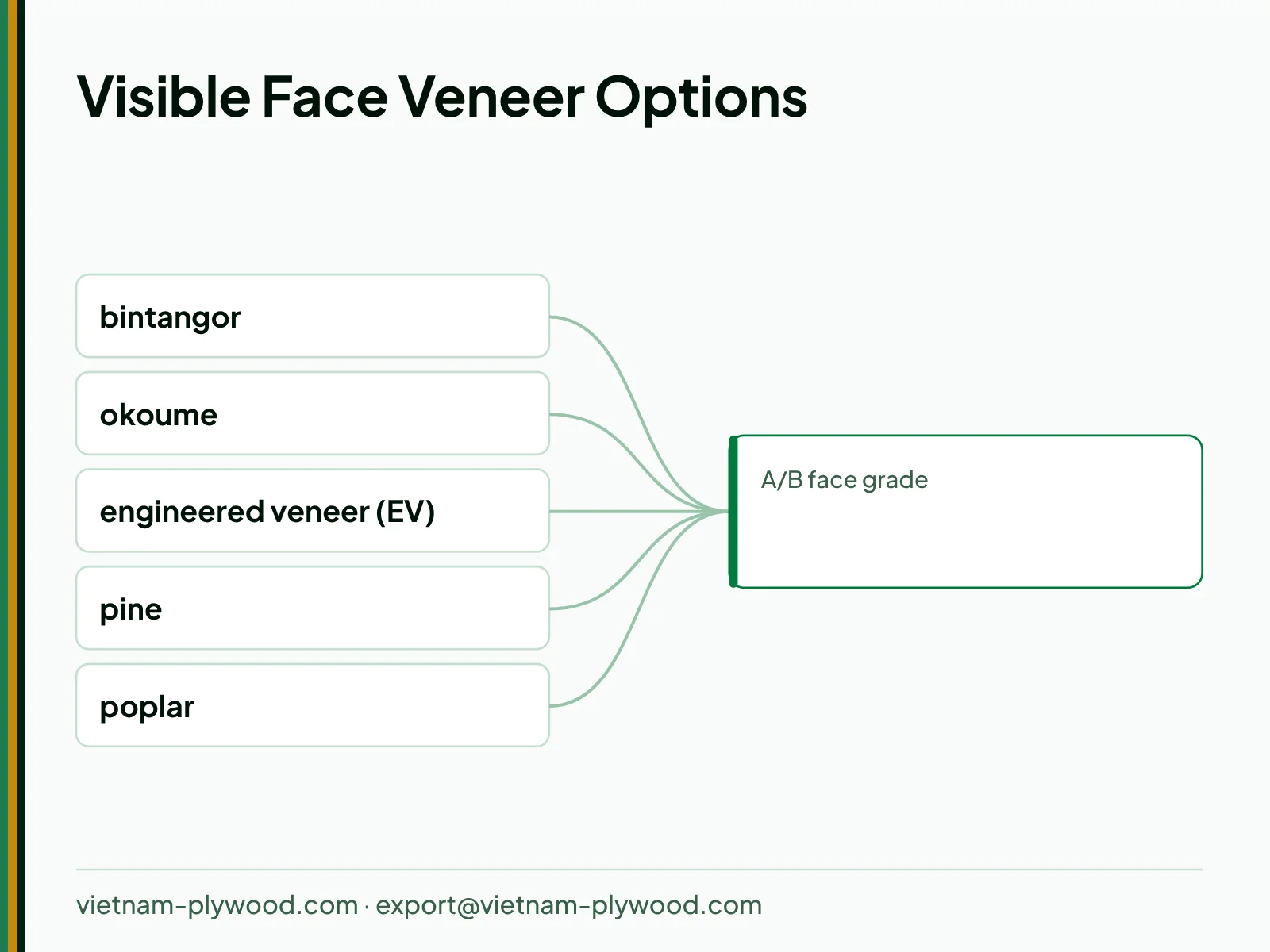
For a visible component, select a face such as bintangor, okoume, engineered veneer (EV), pine or poplar and state the A/B face grade. The face names the product; density follows the core. Common face veneer thickness is 0.2–0.4 mm. Decorative veneer is an appearance decision, not evidence of higher frame capacity.
Our furniture line uses full-stitched styrax or eucalyptus core with sanding and E0/E1 emission classes. A furniture maker can request a matching visible face across arms and trim while keeping covered parts on the commercial schedule. The wardrobe plywood grade comparison explains the same visible-versus-concealed grading logic in cabinet production.
What plywood is used for chair seats?
Chair seat plywood is selected for the seat geometry, support spacing, fixing pattern and whether upholstery covers the surface. Flat upholstered seat bases often call for a cut panel with consistent thickness and clean edges. A visible seat underside needs a more controlled face than a completely concealed pad support.
For chair plywood seat orders, specify the unsupported opening and how the seat connects to the frame. A narrow support ledge, concentrated screw positions or a curved seat outline changes the acceptance checks. The buyer should approve a physical prototype of the complete seat assembly before committing to production quantities.
Our panel thickness range is 3–40 mm, with common orders at 3, 5, 9, 12, 15, 18, 21 and 25 mm. These are manufacturing options, not a chair-load recommendation. A furniture engineer chooses thickness from the actual span and test target. For wider unsupported panels, see the shelving plywood span discussion of span and deflection as separate design questions.
How should glue, emissions and core construction be specified?
Glue performance and formaldehyde emission class are separate purchase-order fields. For covered indoor sofa components, the buyer can specify MR melamine glue and an emission class appropriate to the destination market. Phenolic weather-and-boil-proof (WBP) glue is a different bond specification and should be requested only where the design calls for it.
Our MR hot-press range is 110–120 °C; phenolic WBP pressing uses 130–145 °C. The MR description includes a 12-hour boil condition, while WBP describes a 72-hour boil condition. Neither label replaces an agreed test report for the finished furniture application.
Core construction also matters. Full stitched veneer gives the most controlled internal build in our range, followed by stitched outer layers with edge-trimmed inner veneers, finger-jointed construction and loose-laid veneer. Specify which construction the fastener zone requires rather than treating a smooth face as a substitute for an internal core inspection.
For United States imports, the US Environmental Protection Agency’s 2016 formaldehyde-rule guidance identifies hardwood plywood among regulated composite wood products under Toxic Substances Control Act (TSCA) Title VI. The EPA’s official FAQ states that the hardwood-plywood emission limit is 0.05 ppm. A US buyer should request the applicable third-party certification evidence for the exact panel build; member-factory documents are shown with factory details masked, on request.
Can LVL rails be used in sofa frames?
Laminated veneer lumber (LVL) rails can be considered for long, narrow sofa members when the furniture engineer specifies their section, connections and performance. LVL places veneers primarily along the member length, unlike cross-laminated plywood panels. The two materials serve different shapes in a furniture bill of materials.
Use plywood for broad webs, gussets and seat-box faces. Evaluate LVL for rails where the drawing calls for a long linear member. Check rail bow, straightness, end splits and screw positions against the approved sample. Do not substitute an LVL rail for a plywood web merely because both are veneer-based.
LVL is a separate line item to source and qualify against the buyer’s drawings; it is not a stated HCPLY pressed product. The specification should identify its producing source and test evidence separately. That distinction matters when a buyer requests combined shipping and one inspection plan.
Can sofa-frame plywood and LVL rails ship in the same container?
Sofa-frame plywood and separately qualified LVL rails can share a 40-foot high-cube (40HC) container when the combined cargo fits the 28.5 t payload limit and the loading plan. Reserve the LVL weight and packaging space before finalizing plywood pallets. A plywood-only maximum is not the correct mixed-load quantity.
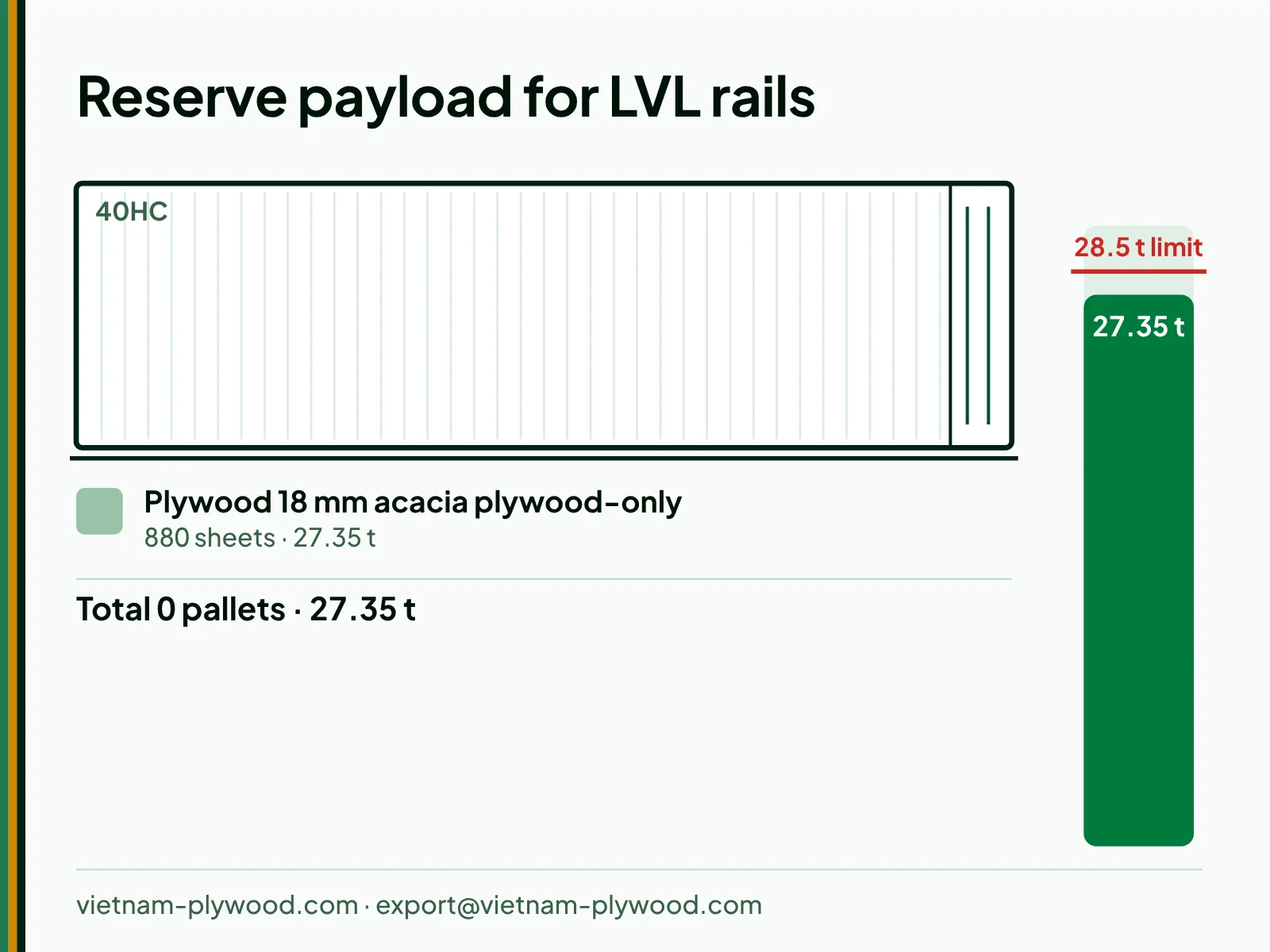
For example, 18 mm, 1220 × 2440 mm acacia plywood weighs 31.08 kg per sheet. The full plywood-only reference is 880 sheets, 47.15 m³ and 27.35 t. Adding LVL to that full configuration would increase the load, so remove enough plywood pallets or sheets to accommodate the actual LVL gross cargo weight and its stowage. The precise mixed quantity requires the LVL packing list.
The same thickness in styrax core weighs 26.79 kg per sheet, with a full reference of 990 sheets and 26.52 t; eucalyptus core weighs 34.83 kg per sheet, with 795 sheets and 27.69 t. Those different loading outcomes come from core density, pallet count and stack height. For container-load calculation by format, use container packing.
A mixed shipment needs segregated package marks, counts and weights for each item. HCPLY coordinates the plywood export shipment and loading documents; separately sourced LVL must have its own traceable specification and verified packing figures before consolidation is agreed.
What can the buyer inspect at the producing factory?
A buyer can witness the producing factory’s panel identification, cut-edge quality, dimensions, core build and packing against the approved sofa component specification. Inspection should start with the drawing and purchase order, then follow selected panels from stack to measurement. A visible-face sample and a hidden-web sample should not be judged by the same appearance rule.
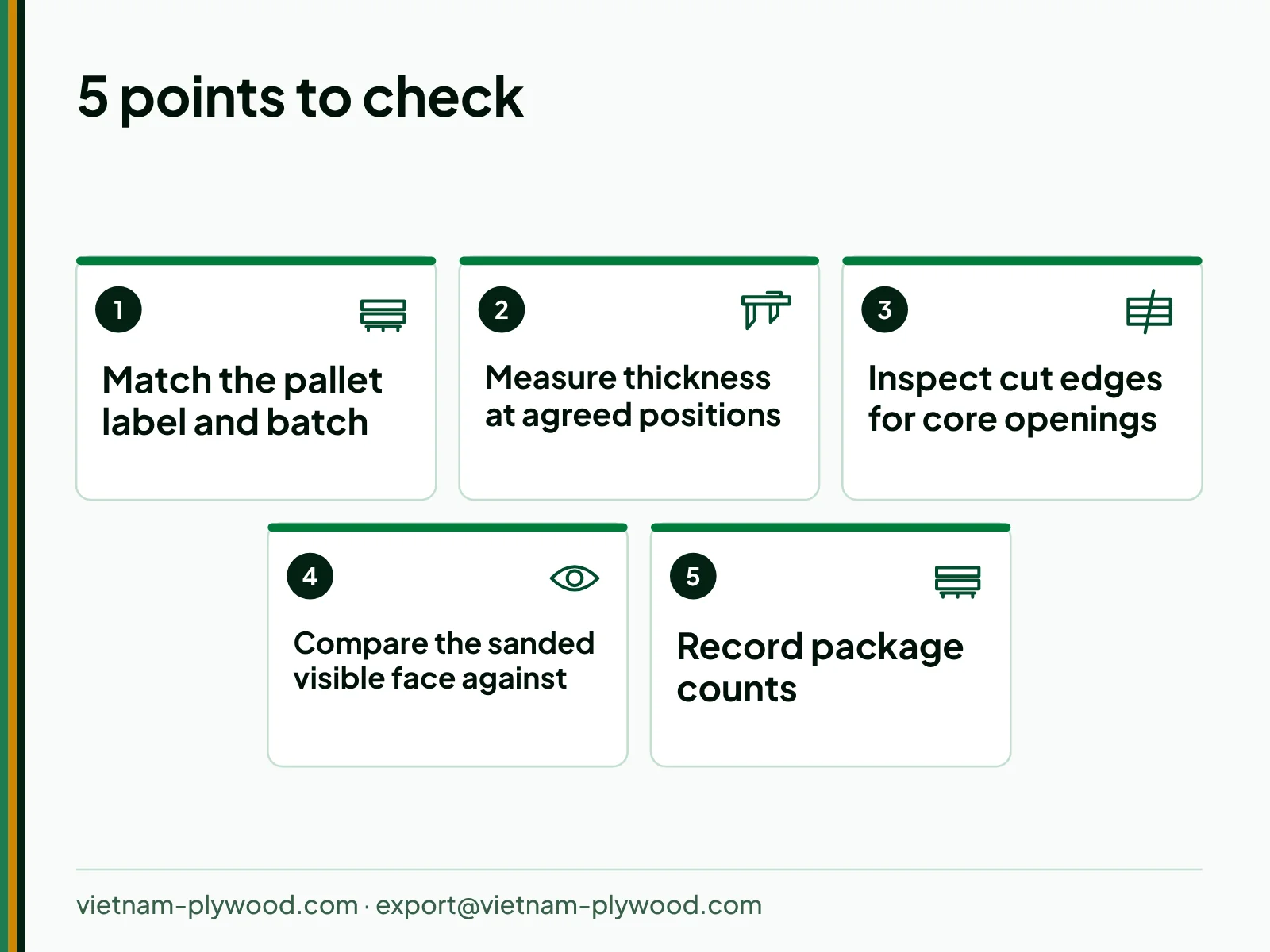
- Match the pallet label and batch to the approved core, glue, emission and face specification.
- Measure thickness at agreed positions and compare with the ordered tolerance; check length and width against ±2 mm.
- Inspect cut edges for core openings, delamination and damage at planned screw locations.
- Compare the sanded visible face against the agreed A/B reference and the covered face against its separate acceptance sample.
- Record package counts, marks and condition before loading, then match them to the packing list.
Buyers visit the factory office and inspect goods at the producing factory. Our three factories are in Phu Tho and Hai Phong; each order is produced at the line fitting its specification and shipped directly from it. HCPLY manages specification, on-site quality control, export paperwork and loading.
How should an importer compare the two plywood quotations?
Compare quotations by core construction, exposed-face requirement, thickness tolerance, glue and emission evidence before comparing the unit price. The commercial-line build costs less than a sanded, full-stitched furniture-line build because its finish and core preparation are different. Additional cutting, tighter tolerances and selected veneers add manufacturing work.
Commercial plywood starts from US$250/m³ FOB Hai Phong (October 2026); furniture plywood starts from US$350/m³ FOB Hai Phong (October 2026). These dated starting points do not replace a quotation for the sofa drawing, cut pattern and agreed face. A mixed schedule should show separate quantities for concealed and visible components.
Minimum order is one 40HC, with specifications mixed within the payload limit. Factory lead time runs 15–45 days from receipt of the 30% deposit; the exact figure depends on order size, line loading and what the contract fixes. Balance is 70% against the scanned bill of lading (B/L), by telegraphic transfer (T/T) or irrevocable letter of credit (L/C) at sight. Delivery can be FOB Hai Phong, cost and freight (CFR/CNF) or cost, insurance and freight (CIF). Free samples are available; new buyers book their courier, and its cost can be credited against a real order. See production lead time for planning the approval sequence.
Which documents support the sofa-frame shipment?
The shipment document set identifies the panel order, quantities, shipping route and any agreed certification evidence. HCPLY prepares the commercial invoice, packing list, B/L, certificate of origin, phytosanitary and fumigation papers, and insurance when CIF applies. After loading, the draft shipping documents come to you for approval.
For European Union lots, the certificate-of-origin route includes EUR.1 and the EUTR/EUDR file set. Agreed factory documentation can include an FSC claim on sales documents, an emission certificate and test reports for the ordered build. FSC, CARB P2, ISO 9001 and CE documents belong to the member factories and are shown with factory details masked, on request.
The packing list is the direct cross-check for the number of plywood bundles and any separately listed LVL rails. The emission certificate addresses the panel’s emission specification; it does not describe the rail’s bending strength. For buyers combining multiple plywood applications, several plywood types in one order outlines how to keep the item schedule clear.
What specification should the furniture buyer send?
Send a part-by-part specification separating covered webs, visible arms, chair seats and any separately sourced LVL rails. The drawings should show cut sizes, edge finishing, fastener zones and the acceptance sample for each part. A destination port and package plan allow the factory to quote the right shipping arrangement.
For small-gauge inserts, see thin plywood supply.
Application: Upholstered sofa frame webs / exposed arm rails / chair seats
Line or core: Commercial acacia / furniture styrax or eucalyptus
Glue: MR melamine or specified phenolic WBP
Emission: E0 / E1 / agreed destination-market evidence
Face and grade: Matt concealed / named veneer A/B visible
Thickness and tolerance: ___ mm; commercial ±0.5 mm or furniture ±0.2/±0.3 mm
Size: ___ × ___ mm; cutting drawing attached
Quantity: ___ sheets or cut parts; separate LVL rail packing schedule
Destination port: ___
Book a factory visit with Lucy at export@vietnam-plywood.com through the contact page to review samples and the inspection points at the producing factory.