





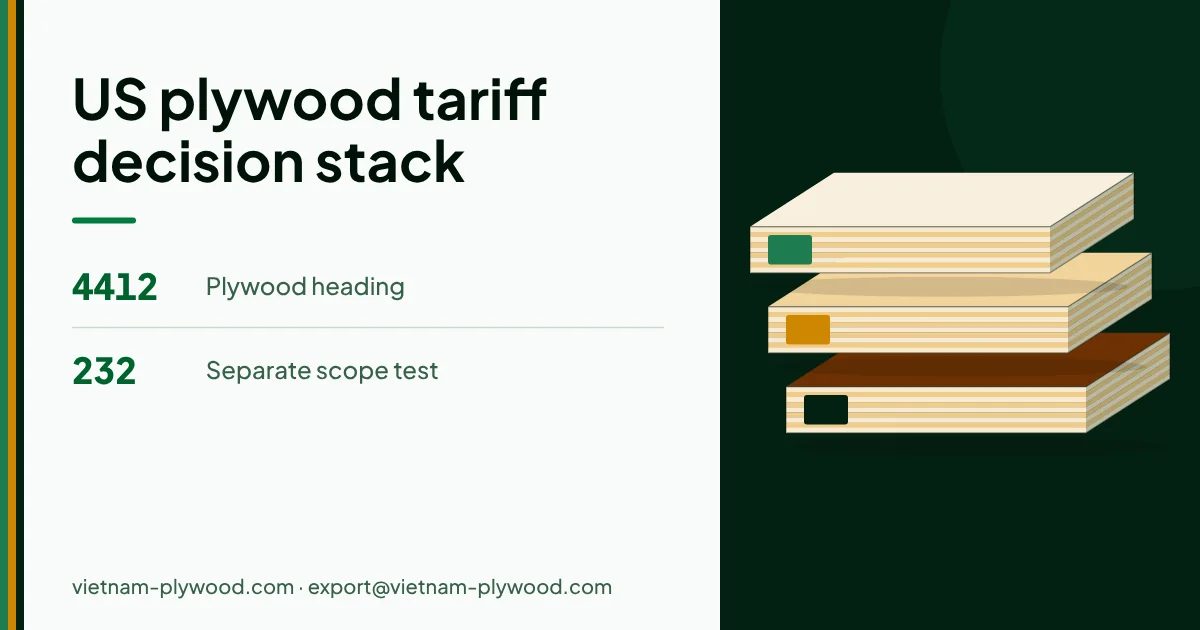
Section 232 wood tariffs cover specified timber and downstream products, while ordinary Vietnamese plywood sheets require a separate HTS 4412 and reciprocal-duty review. A wrong classification can increase landed cost or delay customs release. HCPLY supplies factory-level panel descriptions so US importers can distinguish a sheet shipment from covered cabinets and parts.
Do section 232 wood tariffs apply to plywood?
Section 232 wood tariffs under the September 2025 timber proclamation do not automatically attach to ordinary plywood sheets classified in heading 4412. The proclamation targets specified softwood timber and lumber, upholstered wooden furniture, kitchen cabinets, vanities and certain parts. A plywood sheet used later to make a cabinet remains a different imported article from a completed cabinet or qualifying cabinet part. Classification at entry controls the result.
The White House’s 2025 timber proclamation establishes the product-specific measures. US Customs and Border Protection (CBP), in its 2025 entry guidance, identifies the covered tariff lines. Its softwood list is concentrated in headings 4403, 4406 and 4407; heading 4412 does not appear in that list.
Ask the US customs adviser to classify the imported article by its actual construction and processing.
What is the US tariff on plywood from Vietnam?
There is no single US duty rate for every Vietnamese plywood shipment. Start with the exact ten-digit Harmonized Tariff Schedule of the United States (HTSUS) provision, read its Column 1 general duty, then evaluate the reciprocal measure and any antidumping or countervailing duties. Section 232 is a separate product-scope check.
A 4412 heading alone lacks the detail needed to select a duty rate. Ask the US entry filer for the current ten-digit tariff provision, its Column 1 general duty and the applicable legal notes before calculating landed cost.
The White House’s July 2025 reciprocal-rate order listed Vietnam at 20%. The September timber proclamation subsequently changed Chapter 44 exceptions. Consequently, a buyer should never add 20% to every 4412 shipment without checking the operative Chapter 99 instructions, applicable exceptions and entry date.
For a broader documentary overview, see our certifications and compliance articles.
How does the reciprocal tariff apply to Vietnamese plywood?
The reciprocal tariff is tested against the actual Chapter 44 subheading and the corresponding Chapter 99 provision at the time of entry. The 20% Vietnam figure in the July 2025 order is a country rate, while the September proclamation altered which Chapter 44 provisions could claim an exception. A country headline cannot resolve the classification-specific treatment.
CBP’s October 2025 guidance says that 158 Chapter 44 subheadings were removed from the reciprocal-tariff exception list effective October 14, 2025. That change explains why older explanations saying all wood products were excluded can produce an incorrect duty budget. The proclamation also preserves a narrower exception for specified aligned-partner provisions that are outside the described antidumping or countervailing duty categories.
Have the entry filer show the ordinary tariff line and the Chapter 99 line side by side. Record the entry date, origin, exception and legal authority.
Are plywood kitchen cabinets subject to Section 232?
Completed kitchen cabinets, vanities and covered parts can fall under Section 232 even when made from plywood. Unworked plywood sheets in heading 4412 do not become cabinet parts merely because the buyer intends to machine them later. What arrives at the US border, and how the applicable tariff description defines it, governs the classification.
The White House’s 2025 proclamation originally imposed 25% on specified kitchen cabinets, vanities and parts and described an increase to 50% from January 1, 2026, subject to subsequent agreements or amendments. CBP’s 2025 guidance associates covered cabinet entries with specified 9403 provisions and Chapter 99 codes. Those historical figures must be checked against the current HTS before a 2026 entry is filed.
Machining and assembly state can change the classification question. Obtain a ruling for material uncertainty. HCPLY produces plywood sheets; we do not represent the downstream assembly as part of our sheet specification.
How do Section 232, reciprocal tariffs and AD/CVD stack?
Treat the duty calculation as a sequence of separate legal tests rather than a universal percentage sum. Ordinary customs duty is the starting line; reciprocal and Section 232 provisions have interaction rules; antidumping and countervailing duties (AD/CVD) require their own scope analysis. A duty order can matter even when the general HTS duty is free.
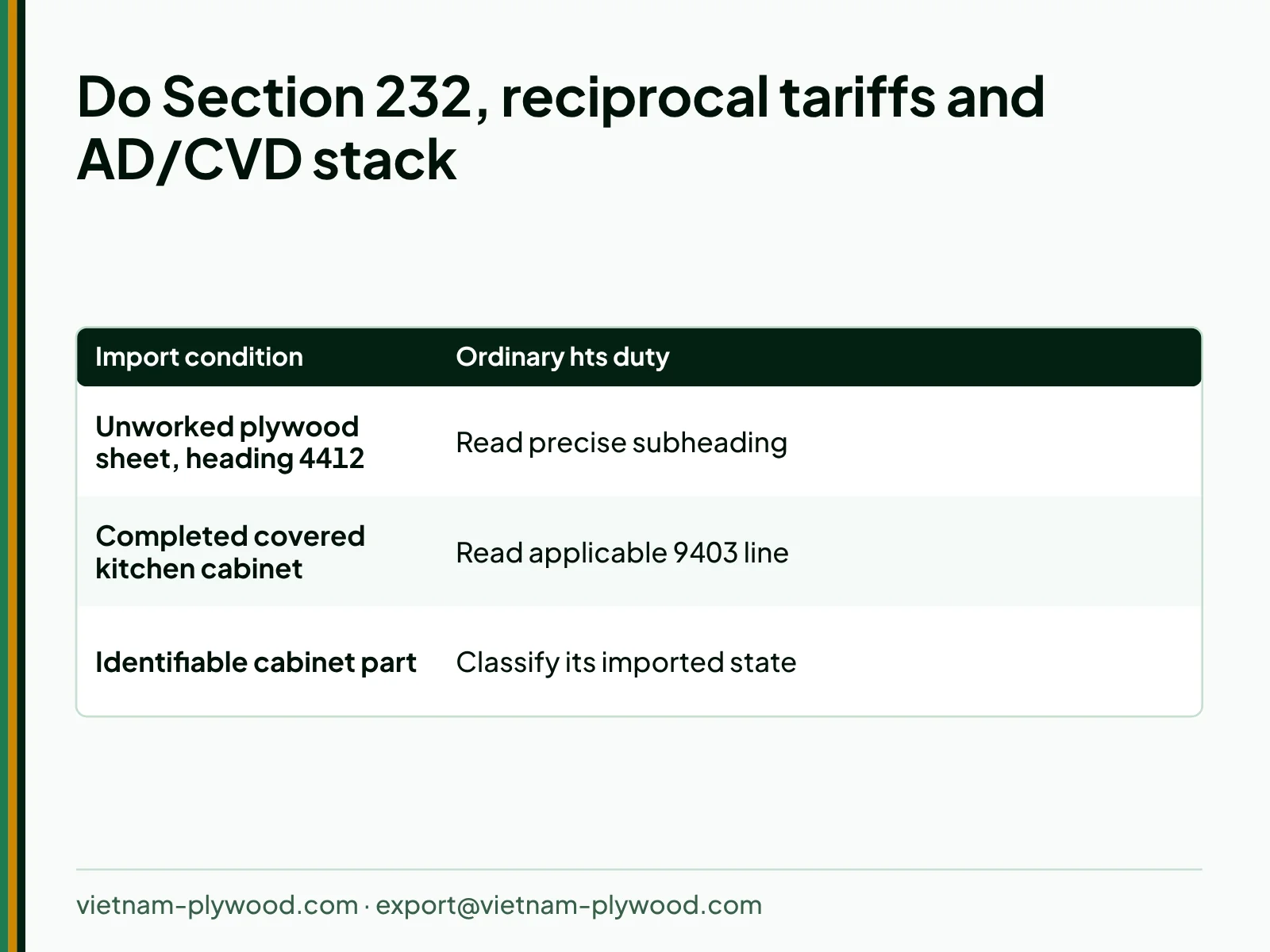
| Import condition | Ordinary HTS duty | Reciprocal measure | Section 232 timber measure | AD/CVD review | Buyer action |
|---|---|---|---|---|---|
| Unworked plywood sheet, heading 4412 | Read precise subheading | Check current Chapter 99 coverage and exceptions | Not listed in original timber-covered codes | Check order scope and exporter/product facts | Cost sheet imports as panels |
| Completed covered kitchen cabinet | Read applicable 9403 line | Apply the proclamation’s non-stacking rule where covered | Check cabinet-specific rate and current amendments | Check any applicable order | Cost as imported cabinet |
| Identifiable cabinet part | Classify its imported state | Test Chapter 99 instructions | Check covered part descriptions | Check any applicable order | Preserve drawings and machining records |
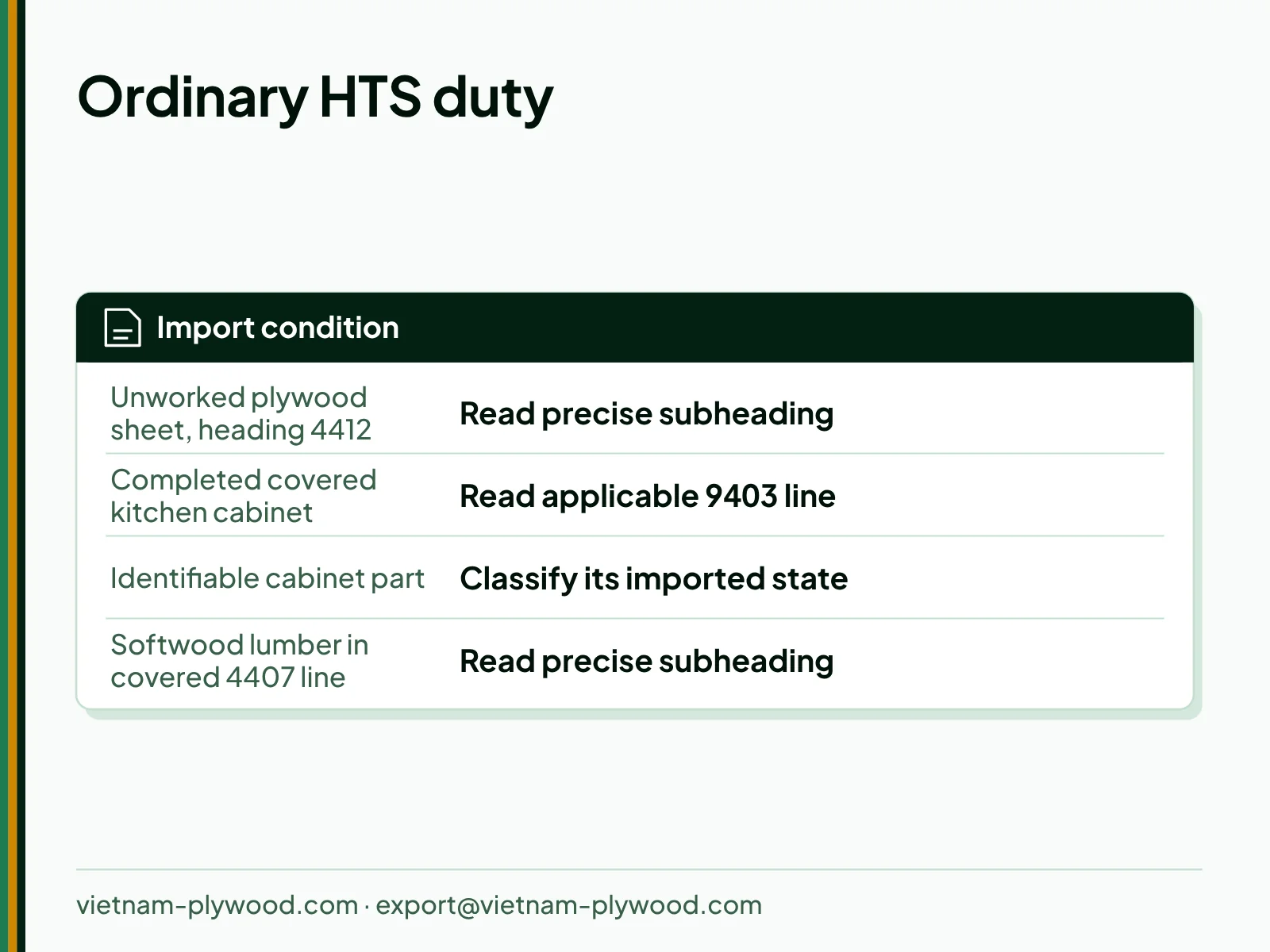
| Softwood lumber in covered 4407 line | Read precise subheading | Check applicable exclusion from reciprocal tariff | Check lumber-specific provision | Check order scope | Cost as lumber |
The 2025 White House proclamation says products tariffed under its Section 232 wood action are excluded from the specified reciprocal tariffs. It also states that its Section 232 duties are additional to other applicable duties unless a stated exception controls. Thus the same article should not simply receive both special tariffs because both programs exist.
AD/CVD is a different inquiry. The importer’s customs adviser should match the written order scope, country of origin, producer/exporter identity and merchandise characteristics, then establish the relevant cash-deposit instructions. Our companion US hardwood plywood duty scope explains why a broad product label is insufficient.
How do I read the 4412 HTS line for plywood?
Read heading 4412 as the beginning of a classification tree, not the completed tariff answer. The next distinctions can include veneer construction, outer-ply wood, surface covering, face species, thickness, dimensions and intended flooring characteristics. The ten-digit statistical reporting number adds further detail to the legal tariff line.
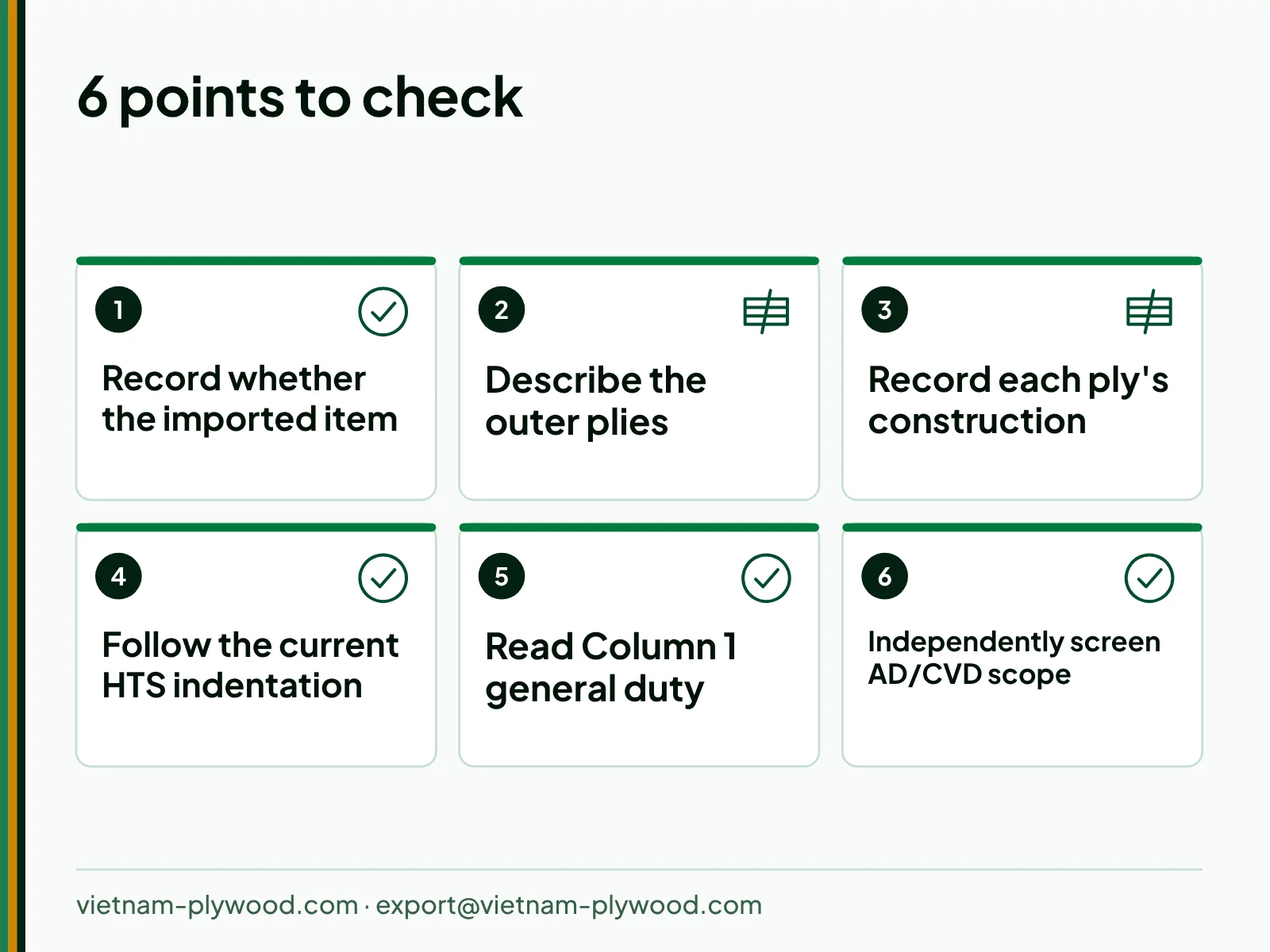
- Record whether the imported item is plywood, another veneered panel or a different wood product.
- Describe the outer plies and face species separately from the internal core; identify any surface covering.
- Record each ply’s construction, finished thickness, sheet dimensions and any machining.
- Follow the current HTS indentation through the applicable eight-digit provision and ten-digit reporting suffix.
- Read Column 1 general duty, relevant legal notes and Chapter 99 additional provisions.
- Independently screen AD/CVD scope and document the final entry decision.
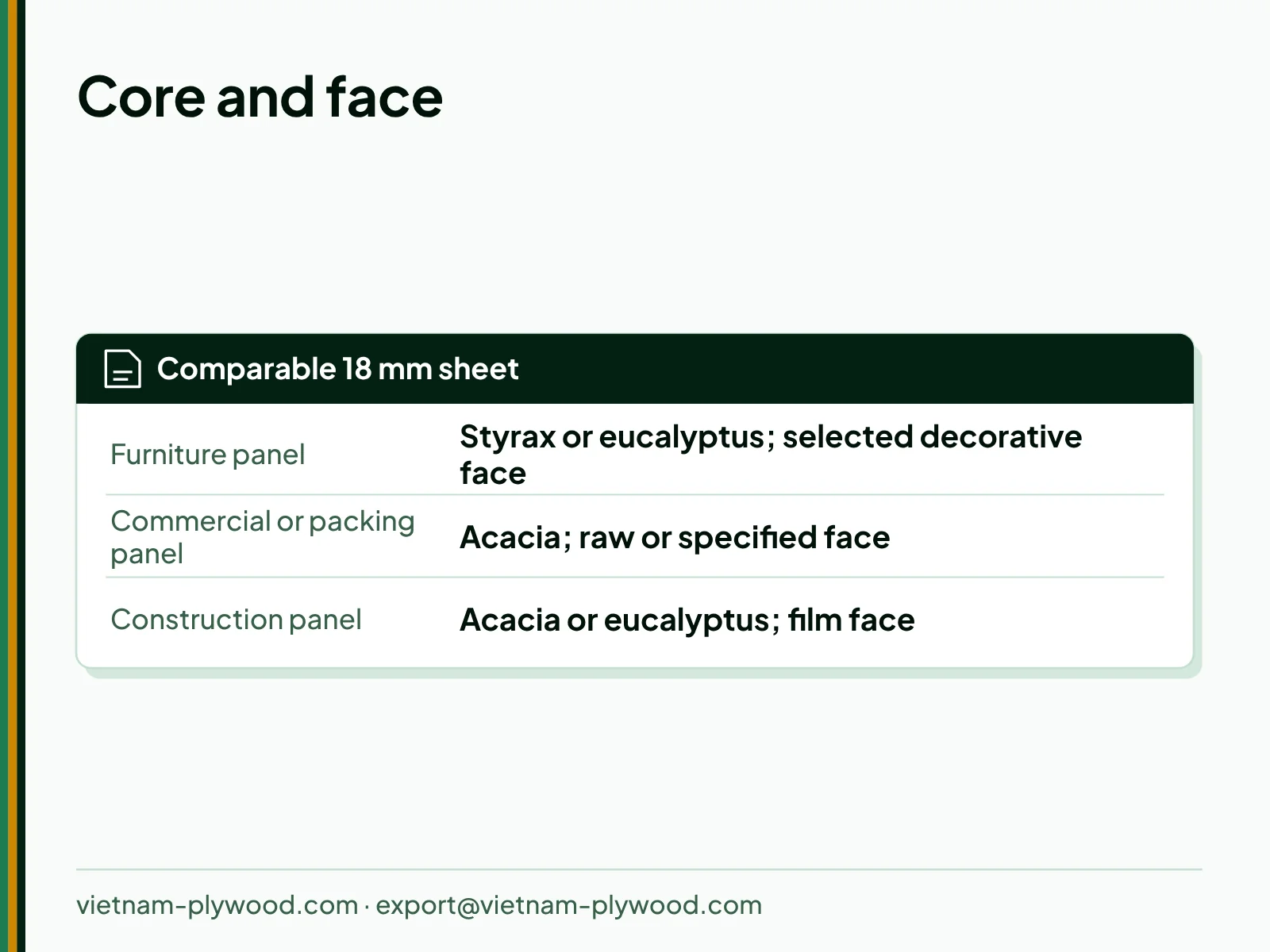
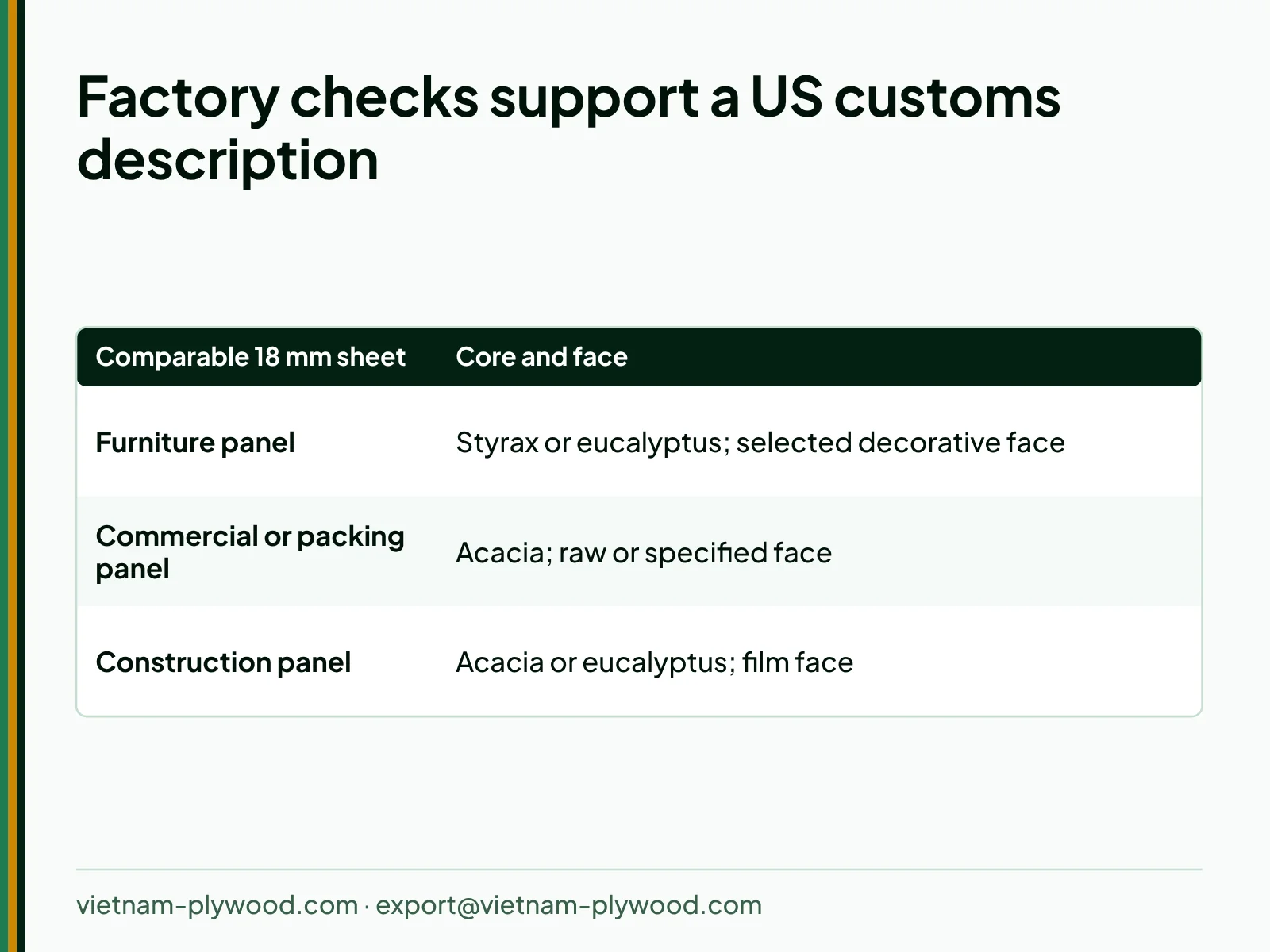
Our furniture line can produce a sanded styrax- or eucalyptus-core panel with a selected decorative veneer. The commercial and packing line uses acacia core with MR glue and an unsanded or light-sanded finish. Our construction line produces film-faced acacia- or eucalyptus-core panels. The face and finished article description, rather than the core density alone, can influence which tariff subdivision deserves examination.
A purchaser should send the full construction drawing and face specification to the US entry filer before locking in the HTS number.
Which factory checks support a US customs description?
The producing factory can show the face, core construction, thickness and finish against the written order before the cargo is loaded. These checks give the buyer’s entry team evidence for a product description, while tariff classification remains the US importer’s responsibility.
| Comparable 18 mm sheet | Core and face | Glue and finish | Inspection focus |
|---|---|---|---|
| Furniture panel | Styrax or eucalyptus; selected decorative face | Ordered glue; sanded | Face species, full stitching, thickness ±0.2 or ±0.3 mm |
| Commercial or packing panel | Acacia; raw or specified face | MR; unsanded or light-sanded | Core, face, thickness ±0.5 mm commercial or ±0.5–1.0 mm packing |
| Construction panel | Acacia or eucalyptus; film face | Phenolic or melamine film system; unsanded | Film type, core, thickness ±0.5 mm |
An inspector can compare approved sample and production sheet, inspect a cut edge, measure thickness and photograph the face and pack markings. For a film-faced shipment, record whether the film is standard 120 g/m², premium 135 g/m² or anti-slip 220 g/m². These are product-identification details rather than US tariff-rate promises.
HCPLY manages the specification, on-site quality control, documents and loading across our three factories. Buyers can inspect goods at the producing factory and visit its factory office. The Vietnam plywood manufacturer overview explains our product families.
What can share a container without confusing the tariff entry?
Mixed specifications can travel in one 40HC within its 28.5 t payload limit, but each distinct customs description needs an accurate invoice and packing-list line. Combining furniture and commercial panels physically does not merge their classifications or trade-remedy treatment.
For 18 mm sheets measuring 1220 × 2440 mm, the reference full-container quantities are 990 styrax sheets at 26.52 t, 880 acacia sheets at 27.35 t, or 795 eucalyptus sheets at 27.69 t. These are separate full-load examples, not quantities to add together. A mixed load requires a fresh weight and pallet calculation for its actual composition.
For instance, an importer might combine a decorative furniture specification with a raw commercial specification when the purchase order identifies both. The packing list should retain separate descriptions, quantities, dimensions, gross and net weights, and pallet identification. Our container loading reference covers the loading arithmetic.
The minimum order is one 40HC, and specifications can be mixed within the payload limit.
Which export documents help the entry team?
The commercial invoice and packing list establish the declared product descriptions and quantities; the bill of lading records shipment movement. A certificate of origin supports the declared origin, while agreed product certificates and test reports identify the build. None of these substitutes for the importer’s HTS and trade-remedy analysis.
Our export document package includes the commercial invoice, packing list, bill of lading, certificate of origin, phytosanitary and fumigation papers, and insurance for CIF shipments. It also includes order-specific certificate documents, such as emission certificates or test reports for the agreed build. After loading, the draft shipping documents come to you for approval.
Ask the US entry team to reconcile the invoice description with the manufacturing specification and the selected tariff line. If a panel is described as birch-faced, record the actual face and core separately; a face name should not be taken as evidence of a birch core. Certificates held by member factories can be shown with factory details masked, on request.
When should a buyer lock the tariff assumption?
Lock the working tariff assumption before agreeing the specification, then check the law again before customs entry. Classification, origin, order scope and effective date are the four inputs most likely to change the landed-cost calculation. A quote based on an old tariff headline can leave an unexpected cash-deposit requirement.
The US importer should request the latest HTS extract, the relevant Chapter 99 instructions and any applicable AD/CVD scope and cash-deposit information from its customs adviser. If classification is uncertain, seek a CBP binding ruling using a full material description and sample where appropriate. Keep the customs adviser’s classification memo with the purchase-order revision.
On our side, the agreed specification fixes the face, core, glue, emission class, thickness, tolerance and size. Production runs 15–45 days from the 30% deposit, set by order size, line loading and the contract. Delivery can be FOB Hai Phong, CFR (CNF) or CIF; those delivery terms do not decide US duty treatment. See production lead times and several plywood types in one order.
What should go into the purchase specification?
Send a product description that a factory inspector and a US customs filer can both read without translating sales shorthand. Keep the commercial application separate from the physical condition at import. The entry filer can then test the tariff line against the finished article rather than a broad purchasing category.
For furniture panels, specify the decorative face and grade, stitched core, surface sanding and the required emission class. For packing panels, state whether the face is raw, the MR glue requirement and the intended thickness tolerance. For film-faced panels, identify film weight and surface pattern. The same nominal thickness can therefore represent distinct factory builds and different classification evidence.
HCPLY’s contact for a written specification is Lucy at export@vietnam-plywood.com. Use the following request format, then request the spec sheet through our contact page.
Application: Furniture / cabinet production / packing / formwork
Producing line or core: Furniture styrax/eucalyptus / commercial acacia / construction acacia/eucalyptus
Glue: MR melamine / WBP phenolic, as specified
Emission: E0 / E1 / E2, as ordered
Face and grade: Species, A/B or applicable birch D/E/F; film weight if applicable
Thickness and tolerance: ___ mm; ___ mm
Size: ___ × ___ mm
Quantity: ___ sheets / ___ 40HC
Destination port: ___, United States
Request the spec sheet.