






US hardwood plywood duty orders require importers to read the current written scope against the actual panel construction before ordering from Vietnam. A wrong classification can cost unexpected cash deposits, delayed clearance, or a rejected shipment. HCPLY helps buyers assemble the physical evidence behind a hardwood plywood antidumping scope assessment.
What does the hardwood plywood antidumping scope cover?
The hardwood plywood antidumping scope covers flat multilayer veneer panels from Vietnam when their physical construction matches the written US order. The November 2026 order includes decorative plywood, certain veneered panels, surface-covered sheets, and panels receiving minor processing. Exclusions are narrowly defined; product names, tariff codes, and intended applications alone do not decide coverage.
The US Department of Commerce’s 2026 antidumping order defines panels by veneers bonded together, with or without a core. At least one outer veneer can be hardwood, softwood, or bamboo. A wood core is not required: the written definition also encompasses other core materials. A veneer face covered by paint, laminate, paper, or phenolic film remains relevant to the classification.
The same notice includes cut-to-size, drilled, punched, notched, and trimmed panels. Processing in another country does not automatically remove a product from the order. The written description controls even when the Harmonized Tariff Schedule of the United States (HTSUS) heading appears outside the principal list. Importers should begin with the actual cross-section, not a sales label.
This distinction matters at quotation stage. We can document how a sheet is built at the producing factory; the US importer and its customs advisers must determine the entry treatment against the operative order. For broader compliance topics, see our certifications articles and Lacey Act documentation guide.
What changed between the July determination and November orders?
The July 2026 final dumping determination was followed by an injury decision and November antidumping and countervailing duty orders. A July news report is therefore insufficient for a November entry decision.
Commerce published its Vietnam final less-than-fair-value determination in July 2026. The US International Trade Commission (USITC) announced on August 19, 2026, an affirmative injury finding for hardwood and decorative plywood, while distinguishing softwood structural products. Commerce then issued antidumping orders on November 17, 2026 and countervailing duty orders on the same date.
The July report in Panels & Furniture Asia focused on a reduced dumping margin and provisional deposits. That reporting described the position before the injury decision and the published orders. A current purchase decision needs the later order text, applicable entry date, and the actual producer/exporter combination. Rate selection and scope classification are different decisions.
The November antidumping notice also records revisions to the scope after the USITC decision. Commerce said it would address proposed certification-program comments in a later changed-circumstances review. Importers should use the published appendix rather than an earlier draft or an anticipated certification mechanism. For other US duties, consult our Section 232 and reciprocal tariffs overview.
Is film-faced plywood covered by the US plywood anti-dumping order?
Film-faced plywood can be covered, because the November 2026 scope expressly includes phenolic-film coverings. The same appendix separately excludes a tightly specified phenolic film-faced plyform product. A film label alone does not establish that exclusion.
The exclusion describes Phenolic Film Faced Plyform, also called Phenolic Surface Film Plywood, with a stated exterior bond classification, opaque film bonded on both faces, a specified film-weight threshold, and moisture-resistant edge coating. The published text prints the threshold as “90g/m3”; buyers should preserve that exact regulatory wording and obtain specialist advice about the unusual unit before claiming qualification. An ordinary construction panel is not automatically within that exception.
Our construction line presses phenolic or melamine film, including anti-slip film, over acacia or eucalyptus cores. Standard film weight is 120 g/m², premium film 135 g/m², and anti-slip film 220 g/m². Those manufacturing specifications describe a product; they do not establish the US exclusion’s bond classification or edge-coating conditions. We do not apply an APA or PS 1 stamp.
At inspection, a buyer can witness face and back film checks, edge condition, core identification, thickness readings, and pallet marking. Request photographs of both faces and the cut edge alongside the agreed build sheet. Compare the evidence with each element of the exclusion before relying on it. Our construction-project supply guide covers the practical build specification.
Does the US plywood duty order apply to LVL?
The order expressly excludes particular laminated veneer lumber (LVL) door and window components and certain LVL stiles and rails. It does not announce a blanket exclusion for every product sold as LVL.
The November 2026 appendix sets detailed dimensional, adhesive, stiffness, grain-orientation, and machining conditions for one door-and-window-component exclusion. A separate exclusion covers certain door stiles and rails within stated dimensional limits. An importer must match the complete product against the relevant clause, including its intended component form and documented construction.
We do not offer LVL as a product line. Our furniture line presses stitched and sanded plywood, while our commercial and packing line produces acacia-core sheets. Neither should be described as an excluded LVL component merely because a buyer plans to cut strips from it.
For a genuine LVL component sourced elsewhere, collect a cross-section drawing, grain-orientation record, dimensions, adhesive specification, stiffness evidence where required, and photographs of machining. Have the importer evaluate the exact exclusion. A broad product-family name cannot replace these details.
How do the same panel dimensions differ across our factory lines?
The same nominal sheet thickness can represent three different constructions, and none gains an automatic duty exemption through its factory line. The physical bill of materials is the starting point for scope analysis.
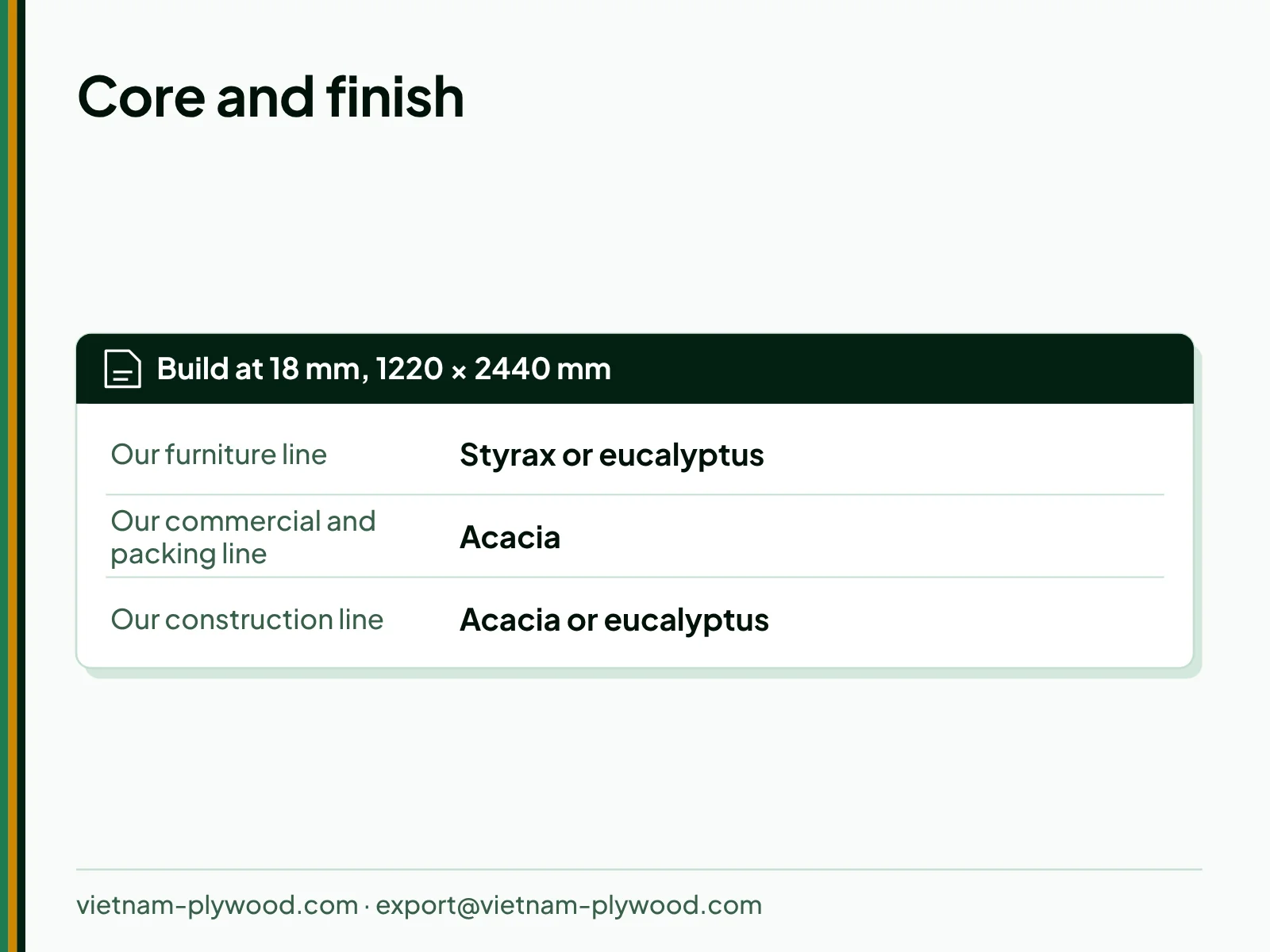
| Build at 18 mm, 1220 × 2440 mm | Core and finish | Ordered tolerance | Scope-relevant observation |
|---|---|---|---|
| Our furniture line | Styrax or eucalyptus; stitched, sanded, veneer face | ±0.2 or ±0.3 mm | Record face species, layers and finish |
| Our commercial and packing line | Acacia; MR glue; unsanded or light-sanded | ±0.5 mm commercial; ±0.5–1.0 mm packing | Record veneer stack and adhesive |
| Our construction line | Acacia or eucalyptus; film face; unsanded | ±0.5 mm | Record both films, edges and bond evidence |
The furniture line can use bintangor, okoume, engineered veneer, and other specified faces. The commercial line prioritizes packing or commercial construction. The construction line handles film-faced formwork builds. A face veneer names the product; core density follows the core species, not the face.
For example, 18 mm sheets at 1220 × 2440 mm weigh 26.79 kg with styrax, 31.08 kg with acacia, and 34.83 kg with eucalyptus, before film weight. These are manufacturing and logistics values, not legal classification tests. See factory-line grade comparisons for a build-focused comparison.
Which documents support a product’s status under the scope?
A credible scope file links the order’s legal wording to the exact product shipped. Build records, photographs, commercial documents, and any independent tests should all identify the same construction.
Start with a signed specification naming face and back veneer, core, layer arrangement, glue, finish, dimensions, intended use, and producing factory. Add dated face/back and edge photographs, cross-section images, measured thickness, coating and adhesive records, and inspection notes. Where an exclusion depends on a test classification or performance threshold, obtain a test report the importer accepts for that exact build.
Then connect the physical evidence to shipment identity. Our export documentation includes commercial invoice, packing list, bill of lading, certificate of origin, and applicable shipment certificates or test reports. After loading, the draft shipping documents come to you for approval. The packing list should identify the relevant SKU and pallet marks, allowing the importer to reconcile the inspected goods with the entered merchandise.
The US import entry record and declared tariff classification are the importer’s responsibility. A certificate of origin documents declared origin; it does not itself resolve the order’s product scope. Likewise, emission documents and a wood legality file answer different questions. For the distinction between origin records and compliance files, read our face-veneer origin guide.
What can an inspector verify before a shipment leaves Vietnam?
An inspector can check whether the actual panels match the specification that the importer intends to classify. The inspection should document observable facts rather than make a legal duty determination.
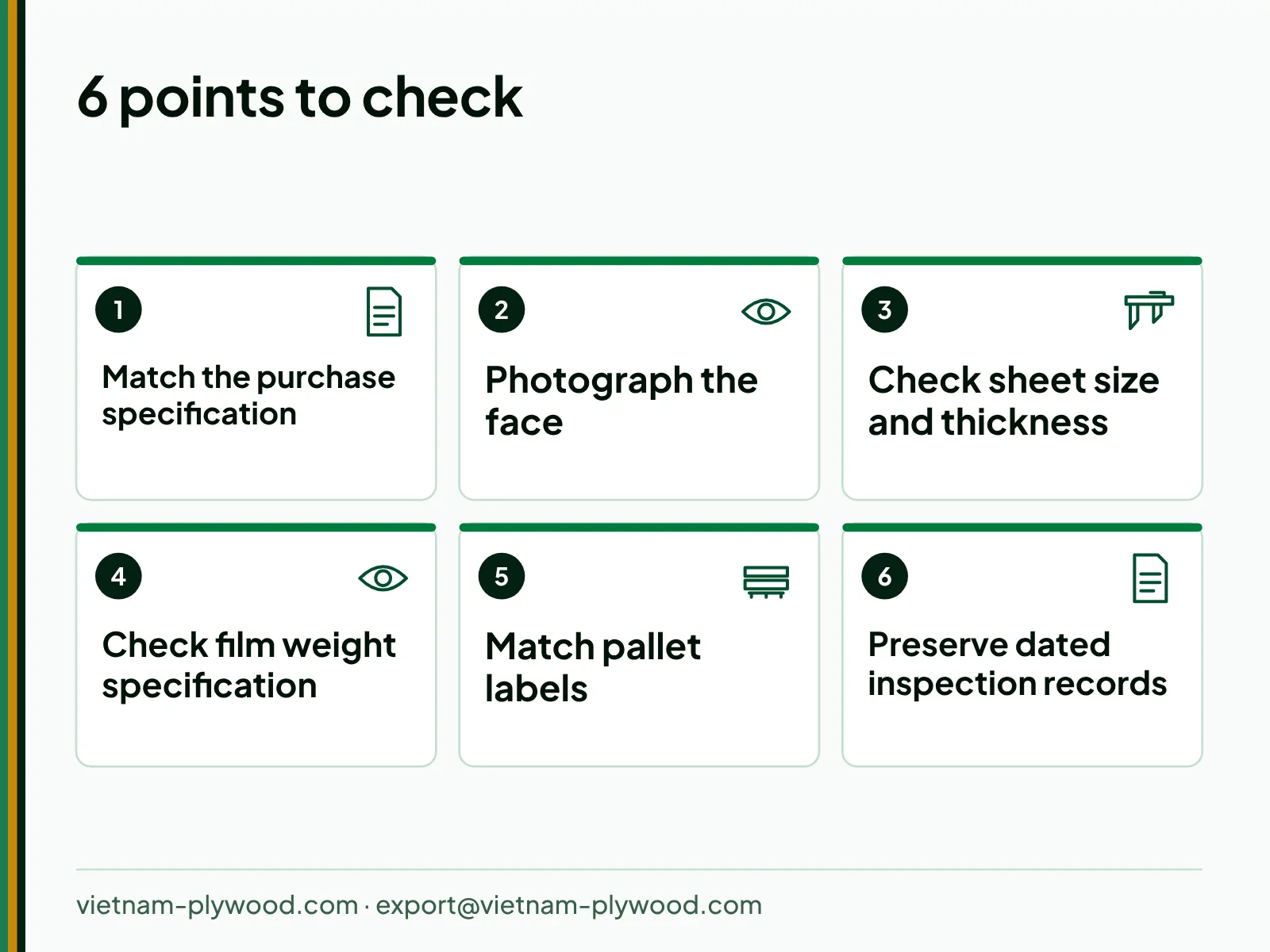
- Match the purchase specification and sample reference to the factory production ticket.
- Photograph the face, back, exposed edge, and full cross-section of each relevant build.
- Check sheet size and thickness against the written tolerance; record representative readings.
- Check film weight specification, face coverage, and edge coating where a film-faced exclusion is under review.
- Match pallet labels, quantities, and product codes to the draft packing list.
- Preserve dated inspection records and any agreed independent test report with the importer’s scope file.
Buyers can visit the factory office and inspect the goods at the producing factory. Our on-site quality control team can show how the build sheet is used during production and loading. If a buyer needs a claim that depends on an external classification, obtain the corresponding third-party evidence before shipment.
For a mixed 40HC, keep each SKU identifiable. The 18 mm reference load is 990 styrax sheets, 880 acacia sheets, or 795 eucalyptus sheets when a container carries that core alone; mixed specifications must remain within the 28.5 t payload limit. For loading methodology see container packing calculations.
When should an importer request a hardwood plywood scope ruling?
Request a Commerce scope ruling when the written order and existing determinations leave a material question about a commercially produced product. The strongest candidates are products near an exclusion boundary or with unusual construction.
Under 19 CFR 351.225, an interested party can seek a ruling for merchandise already in actual production. For a product not yet imported, the applicant must show commercial production and sale. The application should explain why the language covers or excludes the product and address relevant prior determinations.
Film-faced plyform near the exclusion conditions, narrowly dimensioned LVL components, and substantially processed panels merit particular attention. A scope ruling is also worth considering when commercial descriptions conflict with the actual cross-section or when supplier and importer interpretations differ. Ask US trade counsel to review the operative order and the intended entry treatment before signing a supply agreement.
A ruling addresses scope, while cash deposits and tariff treatment require separate review. Do not infer that a pending application suspends ordinary entry obligations. Preserve the filing record and coordinate the importer’s entry instructions with its customs broker.
How do I request a scope ruling on hardwood plywood?
An interested party submits a complete scope-ruling application to Commerce under 19 CFR 351.225, covering the relevant antidumping and countervailing duty proceedings where companion orders exist. The application must describe an actual product and support its requested treatment.
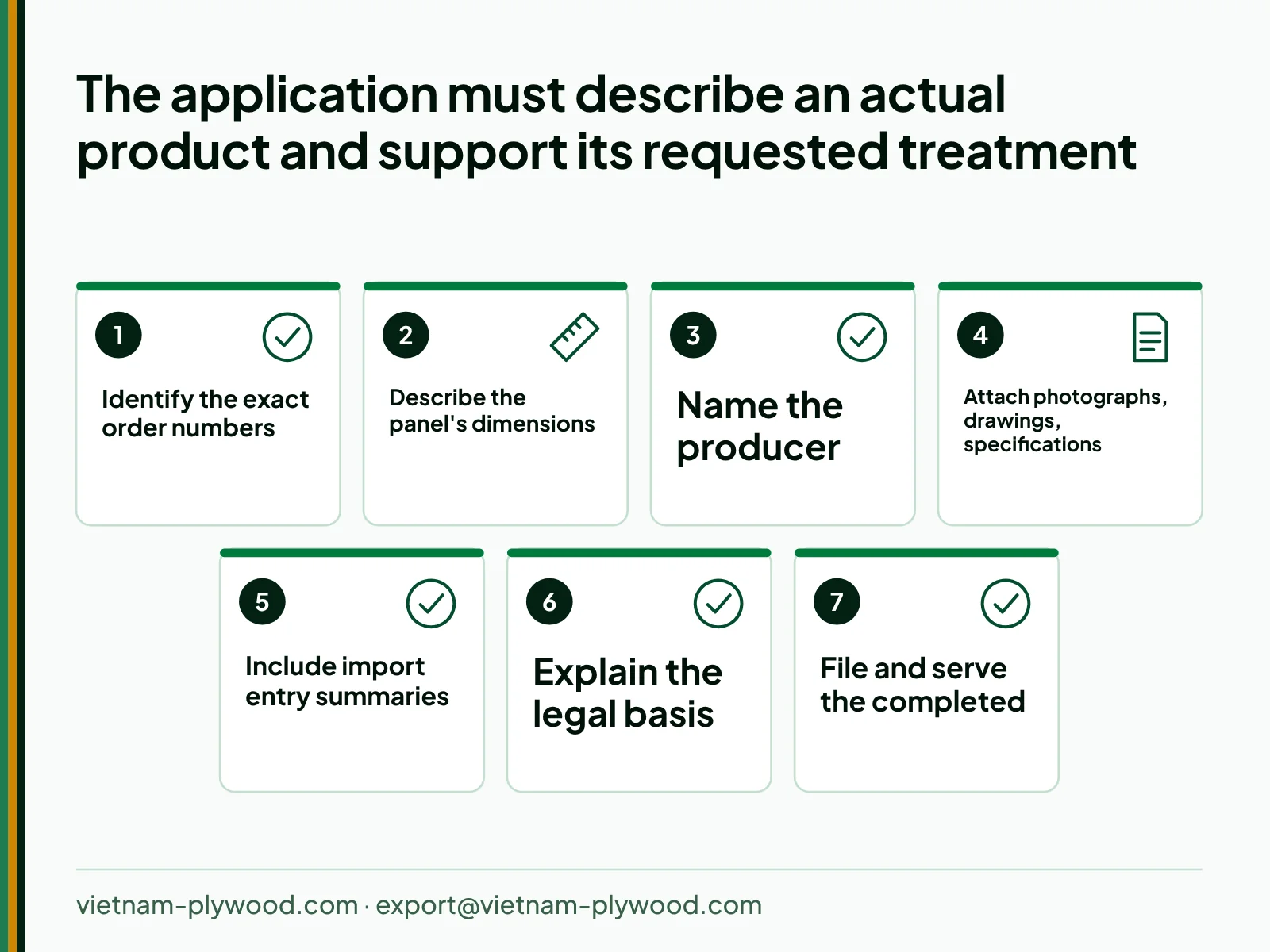
- Identify the exact order numbers and reproduce the operative scope and exclusion clauses.
- Describe the panel’s dimensions, layers, species, adhesive, finishes, processing, and intended uses.
- Name the producer, exporter, importer, origin, and proposed tariff classification.
- Attach photographs, drawings, specifications, production history, sales records, and applicable test evidence.
- Include import entry summaries and contracts for already imported merchandise, or commercial-production and sale evidence for unimported merchandise.
- Explain the legal basis for inclusion or exclusion and attach relevant earlier scope determinations.
- File and serve the completed application according to Commerce’s procedures, including the companion-order records where applicable.
The regulation describes Commerce’s acceptance review and ruling deadlines, with possible extensions. These administrative periods are not shipment lead times. An incomplete filing can be rejected; a product description that changes after filing can undermine the comparison. The importer should keep one controlled revision of the technical specification throughout the proceeding.
HCPLY can supply build and shipment evidence for its own panels. The applicant and its counsel prepare the legal position and submit the application. A ruling should be read for the particular product and entities it addresses, rather than extrapolated to unrelated constructions.
How should an importer compare exclusions without misreading them?
Compare each exclusion element with evidence for the finished article at importation. A partial match is not the same as satisfying a complete exclusion definition.
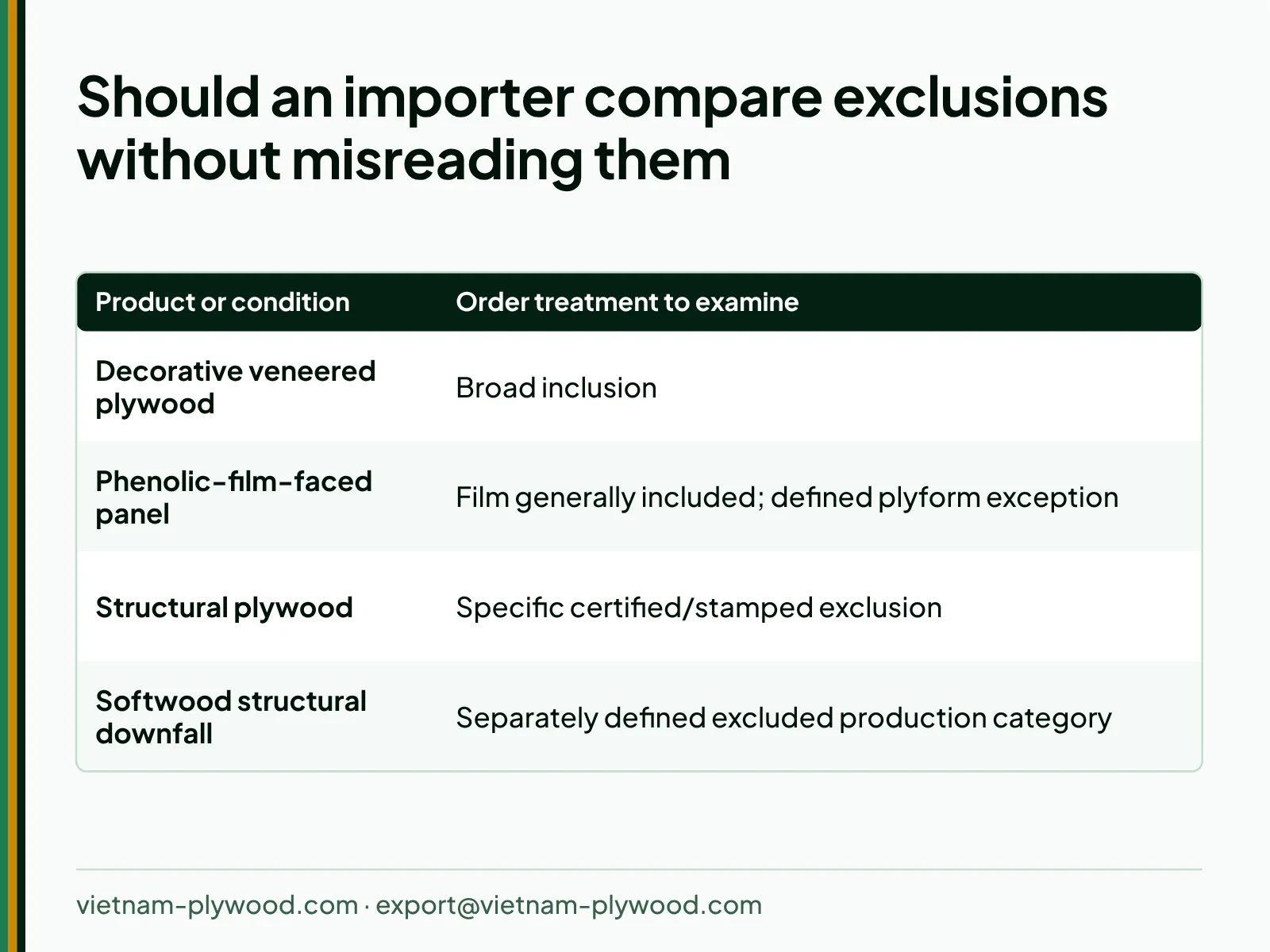
| Product or condition | Order treatment to examine | Evidence that matters | Buying implication |
|---|---|---|---|
| Decorative veneered plywood | Broad inclusion | Veneer cross-section and outer layers | Budget for scope review |
| Phenolic-film-faced panel | Film generally included; defined plyform exception | Both films, bond classification, edge coating | Do not rely on film weight alone |
| Structural plywood | Specific certified/stamped exclusion | Qualifying mark and certification evidence | Do not substitute an unmarked commercial sheet |
| Softwood structural downfall | Separately defined excluded production category | Facility and production-run records | A failed-grade claim needs production proof |
| LVL door/window component | Narrow dimensional and build exceptions | Profiles, grain, adhesive and test evidence | Verify each condition |
| Finished furniture or cabinets | Defined finished/RTA exceptions | Import configuration and all components | Flat plywood blanks are different |
| Finished countertops/table tops | Defined finished-form exceptions | Ready-for-use state at entry | Cutting alone does not qualify |
The November order also excludes certain flooring, cork-faced panels, solid bamboo, and finished two-ply constructions. Those are product-specific provisions. Commerce’s November 2026 order explains the structural-plywood injury distinction and supplies the operative scope wording.
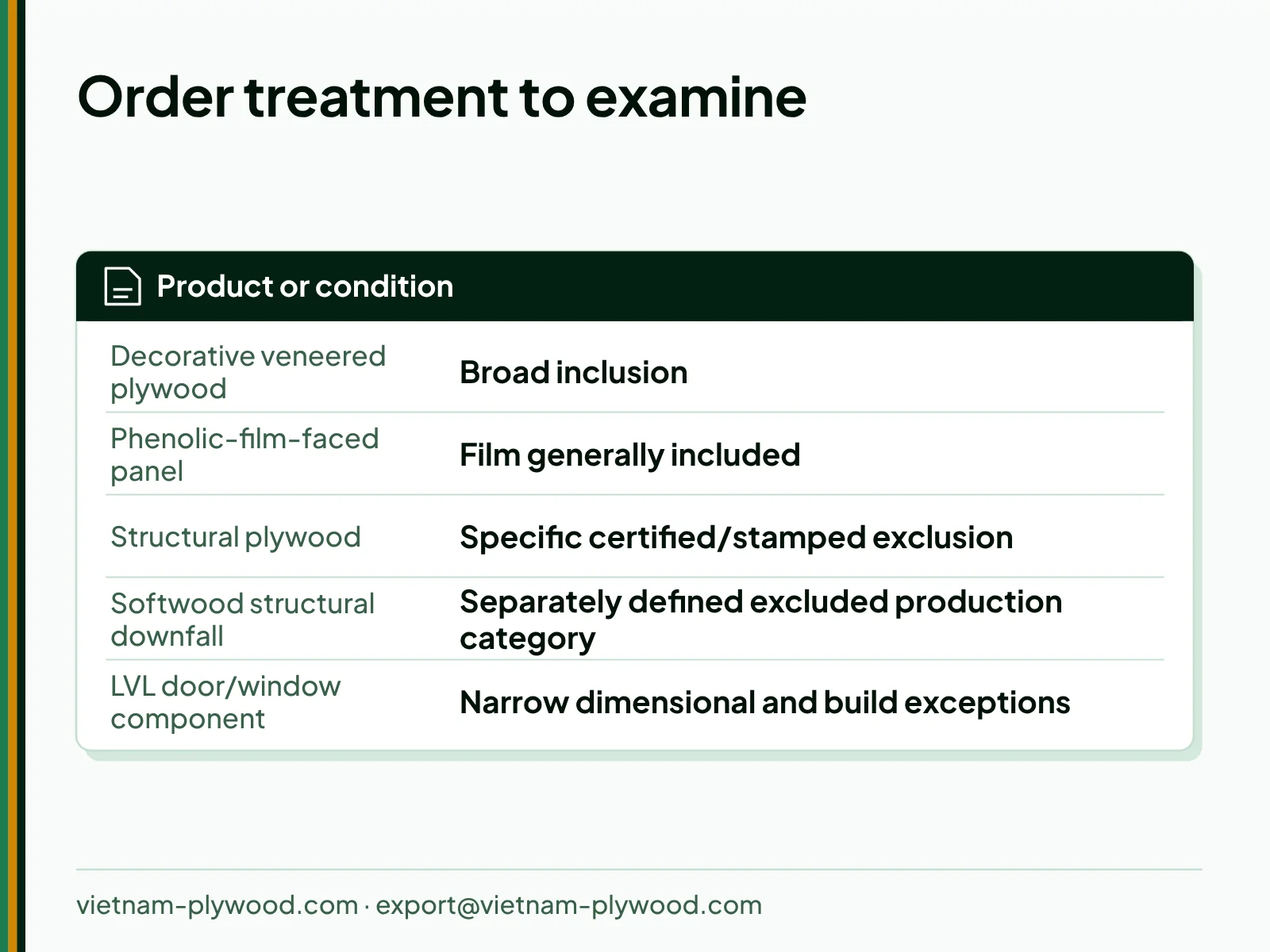
A buyer seeking a furniture panel should compare the actual product with the plywood inclusion first. A buyer seeking a formwork panel should inspect the film and edge conditions before assessing any exception. Keep the legal conclusion separate from the manufacturing quote.
What should the purchase specification and quotation state?
The quotation should state the actual panel build and shipment basis, while the importer records its own scope assessment. A duty assumption should never be hidden inside the product name.
Specify the producing line, face and back, core species, glue, emission class, finish, thickness, tolerance, dimensions, quantity, and port. Glue and emission are separate fields: MR melamine and WBP phenolic describe bonding, while E0, E1, and E2 describe emission classes. US CARB Phase 2 or Toxic Substances Control Act Title VI requirements involve separate third-party certification where applicable.
Our furniture line uses styrax or eucalyptus cores with stitched, sanded builds; our commercial and packing line uses acacia with MR glue. The construction line makes film-faced panels. We handle the written specification, on-site QC, loading, and shipment documentation for the agreed build.
For orders, the minimum is one 40HC, and specifications can be mixed within the payload limit. Factory lead time runs 15–45 days from receipt of the 30% deposit; the exact figure depends on order size, line loading and what the contract fixes. The remaining 70% is paid on the scan of the bill of lading, by T/T, or by irrevocable sight L/C. We ship FOB Hai Phong, or CFR (CNF) or CIF to your port.
For scope-sensitive goods, compare quotations against identical written construction and documentary requirements. Film type, edge treatment, face grade, core construction, and third-party tests affect manufacturing cost. Request the exact build and test evidence before accepting a quote. Contact details and factory visit arrangements are on our manufacturer page.
What should I send before requesting a sample set?
Send a specification that separates the product’s physical build from the importer’s proposed scope position. We can then prepare a matching sample and supporting factory records for evaluation.
Application: US import / intended industrial use and scope question
Line or core: furniture / commercial and packing / construction; styrax / acacia / eucalyptus
Glue: melamine MR / phenolic WBP
Emission: E0 / E1 / E2; separate US emission requirement if applicable
Face and grade: species or film, face/back finish, grade
Thickness and tolerance: mm; specified +/- mm
Size: length x width in mm
Quantity: sheets and 40HC allocation
Destination port: named US port
Ask Lucy at export@vietnam-plywood.com for a sample set matched to the written specification.