





Import duty on plywood from Vietnam changes with the panel construction and the importing country’s tariff schedule. Choosing the wrong code can increase duty, delay customs release or cause a rejected declaration. HCPLY makes furniture, commercial and film-faced plywood with distinct face and core specifications, so the tariff review starts with the actual build rather than the trade name.
What is the import duty on plywood from Vietnam?
Import duty on plywood from Vietnam is the destination tariff for the correctly classified panel, adjusted only when an applicable preference is supported by origin evidence. There is no universal Vietnam plywood percentage: a tropical-faced furniture sheet, a film-faced formwork panel and laminated veneer lumber can occupy different tariff lines. HCPLY prepares the product description before the buyer’s customs filing.
A mistaken classification can increase landed cost, delay release or trigger reassessment. The customs authority determines the import rate; our production records establish what the goods physically are. Start with the destination’s current national tariff, the complete product construction and any applicable trade agreement. For broader trade context, see Industry Knowledge.
Why does the duty rate change with the product type?
Heading 4412 covers plywood, veneered panels and similar laminated wood, but its subheadings distinguish construction and outer-ply characteristics. The Harmonized System (HS) begins with internationally aligned digits; destination schedules add national subdivisions. The face species, individual ply construction and panel type therefore matter more to classification than the sales label alone.
A birch face does not make the core birch. Our birch-faced furniture build uses styrax or eucalyptus core, and the face is identified separately. An okoume or bintangor face calls for a different species assessment than a birch face. A film coating does not automatically establish one universal code. Ask the customs broker to classify the actual section drawing and veneer schedule rather than assigning a number from a product photograph.
Laminated veneer lumber (LVL) is a separate construction question within the broader laminated-wood heading. We do not press LVL. A supplier’s LVL invoice should not be copied into a plywood declaration.
How do our three production lines change the declaration?
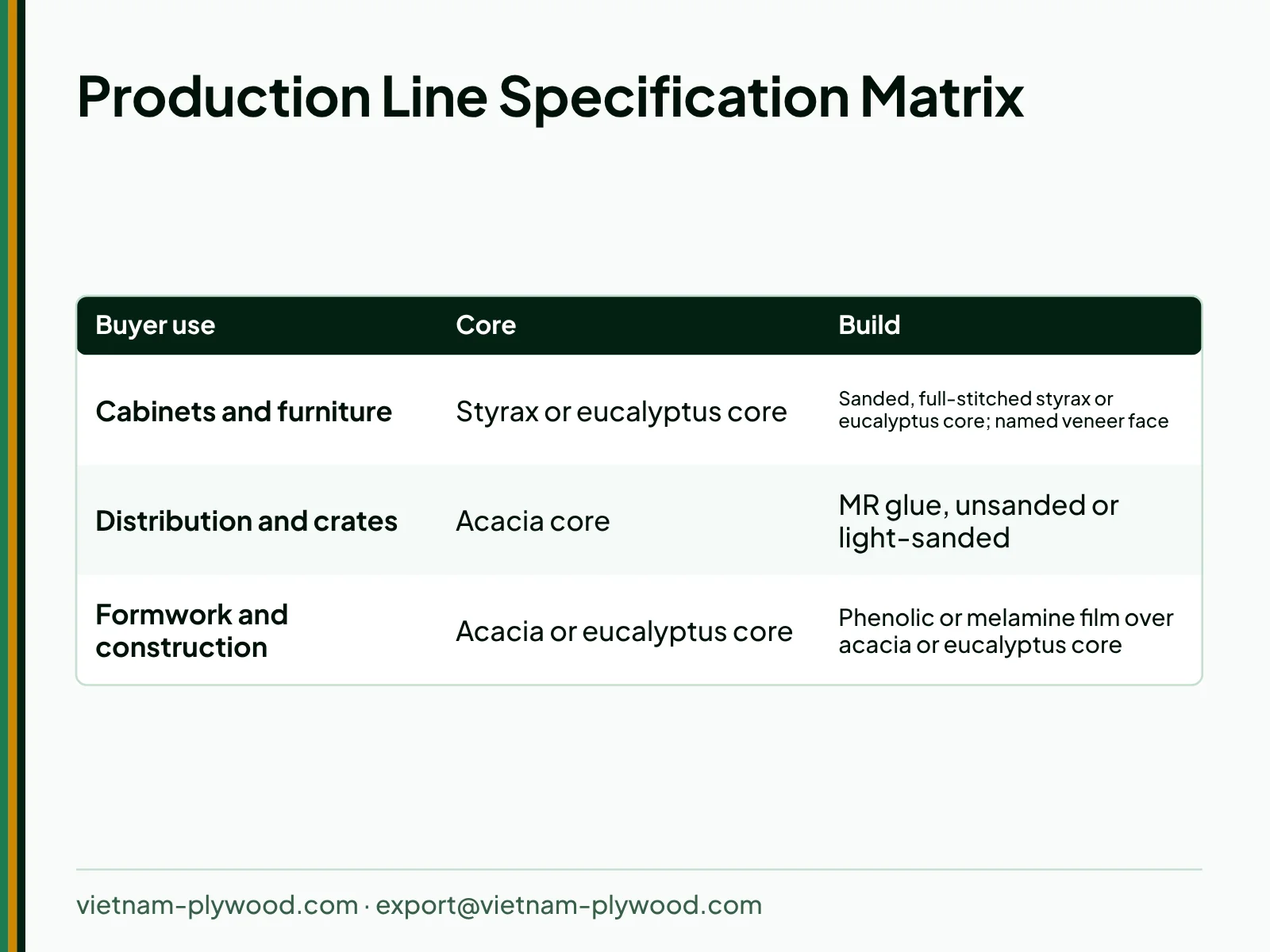
Our three factories make different builds, and those differences belong on the invoice description. The producing factory can show face identification, core layup and finished thickness during inspection. That record helps the importer distinguish panels that look alike when stacked.
| Product group | Build and line | Classification evidence to give customs | Buyer use |
|---|---|---|---|
| Furniture plywood | Our furniture line: sanded, full-stitched styrax or eucalyptus core; named veneer face | Face species, veneer layers, sanded specification | Cabinets and furniture |
| Commercial and packing plywood | Our commercial and packing line: acacia core, MR glue, unsanded or light-sanded | Face identity, acacia layup, packing specification | Distribution and crates |
| Film-faced plywood | Our construction line: phenolic or melamine film over acacia or eucalyptus core | Film description, underlying veneer construction, glue specification | Formwork and construction |
Our furniture plywood page covers the cabinet-facing build. For a combined procurement brief, see one supplier, several plywood types.
Which tariff check applies in each destination?
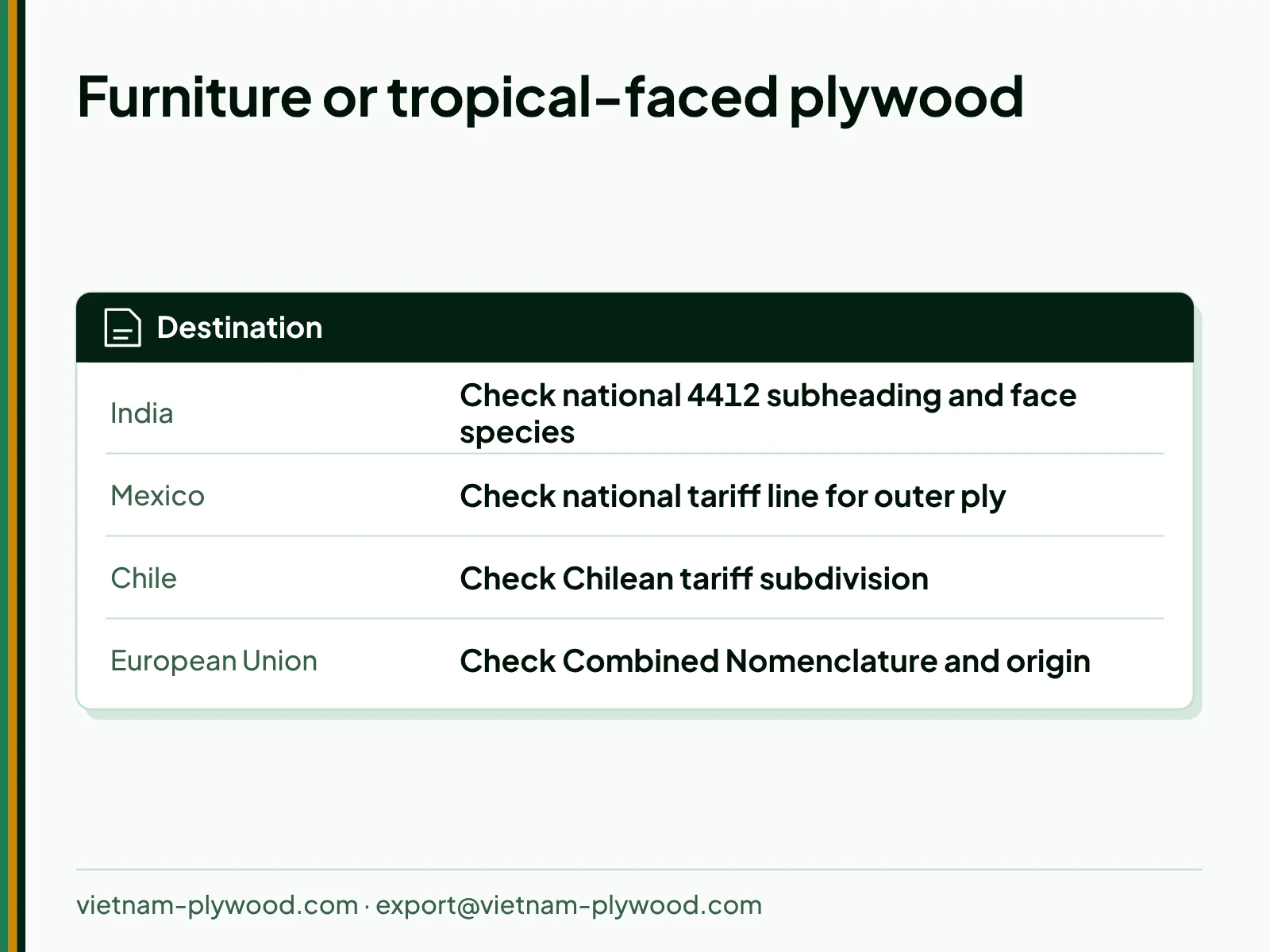
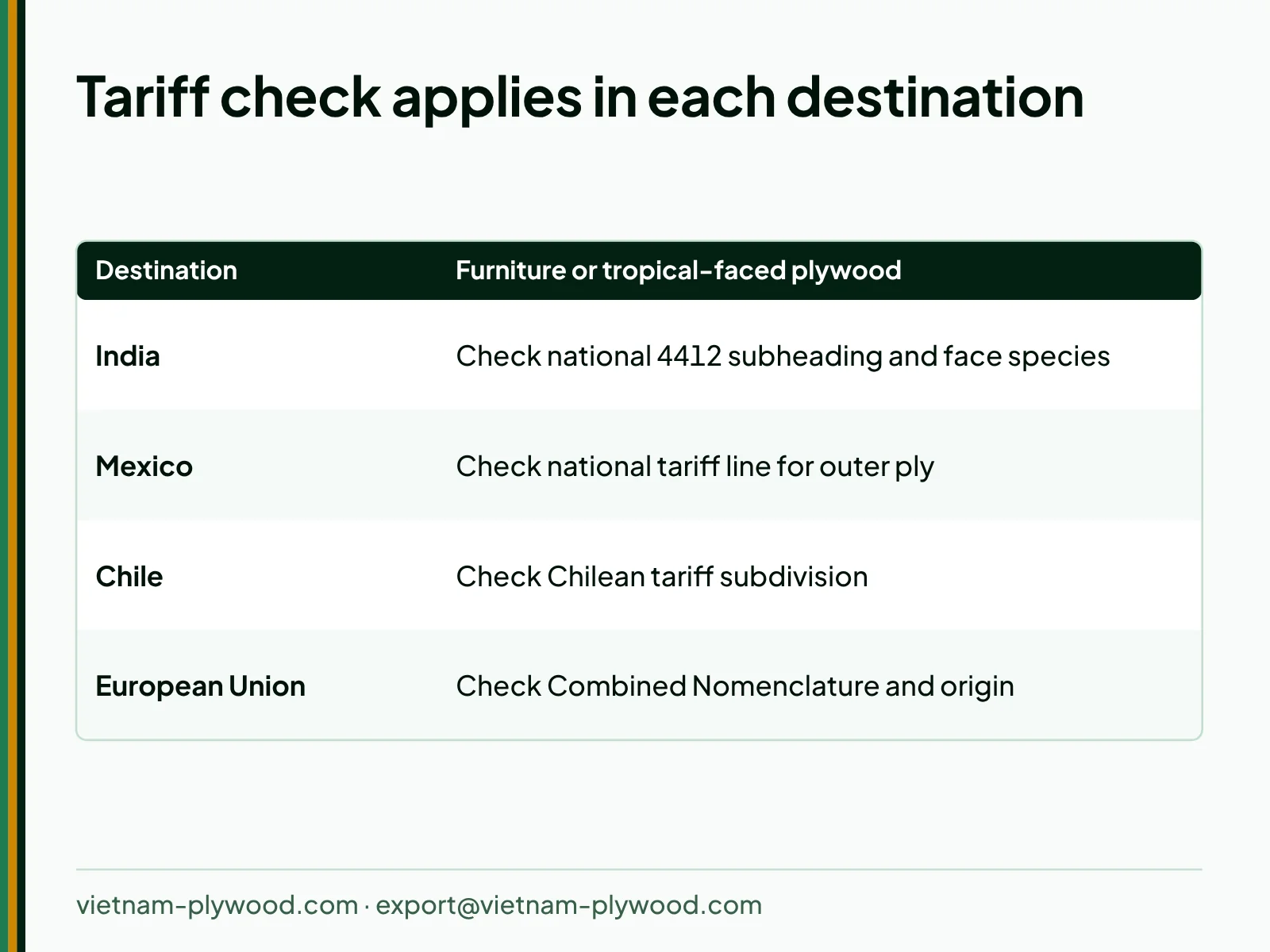
Each market requires a product-by-product tariff lookup, followed by an origin and trade-remedy check. The table is a decision matrix, not a rate quotation: the named official resources do not establish a single current rate for every national subdivision and product group.
| Destination | Furniture or tropical-faced plywood | Commercial or packing plywood | Film-faced construction plywood | Agreement or extra check |
|---|---|---|---|---|
| India | Check national 4412 subheading and face species | Check construction and national suffix | Check coating and underlying plywood classification | ASEAN–India origin preference and Indian import measures |
| Mexico | Check national tariff line for outer ply | Check national tariff line and origin | Check national film-faced classification | CPTPP schedule and origin rule |
| Chile | Check Chilean tariff subdivision | Check Chilean tariff subdivision | Check Chilean tariff subdivision | Compare CPTPP and Chile–Vietnam agreement eligibility |
| European Union | Check Combined Nomenclature and origin | Check Combined Nomenclature and origin | Check film-faced tariff subdivision | EU–Vietnam Free Trade Agreement (EVFTA) preference |
| United States | Check US tariff classification and scope | Check US tariff classification and scope | Check US tariff classification and scope | Antidumping and countervailing scope independently |
| Middle East | Check importing state’s national tariff | Check importing state’s national tariff | Check importing state’s national tariff | Local customs charges and import procedures |
The European Commission’s 2026 EVFTA guidance says qualifying goods must meet product-specific origin rules. For EU-specific treatment, read plywood import duty in the EU from Vietnam. A country name alone is insufficient for an executable landed-cost calculation.
What is the plywood import duty in India?
India’s customs tariff distinguishes plywood classifications within heading 4412; the statutory duty is only one part of the import assessment. The applicable assessment also needs the current notification, any preference, surcharge, tax and trade-remedy treatment checked against the precise Indian tariff line.
For import duty on plywood from Vietnam to India, the buyer should obtain the Indian eight-digit classification before booking. A film-faced formwork panel and a decorative veneer panel need separate descriptions even when both are 18 mm. The ASEAN–India preference requires qualifying origin and the applicable certificate procedure; it does not follow automatically from the shipping port.
For an Indian shipment, give the customs broker the face veneer species, core layup, film or raw finish, sheet dimensions and declared customs value. Check the scope of Indian product compliance requirements separately from the customs percentage. HCPLY does not offer BIS/IS marking. Do not treat a legacy commercial duty calculator as the current statutory assessment.
Does CPTPP reduce the plywood tariff in Mexico or Chile?
The Comprehensive and Progressive Agreement for Trans-Pacific Partnership (CPTPP) can reduce an eligible plywood tariff in Mexico or Chile when the destination’s exact tariff line has a preference and the shipment satisfies its origin rule. It does not create one blanket duty rate for all 4412 goods.
For Mexico and Chile, obtain the current national tariff schedule and the CPTPP preferential schedule for the exact goods code. The importing customs broker should compare the ordinary rate with the applicable preferential rate and check the origin procedure for the entry year.
For Chile, ask the customs broker to compare any applicable bilateral preference with CPTPP for the same tariff line, origin method and evidence. For a mixed load, eligibility can differ between product lines.
Do birch-faced, film-faced and LVL products get different rates?
They can receive different rates because customs classifies the physical goods, including their veneer and laminated construction. Birch-faced plywood is still described by its face and underlying plies. Film-faced plywood needs its coating and plywood construction described; LVL needs its own laminated-wood analysis.
For our construction panels, the film specification is 120 g/m² standard, 135 g/m² premium or 220 g/m² anti-slip only. Film weight describes the face and does not replace the tariff classification. Our furniture faces include birch, okoume and bintangor, with face veneer commonly 0.2–0.4 mm; birch face grades are D/E/F. An inspector can compare the agreed face, edge layers and invoice wording at the producing factory.
A named face veneer is not evidence that the entire sheet uses that timber. This distinction matters when a tariff line explicitly asks for the outer ply species.
How is a mixed container declared at different duty rates?
A mixed container is declared with separate goods lines when its plywood types fall under different customs classifications. Each line needs its own description, quantity, customs value, tariff code and preference claim; the importer then applies the destination’s entry rules. One bill of lading can cover cargo that customs assesses on several lines.
Our minimum order is one 40HC, and specifications can be mixed within its 28.5 t payload limit. At 18 mm and 1220 × 2440 mm, a styrax-core sheet weighs 26.79 kg, an acacia-core sheet 31.08 kg and a eucalyptus-core sheet 34.83 kg, excluding film weight. For full 40HC loads of this size and thickness, the core-specific lookup gives 990 styrax, 880 acacia or 795 eucalyptus sheets; pallet and packaging weights need space in the load plan.
Separate packing-list rows should match the physically labelled pallets and the invoice lines. The container loads resource handles full-load planning; the customs entry must still allocate the declared value by product. Our distributor supply programmes explain how differing specifications can be ordered together.
Which shipping documents support the tariff claim?
The commercial invoice supplies the goods descriptions and declared values; the packing list identifies the quantities and pallet groups. The bill of lading (B/L) documents carriage, while the certificate of origin supports an eligible preference under the destination’s accepted procedure.
Our export package includes the commercial invoice, packing list, B/L, certificate of origin (EUR.1 for EU lots), phytosanitary and fumigation papers, and insurance under CIF. Order-specific certificate documents can include an FSC claim on sales documents, emission certificate and test reports for the agreed build; EU lots also have the EUTR/EUDR file set. Factory certificates are shown with factory details masked, on request. After loading, the draft shipping documents come to you for approval.
Origin evidence and classification evidence solve different questions. A certificate of origin cannot correct an inaccurate product description, while an accurate HS number alone does not grant a preferential rate.
What should the importer check before production?
The importer should lock the national tariff classification against the actual build before approving the order. This prevents an invoice description from being adjusted after a vessel has already departed.
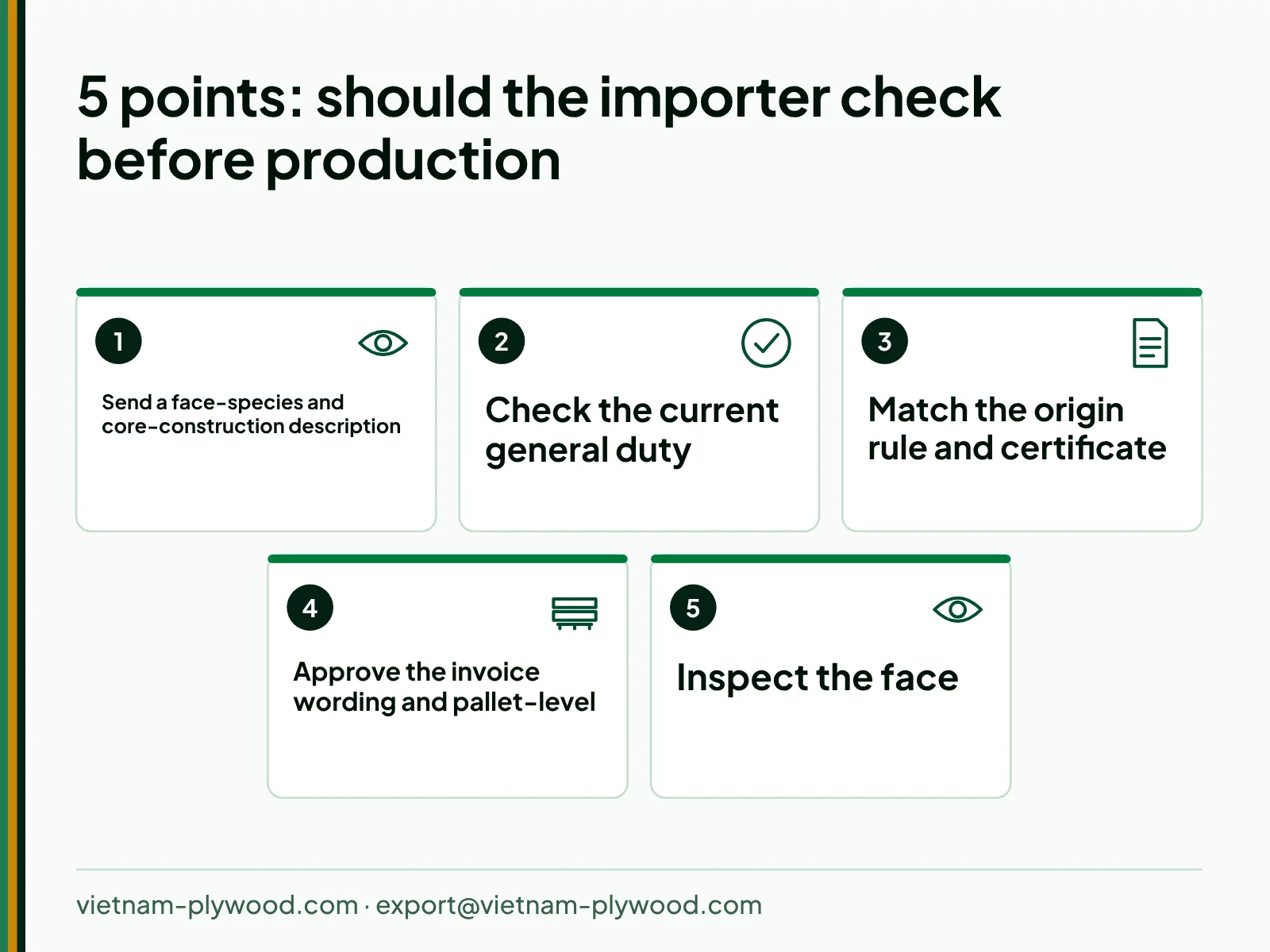
- Send a face-species and core-construction description to the destination customs broker for the national tariff line.
- Check the current general duty, any applicable agreement preference, and separate antidumping or countervailing measures.
- Match the origin rule and certificate format to each goods line; do not assume that Vietnam manufacture alone meets every rule.
- Approve the invoice wording and pallet-level packing breakdown against the agreed physical specification.
- Inspect the face, edge layup, thickness and bundle labels at the producing factory before loading.
The European Commission’s 2026 rules-of-origin guide explains that product-specific origin rules can require a tariff-classification change, a value threshold or specified processing. For the US, the Department of Commerce’s 2026 final hardwood and decorative plywood determinations show why trade remedies need a separate scope review. A basic tariff lookup cannot answer an antidumping scope question.
What specification should accompany a duty quotation?
A duty quotation needs the destination port and customs description alongside the plywood specification. Our furniture panels can be sanded to ±0.2 or ±0.3 mm as ordered; commercial and film-faced panels use ±0.5 mm. These distinctions give the importer a concrete record to compare with the physical goods.
HCPLY ships FOB Hai Phong, CFR (CNF) or CIF. Factory lead time runs 15–45 days from receipt of the 30% deposit; the exact figure depends on order size, line loading and what the contract fixes; the The remaining 70% is paid on the scan of the bill of lading, by T/T, or by irrevocable sight L/C. Free samples are available; new buyers book their courier, and its cost can be credited against a real order.
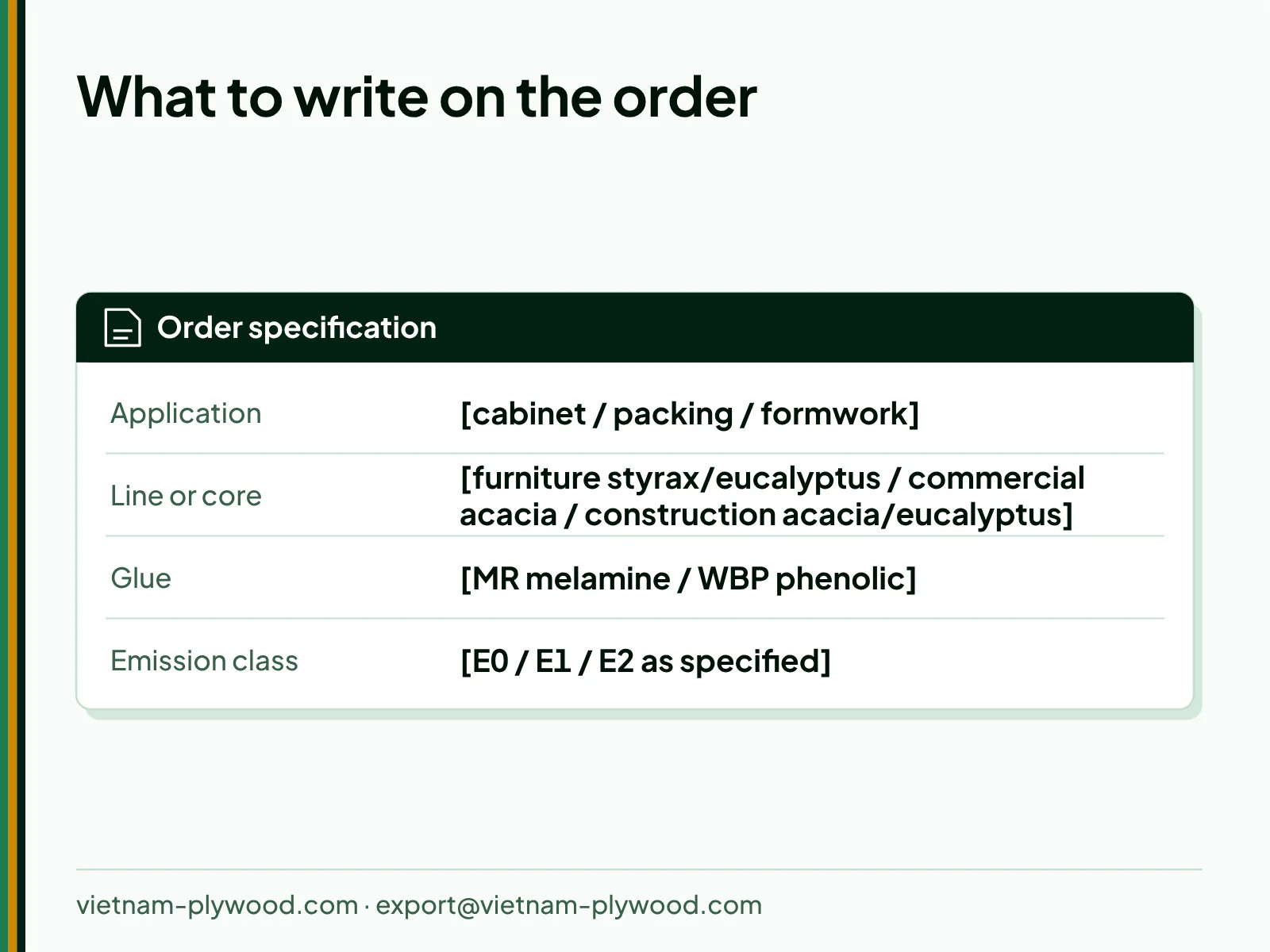
Send the following lines to Lucy at export@vietnam-plywood.com or through contact. They give our factory team and the importer’s customs broker the same starting description.
Application: [cabinet / packing / formwork]
Line or core: [furniture styrax/eucalyptus / commercial acacia / construction acacia/eucalyptus]
Glue: [MR melamine / WBP phenolic]
Emission class: [E0 / E1 / E2 as specified]
Face and grade: [species, grade, film type if applicable]
Thickness and tolerance: [mm, +/- mm]
Size: [length x width, mm]
Quantity: [sheets, pallets, m3]
Destination port: [city, country]
Next step: book a factory visit to inspect the agreed build before shipment.